IJEDR1504161
International Journal of Engineering Development and Research (www.ijedr.org)906
________________________________________________________________________________________________________Abstract - Spring back is one of the most important phenomenon that affects the accuracy of the sheet metal parts. In order to get tight tolerances for the formed parts it is highly recommended to use such process parameters/tool geometry that allow a significantly diminishing of the spring back amount. In this sense, good results could be obtained by applying some methods and techniques of optimization. Optimization of process parameters in sheet metal forming is an important work to reduce manufacturing cost. To determine the optimum values of the process parameters, it is necessary to find their control on the deformation behavior of the sheet metal. The significance of three important process parameters as, punch nose radius, blank holder force and friction coefficient on the deep drawing characteristics, die shoulder radius, sheet thickness, radial clearance etc. of a mild steel cup will be determined. In this paper basic review is presented based upon optimization of process parameter in deep drawing process with the use of different techniques. Verity literatures of research spotlight on parameters that affect most in deep drawing process. By analyzing these parameters, the defects like wrinkling, tearing, earing and spring back is reduced and also we can get the good quality product.
Keywords - Deep Drawing Process, FEA, Spring back.
________________________________________________________________________________________________________
I. INTRODUCTION
Sheet metal forming is the most commonly used manufacturing processes in industry that is used to change the geometry of sheet metal of normally about 6mm thickness without loss of material. This wide use can be attributed to the effortlessness with this a wide range of products can be produced using the method, coupled with its adaptability to new manufacturing technologies such as hydro forming [1]. Sheet metal forming operations consists of simple bending, ironing, wheeling, stretch and roll forming, rubber-pad forming, stamping, flanging, spinning, embossing, hyper-plastic and peen forming, explosive and magnetic-pulse forming and deep drawing of complex parts [2]. Deep drawing is the commonest sheet metal forming process and it is frequently used in the automotive, packaging and home and kitchen appliance producing industries. Deep drawn automotive components such as outer car body panels, inside car body panels, fenders and different stiffeners are the examples. The common products for packaging that are made using sheet metal forming processes include pet geysers, food containers cans, beverage containers cans and toe cups. Some home appliances and kitchen appliances that are produced using sheet metal forming consist as sinks in kitchen, pots and pans. The objective of sheet metal forming processes is first and foremost to produce a desired shape by plastic deformation. The final product quality is dependent on not only the sheet material characteristics but also process variables such as strain, strain rate and temperature [3]. These variables are affected by the tool and die design, blank geometry, properties of the lubricant used and drawing speed. A deviating final product shape can result if incorrect combinations of these factors/process parameters are used. A deviating shape is typically caused by elastic spring back of the job after forming and retracting the tool.
Deep drawing process
IJEDR1504161
International Journal of Engineering Development and Research (www.ijedr.org)907
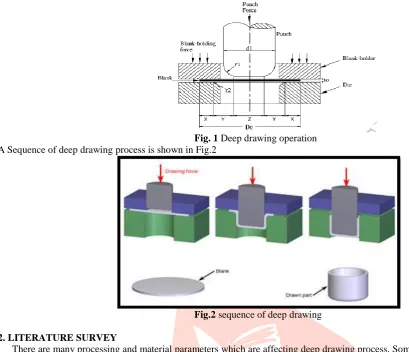
Fig. 1 Deep drawing operationA Sequence of deep drawing process is shown in Fig.2
Fig.2 sequence of deep drawing
2. LITERATURE SURVEY
There are many processing and material parameters which are affecting deep drawing process. Some of the functions are there which cover most of the material and processing parameters affecting the thickness distribution and also the quality of the product. During the last decade many researchers have provided those functions which increase the effectiveness of the process and reduce the undesirable features like earing and wrinkles. Some of the functions which are covering most of the material and processing parameters and also the effect of different material and processing process parameters are given. That’s why effect of different process parameters on the deep drawing and introduction to those functions are given in this review paper. [4]
Effects of Process Parameters:
The process parameters that affect the success or failure of a deep-drawing operation include punch and die radii, punch nose radius, die shoulder radius, blank holding force, sheet Thickness ,radial clearance, , lubrication etc
Die shoulder radius:
The effect of deviation in die radius on effective stress and strain, maximum principal stress, maximum principal strain, damage value and load requirement. The conclusion is that die radius is an important design parameter and they also optimized it using FE simulations [5]. The importance of three parameters die radius, blank holder force and friction coefficient on deep-drawing process characteristics of a SS axi-symmetric cup using finite element method (fem) combined with Taguchi technique. Researcher carried out a reduced set of finite element simulations which is based on the fractional factorial design of L9 orthogonal array and investigates the relative importance of the selected parameters on thickness distribution using ANOVA. From the analysis it is concluded that die radius has the most influence on the deep drawing of stainless steel blank sheet as shown in Fig.3, which is then followed by the blank holder force and then the friction coefficient. [6]
IJEDR1504161
International Journal of Engineering Development and Research (www.ijedr.org)908
Fig.3 Drawing die pass Fig.4 Thinning variations with the die shoulder radius as per results shown for the die shoulder radius (rd) that is less than six times the thickness of the blank (t), the cup has a more value of the spring back percentage, while for die shoulder radius (rd) which is greater than or equal to10t, the spring back percentage have given smaller values as shown in Fig.5. So that the die shoulder radius (rd) should be 10 times sheet thickness [7].
Fig.5 Variation of the spring back percentage with the die shoulder radius
Punch nose radius
Punch nose radius effect on deep drawing operation, there are six types of punches with various nose radii have been used to form a cylindrical cup with dimension as (44mm) outer diameter, (28mm) height, and (0.5mm) sheet thickness of mild steel with (0.15%) carbon content. A commercially available finite element program code (ANSYS 5.4), was used to carry out the numerical simulation of the deep drawing operation, and the numerical results were then compared with the experimental work. The results show that, the amount of work required to form parts with large punch nose radii is very much more than the value required for forming parts with smaller punch nose radii. The largest thinning is noted to occur with hemispherical punch (Dome shaped punch) because of great stretching of the metal over the punch head. Finally the maximum tensile stresses and the maximum thinning of the dome wall occur nearly at the apex of the dome [8]. Simulation was performed under different punch profile radii (rp) as 3, 4 and 5 mm. From Fig.6, it might be observed that the spring back increases as the punch nose radius increases and it can be justified by the amount of plastic deformation. It has to be noted that the stress over the punch corner (punch profile radius) is the most significant factor governing the magnitude of spring back [9].
IJEDR1504161
International Journal of Engineering Development and Research (www.ijedr.org)909
Fig.6 Mean radius of the cup edge Fig.7 Thinning variations with the punch nose radiusThe cup tears due to increased thinning, while thinning is somewhat stable for (rp) greater than 3 time the thickness of sheet metal. In addition, the nose radius of punch influences the spring back of sheet metal blank in the deep drawing processes. Fig.8 shows the spring back percentage with different values of the punch nose radius (rp). from respected graph it has been shown that for a punch nose radius (rp) which is greater than six times the thickness of the blank (t), the cup have small values for the spring back percentage, while for punch nose radius (rp) smaller than (4t), the spring back percentage is increasing [7].
Fig.8 Variation of the spring back percentage in sheet metal with the punch nose radius
Blank holding force
The study related variation in the blank holding force required for the removal of wrinkling and the limiting drawing ratio with sheet metal thickness. Researchers found that blank holding force which is required for the elimination of wrinkling increased speedily as the sheet metal thickness decreased. When the sheet metal thickness was very thin, the required blank holding force was strongly influenced by the coefficient of friction. The limiting drawing ratio also decreased as sheet metal thickness decreased and it decreased quickly below 0.04 mm sheet metal thickness. When the sheet thickness was very thin, the spring back was strongly influenced by the coefficient of friction [10]. Larger BHF is always advantageous to get rid of wrinkling in deep drawn cup shaped product, but always attempts have been made to predict a minimum BHF to minimum spring back. Thinning at wall and thickening of the flange of sheet metal, defects in final product. The blank holder force has the greatest effect on the thinning strain, the coefficient of fiction and plastic strain ratio. Also the strain-hardening model depends on BHF [11].
IJEDR1504161
International Journal of Engineering Development and Research (www.ijedr.org)910
Fig.9 Variation of the sheet metal thinning with the blank holder force (BHF).If the blank-holder force is high, the strain will be the greater over the punch face; though the process is restricted by the strain in the side-wall. If the tension has maximum value, the side-wall will be fail by splitting [13]. It has been shown that the cup fail due to thinning with the increase in the blank holder force (BHF) over 0.5 ton. Fig.10 show the spring back.
Fig.10 Variation of the spring back percentage in sheet metal with the blank holder force (BHF)
The significance of blank holder force on spring back was studied. Three different values of blank holder force are considered for the work. The relationship between the blank holder force and spring back is shown in Fig.11. It is investigated that the spring back value decreases as the blank holder force increases. For this, an optimum value of blank holder force has necessarily to be found in order to get less spring back and avoid the sheet tearing [9].
Fig.11 Mean radius of the cup edge
IJEDR1504161
International Journal of Engineering Development and Research (www.ijedr.org)911
Fig.12 Mean radius of the cup edgeDeep drawing with circular blanks considers the axis-symmetric component using finite element methods. A rigid plastic material model with the variation approaches are used in the finite element analysis. Variation in Amount of draw and flange thickness have been investigated numerically and then verified experimentally, for this purpose the circumferential and radial strains have been calculated [15].
The effect of sheet thickness on spring back on deep draw steel (IS 1079-1994) is studied and keeping all other affecting variable parameters constant. The characteristics trends coming out from the initial experiments are represented as follows. Fig.13 shows the effect of sheet thickness on spring back. It is observed form the figure that sheet thickness is a very important parameter which affecting on spring back. Minimum sheet thickness is creating lower plastic zone which result to higher spring back as compared to higher sheet thickness[16].
Fig.13 Effect of sheet thickness on spring back.
IJEDR1504161
International Journal of Engineering Development and Research (www.ijedr.org)912
Fig.14 Thinning variation with the blank thickness Fig.15 spring back percentage in sheet metal
3. CONCLUSION
Spring back percentage in deep drawing process was studied numerically by means of commercially available FEA software. The significance of some important process parameter such as initial blank thickness, blank holder force(BHF), punch profile radius(Rp), friction coefficient and type of hardening model on spring back of the cup produced by deep drawing process were investigated. The numerical results obtained shows that by increasing the value of the initial blank thickness reduce the spring back of the deformed sheet. Also, with increasing blank holder force (BHF), the spring back will be decreased. And if excessive increasing of blank holder force may cause tearing of sheet. As a effect, an optimum quantity of blank holder force should be selected to decrease the spring back and eliminate the sheet tearing concurrently. The same result were get for the effect of friction coefficient, i.e. by increasing friction coefficient between the blank and blank holder, spring back was decreased in sheet metal. in addition, with the increasing of punch nose radius, the spring back was also increases.
REFERENCES
[1] Gokhale, F, “ Recent Progress on the Understanding of Hydroforming process”, Metal Forming Process, ed. The Metallurgical Society, USA, 2002, pp. 134-146.
[2] Kalpakjian, S., and Schmid, S., 2006. Manufacturing engineering and technology. Fifth ed. Upper Saddle River, NJ: Pearson Education, Inc
[3] Gedney R., “Tensile Testing for Determining the Formability of Sheet Metals”, Admet Report, Inc, Norwood, Massachusetts, 2002, pp. 24-31.
[4] A. R. Joshi, K. D. Kothari, Dr. R. L. Jhala “Effects Of Different Parameters On Deep Drawing Process: Review” International Journal of Engineering Research & Technology (IJERT), Vol. 2 Issue 3, March – 2013, pp. 1-5.
[5] Kopanathi Gowtham, K.V.N.S. Srikanth & K.L.N. Murty (2012), “Simulation of the effect of DIE Radius on Deep Drawing process”, International Journal of Applied Research in Mechanical Engineering (IJARME) ISSN: 2231 –5950, Volume-2, Issue-1, 2012
[6] Padmanabhan R., Oliveira M.C., Alves J.L., Menezes L.F. “Influence of Process Parameters on the Deep Drawing of Stainless Steel”, Finite Elements in Analysis and Design, vol.43, 2007, pp 1062 – 1067.
[7] H. Zein, M. El Sherbiny , M. Abd-Rabou, M. El shazly “Thinning and Spring Back Prediction of Sheet Metal in The Deep Drawing Process” ELSEVIER, Materials & Design,Volume53, January 2014, Pages 797–808.
[8] Dr.Waleed K.Jawad,Jamal H.Mohamed, ―Studying the Effect of Punch Nose Radius on Deep Drawing Operation‖ Eng. &Tech.Vol.26. 2008, pages 55-73.
[9] Mehran Kadkhodayan, Rasoul Pourhasan, “Finite Element Simulation of Process and Springback of Friction Aided Deep Drawing Using Tapered Blank Holder Divided Into Eight Segments” Majlesi Journal of Mechanical Engineering, Vol. 3/ No. 4/ Summer 2010.
[10] Y. Marumo, H. Saiki, L Ruan , “Effect of sheet thickness on deep drawing of metal foils” Journal of Achievements in Materials nd Manufacturing Engineering Vol.20 Issues 1-2 (2007).
[11] Jaisingh Amit, Narasimhan K., Date P.P., Maiti S.K., Singh U.P. “Sensitivity Analysis of a Deep Drawing Process for Miniaturised Products”, Journal of Material Processing Technology, vol. 147, pp 321-327, 2004.
[12] David S, Jeff L, John G. Fundamentals of tool design. American society of tool and manufacturing engineers. New Delhi, Prentice Hall, 2003.
[13] Marciniak Z, Duncan JL, Hu SJ. Mechanics of sheet metal forming. 2nd ed. Butterworth-Heinemann; 2002. p. 53.
[14] A. Wifi, A. Mosallam, "Some aspects of blank-holder force schemes in deep drawing process", Journal of Achievements in Materials and Manufacturing Engineering, Vol. No. 24, Issue No. 1, 2007.
[15] Natarajan S., Venkataswamy S., Bagavathiperumal P. “A Note on Deep Drawing Process: Numerical Simulation and Experimental Validation” Journal of Materials Processing Technology, vol. 127, pp 64-67, 2002