Use of integral experiments for the assessment of the
235
U
capture cross section within the CIELO Project
Raphaelle Ichou1,a, Nicolas Leclaire1, Luiz Leal1 and Evgeny Ivanov1 1
Institut de Radioprotection et de Sûreté Nucléaire (IRSN), 92262Fontenay-aux-Roses Cedex, France
Abstract. A new 235U capture cross-section evaluation, evaluated by ORNL and the CEA Bruyères-le-Châtel (BRC) has been proposed within the CIELO project. IRSN, who participates in the CIELO project, contributes with data testing and has carried out benchmark calculations using few benchmarks, extracted from the ICSBEP database, for testing the new
235
U evaluation. The benchmarks have been selected by privileging the experiments showing small experimental uncertainties and a significant sensitivity to 235U capture cross-section. The
keff calculations were performed with both the MCNP 6 code and the 5.C.1 release of the
MORET 5 code, using the ENDF/B-VII.1 library for all isotopes except 235U, for which both the ENDF/B-VII.1 and the new 235U evaluation was used. The benchmark selection allowed highlighting a significant effect on keff of the new 235U capture cross-section. The results of this
data testing, provided as input for the evaluators, are presented here.
1 Introduction
The Collaborative International Evaluated Library Organization Pilot Project, known as the CIELO project, is an initiative aimed at improving data evaluation by combining efforts from several institutions around the world. Over the last couple of years, evaluation work has been done to improve data evaluation for six isotopes, namely 1H, 16O, 56Fe, 235-238U, and 239Pu. The Working Party on International Nuclear Data Evaluation Co-operation (WPEC) subgroup 29 (SG 29) was established to investigate an issue with the 235U capture cross-section in the energy range from 0.1 to 2.25 keV.1 The WPEC criticality calculation results indicated an overestimation of the 235U capture cross-section of 10 % or more, starting around 100 eV. To understand and solve the problem, recommendation was made to perform new capture cross-section measurements followed by a resonance evaluation. Hence, time-of-flight capture cross-section measurements were done at the Rensselaer Polytechnic Institute (RPI) 2 andat the Los Alamos National Laboratory (LANL).3 Integral quantities, such as fission and
capture resonance integral Westcott factors were also included in the evaluation. These new
measurements were used together with the SAMMY computer code, developed by ORNL, to re-evaluate the 235U resonance parameters in the energy range from thermal to 2.25 keV. The CEA/Bruyères-le-Châtel (BRC) was responsible to re-evaluate the 235U resonance parameters in the fast energy region.
The Institut de Radioprotection et de Sûreté Nucléaire (IRSN) has carried out benchmark calculations, using few benchmarks extracted from the International Criticality Safety Benchmark Evaluation
a
Corresponding author: [email protected]
4
DOI: 10.1051/
C
Owned by the authors, published by EDP Sciences, 201
/201
epjconf 61
Project (ICSBEP) Handbook, 4 for testing the new 235U capture cross-section evaluation over the
whole energy range. The impact of the inclusion of the new evaluation was studied for selected
critical benchmarks that give, when combining experiments, a sensitivity coverage to 235U capture cross-section in each of the thermal, epithermal and fast energy range. The benchmark calculations,
used to investigate the impact of the new 235U evaluation, were performed using Monte-Carlo
methods.
Table 1. Benchmarks integral sensitivities to the 235U capture cross-section.
Series of experiments Bench-mark keff
Benchmark keff uncertainty keff sensitivity 235
U capt. < 0.625 eV
keff
sensitivity 0.625 eV < 235
U capt. < 100 keV
keff
sensitivity 235
U capt. > 100 keV
keff
sensitivity 235
U capt. total HEU-SOL-THERM-004-006 1.00000 0.00590 -10.76% -6.03% -0.04% -16.82% HEU-SOL-THERM-049-012 1.00120 0.00210 -8.72% -8.67% -0.14% -17.53% HEU-SOL-THERM-004-003 1.00000 0.00390 -7.14% -13.91% -0.16% -21.21% HEU-SOL-INTER-001-001 1.00000 0.00330 -5.33% -15.73% -0.34% -21.40% HEU-COMP-INTER-004 1.00000 0.00400 -0.25% -16.01% -0.31% -16.56% HEU-MET-INTER-007-031 0.99960 0.00220 -2.20% -12.77% -1.42% -16.39% HEU-MET-FAST-007-010 0.99810 0.00120 -0.77% -9.64% -2.07% -12.48% HEU-MET-FAST-042-002 0.99960 0.00090 -0.01% -7.47% -2.86% -10.34% HEU-MET-FAST-038-001 0.99990 0.00070 -0.01% -6.31% -3.00% -9.31% HEU-MET-FAST-070-003 1.00130 0.00130 -0.22% -6.57% -3.43% -10.22%
HEU-MET-INTER-006-002 1.00010 0.00080 N.A N.A N.A N.A
HEU-MET-INTER-001-001 0.99660 0.00260 N.A N.A N.A N.A
IEU-MET-FAST-007-001 1.00460 0.00020 0.00% -1.82% -2.97% -4.79% HEU-MET-FAST-007-032 0.99410 0.00120 0.00% -1.09% -3.51% -4.60% HEU-MET-FAST-001-001 1.00000 0.00100 0.00% -0.78% -3.19% -3.97%
2 Benchmark selection
2.1 Description of the method based on sensitivities
The DICE database, associated with the ICSBEP Handbook, was used to select the experiments
sensitive to the 235U capture. The available integral sensitivities, mainly calculated with the
TSUNAMI-3D module of SCALE, were extracted from the database in each of the thermal (E < 0.625 eV), epithermal (0.625 eV < E < 100 keV), and fast (E < 100 keV) energy ranges, for both the 235U capture cross-section and the 235U fission cross-section, which is considered as the main background.
The selection was based on several criteria: experiments showing too high uncertainty in the measured keff were discarded and, when possible, benchmarks showing the highest possible integral sensitivity to
235
U capture in each of the energy ranges and, at the same time, the lowest background cross-sections (235U fission cross-section, H, O, .. etc.) sensitivity, have been selected. Table 1 shows the integral sensitivities to the 235U capture cross-section in each energy range, as well as the total integral
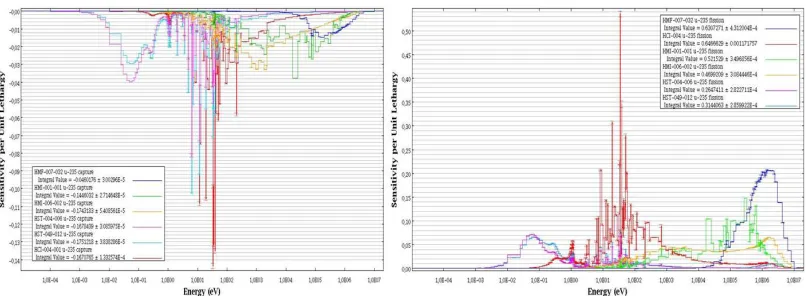
sensitivity to the 235U capture, for the selected benchmarks. The DICE 2014 data also provide with the differential sensitivities of benchmarks to the different parameters as for instance nuclide, type of cross-section, etc. Figure 1 shows the sensitivity of keff to the 235U capture and to the 235U fission
2.2 Benchmark description
The experiments available in the ICSBEP Handbook are categorized by fissile media: Highly (HEU), Intermediate (IEU), or Low Enriched (LEU) Uranium; physical form of the fissile material (metal, solution and miscellaneous systems); and neutron energy range where the majority of the fissions occur (fast, intermediate, thermal spectra systems). The description of the selected benchmarks is presented in Table 2.
Figure 1. Sensitivity of keff to the 235
U capture (left) and to the 235U fission (right) cross-section for the six most sensitive benchmarks, computed with the MORET 5 Monte Carlo code.
Table 2. Selected benchmarks description.
HEU-SOL-THERM-004-(003 and 006) UO2F2 solution – U (93.6%
235U) – Spherical tank – Heavy water
reflection
HEU-SOL-THERM-049-012 Uranyl Nitrate solution – U (85%235U) – Spherical tank – Water reflection
HEU-SOL-INTER-001-001 UO2F2 solution – U (93.6%
235U) – Spherical tank – Heavy water
reflection
HEU-COMP-INTER-004-001
(HECTOR) Uranium/Boron/Graphite powder – U (92%
235U)
HEU-MET-INTER-007-031 Metallic Uranium plates (93.15%
235U) – Polyethylene moderated – No
reflection
HEU-MET-FAST-007-(010 and 032) Metallic Uranium plates (93.15%
235U) – Polyethylene (010), Teflon (032)
moderated - No reflection
HEU-MET-FAST-042-002 Heterogeneous HEU cylinder –Vanadium diluted and Beryllium Oxide
moderated
HEU-MET-FAST-038-001 Heterogeneous cylindrical assembly – (96%
235U), Beryllium and
Beryllium Oxide disks – Depleted Uranium reflection
HEU-MET-FAST-070-003 Highly enriched Uranium, Tungsten, Aluminum Oxide plates – U
(93%235U) – Al
2O3 reflected
HEU-MET-INTER-006-002 (ZEUS-002)
Cylindrical disks assemblies – metallic U (96%235U) – Graphite
moderated and Cu reflected
HEU-MET-INTER-001-001 Uranium/Iron cylinder – U (93%235U) – Stainless steel reflected
IEU-MET-FAST-007-001 (BIGTEN) Uranium (10%235U) cylinders reflected by 15 cm depleted Uranium
3 Results
The impact of the new preliminary 235U resonance evaluation in benchmark calculations was
investigated using the identified benchmarks listed in the ICSBEP compilation. The new set of 235U resonance parameters was converted into the ENDF format and, for testing purpose, included in the ENDF/B-VII.1 235U library, where it replaced the existing ENDF/B-VII.1 resonance parameters. The new 235U-v4 library, also labelled “u235o4brc2”, was processed with the GAIA-NJOY 99 5 code to
generate MCNP formatted cross-section. The keff calculations were performed, for the selected
benchmarks, with both the MCNP 6 6 code and the 5.C.1 release of the MORET 5 7 code, using the ENDF/B-VII.1. In addition, keff calculations were also performed using ENDF/B-VII.1, together with
the new 235U evaluation. The MCNP and the MORET 5 keff results, obtained using the ENDF/B-VII.1
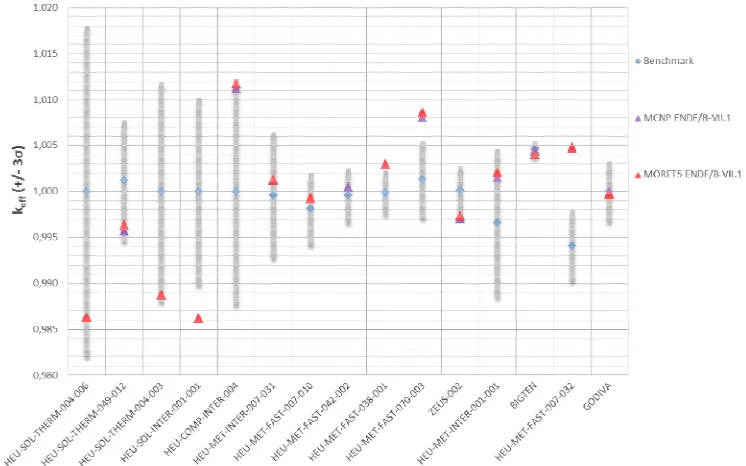
library, are shown in Figure 2, and compared to the benchmark keff. Except for a few cases, the
calculation results are overall in good agreement with the experimental results, within the 3!
experimental uncertainty. The MCNP and MORET results are in good agreement, within 60 pcm (1
pcm = 10-5), with a Monte-Carlo standard deviation of 10 pcm with the MORET code and varying
from 5 to 25 pcm with the MCNP results.
Figure 2.keffresults obtained with MCNP 6 (purple) and MORET 5 (red), using ENDF/B-VII.1 library, together with the benchmark keff(experimental uncertainty in 3!).
The C/E results, obtained with MORET 5, using the ENDF/B-VII.1 library, together with the new
235
the fact that it would be necessary to re-evaluate 238U together with 235U. One can notice that, for the benchmarks sensitive to the intermediate energy range (HMF-038-001, HMF-070-003 and HMI-001), the keff tends to decrease compared to the old evaluation result and a trend in the C/E results can be
observed. The impact of the new evaluation is smaller in the fast energy region (HMF-007-032 and GODIVA), except for BIGTEN, which involves intermediate-enriched uranium. Nevertheless, the benchmark selection allowed highlighting a significant effect on keff of the new 235U capture
cross-section, and the C/E results stay overall in good agreement, with, in some cases, a small improvement. It should be noted however that the results could be impacted by the nuclear data of other materials present in the ENDF/B-VII library. The C/E trend observed here may not be the same, if the 235U evaluation is used with other cross section libraries for the other nuclides. Analysis work is ongoing to extract a tendency of the C/E results, which is important for the evaluation improvement.
Figure 3. C/E results obtained with MORET 5 using ENDF/B-VII.1 library, for the ENDF/B-VII.1 235U (red) and the new 235U-v4 (blue).
4 Conclusion
IRSN and ORNL have been working in collaboration with the CEA/BRC to produce a complete evaluation for 235U. Under reserve of data testing and validation, the evaluation will be made available for possible inclusion in the Joint European Fusion and Fission (JEFF) cross-section library. IRSN, which is involved in the CIELO project in the data testing, especially for the new 235U capture cross-section, has carried out key critical benchmarks selection, regarding the sensitivities to the 235U capture cross-section, in each of the energy ranges, and performed MCNP and MORET calculations for the selected benchmarks, using the new evaluation. The benchmark selection allowed highlighting a significant effect on keff and C/E results with the new 235U evaluation.
Acknowledgements
We would like to thank B. Morillon and P. Romain, from CEA/BRC, that provided the new 235U
References
1. NEA/NSC/WPEC/DOC(2011)433, “Final report of WPEC subgroup 29 on 235U Capture
Cross-section in the keV to MeV Energy Region”, (2011).
2. Y. Danon, Private Communication, to be published, (2012).
3. M. Jandel et al., “New Precision Measurements of the 235U (n,") Cross Section”,PRL109, (2012).
4. International Handbook of Evaluated Criticality Safety Benchmark Experiments,
NEA/NSC/DOC(95)03, OECD Nuclear Energy Agency, (2014).
5. W. Haeck, "GAIA User's Manual - Version 1.0.0", IRSN Report PSN-EXP/SNC/2015-165,
Institut de Radioprotection et de Sûreté Nucléaire, France (2015).
6. MCNP6 User’s Manual - Code Version 6.1.1beta, LA-CP-14-00745 (June 2014).
7. A. Jinaphanh, N. Leclaire, B. Cochet and B. Quaghebeur, “Validation of continuous energy