IJEDR1401171
International Journal of Engineering Development and Research (www.ijedr.org)950
An Intelligent Multi objective Progressive Algorithm
for Identification of Surgically modified Faces
S.Ambarish
Department of Information Technology, SRM University, Chennai, INDIA. [email protected]
________________________________________________________________________________________________________ Abstract - Evolution and low-cost leads to the popularity of plastic surgery techniques and it considerably changes facial aspect and alterations. Social constraint and decreased costs are stimulating more and more people to undergo plastic surgery techniques for changing feature flaws like aging, removing birth marks and disguise, which will lead to a serious challenge for face identifying algorithm. As a result, indentifying individuals after plastic surgery procedures is becoming a relevant problem for law-enforcement agencies to identify face before and after plastic surgeries. In the Current state of the art face recognition algorithms, Extended uniform circular local binary pattern based descriptors, Fast nearest-neighbour algorithm, Granular methods were used. But these methods have trouble like Limited variability in the self-report scores, Multiple Atlases, and Inversion effects. So a new system is proposed with the following phases, (i) Pre-processing of images from data set, (ii) Active Shape Model(ASM) for Feature extraction using Localization of face and primary facial , (iii) Multiple Instances Support Vector machine (MI-SVM) for Classification of feature subset , the above listed modules will refine the accuracy and robustness of the Facial identification system.
Keywords: Face identification, Pre-Processing, Active Shape Model (ASM), Multiple Instances Support Vector Machine (MI-SVM).
I. INTRODUCTION
The attraction for plastic surgery is experienced globally and is driven by aspects such as the availability of advanced technology, inexpensive cost, and the performance speed of procedure. Facial plastic surgery is generally used for correcting feature imperfection or improving the appearance, for example, removing birth marks, moles, scars, and correcting disfiguring defects [2]. The database consists of different types of facial plastic surgery cases such as rhinoplasty (nose surgery), blepharoplasty (eyelid surgery), brow lift, skin peeling, and rhytidectomy (face lift). In the real world, it is difficult to segregate one who have undergone plastic surgery and use special mechanism to recognize them. So, face recognition algorithms should be resistant to variations introduced by plastic surgery even in general operating environments. If the results of Plastic Surgery are long-lasting or permanent then it will provide easy way to evade law and security mechanisms. At times, authentic users may get reject because of facial plastic surgery. Patients one who suffering from structural or functional impairment of facial features will be beneficial because of these surgical procedures, but at the same time one who are trying to conceal their Identity with the intent to commit fraud or evade law enforcement can misuse these procedures. Anti-social elements will move around freely without any fear of being identified by any face recognition system because of these surgical procedures. Therefore, law-enforcement agencies will face challenges in identifying individuals across plastic surgery procedures. So, the matching performance of various existing face matching algorithms will report a significant humiliation when confronted with pre- and post-plastic surgery face images in the database. Then the face recognition method can be implemented in the several fields of the real time components in the world.
II. EXISTING SYSTEM
Traditionally, face recognition research has focused primarily on developing novel characterizations and algorithms to deal with challenges posed by variations in acquisition conditions like illumination conditions and head pose. Tremendous success in dealing with these problems is probably one of the primary factors that have generated interest in new avenues in face matching that include matching faces across plastic surgery variations. Matching across plastic surgery variations are introduced in several algorithms in a new dimension to face recognition discussing various ethical, social and engineering challenges [3]. They observe that six existing appearance, feature and texture-based face matching algorithms show significant performance degradation on the plastic surgery database. The existing algorithms evaluated are:
Principal Component Analysis (PCA), Fisher Discriminant Analysis (FDA), Local Feature Analysis (LFA), Circular Local Binary Pattern (CLBP), Speeded Up Robust Features (SURF), and
Neural Network Architecture-based 2-D Log Polar Gabor Transform (GNN).
III. PROBLEM STATEMENT
IJEDR1401171
International Journal of Engineering Development and Research (www.ijedr.org)951
some semblance of consistency. Data pre-processing describes any type of processing performed on raw data to prepare it for another processing procedure [6]. Data pre-processing changes the data into a format that will be more easily and effectively processed for the purpose of the user, generally used as a preliminary data mining practice- for example, in a neural network. Here are the few tools and methods used for pre-processing: Sampling, which selects a representative subset from a large population of data, Transformation, which manipulates raw data to produce a single input,
De-noising, which removes noise from data; normalization, which organizes data for more efficient access, Feature Extraction, which pulls out specified data that is significant in some particular context.
In fig 1 the images are filtered using the Laplacian and Gaussian filters to remove noises and other components in the image set [5].
Fig1.pre-processing image 4.2 Feature Extraction
4.2.1 Active Shape Model (ASM)
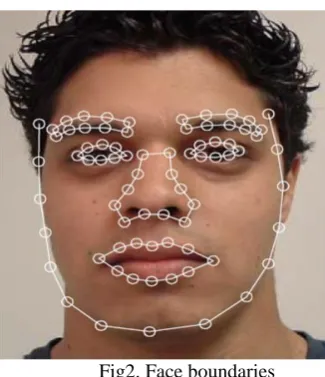
The Active Shape Model (ASM) is one of the most popular local texture models for face alignment and will be applicable in many fields such as locating facial features in the image, face synthesis, etc. localizing the feature points on face images such as the contour points of eye, nose, mouth and face will be the main objective of Active shape model (ASM). There are two stages of Active Shape Model(ASM) : in the first stage, given the initial labels, searching for a new position for every label point in its local region which best fits the corresponding local 1-D profile texture model; in the second stage, updating the shape parameters which best fits these new label positions [6]. The ASM starts the search for landmarks from the mean shape aligned to the position and size of the face determined by a global face detector fig 2. It then repeats the following two steps until convergence
1. Suggest a tentative shape by adjusting the locations of shape points by template matching of the image texture around each point
IJEDR1401171
International Journal of Engineering Development and Research (www.ijedr.org)952
Fig2. Face boundariesIn this above Active Shape Model (ASM), the face components are marked as facial alignments for the loalization of the face componentsin the image. Here the face attributes are marked in several components such as eye, nose, ears, mouth, chin. These favors the overall facial alignments for the facial components in the method [7] [8].
4.3 Classification
4.3.1 Multiple Instance Support Vector Machine (MI-SVM):
Multiple Instance Support Vector Machine (MI-SVM) is a type of supervised learning with missing data. Here, each example has one or more instances. In the training set, we have only Labels at bag level. The task is to label both bags and instances from the test set. In most Practical MI problems, there is a relationship between the instances of a bag. Capturing this relationship may help learn the underlying concept better. The key idea is to allow a structured support vector machine (SVM) to “guess” at the true underlying structure, so long as it is consistent with the bag labels. Steps in Multiple Instance Support Vector Machine
The images are accessed from the Feature Extraction for the Classification module. Maximum Pattern Margin Formulation of MI-SVM.
Maximum Bags of instances are used to classify the image component. These instances have positive and negative bags of labels in the system.
V. EXPERIMENT RESULTS
5.1 Figures and Tables
In the Mat lab tools for extraction of facial components there face images are localized according to the facial attributes and these attributes are accessed using this tool in fig3.
Fig 3 Feature extraction code
IJEDR1401171
International Journal of Engineering Development and Research (www.ijedr.org)953
Fig4. Facial local attributesIn this module the face image is divided into five types such as P,Q,R,T,U components fig 4. These components are accessed through the facial module to form the complete face values to identify the facial modules in the system.
The next image denote the face boundary of the facial images to denote the local facial components [9]. This helps to denote the face attributes and face components by using the ASM algorithm. These boundaries are continous landmark frame for the frame of face module in the fig 5.
Fig5. Face boundary points
5.2 Performance Evaluation
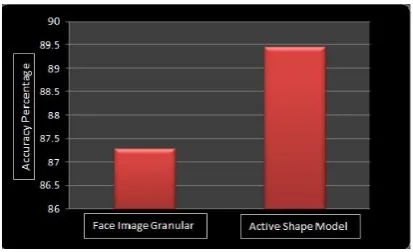
A chart for comparison of the existing and proposed system. which lists the difference between the existing system and proposed system. This proves that the accuracy rate of proposed system is quite higher than the existing system and this helps to identify the face recognition system.
The threshold values between pre and post face images are between the limit +0.5 or -0.5. The Accuracy rate is mentioned in the table 1 using pre and post facial images.
IMAGES SET
ACCURACY THRESHOLD VALUE PRE IMAGE 3.8656
0.2853 POST
IMAGE
4.1509
Table1. Accuracy table
IJEDR1401171
International Journal of Engineering Development and Research (www.ijedr.org)954
Fig 6. Percentage chartVI. CONCLUSION
The procedures can significantly change the facial regions both locally and globally, altering the appearance, facial features, and texture, thereby posing a serious challenge to face recognition systems. Existing face recognition algorithms generally rely on local and global facial features and any variation can affect the recognition performance. This proposed introduces plastic surgery as a new dimension to face recognition. Hence further evolutionary method for optimization technique will be accessed in later period of the project.
VII. REFERENCES
[1] American Society for Aesthetic Plastic Surgery 2010 Statistics 2010 [Online]. Available: http://www.surgery.org/media/statistics
[2] R. Singh, M. Vatsa, H. S. Bhatt, S. Bharadwaj, A. Noore, and S. S. Nooreyezdan, “Plastic surgery: A new dimension to face recognition,” IEEE Trans. Inf. Forensics Security, vol. 5, no. 3, pp. 441–448, Sep. 2010.
[3] M. De Marsico, M. Nappi, D. Riccio, and H. Wechsler, “Robust face recognition after plastic surgery using local region analysis,” in Proc. Int. Conf. Image Analysis and Recognition, 2011, vol. 6754, pp. 191–200.
[4] G. Aggarwal, S. Biswas, P. J. Flynn, and K. W. Bowyer, “A sparse representation approach to face matching across plastic surgery,” in Proc.Workshop on the Applications of Computer Vision, 2012, pp.1–7.
[5] H. S. Bhatt, S. Bharadwaj, R. Singh, and M. Vatsa, “On matching sketches with digital face images,” in Proc. Int. Conf. Biometrics:Theory Applications and Systems, 2010, pp.1–7.
[6] D. G. Lowe, “Distinctive image features from scale-invariant keypoints,” Int. J. Comput. Vis.,vol. 60, no. 2, pp. 91–110, 2004.
[7] B. Heisele, P. Ho, J. Wu, and T. Poggio, “Face recognition: Component- based versus global approaches,” Comput. Vis. Image Understand., vol. 91, pp. 6–21, 2003
[8] B. Weyrauch, B. Heisele, J. Huang, and V. Blanz, “Component-based face recognition with 3d morphable models,” in Proc. Int. Conf. ComputerVision and Pattern Recognition Workshop, 2004, pp. 85–91.
[9] F. Li and H. Wechsler, “Robust part-based face recognition using boosting and transduction,” in Proc. Int. Conf. Biometrics: Theory,Applications, and Systems, 2007, pp. 1–5.
[10]B. Gökberk, M. O. Irfanoglu, L. Akarun, and E. Alpaydin, “Learning the best subset of local features for face recognition,” PatternRecognit.,vol. 40, pp. 1520–1532, 2007.
[11]P. Sinha, B. Balas, Y. Ostrovsky, and R. Russell, “Face recognition by humans: Nineteen results all computer vision researchers should know about,” Proc. IEEE, vol. 94, no. 11, pp. 1948–1962, Nov. 2006.
[12]R. Campbell, M. Coleman, J.Walker, P. J. Benson, S.Wallace, J.Michelotti, and S. Baron-Cohen, “When does the inner-face advantage in familiar face recognition arise and why?,” Vis. Cognit., vol. 6, no. 2, pp. 197–216, 1999.
[13]W. G. Hayward, G. Rhodes, and A. Schwaninger, “An own-race advantage for components as well as configurations in face recognition,” Cognition vol. 106, no. 2, pp. 1017–1027, 2008.
[14]A. Schwaninger, J. S. Lobmaier, and S. M. Collishaw, “Role of featural and configural information in familiar and unfamiliar face recognition,” in Proc. Int. Workshop on Biologically Motivated ComputerVision, 2002, pp. 245–258.