Distinguishing and Forgery Attacks on
Alred
and Its AES-based Instance
Alpha
-MAC
⋆Zheng Yuan1,2, Keting Jia3, Wei Wang3, and Xiaoyun Wang⋆⋆2,3
1
Beijing Electronic Science and Technology Institute, Beijing 100070,China 2
Center for Advanced Study, Tsinghua University, Beijing 100084, China [email protected]
3
Key Laboratory of Cryptographic Technology and Information Security, Ministry of Education, Shandong University, Jinan 250100, China
Abstract. In this paper, we present new distinguishers of the MAC con-structionAlredand its specific instance Alpha-MAC based on AES, which is proposed by Daemen and Rijmen in 2005. For theAlred
con-struction, we describe a general distinguishing attack which leads to a forgery attack directly. The complexity is 264.5
chosen messages and 264.5 queries with success probability 0.63. We also use a two-round collision differential path forAlpha-MAC, to construct a new distinguisher with about 265.5
queries. The most important is that the new distinguisher can be used to recover the internal state, which is an equivalent secret subkey, and leads to a second preimage attack. Moreover, the distin-guisher onAlredconstruction is also applicable to the MACs based on CBC and CFB encryption mode.
Keywords:Distinguishing attack, Forgery attack,Alredconstruction,
Alpha-MAC, AES
1
Introduction
Message Authentication Code (MAC) is a fixed length information used to ensure data integrity and authenticity, and is widely used in Internet community such as IPsec, SNMP, SSL, etc. MAC takes a secret key and a message of arbitrary length as inputs, and outputs a short digest. Many research groups have presented various approaches to construct MAC functions, for example, MAA [7], UMAC [3], OMAC [9], TMAC [12], XCBC [4], RMAC [10], NMAC [1], and HMAC [13], etc.
The MAC construction Alred was introduced by Daemen and Rijmen in
FSE 2005, and an efficient instance based on AES is calledAlpha-MAC [6]. The Alred construction is an iterative MAC function using components of block
ciphers. The secret key, which is used as the key of the block cipher, is applied in the initialization and the final transformation, respectively. The internal state
⋆This work is supported by the National Outstanding Young Scientist (No.60525201), China Postdoctoral Science Foundation Funded Project (No. 20080430423) and Na-tional 973 Program of China (No.2007CB807902)
is changed by consecutive injections of message blocks. TheAlpha-MAC is the Alred construction instantiated with AES [5]. Since the AES algorithm has
been widely used in the real world, theAlpha-MAC can be easily implemented,
which is a factor 2.5 more efficient than the popular CBC-MAC with AES. The designers [6] proved that the Alred construction is as strong as the
underlying block cipher with respect to key recovery and any forgery attack not involving internal collisions. Furthermore, for Alpha-MAC, they showed
that any colliding messages of the same size have to be at least 5 blocks long. Recently, Huang et al. [8] exploited the algebraic properties of the AES, con-structed internal collisions, and found second preimages for Alpha-MAC, on
the assumption that a key or an internal state is known. Biryukov et al. [2] proposed a side-channel collision attack onAlpha-MAC recovering its internal
state, and mounted a selective forgery attack.
The main contribution of this paper is to present interesting distinguishing attacks on theAlredconstruction andAlpha-MAC, which can lead to forgery
attack directly. More important, the distinguishing attack onAlpha-MAC can
be applicable to recover the internal state, which results in a second preimage attack.
There are two kinds of distinguishing attacks on MACs. Preneel and van Oorschot [14] introduced a general distinguishing attack to identify iterated MACs from a random function. Using the birthday paradox, they detect the internal collision by appending the same one-block message. Another kind is to distinguish the cryptography primitive embedded in the MAC construction from a random function [11]. Recently, new techniques to identify the underlying hash functions of MACs are presented in [15,16]. Wang et. al. [16] presented distin-guishing attacks on HMAC/NMAC-MD5 and MD5-MAC, and recovered partial subkey of the MD5-MAC. Their distinguisher makes use of inner near-collisions, which can leak more information than inner collisions.
Our distinguishing attacks are enlightened by Wang et al.’s work, which can detect the inner near-collision with some specific differences. First, we describe a distinguishing attack on theAlredconstruction. By the birthday attack [17],
there exists a collision differential path with some specific differences in the state, which is an inner near-collision, and can be recognized with probability 1 by appending another message pair with the same difference. Second, we present a new distinguisher forAlpha-MAC based on a two-round collision differential
path of AES. Furthermore, combining the structural features of the Alpha
-MAC with the algebraic properties of AES, the differential path can be used to recover the internal state, which is an equivalent subkey. With the recovered subkey, we can obtain the second preimage of the MAC for any given message
M and its MAC value. The complexity of all the attacks is up to 265.5 choose messages and 265.5 queries with success rate 0.63. Moreover, the distinguishing attack on theAlredconstruction is also applicable to the MACs based on CBC
and CFB encryption mode.
-MAC. Section 3 shows our new distinguishing attack and forgery attack on theAlredconstruction. New distinguishing and recovery attack on AES-based Alpha-MAC are introduced in the section 4. Finally, We conclude the paper in
Section 5.
2
Backgrounds and Notations
In this section, we define the notations, and give a brief description of theAlred
construction andAlpha-MAC.
2.1 Notation
f : the iteration function
xi : the message word
yi : the state after thei-th iteration
k : the secret key
C : the output of MAC taking secret keyKand messageM as input
∆A : the XOR difference ofAandA′
n : the length of the state
lw : the length of the message word
lm : the length of the MAC output
MkN : the concatenation ofM andN
S(a) : the output of S-box withaas input
2.2 The Alred Construction
The MAC constructionAlred[6] bases on an iterated block cipher. The length
of the secret key equals to that of the underlying block cipher, and the message length is a multiple oflw bits.
Denote thei-th message word asxi, and the state after thei-th iteration as
yi. For messageM = (x1, x2,· · · , xt), the construction is as follows. 1. Apply the block cipher to the state of all-zero block, i. e.,
y0= Enck(0).
2. Perform the following iterationf for each message word: (a)Injection layout: Map the bits of the message word to aninjection input that has the same dimensions as a sequence of rround keys of the block cipher. (b) Apply a sequence ofrblock cipher round functions to the state, replacing the round keys with the injection input.
yi=f(yi−1, xi), i= 1,2,· · · , t.
3. Apply the block cipher to the stateyt, and truncate the firstlm bits of the state as the output. The final outputC is
2.3 A Brief Description of Alpha-MAC
Alpha-MAC [6] is a specific instance of theAlred construction with AES as
the underlying block cipher, where lw = 32 and r = 1. Similar with AES, the
Alpha-MAC supports key length of 128, 192 and 256 bits. The Alpha-MAC
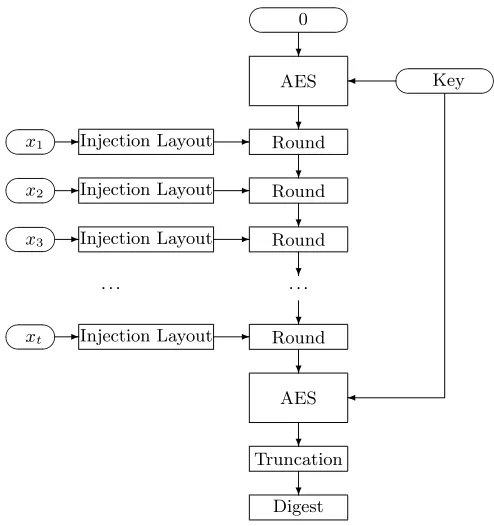
function is depicted in Figure 1.
0
?
AES Key
?
?
?
?
?
? p p p p p p
Round
Round
Round
Round Injection Layout
Injection Layout
Injection Layout
Injection Layout
x1
x2
x3
xt
AES
?
? Truncation
Digest
Fig. 1.The Construction of Alpha-MAC
The message padding method appends a single 1 followed by the minimum number of 0 bits such that the length of the result is a multiple of 32. For AES-128, the injection layout places the 4 bytes of each message word xi = (xi,0, xi,1, xi,2, xi,3) into a 4×4 array with the form:
xi,00xi,10 0 0 0 0
xi,20xi,30 0 0 0 0
,
which acts as the corresponding 128-bit round key. The Alpha-MAC round
– AddRoundKey (AK): add the injection input to the state by XOR operation.
– SubBytes (SB): operate a non-linear byte substitution on each byte of the state independently using an 8×8 S-box.
– ShiftRows (SR): cyclically shift left the bytes in the last three rows of the state with different number of bytes, 1 for the second, 2 for the third and 3 for the fourth row.
– MixColumns (MC): multiply each column of the state with a matrix.
In this paper, we assume there is no truncation on the final output, i. e.,lm= 128.
2.4 The Outline of the Related Works
We recall the general distinguishing-R attack on all iterated MACs proposed by Preneel and van Oorschot [14], and the distinguishing-H attack on HMAC/NMAC-MD5 and HMAC/NMAC-MD5-MAC introduced by Wang et al. [16]. These attacks motivate us to explore new distinguish attacks on MACs based on block cipher.
Preneel et al. proposed a general forgery attack on MAC by birthday paradox, which is applicable to all deterministic iterated MACs, including MAA and CBC-MAC. They detected all the colliding pairs among 2(n+1)/2 known text-MAC pairs by birthday attack [17], wherenis the bit length of the chaining variable. For each searched collisions, i. e., M AC(k, M) =M AC(k, M′), they appended
one-block messageN to identify whether it is an internal collision, according to the equationM AC(k, M||N) =M AC(k, M′||N) holds or not. Once an internal
collision is recognized, they can query the MAC with MkN′, then they carried
out a forgery, i. e., a new message M′kN′ with a valid MAC. But the method
can’t distinguish the cryptographic primitives embedded in the MAC.
Wang et al. [16] introduced another interesting idea which can distinguish HMAC/NMAC-MD5 without the related-key setting and implement partial key recovery attack on MD5-MAC. The main idea of the distinguishing attack is: Firstly, they collect enough two-block message pairs (MkN, M′kN) to guarantee
the appearance of an expected internal near-collision in the first iteration. Then detect such a near-collision by changing the second block with another message
N′. Once the expected inner near-collision is identified, the MAC is based on
MD5.
3
Distinguishing and Forgery Attack on MAC
Construction
Alred
In this section, we present distinguishing and forgery attack onAlred
construc-tion. Enlightened by Wang et al.’s idea, we can get proper output difference as an inner near-collision by the birthday paradox. When the MAC construction is
Alredrather than a random function, this kind of inner near-collision can be
3.1 Distinguishing Attack on AlredConstruction
The iteration part ofAlredconstruction is based on the round function of block
cipher, where the round key is substituted for the injection input. The core of our distinguisher is to detect∆yj−1, which is the output difference of (j−1)-th
iteration. According to the operation between the injection input and the state involved in the iteration f, the message word difference ∆xj may extinguish
∆yj−1, and lead to a collision at the final output. The form of the difference
depends on the operation between the injection input and the state involved in the round function, e. g., for Alred based on IDEA or RC6, the operation is
modular addition, while for others, it is XOR. The rest of this paper takes the XOR operation.
j −1
x1
. . .
. . .
Injection Layout
Injection Layout
Injection Layout Injection Layout Injection Layout Injection Layout
Injection Layout
j −1
j +1
Round
. . .
y’−1
x’ x’1
x’
Round Round
y−1
collision
Round’ Round
collision x
x
Round
j j
xj j
y0
Fig. 2.The Distinguisher with XOR Operation
As shown in Fig. 2, there is an inner near-collision after roundj−1. When
∆xj =∆yj−1, there will bexj⊕yj−1=x′j⊕y′j−1, which is an internal collision, and can be propagated to the output. If the construction is Alredwith XOR
operation, replace the (xj, x′j) with different (xj, x′j), where∆xj =∆xj, a col-lision still happens. According to this property, the distinguisher is constructed as follows:
1. Randomly choose a structureT ={Mi|Mi= (xi
2. By birthday paradox, a collisionCa=Cbcan be obtained. The correspond-ing message words areMa andMb.
3. Supposexj is the first unequal word inMa andMb counting backwards, i. e.Ma= (xa
1,· · ·, xaj, xj+1,· · ·, xt)},Mb = (xb1,· · ·, xbj, , xj+1,· · ·, xt)}. We replace (xa
j, xbj) with another (xaj, xbj), wherexja⊕xbj =xaj ⊕xbj. Query the MACs with (Ma, Mb), where Ma ={xa
1,· · ·, xaj−1, xaj} and Mb ={xb1,· · · ,
xb j−1, xbj}.
– IfCa=Cb, we conclude that the MAC isAlredconstruction. – Else, it is a random function.
Note that tshould be large enough to guarantee there is an inner near-collision at roundj−1, j≤t.
This attack requires about 2(n+1)/2 chosen messages and works with a prob-ability of 0.63 by the birthday paradox. If we double the number of chosen text-MAC pairs, the success rate can be increased to 0.98.
Remark.With regard to MACs based on CBC encryption mode for block ciphers, e.g. CBC-MAC, OMAC, TMAC, etc., the iteration of MAC is defined as follows:
Hi=f(Hi−1, xi) =Ek(Hi−1⊕xi).
The above attack can be applied similarly. Besides, the method also works for the MACs based on CFB mode, i. e.,
Hi=f(Hi−1, xi) =Ek(Hi−1)⊕xi.
3.2 Forgery Attack on AlredConstruction
Once the inner near-collision is identified, we replace message words with the same difference, and achieve a new collision pair. Hence, the forgery attack is easily realized with the same complexity and success rate as the distinguishing attack. The details are as follows:
Suppose (Ma, Mb) is the colliding pair detected in the above distinguishing attack. We query the MAC oracle aboutMga, whereMga = (xa
1,· · ·, xaj−1,xfaj, s), and s is an arbitrary message string. Then we construct the forgery of gMb = (xb
1,· · ·, xbj−1,xfaj⊕∆xj, s) with one query.
4
Recovery the Equivalent Subkey of
Alpha
-MAC
The above distinguisher is applicable to distinguish theAlpha-MAC from a
4.1 Some Useful Properties of AES
This section presents a two-round collision differential path of AES, and sum-marizes some useful properties based on it. The two-round differential path will be used to recover the inner state in Section 4.3.
Fori= 1,· · ·, t, denote
yi−1,0 yi−1,1 yi−1,2 yi−1,3
yi−1,4 yi−1,5 yi−1,6 yi−1,7
yi−1,8 yi−1,9 yi−1,10yi−1,11
yi−1,12yi−1,13yi−1,14yi−1,15 ⊕
xi,00xi,10 0 0 0 0
xi,20xi,30 0 0 0 0
SB −−→
zi,0 zi,1 zi,2 zi,3
zi,4 zi,5 zi,6 zi,7
zi,8 zi,9 zi,10zi,11
zi,12zi,13zi,14zi,15 ,
whereyi−1is the output of roundi−1, and (xi,0,0,xi,1,0,0,0,0,0,xi,2,0,xi,3,0,0,0,0,0) is the injection input to roundiwhich acts as the round key. Suppose (yt−2, xt−1, xt) and (y′
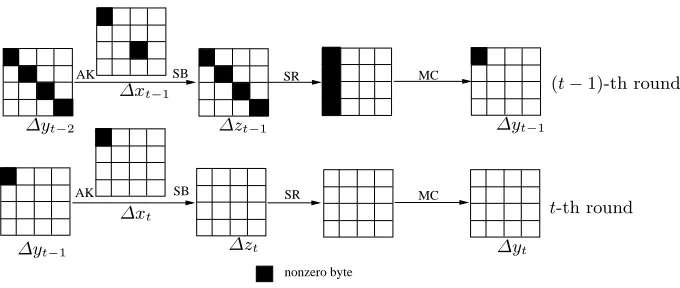
t−2, x′t−1, x′t) follow the two-round collision differential path as depicted in Fig. 3.
00 00 11 11 000 000 000 000 000 000 000 000 111 111 111 111 111 111 111 111 0000 1111 00000 11111 00000 11111 0 0 1 1 0 1 00 00 11 11 0 0 1 1 00 00 11 11 0 1 00 00 11 11 00 00 11
11 01
0 0 1 1 0 0 1 1 MC MC AK SB AK SB SR SR nonzero byte ∆yt
(t−1)-th round
t-th round ∆yt−1
∆yt−1
∆xt−1
∆xt
∆yt−2 ∆zt−1
∆zt
Fig. 3.Two-Round Collision Differential Path
From the differential path, we can see that there is only one nonzero byte in
∆yt−1, which equals to ∆xt,0. Because MC is a linear transformation, and SR
has no impact on the value of difference, we can compute the output differences of four S-boxes in the (t−1)-th round:
(∆zt−1,0, ∆zt−1,5, ∆zt−1,10, ∆zt−1,15)T =M C−1(∆xt,0,0,0,0)T. (1)
Since the branch number of MC transformation in AES is 5 [5], there are four nonzero bytes in ∆zt−1. It is noted that given (yt−2, yt′−2) and (xt, x′t), there will be a collision if and only if (∆zt−1,0, ∆zt−1,5, ∆zt−1,10, ∆zt−1,15) satisfies
Property 1. Provided that (yt−2, xt−1, xt) and (yt′−2, x′t−1, x′t) following the two-round collision differential path, randomly choose 28different pairs of (x
t−1,0, x′t−1,0) to replace (xt−1,0, x′t−1,0), respectively, and compute 28 corresponding pairs of (yt, y′t), there exists one collision of (yt, yt′) on average.
Proof. Since only (xt−1,0, xt′−1,0) changes, all bytes in ∆zt−1 remain the same except ∆zt−1,0, where∆zt−1,0 = S(yt−2,0, xt−1,0)⊕S(yt′−2,0, x′t−1,0). Thus, in order to obtain a new collision, (xt−1,0, x′t−1,0) must satisfy
S(yt−2,0⊕xt−1,0)⊕S(yt′−2,0⊕x′t−1,0) =∆zt−1,0.
From the distribution table of S-box in AES, we can observed that, there are 27 pairs corresponding to each output difference on average. Hence, one randomly chosen pair leads to the expected output difference ∆zt−1,0 with probability 27/215= 2−8, there is excepted to have a collision among the 28(y
t, y′t).
This property is used in the new distinguishing attack to identify the Al-pha-MAC from a random function. ForAlpha-MAC, the inner state yt
−2 is unknown, however, we can recover two bytes ofyt−2by the next two properties.
Property 2. Suppose (yt−2, xt−1, xt) and (yt′−2, x′t−1, x′t) follow the two-round collision differential path, where (yt−2, y′t−2) are unknown, we can compute the value (yt−2,0, yt′−2,0) with about 216 XOR operations and 210 chosen messages.
Proof. If (yt−2, xt−1, xt) and (y′t−2, x′t−1, x′t) follow the two-round differential path, there will be
S(yt−2,0⊕xt−1,0)⊕S(yt′−2,0⊕x′t−1,0) =∆zt−1,0. (2)
According to Property 1, we get
S(yt−2,0⊕xt−1,0)⊕S(yt′−2,0⊕x′t−1,0) =∆zt−1,0. (3)
Thus, we can guess all 216possibilities of (y
t−2,0, yt′−2,0) and filter out the wrong ones by equation (2) and (3).
If there are more than one solution left, we replace the messages as described in Property 1, and get another pair (xt−1,0, x′t−1,0) with
S(yt−2,0⊕xt−1,0)⊕S(yt′−2,0⊕x′t−1,0) =∆zt−1,0 (4)
which leads to a collision, and achieve the right value of (yt−2,0, yt′−2,0). The time complexity is dominated by the exhaustive search of 216possibilities of (yt−2,0, y′t−2,0), and the number of chosen messages to get equations (3) and (4) is 210.
In a similar way, we can recover the value (yt−2,10, yt′−2,10) by replacing the (xt−1,10, x′t−1,10) with 29 different pairs of (xt−1,10, x′t−1,10).
Property 3. Suppose (yt−2, xt−1, xt) and (yt′−2, x′t−1, x′t) follow the two-round collision differential path, where (yt−2, y′t−2) are unknown, we can compute the
4.2 Distinguishing Attack on Alpha-MAC
Similar with the distinguisher forAlredconstruction, the new distinguisher on Alpha-MAC is based on the identification of an inner near-collision
∆yt−1=
∆xt,00 0 0
0 0 0 0
0 0 0 0
0 0 0 0
,
just the same as the∆yt−1in Fig. 3. There exists such an inner near-collision with this form by the birthday paradox, and we can detect it by the new distinguisher. Moreover, combining with the properties introduced in Section 4.1, the detected difference can lead to the recovery of the inner state, which results in the recovery ofy0. It is noted that, y0=Enck(0), is equivalent to a prefix subkey.
Reference [6] claims that an extinguishing differential inAlpha-MAC spans
at least 5 message words, and given the state value yi−1, the map from the
sequence of four message words (xi, xi+1, xi+2, xi+3) to the state value before iteration i+ 4 is a bijection. Hence, we choose a structure composed of 264.5 messages with t-word length, where t ≥6 in order to guarantee the map form (x1,· · ·, xt−1) toyt−1is a random function, and the expected inner near-collision can be obtained by birthday attack. It is recommended to chooset= 9.
We construct two structures as follows:
T1={M = (x1, x2,· · ·, xt−1, xt)},
T2={M = (x1, x2,· · ·, xt−1, xt⊕(η,0,0,0))},
where (x1, x2,· · ·, xt−2, xt−1,0, xt−1,3) are randomly chosen, xt−1,1, xt−1,2, xt andηare fixed, i. e., we choose∆xt−1, ∆xtas shown in Fig. 3. The distinguisher works in the following manner:
1. Query the MAC with all the 265.5 messages in structure T1 and T2, and obtain the corresponding MACs.
2. According to the birthday paradox, a collision can be obtained, i. e.,Ca 1 =
Cb
2, whereC1a belongs to the MAC values ofT1, andC2b belongs to the MAC values ofT2. Suppose corresponding messages areMa and Mb, denote the word differences of (xa
t−1−xbt−1) and (xta−xbt) as∆xt−1and∆xt, respectively. Randomly choose another different pair of (Ma, Mb), where
Ma= (xa
1,· · · , xat−1, xat), Mb= (x1b,· · · , xbt−1, xbt), ∆xt=∆xt.
Query the MAC with the new message pair (Ma, Mb).
If they still collide, the MAC algorithm is Alred-MAC, and goto step 3.
Otherwise, we conclude that the MAC is a random function. 3. Replace (xa
– If a collision appears, theAlredconstruction is concluded as aAlpha
-MAC by Property 1.
– Otherwise, is based on a random function.
Complexity Analysis. The complexity is 265.5 queries and 265.5 chosen messages in step 1. There is only 2 queries in step 2, and 256 queries in step 3. So the total complexity is dominated by step 1, which is about 265.5queries and 265.5 chosen messages.
Success Rate.The probability that there is a collision among the two struc-tures is 0.63 according to the birthday paradox. Once the collision pair is found, the conclusion of the attack is correct according to the property of AES. There-fore, the success rate is 0.63. We can improve the success rate to 0.98 by doubling the size of each structure.
4.3 Internal State Recovery of Alpha-MAC
In this section, we show a technique which can recover the internal state with the help of the new distinguisher presented above. When the inner near-collision is identified, we can deduce the input and output difference of two S-boxes in the (t−1)-th round, which allows us to recover the corresponding byte (yt−2,0, yt−2,10) according to Property 1 and 2. Combining with the relation
between the round function of AES, we explore equations between the internal states, and can obtain 8 bytes of the stateyt−3. The rest 8 bytes can be recovered
by exhaustive search.
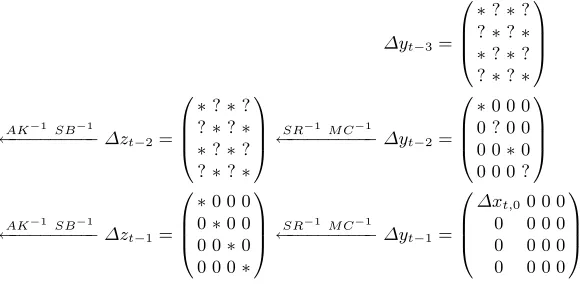
We depict the process of the state recovery in Fig. 4, where ∗ denotes the difference that can be computed, ? stands for the unknown difference, and 0 means the same. The details of the recovery attack are as follows:
∆yt−3=
∗?∗? ?∗?∗ ∗?∗? ?∗?∗
AK−1 SB−1
←−−−−−−−−−∆zt−2=
∗?∗? ?∗?∗ ∗?∗? ?∗?∗
SR−1M C−1
←−−−−−−−−−∆yt−2=
∗0 0 0
0 ? 0 0 0 0∗0
0 0 0 ?
AK−1 SB−1
←−−−−−−−−−∆zt−1=
∗0 0 0
0∗0 0
0 0∗0
0 0 0∗
SR−1M C−1
←−−−−−−−−−∆yt−1=
∆xt,00 0 0 0 0 0 0 0 0 0 0 0 0 0 0
1. Recovering(ya
t−2,0, ytb−2,0, yta−2,10, ytb−2,10).
Once theAlpha-MAC is recognized by the distinguisher presented in
Sec-tion 4.2, we get (ya
t−2, xat−1, xta) and (ybt−2, xbt−1, xbt), (yta−2, xat−1, xat) and (yb
t−2, xbt−1, xbt), which follow the two-round differential path (See Fig. 3), re-spectively. Then we achieve the value (ya
t−2,0, ybt−2,0) and (yta−2,10, ytb−2,10) ac-cording to Property 1 and 2. Hence, we get the values∆yt−2,0and∆yt−2,10.
2. Recovering(ya
t−3,0, ytb−3,0, yat−3,2, ybt−3,2, yta−3,8, ybt−3,8, yta−3,10, ybt−3,10). ApplyM C−1andSR−1 to the statey
t−2, we get the following differences:
(∆zt−2,0, ∆zt−2,5, ∆zt−2,10, ∆zt−2,15)
T =M C−1(∆y
t−2,0,0, ∆yt−2,8,0)T,(5)
(∆zt−2,2, ∆zt−2,7, ∆zt−2,8, ∆zt−2,13)T =M C−1(∆yt−2,2,0, ∆yt−2,10,0)T.(6)
For the (ya
t−2, xat−1, xat) and (ybt−2, xbt−1, xbt) detected in the distinguisher, we first recover (ya
t−3,0, ybt−3,0).
(a) As∆zt−2,0is deduced from equation (5), there will be
S(yta−3,0⊕xat−2,0)⊕S(ybt−3,0⊕xbt−2,0) =∆zt−2,0. (7)
From the distribution table of S-box, for a fixed output difference, there will be about 28 corresponding input, thus we can sieve 28 possible (ya
t−3,0, ytb−3,0).
(b) We explore a new technique to discover the correct (ya
t−3,0,ytb−3,0) among the 28 sieved values. For each left (ya
t−3,0,ybt−3,0), query the MAC with about 28 different (Ma, Mb), where
Ma={xa
1,· · ·, xat−3, xt−2, xt−1, xat}, Mb={xb1,· · ·, xbt−3, x′t−2, x′t−1, xbt}. are constructed as follows, the correct (ya
t−3,0,ytb−3,0) is expected to cause a collision.
For each sieved (yt−3,0, y′t−3,0), replace (xat−2,0, xbt−2,0) with the exact pair (xt−2,0, x′t−2,0), where
xt−2,0=xbt−2,0⊕yt−3,0⊕yt′−3,0, x′t−2,0=xat−2,0⊕yt−3,0⊕yt′−3,0.
−If (yt−3,0, y′t−3,0) = (yat−3,0, ybt−3,0), the two inputs to the S-box are
xt−2,0⊕yta−3,0=xbt−2,0⊕yta−3,0⊕ybt−3,0⊕yat−3,0=xbt−2,0⊕ybt−3,0,
x′
t−2,0⊕ytb−3,0=xat−2,0⊕yta−3,0⊕ybt−3,0⊕ybt−3,0=xat−2,0⊕yat−3,0, respectively, and the corresponding outputs are
S(xt−2,0⊕yt−3,0) =zt−2,0=zbt−2,0, S(x′t−2,0⊕y′t−3,0) =zt′−2,0=zta−2,0.
In this way, the value∆zt−2,0 =∆zt−2,0,which means ∆zt−2=∆zt−2 since other bytes remain the same. Then (yt−3, xt−2) and (y′t−3, x′t−2) can lead to the same∆yt−2 where
It is noted that the valuezt−2,0 only affects four bytes ofyt−2, which is
the bytes of the first column (yt−2,0, yt−2,4, yt−2,8,yt−2,12), and the other
bytes remain the same. So that the 2nd to 4th column of∆yt−1are the same with∆yt−1. Thus, there will be a collision at (yt, yt′) if and only if
S(yt−2,0⊕xt−1,0)⊕S(yt′−2,0⊕x′t−1,0) =∆zt−1,0. (8)
Replace (xa
t−1,0, xbt−1,0) with 28 different pairs (xt−1,0, x′t−1,0), there is excepted to have one satisfy equation (8).
Therefore, query the MAC with the corresponding 28different (Ma, Mb), there will be one colliding pair on average.
−Else (yt−3,0, y′t−3,0)6= (yta−3,0, ybt−3,0), the two inputs to the S-box are
xt−2,0⊕yta−3,0=xbt−2,0⊕yt−3,0⊕y′t−3,0⊕yat−3,0,
x′
t−2,0⊕ytb−3,0=xat−2,0⊕yt−3,0⊕y′t−3,0⊕ybt−3,0. The following equation holds with probability 2−8.
S(xt−2,0⊕yt−3,0)⊕S(x′t−2,0⊕yt−3,0) =∆zt−2,0.
Thus,∆zt−2 changes, so that∆yt−2,4= 0,∆yt−2,8= 0, and∆yt−2,12= 0 hold with probability 2−24. Therefore, query the MAC with the 28 different (Ma, Mb), no collision will happen.
In this way, we can sieve the right (ya
t−3,0, ytb−3,0). In the Appendix, we describe a concrete algorithm to recover (ya
t−3,0, ytb−3,0), where only the correct solution is sieved. The value of (ya
t−3,2, ytb−3,2), (yat−3,8, ybt−3,8) and (ya
t−3,10, ybt−3,10) can be recovered in a similar way. 3. Recovering(ya
t−3,5, ytb−3,5, yat−3,7, ybt−3,7, yta−3,13, ybt−3,13, yta−3,15, ybt−3,15). According to the form of the injection input, we get the following equations:
∆zt−2,5=S(yat−3,5)⊕S(ybt−3,5), (9)
∆zt−2,7=S(yat−3,7)⊕S(ybt−3,7), (10)
∆zt−2,13=S(yat−3,13)⊕S(ybt−3,13), (11)
∆zt−2,15=S(yat−3,15)⊕S(ybt−3,15). (12)
From all the deduced value of (ya
t−2,0, ytb−2,0, yta−2,10, ytb−2,10), the next equa-tions derived the round function hold.
yat−2,0= 3S(yat−3,0⊕xat−2,0)⊕2S(yta−3,5)⊕S(yta−3,10⊕xta−2,3)⊕S(yat−3,15)(13)
ybt−2,0= 3S(ybt−3,0⊕xbt−2,0)⊕2S(ytb−3,5)⊕S(ytb−3,10⊕xtb−2,3)⊕S(ybt−3,15)(14)
yat−2,10=S(yta−3,2⊕xat−2,1)⊕S(y
a
t−3,7)⊕3S(y
a
t−3,8⊕xat−2,2)⊕2S(y
a
t−3,13)(15)
ybt−2,10=S(ytb−3,2⊕xbt−2,1)⊕S(ytb−3,7)⊕3S(ytb−3,8⊕xtb−2,2)⊕2S(ybt−3,13)(16)
We can see that, there are only four unknown bytes (ya
t−3,5, yat−3,15, ybt−3,5,
ya
S(yb
t−3,5), S(yta−3,15)) can be easily computed. Then we obtain the corre-sponding input. Using equations (11), (12), (15) and (16) to recover (ya
t−3,7,
ya
t−3,13, ybt−3,7, yta−3,13) in the same way. To sum up, we recover 8 bytes ofya
t−3and 8 bytes ofytb−3, respectively. 4. Recovering the internal statey0.
For each solution derived, guess all the 264 possible values for the rest bytes ofya
t−3, compute backwards, i. e., do the decryption with (xat−4,· · ·, xa1) as the decryption subkey, and obtain 264values ofy0. For eachy0, compute the correspondingyb
t−3with (xb1,· · · , xbt−3) to filter out the wrong guesses. If there are more than one y0 left, using the distinguisher to get another colliding pair, and repeat the recovery attack until there is only one value left. Two colliding pairs is enough to sieve the righty0.
The complexity of this attack is dominated by the distinguishing attack and the final exhaustive search, which is about 265.5 chosen messages and 265.5 queries.
Second Preimage forAlpha-MAC
Once the internal statey0 is recovered, we can apply Huang et al.’s attack [8] to find the second preimages for Alpha-MAC directly, or Biryukov et al.’s
attack [2] to construct a selective forgery attack.
5
Conclusions
In this paper, distinguishing and forgery attacks on theAlredconstruction and
its specific instanceAlpha-MAC are presented. The complexity of the attacks
is dominated by the birthday attack instead of exhaustive search. We construct distinguisher to detect inner near-collisions with specific differences rather than collisions, from which more information can be derived. Especially forAlpha
-MAC, our distinguishing attack can be converted into a recovery attack of the internal state, which equals to a subkey. The recovered equivalent subkey can result in the second preimage attack onAlpha-MAC. It is to say, for any given
text-MAC pair (M, C), we can obtain anotherM′6=M with the sameC.
More-over, these attacks are also applicable to the MACs based on CBC and CFB encryption mode.
References
1. M. Bellare, R. Canetti, H. Krawczyk, Keying Hash Functions for Message Authen-tication, CRYPTO 1996, LNCS 1109, pp. 1-15, 1996.
2. A. Biryukov, A. Bogdanov, D. Khovratovich, T. Kasper, Collision Attacks on AES-Based MAC:Alpha-MAC, CHES 2007, LNCS 4727, pp. 166-180, 2007.
3. J. Black, S. Halevi, H. Krawczyk, T. Krovetz, P. Rogaway, UMAC: Fast and Secure Message Authentication, CRYPTO 1999, LNCS 1666, pp. 216-233, 1999.
4. J. Black, P. Rogaway, CBC MACs for Arbitrary-Length Messages: The Three-Key Constructions, CRYPTO 2000, LNCS 1880, pp. 197-215, 2000.
6. J.Daemen, V. Rijmen, A New MAC ConstructionAlredand A Specific Instance
Alpha-MAC. FSE 2005, LNCS 3557, pp. 1-17, 2005.
7. D. W. Davies, A Message Authenticator Algorithm Suitable for A Mainframe Com-puter. CRYPTO 1984, LNCS 196, pp. 393-400, 1985.
8. J. Huang, J. Seberry, W. Susilo, On the Internal Structure of Alpha-MAC. VI-ETCRYPT 2006, LNCS 4341, pp. 271-285, 2006.
9. T. Iwata, K. Kurosawa, OMAC: One-Key CBC MAC, FSE 2003, LNCS 2887, pp. 129-153, 2003.
10. E. Jaulmes, A. Joux, F. Valette, On the Security of Randomized CBC-MAC beyond the Birthday Paradox Limit: A New Construction, FSE 2002, LNCS 2365, pp. 237-251, 2002.
11. J. Kim, A. Biryukov, B. Preneel, S. Hong, On the Security of HMAC and NMAC Based on HAVAL, MD4, MD5, SHA-0, and SHA-1. SCN 2006, LNCS 4116, pp. 242-256, 2006.
12. K. Kurosawa, T. Iwata, TMAC: Two-Key CBC-MAC, CT-RSA 2003, LNCS 2612, pp. 265-273, 2003.
13. NIST, FIPS 198, The Keyed-Hash Message Authentication Code (HMAC), 2002. 14. B. Preneel, P. Oorschot, MDx-MAC and Building Fast MACs from Hash Functions.
CRYPTO 1995, LNCS 963, pp. 1-14, 1995.
15. X. Wang, W. Wang, K. Jia, M. Wang, New Distinguishing Attack on MAC using Secret-Prefix Method. Submitted to FSE 2009.
16. X. Wang, H. Yu, W. Wang, H. Zhang, T. Zhan, Cryptanalysis on HMAC/NMAC-MD5 and HMAC/NMAC-MD5-MAC. Submitted to EUROCRYPT 2009.
Appendix: An Algorithm to Recover the Internal State
(
y
at−3,0
, y
b t−3,0
)
Provide that (xa
1,· · ·, xat−1, xat) and (xb1,· · ·, xbt−1, xbt) are the colliding pairs ob-tained in the distinguishing attack on Alpha-MAC. We describe an algorithm
to recover the internal value of (ya
t−3,0, ytb−3,0).
Algorithm: Recovering the Internal State (ya
t−3,0, ytb−3,0) INPUT:
T3={(in, in′)|S(in)⊕S(in′) =∆zt−2,0}
T4={(yt−3,0, yt′−3,0)|S(xat−2,0⊕yt−3,0)⊕S(xbt−2,0⊕yt′−3,0) =∆zt−2,0)} T5={Ø}
OUTPUT: (ya
t−3,0, ytb−3,0).
1. For (yt−3,0, y′t−3,0)∈T4,
T4=T4\(yt−3,0, yt′−3,0), deleting the element (yt−3,0, y′t−3,0) fromT4; Computeγ=yt−3,0⊕yt′−3,0; xt−2,0=xbt−2,0⊕γ; x′t−2,0=xat−2,0⊕γ; Let xt−2= (xt−2,0, xat−2,1, xat−2,2, xat−2,3);
x′
t−2= (x′t−2,0, xbt−2,1, xbt−2,2, xbt−2,3). Forxt−1,0 from 0 to 255 do
Forx′
t−1,0 from 0 to 255 do
Let xt−1= (xt−1,0, xat−1,1, xat−1,2, xat−1,3);
x′
t−1= (x′t−1,0, xbt−1,1, xbt−1,2, xbt−1,3). Query theAlpha-MAC withMa, Mb, where
Ma={xa
1,· · ·, xat−3, xt−2, xt−1, xat},
Mb={xb
1,· · · , xbt−3, x′t−2, x′t−1, xbt}.
Let Ca=Alpha-MAC(Ma), Cb=Alpha-MAC(Mb). IfCa=Cb thenT
5=T5∪(yt−3,0, y′t−3,0), and goto 1. 2. For (yt−3,0, y′t−3,0)∈T5do
Letxt−2,0=in⊕yt−3,0,x′t−2,0=in′⊕yt−3,0, wherein6=yt−3,0⊕xat−3,0,
in′6=y′
t−3,0⊕xbt−3,0. Forxt−1,0 from 0 to 255 do
Forx′
t−1,0 from 0 to 255 do
Let xt−1= (xt−1,0, xat−1,1, xat−1,2, xat−1,3);
x′
t−1= (x′t−1,0, xbt−1,1, xbt−1,2, xbt−1,3). Query theAlpha-MAC withMa, Mb, where
Ma={xa
1,· · ·, xat−3, xt−2, xt−1, xat},
Mb={xb
1,· · · , xbt−3, x′t−2, x′t−1, xbt}.
Let Ca=Alpha-MAC(Ma), Cb=Alpha-MAC(Mb). IfCa6=Cb thenT
5=T5\(yt−3,0, yt′−3,0), and goto 2.