1
ORGANIZATIONAL CONSTRAINTS AND PERFORMANCE OF SOLID WASTE MANAGEMENT PROJECTS IN NAIROBI CITY COUNTY, KENYA
MARY WANJIKU GATHONG’A D53/28323/2014
A RESEARCH PROJECT SUBMITTED IN PARTIAL FULFILLMENT FOR THE AWARD OF DEGREE IN MASTER OF BUSINESS ADMINISTRATION
(PROJECT MANAGEMENT), KENYATTA UNIVERSITY.
i
DECLARATION
This research project is my original work and has not been presented for a degree or other award in any other university.
No part of this research project should be reproduced without authority of the author or and Kenyatta University.
Signature ……… Date ……….
Mary Wanjiku Gathong’a D53/28323/2014
This research project has been submitted to the university with my approval as the university supervisor.
Signature ……… Date ……….
DR. SAMUEL MAINA,
Department of Business Administration School of Business
ii
DEDICATION
iii
ACKNOWLEDGEMENT
iv
OPERATIONAL DEFINITION OF TERMS
Solid waste: They are objects or substances made of solid matter disposed off, because the initial user has no further use for them.
Waste management: These are activities that include generation, storage, control, transport selection and disposal of waste.
Performance Refers to the accomplishment of a given task measured against preset known standards of accuracy, completeness, cost, and speed.
Organizational constraints Implies to the scope of impediments encompassed in planning, organizing and management of waste generation and waste handling processes
Solid waste management projects
v
TABLE OF CONTENTS
DECLARATION ... i
DEDICATION ... ii
ACKNOWLEDGEMENT ... iii
OPERATIONAL DEFINITION OF TERMS ... iv
TABLE OF CONTENTS ... v
LIST OF TABLES ... viii
ABBREVIATIONS AND ACRONYMS ... ix
ABSTRACT ... x
CHAPTER ONE: INTRODUCTION ... 1
1.1 Background of the Study ...1
1.1.1 Organizational Constraints and Performance of Solid Waste Management Projects ...2
1.1.2 Projects Performance ...3
1.1.3 Overview of Nairobi City County ...4
1.2 Statement of the problem ...4
1.3 Objective of the Study ...7
1.3.1 General Objectives ...7
1.3.2 Specific Objectives ...7
1.4 Study hypotheses ...7
1.5 Significant of the Study ...8
1.6 Scope of the Study ...8
1.7 Limitations of the Study ...8
1.8 Organization of the Study ...9
CHAPTER TWO ... 10
LITERATURE REVIEW ... 10
2.1 Introduction ... 10
vi
2.2.1 Zero Waste Theory ... 10
2.2.2 Integrated Waste Management Theory ... 11
2.3 Empirical Review ... 13
2.3.1 Project Funding and Performance of Solid Waste Management Projects ... 13
2.3.2 Project Planning and Performance of Solid Waste Management Projects ... 14
2.3.3 Personnel skills and performance of solid waste management projects... 16
2.3.5 Role of households and the performance of solid waste management projects ... 18
2.4 Summary and Research Gaps ... 20
2.5 Conceptual Framework ... 23
CHAPTER THREE ... 25
RESEARCH METHODOLOGY ... 25
3.1 Introduction ... 25
3.2 Research Design ... 25
3.3 Target Population ... 25
Source: KRA (2016) ... 26
3.4 Sampling Design ... 26
3.4.1 Sampling Procedure for Employees ... 26
3.4.2 Sampling Procedure for Managers ... 27
3.5 Data Collection Instruments ... 27
3.5.1 Questionnaires for Employees ... 28
3.5.2 Interview Guide for Managers... 28
3.6 Pilot Study ... 28
3.6.1 Validity of the Instruments ... 28
3.6.2 Reliability of the Instruments ... 29
3.7 Data Collection Procedure ... 30
3.8 Data Analyses and Presentation ... 31
3.9 Ethical Considerations ... 31
CHAPTER FOUR ... 32
RESULTS AND DISCUSSIONS ... 32
vii
4.2 Respondent’s Rate ... 32
4.4 The Effect of Project Funding on Performance of Solid Waste Management Projects in NCC. ... 37
4.5 The Effect of Project Planning on Performance of Solid Waste Management Projects in NCC. ... 39
4.6 The Effect of Personnel Skills on Performance of Solid Waste Management Projects in NCC. ... 41
4.7 The Effect of Role of Households on Performance of Solid Waste Management Projects in NCC. ... 44
4.8 Performance of Solid Waste Management ... 47
4.9 Regression Analysis ... 49
CHAPTER FIVE ... 52
SUMMARY, CONCLUSIONS AND RECOMMENDATIONS ... 52
5.1 Introduction ... 52
5.2 Summary of the Findings ... 52
5.2.1 The Effect of Project Funding on Performance of Solid Waste Management Projects in NCC. ... 52
5.2.2 The Effect of Project Planning on Performance of Solid Waste Management Projects in NCC. ... 53
5.2.3 The Influence of Personnel Skills on Performance of Solid Waste Management Projects in NCC. ... 53
5.2.4 The Influence of Role of Households on Performance of Solid Waste Management Projects in NCC. ... 54
5.2.5 Performance of Solid Waste Management ... 55
5.3 Conclusions ... 55
5.4 Recommendations ... 56
5.5 Areasfor further studies ... 58
APPENDICES ... 66
Appendix I: LETTER OF INTRODUCTION ... 66
Appendix II: QUESTIONNAIRE GUIDE ... 67
Appendix III: RESEARCH AUTHORIZATION FOR NACOSTI ... 72
viii
LIST OF TABLES
Table 2.1: Summary of the Knowledge Gaps ... 21
Table 3.2: Reliability Results ... 30
Table 4.1: Respondents’ rates ... 33
Table 4.2: Demographic Information ... 34
Table 4.3: Project Funding ... 37
Table 4.4: Project Planning ... 39
Table 4.5: Personnel Skills ... 42
Table 4.6: Role of Households ... 44
Table 4.7: Performance of Solid Waste Management... 48
ix
ABBREVIATIONS AND ACRONYMS APA American Psychological Association ANOVA Analysis of Variance
KRA Kenya Revenue Authority
NACOSTI National Commission for science, Technology and innovation SPSS Statistical Package for Social Sciences
CBD Central Business District
CBO Community Based Organization
CDC Centers for Disease Control and Prevention
CSIRO Commonwealth Scientific and Industrial Research Organization EMCA Environmental Management and Co-ordination Act
EMCR Environmental Management and Co-ordination Regulations JICA Japan International Cooperation Agency
KNBS Kenya National Bureau of Statistics NEMA National Environmental Organization
MENR Ministry of Environments and Natural Resources NCC Nairobi City County
PAHO Pan American Health Organization SWM Solid Waste Management
UNEP United Nations Environmental Program UNDP United Nations Development Program
x ABSTRACT
1
CHAPTER ONE: INTRODUCTION
1.1 Background of the Study
Organizational constraints and performance of solid waste management implies the scope of impediments encompassed in planning, organizing and management of waste generation and waste handling processes (UNSD, 2007). Solid waste management according to Carton (2009), revolves around utilizing the available assets, for example physical, human and capital resources to tackle waste generation from the point of inception to disposal.
Wastes are unusable items or materials disposed off since the original user has no further use for them (Bilitewski et al., 1997; Williams, 2005). Any unwanted materials from industrial, commercial, agricultural, mining, household wastes and sludge can be referred to as solid waste (Cheeseman et al., 2006). Solid waste- made of solid matter- has been a matter of concern since man started living in settled societies and communities (Anand, 2010; Kumar, 2009).
2
(City of Nairobi Environmental Outlook, 2007). The rampant increase of solid waste is fueled by changing income, increasing population, change in consumption patterns, and industrialization and urbanization.
With many and huge disposal of diverse solid waste in wrong places, Kenya is faced with a big challenge in tackling management of solid waste in amicable ways (Kombo, 2006). According to Schnitzer and Ngoc (2009), the challenges in management of solid waste projects arise after failure to establish a rationale to articulate organizational constraints issues in funding, personnel skills, legislation and demographic factors among others in this industry.
1.1.1 Organizational Constraints and Performance of Solid Waste Management Projects
According to Adepoju (2000) there are various organizational constraints in performance of solid waste management projects that greatly affect their success, for example; legislation and governance, solution of financial constrictions, awareness creation, planning, and controlled urbanization, inculcating technical skills and stakeholders’
involvement (Kazungu, 2010).
Kenya’s vision 2030 stipulates cohesion of these organizational constraints as lee ways to
3
pave way for the ability of the solid waste management projects to keep up with the ever increasing serious and adverse consequences that otherwise will be experienced by the population health and the urban environment (Mihelcic, 2009; Caplan et al., 2012).
1.1.2 Projects Performance
The concept of project performance in solid waste management is based upon value creation to the incoming bulk refuse to achieve the set standards of the intended outputs (Diaz et. al., 1985). Regular monitoring and evaluation of project performance enable the aligning of business undertakings to the vision and approach of the involved companies by refining both internal and external communication, and surveillance against the strategic goals (Omuterema, 2013). Monitoring and evaluation is a weighing tool that puts into consideration economic viability, consumer satisfaction and project progress. Organizations can use these standards to balance the implementation of their strategy and account for the recommended provision of enough resources especially funding.
4
endowed resulting in endless duels of blame shift and culminating to a dirty city (The National Climate Change Action Plan, 2013-2017).
1.1.3 Overview of Nairobi City County
Nairobi City County was created after the inauguration of the Kenyan constitution of 2010 and it is a replacement of the now obsolete City Council of Nairobi. This county functions under the provisions of the Devolved Government Act, Cities and Urban Areas Act among others. Nairobi has a population of 3, 138, 369 according to the 2009 census (Kenya National Bureau Statistics (KNBS), 2010). A steady increase in the population growth rate in Kenya has been observed. The current trend in population growth in Kenya depicts that there will be a hike in population growth, with Nairobi’s population
estimated to reach 5 million people by 2025 (Wayback Machine, 2013).
This calls for implementation of effective measures and projects to manage solid waste as it tends to increase with the growth in population. The Nairobi County government is mandated with the obligation of providing diverse services to its residents. The new Nairobi Water and Environmental Services Authority, regulates the water, energy, forestry, environment and natural resources sectors of the county charged with policy formulation and offers guidance in solid waste management areas especially in the county (Nairobi City County Waste Management Bill, 2015; National Environmental Management Authority (NEMA), 2014).
1.2 Statement of the problem
5
handling of solid waste. Most of these SWM projects in Kenya are faced with many challenges which negatively affect their performance, and so their intended objectives are not effectively met (NEMA, 2014). Out of all SWM projects licensed by the City Hall between 2011 and 2014, 60 % of them have been implemented with about 30% showing progressive results (Nairobi County Integrated Development Plan, 2014).
A wide ray of SWM projects in Nairobi City County uses traditional oriental procedures like open dumping, so; they rarely meet the set goals and objectives (City of Nairobi Environmental Outlook, 2007). The inability of these projects to keep up with the ever increasing waste has got very serious adverse consequences on population health and the urban environment (Ogola, 2013).
6
With the rapid advent of newer and increasingly complex technologies, the solid waste management sector should be fused with modern approaches that would ensure effective and successful performance of the projects (UNEP, 2012). This is achievable through research in areas of inter-relation with incremental and cumulative nature of technological dynamic and the limits of the projects’ ability to learn and manage their growth. In response to negative effects caused by improper solid waste disposal, several researches have been carried out in Kenya. Ng’era (2014) studied on the problems and openings in non-biodegradable solid waste reduce, reuse and recycle in Thika Town. The researcher found out that Thika Sub County has limited information on policies and by laws of non-biodegradable solid waste reuse and recycling.
The region rarely involves the residents and private sector. Likewise, Diana (2015), investigated on management of solid waste impacts in Embu County. The findings indicated that there is need to employ more workers, acquire more vehicles, equipment and come up with a payment system for solid waste management. In addition Ochieng (2015), did a study on nexus between environmental safety and solid waste management in Kenya Defense Forces (KDF) and concluded that there are gaps in sector regulations which make it hard for execution of laws to institutions like the KDF.
7 1.3 Objective of the Study
1.3.1 General Objectives
To evaluate the organizational constraints and performance of solid waste management projects in Nairobi City County.
1.3.2 Specific Objectives
The study research had the following specific objective
1. To determine the effect of project funding on performance of solid waste management projects in NCC.
2. To determine the effect of project planning on performance of solid waste management projects in NCC.
3. To establish the effect of personnel skills on performance of solid waste management projects in NCC.
4. To assess the effect of role of households on performance of solid waste management projects in NCC.
1.4 Study hypotheses
H01. There is no effect of project funding on performance of solid waste management projects in NCC.
H02. There are no effects of project planning on performance of solid waste management projects in NCC.
H03. There is no effect of personnel skills on performance of solid waste management projects in NCC.
8 1.5 Significant of the Study
This research is important as its findings will help in determining the organizational constraints in performance of solid waste management projects in NCC, which can be used to come up with viable solutions to improve on solid waste management. This study will help project officers in identifying effective means of ensuring solid waste management projects implemented achieve great performance. The study will also give possible remedies and recommendations to help county governments come up with effective solid waste management projects. Furthermore, the study will provide a baseline for further research on other constraints affecting SWM projects in urban areas.
1.6 Scope of the Study
The study focused on organizational constraints and performance of solid waste management projects in Nairobi City County. The researcher conducted the research within the month of January 2018. The study was carried out in each category of solid waste projects within Nairobi County licensed by the KRA as listed below; organic waste SWM projects, paper SWM projects, plastic SWM projects, glass and metal SWM projects. Due to similarity of the services offered by these organizations two projects were selected for the study for each category. Different solid waste management managers from each category of solid waste projects participated in the study.
1.7 Limitations of the Study
9
overcame these by reassuring confidentiality to the respondents of any information given by them. For those with busy schedules, considerable amount of time for filling in the questionnaires was given.
1.8 Organization of the Study
This project was organized in five chapters. Chapter one covered background of the study, statement of the problem, objectives of the study, significance of the study, scope of the study and limitations of the study. Chapter two dealt with the literature review on organizational constraints and performance of solid waste management projects. This chapter has the following sub-topics; theoretical review, empirical Review, summary and research Gaps, and conceptual framework.
10
CHAPTER TWO LITERATURE REVIEW 2.1 Introduction
This chapter is a survey of literature on performance of solid waste management within Nairobi City County in reference to other urban centers previously studied. It highlights; the theoretical review with the view of bringing forth the various theories of solid waste management, empirical review and organizational constraints and performance of solid waste management.
2.2 Theoretical Review
2.2.1 Zero Waste Theory
Modern examples of the zero waste concept were reported as early as 1893, (Farrel, 2002) with Paul Palmer being the first scientist to use the term officially in 1973, - Zero Waste Systems- insinuating that waste must be eliminated ‘upstream’ at the source. In the study it is argued that, the rational beginning point for managing solid waste effectively is to minimize or limit the amounts of waste, by managing it informally within the generation site or formally by an external entity after waste is disposed.
11
end products. The study found out that the Municipality has to an extent withdrawn its waste collection services from that area leaving it to private collectors who only serve individuals willing and able to pay for the services. Most previous in-roads had focus on diversification of skill and the deal has been to alter and repackage the products through innovations prompted by need and essentiality of solving an existing problem, for example plastics insalubrious headache (Magutu et al., 2010).
There are myriads of industries existing along this field. Ironically, they are lamed by deeply rooted challenges revolving around their performance. These include; underfunding, rudimental project planning, vaguely shaped and unprofessional personnel skills, unsettled demographic issues, unclear roles of households and finally, conflicting legislation policies (Mazzanti, 2008).
In the solid waste management sector, the theory of zero waste can be a frame of reference when designing and implementing new waste management systems and for analyzing and optimizing the existing ones. On the other hand, the interrelation of zero waste theory with the concept of evaluating the constraints in performance in this industry will help to keep check of all the aspects (technical and non-technical) and promote their efficiency. A phase of redistribution of responsibility more equitably from the national level, trickling down to counties and to households should be expertly tailored (Diaz et. al., 1985).
2.2.2 Integrated Waste Management Theory
12
management is a cyclical, goal-oriented process that tries to seek efficiency in solid waste management. It comprises of four different phases; waste collection, recycling, treatment and disposal. Waste management ought to be tackled from a holistic perspective where the complete cycle of material use is considered, that is different from the isolated, sectorial approaches. This approach advocated for an amplified urgency and effort to fast track implementation of generic methods to manage solid waste for sustainable development. SWM comprises waste generation and waste handling processes (UNSD, 2007).
The work of Kariuki (2014) on elements influencing SWM in Thika Sub County, used the integrated waste management theory to show that the inspecting and implementation of the collection, movement and disposal activities of waste companies are not adequate since there is weak enforcement of Thika Council bylaws. Solid waste services are not urgently attended to by the City Council which leads to illegal dumping hence unnecessary pilling. If Thika sub county Government were to mend on their solid waste services, the customers of those services may be willing to pay to ensure continued service provision. This will enable the County Government to have more funds to improve on SWM.
13 2.3 Empirical Review
2.3.1 Project Funding and Performance of Solid Waste Management Projects
Implementation of SWM projects requires huge amount of funds for them to be successful. In developing countries, there is a major challenge of insufficient funds being allocated to management of wastes. The study carried out by Liyala (2011) argues that, waste management in developing countries is rarely budgeted for since it is not considered a priority by urban authorities. This has adverse effect on SWM projects that are implemented in the urban areas. Mainly, funds for management of wastes are from diverse external sources such as central government and donors who give funds as grants (Odhiambo, 2007). Very few projects are financially self-reliant thus, when the external funding is not forthcoming, the projects fail to kick off or come to a sudden halt (Liyala, 2011).
According to a study by Ogola (2013), low priority is attached to SWM in developing countries. Consequently, limited funds are budgeted for the sector by authorities, and the standards required for protection of public health and the environmental interests are not achieved. Extra financing of the sector should be evaluated and County Government Act and By-Laws should be modernized to conform to Kenya Waste Management Regulations 2006 to ensure its sustainability.
14
local taxation system which weakens the funding for activities offered by public institutions. This fragile financial basis of Kenyan governments can be complemented by gathering of user service charges. Nevertheless, users in city suburbs are unable to pay for the amenities, their willingness to cater for services which are inconsistent and ineffective is very low too. An effective approach that is used to raise money should be looked at in any collective project in order to make sure that it is sustainable (Odipo, 2015).
2.3.2 Project Planning and Performance of Solid Waste Management Projects
Inadequate planning often has a big influence on managing waste in developing nations. Improper planning in implementation of SWM projects affects their execution and performance. Moreover, as the study of Oberlin (2011) postulates, non-transparent legislation and unclear policies are major causes of poor performance of SWM projects. Interfered articulation of objectives, by political based agendas and self-interests weakens the institutions mandated with implementing SWM projects and creates a difficult community which does not acknowledge waste management initiatives (Okot-Okumu & Nyenje, 2011).
15
government level on specific modules of the SWM system, e.g. communication methods and risk management should also be integrated (Kaloki, 2014).
The set policies should encourage documentation of integrated, city-level SWM projects and demonstration projects and process-oriented advisory services at national level on specific modules of the SWM system (Muhani, 2014). Njagi, (2015) concludes that the project planners should establish programs and materials for researches on human resources development. This is to breed comprehensive manuals and guiding principles for propagation of knowledge and skills through literature, case studies, project documents and articles in support exchange experiences. The ministry of planning and devolved county functions should establish more comprehensive policies and follow their articulation of the existent bills of law.
16
Nairobi County Government Act and by extension most of the County by-laws are outdated in nature hence there is no consistence with Waste Management regulations 2006. A majority of the regulations are focused on disposal, while the former focuses on prevention. These discrepancies toughens the process of laying a strong foundation and building on sustainable institutional frameworks i.e. formal regulations’ systems, laws and guidelines; and informal agreements, customary laws and traditions, which educates social and economic interactions and behavior (Kaiganaine, 2012).
The County by-laws should be harmonized such that the established rule of law self-regulates, as permitted for by relevant authority such as the national government or the constitution. The relevant authority, mostly legislative arm or other government sector, should establish the control measures to ensure the regulations are executed. It should ensure such policies are embracing the dynamism of the society and are in cohesion with other closely related and even unrelated industries (Agboje et al., 2014).
2.3.3 Personnel skills and performance of solid waste management projects
17
surroundings, domestic sensitization to uphold healthy environments, domestic waste disposal, and children’s inculcation of expected participations in solid waste management and care for the Mother Nature is missing (Towett, 2015).
Public awareness on safe SWM practices seems relatively low in Nairobi. From earlier surveys and reports respondents do not display much concern regarding solid waste management (Nation Daily, September 5 2016). Considering the degradation of the physical environment and the negative health impacts associated, this low level of concern is striking. Yet, the negative environmental and health impacts, for instance pollution of air caused by waste when it is burnt, affect everybody in the community similarly, regardless of income level or regional boundary (Omuterema, 2013).
A large percentage of the populations assume that the county government is solely responsible for ensuring clean habitats. With this notion, majority of the citizens may fail to join hands in campaigns for cleaning up the surrounding. This hence can explain the reason as to why Nairobi city is enclosed in filth and yet residents seem to be unconcerned (Kariuki, 2015). Civic education is crucial in imparting general environmental care awareness, education and skills to public so as to face problem which is a shared responsibility of the County government and the communities (Liyala, 2011).
18
befitting social aspects principles such as sufficient morals and responsibilities, remains unclear and should be tailored to meet the set out needs and expectations. Establishing programs and materials for research on human resource development to breed elaborate manuals and guidelines for dissemination of know-how and skills is paramount. This can be done through case studies and documentation of resourceful literature.
2.3.5 Role of households and the performances of solid waste management projects Effective SWM policies can only be coupled to a sensitized society. African urban areas like Nairobi (Kenya), Dar-es-salaam in Tanzania and Kinshasa in D.R.C. are characterized by aspects of waste management problems. These includes; uncontrolled dumping of solid waste on roadsides, drainage channels and recreational parks, thus posing health hazards to adjacent residential areas (Kazungu, 2010). For years, solid waste has been burned, re-used, or dumped with a qualitative level of processing which depends on the economic, cultural, social and political developments of communities (Bagchi, 1994). Unbalanced public training and low citizen participation adversely affects waste management processes.
Citizens should have knowledge on SWM and be more involved in the routine waste collection activities as they should know their responsibility in waste generation, collection timetable and the standard measures of waste management (Nkwocha and Emeribe, 2008). In the NCC public domain, diverse cultures are not fused with harmonious principles concerning waste.
19
2008). Primarily, civic education should train the society to minimize the level of waste they produce. Besides, society awareness creation on domestic waste separation at the source to have it ready for collection should be encouraged (Nation Daily, January 11, 2016).
The private sector controls about 70% in development schemes of a country (Rondinelli and Cheema, 1988). Considering the current changes in the entire waste sector, Nairobi City County government as well as private entities has come up with specific project proposals seeking implementation of initiatives to reduce carbon emissions and solid waste as a basic requirement for ecologically sustainable development (The National Climate Change Action Plan, 2013-2017).
However, the county offices provide inadequate assistance to private companies to enable them to operate in informal settlements (Kenya National Water Development Report, 2006). The non-cohesive nature of the task forces makes the event overwhelming, with the waste collection agencies that include the NCC and private projects only managing to gather approximately 20% to 30% of the produced waste material (Njoroge et al., 2014). The approximated remains of about 1200 tons of daily solid waste material is left unattended to, disposed in environmental unfriendly ways or in control of ad hoc community-based groups or voluntary groups in the city (JICA, 2015).
20
general in participating the services and provision the necessary facilities to households and waste workers (Kazungu, 2010). The avenue through which the county government should involve both private and public organizations to boost their garbage management should be paved e.g. through public training and waste management campaigns (Liyala, 2011).
The three major stakeholders; public, NCC and the private sector, should be involved in all SWM phases that is waste collection, waste separation, waste transportation all the way to waste treatment and discarding. This will push for better reduction of waste that has to be disposed. They should be charged with proper handling, storage and disposing of the waste they generate to facilitate proper disposal and promote a clean environment for their activities (Kinyanjui, 2014).
2.4 Summary and Research Gaps
The literature review climaxes at a call for further researches in the area of organizational constraints in performance of the SWM projects. From the literature, it is clear that planning, skills and personnel, project funding and stakeholders have great influence on accomplishment of the goals of the SWM projects. The NCC advocates for effort to hasten the implementation of generic methods to manage solid waste and realize sustainable development (UNSD, 2007).
21
practices or activities in another area (Morwood, 1994). Thus, action oriented learning system and methodology aimed at promoting efficiency, should be evaluated and deployed to reduce difficult and inefficient tasks (Cal Recovery Inc., 1993).
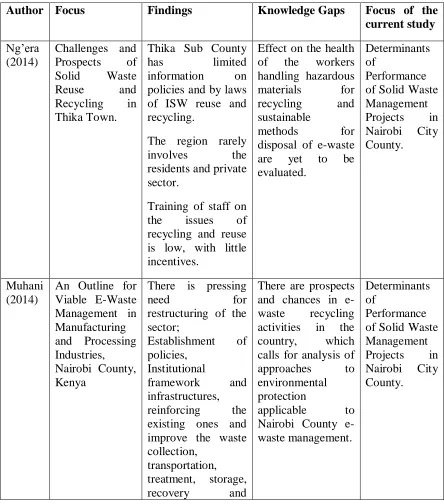
Table 2.1: Summary of the Knowledge Gaps
Author Focus Findings Knowledge Gaps Focus of the current study Ng’era
(2014)
Challenges and Prospects of Solid Waste
Reuse and
Recycling in Thika Town.
Thika Sub County
has limited
information on policies and by laws of ISW reuse and recycling.
The region rarely involves the residents and private sector.
Training of staff on the issues of recycling and reuse is low, with little incentives.
Effect on the health of the workers handling hazardous materials for recycling and sustainable
methods for disposal of e-waste are yet to be evaluated.
Determinants of
Performance of Solid Waste Management Projects in Nairobi City County.
Muhani (2014)
An Outline for Viable E-Waste Management in Manufacturing and Processing Industries, Nairobi County, Kenya
There is pressing
need for
restructuring of the sector;
Establishment of policies,
Institutional
framework and infrastructures, reinforcing the existing ones and improve the waste collection,
transportation, treatment, storage, recovery and
There are prospects and chances in e-waste recycling activities in the country, which calls for analysis of approaches to environmental protection
applicable to Nairobi County e-waste management.
Determinants of
22 disposal.
Kariuki (2015)
Dynamics affecting Solid Waste
Management in Urban Centers: A Case study of Kiambu County, Kenya
Ineffective
budgeting and physical capacity by government
authorities and other players involved in waste collection results to deplorable conditions in cities.
The avenue through which the county government should involve the public and more private organizations to boost their garbage management is not well paved e.g. through public training and waste management
campaigns.
Determinants of
Performance of Solid Waste Management Projects in Nairobi City County.
Nyakio (2015)
Effects of Solid Waste
Management in Embu Town, Embu County, Kenya.
There is need to develop a payment system so that the money collected can directly go to waste management.
Free public private partnership
implementation to advocate for transparency and accountability.
Determinants of
Performance of Solid Waste Management Projects in Nairobi City County.
Wando (2015)
Nexus between Environmental Safety and Solid Waste
Management in Kenya Defense Forces.
There are gaps in sector regulations which make it hard for execution of laws to institutions like the KDF. Little capacity within the lead agencies and financial
implications also influence greatly on the responsible bodies’ ability to
enforce the
regulations even where applicable.
To explore the potential
investment
opportunities and projections
concerning SWM within the KDF.
Determinants of
23 2.5 Conceptual Framework
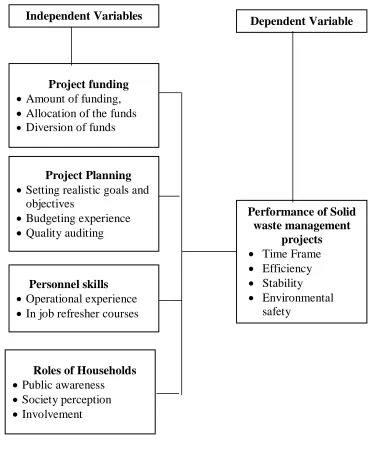
24 Figure 2.1: Conceptual Framework
Source: Author, 2018
Independent Variables Dependent Variable
Project funding Amount of funding, Allocation of the funds
Diversion of funds
Project Planning Setting realistic goals and
objectives
Budgeting experience Quality auditing
Personnel skills Operational experience In job refresher courses
Roles of Households Public awareness Society perception Involvement
Performance of Solid waste management
projects Time Frame Efficiency Stability Environmental
25
CHAPTER THREE
RESEARCH METHODOLOGY
3.1 Introduction
This chapter presents the research design, target population, sampling procedure and sample size, research instrument, pilot study, data collection techniques, data analyses methods and ethical issues.
3.2 Research Design
The study used descriptive design. This involves explaining the elements of a particular distinct or of a group of items. According to Kothari (2005), the design helps the researcher to obtain clear information about the targeted group. Descriptive design provided a chance for the researcher to determine and understand various organizational constraints in performance of solid waste management projects in Nairobi City County, Kenya.
3.3 Target Population
The total number of representation of solid waste management projects categories was 5 (that is, metal, plastic, paper, glass and organic solid waste management projects). From these, 2 projects from each categories were selected since they offer similar services and also due to the fact that they are registered and licensed by Kenya Revenue Authority (KRA, 2016).
26
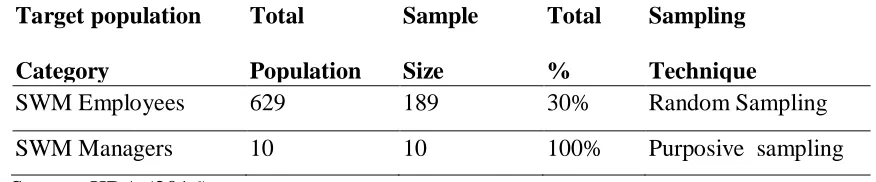
employees (Institute for Social Accountability, 2017). The target population of all selected employees from the ten projects was 189 employees and 10 projects managers as illustrated in Table 3.1.
Table 3.1: Target Population
Source: KRA (2016)
3.4 Sampling Design
3.4.1 Sampling Procedure for Employees
In this research, the employees were the respondents. This is because the researcher was interested in the organizational constraints in solid waste management services and they were in a better position to give out information regarding solid waste management. There were 629 employees in all the ten selected projects for the study in the area. Thirty % of the employees which translate to 189 employees were sampled proportionally from every project. The employees were then stratified into male and female, this greatly narrows down the margin of selecting one gender. They were then randomly selected according to the number of employees in each project during data collection.
Stratified sampling was used to include both male and female thus clearing any gender imbalances. This, according to Gay et al (2009), is a process that allows researchers to verify methods that allows researchers to specify the possibility that each member of the targeted group will be picked for the sample. In order to give equal opportunities for
Target population Category
Total Population
Sample Size
Total %
Sampling Technique
SWM Employees 629 189 30% Random Sampling
27
participation, simple random sampling was used for selecting employees. Stratified sampling aided the researcher in generalizations thus seeking representativeness of the wider population (Cohen et al., 2007).
Since the sample size rests solemnly on the nature of the inhabitants under study and purpose of the research, there is no fixed size for the sample (Cohen et al., 2007; Mugenda & Mugenda, 2009). A sample of 10% to 30% of population is acceptable for a survey research (Gay et al., 2009). For this study, the researcher chose to use 30% as the percentage of sampling in order to increase the reliability of results obtained.
3.4.2 Sampling Procedure for Managers
The SWM managers were automatically selected from the ten projects as respondents for this research and this was applied to the managers of the same projects. The sample size for managers was the same with that of projects which was 30% of the population in the study area.
3.5 Data Collection Instruments
28 3.5.1 Questionnaires for Employees
The research employed questionnaires to elicit the desired information (Ogula, 2002). It was self-administered and took the respondents around 15 minutes to fill in.
3.5.2 Interview Guide for Managers
The researcher requested the managers to participate in an interview. They possessed more detailed and firsthand information about solid waste management services. An interview guide is a verbal questionnaire which entails data collection through direct verbal communications between the interviewer and the interviewee(s) Budhal (2000).
Thematic concerns on research questions guided on the division of the interview schedule into sections with probed as it were required. For all the managers selected, interviews were conducted in their projects and the expected time to fill in was between 25-35 minutes. This was purposed to help the researcher understand the managers’ perceptions in regard to organizational constraints in performance of SWM projects in the county. 3.6 Pilot Study
A pilot study is very crucial as it aids in disclosing any shortages that may be in the questionnaire so that they are addressed on time. In this study, the research instruments were piloted to 10 managers of Solid Waste Management projects and 189 employees of the same projects In Nairobi County. This was to test the reliability and validity of questionnaires which were used.
3.6.1 Validity of the Instruments
29
that validity involves three dimensions that is; construct, content and criterion validity. In this research study, validity was ensured through face validity, whereby the researcher had questionnaire reviewed by a statistician and a lecturer from the department of the business administration in the school of business at Kenyatta University both of whom are experts in research.
Construct validity was maintained through restricting the set questions to the conceptualizations of the variables thereby ensuring that the indicators of a particular variables fall within the same construct. Content validity ,whereby the instrument was designed according to the study variables and their respective indicators of measurement. A coefficient of 0.80 or more simply shows that there is high validity of data (Mugenda and Mugenda, 2003).
3.6.2 Reliability of the Instruments
According to Orodho (2009), reliability refers to the consistency of an instrument to produce similar results at different times. In this research, the pilot study comprised of 10 project managers from solid waste management projects in Nairobi County, Kenya. The respondents’ questionnaires were tested using split-half techniques after the pilot study.
Split –half techniques refers to the type of reliability testing based on the co-efficient of internal consistency of a research instrument.
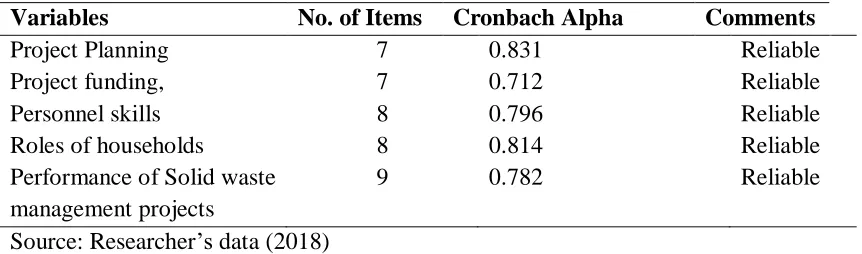
The examination of internal consistency reliability was done by use of Cronbach’s Alpha
30
revealed that acceptance value for Cronbach’s Alpha is between 0.7 and 0.9 but, an alpha coefficient of 0.5 or greater is enough to accept presence of internal consistency (Cooper, 2004). A loading of 0.7 indicates that about one half of the items variance was attributed to the construct. The researcher adopted Cronbach’s formula as follows;
𝛼 = 𝑁.𝑐 𝑣+(N−1).𝑐
Where;
𝑁 is equal to the number of items,
𝑐 is the average inter-item covariance among the items and
𝑣 is equal to the average variance.
Table 3.2: Reliability Results
Variables No. of Items Cronbach Alpha Comments
Project Planning 7 0.831 Reliable
Project funding, 7 0.712 Reliable
Personnel skills 8 0.796 Reliable
Roles of households 8 0.814 Reliable
Performance of Solid waste management projects
9 0.782 Reliable
Source: Researcher’s data (2018)
3.7 Data Collection Procedure
31 3.8 Data Analyses and Presentation
The data collected through questionnaires used qualitative analysis. The data collected were first coded and then quantitatively analyzed according to statistical information derived from the research objectives and research questions. The data analyses made use of SPSS (Statistical Package for the Social Sciences) software program version 20. The raw data were examined and analyzed to establish accuracy. The process of analyses involved arranging, organizing into manageable units, synthesizing and looking for patterns among variables. Regression analyses were used to determine the effect that independent variables had on dependent variable. The information was displayed on tables, in order to give a clear understanding on the findings.
3.9 Ethical Considerations
Approval to conduct the research was sought from graduate school of Kenyatta University. Ethical clearance was obtained from Kenyatta University Ethical Review Committee (KUERC). The researcher sought informed consent from respondents prior to administering the questionnaires. The respondents were asked not to indicate their names and the questionnaires bore no identification linked to individual respondents. The respondents’ participation in the study was voluntary. The findings were only used for
32
CHAPTER FOUR
RESULTS AND DISCUSSIONS 4.1 Introduction
This chapter presents the analyses of the findings pertaining the organizational
constraints and performance of SWM projects in Nairobi City County. Descriptive statistics were used to analyze the information collected and summarized using tables. The study had the general objective as evaluating the organizational constraints and performance of solid waste management projects in Nairobi City County.
The specific objectives were; to determine how project funding affect the performance of solid waste management projects in NCC, to determine the effect of project planning on performance of solid waste management projects in NCC, to establish the effect of personnel skills on performance of solid waste management projects in NCC and to assess the effect of the role of households on performance of solid waste management projects in NCC.
The data collected was analyzed using SPSS version 20. The data analyses started with respondents rate, followed by respondents demographic information and finally by analyses and discussion of each of the objectives.
4.2 Respondent’s Rate
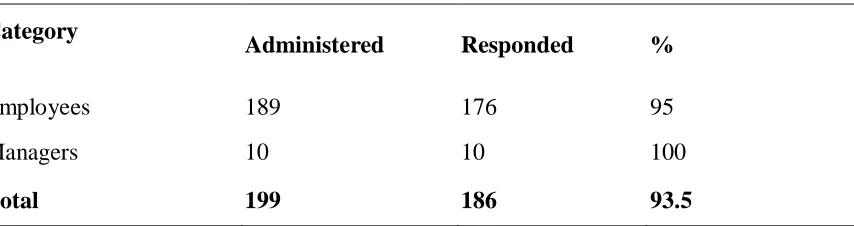
33 Table 4.1: Respondents’ rates
Category
Administered Responded %
Employees 189 176 95
Managers 10 10 100
Total 199 186 93.5
Source: Author, 2018
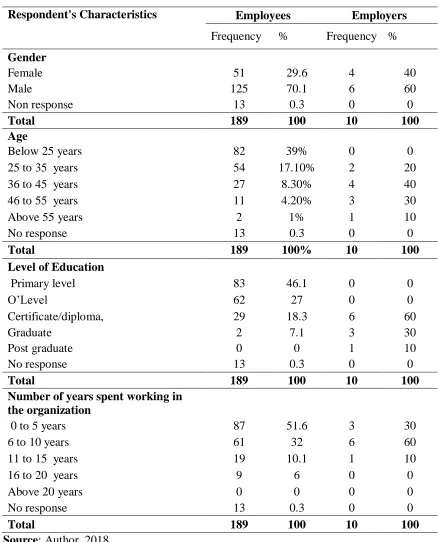
34 4.3 Respondents’ Demographic Characteristics Table 4.2: Demographic Information
Respondent's Characteristics Employees Employers Frequency % Frequency %
Gender
Female 51 29.6 4 40
Male 125 70.1 6 60
Non response 13 0.3 0 0
Total 189 100 10 100
Age
Below 25 years 82 39% 0 0
25 to 35 years 54 17.10% 2 20
36 to 45 years 27 8.30% 4 40
46 to 55 years 11 4.20% 3 30
Above 55 years 2 1% 1 10
No response 13 0.3 0 0
Total 189 100% 10 100
Level of Education
Primary level 83 46.1 0 0
O’Level 62 27 0 0
Certificate/diploma, 29 18.3 6 60
Graduate 2 7.1 3 30
Post graduate 0 0 1 10
No response 13 0.3 0 0
Total 189 100 10 100
Number of years spent working in the organization
0 to 5 years 87 51.6 3 30
6 to 10 years 61 32 6 60
11 to 15 years 19 10.1 1 10
16 to 20 years 9 6 0 0
Above 20 years 0 0 0 0
No response 13 0.3 0 0
Total 189 100 10 100
35
Table 4.2 showed that a majority of the employees were male with a frequency of 125 (70.1%) while a minority was female with a frequency of 51(29.1%). Besides this, non-response had the frequency of 13 (0.3%). On the other hand as the Table indicates, majority of the project managers were male with a frequency of 6 (60%) while the minority were female with a frequency of 4 (40%), while non-response had the frequency of zero with 0 %. However, the percentage rate for the male employees and project managers were much higher than that of female employees and project managers. Never the less, the study showed that all the gender was well represented.
From Table 4.2, 39 % of the employees were below 25 years, while 17.1 % were between ages 25 to 35 years. The rest were between the ages of 36 to 45 years with 8.3 %, and 46 to 55 years with 4.2 % and others were above 55 years with 1 %. On the side of project managers, it was shown that none (zero %) were below 25 years, only 20 % of the project managers were between ages of 25 to 35 years. The rest were between the ages of 36 to 45 years with 40 %, 46 to 55 years with 30 % and others were above 55 years with 10 %. The data showed that age is an important factor for one to conduct a certain responsibility in any given task as well as to be assigned any leadership position. In addition, the study showed that all the ages within the most productive age gap were well represented in the research study.
Information on the employees’ level of education indicated that 46.1 % of them were
36
their highest education level and responded as represented in Table 4.2. The information showed that 60 % of project managers were certificate/diploma holders, 30 % were graduates, and 10 % of them were post graduate. However, none of them had O’Level and primary levels as their highest level of education. The information showed that most of the project managers are qualified to manage solid waste management projects in the county and therefore are capable of leading and coordinating well in various solid waste projects.
Information on the respondents’ number of years spent working in the organization; the
data presented showed that 51.6 % of employees had worked in the projects for between 0 to 5 years, while 32 % had worked there for between 6 to 10 years. Only 10.1 % had worked in the project for 11 to 15 years while the rest had worked for between16 to 20 years with 6 % and none (0 %) having worked for duration of above 20 years.
37
4.4 The Effect of Project Funding on Performance of Solid Waste Management Projects in NCC.
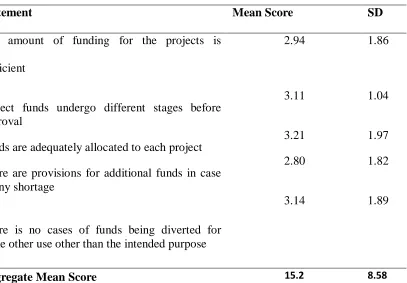
Participants were required to show the extent to which they agreed on how project funding influences performance of solid waste management projects and the outcome was as indicated in Table 4.3.
Table 4.3: Project Funding
Statement Mean Score SD
The amount of funding for the projects is sufficient
2.94 1.86
Project funds undergo different stages before approval
3.11 1.04
Funds are adequately allocated to each project
3.21 1.97
There are provisions for additional funds in case of any shortage
2.80 1.82
There is no cases of funds being diverted for some other use other than the intended purpose
3.14 1.89
Aggregate Mean Score 15.2 8.58
Source: Author, 2018
38
aggregate mean score of 3.21 and standard deviation of 1.97. On the statement that there are provisions for additional funds in the case of any shortage, majority indicated that they strongly disagree with an aggregate mean score of 2.80 and standard deviation of 1.82. On the statement that ‘there are no cases of funds being diverted for some other use other than the intended’ majority of the respondents indicated that they strongly disagree
with an aggregate mean score of 3.14 and standard deviation of 1.89.
From the findings, the amount of funds for the projects is insufficient and this could be the main reason as to why project funds undergo different stages before they are approved as indicated by the majority. It was revealed that funds are not adequately allocated to each project probably because of it being inadequate. The findings revealed further that there are no provisions for additional funds in case of a shortage as majority of the participants illustrated. This could be due to insufficiency of funds in solid waste management programs.
39
self-reliant and so when the external funding is not available, solid waste management projects fail or come to an end.
4.5 The Effect of Project Planning on Performance of Solid Waste Management Projects in NCC.
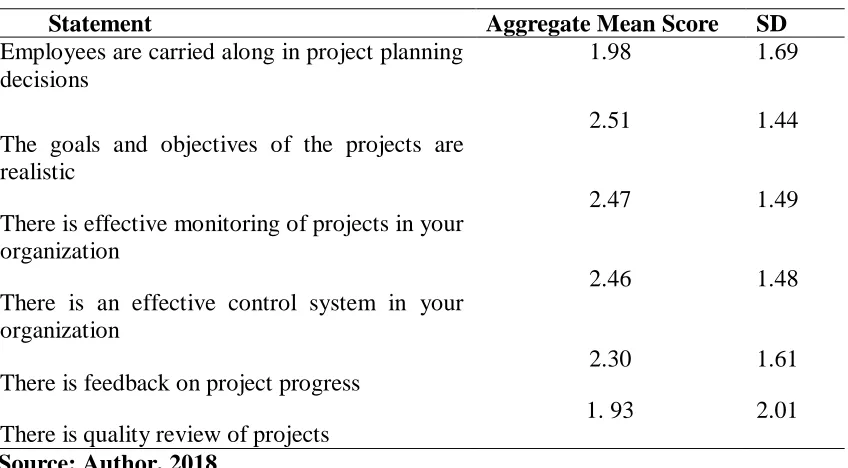
Respondents were asked to indicate the extent to which they agreed on how project planning influences performance of solid waste management projects and the findings were as indicated in Table 4.4.
Table 4.4: Project Planning
Statement Aggregate Mean Score SD
Employees are carried along in project planning decisions
1.98 1.69
The goals and objectives of the projects are realistic
2.51 1.44
There is effective monitoring of projects in your organization
2.47 1.49
There is an effective control system in your organization
2.46 1.48
There is feedback on project progress
2.30 1.61
There is quality review of projects
1. 93 2.01
Source: Author, 2018
40
majority of the respondents indicated that they strongly disagree with an aggregate mean score of 2.47 and standard deviation of 1.49. On whether there is an effective control system in your organization, majority of the respondents indicated that they strongly disagree with an aggregate mean score of 2.46 and standard deviation of 1.48.
On whether there is feedback on project progress, majority of the respondents indicated that they strongly disagree with an aggregate mean score of 2.30 and standard deviation of 1.61. On the statement that ‘There is quality review of projects’ majority of the respondents indicated that they strongly disagree with an aggregate mean score of 1.93 and standard deviation of 2.01.
From the findings, it was revealed that employees are not carried along in project planning decisions. This probably could be due to the fact that, the management does not take the activity so serious and hence fails to involve the employees. This has contributed to lack of transparency and can easily lead to production of negative results.
It was also observed that the goals and objectives of the projects are not realistic, and there is no effective monitoring of projects in their organization. This could be due to the issue of insufficient funds hence difficulties in carrying out monitoring activities. The results showed that there are no effective control systems in their organization and in addition, there is no feedback on project progress. This could be due to the fact that the management lack transparency amongst themselves and hence unable to give out feedback. The study revealed further that there is no quality review of projects.
41
He further explains that interfered articulation of objectives, by political based agendas and self-interests weakens the institution mandated with implementing SWM projects and creates a difficult community which does not acknowledge waste management initiatives.
Kaloki (2014) stresses the importance of human resourcing, communication methods and risk management for good results in solid waste management. He adds that the set objectives by the county solid waste managers, should measurably integrate city-level SWM projects and demonstration projects plus other identified deliverables like process-oriented advisory services at central government level on specific elements of SWM systems.
Similarly, Muhani (2014) states that the set policies should encourage documentation of integrated, city-level SWM projects and demonstration projects and process-oriented advisory services at central government level on specific components of the SWM system. This therefore makes it easy for the solid waste management activity to perform better. Giving feedback is crucial, as in the study carried out by Njagi (2015) that the project planners should establish programs and materials for researches on human resources development and have manuals and guidelines for dissemination of important information, know-how and skills throughout the projects.
4.6 The Effect of Personnel Skills on Performance of Solid Waste Management Projects in NCC.
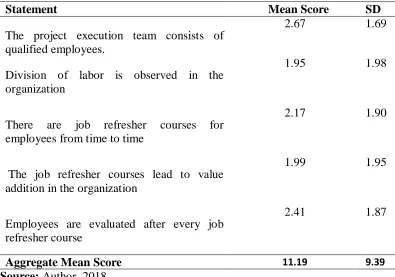
42 Table 4.5: Personnel Skills
Statement Mean Score SD
The project execution team consists of qualified employees.
2.67 1.69
Division of labor is observed in the organization
1.95 1.98
There are job refresher courses for employees from time to time
2.17 1.90
The job refresher courses lead to value addition in the organization
1.99 1.95
Employees are evaluated after every job refresher course
2.41 1.87
Aggregate Mean Score 11.19 9.39
Source: Author, 2018
43
of the respondents indicated that they strongly disagree, with an aggregate mean score of 2.41 and standard deviation of 1.87.
From the findings, it was revealed that the project execution team does not consist of qualified employees. This could be probably because majority of the respondents had attained O’levels and very few had done SWM related courses. In this study, adequate
skills are lacking and these would probably adversely affect the effectiveness in solid waste management. It was observed that division of labor is not observed in the organization and hence this limits the effectiveness of the work in projects.
It was also revealed that there are no job refresher courses for employees from time to time and this could be probably due to lack of funds. It was found out that the few present job refresher courses do not lead to value addition in the organization. At the same time, employees are not evaluated after every job refresher course and this could be due to insufficiency of funds.
44
4.7 The Effect of Role of Households on Performance of Solid Waste Management Projects in NCC.
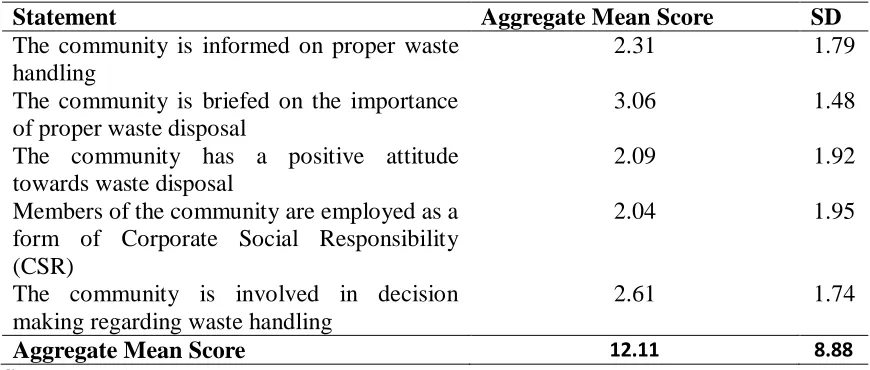
Respondents were asked to indicate the extent to which they agreed on how the role of households influences performance of solid waste management projects and the findings were as indicated in Table 4.6.
Table 4.6: Role of Households
Statement Aggregate Mean Score SD
The community is informed on proper waste handling
2.31 1.79
The community is briefed on the importance of proper waste disposal
3.06 1.48
The community has a positive attitude towards waste disposal
2.09 1.92
Members of the community are employed as a form of Corporate Social Responsibility (CSR)
2.04 1.95
The community is involved in decision making regarding waste handling
2.61 1.74
Aggregate Mean Score 12.11 8.88
Source: Author, 2018
From Table 4.6, on whether the community is informed on proper solid waste handling, majority of the respondents indicated that they strongly disagree. This had an aggregate mean score of 2.31 and standard deviation of 1.79 that they strongly agree. On the statement that ‘The community is briefed on the importance of proper waste disposal’,
majority of the respondents indicated that they strongly disagree with an aggregate mean score of 3.06 and standard deviation of 1.48.
On the statement that ‘The community has a positive attitude towards waste disposal’
45
community are employed as a form of Corporate Social Responsibility (CSR)’ Majority of the respondents indicated that they strongly disagree with an aggregate mean score of 2.04 and standard deviation of 1.95. On the statement that ‘the community is involved in decision making regarding waste handling’ majority of the respondents indicated that
they strongly agree with an aggregate mean score of 2.61 and standard deviation of 1.74.
From the findings, it was observed that the community is not informed on proper waste handling and probably that is why they have little knowledge on solid waste management since they don’t consider it as of any importance. It was also found out that the community is not briefed on the importance of proper waste disposal. Insufficiency of funds may be the reason as to why there are no such services as going to the field to sensitize the community.
It was also revealed that, the community does not have a positive attitude towards waste disposal. This could be due to the fact that they are not informed on proper waste handling, not involved in decision making regarding waste handling nor briefed on the importance of proper waste disposal. In addition, members of the community are not employed as a form of Corporate Social Responsibility (CSR) and this would hence make them lack interest in solid waste management.
46
The findings also concur with those of Towett (2015) who argues that people’s opinion on responsibilities for maintaining clean surroundings, sensitization of household to uphold health environments, disposal of household waste, and children’s inculcation of expected participations in solid waste management and care for the Mother Nature. The level of public awareness about safe solid waste management practices seems to be relatively low in Nairobi. From earlier surveys and reports respondents do not display much concern regarding solid waste management (Nation Daily, September 5 2016).
Every community should be informed on the essence of solid waste management since it affect everyone, as it is explained by Omuterema (2013) that the negative environmental and health impacts, for instance air pollution caused by the burning of waste, affect everybody in the community similarly, regardless of income level or regional boundary. This is also supported by Liyala (2011) who states that civic education is crucial in imparting general environmental care awareness, education and skills to public to face problem as a shared responsibility of both the individual in the respective communities and the county government.
47
collection activities since they should be aware of their responsibility in waste generation, collection timetable and the standard procedures of waste management.
It is revealed from other studies that there is limited focus on teachings, whether through traditions, in the existing curricula or in general skills acquisition on SWM, leaving it an enormous impediment (CSIRO, 2008).
Primarily, civil educators should train the society on minimization of solid waste produced, this is in line with this study’s findings. In addition, the research by Kariuki (2015) explains that inefficiency in actual abilities by government agencies and other stakeholders tasked in waste management results to deplorable conditions in cities. The findings are also supported by those of Liyala (2011) who suggests that the part of the revenue that the county government collects should be used to involve the public and more private organizations to boost their garbage management as well as for public training and waste management campaigns.
4.8 Performance of Solid Waste Management
48
Table 4.7: Performance of Solid Waste Management
Statement Aggregate Mean Score SD
Projects are carried out within the set time frame
2.41 1.59
The set goals and objectives of the projects are met at the end of the project
2.19 1.93
Projects are carried out in line with budgets 2.07 1.98 There is consistency in the performance of
projects
2.64 1.35
Source: Author, 2018
From Table 4.7, on whether the projects are carried out within the set time frame, majority of the respondents indicated that they strongly disagree, with an aggregate mean score of 2.41 and standard deviation of 1.59. On the statement that ‘The set goals and objectives of the projects are met at the end of the project’ majority of the respondents indicated that they disagree, with an aggregate mean score of 2.19 and standard deviation of 1.93. On the statement that ‘Projects are carried out in line with budgets’ majority of the respondents indicated that they strongly disagree, with an aggregate mean score of 2.07 and standard deviation of 1.98. On the statement that ‘There is consistency in the performance of projects’ majority of the respondents indicated that they strongly disagree with an aggregate mean score of 2.64 and standard deviation of 1.35.
49
intended ones. Therefore as a results of all these, there is no consistency in the performance of projects.
These findings corresponds with those of Magutu et al., (2010) and Mazzanti (2008) who explain that there are myriads of industries existing along the field of solid waste management, which are lamed by deeply rooted challenges revolving around their performance in underfunding, rudimental project planning, vaguely shaped and unprofessional personnel skills, unsettled demographic issues, unclear roles of households and finally, confronting legislation policies. Additionally, these findings are in line with the study of Oberlin (2011) who postulates that, non-transparent legislation and unclear policies are major causes of poor performance of SWM projects as is it observed in the study research.
4.9 Regression Analysis
50 Table 4.8: Regression Coefficients
Model Unstandardized
Coefficients
Standardize d
Coefficients B Std. Error Beta
t Sig
(Constant) 0.128 1.2124 1.414 0.0122
Project Planning 0. 679 0.1022 0.141 4.232 0.0131
Project funding, 0. 692 0.3314 0.143 3.313 0.0123
Personnel skills 0.634 0.2169 0.115 3.125 0.0113
Roles of households
0.245 0.1413 0.129 3.1142 0.0124
Source: Author, 2018
From the finding in Table 4.8, the established regression equation was organizational constraints and performance of solid waste management projects in Nairobi County = 0.128+ 0. 679X1+ 0. 692X2+ 0.634X3+0.245 X4.
51