TABLE OF CONTENTS:
Vol. 39, No. 5, September 1988
ARTICLESForage Quality
386 Field Evaluation of Five Grasses Grown on a Saline Soil by Pat 0. Currie, Thomas 0. Hilken, and Richard S. White
389 Diet Quality of Steers Grazing Three Range Sites in South Florida by K.R. Long, R.S. Kalmbacher, and F.G. Martin
392 The Botanical Composition of the Diet of Free-ranging Cattle on an Alpine Range in Australia by H. Van Rees and J.H.G. Holmes
Herbicide Effects
396 Nutritive Value of Forages on Sandy Soils as Affected by Tebuthiuron by Mario Biondini, R.D. Pettit, and Virgil Jones
399 Herbicide Conversion of a Sand Shinnery Oak (Quercuz bovordii) Community: Effects on Biomass by W.E. Sears, C.M. Britton, D.B. Wester, and R.D. Pettit 403 Herbieide Conversion of a Sand Shinnery Oak (Quercus ~avardii) Community:
Effects on Nitrogen by W.E. Sears, C.M. Britton, D.B. Wester, and R.D. Pettit
408
409
414
A Note on Determining Soil Properties for Soils Containing Rock Fragments by D.L. Brakensiek, W.J. Rawls, and G.R. Stephenson
Relation between Ecological Range Condition and Proportion of Soil-surface Types by Richard E. Eckert, Jr., Frederick F. Peterson, and J. Tim Belton Effects of Soil-surface Morphology on Emergence and Survival of Seedlings in Big
Sagebrush Communitiesby Richard E. Eckert, Jr., Frederick F. Peterson, Michael S. Meurisse, and Jennifer L. Stephens
Grazing: Forage Selection and Effects
421 Iufluence of Breed on Forage Intake of Range Beef Cows by S.L. Kronberg, K.M. Havstad, E.L. Ayers, and D.E. Doornbos
Botanical Composition and Nutritional Quality of Alpaca Diets in Two Andean Rangeland Communities by Richard J. Reiner and Fred C. Bryant
Effect of Various Grazing Systems on Type and Density of Cattle Trails by John W. Walker and R.K. Heitschmidt
424
428
431
434
Vegetation Responses to Long-term Sheep Grazing on Mountain Ranges by James E. Bowns and Calvin F. Bagley
Vegetation of Exclosures in Southwestern North Dakota by Michael D. Brand and Harold Goetz
Plants: Germination and Establishment
438 Woody Plant Reestablishment in Modified Pinyon-Juniper Woodlands, New Mexico by Kieth E. Severson
443
450
Photosynthetic Characteristics of Crested Wheatgrass and Bluebunch Wheatgrass by Robert S. Nowak and Martyn M. Caldwell
Published bimonthly-January, March, May. July, September, November
Copyright 1986 by the Society for Range Manage- ment
INDIVIDUAL SUBSCRIPTION is by membership in the Society for Range Management.
LIBRARY or other INSTITUTIONAL SUBSCRIP- TIONS on a calendar year basis are $56.00 for the United States postpaid and $66.00 for other coun- tries, postpaid. Payment from outside the United States should be remitted in US dollars by interna- tional money order or draft on a New York bank. BUSINESS CORRESPONDENCE, concerning sub- scriptions, advertising, reprints, back issues, and related matters, should be addressed to the Manag- ing Editor, 2760 West Fifth Avenue, Denver, Colo. 60204.
EDITORIALCORRESPONDENCE, concerning manu- scripts or other editorial matters, should be addressed to the Editor, 2760 West Fifth Avenue, Denver, Cola. 60204.
INSTRUCTIONS FOR AUTHORS appear on the inside back cover of each issue. A Style Manual is also available from the Society for Range Manage- mentattheaboveaddress@$1.25forsinglecopies; $1.00 each for 2 or more.
THE JOURNAL OF RANGE MANAGEMENT (ISSN 0022-409X) is published six times yearly for $56.00 per year by the Society for Range Management, 2760 West Fifth Avenue, Denver, Colo. 80204. SECOND CLASS POSTAGE paid at Denver, Colo. POSTMASTER: Return entire journal wlth address change-RETURN POSTAGE GUARANTEED-to Society for Range Management, 2760 West Fifth Avenue, Denver, Colo. 60204.
454
457
460
Management of Subterranean Clover in Pine Forested Range by Mark K. John- son, Lee G. Davis, Kenneth F. Ribbeck, Jeffrey H. Render, and Henry A. Pearson Pollination Requirements of Cicer Milkvetch, Astragulus cicer L. by K.W.
Richards
Cultural Practices for Establishing Fourwing Saltbush within Perennial Grass Stands by Joseph L. Petersen, Darrell N. Ueckert, and Robert L. Potter
Range Management Practices and Scenic Beauty
464 Range Management and Scenic Beauty as Perceived by Dispersed Recreationists by H. Reed Sanderson, Richard A. Megnanck, and Kenneth C. Gibbs.
Measurements
470 Viewpoint: Animal-Unit Equivalents Should Be Weighted by Dietary Differences by N. Thompson Hobbs and Len H. Carpenter
471 Viewpoint: Animal-Unit Equivalents Cannot Be Meaningfully Weighted by Indi- ces of Dietary Overlap by David. L. Scarnecchia
472 Biomass Estimation for Four Common Grass Species in Northern Arizona Ponde- rosa Pine by Steven W. Andariese and W. Wallace Covington
TECHNICAL NOTES:
474 A Rumen Cannula for Small Ruminants by William H. Miller and Michael Maltby 475 A Rising Plate Meter for Estimating Production and Utilization by Jerry H.
Scrivner, D. Michael Center, and Milton B. Jones
478 Use of the FW-1 Water Level Recorder for Control of Electrical Equipment by
R.E. Wilson, A. Dolphin, and J.R. Simanton BOOK REVIEWS
479 North American Game Birds and Mammals by A. Starker Leopold, Ralph J. Gutitrrez, and Michael T. Bronson; Nutrition of Grazing Ruminants in Warm Climates by Lee Russell McDowell; Wildlife Food Plants: A Microscopic View by Elizabeth L. Green, Lytle H. Blankenship, Virginia F. Cogar, and Terra McMa- hon; U.S. Forest Service Grazing and Rangelands by William D. Rowley; and Forest Ecosystems, Concepts, and Management by Richard H. Waring and Wil- liam H. Schlesinger.
Miscellaneous 395 Employment
The Journal of Range Management serves as a forum for the presentation and discussion of facts, ideas, and philosophies pertaining to the study, management, and use of range- lands and their several resources. Accord- ingly, all material published herein is signed and reflects the individual views of the authors and is not necessarily an official position of the Society. Manuscripts from any source- nonmembers as well as members-are wel- come and will be given every consideration by the editors. Submissions need not be of a technical nature, but should be germane to the broad field of range management. Editor- ial comment by an individual is also welcome and subject to acceptance by the editor, will be published as a “Viewpoint.”
Managing Editor Edltor Book Review Edltor
PETER V. JACKSON Ill PATRICIA G. SMITH GRANT A. HARRIS
2760 West Fifth Avenue Society for Range Management Forestry and Range Management Denver, Colorado 80204 2780 West Fifth Avenue Washington State University
Denver, Colorado 80204 Pullman, Washington 99164-6410
ASSOCtATE EDITORS E. TOM BARTLETT
Dept. of Range Science Colorado State University Fort Collins, Colorado 80523
LYMAN MCDONALD Statistics Department
College of Commerce and Industry Unrversity of Wyoming
Laramie. Wyoming 82071 G. FRED GIFFORD
Dept. of Range Wildlife, and Forestry University of Nevada
Rena, Nev. 89506
HOWARD MORTON 2000 E. Allen Road Tucson, Arizona 85719 THOMAS A. HANLEY
Forestry Sciences Lab Box 909
ROBERT MURRAY
US Sheep Experiment Statjon Dubois. Idaho 83423
Juneau, Alaska 99802 DARRELL UECKERT
RICHARD H. HART USDA-ARS 8408 Hildreth Rd. Cheyenne, Wyoming 82009 N. THOMPSON HOBBS
Colorado Div. of Wildlife 317 W. Prospect
Fort Collins, Colorado 80526
Texas Agricultural Expenment Station 7887 N. Highway 87
San Angelo, Texas 76901 LARRY M. WHITE
USDA ARS
S. Plains Range Research Station 2000 18th St.
Woodward. Oklahoma 73801
W.K. LAUENROTH
Department of Range Science Colorado State University Fort Collins, Colorado 80523
JAMES YOUNG USDA ARS
Field Evaluation of Five Grasses Grown on a Saline Soil
PAT 0. CURRIE, THOMAS 0. HILKEN, AND RICHARD S. WHITE
Russian wiidrye (Psathyrostachys juncea), Aitai wiidryc (zcy- mus august@, creeping foxtail (Alopccuncs arundinaceus), and 2 forms of a biuebuncb wheatgrass (Psa&roegueria spicata) X quackgrass (.EIy&@r repn.s) hybrid (RS-1 and RS-2) were evaiu- ated in 1983 and 1984 for their suitability as forage for beef cattle. Hybrid selections produced 5,554 kg/ha of forage and their yields in 1983 were signifRantiy more than those from tbe 2 wildryes and creeping foortaii that averaged 2,810 and 4,292 kg/ha, respectively. In 1984, there was not a significant difference among yields for the 5 grasses, but there was a significant increase in yield from 1983 for the 2 wildryes and creeping foxtail. Percent crude protein averaged 16% in the wfidryes and 12.5% in the 2 hybrids and creeping foxtaii in 1983. However, percent phosphorus averaged 40% in the creep ing foxtail and .30% in tbe hybrids. In 1984, percent crude protein and phosphorus for all 5 grasses were lower than in 1983, but trends were sbniiar. Ail 5 grasses exceeded tbe NRC crude protein and phosphorous rquirement for a 500-kg iactating cow in 1983. In 1984, only the creeping foxtaii and RS-1 hybrid exceeded the phosphorous requirement. In vitro organic matter digestibiiity averaged 64% in tbe ryegrasses and 54% in the hybrids for both years. In 1983, ail 5 grasses exceeded the metaboiixabie energy requirement of a iactating SOO-kg cow. Based on caicuiated nutri-
tional index, Russian wildrye and Aitai wiidrye ranked 1 and 2 with the creeping foxtail and RS-2 hybrid rankbrg 4 and 5, respec- tively, in 1983. In 1984, Russian wiidrye and the creeping foxtail ranked 1 and 2, and the RS-1 hybrid and RS-2 hybrid ranked 4 and 5.
Evaluating performance of new cultivars and species under a variety of environmental and soil conditions is important in order to develop recommendations for their use (Murray 1984). Species such as Russian wiidrye (Psathvrostuchysiunceu~‘, Altai wildrye (Leymus angustus), and creeping foxtail (Alopecurus arundina- cew) have been used in the Northern Great Plains. These grasses have proven their value and seed is commercially available. How- ever, scientists at the Crops Research Laboratory* at Logan, Utah, are breeding and evaluating superior strains of interspecific hybrids for future introductions. One hybrid, a bluebunch wheat- grass (Pseuduroegneria spicata) X quackgrass (Elytrigia repens), has shown potential for being a productive forage species. Field evaluation of this hybrid in comparison with other species under a variety of environments and soil conditions is needed. The objec- tive of this study was to assess the performance of 3 commercially available grasses and 2 new selections of the bluebunch wheatgrass X quackgrass hybrid grown on a saline soil near Miles City, Mont.
Materials and Methods Study Area
The research was conducted on the Fort Keogh Livestock and Range Research Station of the Agriculture Research Service, Authors are supervisory range scientist, Agricultural Research Service, USDA; research associate, Montana Agricultural Experiment Station; and plant physiologist, Agricultural Research Service. USDA: rcsnectivclv.
-fiis research is a contribution from the USDA, Agricultural Research Service, Fort Keogh Livestock and Range Research Laboratory and the Montana Agricultu- ral Expenmcnt Station, Journal Series No. J-1715.
The authors wish to thank an anonymous reviewer for comments which improved the manuscript.
Manuscript accepted 27 January 1986.
rNomenclature on the wildryes and wheatgrasses follows that proposed by Dewey fl954).
iM&ained by USDA-ARS in cooperation with Utah State University, Logan, Utah.
386 JOURNAL OF RANGE MANAGEMENT 39(5), September 1996
USDA located approximately 3.2 km southwest of Miles City, Mont. Soils of the study site have been classified by the Soil Conservation Service3 as an udorthentic chromustert, a member of a very fine, montmorillonitic, frigid family. Surface (O-15 cm) pH of the soil averages 8.5 and the pH of the subsurface (15-76 cm) is 9.0. Typically these soils have a heavy clay texture throughout the profile and are silty clay or clay comprised of 67% clay, 26% silt, and 7% sand. Because of the excess clay fines and high salt concen- tration, percolation is slow and shrink-swell is excessive. With drying during the hot summer months, cracks 5-15 cm wide fre- quently develop in the soil to a depth of 25.4 cm or more. Water permeability is also a serious problem with an estimated penetra- tion rate of not more than 5 cm of water per irrigation.
About 15 years ago, the native Western wheatgrass (Pascopy- rum smithii) vegetation was plowed, and an attempt made to intensively farm the site for cultivated row crops or alfalfa (Medi- cage sativa). These crops, particularly alfalfa, wheat (Triticum aestivum) and barley (Hordeum vulgare), were not compatible with the adverse characteristics of the soil and almost all efforts at crop production were failures. It was our goal to establish and test yields and nutrient qualities of grasses potentially adapted to this saline soil and determine their relative suitability for sustained productivity in reclaiming this saline area.
Grass Descriptions and Characteristics
Common names, scientific names and seeding rates for the 5 grasses studied are given in Table 1. “Vinall” Russian wildrye and
Table 1. Common name, sckntifk name and seeding rate for the five gnsees studkd during 1983 and 1984.
Common name Prairieland Altai wildrye Vinall Russian wildrye Garrison creeping foxtail Bluebunch wheatgrass X
quackgrass hybrid RS-1 hybrid
bluebunch wheatgrass caespitose form RS-2 hybrid
quackgrass rhizomatous form
Seeding rate Scientific name’ kg/ha
Leymus angustus 5.6
Psathyrostachys juncea 9.2 Alopecurus arundinaceus 5.6
Pseudoroegneria spicata X 4.6
Elytrigia repens
lNomenclature on the wildryes and wheatgrass follows that proposed by Dewey (1984).
“Prairieland” Altai wildrye are 2 introduced, cool-season, erect bunchgrasses that are winterhardy, drought resistant, salt tolerant and very persistent in the Northern Great Plains (Brown and Wiesner 1984; Asay and Knowles 1985; Lawrence 1976, 1983). “Garrison” creeping foxtail is a perennial grass with dense, vigor- ous rhizomes that is tolerant of both moderately acid and moder- ately alkaline soils (Stroh et al. 1978). With optimum soil moisture, fertility and management, all 3 grass species have been reported to produce- yields of excellent quality forage (Stroh et al. 1978, Asay and Knowles 1985, Lawrence 1976).
grass. It is referred to as the RS hybrid. Two germplasms, RS-1 and RS-2, were released to breeders for seed increase in April 1980 (Asay and Dewey 1981). These 2 selections are characterized by having the vigor and productivity of quackgrass and the attributes and adaptations of bluebunch wheatgrass in semiarid rangelands. Parental clones of the RS-1 and RS-2 germplasms were selected on the basis of general vigor, degree of vegetative spread, leafiness, forage and seed yield, and seed quality. The RS-1 population is essentially caespitose, with limited rhizome development, while the RS-2 population has more rhizomes.
S8mpling Procedure
A prototype range improvement machine (RIM) was used to plant the 5 grasses in the late summer of 1981 (Erickson and Currie
1982, Currie et al. 1984). Grasses were seeded in 1.7-ha plots arranged in a randomized complete block with 2 replications. The 5 grasses used in the study were planted during early September on 50-cm row spacing with alfalfa interseeded in alternate rows. Shortly after planting, the field was irrigated to promote seedling emergence.
Measurements of herbage yields and quality were taken on 15 June 1983 and 3 July 1984. Five 0.6 by 10.3-m sampling plots were located perpendicular to drill rows in each of the 2 replications of 5 grasses. A plot harvester was used to remove all herbage above a IO-cm stubble height within individual plots. Harvested samples were then oven dried at 60° C and weighed to estimate herbage production. Two supplementary subsamples were obtained adjacent to harvested plots and cornposited for chemical analysis. Subsamples were evaluated for nitrogen, phosphorus, and in vitro organic matter digestibility (IVOMD). IVOMD was determined from a modified Tilley and Terry (1963) technique for measuring rumen digestibility. Nitrogen and phosphorous content was ana- lyzed using the Technicon Autoanalyzer’ (Technicon Autoana- lyzer II Methodology, 1977). Nitrogen is reported as percent crude protein (%N X 6.25).
A multiway classification analysis of variance, using a random- ized, complete block design (Steel and Torrie 1960), was used to analyze total yields, 70 crude protein, phosphorus and IVOMD of the grasses. The honestly significant difference (hsd) procedure was used to compare means and a 95% confidence interval calculated for each mean (Steel and Torrie 1960). Data were analyzed separ- ately for 1983 and 1984 because of the difference in sampling dates each year. A paired t-test was used to evaluate yearly differences in forage yield.
A nutritional ranking index was calculated to compare the 5 grasses in terms of their overall relative nutritional value. Index values were calculated by summing the crude protein, phosphorus, ‘The WC of a trade name does not constitute endorsement by USDA-AR& but is presented for the convenience of the reader.
and IVOMD for each of the 5 grasses and these sums were then ranked relative to individual species performance.
Results and Discussion
The RS-1 and RS-2 hybrids produced the greatest yields for both years, averaging 5,610 kg/ha (Table 2). Based on the 1983 data, the 2 wildryes were significantly lower in yield, averaging only 2,810 kg/ha while the hybrids averaged 5,554 kg/ha. The creeping foxtail produced 4,292 kg/ ha and was intermediate in yield. Although there was not a significant difference in yield among the 5 grasses in 1984, Russian wildrye and creeping foxtail produced the least forage, averaging 4,496 kg/ ha and 5,198 kg/ ha, respectively, while the RS-1 and RS-2 produced 5,851 and 5,480 kg/ ha, respectively. Altai wildrye was intermediate in yield, pro- ducing 5,278 kg/ ha. Comparison of yields from consecutive years showed a significant (m.05) increase in the 2 wildryes and creep- ing foxtail in the second year. In contrast, the hybrids did not differ between years (Fig. 1). Asay and Dewey (1981) reported that
5ooo
5500
Jo00
1- \
s4rJ@J
3!500
3ooa
2500
a304 8384 8384 8384 8384
Fig. 1. Mean herbageyield(kg/ha)of the5grassesfor 1983and1984. Bars with different superscripts were significantly different (pC.05). ALAR = Garrison creeping foxtail, RS-1 and RS-2 = two forms of a bluebunch wheatgrass X quackgrass hybrid, PSJU= Russian wildrye, and LEAN = Altai wildrye.
forage yields of the RS hybrid were equivalent to those of crested wheatgrass (Agropyron cristatum) or Russian wildrye on a surface mine reclamation site near Decker, Montana receiving approxi- mately 30 cm annual precipitation. Also, yields were significantly higher than for most of the other 6OTriticeae species and hybrids in the trial, including western wheatgrass and bluebunch wheatgrass.
Table 2. Crude protein, phosphorus, IVOMD, yields, nhtivc nutritional index, end rank 01 the flve grasses for 15 June 1983 end 3 July 1984. A 95% conZidence interwl is shown for each mean.
Percent
Crude Protein’ Phosphorus IVOMD Yield Index Rank
1983
Altai 16.f 1 .33b f .02 65’ f I 3037b’ f 603 81.3 2
Russian 16.f 1 .33b f .03 66’ f 1 2583b f 486 82.3 1
RS-I 13bf 1 .31Cb f .02 57c f 2 5791. f 595 70.3 3
RS-2 12bf 1 .30’ f .02 54c f 2 5316’ f 606 66.3 5
Garrison 12bf 1 .40’ f .03 57’ f 2 4292mb f 487 69.4 4
1984
Altai 10.f 1 .20b f .Ol 59.bf 2 5278’ f 595 69.2 3
Russian 13af 1 .21b f .Ol 64’ f 1 4496’ f 854 77.2 I
RS-1 9’f 1 .24b f .02 53’ f 2 5851’ f 825 62.2 4
RS-2 9’ f 1 .20b f .Ol 52’ f 1 5480’ f 466 61.2 5
Garrison 12”f 2 .30. f .02 58b f 2 5198’ f 630 70.3 2
‘Columns with different superscripts were significantly different (e.05) using hsd analysis.
In 1983, crude protein was greater in the wildryes than in the 2 hybrids and creeping foxtail (Table 2). The creeping foxtail had the highest percent phosphorus, while the hybrid had the lowest, and the wildryes were intermediate in value. Percent crude protein, phosphorus, and IVOMD for the 5 grasses were lower in 1984 than in 1983 but trends were similar. Exceptions to these were noted in the creeping foxtail, which had similar crude protein and IVOMD contents in 1983 and 1984. Also, the RS-2 and the 2 wildryes had proportionately lower phosphorous values than the RS-1. One possible explanation for these lower values in 1984 is that samples were taken about 2 weeks later than they were in 1983. Thus, the grasses were probably more mature and could be expected to have lower values (Vavra and Raleigh 1976). Perez-Trejo et al. (1979) found this occurred in earlier studies and reported a very sharp drop in crude protein content of the RS hybrid between May 15 and June 15, from 26.1 to 13.490, respectively.
In 1983, crude protein and phosphorous values in all species exceeded the minimum levels of 9 and .22%, respectively, as requirements for a 500-kg cow with average milking ability during the first 3-4 months postpartum (National Research Council 1984). However, in 1984, both RS hybrids just met the 9% protein requirement while the other grasses exceeded the minimum level standard. Only the RS-1 hybrid and creeping foxtail met the .22% phosphorous requirement. In vitro organic matter digestibility was highest in the wild ryegrasses, lowest in the hybrid, and interme- diate in creeping foxtail for both years. The RS hybrids averaged 54% IVOMD for both years while the wildryes averaged 64% IVOMD. The creeping foxtail had an intermediate value of 57% for both years. Asay and Dewey (1981) reported that in vitro digestibility and crude protein content of the RS hybrid was inter- mediate to the parental species.
The requirement for metabolizable energy of a 500-kg cow with an average milking ability during the first 3-4 months postpartum is 2.50 Meal/ kg of dry matter (DM) (National Research Council 1984). An equation developed by Terry et al. (1973) for the predic- tion of metabolizable energy on a MJ/ kg DM basis was derived using IVOMD and crude protein values. The relationship was best expressed by the following equations: Digestible energy = .I233 crude protein + .1705 IVOMD, and metaboliiable energy = .815 digestible energy. The MJ/kg DM were converted to Meal/kg DM. Using the above relationship, we predicted that all grasses exceeded the metabolizable energy requirement of a lactating cow except the RS hybrid samples collected in 1984. In this sample, crude protein and average IVOMD content were 9 and 5390, respectively. However, the RS hybrid did exceed the requirements of a dry pregnant cow during the middle third of pregnancy (1.76 Meal/ kg DM) during 1984 (National Research Council 1984).
Relative nutritional values of the 5 grasses, as determined by the nutritional index, ranked the Russian and Altai wildrye as 1 and 2, respectively in 1983 (Table 2). The creeping foxtail and RS-2 hybrid ranked 4 and 5, respectively, and RS-1 hybrid grass was intermediate in 1983. However in 1984, the Russian wildrye and creeping foxtail ranked 1 and 2, while the RS-1 and RS-2 hybrid ranked 4 and 5, respectively (Table 2). Murray (1984) ranked 14 grass accessions based on a sum of percentages for the largest leaf yield, percent crude protein content, and percent of greatest sheep use. He reported that Russian wildrye and crested wheatgrasses ranked the highest and lowest, respectively, while the RS hybrid ranked intermediate.
All 5 grasses were well adapted to the irrigated saline soil. Yields from the RS hybrids after the establishment year were greater than
those from the other grass. However, the third year after planting there was not a significant difference in yields among the 5 grasses. Although information on animal utilization was not obtained, our data on yield and quality show that the wildryes and creeping foxtail were well suited for grazing. They produced ample herbage and had high forage qualities at maturity. The RS hybrid was generally adequate; however, it had a lower nutritional index as it matured. Its high productivity may make it more advantageous for a dual use rather than for grazing only. Thus, a possible manage- ment option might be to feed it as hay to dry cows rather than as a pasture grass for lactating animals. Another option would be to cut hay and graze the regrowth. Murray (1984) found that sheep use of the RS hybrid and Russian wildryes increased steadily with the changes in maturity as season advanced. In contrast, the wheat- grasses became less preferred with advancing maturity. Asay and Dewey (1981) reported that preliminary data from feeding and grazing trials indicate that the RS hybrid was readily accepted by sheep and cattle.
Literature Cited
Asay, K.H., and D.R. Dewey. 1981. Registration of Agropyron repens X A. spicarum germplasms RS-1 and RS-2. Crop Sci. 21:351.
Asay, K.H., and R.P. Knowles. 1985. Current status and future of intro- duced wheatgrasses and wildryes for rangeland improvement. Proc. 38th Annu. Meeting of the Sot. for Range Manage. Salt Lake City, Utah. 109-l 16.
Brown, GA., and L.E. Wiesner. 1984. Selecting species for revegetation: A guide for disturbed lands in the Western Coal Region. Montana Agr. Exp. Sta. Spec. Rep. 3 Montana State Univ., Bozeman.
Dewey, D.R. 1984. The genomic system of classification as a guide to intergeneric hybridization with the perennial Triticeae. p. 209-279. In: J.P. Gustafson (ed.). Gene manipulation in plant improvement. Plenum Publishing Corp., New York.
Donahue, R.L., R.H. Follett, and R.W. Tullock. 1976. Our soils and their management. Interstate Printers and Publishers Inc. Danville, Ill. Erickson, L.R., and P.O. Currie. 1982. A multifunction rangeland
improvement machine for semi-arid regions. ASAE paper 82-1021. Amer. Sot. Agr. Engr. St. Joseph, MO.
Lawrence, T. 1976. Prairieland, Altai wild ryegrass. Can. J. Plant Sci. 56991-992.
Lawrence, T. 1983. Altai wild ryegrass. Agr. Can. Res. Br. Confr. 1983-3E. Murray, R.B. 1984. Yield, nutrient quality and palatability to sheep of 14 grass accessions for potential use on sagebrush-grass range in southeast- ern Idaho. J. Range Manage. 37:343-349.
National Research Councl. 1984. Nutrient requirements of beef cattle. (6th Ed.). Nat. Acad. of Sci.-Nat. Res. Count. Washington, D. 45-46.
Perez-Trejo, F., P.D. Dwyer, and K.H. Asay. 1974. Forage vield. nheno- logical development and forage quality of an Agropyr&*rep& X A. spicatum Hybrid. J. Range Manage. 32387-390.
Steil, R.D., and J.H. To& l%O. Principles and procedures of statistics. McGraw-Hill Book Co., Inc. New York.
Stroh, J.R., J.L. McWilIiams, and A.A. Thornburg. 1978. Garrison creep- ing foxtail. SCS, USDA.SCS-TP-156.
Technicon Autoanalyzer II Methodology. 1977. Digestion and sample preparation for the analysis of total Kjeldahl nitrogen/ phosphorus using the Technicon BD-20 block digestor. Industrial Method No. 369-75-A/B. Tilley, J.M., and R.A. Terry. 1963. A two-stage technique for the in vitro
digestion of forage crops. J. Brit. Grass]. Sot. 18:104-l 11.
Terry, R.A., D.F. Osbourn, S.B. CammeII, and J.S. Fenlon. 1973. In vitro digestibility and the estimation of energy in herbage. Vaxtodling 28. Proc. 5th General Meeting of the European Grassl. Fed. of Uppsala. 19-25.
Vavra, M., and R.J. Raleigh. 1976. Coordinating beef cattle management with the range forage resource. J. Range Manage. 29449452.
Diet Quality of Steers Grazing Three Range Sites in South
Florida
K.R. LONG, R.S. KALMRACHER, AND F.G. MARTIN
AbStiCt
Crude protein and in vitro organic matter dlgestlblllty (IVOMD) were studied in diets of 4 or 5 esophageally flstulated steers grazing pincpaimetto (PP), fresh-water marsh (FM), or transition (T) sites. Crude protein ln summer diets on FM (10.6%) was hlgher (I90.05) than that on PP (7.3%) and T (7.3%). There were no differences among sites for diet crude protein content (7.1%) dur- ing winter. There were no differences (J90.05) ln diet IVOMD among 3 range sites in summer (46.8%) or winter (33.7%). Data suggest that diets selected on PP and T sites could meet protein requirements for dry cows in summer hut not winter. Diets from the FM site could meet protein needs of lactating cows in summer, hut in winter crude protein would be deficient for dry cows because of senescence of the major grass, Panicum hemitomon. Energy from the 3 sites in summer would be marginal for maintenance of dry cows, but in winter none of the sites would be adequate without energy supplementation.
Florida range south of 28O N is cut-over pine (Pinus elliottii, P. palustris) forest where natural tree regeneration has been sparse. Today this “flatwoods” range is a mixture of grasses, forbs, and shrubs with scattered pines (Hilmon 1964, White 1973). Three ecological types or range sites have been recognized (Hilmon 1964). First is the pine-palmetto site where prevailing vegetation is saw-palmetto (Serenoa repens) and major grass genera are Aris- tida, Andropogon, Panicum, and Schizachyrium. A second type is the fresh-water marsh or maidencane (Panicum hemitomon)pond, which is dispersed along natural drainageways throughout the pine-palmetto site. Finally, there exists a transition between pine- palmetto and fresh-water marsh. All three sites usually exist in a single pasture, but along major drainageways, viz the Kissimmee River Valley, large pastures often are exclusively fresh-water marsh.
On almost all Florida ranches where range is used, dry pregnant cows graze range in winter and fertilized, subtropical grasses are used by lactating cows in summer. Several studies have indicated that grasses are major components of cattle diets on ranges in the southeastern United States. Ninety percent of the diet was made- up of grasses on south Georgia wiregrass (Aristida stricta) range (Lewis and McCormick 197 1). Wiregrass composed about 3 1% of diets in April after a winter bum but was replaced by bluestem (Andropogon spp.) in June (38%) and September (37%). Grasses made up 77% of cattle diets during January to March on range at Ona, Fla., where about 50% of pasture yield was attributed to creeping bluestem (Schizachyrium stoloniferum), chalky bluestem (Andropogon capillipes), and maidencane (Kalmbacher et al. 1984).
Hand picked forage from pine-wiregrass range was found to be less than 8% crude protein with in vitro dry matter digestibility less than 40% from April to September (Lewis et al. 1975). Crude protein content of leaves of 4 grasses ranged from 4% in wiregrass to 12% in maidencane, while in vitro organic matter digestibility (IVOMD) ranged from 20% in lop-sided indiangrass (Sorghas- trum secundum) to 40% in maidencane (Kalmbacher 1983). Creep- ing bluestem in winter averaged 4.8% crude protein and 31% IVOMD in leaves sampled after a 9-month deferment, but 60day regrowth averaged 6.5% crude protein and 35.8% IVOMD (Kalm- bather et al. 1981). Creeping bluestem quality was at its highest 60days after a February burn, when protein was 8 to 10% and Authors are former graduate assistant, Department of Agronomy, University of Florida, Gainesville, 3261 I; agronomist, Ona Agricultural Research Center, 0~ Fla. 33865; statistician, Department of Statistics, University of Florida, Gainesville 32611.
This is Florida Agr. Exp. Sta. Rep. No. 5819. Manuscript accepted 2 April 1986.
JOURNAL OF RANGE MANAGEMENT 39(5), September 1988
IVGMD was 52 to 62% (Kalmbacher et al. 1985).
The purpose of this study was to measure crude protein and IVOMD in diets that were selected by esophageally fistulated cattle grazing 3 major range sites in Florida.
Methods and Materials Site Description
The study was conducted on the University of Florida’s Agricul- tural Research Center near Ona (27O 25’ N 8 lo 55’ W). Climate is characterized by high humidity, long warm summers, short mild winters, and a frost-free period of approximately 275 days.
The experimental area was divided into 2 adjacent 8. l-ha pas- tures, each containing 3 sites or plant communities. Dry matter yield of the sites (Kalmbacher et al. 1984) and relative frequency of the major species (Long 1983) were not different between the pastures when they were compared at the same time. These data indicated the pastures were in good to excellent condition.
The pine-palmetto range type occurred on about 5.7 ha (70%) of each pasture and contained such characteristic plants as creeping bluestem, lopsided indiangrass, saw-palmetto, gallberry (Ilex gla- bra), red root (Lachnanthes caroliniana), and yellow-eyed grass (Xyris spp.), A maidencane pond or fresh marsh comprised 1.6 ha (20%) of each pasture. A transition area between the sites men- tioned above comprised 0.8 ha (10%) of each pasture, and charac- teristic species included: chalky bluestem, creeping bluestem, low panicums (Dichanthelium spp.), carpetgrasses (Axonopus spp.), broomsedge bluestem (A. virginicus), saw-palmetto, St. John’s- wort (Hypericum spp.), Southern wax-myrtle (Myrica cerifea), gallberry, red root, goldenrod (Solidagojistulosa) and milkworts (Polygala spp.). A list of available plants and dry matter yield of major species has been published (Kalmbacher et al. 1984).
Soils on the pine-palmetto site were Ona and Smyrna fine sands (sandy, siliceous, hyperthermic Typic and Arenic Haplaquods, respectively). Soil on the fresh marsh was a Samsula muck (sandy, siliceous, silicdysic, hyperthermic Terric Medisaprist). Soil on the transition site was a Basinger fine sand (sandy, siliceous, hyper- thermic Spodic Psammaquent). The area was nearly level and poorly drained.
Diet Sampling
One pasture was grazed during summer and will be referred to as ‘summer’ pasture. The second pasture was grazed in ‘winter’ and will be referred to as such. The summer pasture was first grazed from 16 June to 26 Aug. 1980. During this time 101 diets were sampled from 4 esophageally fistulated Brahman-cross steers (325 kg): 47 on pine-palmetto, 37 on fresh marsh, and 17 on the transi- tion area. Forage was collected from 5 fistulated steers on the winter pasture between 12 Jan. and 15 Mar. 1981, when a total of
108 diet samples were collected (36 on each site).
Collections on summer pasture in the second year were made from 9 June to 15 Sept. 198 1. During this time 29 diets were sampled on pine-palmetto site, and 30 on each of the other 2 sites. The winter pasture was grazed from 3 Jan. to 16 Mar. 1982. On the pine-palmetto, transition, and fresh-water marsh sites of the winter pasture, 27, 26, and 26 diet samples were obtained, respectively.
Esophageally fistulated steers were allowed a 2-week adjustment on the study pastures prior to collection. Animals were corralled at night to aid in capture at 0800 hr, to insure appetite, and to minimize regurgitation during collection. Fistulated steers were equipped with screen-bottom collection bags, then they were hazed toward a predetermined site in the pasture being studied.
A 1 .O to 1.5-kg sample of ingested forage was usually obtained once per day in 15 to 20 minutes. The fistulated steers were herded
back to the pen after collections were made, collection bags removed, and cannulae replaced. Steers were fed 0.5 to 1.0 kg/steer (summer or winter, respectively) of mixed grain, which served to maintain their body condition and act as an enticement to return to the corral. Minerals and water were provided
ad libitum.
Animals were released after collections but penned and fed the same amounts in evening.Diets collected by steers were spread on screen frames, dried at 50” C for 24 hours, and ground (O&mm mesh). Samples were analyzed for crude protein (Gallaher et al. 1976, Isaacand Johnson 1976) and IVOMD (Moore and Mott 1974, 1976).
Nonfistulated steers were used during collection periods to assure uniform grazing and provide additional grazing pressure. Stocking rates in 1980and 1981 (including nonfistulated steers) for summer and winter pastures were 55 and 53 animal unit grazing days/ha, respectively. Stocking rates for these respective pastures in 198 l-82 were 59 and 40 animal unit grazing days/ ha.
Hand-plucked samples corresponding to major species and plant parts observed to be consumed by fistulated steers were collected during the sampling period. These samples provided crude protein and IVOMD data for major plants in the diet.
Data analysis used the general linear model (GLM) procedure of the statistical analysis system (SAS) (Helwig and Council 1979). Two pastures formed large blocks made up of 3 areas each. Each area was grazed with up to 5 steers (replications) which were sampled periodically throughout summer and winter. Hand- collected forage samples were not replicattd statistically.
Results and Discussion Diet Crude Protein
Summer
Diet crude protein was greater (KO.05) on marsh than on pine-palmetto or transition sites, which were not different from each other (Table 1). Diet protein was greater on the marsh because Table 1. Diet crude protein ad IVOMD of five esophagully fistuhted steers grazing three range sites in summer l d winter. Avengea of 1980-81 and 1981-82. Ona, Florida.
Forage Quality Index
Crude protein IVOMD
Range Site
Pasture PP’ T FM PP T FM-
-k----
Summer 7.3 b2 1.3 b 10.6a 46.8 a 44.6 a 48.9 a
Winter 7.0 a 7.0 a 7.4 a 32.2 a 34.8 a 34.0 a
* * l *
1PP is pine-palmetto; FM is fresh marsh, T is transition between PP and FM. *Means within a forage quality index, within a season followed by the same letter are not significantly different (Duncan’s MRT, (KO.05).
*Seasons different, KO.05.
of the high amount of maidencane eaten. Organic soils of the marsh supply more nitrogen than sandy soils of pine-palmetto and transition sites (Bryan 1960), and this increases forage crude pro- tein content. Diets of cattle grazing marsh were about 91% maid- encane (Kalmbacher et al. 1984), which was the dominant forage on that site. Hand-collected maidencane in June, July, and August 1980 averaged 9, 10, and 9% crude protein, respectively. In an earlier report upper leaves and stem portions similar to those eaten by cattle in this study were found to contain 8 to 12% crude protein (Kalmbacher 1983).
Crude protein content of diets from pine-palmetto and transi- tion sites were similar (Table 1) because botanical composition of the diets was similar (Kalmbacher et al. 1984). Hand-collected samples of chalky and creeping bluestem contained 6 to 7% crude protein. Forbs constituted only 20% of the pine-palmetto and transition area diets, and hand-collected samples indicated they
contained 8 to 10% crude protein. Forbs like milkworts, meadow beauty (Rhexia spp), and immature goldenrod probably improved diet crude protein above that which would be observed only if grasses were eaten.
Winter
There were no differences (m.05) in diet crude protein among the 3 sites in winter, but there was a site X season interaction (PCO.05) (Table 1). This was due to the decline in diet crude protein on the marsh from summer to winter. Hand-collected samples of frosted maidencane ranged from 4 to 5% crude protein in winter. Therefore, diet crude protein on the fresh marsh declined (x0.05). Crude protein content of diets from pine-palmetto and transition sites were not different within summer or winter, nor did the respective sites change over seasons. Although the fresh marsh was higher in protein content than the other sites in summer, there was no difference (m.05) between the fresh marsh and other sites in winter.
Since grasses were low in protein in both summer and winter, diet protein in the pine-palmetto or transition areas was elevated seasonally by either forbs (summer) or shrubs (winter). Hand- collected samples of chalky and creeping bluestem contained 4 to 6% crude protein in winter. Crude protein content of hand- collected shrubs ranged from 5 to 6% in gallberry, 7 to 8% in saw-palmetto and 9 to 14% in wax myrtle. Forbs were usually not available from January to mid-February, but crude protein in new
Solidago futulosa
growth was measured as high as 18%. Grass composition of the diets remained similar from summer to winter, but forb and shrub content varied (Kalmbacher et al. 1984). The nutritional importance of protein from forbs in summer seems to have been replaced by protein from shrubs in winter, particularly new shrub growth that is usually initiated in February and March.Nothing is known about the digestibility of protein in these diets. Crude protein digestion coefficients (lignin ratio calculations) on burned wiregrass range in Georgia varied from 10 to 30% for diets composed of many of the same species found in the present study (Hale et al. 1962).
go1.
I *. . . I I I I614 WI4 6/24 714 7114 7/24 013 WI3 S/23 s/e 9/12
DATE
Fig. 1. Crude profein content and in vitro organic matter digestibility (IVOMD) in the diets of esophageally futulated steers grazing 3 range sites in summer. Ona, Florida. 1980-1982.
Trends in Range Sites
The
interaction for collections within sites was always significant (PCO.OS), but no equations could be found to fit these data. There- fore, curves were empirically determined by a procedure (Reimsch“01. . .
VUJ VI6 v22 Ino w3 2/9 216 2/21 2R7 3f!l YII 307 DATE
Fig. 2. Crude protein content and in vitro organic matter digestibility (IVOMD) in the diets of esophageally fistulated steers grazing 3 range sites in winter. Ona, Florida. 1980-1982.
1967) which minimized the linear combination of the sum of squares of residual fit and the integral of the sum of the second derivative (Figs. 1 and 2). Each data point is an average of diet crude protein or IVOMD over steers for a given day.
Diet crude protein on pine-palmetto and transition sites remained rather constant within summer (Fig. 1) and winter (Fig. 2), with only a slight decline of 1 to 2% from June to September. Creeping bluestem protein content in a clipping study declined 4 to 6% in August perhaps due to hot, humid weather (Kalmbacher et al. 1985). Crude protein on the fresh marsh site remained higher (KO.05) than on the pine-palmetto and transition sites through- out the summer (Table 1 and Fig. l), but in winter the 3 sites were similar (Table 1 and Fig. 2). After mid-February crude protein in diets on the marsh site began to increase due to green-up of maidencane.
Diet IVOMD
Summer
There were no differences (130.05) in diet IVOMD among range sites grazed in summer (Table 1). Hand-collected creeping bluestem was 44,41, and 39% IVOMD in June, July, and August; chalky bluestem, 32, 32, 38%; and maidencane, 52, 51, and 44%, respectively. Creeping and chalky bluestems made-up 58 and 63% of pine-palmetto and transition diets (Kalmbacher et al. 1984). Diet IVOMD remained fairly constant because of higher digestibil- ity of forbs, which made-up 22 and 17% of pine-palmetto and transition area diets. Forbs such as red root, milk worts, and meadow beauty ranged from 37 to 60% IVOMD in summer.
Winter
Diet IVOMD values from range sites in winter were not different (m.05) from each other, but all winter diets were lower in IVOMD as compared to respective summer diets (Table 1). Chalky and creeping bluestems ranged from 26 to 36% IVOMD, while maidencane ranged from 25 to 66%. Forbs were not important diet components until late February when higher IVOMD values were associated with spring green-up.
Most shrubs were considerably lower than grasses in IVOMD. Wax myrtle and saw-palmetto were 19 to 25% and 26 to 27% IVOMD, respectively. Gallberry was an exception, as hand- collected samples ranged from 44 to 51% IVOMD. Although shrubs eaten in winter may have been able to substitute for the protein contributed by forbs in summer, shrubs were not able to improve winter diet IVOMD.
Trends in Range Sites
Fresh marsh diets declined in IVOMD in August and September (Fig. 1) because of an increase in plant maturity and weathering. Fresh marsh diet-IVOMD continued to declined from about 36% (early January) to about 34% (mid-February), then increased to about 38% by mid-March with the advent of spring green-up (Fig. 2). By June diet-IVOMD was about 45% and still improving until mid August (52%) (Fig. 1).
The pine-palmetto site steadily declined in IVOMD through summer (Fig. l), but remained uniformly low in winter (Fig. 2). Diet IVOMD from the transition site followed a pattern similar to the marsh, increasing until late July, then declining (Fig. 1). Little change took place in diet IVOMD from January (35%) until mid- March (36%) (Fig. 2).
Implications for Management
Forage from both pine-palmetto and transition sites would meet crude protein requirements (7.0%) of a dry-pregnant cow (400 kg) in summer during the middle third of pregnancy, but not winter during the last third of pregnancy (8.0%) (NRC 1984). When calving occurs on range, protein should be supplemented for the lactating animal. Fresh marsh pastures should be grazed in summer because of the large decline in crude protein from summer to winter. The marsh grazed in this study (10.6%) could meet crude protein needs of lactating cows (10.2%) in summer, but not in winter (7.4%).
Diet energy based on TDN estimated from IVOMD would be limiting on the range sites studied. TDN from these sites would be marginal for maintenance of a dry cow (400 kg, middle third pregnancy, 49% TDN) in summer, but inadequate in winter (NRC 1984). TDN would be limiting on all range sites in summer and winter for a lactating cow, which requires about 57% TDN. Florida ranchers will need to supplement cow diets with both energy and protein if COWS remain on any range site after parturition in Janu- ary to May before green-up of fertilized introduced grasses.
Literature Cited
Bryan, OX. 1960.
Soils of Florida and their crop adaptation. Bulletin No. 42. Florida Dep. Agr. Tallahassee.CIlIaher, R.N., CO. Wcldon, and F.C. Boewell. 1976. A semi-automated procedure for total nitrogen in plant and soil samples. Soil Sci. Sot. Amer. Proc. 40~887-889.
Hale, O-M., R.H. Hughes, and F.E. Knox. 1962. Forage intake by cattle grazing wiregrass range. J. Range Manage. 156-19.
Hilmon, J.B. 1964. Plants of the Caloosa experimental range. U.S. Forest Serv. Asheville, N.C.
Helwig, J.T., and K.A. Council. 1979. S.A.S. users guide. SAS Institute. Raleigh, N.C.
Isaac, R-A., end W.C. Johnson. 1976. Determination of total nitrogen in plant tissues using a block digester. J. Ass. Off. Anal. Chem. 6998-101. Kalmbacher, R.S. 1983. Distribution of dry matter and chemical constitu- ents in plant parts of four Florida native grasses. J. Range Manage. 36:298-301.
Kalmbacher, R.S., K.R. Long, M.K. Johnson, and F.G. Martin. 1984.
Botanical composition of diets of cattle grazing south Florida rangeland. J. Range Manage. 37:334-340.
Kalmbacher, R.S., F.G. Martin, and J.M.S. Andrade. 1981. Yield and quality of creeping bluestem as affected by time of cutting. J. Range Manage. 341471474.
Kalmbacher, R.S., F.G. Martin, W.S. Terry, D.H. Hunter, and L.D. White. 1985. Effects of clipping on burned and unburned creeping blue- stem. J. Range Manage. 38531-535.
Lewis, C.E., R.S. Lowery, W.G. Mooeon, and F.E. Knox. 1975. Seasonal trends in nutrients and cattle digestibility of forage on pine-wiregrass range. J. Anim. Sci. 41:208-212.
Lewis, C.E., and W.C. McCormick. 1971. Supplementing pine-wiregrass NRC-1984. Nutrient requirements of domestic animals. No. 1. Nutrient range with improved pasture in south Georgia. J. Range Manage. requirements of beef cattle. Fifth revised ed. Nat. Acad. Sci., Nat. Res. 243334-339. Council. Washington, D.C.
Long, K.R. 1983. Evaluation of Florida native range using esophageal fistulated steers. M.S. Thesis. Univ. of Florida, Gainesville.
R&n&, C.H. 1967. Smoothing by spline functions. Numerische Mathe- Moore, J.E., and G.O. Mott. 1974. Recovery of residual organic matter
matik l&177-183. from in vitro digestion samples. J. Dairy Sci. 57: 1258-1259.
White, L.D. 1973. Native forage resources and their potential p. l-17. In: Range Res. of the Southeastern U.S., Amer. Soc.Agron. Madison, Wis.
The Botanical Composition of the Diet of Free-ranging Cat-
tle on an Alpine Range in Australia
H. VAN REES AND J.H.G. HOLMES
Five oesophagal-fistuiated steers were used to determine the botanical composition, on a quantitative basis, of the diet of free- ran&g cattle on an alpine mnge in Victoria, Austin. The steers primarily selected 4 grass species, 3 sedges and 1 rush, 6 forbs and 3 shrub species. Species selection changed significantly with seasonal advance. Generally m species were preferred early in the grazing season, shrubs in the middle of the season and forbs towards the end of the season. The main species identified in the diet which should be used as indicator species of range condition are: alpine stu-bushC1siaolrrriohymolPoidcsF. Mucll.),anow daisy (C&nisia ustefiflo& J.D. Hook), alpine greviilea (Grev&!u austmlis R. Br.), scaly buttons (Leptorhynchos squamutus (Labill.) Less.) and soft snow grass (Pou hiemata Vick.).
The Bogong High Plains are an alpine range located in south- eastern Australia. The alpine vegetation on the High Plains has provided summer grazing for livestock since the 1850’s. Overgraz- ing by sheep, cattle and horses, especially during drought years, resulted in a depletion of vegetation cover associated with exten- sive soil erosion (Costin 1958). The uncontrolled grazing practices were regarded as deleterious to catchment condition and in 1945 government departments dealing with land management imposed strict regulations on the graziers. Sheep and horses were banned, the use. of fire to improve the palatability of the herbaceous vegeta- tion was stopped. Cattle numbers were controlled and the grazing season was restricted to the summer and early autumn period (mid December to early April). In the 1960’s the most exposed sites (those with highest altitude) were withdrawn from grazing, and . . Authors are former post-graduate student and lecturer, Animal Production Sec- tion, School of Agriculture and Forestry, University of Melbourne, Parkville, Victo- ria 3052, Australia; van Rees is currently a soil conservationist with the Land Protec- tion Service, Dept. of Conservation, Forests and Lands, 378 Cotham Rd., KCW, Victoria 3101, Australia.
This research was supported in part by the Dept. of Conservation, Forests and Lands, Victoria and by the University of Melbourne.
Manuscript accepted 16 Deccmbcr 1985.
392
vegetation cover on these sites has improved markedly (SCA 1978; also Wimbush and Costin 1979). In the 1970’s conservation groups began to lobby the government to impose further restrictions on alpine grazing and as a consequence the High Plains were declared a National Park in 198 1. The grazing lobby presented a persuasive case for the continuation of alpine grazing and it is present government policy to maintain the practice.
More information with regard to the effect of grazing on the alpine environment is needed in order for the National Parks Service to be able to make the right management decisions. The preferred utilization by cattle of particular vegetation communities was reported by van Rees and Hutson (1983). The objectives of this paper are to define quantitatively the diet of cattle in the 3 most common alpine vegetation communities, and to relate the compo- sition of the diet to the availability of plant species in the field. Management implications of these findings are discussed.
Study Area
The Bogong High Plains is a dissected alpine plateau with an altitude range from 1,660 m to 1,984 m A.S.L. The study area was located on the main plateau of the High Plains in the vicinity of Mt. Nelse (37O 51’S, 147O 20’E). The major vegetation communities in the study area were grassland, heathland and mossbeds. Vegeta- tion classification followed that of McDougall (1982). Average annual precipitation on the High Plains is 2,555 mm, with much of this falling as snow during the winter and early spring. For most of the study period, December 1982 until April 1983, eastern Austra- lia experienced dry weather conditions and the High Plains received only 33% of average summer rainfall. A drought-breaking rain of 300 mm in the third week of March 1983 brought the total summer rainfall to average. Although the High Plains experienced dry conditions, the nutritional quality of preferred dietary species did not appear to vary significantly from preceding grazing seasons (van Rees and Beard 1984).
Methods
Sampling TechniqueFive ‘mountain-raised’ oesophageal-fiitulated steers were used for diet determination. The steers were yarded at night but were unrestricted in their movements during the day. Oesophageal extrusa samples were collected from the steers approximately every third morning in one of 4 areas. In each area 3 vegetation communities, grassland, heathland and mossbeds, were sampled before moving to the next area. Each vegetation community in each area was sampled at least once per month during the 3 months grazing season. During a sampling period the steers were permitted to graze an area of approximately 2 ha (termed a sample site) in only 1 vegetation community. This experimental design allowed for a determination of variation in:
(i) diet selection between steers,
(ii) diet selection in different vegetation communities, (iii) diet selection with seasonal advance, and (iv) diet selection within communities between areas.
Extrusa samples were collected after a 4%minute grazing period. The botanical composition of the extrusa samples was determined using the microscope-point technique (Heady and Tore11 1959). Two hundred points were used for each sample. The percentage cover of each species was corrected to a dry weight basis using weight for area constants, determined for each species following the method described by Hamilton and Hall (1975). On average less than 5% of an extrusa sample consisted of unidentifiable material.
Statistical Analyses
Only those species which comprised more than 5% of the diet of any one steer on at least one collection day were included in the statistical analyses. The analyses took the form of multi-way analy- sis of variance (Nie et al. 1975). Differences in diet selection between steers, collection days during the season, areas and vegeta- tion communities were determined for each of the major species (>5%) in the diet.
Availability
The consumption of the major species throughout the season was compared to the availability of the species at each sample site. Availability was determined using a quadrat technique. Each vas- cular plant species in a 5 X4-m quadrat was recorded and assigned a quantitative estimate of cover and abundance using a scale similar to that designed by Braun-Blanquet (1932). Three quadrats were taken at each sample site; the results were averaged. There was little variation in cover and abundance of species between quadrats within the same vegetation community. The native alpine plant species are perennial, and there was no observable change during the season in the contribution each of the species made to the vegetation.
Results
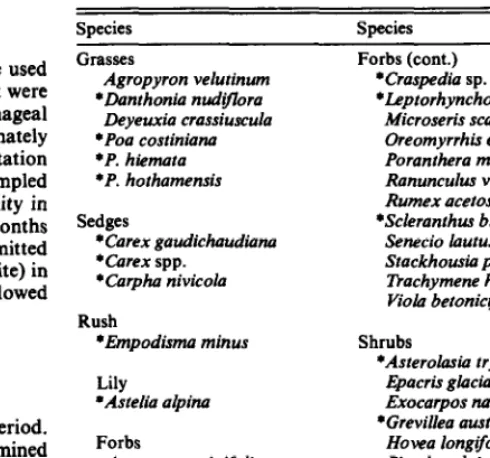
During the 1982-83 grazing season, 177 extrusa samples were collected on 4 1 collection days, in 4 areas in 3 vegetation communi- ties. Six grass species, 3 sedges and 1 rush, 16 species of forbs and 8 species of shrubs were identified in the extrusa samples (Table 1). Of these 34 species only 17 species comprised more than 5% of the diet of any one steer on at least 1 collection day. Only these 17 species will be discussed.
Grassland
In the grassland community 2 grasses, I sedge, 2 forbs and 2 shrubs were the main components in the diet of cattle (Table 2). Changes in dietary preferences were clearly evident with seasonal
Table 1. Specks identHied in extrusa samples.
Species Grasses
Agropyron velutinum *Danthonia nudflora
Deyeuxia crassiuscula * Poa cosiiniana *P. htemata *P. hothamensis
Sedges
*Carex gaudichaudiana +Carex spp.
*Carpha nivicola Rush
l
Empodisma minusLily
‘Astelia alpina Forbs
Acaena anserin~olia *Asperula gunnii Telmisia astehifolia
Species
Forbs (cont.) Yraspedia sp.
*Leptorhynchos squamatus Microsen’s scapigera Greomyrrhis eriopoda Poranthera microphylh Ranunculus victoriensis Rumex acetoseha ‘Scleranthus btj7oru.s
Senecio ktutus Stackhousia pulvinatis
Dachymene humilis Viola betonic$olia Shrubs
*Asierolasia trymalioides Epacris glacialis Exocarpos nanus l Grevillea australis
Hovea longifolia Pimelea alpina P. axifora *Riches continentis
*these species contribute more than 5% to the diet on at least 1 collection day.
advance. The intake of soft snow grass (Poa hiemata Vick.)’ decreased during the season while the intake of the snow daisy (Celmisia asteliifolia J.D. Hook) increased, and the intake of the shrubs alpine star-bush (Asterolasia trymalioides F. Muell.) and
Table 2. Major plant species grazed by 5 fistdated steera ia grasshd, expressed as percent dry matter of species identified in extrusa samples, during January, February, and March 1983, and
l
vahbility, in percent cover, of the ape&a as an average of tbe 4 p&and sitea.Species
January February March Availability Y&m. 7d.m. O/od.m. %cover
Asterolasia trymalioides Carex spp.
Celmisia asteliifolia Danthonia nudt~ora Grevillea australis Leptorhynchos squamatus Poa hiemata
Unidentifiable material
3.2 20.8 10.4 o-5
4.1 1.4 0.7 O-5
3.7 9.2 40.1 6-20
7.7 4.0 7.4 O-5
10.2 18.4 2.2 O-5
10.9 5.9 6-20
55.5 387:: 31.8 51-75
4.7 0.5 1.5 3
alpine grevillea (Grevillea australis R. Br.) was highest in the middle of the grazing season (Table 2). The average percentage cover of these species in the grassland community provides infor-
mation on the degree of selective grazing by the steers on some of the major species. The alpine star-bush and alpine grevillea and the snow daisy were strongly selected towards the middle and end of the grazing season (Table 2).
Heatbland
In the heathland community 2 grass species, 4 forbs and 2 shrubs were the main species grazed by the steers (Table 3). Changes in dietary preferences with seasonal advance were similar to what occurred in the grassland community, with the grasses decreasing in the diet during the season, the forbs increasing and the shrubs being most represented during the middle of the season (Table 3). Alpine star-bush, snow daisy and soft snow grass were grazed in a higher proportion than their availability (Table 3).
Mossbed
In the mossbed community 1 grass species, 1 sedge, 1 rush, 1 lily,
JOURNAL OF RANGE MANAGEMENT 39(5), September 1966 393