Automatic Labeling of Problem-Solving Dialogues for Computational
Microgenetic Learning Analytics
Yuanliang Meng
∗, Anna Rumshisky
∗, Florence Sullivan
†, Kevin Keith
†∗Text Machine Lab, Department of Computer Science, University of Massachusetts Lowell †College of Education, University of Massachusetts Amherst
{ymeng, arum}@cs.uml.edu
[email protected], [email protected]
Abstract
This paper presents a recurrent neural network model to automate the analysis of students’ computational thinking in problem-solving dialogue. We have collected and annotated dialogue transcripts from middle school students solving a robotics challenge, and each dialogue turn is assigned a code. We use sentence embeddings and speaker identities as features, and experiment with linear chain CRFs and RNNs with a CRF layer (LSTM-CRF). Both the linear chain CRF model and the LSTM-CRF model outperform the na¨ıve baselines by a large margin, and LSTM-CRF has an edge between the two. To our knowledge, this is the first study on dialogue segment annotation using neural network models. This study is also a stepping-stone to automating the microgenetic analysis of cognitive interactions between students.
Keywords:dialogue act annotation, recurrent neural networks, microgenetic learning analytics
1.
Introduction
Microgenetic analysis is an observational research tech-nique in which the researcher attends closely to the dis-course interactions and the use of tools within the learning environment in order to understand the genesis (or the ori-gins) of cognitive change (Wertsch, 1991). It has a broad impact on the design and enactment of curriculum, the de-sign of learning environments, as well as pedagogical prac-tices. Microgenetic Learning Analytics (MLA) (Sullivan et al., 2015) requires the collection and analysis of all in-teractions among students over a given period of time. It has been noted that the robustness of microgenetic analy-sis derives from high-density observation (Siegler, 2006). However, it is the time-consuming nature of collecting and analyzing high-density observations that has restricted the application of microgenetic analysis to small case studies. This paper is an initial attempt to identify computational methods that will allow for automation of MLA of conver-sational data. Such automation will transform educational researchers’ ability to perform microgenetic analysis. This paper presents a pilot study to automate the analysis of cognitive interactions in dialogue. We have transcripts of the dialogues from middle school students solving a robotics challenge (Sullivan et al., 2015). Dialogue turns (utterances) are annotated with carefully designed labels, known as the “computational thinking codes (CT codes)”. We need to build computational models to assign the codes to dialogue turns automatically. In a broader sense, this is a dialogue action (DA) annotation task, with multiple agents in the dialogue. It is also related to the sequential sentence labeling task, in which a series of sentences need to be la-beled.
2.
Related Work
Many different classification algorithms have been used for dialogue act annotation. The most popular ones use sup-port vector machines (SVM) (Margolis et al., 2010; Tavafi et al., 2013), Hidden Markov models (HMM) (Kim et al.,
2010; Tavafi et al., 2013), conditional random fields (CRF) (Kim et al., 2010; Tavafi et al., 2013), and decision trees (Moldovan et al., ; Samei et al., 2014). These methods re-quire handcrafted features, and their performance depends on the application domain. Few if any works to date have used the recently popular neural network-based approaches for dialogue segment labeling.
We can also consider DA annotation a special case of se-quential sentence labeling, in which every sentence is an utterance. Existing systems for sequential sentence la-beling are mostly based on traditional statistical machine learning methods too, such as Na¨ıve Bayes (Huang et al., 2013), SVM (McKnight and Srinivasan, 2003; Hirohata et al., 2008), HMM (Lin et al., 2006), and CRF (Hirohata et al., 2008; Hassanzadeh et al., 2014). Recently, popu-lar approaches use neural networks with word embeddings (Socher et al., 2013; Kim, 2014) and/or character embed-dings (Zhang et al., 2015; Conneau et al., 2016) to train sentence encoders, and then perform classification. Those neural networks use either convolutional layers or recur-rent layers to learn deep representations, and often produce better results than older systems. However, one drawback of most of the models is that they do not make use of con-text, but focus on representing each sentence independently (Dernoncourt et al., 2016). Moreover, the sequence of la-bels are not directly modeled like in CRF, although RNNs can capture that indirectly.
Dernoncourt et al. (2016) tries to combine the properties of RNN and CRF. They use character and token embeddings to train a sentence encoder, and use an output sequence op-timization layer to incorporate transition probabilities of la-bels. However, their data is from medical paper abstracts, which have a strong tendency to follow certain styles of writing, and are much shorter than dialogues. They only have 5 classes, all with very distinctive semantic proper-ties. Our 10 labels demand deeper understanding to be dis-tinguished.
recognition and other token-based sequence tagging tasks (Huang et al., 2015; Dernoncourt et al., 2017). The se-quence optimization layer is also called a CRF layer. Sen-tences are much longer than name entities and contain more complex meanings, and thus sequential sentence labeling is a more difficult task.
3.
Dataset
The dataset consists of dialogues of middle school students solving a robotics challenge together. There are two collab-orative teams. Team A has 1 boy and 2 girls, and Team B has 2 boys. All students wore wireless microphones, and their interactions were videotaped. In this study, we ob-tained the transcribed dialogues and use text data for anal-ysis.
In order to use RNNs to process sequences of sentences, we need to train a sentence encoder. Given the small dataset, we also tried external resources. Conneau et al. (2017) proposed a model to produce “universal sentence represen-tations”. They train sentence encoders on Natural Lan-guage Inference (NLI) task and claim such a process in-volves high-level understanding of text, and thus generates better sentence embeddings than other supervised or un-supervised learning methods. In our experiments, we use their pre-trained sentence encoder to represent sentences. The encoder is trained on SNLI (Bowman et al., 2015) and MultiNLI (Williams et al., 2017).
3.1.
Computational Thinking Coding Scheme
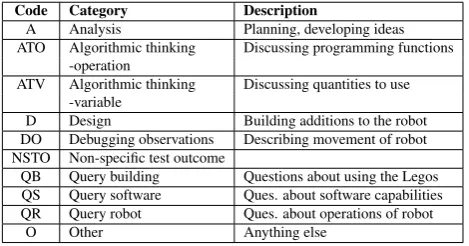
The dialogue of each team is segmented into 20-minute conversation chunks. Eventually we have 10 chunks for Team A and 9 for Team B. Then the dialogue turns of the 19 files are fully annotated. We developed a computational thinking coding scheme, as shown in Table 1.
Code Category Description
A Analysis Planning, developing ideas ATO Algorithmic thinking Discussing programming functions
-operation
ATV Algorithmic thinking Discussing quantities to use -variable
D Design Building additions to the robot DO Debugging observations Describing movement of robot NSTO Non-specific test outcome
QB Query building Questions about using the Legos QS Query software Ques. about software capabilities QR Query robot Ques. about operations of robot
O Other Anything else
Table 1: Computational thinking coding scheme.
Every dialogue turn is labeled with one of the codes in Table 1. A dialogue turn is an utterance generated by a speaker. Occasionally a turn is split and assigned with two different labels, when the speaker expresses two ideas. In this case we describe it as two dialogue turns from the same speaker. In total we annotated 5723 dialogue turns from the 19 files. Utterances from individuals who are not the team members are excluded from analysis.
The code “QB” does not exist in any data we use, so it is ig-nored. The remaining classes are heavily imbalanced. For example, 58% of the dialogue turns have “O” label but only 0.6% have the “QS” label. Some techniques are commonly
used to deal with imbalanced data, such downsampling, up-sampling, setting weights etc., driven by specific purposes. In our experiment, we do not employ any of the techniques, but train our models on raw data.
3.2.
5-folds cross validation
Since the dataset is relatively small and the classes are im-balanced, we use 5-fold cross validation to evaluate the fi-nal results. In each iteration of training/testing, 15 out of 19 files are chosen as training set, and the remaining 4 files as test set. In the five iterations, the test sets are all differ-ent without overlapping, except that one file is used twice (because4×5 = 20).
One may argue the files reflect different stages of the robotics challenge, and are not independent. However, we investigate the data in details and find local context much more relevant than long-distance context, so treating the files independently should not create significant errors. Hyper-parameters are tuned on one split of data only. The 15 training files are divided as training and validation set by 13:2.
4.
Experiments
We built two models. One is a conventional CRF model, and the other is an RNN with a CRF layer.
4.1.
Linear Chain CRF model
Until very recently, linear chain CRFs have been the pre-ferred choice for sequence labelling tasks in NLP. We ran this model as a baseline to compare to. This model esti-mates the conditional probability of a label sequence, as-suming that a label at a certain time step depends on its pre-ceding label as well as input data. The objective is to find the feature weights that maximize the conditional probabil-ity as shown in equation 1.
p(y|x)∝exp
In our case, every time steptis corresponding to a dialogue turn with a label. The inputX can be the whole series of input data although in practice we only use a portion of the whole input at each time step. Naturally, we can use the text of each dialogue turn, and possibly of nearby turns. There-fore we rewrite the feature function asfi(yt, yt−1, xt).
Herefiuses the previous labelyt−1, current labelytand
current input text representationxtas input. D is the
di-mensionality of the feature space. wiis the set of
The features used in the linear chain CRF model do not create an adequate context representation. Adding features from neighboring sentences to the model can potentially improve it, however, it increases feature dimensionality rapidly, making it difficult to capture long-distance depen-dencies. Recurrent neural networks models provide a more elegant solution to this issue.
4.2.
LSTM Model with CRF Layer
LSTM uses gated cells to preserve memory through multi-ple time steps. Therefore it is possible to incorporate con-textual information. Neural networks also tend to process high-dimensional representations better than some of the more conventional statistical machine learning methods. We add a CRF output layer to the model, which allows us to jointly model the output labels. The CRF layer essentially maximizes the label sequence score s, computed as follows:
s(y1:T) = T
X
t=2
A[yt−1, yt] + T
X
t=1
a[yt] (2)
where A is the matrix of transition probabilities, and a
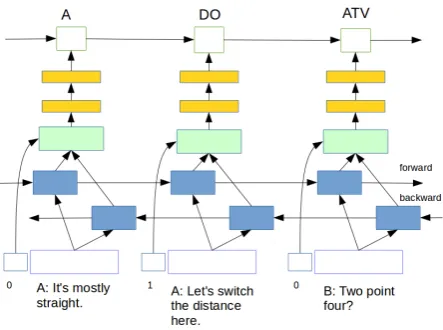
represents the individual probability of a label. Dialogue turn representations are fed into a bidirectional LSTM (Bi-LSTM) layer. The output of the Bi-LSTM layer is concate-nated with the speaker identity input, and then followed by two fully connected hidden layers.
The full model architecture is shown in Figure 1. The bottom row shows the sequence of input utterances, with sentence embeddings and speaker identities. 1 means the speaker is the same as the previous one, and 0 otherwise. Backward and forward LSTMs are shown in blue, followed by the concatenation layer in green. Yellow blocks are hid-den layers. The top row is the CRF layer. In this example three output labels are shown (A = “Analysis”, DO = “De-bugging operation”, ATV = “Algorithmic thinking / Vari-able”). Rightward arrows indicate that each label depends on its preceding label.
Figure 1: Bi-LSTM-CRF model.
We experimented different ways to obtain sentence en-coders. (1) We use the same sentence encoder as in 4.1., so the sentence vectors fed into the Bi-LSTM layer are the same as before. (2) We train our own sentence encoder. For each sentence, pre-trained word embeddings are fed into a
Bi-LSTM layer, followed by a Maxpooling layer. The en-coder is co-trained with the classifier. (3) We combined the encoders from (1) and (2), concatenating the outputs of the two. In each case, we also supplement it with speaker iden-tity.
Ideally the model should be time-variant and uses time step as variable too, because the time/stage of a dialogue may have an impact on the labels. However, currently we only have the full dialogues of two teams and there is no suffi-cient data to train a time-variant model.
4.3.
Hyper-parameters
For the Linear chain CRF model, we setc1 = 1.0,c2 = 10−3. These are L1 and L2 regularizations. We tried differ-ent number ofmax iterationsand found 200 to be desir-able. All other hyper-parameters are just default values of the library.
For LSTM-CRF, our final model has 1024 LSTM units to process sequences of sentence embeddings, and the hid-den layers have 1024 and 512 neurons, respectively. Input dropout for sentence embeddings is 0.4. The two hidden layers both have a dropout rate 0.5. When a sentence en-coder is trained, 512 LSTM units are used. After Maxpool-ing, the results are concatenated with pre-trained sentence embeddings. The configuration of other parts of the neural network are intact.
There is no dropout for speaker identity input. All mod-els are trained with 100 epochs. We found the results do not have noticeable changes when the epochs are set in the 80∼200 range.
The glove.840B.300d word vectors1 are used for word
embeddings. It was trained on 840 billion tokens and rep-resents tokens with 300d vectors.
4.4.
Results
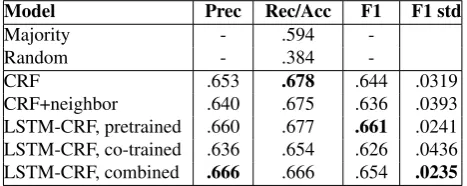
From 5-fold cross validation, the precision, recall and F1 scores of all 5 runs are calculated and averaged. Within each run, the scores are the prevalence-weighted macro-averages across classes. In other words, the scores are av-eraged over all classes and weighted by their frequencies. Using this method, recall will be the same as accuracy. It should also be noted that F1 score is not necessarily be-tween precision and recall in this method. We calculated the standard deviation of F1 scores to check the stability of the results.
We list two na¨ıve baselines to compare to. The majority baseline assumes a model assigns the majority class “O” to all occurrences. From the 5-fold CV, there are 5556 pre-dicted labels and 3303 of them have “O” as the true label. Therefore the majority baseline is 3303/5556=0.594. The random baseline assumes a model assigns labels based on their statistical distributions in training data. Then the ex-pected accuracy will beP
ip
2
i wherepiis the probability
of classi. In our case the value is 0.384.
All the results are shown in Table 2. Our models outper-form the two na¨ıve baselines by a large margin. Judging from F1 score, the LSTM-CRF model with pre-trained sen-tence encoder has the best performance, although the recall
1
Model Prec Rec/Acc F1 F1 std
Majority - .594
-Random - .384
-CRF .653 .678 .644 .0319
CRF+neighbor .640 .675 .636 .0393 LSTM-CRF, pretrained .660 .677 .661 .0241 LSTM-CRF, co-trained .636 .654 .626 .0436 LSTM-CRF, combined .666 .666 .654 .0235
Table 2: Evaluation results. “Majority” means assigning the majority label (“O” in our case) to all dialogue turns. “Random” means randomly assigning labels based on their statistical distributions. Precision, recall, and F1 scores are the averages of the 5-fold cross validation evaluation, re-spectively. “F1 std” is the standard deviation of the 5 F1 scores.
score is no better than that of the CRF model. LSTM-CRF with co-trained sentence encoder does not perform very well, probably because the training set is too small. Com-bining the two encoders does not boost results. It may sug-gest that the pre-trained sentence encoder is overall much better.
“CRF+neighbor” refers to the CRF model with neighboring sentence embeddings as input, in addition to current sen-tence. Such a technique incorporates more context in the model, but actually the performance is lower. Probably the data dimensionality has become too high for a CRF model to work properly.
Taking a close look, we find the CRF models tend to ig-nore low-frequency classes. For example, the smallest class QR (“query robot”) occurs 37 times in all the 5556 test in-stances. The CRF model does not capture any of them (0 re-call), but the LSTM-CRF model with pre-trained sentence embeddings manages to identify 1 of them correctly. The second smallest class QS (“query software”) occurs 116 times. The CRF model only identifies 1, but the LSTM-CRF model finds 18 of them. Depending on the purpose, there can be more specific ways to evaluate the results, which will not be discussed in this paper.
5.
Conclusion
In order to automatically label dialogue turns with compu-tational thinking codes, we experimented with two com-putational approaches: (1) a linear chain Conditional Ran-dom Field (CRF) model, and (2) a recurrent neural network model with a CRF layer. Both of them beat na¨ıve base-lines by a large margin. Although our dataset is relatively small, the RNN-based model seems to outperform the con-ventional CRF model.
Our research is also a stepping-stone for microgenetic anal-ysis of observational data. Eventually the analanal-ysis will help us understand collaborative learning and working in a team setup.
6.
Bibliographical References
Bowman, S. R., Angeli, G., Potts, C., and Manning, C. D. (2015). A large annotated corpus for learning natural
language inference. InProceedings of the 2015 Confer-ence on Empirical Methods in Natural Language
Pro-cessing (EMNLP). Association for Computational
Lin-guistics.
Conneau, A., Schwenk, H., Barrault, L., and LeCun, Y. (2016). Very deep convolutional networks for natural language processing. CoRR, abs/1606.01781.
Conneau, A., Kiela, D., Schwenk, H., Barrault, L., and Bordes, A. (2017). Supervised learning of universal sentence representations from natural language inference data.arXiv preprint arXiv:1705.02364.
Dernoncourt, F., Lee, J. Y., and Szolovits, P. (2016). Neu-ral networks for joint sentence classification in medical paper abstracts. CoRR, abs/1612.05251.
Dernoncourt, F., Lee, J. Y., Uzuner, ˜A., and Szolovits, P. (2017). De-identification of patient notes with recurrent neural networks. JAMIA, 24(3):596–606.
Hassanzadeh, H., Groza, T., and Hunter, J. (2014). Iden-tifying scientific artefacts in biomedical literature: The evidence based medicine use case. Journal of Biomedi-cal Informatics, 49:159–170.
Hirohata, K., Okazaki, N., Ananiadou, S., and Ishizuka, M. (2008). Identifying sections in scientific abstracts us-ing conditional random fields. InIn Proc. of the IJCNLP 2008.
Huang, K.-C., Chiang, I.-J., Xiao, F., Liao, C.-C., Liu, C. C.-H., and Wong, J.-M. (2013). Pico element detection in medical text without metadata: Are first sentences enough? Journal of Biomedical Informatics, 46(5):940– 946.
Huang, Z., Xu, W., and Yu, K. (2015). Bidirec-tional LSTM-CRF models for sequence tagging. CoRR, abs/1508.01991.
Kim, S. N., Cavedon, L., and Baldwin, T. (2010). Classi-fying dialogue acts in one-on-one live chats. In Proceed-ings of the 2010 Conference on Empirical Methods in
Natural Language Processing, EMNLP ’10, pages 862–
871, Stroudsburg, PA, USA. Association for Computa-tional Linguistics.
Kim, Y. (2014). Convolutional neural networks for sen-tence classification. CoRR, abs/1408.5882.
Lin, J., Karakos, D., Demner-Fushman, D., and Khudanpur, S. (2006). Generative content models for structural anal-ysis of medical abstracts. In Proceedings of the Work-shop on Linking Natural Language Processing and
Bi-ology: Towards Deeper Biological Literature Analysis,
BioNLP ’06, pages 65–72, Stroudsburg, PA, USA. As-sociation for Computational Linguistics.
Margolis, A., Livescu, K., and Ostendorf, M. (2010). Do-main adaptation with unlabeled data for dialog act tag-ging. InProceedings of the 2010 Workshop on Domain
Adaptation for Natural Language Processing, DANLP
2010, pages 45–52, Stroudsburg, PA, USA. Association for Computational Linguistics.
McKnight, L. and Srinivasan, P. (2003). Categorization of sentence types in medical abstracts. InAMIA. AMIA. Moldovan, C., Rus, V., and Graesser, A. C. (). Automated
Okazaki, N. (2007). Crfsuite: a fast implementation of conditional random fields (crfs).
Samei, B., Li, H., Keshtkar, F., Rus, V., and Graesser, A. C. (2014). Context-based speech act classification in intelligent tutoring systems. In Stefan Trausan-Matu, et al., editors,Intelligent Tutoring Systems, volume 8474
of Lecture Notes in Computer Science, pages 236–241.
Springer.
Siegler, R., (2006). Microgenetic analysis of learning, pages 464–510. John Wiley & Sons, Hoboken, NJ. Socher, R., Perelygin, A., Wu, J. Y., Chuang, J., Manning,
C. D., Ng, A. Y., and Potts, C. (2013). Recursive deep models for semantic compositionality over a sentiment treebank. InProceedings of the conference on empirical
methods in natural language processing (EMNLP),
vol-ume 1631, page 1642. Citeseer.
Sullivan, F. R., Adrion, W. R., and Keith, P. K. (2015). Mi-crogenetic learning analytics: A computational approach to research on student learning. In Paper presentation at the annual meeting of the American Educational Re-search Association, Chicago, IL, April.
Tavafi, M., Mehdad, Y., Joty, S., Carenini, G., and Ng, R. (2013). Dialogue act recognition in synchronous and asynchronous conversations. InProceedings of the
SIG-DIAL 2013 Conference, page 117–121, Metz, France,
August. Association for Computational Linguistics, As-sociation for Computational Linguistics.
Wertsch, J. (1991). Voices of the mind: A sociocultural approach to mediated action. Harvard University Press, Cambridge, MA.
Williams, A., Nangia, N., and Bowman, S. R. (2017). A broad-coverage challenge corpus for sentence under-standing through inference.CoRR, abs/1704.05426. Zhang, X., Zhao, J. J., and LeCun, Y. (2015).