Neural Models of Selectional Preferences
for Implicit Semantic Role Labeling
Minh Le and Antske Fokkens
Computational Lexicology and Terminology LabVrije Universiteit Amsterdam, the Netherlands
{m.n.le, antske.fokkens}@vu.nl
Abstract
Implicit Semantic Role Labeling is a challenging task: it requires high-level understanding of the text while annotated data is very limited. Due to the lack of training data, most researches either resort to simplistic machine learning methods or focus on automatically acquiring training data. In this paper, we explore the possibilities of using more complex and expressive machine learning models trained on a large amount of explicit roles. In addition, we compare the impact of one-way and multi-way selectional preference with the hypothesis that the added information in multi-way models are beneficial. Although our models surpass a baseline that uses prototypical vectors for SemEval-2010, we otherwise face mostly negative results. Selectional preference models perform lower than the baseline on ON5V, a dataset of five ambiguous and frequent verbs. They are also outperformed by the Na¨ıve Bayes model of Feizabadi and Pado (2015) on both datasets. We conclude that, even though multi-way selectional preference improves results for predicting explicit semantic roles compared to one-way selectional preference, it harms performance for implicit roles. We release our source code, including the reimplementation of two previously unavailable systems to enable further experimentation.
Keywords:neural network, implicit semantic role labeling, selectional preferences
1.
Introduction
Defined as the recovery of semantic roles beyond imme-diate syntactic structure, implicit Semantic Roles Labeling (iSRL) can contribute valuable information for obtaining complete semantic interpretations of text. Yet, it has been elusive since its first shared task eight years ago (Ruppen-hofer et al., 2010).
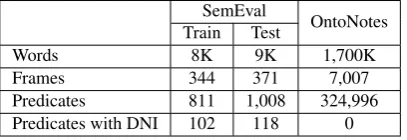
The main difficulty faced by researchers is the small size of training data. Compared to traditional SRL datasets, SemEval-2010 is hundreds-fold smaller, containing only slightly more than a hundred of training examples (Ta-ble 1). Early work applying traditional semantic role la-beling (SRL) techniques to iSRL was met with deflating results. Therefore, researchers limited themselves to sim-plistic machine learning models such as Na¨ıve Bayes (Feiz-abadi and Pado, 2015, among others) or abandoned ma-chine learning altogether (Laparra and Rigau, 2013). Sev-eral studies were devoted to the automatic expansion of training data (see Section 2 for an overview).
This paper presents an attempt to recover implicit semantic roles using neural networks. We take advantage of the fact that OntoNotes contains a vast amount of manually anno-tated explicit semantic roles from which we can learn the selectional preference of frames (e.g. look.01 prefers ani-mate fillers for roleA0(looker)). A neural network is used to capture complex interactions between a predicate, a tar-get role and its co-occurring roles. In addition, we com-pare the impact of one-way selectional preference, taking only the selectional preference of the predicate for the tar-get role into account, to multi-way selectional preference, which uses information from all semantic roles related to the predicate.
The contribution of this paper is twofold: First, we experi-mented with a class of simple neural models for iSRL and two types of selection preference. While the results are mostly negative, they highlight the importance of discourse
SemEval
OntoNotes Train Test
Words 8K 9K 1,700K
Frames 344 371 7,007
Predicates 811 1,008 324,996 Predicates with DNI 102 118 0
Table 1: Statistics of an iSRL dataset (SemEval-2010, PropBank version) and a traditional SRL dataset (OntoNotes).
information (see Section 4.4 and 4.5) and suggest future di-rections that should (not) be taken.
The rest of the paper is organized as follows: Section 2 summarizes the foundation of iSRL and related work. In Section 3, we outline our models of selectional preference. Section 4 quantifies the effectiveness of selectional prefer-ence with regard to iSRL. Section 5 concludes the work and outlines future directions of research.
2.
Background and Related Work
In this section, we explain what implicit Semantic Role La-beling entails. This is followed by an overview of previous work on this task. Next, we address related work that uses selectional preferences. Consider the following sentence from SemEval-2010 training set:
(1) Apparently [the tenants]A0had [brought]bring.01 [lit-tle or nothing]A1 with them, and all the furniture down to the smallest details had been taken over with [the house]A2.
The rolesA0andA1of the predicatebring.01can be filled with phrases in the immediate syntactic structure while the filler ofA2falls into a separate clause. Typically, a SRL system would annotate the fillers forA0andA1and ignore
A2. It is therefore called a Null Instantiation (NI).
Null-instantiations can be indefinite (INI) and definite (DNI). To reuse examples from Ruppenhofer et al. (2010), in the blog headlineMore babbling about what it means to know, the subject of knowing is not expected to be instanti-ated within the discourse. In contrast, in the sentenceDon’t tell me you didn’t know!, the hearer expects a concrete filler for the role of what (s)he should know and it can be ex-pected to be present in previous context. The first example is a case of INI while the second is a DNI.
2.1.
Previous work on iSRL
Traditional SRL techniques led to very low results for iSRL due to data sparseness (Chen et al., 2010; Tonelli and Del-monte, 2010). Researchers therefore explored simpler al-ternatives such as BayesNet (Silberer and Frank, 2012; Roth and Frank, 2013; Roth and Frank, 2015), Na¨ıve Bayes (Feizabadi and Pado, 2015), and memory-based learning (Schenk et al., 2015). Others proposed non-parametric ap-proaches such as observed frequency (Laparra and Rigau, 2012), prototypical vectors (Schenk and Chiarcos, 2016) and other heuristics (Laparra and Rigau, 2013; Gorinski et al., 2013).
In addition to methods of machine learning and heuristics, previous work investigated the possibilities of increasing training data. Feizabadi and Pado (2015) combine multiple corpora and apply domain adaptation methods to deal with the difference in genre. They demonstrated that combin-ing two iSRL corpora led to improved performance. Sil-berer and Frank (2012) and Roth and Frank (2015) used heuristics to generate iSRL training examples from manu-ally and automaticmanu-ally annotated SRL corpora. This work differs from these approaches, because their research fo-cused on creating iSRL training examples of reasonable quality rather than using a SRL resource directly.
2.2.
Selectional preferences
Selectional preference has a long research tradition (Katz and Fodor, 1963) and has been applied in various tasks such as syntactic parsing (Zhou et al., 2011), textual inference (Ritter et al., 2010), and semantic role labeling (Zapirain et al., 2013). The idea is simple: a role is filled with some words more frequently than others. For example,the man
is much more likely a filler for the roleA0(leader) of the predicatelead.01than e.g.the bottle(an inanimate object) although one can construct a grammatically and semanti-cally correct example for each filler.
Next to the role’s semantics, co-occurring roles also have an influence. For example, iflead.01’s roleA4(goal) is filled bythe guest house,the nationis an implausible filler forA1
(thing led), while it is perfectly plausible had we not known what fillsA4. This is known asmulti-way selectional pref-erence(van de Cruys, 2014).
One-way selectional preferences have been applied to im-plicit semantic role labeling before. Silberer and Frank (2012)’s system include a feature calculated using weighted similarity to head words that are observed to fill a role. The selectional preference model itself is described in (Erk, 2007) and (Resnik, 1996). A simpler model that uses un-weighted similarity is used by Schenk and Chiarcos (2016). Our results show that adding multi-way selectional prefer-ence improves results on explicit semantic roles, but not for iSRL. Recently work by Do et al. (2017) is closest to our work but they apply their methods on nominal data and did not compare one-way and multi-way selectional prefer-ence.
2.3.
Neural networks
Recent years have witnessed a surge of research interest in neural networks for natural language processing (Goldberg, 2016). Plenty of models have been proposed for various tasks (Godbole et al., 2015; Zhou and Xu, 2015; Andor et al., 2016, among many others). Apart from Do et al. (2017) who uses a different architecture for a different version of the task, we are not aware of work that applies neural net-works to iSRL.
3.
Models
In this study, we focus exclusively onDNI resolution, the last and hardest step in iSRL. For each test case, we assume that the predicatepis already identified and disambiguated, the target roler∗is given, and overt roles are coupled with their fillers{(rj, gj)|j = 1..m}. The goal is to rank the correct filler highest among the candidates{ci|i = 1..n}. To test a simple multi-way selectional preference model, we use the following formula to assign a score for each candidate:
s(ci) = m M
j=1
f(p, r∗, rj, gj, ci) (1)
wheremis the number of explicit roles known to the sys-tem,L
s0(ci) =f0(p, r∗, ci) (2)
f andf0 are neural networks that have the same
architec-ture, except the number of inputs. The precise form of the neural networks and the aggregation function is determined via a hyperparameter search (see Section 4.3).
Role fillers{gj} and candidates {ci} can be transformed into features by extracting the head word, but other features can also be used. Together with predicate and role names, they are embedded into a vector space. The embedding ma-trix is trainable and can be initialized with pretrained word vectors for better performance.
Compared to a model that computes prototypical vectors as the average of observed vectors in the fashion of Schenk and Chiarcos (2016), our neural models have (at least) two advantages:
• Distributed representation is used to represent predi-cates and roles, not only fillers, allowing the model to work in cases of unseen predicates or predicate-role combinations.
• The representation enables the sharing of statistical strength between predicates, i.e. rare predicates can get more accurate predictions by means of resem-blance to frequent predicates.
An additional motivation is that multi-way preference can offer a solution to the context-dependent nature of semantic role labeling. Our current results, however, do not provide sufficient evidence to support such a claim.
4.
Experiments
We evaluate our models for DNI resolution by comparing our model to a baseline and to Feizabadi and Pado (2015). In addition, we perform an ablation analysis to find out which components of the model are useful.
4.1.
Data
We train our selectional preference model on OntoNotes (Weischedel et al., 2013), a balanced 1.7M words corpus with over 320K manually annotated predicates and their ex-plicit arguments.
SemEval-2010 (Ruppenhofer et al., 2010) is a standard dataset to evaluate iSRL systems. It contains chapters of Sherlock Holmes, one for training and two for testing, an-notated with both implicit and explicit semantic roles. The organizers provide two versions of the same dataset: one annotated with FrameNet roles and the other PropBank. Because OntoNotes was compiled using PropBank, we also use the PropBank version of SemEval-2010.
Note that OntoNotes differs from SemEval-2010 in task (explicit versus implicit SRL), genres (news, weblogs and conversations versus novel) and time period (20th century versus 19th century). Training on OntoNotes SRL and test-ing on SemEval-2010 iSRL can be seen as a form of domain adaptation and requires powerful generalization.
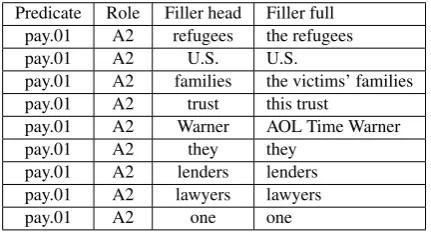
We also test our models on ON5V (Moor et al., 2013) which poses a different challenge. Implicit semantic roles were manually annotated on top of explicit seman-tic roles and other linguisseman-tic information on a selection of
Predicate Role Filler head Filler full pay.01 A2 refugees the refugees pay.01 A2 U.S. U.S.
pay.01 A2 families the victims’ families pay.01 A2 trust this trust
pay.01 A2 Warner AOL Time Warner pay.01 A2 they they
pay.01 A2 lenders lenders pay.01 A2 lawyers lawyers
pay.01 A2 one one
Table 2: Examples from ON5V showing the diversity of fillers in terms of semantic types, part-of-speech, and top-ics.
OntoNotes documents. The authors chose five highly fre-quent verbs to annotate in order to create “high-volume of annotations for specific verb predicates”.1 As a result, the words and phrases that fill each role are very diverse, as illustrated by the examples in Table 2. To achieve high per-formance on this dataset, a model needs to be selective yet general enough to encompass different types of fillers.
4.2.
Baseline
Our baseline is inspired by Schenk and Chiarcos (2016). For every<predicate, role>pair found in our training set, it computes a prototypical vector and, at test time, returns the candidate that is closest to the prototypical vector. Fol-lowing their best model, we use the pretrained embeddings from Collobert et al. (2011).
Due to some differences between research questions and experimental setup, the results cannot be compared to Schenk and Chiarcos’s algorithm directly. Firstly, for a fair comparison with selectional preference-based models, we use only the head word of each candidate (whereas they av-erage all words in the phrase). Secondly, we train and eval-uate on PropBank-style datasets while they use FrameNet-style data.
4.3.
Experimental Setup
We use the baseline described in the previous section and a Na¨ıve Bayes model trained on SemEval-2010 data (Feiz-abadi and Pado, 2015) to compare to our model’s perfor-mance. To quantify the effect of different aspects of the model, we investigate the following variants:
ONEWAY captures one-way selectional preference and represents fillers by their syntactic head.
MULTIWAY captures multi-way selectional preference and represents fillers by their syntactic head.
SYNSEM uses richer features for fillers rather than selec-tional preferences. We use five syntactic and semantic features from Feizabadi and Pado (2015), namely, Ex-pected roles, Semantic Type, Word Frequency,POS, andConstituent type.2
1
They are:pay,give,bring,leave,put.
2
Train (%) Validation (%) ONEWAY 59.52 46.61±0.23 MULTIWAY 58.52 47.64±0.19
Table 3: Accuracy of selectional preference models on OntoNotes (for validation set we report mean and standard deviation over 5 runs).
SYNSEM+ONEWAY combines richer features with one-way selectional preference.
SYNSEM+MULTIWAY takes into account co-occurring roles to capture multi-way selectional preference.
We construct one training example for each argument found in OntoNotes and split the data into 90% for training and 10% for development. Models are trained to choose the right filler for each target role with as input: the predicate, the role and, if applicable, other explicit arguments. We evaluate on the NI-only test set from SemEval-2010 using the standard evaluation script (Ruppenhofer et al., 2010). We initiated the embedding matrix with 27K vectors from the pretrained embeddings of Collobert et al. (2011). We use AdaGrad (Duchi et al., 2011) for optimization; the ini-tial learning rate was customized for each model to avoid gradient explosion. All models were trained until no im-provement was observed on the development set (but not more than 1,000 epochs, for practical reasons). To account for random initialization in neural networks, we run each model 15 times and average the results. An arbitrary but fixed random seed was used for each run to ensure repro-ducibility.
All hyperparameters were tuned on OntoNotes develop-ment set. We tested sum and max for aggregation func-tion; sigmoid, tanh, and cube for activation function (Chen and Manning, 2014); different strength of dropout (Hin-ton et al., 2012), regularization, and learning rate. Because of limited computational resource, we performed a random hyperparameter search to find the best setting. As discussed in Section 3, fillers can be represented in different ways. We observed that using both the head word and the closest coreferent non-pronoun head word is better than using the head word only on our development set. Notice that gold coreference chains are assumed to be available at test time and were used in previous work (Silberer and Frank, 2012) as well as the system we compare to (Feizabadi and Pado, 2015).
The source code of all experiments, including random seeds and replication instructions, is publicly available at:
https://bitbucket.org/cltl/isrl-sp.
4.4.
Results on SemEval-2010
Table 3 shows the performance of selectional preference models with regard to resolving the explicit roles of OntoNotes. Selectional preference alone (without the help of syntactic structures) can find the correct filler in more than 47% of the cases. We observe a small but statistically significant (p <0.05) improvement on the validation set by adding multiway selectional preference.
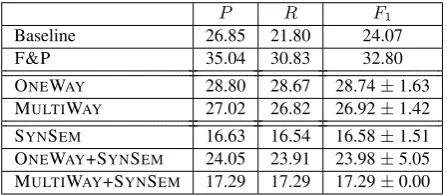
The results in Table 4 show that our models significantly increase theF1score above the baseline on SemEval-2010
P R F1
Baseline 26.85 21.80 24.07
F&P 35.04 30.83 32.80
ONEWAY 28.80 28.67 28.74±1.63 MULTIWAY 27.02 26.82 26.92±1.42
SYNSEM 16.63 16.54 16.58±1.51 ONEWAY+SYNSEM 24.05 23.91 23.98±5.05 MULTIWAY+SYNSEM 17.29 17.29 17.29±0.00
Table 4: Results on SemEval-2010. Results of neural mod-els are averaged over 15 runs. F1scores are reported with
mean and standard deviation when possible.
P R F1
Baseline 13.00 13.00 13.00
F&P 16.72 15.19 15.90
ONEWAY 10.64 10.64 10.64±1.44 MULTIWAY 9.14 9.14 9.14±1.46 SYNSEM 5.92 5.92 5.92±2.10 ONEWAY+SYNSEM 10.37 10.37 10.37±5.50 MULTIWAY+SYNSEM 1.24 1.24 1.24±0.00
Table 5: Results on ON5V
dataset. Both neural models show significant improvement in precision and an even bigger improvement in recall. This can be attributed to their ability to generalize to unseen predicate-role combinations and abstract away from ob-served ones in their hidden layer. Contrary to our expec-tation, MULTIWAYis inferior to ONEWAY(p <0.05). ONEWAYand MULTIWAYdo not outperform F&P which is simpler in terms of machine learning architecture, but is trained on in-domain, iSRL data, and uses more features. To bridge the gap between the models, we also integrate Feizabadi and Pado’s syntactic and semantic features into our neural models but they do not lead to improved perfor-mance.
Table 3 and Table 4 reveal an increase in random fluctua-tion when moving from OntoNotes to SemEval-2010, prob-ably because of a difference of some orders of magnitude in size. Moreover, SYNSEM+ONEWAYgets an F1-score
of 16.54% for one of its runs (lower than the mean of all other neural models) and 29.43% for another (higher than all means). These observations stress the importance of running experiments multiple times when random factors (such as parameter initialization and the order of training examples) are involved. Based on a single run, a model might be heavily over- or underrated.
4.5.
Results on ON5V
In Table 5, we report the results of models on ON5V (Moor et al., 2013). Again, the Na¨ıve Bayes model using both local and discourse information proposed by Feizabadi and Pado (2015) clearly provides the best performance, whereas neural models do not show improvement over the baseline (p <0.05).
The disappointing performance points to its inherent limi-tation: it expects one prototypical filler perhpredicate, rolei
We expected that MULTIWAYwould alleviate this problem by varying the predicted vector based on surrounding roles. While it achieves that for explicit SRL on OntoNotes (Ta-ble 3), the result does not carry over to ON5V.
Local syntactic and semantic information do not improve results for SemEval. This applies even more strongly to ON5V. SYNSEM leads to very low results when stand-ing alone and does not improve performance when com-bined with ONEWAY or MULTIWAY (the difference be-tween ONEWAYand its combination with SYNSEMis not statistically significant). In comparison with F&P, this re-sult emphasizes the importance of discourse information in the task.
5.
Conclusions
In this paper, we investigated the use of more expressive machine learning models for implicit Semantic Role Label-ing. We proposed novel neural models that use selectional preference and applied them to iSRL. Our empirical results show that neural models are only better than a lookup table of prototypical vectors in a natural setting such as SemEval-2010 while underperforming for highly frequent and am-biguous words in ON5V. Furthermore, the added expressive power does not help neural models to overcome a simpler model trained on in-domain data and equipped with dis-course features (though it should be noted that we tested only a small family of simple architectures, cf. Do et al. (2017)). Multi-way preference is found to be helpful in the case of (explicit) semantic role labeling but not for iSRL. Although the results are mostly negative, our research pro-vides hard-earned insights into this challenging task which we believe will be useful for researchers.
We release all of our models and the implementation of Schenk and Chiarcos (2016) and Feizabadi and Pado (2015)’s models as open-source software. We also report the fluctuation of results which stresses the importance of measuring a model multiple times when stochastic factors are involved.
Overall, this paper provides a solid basis for further re-search. Our observations on fluctuation and significance suggest more evaluation data may be needed to identify the true impact of specific models and features.
6.
Acknowledgements
The work presented in this paper was funded by the Nether-lands Organization for Scientific Research (NWO) via the Spinoza grant, awarded to Piek Vossen and via VENI grant 275-89-029 awarded to Antske Fokkens. Experiments were carried out on the Dutch national e-infrastructure with the support of SURF Cooperative.
7.
Bibliographical References
Andor, D., Alberti, C., Weiss, D., Severyn, A., Presta, A., Ganchev, K., Petrov, S., and Collins, M. (2016). Glob-ally Normalized Transition-Based Neural Networks. In
Proceedings of the 54th Annual Meeting of the Asso-ciation for Computational Linguistics, volume 1, pages 2442–2452, Berlin, Germany. Association for Computa-tional Linguistics.
Chen, D. and Manning, C. (2014). A Fast and Accurate Dependency Parser using Neural Networks. InEMNLP 2014, pages 740–750. ACL.
Chen, D., Schneider, N., Das, D., and Smith, N. A. (2010). SEMAFOR: Frame argument resolution with log-linear models. InProceedings of the 5th International Work-shop on Semantic Evaluation, pages 264–267, Uppsala, Sweden. ACL.
Collobert, R., Weston, J., Bottou, L., Karlen, M., Kavukcuoglu, K., and Kuksa, P. (2011). Natural lan-guage processing (almost) from scratch. Journal of Ma-chine Learning Research, 12:2493–2537.
Do, Q. N. T., Bethard, S., and Moens, M.-F. (2017). Im-proving Implicit Semantic Role Labeling by Predicting Semantic Frame Arguments. arXiv:1704.02709. Duchi, J., Hazan, E., and Singer, Y. (2011). Adaptive
Sub-gradient Methods for Online Learning and Stochastic Optimization. Journal of Machine Learning Research, 12:2121–2159.
Erk, K. (2007). A Simple, Similarity-based Model for Selectional Preferences. In ACL 2007, pages 216–223, Prague, Czech Republic.
Feizabadi, P. S. and Pado, S. (2015). Combining Seem-ingly Incompatible Corpora for Implicit Semantic Role Labeling. In*SEM 2015, pages 40–50.
Fokkens, A., Erp, M., Postma, M., Pedersen, T., Vossen, P., and Freire, N. (2013). Offspring from Reproduction Problems: What Replication Failure Teaches Us. In Pro-ceedings of the 51st Annual Meeting of the Association for Computational Linguistics (Volume 1: Long Papers), pages 1691–1701. Association for Computational Lin-guistics.
Godbole, V., Liu, W., and Togneri, R. (2015). An Inves-tigation of Neural Embeddings for Coreference Resolu-tion. Computational Linguistics and Intelligent Text Pro-cessing, 9041:241–251.
Goldberg, Y. (2016). A Primer on Neural Network Models for Natural Language Processing. Journal of Artificial Intelligence Research, 57:345–420.
Gorinski, P., Ruppenhofer, J., and Sporleder, C. (2013). Towards Weakly Supervised Resolution of Null Instanti-ations. Proceedings of IWCS, pages 119–130.
Hinton, G. E., Srivastava, N., Krizhevsky, A., Sutskever, I., and Salakhutdinov, R. R. (2012). Improving neural net-works by preventing co-adaptation of feature detectors.
arXiv preprint arXiv:1207.0580, pages 1–18.
Katz, J. J. and Fodor, J. A. (1963). The structure of a se-mantic theory. Language, 39(2):170–210.
Laparra, E. and Rigau, G. (2012). Exploiting Explicit Annotations and Semantic Types for Implicit Argument Resolution. InSemantic Computing (ICSC), 2012 IEEE Sixth International Conference on, pages 75–78, 9. Laparra, E. and Rigau, G. (2013). ImpAr: A Deterministic
Algorithm for Implicit Semantic Role Labelling. In Pro-ceedings of the 51st Annual Meeting of the Association for Computational Linguistics (Volume 1: Long Papers), pages 1180–1189.
Annotation, Data Analysis and Evaluation Experiments. InProceedings of the 10th International Conference on Computational Semantics, pages 369–375.
Resnik, P. (1996). Selectional constraints: an information-tehoretic model and its computational realization. Cog-nition, 61(508):127–159.
Ritter, A., Etzioni, M., and Etzioni, O. (2010). A Latent Dirichlet Allocation method for Selectional Preferences.
Proceedings of the 48th Annual Meeting of the Associa-tion for ComputaAssocia-tional Linguistics, pages 423–434. Roth, M. and Frank, A. (2013). Automatically
Identify-ing Implicit Arguments to Improve Argument LinkIdentify-ing and Coherence Modeling. Proceedings of the Second Joint Conference on Lexical and Computational Seman-tics (*SEM), 1:306–316.
Roth, M. and Frank, A. (2015). Inducing Implicit Argu-ments from Comparable Texts: A Framework and its Ap-plications.Computational Linguistics, 41(4):625–664. Ruppenhofer, J., Sporleder, C., Morante, R., Baker, C., and
Palmer, M. (2010). SemEval-2010 Task 10: Linking Events and Their Participants in Discourse. In Proceed-ings of the 5th International Workshop on Semantic Eval-uation, ACL 2010, pages 45–50, Uppsala, Sweden. Schenk, N. and Chiarcos, C. (2016). Unsupervised
Learn-ing of Prototypical Fillers for Implicit Semantic Role La-beling. In Proceedings of the 2016 Conference of the North American Chapter of the Association for Com-putational Linguistics: Human Language Technologies, pages 1473–1479, San Diego, California, 6. Association for Computational Linguistics.
Schenk, N., Chiarcos, C., and Sukhareva, M. (2015). To-wards the Unsupervised Acquisition of Implicit Seman-tic Roles. InRANLP 2015, pages 570–578.
Silberer, C. and Frank, A. (2012). Casting Implicit Role Linking As an Anaphora Resolution Task. In Proceed-ings of the First Joint Conference on Lexical and Compu-tational Semantics - Volume 1: Proceedings of the Main Conference and the Shared Task, and Volume 2: Pro-ceedings of the Sixth International Workshop on Seman-tic Evaluation, SemEval ’12, pages 1–10, Stroudsburg, PA, USA. Association for Computational Linguistics. Tonelli, S. and Delmonte, R. (2010). VENSES++:
Adapt-ing a deep semantic processAdapt-ing system to the identifi-cation of null instantiations. InProceedings of the 5th International Workshop on Semantic Evaluations, ACL 2010, number July, pages 296–299, Uppsala, Sweden. Association for Computational Linguistics.
van de Cruys, T. (2014). A Neural Network Approach to Selectional Preference Acquisition. EMNLP 2014, pages 26–35.
Zapirain, B., Agirre, E., M`arquez, L., and Surdeanu, M. (2013). Selectional Preferences for Semantic Role Clas-sification.Computational Linguistics, 39(3).
Zhou, J. and Xu, W. (2015). End-to-end learning of seman-tic role labeling using recurrent neural networks. ACL 2015, pages 1127–1137.
Zhou, G., Zhao, J., Liu, K., and Cai, L. (2011). Exploiting Web-Derived Selectional Preference to Improve Statisti-cal Dependency Parsing. Proceedings of the 49th Annual
Meeting of the Association for Computational Linguis-tics: Human Language Technologies, pages 1556–1565.
8.
Language Resource References
Moor, Tatjana and Roth, Michael and Frank, Anette.(2013). The OntoNotes 5 Verbs Non-local Role Linking Data Set (ON5V). Heidelberg Universit¨at.
Ruppenhofer, Joseph and Sporleder, Caroline and Morante, Roser and Baker, Colin and Palmer, Martha. (2010).
SemEval-2010 Task 10: Linking Events and Their Partic-ipants in Discourse. Association of Computational Lin-guistics.