Improving Implicit Semantic Role Labeling
by Predicting Semantic Frame Arguments
Quynh Ngoc Thi Do1, Steven Bethard2, Marie-Francine Moens1 1Katholieke Universiteit Leuven, Belgium
2University of Arizona, United States
[email protected] [email protected] [email protected]
Abstract
Implicit semantic role labeling (iSRL) is the task of predicting the semantic roles of a predicate that do not appear as explicit ar-guments, but rather regard common sense knowledge or are mentioned earlier in the discourse. We introduce an approach to iSRL based on a predictive recurrent neu-ral semantic frame model (PRNSFM) that uses a large unannotated corpus to learn the probability of a sequence of semantic arguments given a predicate. We lever-age the sequence probabilities predicted by the PRNSFM to estimate selectional preferences for predicates and their argu-ments. On the NomBank iSRL test set, our approach improves state-of-the-art perfor-mance on implicit semantic role labeling with less reliance than prior work on manu-ally constructed language resources. 1 Introduction
Semantic role labeling (SRL) has traditionally fo-cused on semantic frames consisting of verbal or nominal predicates andexplicit argumentsthat oc-curwithinthe clause or sentence that contains the predicate. However, many predicates, especially nominal ones, may bear arguments that are left implicit because they regard common sense knowl-edge or because they are mentioned earlier in a discourse (Ruppenhofer et al.,2010;Gerber et al., 2009). These arguments, calledimplicit arguments, are resolved by another semantic task, implicit se-mantic role labeling (iSRL). Consider a NomBank (Meyers et al.,2004) annotation example:
[A0 The network] had been expected to
have [NP losses] [A1 of $20 million]
. . . Those [NPlosses] may widen because
of the short Series.
The predicatelossin the first sentence has two ar-guments annotated explicitly: A0,the entity losing something, and A1,the thing lost. Meanwhile, the other instance of the same predicate in the second sentence has no associated arguments. However, for a good reader, a reasonable interpretation of the secondlossshould be that it receives the same A0 and A1 as the first instance. These arguments are implicit to the secondloss.
As an emerging task, implicit semantic role la-beling faces a lack of resources. First, hand-crafted implicit role annotations for use as training data are seriously limited: SemEval 2010 Task 10 (Baker et al.,1998) provided FrameNet-style (Baker et al., 1998) annotations for a fairly large number of pred-icates but with few annotations per predicate, while Gerber and Chai(2010) provided PropBank-style (Palmer et al.,2005) data with many more anno-tations per predicate but covering just 10 predi-cates. Second, most existing iSRL systems depend on other systems (explicit semantic role labelers, named entity taggers, lexical resources, etc.), and as a result not only need iSRL annotations to train the iSRL system, but annotations or manually built resources for all of their sub-systems as well.
We propose an iSRL approach that addresses these challenges, requiring no manually annotated iSRL data and only a single sub-system, an explicit semantic role labeler. We introduce a predictive recurrent neural semantic frame model (PRNSFM), which can estimate the probability of a sequence of semantic arguments given a predicate, and can be trained on unannotated data drawn from the Wikipedia, Reuters, and Brown corpora, coupled with the predictions of the MATE (Bj¨orkelund et al., 2010) explicit semantic role labeler on these texts. The PRNSFM forms the foundation for our iSRL system, where we use its probability estimates over sequences of semantic arguments to predict selec-tional preferencesfor associating predicates with
their implicit semantic roles. Our PRNSFM-based iSRL model improves state-of-the-art performance, outperforming the only other system that depends on just an explicit semantic role labeler by 10 % F1, and achieving equal or better F1 score than sev-eral other models that require many more lexical resources.
Our work fits today’s interest in natural language understanding, which is hampered by the fact that content in a discourse is often not expressed explic-itly because it was mentioned earlier or because it regards common sense or world knowledge that resides in the mind of the communicator or the audi-ence. In contrast, humans easily combine relevant evidence to infer meaning, determine hidden mean-ings and make explicit what was left implicit in the text, using theanticipatory powerof the brain that predicts or “imagines” circumstantial situations and outcomes of actions (Friston,2010;Vernon,2014) which makes language processing extremely effec-tive and fast (Kurby and Zacks,2015;Schacter and Madore, 2016). The neural semantic frame rep-resentations inferred by our PRNSFM take a first step towards encoding something like anticipatory power for natural language understanding systems. The remainder of the paper is organized as fol-lows: First, section2 describes the related work. Second, section 3 proposes the predictive recur-rent neural semantic frame model including the formal definition, architecture, and an algorithm to extract selectional preferences from the trained model. Third, in section4, we introduce the appli-cation of our PRNSFM in implicit semantic role labeling. Fourth, the experimental results and dis-cussions are presented in section5. Finally, we conclude our work and suggest some future work in section6.
2 Related work
Language Modeling Language models, from n-gram models to continuous space language models (Mikolov et al., 2013; Pennington et al., 2014), provide probability distributions over sequences of words and have shown their usefulness in many natural language processing tasks. However, to our knowledge, they have not yet been used to model semantic frames. Recently,Peng and Roth(2016) developed two distinct models that capture seman-tic frame chains and discourse information while abstracting over the specific mentions of predicates and entities, but these models focus on discourse
processing tasks, not semantic frame processing.
Semantic Role Labeling In unsupervised SRL, Woodsend and Lapata(2015) andTitov and Khod-dam(2015) induce embeddings to represent a pred-icate and its arguments from unannotated texts, but in their approaches, the arguments are words only, not the semantic role labels, while in our models, both are considered.
Low-resource Implicit Semantic Role Labeling
Several approaches have attempted to address the lack of resources for training iSRL systems. La-parra and Rigau (2013) proposed an approach based on exploiting argument coherence over dif-ferent instances of a predicate, which did not re-quire any manual iSRL annotations but did rere-quire many other manually-constructed resources: an ex-plicit SRL system, WordNet super-senses, a named entity tagger, and a manual categorization of Super-SenseTagger semantic classes. Roth and Frank (2015) generated additional training data for iSRL through comparable texts, but the resulting model performed below the previous state-of-the-art of Laparra and Rigau(2013). Schenk and Chiarcos (2016) proposed an approach to induce prototypical roles using distributed word representations, which required only an explicit SRL system and a large unannotated corpus, but their model performance was almost 10 points lower than the state-of-the-art ofLaparra and Rigau(2013). Similar toSchenk and Chiarcos(2016), our model requires only an ex-plicit SRL system and a large unannotated corpus, but we take a very different approach to leverag-ing these, and as a result improve state-of-the-art performance.
3 Predictive Recurrent Neural Semantic Frame Model
Our goal is to use unlabeled data to acquire selec-tional preferences that characterize how likely a phrase is to be an argument of a semantic frame. We rely on the fact that current explicit SRL sys-tems achieve high performance on verbal predi-cates, and run a state-of-the-art explicit SRL system on unlabeled data. We then construct a predictive recurrent neural semantic frame model (PRNSFM) from these explicit frames and roles.
verbal semantic frames, and represent arguments with their nominal/pronominal heads. For example,
Michael Phelps swam at the Olympics is
repre-sented as [swam:PRED,Phelps:A0,Olympics :AM-LOC, EOS], where the predicate is labeled PRED and the argumentsPhelpsandOlympicsare labeled A0 and AM-LOC, respectively. Our PRNSFM’s task is thus to take a predicate and zero or more arguments, and predict the next argument in the se-quence, or EOS if no more arguments will follow.
We choose to model semantic frames as a se-quence (rather than, say, a bag of arguments) be-cause in English, there are often fairly strict con-straints on the order in which arguments of a verb may appear. A sequential model should thus be able to capture these constraints and use them to im-prove its probability estimates. Moreover, a sequen-tial model has the ability to learn the interaction between arguments in the same semantic frame. For example, considering a swimming event, if
Phelps is A0, thenOlympicsis more likely to be the AM-LOC thanlake.
Formally, for each tth argument of a semantic
framef, we denote its word (e.g.,Phelps) aswf,t,
its semantic label (e.g., A0) aslf,t, wherew∈V,
the word vocabulary, and l ∈ L∪[PRED], the set of semantic labels. We denote the predicate word and label, which are always at the 0th
po-sition in the sequence, in the same way as argu-ments: wf,0 and lf,0. We denote the sequence
[wf,0, wf,1, . . . , wf,t−1]aswf,<t, and the sequence
[lf,0, lf,1, . . . , lf,t−1]aslf,<t. Our model aims to
estimate the conditional probability of the occur-rence ofwf,tas semantic rolelf,tgiven the
preced-ing words and their labels:
P(wf,t:lf,t|wf,<t:lf,<t)
We use a recurrent neural network to learn this probability distribution over sequences of semantic frame arguments. For a semantic framef withN
arguments, at each time step0≤t≤N, given the inputwf,t:lf,t, the model computes the distribution
P(wf,t+1:lf,t+1|wf,<t+1:lf,<t+1)and predicts the
next most likely argument (or EOS). During train-ing, model parameters are optimized by minimiz-ing prediction errors over all time steps.
We consider two versions of this model that dif-fer in input (Vin) and output (Vout) vocabularies. 3.1 Model 1: Joint Embedding LSTM
We adopt the standard recurrent neural network language model (Mikolov et al.,2010), which is a
natural architecture to deal with a sequence predic-tion problem.
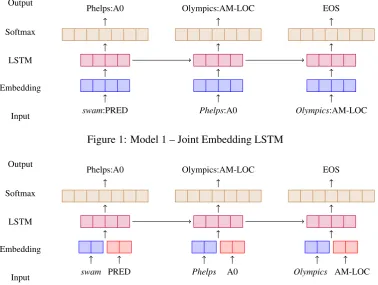
Model 1 consists of three layers (see Figure1): an embedding layer that learns vector representa-tions for input values; a long short-term memory (LSTM) layer that controls the sequential informa-tion receiving the vector representainforma-tion as input; and a softmax layer to predict the next argument using the output of the LSTM layer as input.
This model treats the word and semantic label as a single unit in both input and output layers. The model, therefore, learns joint embeddings for the word and its corresponding semantic label. For example, if we take “Michael Phelps swam at the Olympics” as training data, the three in-put values would beswam:PRED,Phelps:A0 and
Olympics:AM-LOC, and the three expected outputs would be Phelps:A0, Olympics:AM-LOC, EOS. Since each word:label is considered as a single unit, the embedding layer will learn three vector repre-sentations, one forswam:PRED, one forPhelps:A0, and one forOlympics:AM-LOC. As can be seen, an important difference between our problem and the traditional language model is that we have to deal with two different types of information – word and label. By concatenating word and label, the standard recurrent neural network model can be applied directly to our data.
The detail of Model 1 is as following:
Embedding Layer is a matrix of size|Vin| ×d
that maps each unit of input into and-dimensional vector. The matrix is initialized randomly and up-dated during network training.
LSTM Layer consists of m standard LSTM units which take as input the output of the em-bedding layer, xt, and produce an output ht by
updating at every time step0≤t≤T:
it=sigmoid(Wixt+Uiht−1+bi)
ˆ
Ct=tanh(Wcxt+Ucht−1+bc)
ft=sigmoid(Wfxt+Ufht−1+bf)
Ct=it∗Cˆt+ft∗Ct−1
ot=sigmoid(Woxt+Uoht−1+bo)
ht=ot∗tanh(Ct)
whereWi, Wc, Wf, Woare weight matrices of size
d×m;Ui, Uc, Uf, Uoare weight matrices of size
m×m;bi, bc, bf, boare bias vectors of sizem; and
Output
Softmax
LSTM
Embedding
Input swam:PRED
Phelps:A0
Phelps:A0 Olympics:AM-LOC
Olympics:AM-LOC EOS
Figure 1: Model 1 – Joint Embedding LSTM Output
Softmax
LSTM
Embedding
Input swam PRED
Phelps:A0
Phelps A0 Olympics:AM-LOC
Olympics AM-LOC EOS
Figure 2: Model 2 – Separate Embedding LSTM
the input gate, states of the memory cells, activation of the memory cells’ forget gates, memory cells’ new state, and output gates’ values, respectively.
Softmax Layer computes the probability distri-bution of the next argument given the preceding arguments at time stept:
P(wf,t+1:lf,t+1|wf,<t+1:lf,<t+1) =
softmax(htW +b) (1)
whereW is a weight matrix of sizem× |Vout|,
andbis a bias vector of size|Vout|. The predicted
next argument is: argmax
wf,t+1:lf,t+1
P(wf,t+1:lf,t+1|wf,<t+1:lf,<t+1)
The network is trained using the negative log-likelihood loss function.
3.2 Model 2: Separate Embedding LSTM
Model 2 shares the same basic structure as Model 1, but considers the word and the semantic label as two different units in the input layer. As shown in Figure2, we use two different embedding layers, one for word values and one for semantic labels, and the two embedding vectors are concatenated before being passed to the LSTM layer. The LSTM
and softmax layers are then the same as in Model 1. For example, if we take “Michael Phelps swam at the Olympics” as training data, the three input words would beswam,Phelps, andOlympics, the three input roles would be PRED, A0 and AM-LOC, and the three expected outputs would be
Phelps:A0,Olympics:AM-LOC, EOS. A total of
six different vector representations will be learned: a word embedding for each ofswam,Phelps, and
Olympics, and a label embedding for each of PRED, A0 and AM-LOC.
In this model, the embedding layer for labels is initialized randomly (as in Model 1), but the embedding layer for word values is initialized with publicly available word embeddings that have been trained on a large dataset (Mikolov et al.,2013).
As compared to the joint-embedding Model 1, the separate-embedding Model 2 gives up a little power to represent the interaction between words and labels, but has a less sparse input vocabulary and gains the ability to incorporate pre-trained word embeddings.
3.3 Selectional Preferences
p:PRED
w1:l1
w w:l
w:l P1
P2 Pw
P11 P12 Pw1 P21 P
22 Pw2
Pw11 P
w12
w2:l2 w:l
w11:l11 w12:l12 w21:l21 w22:l22
w:l w:l
w:l w:l
Pw21 Pw22
Time 0: S0 = [[p:PRED]]
Time 1: S1 = [[p:PRED,w1:l1], [p:PRED,w2:l2]]
Time 2: S2 = [[p:PRED,w1:l1,w11:l11], [[p:PRED,w1:l1,w12:l12],
[p:PRED,w2:l2,w21:l21], [p:PRED,w2:l2,w22:l22]] P(w:l|p) ~ Pw+Pw1P1+Pw2P2+Pw11P11P1 + Pw12P12P1 + Pw21P21P2 + Pw22P22P2
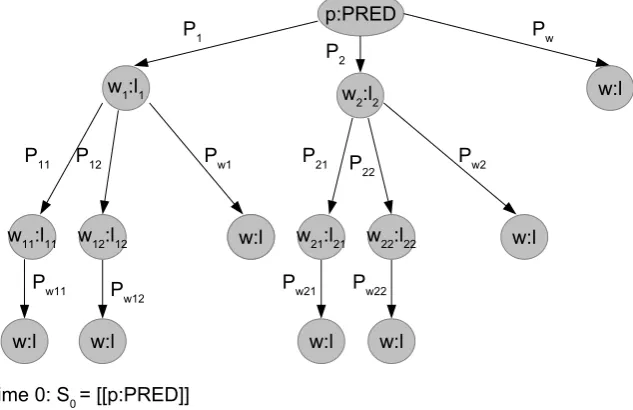
Figure 3: Selectional Preference Inference example:k=2,T=3. The possible sequences are represented as a tree. Each arrow label is the probability of the target node to be predicted given the path from the tree root to the parent of the target node.
system needs a selectional preferencescore rep-resenting the probability of a wordwbeing thel
argument of predicatep,P(w:l|p:P RED). Thus, to convert our PRNSFM probabilities to selectional preferences, we need to marginalize over the possi-ble argument sequences.
We approximate this marginalization by con-structing a tree where the root is the predicate,p, the branches are likely sequences of arguments, and the leaves are the word and label for which we need to estimate a probability,w:l. Formally, we define this tree of possible sequences as:
St=
{[p:P RED]} ift= 0
{[q, wt:lt]: q∈St−1,
wt:lt∈argmaxk(q)}
if0< t < T
{[q, w:l]:q ∈St−1} ift=T
wherewf,0:lf:0 =p:P RED;kandT are
thresh-olds; and argmaxk(q)is thekword:label pairs
that have the highest probability of being the next argument given the sequence q according to the PRNSFM.
We then estimateP(w:l|p:P RED)as the sum of the probabilities of all the sequences encoded in
the tree. Formally:
P(w:l|p:P RED)≈ X
0≤t≤T
P(w:l|wf,<t+1:lf,<t+1)
≈ X
0≤t≤T
X
q∈St
P(w:l|q)×P(q)
where the probability of an argument sequenceqis the product of the PRNSFM’s estimates for each step in the sequence:
P(q) =P(wt:lt|wt−1:lt−1, . . . , p:PRED)
×P(wt−1:lt−1|wt−2:lt−2, . . . , p:PRED)
×. . .×P(w1:l1|p:PRED) (2)
An example of the calculation ofP(w:l|p:P RED) is shown in Figure3.
all possible sequences, so we must limit the tree somehow. Thus, we only ask the PRNSFM for its topkpredictions at each branch point, and we only explore sequences with a maximum length ofT. 4 Implicit Semantic Role Labeling
As you will recall from previous sections, implicit semantic role labeling is the task of identifying discourse-level arguments of a semantic frame, which are missed by standard semantic role label-ing, which operates on individual sentences. For instance, in “This house has a new owner. The sale was finalized 10 days ago.”, the semantic frame evoked by “sale” in the second sentence should receive “the house” as an implicit A1 semantic role. Humans easily resolve the object of the sale given the candidates (in our example: “house” and “owner”), but for a machine this is more difficult unless it has knowledge on what the likely objects of a sale are. This kind of knowledge of selec-tional preferences can be extracted from our trained PRNSFM.
The previous section described how to extract selectional preferences from our PRNSFM. How-ever, that model is trained on verbal predicates, and the test data that we use (Gerber and Chai,2010) contains nominal predicates. Thus, for each triple of a nominal predicatenp, a word candidatew, and a labell, we approximate the selectional preference score ofwbeing the implicit argument rolelofnp
as:
P(w:l|np) =maxp∈V(np)P(w:l|p:PRED) whereP(w:l|p)is the selectional preference score described in Section3.3, andV(np)is set of verbal forms ofnp. Here, we use the NomBank lexicon to get verbs associated with each nominal predicate, and then find instances of those verbs in the explicit SRL training data. For example, for the nounfunds,
V(funds) ={funds,fund,funding,funded}. We apply selectional preferences to iSRL follow-ing (Laparra and Rigau,2013). For each nominal predicatenpand implicit labell, the current and previous two sentences are designated thecontext window. Each sentence in the context window is annotated with the explicit SRL system. If any in-stances ofnporV(np)in the text have an explicit argument of type l, we deterministically predict the closest such argument as the implicitl argu-ment ofnp. Otherwise, we run the PRNSFM over each word in the context window, and select the
word with the highest selectional preference score above a thresholds. If all the candidates’ scores are less thans, the system leaves the missing argu-ment unfilled. We optimized this threshold on the development data, resulting ins= 0.0003.
As in Laparra and Rigau (2013), we apply a
sentence recency factorto emphasize recent can-didates. The selectional preference scorexis up-dated as x0 = x− z+z ×αd where d is the
sentence distance, andαandzare parameters. We setz= 0.00005based on the development set and setα= 0.5as in (Laparra and Rigau,2013). 5 Experiments
We evaluate the two PRNSFM models on the iSRL task. The tools, resources, and settings we used are as follows:
Semantic Role Labeling We used the full pipeline from MATE (https://code.google.com/ archive/p/mate-tools/) (Bj¨orkelund et al.,2010) as the explicit SRL system, retraining it on just the CoNLL 2009 training portion.
Unannotated Data The unannotated data used in the experiments was drawn from Wikipedia (http://corpus.byu.edu/wiki/), Reuters (http://about. reuters.com/researchandstandards/corpus/), and Brown (https://catalog.ldc.upenn.edu/ldc99t42).
Dataset for PRNSFM The first 15 milion short and medium (less than 100 words) sentences from the unannotated data (described above) were an-notated automatically by the explicit SRL system. The obtained annotations were then used together with the gold standard CoNLL 2009 SRL training data to train the PRNSFM.
Neural network training and inference Param-eters were selected using the CoNLL 2009 develop-ment set. We set the dimensions of word and label embeddings in the PRNSFM to 50 and 16, respec-tively. The hidden sizes of LSTM layers are the same as their input sizes. Word embedding layers are initialized by Skip-gram embeddings learned by training the word2vec tool (Mikolov et al.,2013) on the unannotated data. Our models were trained for 120 epochs using the AdaDelta optimization algorithm (Zeiler,2012). For fast selectional pref-erence computing, we setk= 1andT = 41.
1We selected relatively small values for the parameters to
Evaluation We follow the evaluation setting in Gerber and Chai(2010);Laparra and Rigau(2013); Schenk and Chiarcos(2016)2: the method is
evalu-ated on the evaluation portion of the nominal iSRL data by Dice coefficient metrics. For each miss-ing argument position of a predicate instance, the system is required to either (1) identify a single constituent that fills the missing argument position or (2) make no prediction and leave the missing argument position unfilled. To give partial credit for inexact argument boundaries, predictions are scored by using the Dice coefficient, which is de-fined as follows:
Dice(predicted, true) = 2|predicted|predicted|+∩|truetrue||
P redictedcontains the tokens that the model has identified as the filler of the implicit argument po-sition. T rue is the set of tokens from a single annotated constituent that truely fill the missing ar-gument position. The model’s prediction receives a score equal to the maximum Dice overlap across any of the annotated fillers (AF)3:
Score(predicted) = max
true∈AFDice(predicted, true)
Precision is equal to the summed prediction scores divided by the number of argument positions filled by the model. Recall is equal to the summed pre-diction scores divided by the number of argument positions filled in the annotated data.
5.1 Experimental Setup
In the baseline mode, instead of using the PRNSFM, we only use the deterministic predic-tion by the explicit SRL system. We refer to this mode asBaselinein Table1.
In themain mode, the joint embedding LSTM model (Model 1) and the separate embedding LSTM model (Model 2) were trained on the same dataset which is a combination of the automatic SRL annotations and the gold standard CoNLL small values reported in the article achieved similar results with faster processing times.
2FollowingSchenk and Chiarcos(2016), we do not
per-form the alternative evaluation ofGerber and Chai(2012) that evaluates systems on the iSRL training set, since the iSRL training set overlaps with the CoNLL 2009 explicit semantic role training set on which MATE is trained.
3For iSRL, one implicit role may receive more than one
annotated filler across a coreference chain in the discourse.
2009 training data as described in the previous sec-tion. We denote this mode asgold CoNLL 2009 + unlabeledin Table1.
To evaluate how well the system acquires knowl-edge from unlabeled data, we also train the PRNSFM only on the gold standard CoNLL 2009 training data. We denote this mode asCoNLL 2009
in Table1.
In order to compare the performance of our se-quential model to a non-sese-quential model, we train a skip-gram neural language model on the same unlabeled and labeled data as the PRNSFM in the main mode. The skip-gram model treats the pred-icates and arguments as a bag of labeled words rather than a sequence. TheP(w:l|p)is computed at the output layer of the skip-gram model by con-sideringw:las the context of p. We denote this mode asSkip-gramin Table1.
5.2 Results and Discussion
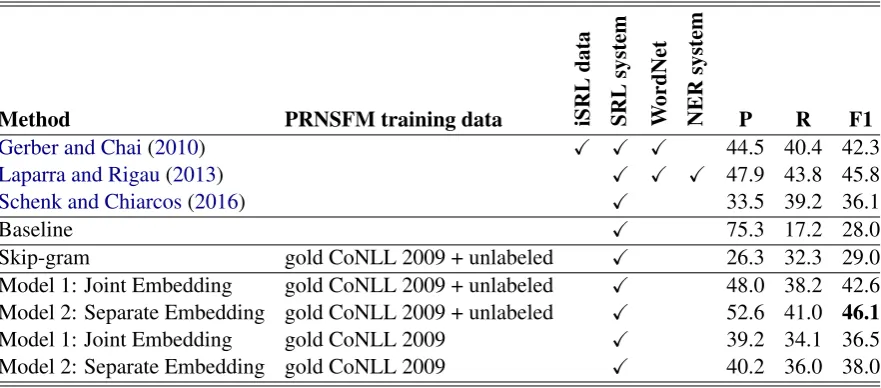
Table 1 shows the prior state-of-the-art and the performance of the baseline, skip-gram and our PRNSFM-based methods.
Our Model 2 achieves the highest precision and F1 score. This is notable because the first two mod-els require many more language resources than just an explicit SRL system: Gerber and Chai (2010) use WordNet and manually annotated iSRL data, whileLaparra and Rigau(2013) use WordNet, named entity annotations, and manual semantic category mappings. Schenk and Chiarcos(2016), like our approach, use only an explicit SRL sys-tem, but both our models strongly outperform their results. We assume that the difference here is caused by our proposed neural semantic frame model (PRNSFM).Schenk and Chiarcos (2016) measure the selectional preference of a predicate and a role as a cosine between a standard word2vec embedding for the candidate word, and the aver-age of all word2vec embeddings for all words that appear in that role. Our algorithms are very differ-ent: we take a language modeling approach and leverage the sequence of semantic roles, we learn custom word/role embeddings tuned for SRL, and then marginalize over many possible argument se-quences. We assume that the learned PRNSFM representations are better informed about semantic frames than simple word embeddings, which only capture knowledge of contextual words.
com-Method PRNSFM training data iSRL
data
SRL
system
W
ordNet
NER
system
P R F1
Gerber and Chai(2010) X X X 44.5 40.4 42.3
Laparra and Rigau(2013) X X X 47.9 43.8 45.8
Schenk and Chiarcos(2016) X 33.5 39.2 36.1
Baseline X 75.3 17.2 28.0
Skip-gram gold CoNLL 2009 + unlabeled X 26.3 32.3 29.0
Model 1: Joint Embedding gold CoNLL 2009 + unlabeled X 48.0 38.2 42.6 Model 2: Separate Embedding gold CoNLL 2009 + unlabeled X 52.6 41.0 46.1
Model 1: Joint Embedding gold CoNLL 2009 X 39.2 34.1 36.5
Model 2: Separate Embedding gold CoNLL 2009 X 40.2 36.0 38.0 Table 1: Implicit role labeling evaluation.
pared to training on only the CoNLL 2009 labeled data, providing evidence that the models have ac-quired linguistic knowledge from the unlabeled data. Although the automatically annotated data used to train the PRNSFM can be noisy, using a large amount of data has smoothed out the noise.
Moreover, the better performance of our mod-els over the standard skip-gram neural language model proves the effectiveness of modeling seman-tic frames as sequential data. The intuition here is that explicit semantic arguments have typical or-derings in which they occur, so a sequential model should be a good fit for this problem. Modeling this sequential aspect of the problem is effective, but requires us to marginalize out positional infor-mation to compute selectional preferences, since implicit semantic arguments can occur anywhere in the discourse and do not have a typical position.
Among our two models, Model 2, which learns separate vector representations for words and se-mantic roles, is better than Model 1, which learns a single vector representation of each (word, seman-tic role) pair. The separate representation of words and roles means that Model 2 can share informa-tion across multiple occurrences of a word even if the semantic roles of that word are different, and this model can use publicly available embeddings pre-trained from even larger unannotated corpora when initializing its embeddings.
Gerber and Chai(2012) report an inter-annotator agreement of 64.3% using Cohen’s kappa mea-sure on the annotated NomBank-based iSRL data. This value is borderline between low and moderate agreement indicating the sheer complexity of the
Predicate Baseline 2010 2013 2016 2017 sale 36.2 44.2 40.3 37.2 52.8
price 15.4 34.2 53.3 27.3 29.0 investor 9.8 38.4 41.2 33.9 43.1
bid 32.3 21.3 52.0 40.7 35.5 plan 38.5 64.7 40.7 47.4 76.8
cost 34.8 62.9 53.0 36.9 44.4 loss 52.6 83.3 65.8 58.9 72.8 loan 18.2 37.5 22.2 37.9 38.6
investment 0.0 30.8 40.8 36.6 23.5 fund 0.0 15.4 44.4 37.5 42.8 Table 2: A comparison on F1 scores (%). 2010: (Gerber and Chai,2010), 2013: (Laparra and Rigau, 2013), 2016: Best model from (Schenk and Chiar-cos,2016), 2017: Our best model (Model 2).
annotation task, and explaining the relatively low performance of the iSRL systems.
In Table2, we compare the F1 scores over all the ten predicates of our Model 2 to other state-of-the-art systems4. Our system obtains relatively
high scores (>50%) on three predicates including “sale”, “plan” and “loss”. These three are the most frequent predicates (among the 10 defined in the nominal iSRL dataset) in the CoNLL 2009 train-ing data – they occur 1016, 318 and 275 times in verbal forms, respectively. In contrast, irregular predicates such as “bid” or “loan” usually have low performance. This is possibly caused by the
de-4As an overly conservative estimate, we take a t-test over
pendence of our PRNSFM on the performance of the explicit semantic role labeling system on verbal predicates.
It is important to consider how iSRL can be ex-tended beyond the 10 annotated predicates of Ger-ber and Chai(2010). Our models do not require any handcrafted iSRL annotations for training, and thus can be applied to all predicates observed in large unannotated data on which they are trained.
However, as other work in iSRL, our approach still relies on a resource-heavy SRL system to learn selectional preferences. It would be interesting to investigate in further studies whether this SRL system can be replaced by a low-resource system (Collobert et al.,2011;Connor et al.,2012). 6 Conclusion and Future Work
We have presented recurrent neural semantic frame models for learning probability distributions over semantic argument sequences. By modeling se-lectional preferences from these probability dis-tributions, we have improved state-of-the-art per-formance on the NomBank iSRL task while us-ing fewer language resources. In the future, we believe that our semantic frame models are valu-able in many language processing tasks that require discourse-level understanding of language, such as summarization, question answering and machine translation.
Acknowledgment
This work is carried out in the frame of the EU CHIST-ERA project “MUltimodal processing of Spatial and TEmporal expRessions” (MUSTER), and the “MAchine Reading of patient recordS” project (MARS, KU Leuven, C22/015/016).
References
Collin F. Baker, Charles J. Fillmore, and John B. Lowe. 1998. The berkeley framenet project. In Proceed-ings of the 36th Annual Meeting of the Associa-tion for ComputaAssocia-tional Linguistics and 17th Inter-national Conference on Computational Linguistics - Volume 1. Association for Computational
Linguis-tics, Stroudsburg, PA, USA, ACL ’98, pages 86–90.
https://doi.org/10.3115/980845.980860.
Anders Bj¨orkelund, Bernd Bohnet, Love Hafdell, and Pierre Nugues. 2010. A high-performance syn-tactic and semantic dependency parser. In Col-ing 2010: Demonstrations. Coling 2010 Orga-nizing Committee, Beijing, China, pages 33–36.
http://www.aclweb.org/anthology/C10-3009.
Ronan Collobert, Jason Weston, L´eon Bottou, Michael Karlen, Koray Kavukcuoglu, and Pavel Kuksa. 2011. Natural language processing (almost) from scratch. J. Mach. Learn. Res.12:2493–2537.
http://dl.acm.org/citation.cfm?id=1953048.2078186. M. Connor, C. Fisher, and D. Roth. 2012. Starting from
Scratch in Semantic Role Labeling: Early Indirect Supervision. Cognitive Aspects of Computational Language Acquisition.
Karl Friston. 2010. The free-energy principle: a uni-fied brain theory? Nature Reviews Neuroscience
11(2):127–138.https://doi.org/10.1038/nrn2787. Matt Gerber, Joyce Y. Chai, and Adam Meyers. 2009.
The role of implicit argumentation in nominal srl. In Proceedings of Human Language Technologies: The 2009 Annual Conference of the North American Chapter of the Association for Computational Lin-guistics. Association for Computational Linguistics, Stroudsburg, PA, USA, NAACL ’09, pages 146–154.
http://dl.acm.org/citation.cfm?id=1620754.1620776. Matthew Gerber and Joyce Chai. 2010. Beyond
NomBank: A Study of Implicit Arguments for Nominal Predicates. In Proceedings of the 48th Annual Meeting of the Association for Computa-tional Linguistics. Association for Computational Linguistics, Uppsala, Sweden, pages 1583–1592.
http://www.aclweb.org/anthology-new/P/P10/P10-1160.bib.
Matthew Gerber and Joyce Y. Chai. 2012. Semantic role labeling of implicit arguments for nominal pred-icates.Computational Linguistics38(4):755–798. C.A. Kurby and J.M. Zacks. 2015. Situation Models in
Naturalistic Comprehension, Cambridge University Press, pages 59–76.
Egoitz Laparra and German Rigau. 2013. Impar: A deterministic algorithm for implicit semantic role labelling. In Proceedings of the 51st Annual Meeting of the Association for Computational Lin-guistics, ACL 2013, 4-9 August 2013, Sofia, Bul-garia, Volume 1: Long Papers. pages 1180–1189.
http://aclweb.org/anthology/P/P13/P13-1116.pdf. A. Meyers, R. Reeves, C. Macleod, R. Szekely,
V. Zielinska, B. Young, and R. Grishman. 2004. The nombank project: An interim report. In A. Meyers, editor, HLT-NAACL 2004 Workshop: Frontiers in Corpus Annotation. Association for Computational Linguistics, Boston, Massachusetts, USA, pages 24– 31.
Tomas Mikolov, Kai Chen, Greg Corrado, and Jef-frey Dean. 2013. Efficient estimation of word rep-resentations in vector space. CoRRabs/1301.3781.
http://arxiv.org/abs/1301.3781.
Martha Palmer, Daniel Gildea, and Paul
Kingsbury. 2005. The Proposition Bank:
An annotated corpus of semantic roles.
Computational Linguistics 31(1):71–106.
http://www.cs.rochester.edu/ gildea/palmer-propbank-cl.pdf.
Haoruo Peng and Dan Roth. 2016. Two discourse driven language models for semantics. In Proceed-ings of the 54th Annual Meeting of the Association for Computational Linguistics, ACL 2016, August 7-12, 2016, Berlin, Germany, Volume 1: Long Papers.
http://aclweb.org/anthology/P/P16/P16-1028.pdf.
Jeffrey Pennington, Richard Socher, and Christopher D. Manning. 2014. Glove: Global vectors for word representation. In Empirical Methods in Natural Language Processing (EMNLP). pages 1532–1543.
http://www.aclweb.org/anthology/D14-1162.
Michael Roth and Anette Frank. 2015. Inducing Im-plicit Arguments from Comparable Texts: A Frame-work and its Applications. Computational Linguis-tics41:625–664.
Josef Ruppenhofer, Caroline Sporleder, Roser Morante, Collin Baker, and Martha Palmer. 2010.
Semeval-2010 task 10: Linking events and their participants in discourse. In Proceedings of the 5th International Workshop on Semantic Evalua-tion. Association for Computational Linguistics, Stroudsburg, PA, USA, SemEval ’10, pages 45–50.
http://dl.acm.org/citation.cfm?id=1859664.1859672.
D.L. Schacter and K.P. Madore. 2016. Remember-ing the past and imaginRemember-ing the future: IdentifyRemember-ing and enhancing the contribution of episodic memory.
Memory Studies9(3):245–255.
Niko Schenk and Christian Chiarcos. 2016. Unsuper-vised learning of prototypical fillers for implicit se-mantic role labeling. In NAACL HLT 2016, The 2016 Conference of the North American Chapter of the Association for Computational Linguistics: Human Language Technologies, San Diego Cali-fornia, USA, June 12-17, 2016. pages 1473–1479.
http://aclweb.org/anthology/N/N16/N16-1173.pdf.
Ivan Titov and Ehsan Khoddam. 2015. Unsupervised induction of semantic roles within a reconstruction-error minimization framework. In Proceedings of the North American chapter of the Association for Computational Linguistics (NAACL).
David Vernon. 2014. Artificial Cognitive Systems: A Primer. The MIT Press.
Kristian Woodsend and Mirella Lapata. 2015. Dis-tributed representations for unsupervised semantic role labeling. In Proceedings of the 2015 Con-ference on Empirical Methods in Natural Lan-guage Processing. Association for Computational Linguistics, Lisbon, Portugal, pages 2482–2491.
http://aclweb.org/anthology/D15-1295.
Matthew D. Zeiler. 2012. ADADELTA: an adap-tive learning rate method. CoRR abs/1212.5701.