Stochastically Evaluating the Validity of Partial Parse Trees in
Incremental Parsing
Yoshihide Kato1, Shigeki Matsubara2 and Yasuyoshi Inagaki3
Graduate School of International Development, Nagoya University1
Information Technology Center, Nagoya University2
Furo-cho, Chikusa-ku, Nagoya, 464-8601 Japan
Faculty of Information Science and Technology, Aichi Prefectural University3
1522-3 Ibaragabasama, Kumabari, Nagakute-cho, Aichi-gun, 480-1198 Japan
Abstract
This paper proposes a method for evaluating the validity of partial parse trees constructed in incre-mental parsing. Our method is based on stochastic incremental parsing, and it incrementally evaluates the validity for each partial parse tree on a word-by-word basis. In our method, incremental parser returns partial parse trees at the point where the va-lidity for the partial parse tree becomes greater than a threshold. Our technique is effective for improv-ing the accuracy of incremental parsimprov-ing.
1 Introduction
Real-time spoken language processing systems, such as simultaneous machine interpretation sys-tems, are required to quickly respond to users’ utter-ances. To fulfill the requirement, the system needs to understand spoken language at least incremen-tally (Allen et al., 2001; Inagaki and Matsubara, 1995; Milward and Cooper, 1994), that is, to ana-lyze each input sentence from left to right and ac-quire the content.
Several incremental parsing methods have been proposed to date (Costa et al., 2001; Haddock, 1987; Matsubara et al., 1997; Milward, 1995; Roark, 2001). These methods construct candidate partial parse trees for initial fragments of the input sentence on a word-by-word basis. However, these methods contain local ambiguity problems that par-tial parse trees representing valid syntactic relations can not be determined without using information from the rest of the input sentence.
On the other hand, Marcus proposed a method of deterministically constructing valid partial parse trees by looking ahead several words (Marcus, 1980), while Kato et al. proposed an incremental parsing which delays the decision of valid partial parse trees (Kato et al., 2000). However, it is hard to say that these methods realize broad-coverage incre-mental parsing. The method in the literature (Mar-cus, 1980) uses lookahead rules, which are con-structed by hand, but it is not clear whether broad
coverage lookahead rules can be obtained. The
incremental parsing in the literature (Kato et al., 2000), which is based on context free grammar, is infeasible to deal with large scale grammar, because the parser exhaustively searches all candidate partial parse trees in top-down fashion.
This paper proposes a probabilistic incremental parser which evaluates the validity of partial parse trees. Our method extracts a grammar from a tree-bank, and the incremental parsing uses a beam-search strategy so that it realizes broad-coverage parsing. To resolve local ambiguity, the parser in-crementally evaluates the validity of partial parse trees on a word-by-word basis, and delays the deci-sion of which partial parse trees should be returned, until the validity for the partial parse tree becomes greater than a threshold. Our technique is effective for improving the accuracy of incremental parsing.
This paper is organized as follows: The next section proposes a probabilistic incremental parser. Section 3 discusses the validity of partial parse tree constructed in incremental parsing. Section 4 pro-poses a method of incrementally evaluating the va-lidity of partial parse tree. In section 5, we report an experimental evaluation of our method.
2 TAG-based Incremental Parsing
Our incremental parsing is based on tree adjoining grammar (TAG) (Joshi, 1985). This section pro-poses a TAG-based incremental parsing method.
2.1 TAG for Incremental Parsing
Firstly, we propose incremental-parsing-oriented TAG (ITAG). An ITAG comprises two sets of ele-mentary trees just like TAG: initial trees and auxil-iary trees. The difference between ITAG and TAG is the form of elementary trees. Every ITAG ini-tial tree is expanded. A tree is leftmost-expanded if it is of the following forms:
1. [t]X, where tis a terminal symbol andX is a
S NP VP PRP
I
VP VB NP found
NP DT NN
a
NN dime
NP DT NN the
NN wood Initial trees:
1 2 5 7 8 10VP VB NP found
3ADJP
PP
IN NP
in NP
NP* PP
IN NP
in VP VP* Auxiliary trees:
1 2NP
DT NN
a
6JJ
NP
DT NN
the
9 [image:2.595.80.292.79.281.2]JJ VP VB found
4Figure 1: Examples of ITAG elementary trees
2. [σX1· · ·Xk]X, whereσis a leftmost expanded
tree,X1, . . . , Xk,Xare nonterminal symbols.
On the other hand, every ITAG auxiliary tree is of the following form:
[X∗σX
1· · ·Xk]X
where σ is a leftmost expanded tree and X,
X1, . . . , Xkare nonterminal symbols. X∗ is called
a foot node. Figure 1 shows examples of ITAG ele-mentary trees.
These elemental trees can be combined by using two operations: substitution and adjunction.
substitution The substitution operation replaces a
leftmost nonterminal leaf of a partial parse tree
σwith an initial treeαhaving the same
nonter-minal symbol at its root. We writesα for the
operation of substituting α and sα(σ) for the
result of applyingsαtoσ.
adjunction The adjunction operation splits a
par-tial parse treeσ at a nonterminal node having
no nonterminal leaf, and inserts an auxiliary
treeβ having the same nonterminal symbol at
its root. We writeaβ for the operation of
ad-joiningβ andaβ(σ)for the result of applying
aβ toσ.
The substitution operation is similar to rule expan-sion of top-down incremental parsing such as (Mat-subara et al., 1997; Roark, 2001). Furthermore, by introducing the adjunction operation to incre-mental parsing, we can expect that local ambiguity of left-recursive structures is decreased (Lombardo and Sturt, 1997).
Our proposed incremental parsing is based on
ITAG. When i-th word wi is scanned, the parser
combines elementary trees forwiwith partial parse
trees for w1· · ·wi−1 to construct the partial parse
trees forw1· · ·wi−1wi.
As an example, let us consider incremental pars-ing of the followpars-ing sentence by uspars-ing ITAG shown in Figure 1:
I found a dime in the wood. (1)
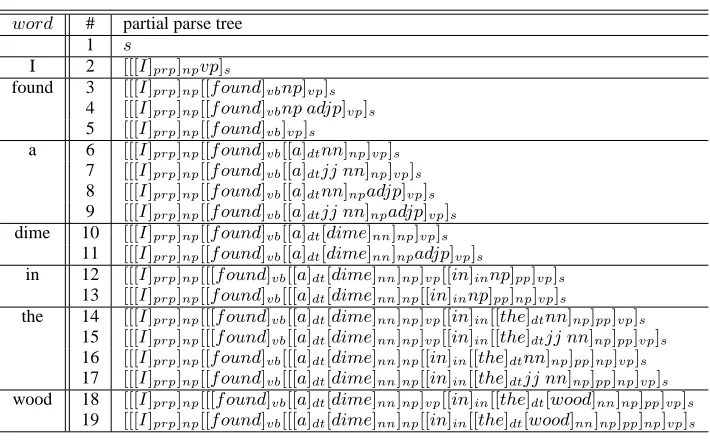
Table 1 shows the process of tree construction for the sentence (1). When the word “found” is scanned, partial parse trees #3, #4 and #5 are con-structed by applying substitution operations to par-tial parse tree #2 for the inipar-tial fragment “I”. When the word “in” is scanned, partial parse trees #12 and #13 are constructed by applying adjunction opera-tions to partial parse tree #10 for the initial frag-ment “I found a dime”. This example shows that the ITAG based incremental parsing is capable of constructing partial parse trees of initial fragments for every word input.
2.2 ITAG Extraction from Treebank
Here, we propose a method for extracting an ITAG from a treebank to realize broad-coverage incre-mental parsing. Our method decomposes parse trees in treebank to obtain ITAG elementary trees. The decomposition is as follows:
• for each node η1 having no left-sibling, if the
parentηp has the same nonterminal symbol as
η1, split the parse tree atη1 andηp, and
com-bine the upper tree and the lower tree. η1 of
intermediate tree is a foot node.
• for each nodeη2 having only one left-sibling,
if the parentηpdoes not have the same
nonter-minal symbol as the left-siblingη1ofη2, split
the parse tree atη2.
• for the other nodeηin the parse tree, split the
parse tree atη.
For example, The initial treesα1,α2,α5,α7α8and
α10and the auxiliary treeβ2are extracted from the
parse tree #18 in Table 1.
Table 1: Incremental parsing process of “I found a dime in the wood.”
word # partial parse tree
1 s
I 2 [[[I]prp]npvp]s
found 3 [[[I]prp]np[[f ound]vbnp]vp]s 4 [[[I]prp]np[[f ound]vbnp adjp]vp]s 5 [[[I]prp]np[[f ound]vb]vp]s
a 6 [[[I]prp]np[[f ound]vb[[a]dtnn]np]vp]s 7 [[[I]prp]np[[f ound]vb[[a]dtjj nn]np]vp]s 8 [[[I]prp]np[[f ound]vb[[a]dtnn]npadjp]vp]s 9 [[[I]prp]np[[f ound]vb[[a]dtjj nn]npadjp]vp]s dime 10 [[[I]prp]np[[f ound]vb[[a]dt[dime]nn]np]vp]s
11 [[[I]prp]np[[f ound]vb[[a]dt[dime]nn]npadjp]vp]s
in 12 [[[I]prp]np[[[f ound]vb[[a]dt[dime]nn]np]vp[[in]innp]pp]vp]s 13 [[[I]prp]np[[f ound]vb[[[a]dt[dime]nn]np[[in]innp]pp]np]vp]s
the 14 [[[I]prp]np[[[f ound]vb[[a]dt[dime]nn]np]vp[[in]in[[the]dtnn]np]pp]vp]s 15 [[[I]prp]np[[[f ound]vb[[a]dt[dime]nn]np]vp[[in]in[[the]dtjj nn]np]pp]vp]s 16 [[[I]prp]np[[f ound]vb[[[a]dt[dime]nn]np[[in]in[[the]dtnn]np]pp]np]vp]s 17 [[[I]prp]np[[f ound]vb[[[a]dt[dime]nn]np[[in]in[[the]dtjj nn]np]pp]np]vp]s wood 18 [[[I]prp]np[[[f ound]vb[[a]dt[dime]nn]np]vp[[in]in[[the]dt[wood]nn]np]pp]vp]s
19 [[[I]prp]np[[f ound]vb[[[a]dt[dime]nn]np[[in]in[[the]dt[wood]nn]np]pp]np]vp]s
at left recursive nodes and nodes having left-sibling. The elementary trees extracted by our method are of the forms described in section 2.1, and can be com-bined from left to right on a word-by-word basis. The property is suitable for incremental parsing. On the other hand, the elementary trees obtained by the method based on head information does not neces-sarily have this property1.
2.3 Probabilistic ITAG
This section describes probabilistic ITAG (PITAG) which is utilized by evaluating partial parse trees in incremental parsing. PITAG assigns a probability to the event that an elementary tree is combined by substitution or adjunction with another tree.
We induce the probability by maximum
likeli-hood estimation. Letαbe an initial tree andX be
the root symbol ofα. The probability thatαis
sub-stituted is calculated as follows:
P(sα) = P C(sα)
α0∈I(X)C(sα0) (2)
whereC(sα)is the count of the number of times of
applying substitutionsα in the treebank, andI(X)
is the set of initial trees whose root is labeled with X.
1
For example, the tree extraction based on head informa-tion splits the parse tree #18 at the node labeled withdtto ob-tain the elementary tree[a]dtfor “a”. However, the tree[a]dt cannot be combined with the partial parse tree for “I found”, since substitution node labeled withdtexists in the initial tree
[dt[dime]nn]npfor “dime” and not the partial parse trees for “I found”.
Letβbe a auxiliary tree andXbe the root symbol
ofβ. The probability thatβis adjoined is calculated as follows:
P(aβ) = C(aβ)
C(X) (3)
where C(X) is the count of the number of
occur-rences of symbolX. The probability that adjunction
is not applied is calculated as follows:
P(nilX) = 1− X
β∈A(X)
P(aβ) (4)
wherenilXmeans that the adjunction is not applied
to a node labeled withX, andA(X)is the set of all
auxiliary trees whose root is labeledX.
In this PITAG formalism, the probability that el-ementary trees are combined at each node depends
only on the nonterminal symbol of that node2.
The probability of a parse tree is calculated by the product of the probability of the operations which are used in construction of the parse tree. For ex-ample, the probability of each operation is given as shown in Table 2. The probability of the partial
parse tree #12, which is constructed by using sα1,
sα2, sα5, sα7, nilN P andaβ2, is 1×0.7×0.3×
0.5×0.7×0.7 = 0.05145.
We write P(σ) for the probability of a partial
parse treeσ.
2
Table 2: Probability of operations
operation probability
sα1 1.0
sα2 0.7
sα7,sα10 0.5 sα5,sα8 0.3 sα4,sα6,sα9 0.2
sα3 0.1
aβ1 0.3
aβ2 0.7
nilN P 0.7
nilV P 0.3
2.4 Parsing Strategies
In order to improve the efficiency of the parsing, we adapt two parsing strategies as follows:
• If two partial parse trees have the same
se-quence of nodes to which ITAG operations are applicable, then the lower probability tree can be safely discarded.
• The parser only keeps n-best partial parse trees.
3 Validity of Partial Parse Trees
This section gives some definitions about the valid-ity of a partial parse tree. Before describing the va-lidity of a partial parse tree, we define the subsump-tion relasubsump-tion between partial parse trees.
Definition 1 (subsumption relation) Let σ and τ be partial parse trees. Then we write σ ¤τ, if
sα(σ) = τ, for some initial treeα oraβ(σ) = τ, for some auxiliary tree β. Let ¤∗ be the reflexive transitive closure of¤. We say thatσ subsumesτ,
ifσ¤∗τ. 2
Thatσ subsumesτ means thatτ is the result of
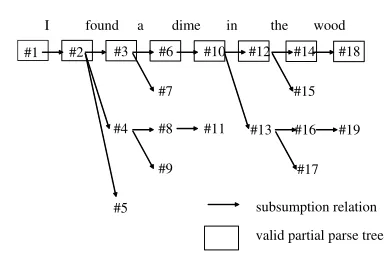
ap-plying a substitution or an adjunction toσ. Figure 2
shows the subsumption relation between the partial parse trees constructed for the sentence (1).
If a partial parse tree for an initial fragment repre-sents a syntactic relation correctly, the partial parse tree subsumes the correct parse tree for the input sentence. We say that such a partial parse tree is
valid. The validity of a partial parse tree is defined
as follows:
Definition 2 (valid partial parse tree) Let σ be a partial parse tree and w1· · ·wn be an input sen-tence. We say thatσis valid forw1· · ·wnifσ sub-sumes the correct parse tree forw1· · ·wn. 2
#1 I
#2 #3 #6
#7
found a dime
#10 #12 #14 #18
#19 #16 #13
in the wood
subsumption relation
#4 #8
#9 #11
#15
#17
#5
Figure 2: Subsumption relation between partial parse trees
#1 I
#2 #3 #6
#7
found a dime
#10 #12 #14 #18
#19 #16 #13
in the wood
subsumption relation
#4 #8
#9 #11
#15
#17
valid partial parse tree #5
Figure 3: Valid partial parse trees
For example, assume that the #18 is correct parse tree for the sentence (1). Then partial parse tree #3
is valid for the sentence (1), because #3¤∗#18. On
the other hand, partial parse tree #4 and #5 are not valid for (1). Figure 3 shows the valid partial parse trees for the sentence (1).
4 Evaluating the Validity of Partial Parse Tree
The validity of a partial parse tree for an initial frag-ment depends on the rest of the sentence. For ex-ample, the validity of the partial parse trees #3, #4 and #5 depends on the remaining input that follows the word “found.” This means that the validity dy-namically varies for every word input. We define a conditional validity of partial parse tree:
V(σ |w1· · ·wj) = P
τ∈Sub(σ,w1···wj)P(τ)
P
τ∈T(w1···wj)P(τ) (5)
where σ is a partial parse tree for an initial
frag-ment w1· · ·wi(i ≤ j), T(w1· · ·wj) is the set of
constructed partial parse trees for the initial frag-mentw1· · ·wj andSub(σ, w1· · ·wj)is the subset
ofT(w1· · ·wj)whose elements are subsumed byσ.
The equation (5) represents the validity ofσon the
condition w1· · ·wj. σ is valid for input sentence
[image:4.595.118.249.105.247.2] [image:4.595.326.520.227.358.2]subsumed byσis valid. The equation 5 is the ratio of such partial parse trees to the constructed partial parse trees.
4.1 Output Partial Parse Trees
Kato et al. proposed a method of delaying the deci-sion of which partial parse trees should be returned as the output, until the validity of partial parse trees
are guaranteed (Kato et al., 2000). The idea of
delaying the decision of the output is interesting. However, delaying the decision until the validity are guaranteed may cause the loss of incrementality of the parsing.
To solve the problem, in our method, the in-cremental parser returns high validity partial parse trees rather than validity guaranteed partial parse trees.
When thej-th wordwjis scanned, our
incremen-tal parser returns the following partial parse:
argmax{σ:V(σ,w1···wj)≥θ}l(σ) (6)
where θ is a threshold between [0,1] and l(σ) is
the length of the initial fragment which is yielded by σ. The output partial parse tree is the one for the longest initial fragment in the partial parse trees
whose validity are greater than a thresholdθ.
4.2 An Example
Let us consider a parsing example for the sentence (1). We assume that the thresholdθ= 0.8.
Let us consider when the partial parse tree #3, which is valid for (1), is returned as output. When the word “found” is scanned, partial parse
trees #3, #4 and #5 are constructed. That is,
T(I found) = {#3,#4,#5}. As shown in Figure
2, Sub(#3,I found) = {#3}. Furthermore,
P(#3) = 0.7, P(#4) = 0.1 andP(#5) = 0.2.
Therefore, V alidity(#3,I found) =
0.7/(0.7 + 0.1 + 0.2) = 0.7. Because V alidity(#3,I found) < θ, partial parse tree #3 is not returned as the output at this point. The parser only keeps #3 as a candidate partial parse tree.
When the next word “a” is scanned, partial parse trees #6, #7, #8 and #9 are constructed, where P(#6) = 0.21,P(#7) = 0.14,P(#8) = 0.03and P(#9) = 0.02. Sub(#3,I found a) = {#6,#7}.
Therefore, V alidity(#3,I found a) = (0.21 +
0.14)/(0.21+0.14+0.03+0.02) = 0.875. Because V alidity(#3,I found a) ≥ θ, partial parse tree #3 is returned as the output.
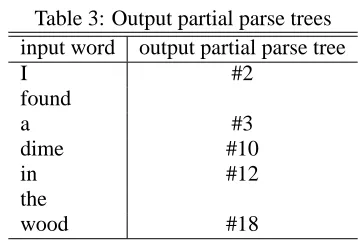
Table 3 shows the output partial parse tree for ev-ery word input.
[image:5.595.336.515.77.197.2]Our incremental parser delays the decision of the output as shown in this example.
Table 3: Output partial parse trees
input word output partial parse tree
I #2
found
a #3
dime #10
in #12
the
wood #18
5 Experimental Results
To evaluate the performance of our proposed method, we performed a parsing experiment. The parser was implemented in GNU Common Lisp on a Linux PC. In the experiment, the inputs of the incre-mental parser are POS sequences rather than word sequences. We used 47247 initial trees and 2931 auxiliary trees for the experiment. The elementary trees were extracted from the parse trees in sec-tions 02-21 of the Wall Street Journal in Penn Tree-bank (Marcus et al., 1993), which is transformed by using parent-child annotation and left factoring (Roark and Johnson, 1999). We set the beam-width at 500.
The labeled precision and recall of the parsing are 80.8% and 78.5%, respectively for the section 23 in Penn Treebank. We used the set of sentences for which the outputs of the incremental parser are identical to the correct parse trees in the Penn Tree-bank. The number of these sentences is 451. The average length of these sentences is 13.5 words.
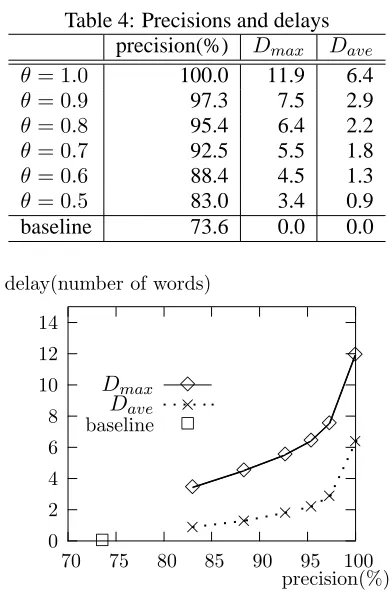
We measured the delays and the precisions for va-lidity thresholds 0.5, 0.6, 0.7, 0.8, 0.9 and 1.0.
We define the degree of delay as follows: Let s = w1· · ·wn be an input sentence and oj(s) be
the partial parse tree that is the output when thej-th
word wj is scanned. We define the degree of delay
whenj-th word is scanned as follows:
D(j, s) =j−l(oj(s)) (7)
We define maximum delay Dmax(s) and average
delayDave(s)as follows:
Dmax(s) = max
1≤j≤nD(j, s) (8)
Dave(s) = n1 n X
j=1
D(j, s) (9)
The precision is defined as the percentage of valid partial parse trees in the output.
Table 4: Precisions and delays
precision(%) Dmax Dave
θ= 1.0 100.0 11.9 6.4
θ= 0.9 97.3 7.5 2.9
θ= 0.8 95.4 6.4 2.2
θ= 0.7 92.5 5.5 1.8
θ= 0.6 88.4 4.5 1.3
θ= 0.5 83.0 3.4 0.9
baseline 73.6 0.0 0.0
0 2 4 6 8 10 12 14
70 75 80 85 90 95 100
delay(number of words)
precision(%)
Dmax
3
3 3 3 3 3 3 Dave
×
× × × × × ×
baseline
2
2
Figure 4: Relation between precision and delay
partial parse tree having highest probability. We call it the parsing baseline.
Table 4 shows the precisions and delays. Figure 4 illustrates the relation between the precisions and delays.
The experimental result demonstrates that there is a precision/delay trade-off. Our proposed method increases the precision in comparison with the base-line, while returning the output is delayed. When
θ = 1, it is guaranteed that the output partial parse
trees are valid, that is, our method is similar to the method in the literature (Kato et al., 2000). In
com-parison with this case, our method whenθ <1
dra-matically decreases the delay.
Although the result does not necessarily demon-strates that our method is the best one, it achieves both high-accuracy and short-delay to a certain ex-tent.
6 Concluding Remarks
In this paper, we have proposed a method of evalu-ating the validity that a partial parse tree constructed in incremental parsing becomes valid. The method is based on probabilistic incremental parsing. When a word is scanned, the method incrementally calcu-lates the validity for each partial parse tree and
re-turns the partial parse tree whose validity is greater than a threshold. Our method delays the decision of which partial parse tree should be returned.
To evaluate the performance of our method, we conducted a parsing experiment using the Penn Treebank. The experimental result shows that our method improves the accuracy of incremental pars-ing.
The experiment demonstrated a precision/delay trade-off. To evaluate overall performance of in-cremental parsing, we would like to investigate a single measure into which delay and precision are combined.
Acknowledgement
This work is partially supported by the Grant-in-Aid for Scientific Research of the Ministry of Education, Science, Sports and Culture, Japan (No. 15300044), and The Tatematsu Foundation.
References
J. Allen, G. Ferguson, and A. Stent. 2001. An Ar-chitecture for More Realistic Conversational Sys-tems. In Proceedings of International
Confer-ence of Intelligent User Interfaces, pages 1–8.
J. Carroll and D. Weir. 2003. Encoding Frequency Information in Stochastic Parsing Models. In R. Bod, R. Scha, and K. Sima’an, editors,
Data-Oriented Parsing, pages 43–60. CSLI
Publica-tions, Stanford.
J. Chen and K. Vijay-Shanker. 2000. Automated Extraction of TAGs from the Penn Treebank. In
Proceedings of the 6th International Workshop on Parsing Technologies, pages 65–76.
D. Chiang. 2003. Statistical Parsing with an Auto-matically Extracted Tree Adjoining Grammar. In R. Bod, R. Scha, and K. Sima’an, editors,
Data-Oriented Parsing, pages 299–316. CSLI
Publica-tions, Stanford.
F. Costa, V. Lombardo, P. Frasconi, and Soda G. 2001. Wide Coverage Incremental Parsing by Learning Attachment Preferences. In
Proceed-ings of the 7th Congress of the Italian Association for Artificial Intelligence, pages 297–307.
N. J. Haddock. 1987. Incremental Interpretation and Combinatory Categorial Grammar. In
Pro-ceedings of the 10th International Joint Confer-ence on Artificial IntelligConfer-ence, pages 661–663.
Y. Inagaki and S. Matsubara. 1995. Models for In-cremental Interpretation of Natural Language. In
Proceedings of the 2nd Symposium on Natural Language Processing, pages 51–60.
reasonable structural descriptions? In D. R. Dowty, L. Karttunen, and A. Zwicky, editors,
Natural Language Parsing, pages 206–250.
Cam-bridge University Press, CamCam-bridge.
Y. Kato, S. Matsubara, K. Toyama, and Y. Ina-gaki. 2000. Spoken Language Parsing based on Incremental Disambiguation. In Proceedings of
the 6th International Conference on Spoken Lan-guage Processing, volume 2, pages 999–1002.
V. Lombardo and P. Sturt. 1997. Incremental cessing and Infinite Local Ambiguity. In
Pro-ceedings of the 19th Annual Conference of the Cognitive Science Siciety, pages 448–453.
M. P. Marcus, B. Santorini, and M. A.
Marcinkiewicz. 1993. Building a Large Anno-tated Corpus of English: the Penn Treebank.
Computational Linguistics, 19(2):310–330.
M Marcus. 1980. A Theory of Syntactic
Recog-nition for Natural Language. MIT Press,
Cam-brige, MA.
S. Matsubara, S. Asai, K. Toyama, and Y. Inagaki. 1997. Chart-based Parsing and Transfer in In-cremental Spoken Language Translation. In
Pro-ceedings of the 4th Natural Language Processing Pacific Rim Symposium, pages 521–524.
D. Milward and R. Cooper. 1994. Incremental In-terpretation: Applications, Theory, and Relation-ship to Dynamic Semantics. In Proceedings of
the 15th International Conference on Computa-tional Linguistics, pages 748–754.
D. Milward. 1995. Incremental Interpretation of Categorial Grammar. In Proceedings of the 7th
Conference of European Chapter of the Associ-ation for ComputAssoci-ational Linguistics, pages 119–
126.
B. Roark and M. Johnson. 1999. Efficient Prob-abilistic Top-down and Left-corner Parsing. In
Proceedings of the 37th Annual Meeting of the Association for Computational Linguistics, pages
421–428.
B. Roark. 2001. Probabilistic Top-Down Parsing and Language Modeling. Computational
Lin-guistics, 27(2):249–276.
F. Xia. 1999. Extracting Tree Adjoining Gram-mars from Bracketed corpora. In Proceedings of