tiff~e
presl
Published by The Liffey Press Ashbrook House 10 Main Street Raheny, Dublin 5, Irelandwww.theliffeypress.com
© 2006 Eileen Drew
A catalogue record of this book is available from the British Library.
ISBN 1-905785-13-5
All rights reserved. No part of this publication may be reproduced or transmitted in any form or by any means, including photocopying and recording, without written permission of the publisher. Such written permission must also be obtained before any part of this publication is
stored in a retrieval system of any nature. Requests for permission should be directed to The Liffey Press, Ashbrook House,
10 Main Street, Raheny, Dublin 5, Ireland.
Printed in Ireland by Colour Books
CONTENTS
ix
and Figures ... xi
Chapter 1: Background ... 1
1.1 Study Objectives ... 2
1.2 Methodology ... 2
1.3 Outline of Chapters... 4
Chapter 2: Literature Review ... 5
2.1 Statistical Variation ... 5
Review of Factors Contributing to Gender Imbalance ... 7
2.2.1 Teaching as Women's Work ... 8
2.2.2 Falling Status of the Teaching Profession ... 9
2.2.3 Relative Pay/Salary Structure ... 10
2.2.4 False Claims of Paedophilia ... 11
2.2.5 Higher Performance of Girls in Secondary Level Education. 11 2.2.6 Men's Experience ofReverse Sexism ... 12
2.2.7 Poor Career Progression Prospects ... 13
2.2.8 Lack of Male Role Models ... 13
2.2.9 Rising Demands and Stress ... 14
2.3 Interventions to Increase Male Representation ... 14
2.3.1 Positive Action ... 14
2.3.2 Irish Requirements ... 15
2.3.3 Salary ... 15
2.3.4 Promote Primary Teachingfor Men ... ]6
2.3.5 Protection/Support ... 17
2.3.6 Exposure to Teaching ... 18
vi Facing Extinction?
Chapter 3: Profile of Survey Respondents ... 21
3.1 Gender ... 21
3.2 Age ... 22
3.3 Marital Status ... 22
3.4 Family Status ... 23
3.5 County/Country of Origin ... 25
3.6 Key Findings ... 27
Chapter 4: Educational History of Respondents ... 29
4.1 Second Level Education ... 29
4.2 Science Subjects Studied ... 30
4.3 Transition Year Experience ... 31
4.4 Third Level Education ... 31
4.5 Parental Levels of Education Attainment.. ... 33
4.6 Key Findings ... 34
Chapter 5: Profile of Schools and Teaching Responsibilities ... 37
5.1 School Location ... 37
5.2 Duration of Teaching Career ... 38
5.3 School Size ... 38
5.4 Current Teaching Contract/Posts ... 39
5.5 Classes Taught. ... 40
5.5 Key Findings ... 41
Chapter 6: Motivation for Choosing Primary School Teaching ... 43
6.1 Entry to the Profession ... 43
6.2 Choice of Teaching as a Career ... 44
6.3 Motivational Factors ... 44
6.4 Fulfilment of Career Expectations ... 47
6.4.1 Lack of Career Progress/Salary ... 49
6.4.2 Nature of Job/Working Conditions ... 51
6.4.3 Political1nfluence/1nterference ... 54
6.4.4 Declining Status/1m age of Teaching Profession ... 55
6.4.5 Behaviour of Pupils/Parents ... 56
6.4.6 Colleges of Education ... 57
6.4.7 Other Unfulfilled Expectations ... 58
6.5 Encouragement of More Men into Teaching at Primary School Level ... 59
6.5.1 Gender Balance Sought ... 60
6.5.2 Rewarding Profession ... 61
Contents vii 6.5.3 Role Models ... 63
6.5.4 Encourage with Proviso/Reservations ... 65
6.6 Factors Militating Against Men Entering the Profession ... 66
6.7 Measures Required to Encourage More Men into Primary School Teaching ... 70
6.7.1 1ncrease Financial1ncentives 71 6.7.2 Promote the 1mage of Primary Teaching 72 6.7.3 1rish Language Requirements 75 6.7.4 Other Measures 77 6.8 Key Findings 81 Chapter 7: Career Development and Gender Issues ... 83
7.1 Training ... 83
7 .2 Promotion/Advancement ... 83
7.3 Women's Prospects of PromotionlAdvan cement Compared with Men's ... 88
7.3.1 Gender Neutrality of Promotion/Advancement Process ... 89
7.3.2 Gender Discrimination Favour Women ... 92
7.3.3 Women Less 1nterested in PromotionIPrincipalship ... 95
7.3.4 Gender Discrimination against Women ... 97
7.3.5 Denial of Discrimination ... 102
7.5 Key Findings ... 103
Chapter 8: Satisfaction with Career Choice and Progression ... 105
8.1 Levels of Satisfaction with Current Teaching Situation ... 105
8.2 Ways of Addressing Sources of Dissatisfaction with Teaching Situation ... 109
8.2.1 Teaching Conditions ... 110
8.2.2 Recognition... 111
8.2.3 Resources ... 113
8.2.41rish Language/SCG Requirement ... 113
8.2.5 Salary ... 115
8.2.6 Promotion Prospects ... 116
8.2.7 Discipline ... 116
8.2.8 Flexibility ... 117
8.3 Levels of Satisfaction with Conditions of Employment.. ... 117
8.4 Sources of Satisfaction ... 119
8.5 Sources of Dissatisfaction ... 120
viii Facing Extinction?
8.6 Addressing Sources of Dissatisfaction with Conditions of
Employment ... 121
8.7 Key Findings ... . ... 124
Chapter 9: Conclusions and Recommendations ... 125
9.1 Final Words - Issues for Men... 125
9.1.1 The "Problem" with Teaching ... 125
9.1.2 Pay/Conditions ... 126
9.1.3 Irish Language/SCG Requirement ... 126
9.1.4 Transfer ... 126
9.1.5 Role ofDepartment ofEducation and Science ... 126
9.1.6 Boards ofManagement ... 127
9.2 Final Words Issues for Women ... 127
9.2.1 Role of Colleges ofEducation ... 127
9.2.2 Bullying ... 128
9.2.3 Intrinsic Rewards of Primary Teaching ... 128
9.2.4lrish/SCG Requirement ... 128
9.2.5 Breaking the Mould ... 129
9.3 Conclusions ... 129
9.4 Recommendations ... 130
9.4.1 Target Marketing ofPrimary Teaching ... 131
9.4.2 Address the Salary Issue ... 131
9.4.3 Take Positive Action ... 131
9.4.4 Promote a More Representative and Positive Image of Teaching ... 131
9.4.5 Career Progression and Development ... 131
9.4.6 Language Requirements ... 132
9.4.7 Boards ofManagement ... 132
Bibliography 133
ACKNOWLEDGEMENTS
This publication, and the research upon which it is based, would not have been possible without the contributions of many individuals and
organisations. The project on men in primary teaching was instigated by the Primary Education Committee which was established in 2003 by the Minister for Education to make recommendations on strate'gies and ini tiatives to increase the number of males entering primary teaching. The research was funded by the Gender Equality Unit of the Department of Education and Science, established under the National Development Plan 2000-2006, and co-funded by European Union Structural Funds.
Special thanks are due to Rhona McSweeney, Gender Equality of the Department of Education and Science, who along with Noel Ward, Irish National Teachers Organisation, provided assistance in the research design and monitoring of the project. Their inputs, comments and feed back were invaluable in guiding the research to completion.
Thanks are due to John Carr, and his staff, in the INTO for the finan cial support towards this publication. I also want to thank all the 613
have tried to accurately reflect these views and to provide a conduit for
their "voices".
The views expressed in this publication are the responsibility of the author and do not necessarily reflect the views of the project sponsors_
Chapter 6
MOTIVATION FOR CHOOSING PRIMARY
SCHOOL TEACHING
6.1
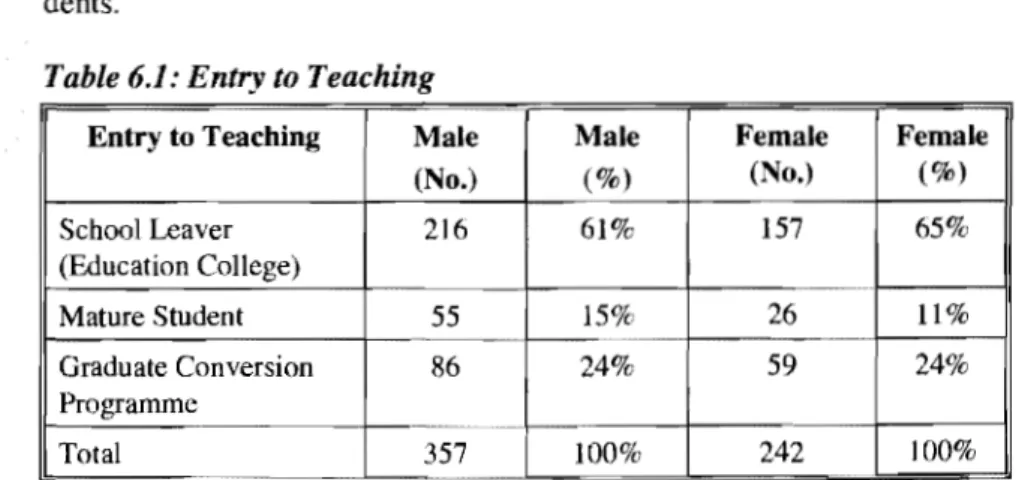
ENTRY TO THE PROFESSIONThe majority of men (61 per cent) and women (65 per cent) entered pri mary school teaching as school leavers who then graduated from Col leges of Education. A further one-quarter (24 per cent) had undergone a Graduate Conversion Programme. The remaining 15 per cent of male and 11 per cent of female teachers came into teaching as mature stu dents.
Table 6.1: Entry to Teaching
Entry to Teaching Male (No.)
Male
(%)
Female (No.)
Female
(%)
School Leaver (Education College)
216 61% 157 65%
Mature Student 55 15% 26 11%
Graduate Conversion Programme
86 24% 59 24%
Total 357 100% 242 100%
44 Facing Extinction? 45
6.2
CHOICE OF TEACHING AS A CAREERRespondents were asked whether teaching was their first choice of ca reer. Three-quarters (76 per cent) of male and 83 per cent of female re spondents stated that it was their first choice.
The remaining 24 per cent of male respondents had other first choice career aspirations in business (12), journalism (7), law (6), physiotherapy (5), accountancy (4), secondary school teacher (4), archaeology (4), computer programming (3), gardaf (3), medicine (3), music (3), PE teaching (3), agricultural science (2), bank clerk (2), scientific field (2), sport (2). Other careers were mentioned by one male respondents only care-staff at special school, dentistry, engineer, architect, environmental science, lighting technician (drama), food processing industry, IT sector, librarian, archivist, machine operator, marine engineer, mental handicap nursing, office worker, priesthood, psychiatric nursing, psychotherapist, TV work/drama, veterinary surgeon.
A small number of male mature entrants referred to their previous careers such as 27 years in dairy industry, three years in chemical engi neering, financial consultant, finance director for 17 years, retail man ager/carpenter in Canada, industrial chemist, four years in the US Air Force.
Female teachers whose career in teaching was not their first choice had aspired to jobs in business/accounting (7), medicine (3), journalism (3), art (3), science (3), occupational/speech therapy (3) and physiother apy (2). Other careers mentioned by individual female respondents in clude home economics teacher, sports scientist, purchasing, library, inte rior design, nursing, HR management, law, research, architecture, psy chology, IT, hotel and catering management, social work, travel and tourism and marketing.
6.3
MOTIV ATIONAL FACTORSRespondents were asked to rate a scale of 1 to 5 I as the strong est motivation through to 5 as weakest motivation) a list of 12 factors that may have encouraged to become primary school teachers. Fig ures 6.1 a and 6.1 b set out key motivating factors (those listed as strongest or strong tnntiW:lti, in order of importance.
~
Motivation/or Choosing Primary School Teachingr
Figure 6.1a: Motivations/or Male Teachers (n=345)
f
t
Salary
Transition Year
Previous career
Promotion prospects
Prestige/status
Work in a team
Family in teaching
Work independ
Academic achievement
Job security
Contrib. to society
Work/life balance
fl
~~~~L--,
tl
==::===)1••••
0% 20% 40% 60% 80% 100%
46 Facing Extinction? 47
Figure 6.1b: Motivations/or Female Teachers (n=234)
Transition Year
Previous career
Promotion prospects
o
Strongest • Strong In Ieacmng 1-1_ _...._Work independ
Academic achievement
Job security
Contrib. to
Work/life balance
0% 20% 40% 60% 80% 100%
As Figures 6.1a and 6.1 b show, there are only minor differences in the factors that influence women and men into primary teaching. Men
ranked work/life balance as number one compared women who ranked it number two. Women ranked to society, in a team and Transition Year experience higher than their male counter parts (Table 6.2).
The ranking of motivational factors for men and women is shown in Table 6.2
Motivation for Choosing Primary School Teaching
Table 6.2: Motivational Factors Influencing Women and Men
110tential Motivators Men's
Ranking
Women's Ranking
Work/Life Balance, inc. hours/holidays 1 2
Contribution to Society/Individuals 2 1
Job Security 3 3
Academic Achievement/Intellectual Challenge 4 4
Desire to Work Independently 5 5
Family Member in Teaching Profession 6 7
Desire to Work in a Team 7 6
Prestige/Status 8 9
Promotion Prospects 9 12
Lack of Progress in Previous Career 10 11
Transition Year Experience 10 8
Salary/Earning Potential 12 10
The least significant motivational factors for male teachers are salary level/earning potential, transition year experience, lack of progress in previous career and promotion prospects. For women the least significant motivational factors are promotion prospects, lack of progress in previ ous career, salary level/earning potential and prestige/ status.
6.4
FULFILMI<~NT OF CAREER EXPI<XTATIONS48 Facing Extinction? 49
Figure 6.2a: Fulfilled Career Expectations ofMale Teachers (n=356)
22%
o
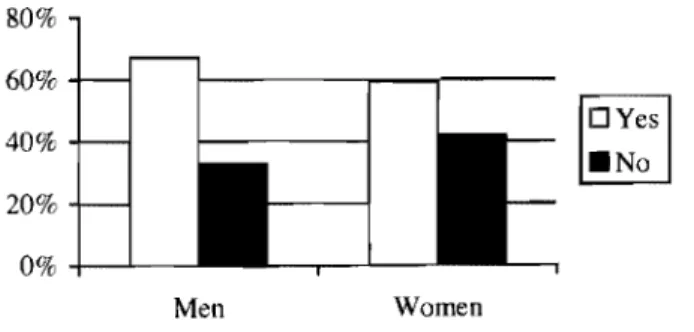
Fulfilled Expectations • Not Fulfilled ExpecationsA higher proportion of women (85 per cent) than men stated that primary teaching has fulfilled their expectations, with 207 positive responses (Figure 6.2.b). The gender difference was statistically significant (chi square 0.032).
Figure 6.2b: Fulfilled Career Expectations of Female Teachers (n=244)
15%
o
Fulfilled Expectations • Not Fulfilled ExpecationsTeachers were also asked if there was a difference between their prior conception of the job and the reality they have experienced. Similar pro portions of men (61 per cent) and women (62 per cent) stated that there was a difference. Among the respondents whose prior conception of the profession had not matched reality, the main reasons related to the fol lowing:
Motivationfor Choosing Primary School Teaching
• Lack of career progress/salary (Section 6.4.1)
• Nature of job/working conditions (Section 6.4.2)
• Political interference (Section 6.4.3)
• Declining status of teaching profession (Section 6.4.4)
• Behaviour of pupils/parents (Section 6.4.5)
• Colleges of Education (Section 6.4.6), and
• Other unfilled expectations (Section 6.4.7) .
Sections 6.4.1 to 6.4.7 provide in depth insights as to the reasons why expectations were not fulfilled.
6.4.1 Lack of Career Progress/Salary
Many male respondents referred to salary levels and the slow progres sion up the pay scale. They also compared their salaries, negatively, with those of graduates working outside primary teaching. Criticisms about remuneration related to the number of points on the teaching scale, op portunities for advancement and rates of progress. Typical comments made by male respondents are outlined below:
"I have an MA in Education yet only receive €500 extra p.a. How farcical! I received no tax relief or funding as I studied in the
[other country named]!"
"Few promotional prospects. Lack ofprestige or status in today's society. Low pay and drawn-out pay scale."
"Salary doesn't justify work. As a result I give grinds and work part-time in a bar. Not possible to save for house on teacher's wage alone."
"Promotional prospects are quite limited especially
if
you switch schools early in your career. ""My career is restricted because I do not speak Irish. "
50 Facing Extinction?
,
51,
"Pay structure is not as good as others who have no professional qualifications or training thus profession proves a stigma e~pe
cially for younger teachers. "
"Very disillusioned by the fact that, after achieving high points and for such a responsible job, the salary doesn't reflect this."
"Promotions area is very closed shop and certain cliques dictate schools/policies. Salary and rewards for qualifications are basic."
"Expected the salary and promotion opportunities to be better." "Teachers have seen their work load increase at an alarming rate yet pay scales have not reflected this."
"Pay is not good considering all the time spent in college. No ex tra pay for correcting copies or doing sport after school. "
"Pay is very poor considering other college grads."
"Very little possibility for progressing and you are unable to climb to another post. "
"Present pay scale (length of time to reach the top), expenses and overall pay are not a fair reflection ofmy chosen career. "
"After seven years I have yet to get even a post of responsibility, despite the best intentions ofthe principal."
"In country areas there is little opportunity to move once I am permanent. Teaching principal posts do become available but are not sought after position. "
"Salary is less than expected. Posts are held by senior teachers. No promotion except to principal the allowance for that is a joke and the work more d{tficult all the time. "
"I will never have post of any sort as I probably will be retired before present holders as I am in the A VC scheme and they are
not. In reality posts of responsibility go on seniority despite fan fare of interviews. Am sickened by the way full-time positions are
filled in West Kerry - friends of the priest or principal always get jobs."
"It's unrewarding."
Motivationfor Choosing Primary School Teaching
"Impossible to get promoted. Additional responsibilities taken on gratis. "
Only two women teachers mentioned salary/progression as a factor con tributing to their unfulfilled expectations:
"Increased salary. Bonuses."
"If
salary was more in tune with industry a lot more men would enter teaching. "6.4.2 Nature of Job/Working Conditions
Male and female respondents referred to the fact that primary school teaching is more challenging, demanding/stressful and/or requires more paperwork/workload than they had envisaged. Others noted that there is more responsibility and pressure than they had expected and that the skills required for the job are multiple and complex. One man expressed this as:
"Would prefer
if
a teacher had just to teach, not be a psycholo gist, crowd controller, babysitter, banker, religious instructorand every other job we seem to have to do. "
Likewise women commented on the multiplicity of skills required for the job:
"You're viewed as a doctor, counsellor etc.for children and also parents. There is a lot of emphasis on paperwork, whereas I thought there should be more emphasis on teaching."
"A lonelier profession than anticipated."
"I teach in a disadvantaged school and sometimes think I need
qualifications in social work, nursing and parenting skills in or der to fully help and educate children in class. "
52 Facing Extinction? ~ 53
"Degree of multi-tasking is very high - teacher, carer, nurse, psychologist. A very high level of responsibility. "
Since the introduction of the new curriculum many male and female teachers have experienced a huge increase in workload that has allowed less time for teaching:
"Too much interference from ex-teachers and other pundits in the Inspectorate and Department. Don't need constant direction and adding on of bureaucratic layers of paperwork from those who haven't taught children for a long time. Have to spend nearly as
long writing notes/plans/schemes etc. as hours t>pent in the class room. Find it especially infuriating to see the Republic's Depart ment foolishly imitate Northern Ireland's curriculum and bu reaucratic workload - they seem intent to copy the NI rationale
and make the same mistakes."
"Felt I was achieving my primary goal but this has dissipated due to the huge and unnecessary workload heaped on teachers with the introduction of the new curriculum. "
"Demands of a small classroom with 30 pupils in it. Feel that I am not able to deliver my desired curriculum and ideas in such a room. I am not listened to in my school due to my age (28)."
"Much more demanding/exhausting than expected. Workload in crease - new curriculum, record keeping, huge classes - almost
impossible to teach. "
"So much more to the job than just teaching responsibility to pupils and parents; stress; overloaded curriculum; preparation
and work out of school hours (which other teachers only appreci ate). "
"Bureaucracy, red tape and curricular constraints continue to disappoint. "
"A bureaucratic and administrative nightmare - very surprised to see the Irish teaching body slipping inexorably down the same route. Thin end (if the wedge now - crap to hit fan later!"
"Thought teaching would allow me to provide much more help and one-to-one attention, but there are too many constraints and
Motivationfor Choosing Primary School Teaching
I find it difficult to teach all curricular areas in their entirety, let alone enhance their social or emotional development. "
Other male respondents criticised the volume of paperwork, class sizes and problems of working in disadvantaged areas:
"Ardently feel that teaching and profession are wallowing in conservatism. "
"Hidden workload, paper work etc. "
"Less emphasis on quality of education. More time spent on ca tering for external activities, i.e. colouring/singing/projects/
5ports, which should be catered for outside class teaching time." "Huge amount of distractional paperwork. Everything must be restricted because of legal implications."
"Teaching in a prefab with no support for our school (Gaelscoil)
as regards resources, new curriculum, is a bit nineteenth cen tury."
"Feel that constant control of large classes comes at a big per sonal cost, i.e. loss offree spirit, fun, spontaneity."
"Feeling of helplessness with regards to disadvantaged children." "Become monotonous with little opportunity to diversify or be promoted unless willing to become a principal (Lack of respect). " "Lack of care given to children by teaching profession who are primarily interested in their own welfare. The over-emphasis on paperwork and curriculum overload. "
"Little funding, big classes, discipline problems. Too much paper work and not enough teaching."
"Due to the impossible workload 1 feel that my teaching is limited
by time constraints and resources. Without more special needs assistants I have to lower the aims to suit the number of children
that I can safely supervise while teaching one or two of the chil dren at the same time."
54
55 Extinction?
"Teaching has many hidden stresses caring Jar large group oj children and re.\ponsibility involved. Schools may not have enough money, or they do and it is not being made available."
"A lot more pressure on teachers regarding special needs child ren within mainstream classes . .,
"Having to continually deal with challenging behaviour in con junction with learning disabilities is more stressful than had been
anticipated. "
"Very idealistic situation, i.e. class size, uniform pupil ability, re sources, e.g. classroom size, equipment, support Jar Jurther ca reer development. "
"Idealism is waning oJ what you can do to help children progress reality oj educational disadvantage - bureaucracy in school etc. "
"We are not provided with the necessary tools oj our trade.
Sometimes our proJession is not re.\pected by parents and De partment as our findings on a child don It enter the equation when
looking Jor resource help despite teaching them six hours every day."
"One meets difficult challenges. Dealing with parents, social problems effecting pupils. Lack oj school funds and large class sizes. "
"Paperwork is becoming very hard. Number of children with problems and behavioural difficulties is increasing."
6.4.3 Political InflnencelInterference
There was some disillusionment among teachers the lack of sup port, constant demands and apparently blatant tactics of the De partment of Education and Science. Men said:
"Far too much bitterness and politics in school systems. Many teachers slow to accept change. Only redeeming Jeature is that individuals are teachers and some teachers who impire are voiceless. The proJession obviously wishes to maintain the status quo."
,
Motivationfor Choosing Primary School Teaching "Board of management have all the power.""Lack of support from Minister and lack oj cop-on in the way the new curriculum was delivered. "
"Politics within schools are ruining my outlook in schools and the education system."
"Except Jor the disdain with which the current Minister treats teachers. "
"Lack ofopportunity and necessity to move for political reasons. " Only one woman referred to politics:
"Micro-politics in schools make or break your enthusiasm and attitude. "
6.4.4 Declining StatnslImage of Teaching Profession
There was a strongly held view that respect for the profession is a lot less than they had expected and that it is being steadily eroded through the media. This in tum reduced the respect from the general public or dren. Male respondents claimed that:
"In general because people tend to stereotype you and teachers are not too popular in society. People are jealous of hours, benchmarking and holidays."
"People do not realise the hours that teachers put in outside school hours with preparation and corrections. "
"Lack oj return Jor the e.fJort put in can be demoralising. You are very much taken for granted in modern society."
"It's hassle and the post of teacher is now less appreciated." "There is a lot less respect for teachers. Prestige and status are
not words I would now associate with teaching. There is more re spect in general in rural areas."
"Poor standing in community."
56 Facing Extinction?
,
57•
i"Am amazed at how answerable we as a profession are to par ents and the huge amount of disrespect shown to us in general. "
"My parents always respected my teachers and supported them and their actions. Feel that many oftoday's parents don't support teachers but view us as 'the enemy'."
"No respect for teachers anymore. Status once associated with teachers is gone."
"There is less respect from parents. "
"Sometimes our profession is not respected by parents and De partment."
6.4.5 Behaviour of PupilslParents
Some respondents referred to the behaviour of pupils while some had failed to realise that the negativity of parents could be so strong.
Male teachers mentioned:
HI find certain children like young adults and are very had to
control and discipline. Didn't realise so much crowd control would be involved. "
"Students are abusive and violent. Our school does not receive the requisite support from the Department. "
"Interfering parents."
"Teaching would be fine
if
there were no parents.""A lot more challengl Children are much more brazen and ungrateful. "
"If
teaching was left to teachers without outside trouble from parents it would be a much easier and more fulfilling job. ""Increased discipline problems and problem children/parents with no respect for school or learning. "
Women also felt unhappy about the attitude of parents:
"Parents are on occasions too demanding."
Motivationfor Choosing Primary School Teaching
"Parents are pushy and expect the world and its mother to be at their beck and call. "
"Did not realise the influence ofparents on job satisfaction. " "Demanding and difficult parents."
"Parental involvement was a lot more negative than when I was
in school. Lack of manners and respect from parents. Have al ways thought the challenge would be with the children. "
"Role and influence ofparents much greater than expected." "There is less respect from parents. "
"Thought parents would be more supportive in helping with the 'nitty-gritty' of homework. There is a lot of energy required in
parenting and I've recently em'ountered parents who don't un derstand the help they have to flive to helD their
6.4.6 Colleges of Education
The view was expressed that teacher education was too aca demic/theoretical and that more practical issues should have been ad dressed. A small number of respondents felt that Colleges of Education prepare one for the ideal class in a middle class area situation. Little is done to prepare them for the realities of working class areas, discipline and disadvantaged children. Men summed this up in:
"Lack of comprehensive direction/instruction in hands-on realis tic fashion. College course unattached to actual requirement of
teaching."
"Difficult to be an expert at everything. Training at college insuf ficient. "
Women also commented on being ill-prepared for classroom conditions:
58 Facing Extinction?
,
59 "Completely unprepared for non-teaching aspects in training!
colleges, e.g. parents, administration, organising events, reli gious sacraments etc. "
"Encountered many things unmentioned in college, e.g. dealing
with international children with no English, behaviour difficul ties. "
"College didn't prepare me in how to handle a whole class situa tion as well as they could have."
"Teaching is the easy part. It is all the extra things that are diffi cult and we are not taught how to deal with in college, e.g. prob lems, parents, bullying, fights in playground. "
"Training could have been more relevant regarding certain sub jects and day to day running ofa class/school."
"Weren 'f preparedfor: day to day issues that crop up."
"When in college teaching is very idealistic and doesn't really prepare for the real job. Difficult in a class size of thirty trying to attend to all the individual needs."
6.4.7 Other Unfulfilled Expectations
Male respondents volunteered a range of other responses reflecting very mixed attitudes towards teaching. Some men are disillusioned and con sidering whether or not to remain within primary school teaching.
"I became a teacher because I was immature and had not got the self-esteem to match my intelligence. I am trying to get out of teaching now."
"Enjoyed my time teaching but don't see it as a job life. In particular the number of unqualified teachers allowed to work in primary schools is upsetting and demotivating."
"I wish to become responsible for the running of a primary school or to influence lifelong learning at a training policy level. "
"Have a wide variety of interests. Teaching only caters for some of these. Would like to set up my own business."
Motivation/or Choosing Primary School Teaching
"On its own teaching a classJrom 21-65 years wouldn'tfulfil ca reer expectations for me. What you're doing when you start is
what you're doing when you finish unless you make a conscious effort to do something d(tferent. "
"Would like to explore other related careers."
"There may still remain talents of mine that are not Jully used in teaching. "
"The career expectations of a 17-year- old are not those of a more mature individual. "
"Have only been teaching for eight months and have not yet ful filled my career expectations. "
No female teachers voiced such views about continuing otherwise) in the profession.
6.5
ENCOURAGEMENT OF MORE MEN INTO TEACHINGAT PRIMARY SCHOOL LEVEL
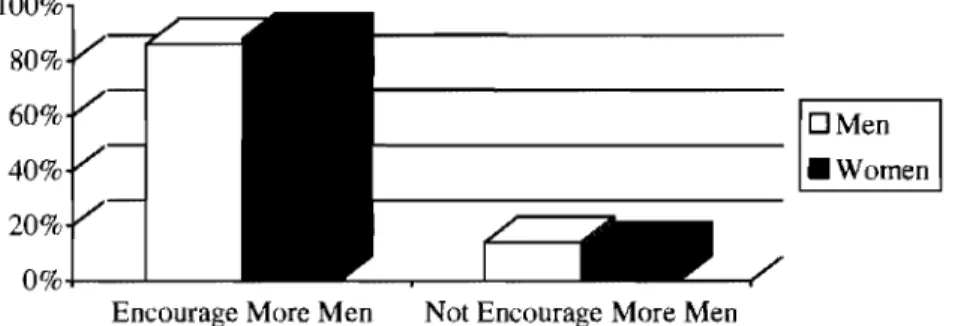
Despite some of the everyday frustrations with primary school teaching outlined in Section 6.4, nearly nine out of ten (86 per cent of men and 88 per eent of women) respondents would encourage more men to take up careers in primary school teaching (Figure 6.3).
A small number (13 per cent of all respondents) would not encourage men to follow this career path.
60 Facing l:xtinction? 61
Figure 6.3: Encourage More Men into Primary Teaching
100%
80%
60% OMen
40% • Women
20%
0%+-1---'---'
Encourage More Men Not Encourage More Men
6.5.1 Gender Balance Sought
Many male teachers feel that the profession is too female-dominated and needs an infusion of men to rectify this.
"The only way to have gender equality is with a gender balance. Anything else does not work. Am sure equality is also an issue for women in a male-dominated environment."
"A men/women balance in school staffing would be healthy for teachers and students. "
"Children often ask me, 'Why are most teachers females?' For that reason children need to get a gender balance with regards to their teacher. "
"Believe that men have a very important role to play in primary education, more especially in creating necessary balance."
"Far too many women in primary schools. A balance is needed." "To provide a more normal view of the world in that both males
and females have similar and differing views that pupils can in terpret for themselves. "
"A better balanced male/female ratio in stalf would add to better and more realistic working atmosphere. Sometimes males/ females are stereotyped into particular roles, which should be discouraged. "
,
Motivationfor Choosing Primary School Teaching"Too many women. Too much touchy feely approaches. Too much talk about soaps in staffroom. "
"Needs to be a greater gender balance within the profession and schools benefit greatly from having a gender balance."
"A larger number is needed to improve gender equality. "
Equally, women seek gender balance as a staffing practice and for the
benefit of children they teach:
"A balance of women and men is hugely important." "Like it to be a more balanced profession."
"Balance is important in every career, both for staff and child ren.
"Feel a balance of male andfemale is important for the children considering the influence we have over them. "
"Gender imbalance is startling."
"Important for gender balance and role models for boys as well as girls."
"Balance in staff room. Different perspectives. "
"It is good for boys to get a balanced view of the world and to see men in roles that they assume are for women only. "
"There is an important balance for the children having both male and female teachers. Healthy for the children to experience both male and female teachers."
6.5.2 Rewarding Profession
Some men referred to their own positive experiences in teaching as a
fulfilling career that should appeal to more men:
62 Facing Extinction? 63
"An opportunity for men to use their sporting skills as well as de veloping children's skills both educationally and socially. "
"Fulfilling job, nice change for pupils to have a male teacher.
Very good working hours and holidays. Great to awaken an in terest in children in your own interests."
"Job security and decent salary as opposed to a job in IT. Great holidays. Friends with other qualifications unhappy with their jobs or forced to emigrate. "
"Love my job and think more men should become teachers. It's the best job in the world. "
"Men are still held in high esteem by many parents especially
if
they love sport. Promotional prospects are vel)' high.""Teaching is a very fulfilling career that not only has great job satisfaction but leaves great time to pursue other interests. "
"A great career for someone interested in it. Being a male teacher is something of a novelty in many schools, but you also have to be quite strong-willed to put up with the extra attention. "
"Important role and a lot of diversity in the job. You can incor porate a lot of your own interests and hobbies into the job. "
"Rewarding at senior class level. Good opportunities for further study/other career interest."
Similar comments were made by female teachers about the positive as pects of teaching:
"Huge job satisfaction."
"Enjoyable career which has a lot ofjob satisfaction. "
"A challenging job
if
that's what they're looking for. Has its perks of holidays and shorter day.""Job is very fulfilling and has a lot to offer outside ofjust being a job."
"Such a rewarding job."
Motivationfor Choosing Primary School Teaching
"Good hours."
"Flexibility of location especially re expensive housing. Family friendly hours. Scope to make creative use (if summer holidays. "
"It can be very rewarding."
"Oflers security, job satisfaction etc. more so than in other jobs as reported by male acquaintances. "
"Great holidays and sports are involved." "Very fulfilling career."
Some female teachers raised the issue that men get promoted faster than women:
"Men still seem to get promoted quicker and more likely to go for promotion. "
"Easier for men to find a job in teaching, they seem to gain re !>pect more easily. "
"Men tend to progress more rapidly promotion-wise."
6.5.3 Role Models
The need for alternative and male role models for all children, though especially boys, was also mentioned by a number of male respondents:
"A good career, high level of promotion available, i.e. higher percentage of men in roles of authority. "
"Children need role models from both genders. Coming to the stage where teaching is seen as a female-dominated pnifession. " "It is increasingly becoming a female-dominated profession. It is important that children are exposed to positive male role models which I believe male teachers provide."
64 Facing Extinction? 65
"Male staff contribute positively in both staffroom and classroom as role models for discipline and a well balanced society. " "Absence ofa father figure in many homes."
"Boys need male role models . . ,
"More men are needed for staffrooms plus as role models in boys schools. Men seem to take more interest in after-school activities." "Particularly because of the increasing number of children with out male role models in their lives."
"More children do not have a positive male role model in their lives. It is important to provide this."
Female respondents also agree that male role models are important:
"Children (in certain areas) could use positive male role models." "An obvious lack of male role models for male and female stu dents they often accept TV/music/sports personalities as realis tic role models, due in many cases to lack of male parent figure. " "Important for gender balance and role models for boys as well as girls. Children from broken homes or single parent families have the chance to have some male role model in their lives. It's bad enough to have single sex schools without having to have the same in college and the workplace."
"Dire need for male role models run the risk offeminising the profession. This will have negative influence on boys."
"Children need more experience with males, especially children with no father at home. "
"Especially important for boys to have a positive male figure to model themselves on. Encouragement from a male figure seems to mean a lot more to the pupils."
Motivation for Choosing Primary School Teaching
6.5.4 Encourage with ProvisolReservations
Another group of men felt that they would encourage more men into primary teaching but only if certain conditions were right. These related to pay/earnings but also to the men who might or might not be suited.
"Yes, if you're not career-driven, not looking to earn a lot of money and have a useful other activity in your life to devote your free time to. "
"You cannot support afamity on the wages and have a quality of life that reflects the effort and sacrifice that goes with the job. "
"Depends on the personality. A person would need to be patient, friendly, accepting of the limited financial reward, and have a
competent level of Irish, PE and music. "
"Great scope for creativity and autonomy but the idea of life-long learning and taking the initiative for proper development needs to
be instilled from beginning. "
"If
they have a commitment to the demands of the profession and necessary skills, personality etc. it can be very rewarding.""Profession is a thoroughly rewarding and enjoyable experience. The salary and the top point of salary is not very endearing." "See no reasonfor them not to other than the stigma ofit being a 'female' job."
"Teaching can be very rewarding provided you get on well with children."
"Would encourage anyone who has an aptitude for the job to do it. There are far too many people who should not have become teachers. "
"Excellent satisfaction. No limits to what one can do. Many ca reers within teaching e.g. curriculum development - but one will not be able to support afamity!"
66 Facing Extinction? 67
"If one is not worried about the money then one should apply." "Men are often promoted with no evidence of their ability or commitment.
If
more men join the profession I would like them to recognise that their efforts will be rewarded - not inferred status where they do nothing to gain it. ""Don 'f feel many men would enJoy the job, however if they felt they would. encourage them as it is a very rewarding and inter
career. "
"Inspectors tell us that gender equality in classes is necessary for the children and so this should carry through to the staJl but money and promotion wouldn't entice career-hungry males into the profession."
"There is an imbalance and I believe this often gives males an unfair advantage when it comes to promotion. Also they tend to have ego problems."
"Why not? Men are generally more ambitious so that's probably what puts them off. Not many career opportunities. "
"Yes if it's a vocation, but no if a man is seeking a prestigious highly paidiob."
Overall there were many more positive views expressed summed up in:
"Feelings I have received regarding the gender imbalance from parents have been very strong. Parents are very positive when they learn that I am teaching their child. Role modelling is the term most used. "
However one woman raised the issue of "possible difficulties for men re child protection issues", though no men referred to this.
6.6
FACTORS MILITATING AGAINST MENENTERING THE PROFESSION
To complement the question about potential motivational factors that might encourage men and women to enter primary school teaching, re spondents were asked to rate (on a scale of 1 to 5 with 1 as the strongest dcmotivation through to 5 as the weakest demotivation) a list of 11
fac-I
I
Motivationfor Choosing Primary School Teaching
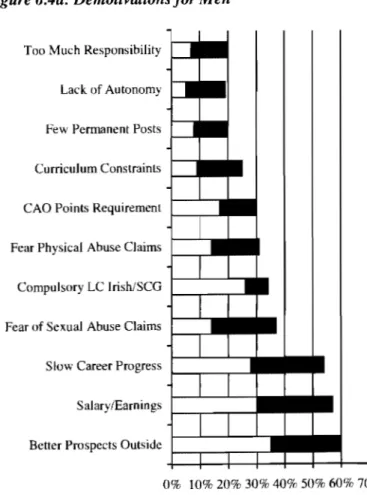
tors that may have discouraged them from becoming primary school teachers. Figure 6.4a shows that for men bctter career prospects outside teaching, salary level/earning potential, slow career progress, fear of false sexual abuse claims and compulsory Irish/SCG are the five most important negative factors that might have discouraged or strongly dis couraged them from primary teaching as a career.
Figure 6.4a: Demotivations for Mell Too Much Responsibility
Lack of Autonomy
Few Permanent Posts
Curriculum Constraints
CAO Points Requirement 1-1_ - . - _
Fear Physical Abuse Claims
Compulsory LC Irish/SCa 1-1-....--...--1
Fear of Sexual Abuse Claims
Slow Career Progress
Salary/Earnings
Better Prospects Outside
0% 10% 20% 30% 40% 50% 60% 70%
68 Facing Extinction? 69
significant (chi-square .000). Lack of permanent posts was more impor tant to women than men in primary teaching (chi-square .003).
Figure 6.4b: Demotivationsfor Women
Too Much Responsibility Lack of Autonomy Few Permanent Posts Curriculum Constraints CAO Points Requirement Fear Physical Abuse Claims Compulsory LC lrish/SCG Fear of Sexual Abuse Claims Slow Carecr Progress Salary/Earnings Bctter Prospects Outside
0% 10% 20% 30% 40% 50% 60% 70%
Some female and male teachers elaborated on why they would discour age more men from embarking upon careers in primary school teaching. The most common and recurrent themes are salary level, especially for men who want to support a family, poor promotion prospects, followed by problems with the curriculum or discipline of pupils. A cross-section of the men's responses is set out below.
,
•.~ Motivation for Choosing Primary School Teaching"Poor salary and promotion prospects. Male response to learn ing/education is not heard in a largely feminine world of educa tion. "
"Not if they want to buy a home or have a quality of life compa rable with their qualifications. Teaching is a hand-to-mouth exis tence whilst people with real jobs get real wages."
"Salary too low."
"Very difficult to raise jamily on wages. Very low status for men - seen as women's work. "
"Level of Irish too high."
"You cannot support a family on the wages and have a quality oj life that reflects the effort and sacrifice that goes with the job." "Until the Department implements nationally an agreed, coher ent, implementable and effective disciplinary code of practice re unruly etc. pupils, I would not recommend men or women to be come teachers. "
"Lack ofpromotional opportunities. Poor salary scale structure." "Frustrated due to unqualified teachers in schools and low wages considering points needed in Leaving Cert. "
"Ambition and hard work gets very little reward in this job. There is no incentive to better yourself. "
"Primarily because of lack of males but it won't happen because of career prospects - nil and earning potential."
"Level of preparation required is excessive. Impossible to teach the full new curriculum to junior classes. "
"Pay not good enough - no chance of overtime - getting a mort gage is out of the question. "
Some women would also discourage men for very similar reasons:
70 Facing Extinction? 71 because it appears that they are favoured for management
positions. "
"Legalities are ~poiling teaching. A lot of jobs being done to please outsiders (parents, inspector) regardless of impact on classroom learning. Paper trails are taking over, parent power can be very scary for new teachers . ..
"Salary and perks not enough."
"Pay not enough to entice men. Very little chance to gain promo tion. No incentive to better yourself academically."
"Not a career that I would encourage to anybody male or fe male."
"Seems more suited to females due to family commitments." "This is inverse discrimination only people who are dedicated to education and their pupils should take up teaching!"
6.7 MEASURES REQUIRED TO ENCOURAGE MORE
MEN INTO PRIMARY SCHOOL TEACHINGOne of the major objectives of this study was to identify measures that could be adopted to encourage more men into primary teaching. Respon dents were asked to suggest possible measures. There were re sponses from men and 178 from women. More money (in the form of improved salary structure/financial rewards/promotion prospects) was mentioned by 140 male and 104 female respondents.
After greater financial rewards, 100 male and 36 female respondents sought measures to promote the teaching profession and improve the public image of the job. The third category of measures related to some form of relaxation of the Irish requirement, mentioned by 14 male and 5 female respondents. A further 41 respondents made various suggestions fell outside these main themes. Among these was the proposal that there should be sex discrimination in favour of men getting into teacher education.
Motivationfor Choosing Primary School Teaching
6.7.1 Increase Financial Incentives
Almost half the teachers who responded to the question raised the issue of inadequate pay and the length of the salary scale making it difficult for many men to "support a family" or obtain a mortgage. Typical of these comments were:
"Proper wage and salary structure." "Salary scale. Promotion opportunities."
"Increase salary. I am not in a position to support any family if my 'intended' wishes to stop working."
"Salary needs to increase. This is a huge deterrent for men. Number ofyears on the scale should be reduced."
"Teaching for men is not a macho job. It would not appeal to business-minded people because of the pay. What sort of man would it appeal to?"
"Higher earning potential/higher promotional prospects." "Better pay. Extra pay for extra-curricular activities."
"Shortening of the pay scale insomuch as it would be possible to reach one's full earning potential in a realistic time like other professions. "
"Increase salary at starting offpoint." "Appropriate salary."
"Higher pay, more chances for promotion and diversity within profession. "
"In today's world with housing affordability etc. men need better pay."
"Pay them [men] more but equality legislation prohibits that." "Ensure that top salary scale is reached within a reasonable
72 Facing Extinction? 73 "Teachers who train school teams etc. should have financial re
ward."
Women also referred to need for pay/salary scale adjustments:
"Better pay structure. Create more opportunities for both gen ders to be promoted or get a sense of having something to con tribute to development of schools."
"Higher salary and faster raising of it through the grades - it takes a long time to reach the highest point. Men value work by salary more than women I think. "
"Job should be on a higher pay scale quicker for males and fe males. "
"Better salaries and other benefits. Men still see themselves as the breadwinner. "
"Higher pay. Greater opportunities to gain promotion (not just based on seniority within a school}."
"Salary needs to be far more attractive with greater promotional prospects and a shorter scale."
"Pay - if men are sole earner the pay would not sustain mortgage/ family."
"Up the salary and try to make people aware of the importance of the job and the contribution you are making to society."
"The pay is a deterrent for men - perhaps ifteachers could climb the salary scale faster it may encourage more. "
However the counterview was also expressed:
"If
you have to use bribes they are not suitable candidates."6.7.2 Promote the Image of Primary Teaching
There was a strong message that next to improving the pay and prospects of primary school teachers, measures to promote a more positive and appealing image of teaching, stressing its positive aspects and overcom ing gender stereotyping, are required. Talks in schools, targeting of
sec-Motivation for Choosing Primary School Teaching
ond level and primary school students, media campaigns, advertisements and Transition Year work experience in schools were all mentioned by men:
"Campaign at secondary level to promote profession. More se lection of academic subjects at university level. Try to counteract current stereotype of teaching being a woman's job."
"Tackle the problem in secondary/VEC schools through career guidance. The myth that women make better teachers should be tackled in careers class."
"Career talks by male teachers in secondary schools."
"Possibly send male teachers to career guidance nights to stress the positives of the profession. "
"Demonstration of the level of sport covered and effect males can have on a schoollchildren to take it up, or follow a male teacher's example through taking part in a female-dominated activity."
"Have open days informing them of what the job entails." "Advertisements on TV."
"Men with an interest in entering the profession could be given a number of days' experience as classroom assistants with other male teachers to let them see what actually goes on. "
"Focus should be placed on Leaving Cert students that role mod els and motivators are essential for living today. This provides for a satisfying and rewarding career. "
"Better communication of what teaching is all about, including benefits. "
"Some men don't believe they would have expertise in many cur ricular areas. Perhaps it should be considered that you do not have to teach music and allow another teacher to do so."
74 Facing Extinction? 75
"Marketing the profession at second and third level students." "Highlighting fact that school is pivotal to societal structure and since Eire is becoming an 'economy', edifice is fast falling." "Aspects job such as autonomy, creativity, problem solving should be emphasised more along with possibilities for develop ment."
"Target Transition Year and Leaving Cert. students to give a more balanced view of what is considered a woman
"Informing potential students of the diversity and challenge posed by modern teaching, especially since the introduction of the revised curriculum."
"Cultural change, the government needs to tackle gender politics, push teaching as a meaningful job, not as the common myth 'if
you can't do anything else teach'. It needs to promote teaching as young and dynamic not old, conservative."
"Focus on the benefits working hours, holidays, sporting op portunities. Try to encourage more homosexual men to enter teaching. ,.
"Male-directed advertising. A similar approach to that taken in UK of 'golden hello' to encourage men. "
"Has to lose its tag of being a mainly female-oriented. Push the that there are loads of girls at college!"
"Inclusion of male teachers in media coverage. Stereotype of primary teachers in news items or publicity has young female teachers in classroom situations."
"An advertisement campaign like that done for Marine Corps." "Interview men who are teachers on TV/radio/print media and let them air their opinions, experiences and recommendations."
Women made similar suggestions:
Motivation/or Choosing Primary School Teaching
"An advertising campaign, perhaps using celebrities or sports stars to talk about male teachers who were role models for them and provided encouragement. "
"Image of teaching needs to change with the times, perhaps bringing teachers in to speak to second level schools. Advertising campaign like that for territorial army on UTV. ,.
"Colleges of ed. should consider how they can encourage men through their promotional material. Guidance teachers should also be made aware that male students may be interested in teaching and provide appropriate information. "
"The ITA recruitment ads (UK) were good. Send male primary teachers to secondary schools to highlight how it is such a good career to complement holidays, sporting interests etc. "
"From secondary school encourage more into work experience. " "Have younger present teachers (male) talk to prospective sec ondary school boys and even show videotapes of their experi ences. More assigning of Transition Year job experience places in schools to boys. "
"Maybe a media campaign highlighting male teachers in a posi tive light. Maybe hone in on male primary teachers in sport . .. "Good, attractive adverts in magazines aimed at teenagers. Link in somehow with GAA, show that 'real men' can teach too. "
"Media could encourage this aspect, also boys could be encour aged in secondary schools. "
"More media coverage showing men teaching."
"More transition year experience or work experience for men in secondary school. "
"Promote it as a parenting-friendly job."
6.7.3 Irish Language Requirements
76 Facing E"ttinction? 77
"Qualification as Gaeilge. H
"Loosen up the Irish requirement. "
HI had many male friends who wanted to become teachers but . ..
they had not enough Irish. "
"Is a grade C in Gaeilge necessary?"
"Change SCG exam and compulsory Honours Irish to level closer to what is required to teach Irish. "
"Less emphasis on Irish."
"Less emphasis on Honours Irish."
"Need for high levels in Irish are turning many talented men away."
"Relax requirements for Irish language." "Reduce level ofIrish language requirement. "
"Possibly making Irish optional giving extra money for those who speak it fluently and hold the proper qualifications."
"Lower standard ofIrish. "
The Irish language requirement was also criticised by women who re sponded:
"Drop the requirement for Honours Irish, though I don't think this would necessarily be a good thing. "
"Having to have an honour in Irish eliminates a lot ofpotentially brilliant men teachers so I would recommend that this should be lowered to pass level and there may be more uptake by men. " "Less emphasis on Irish so that they can get into the courses easier. "
"Higher level Irish not compulsory."
"Look at entry requirements, especially Irish."
Motivationfor Choosing Primary School Teaching
6.7.4 Other Measures
Alternative measures were raised by a substantial number of respon dents. They related to reform of teacher education to make it more man friendly, positive discrimination in favour of men in third level places/selection procedures, lowering the CAO point requirement for teaching and addressing fears of abuse claims against teachers, among others.
Teacher Education
It was mainly men who felt that Colleges of Education need to change:
"Need to make colleges of education more suitable for males. Need to realise that males and females usually have different styles ofteaching. "
"Many men were refused admission to the post grad dip. in edu cation. This should be remedied. "
"Part-time conversion courses."
"Make the interview process more suited to male teachers. Many males apply every year yet only a small percentage are chosen. " "Easier access to college."
"Teacher training broken into two segments junior infants to second class and third to sixth class, the latter more popular with male teachers. "
"Please train them [men]! I have been rejected twice for the graduate conversion programme."
Two women also commented:
"Change the regime in training colleges it's very old fashioned and males don't accept it as well as females."
"Training colleges, especially Mary Immaculate in Limerick, have a very negative attitude towards male teachers. They make
78 Facing Extinction? 79 Positive Discrimination
There is support for positive discrimination, in favour of men, from male and female primary teachers. Male respondents said:
"Allocate a percentage ofplaces on B.Ed courses for men. " "The allocation of a fraction of college places to men only. " "Guaranteed places in colleges. Quicker career advancement for hard workers. At the moment it doesn't matter how hard you work or how little you do."
"Positive discrimination in teaching training colleges, concern ing number ofplaces available to men."
"Have one of the colleges for men only. Bring back an interview to get into colleges. Have a lower points scale."
"Positive discrimination at the point of selection."
"A quota system to more fairly reflect a malelJemale balance in training colleges."
"Promise of a principal's position in a few years?"
Female respondents said:
"Easier access to postgrad H.Dip."
"I agree with suggestions of positive discrimination. Lowering entrance requirements and targeting males at second level. "
"Allocate a certain percentage of teaching places in college for male students as is done for Gaeltacht applicants."
Adapt CAD Points System
Some men felt that the point system needs to be changed:
"Drop the needfor a certain amount ofpoints. "
"Develop a points system that rewards working in disadvantaged schools and allows transfers once a certain number of points is achieved."
Motivationfor Choosing Primary School Teaching
"Drop the points for entry by a significant number and allow some points for extra curricular involvement that would be useful in teaching profession (i.e. sport, music etc.}."
"Lower points - it's not about having the academic qualification - some of the best male teachers were those who scraped in on third round offerslGaeltacht scheme."
"Lower points. Perhaps sport as a more integrated subject." "Maybe an interview process as opposed to simply points and the CAO."
Two women agreed:
"Points system - probably encourage more to do other courses
if
they have got 500 points. ""Lower the CAO points." Abuse Claims
Four women, but no men, raised the issue of possible physical/sexual abuse claims:
"Men worry about sexual abuse allegations against any form of familiarity. "
"Address issues surrounding litigation, e.g. sexual/physical abuse - puts men and women off"
"In our society there's anxiety and caution on the part of male teachers working with infants. Consequently many men will not work with young children for fear of being wrongly accused of anything underhand."
"Assurance that they can not be accused jalsely of inappropriate behaviour. "
Miscellaneous
Other suggestions that were made almost exclusively by
male
respon dents were:80 Facing Extinction? 81
"Solve the lack ofproperly staffed rooms where unruly pupils can be legally sent. When such pupils are defiant there is very little teachers can do. "
"More focussed curriculum/programmes."
"Social attitudes need to change. Teaching is not glorified child minding. Our educators need to be valued more."
"Less paperwork, more specific posts like in secondary school." "Remove the seniority factor. "
"Allow parents to have a voice in who gets promotions."
"Changes in curriculum, too much airy-fairy material to be cov ered."
"Remove ignorant housewives from positions ofpower. "
"Less paperwork. Constant changing of curriculum must stop, especially maths, Irish and English."
"Paternity leave."
"Bring suitability interview back. Emphasise sport and Irish as very important. "
"Make discipline a word that is not taboo any more."
"More support and resources in areas such as art and music." "More peer teaching, of older boys assisting younger students in primary and secondary education. "
"Work experience in upper classes of secondary schools." "A wider transitIOn towards a more healthy, sustainable and fairer society would reduce many of the stresses evident in the
classroom. "
"Systematic disciplinary procedure for consistently disruptive children using a holistic approach."
"Make it safer and uphold teachers' rights."
Motivationfor Choosing Primary School Teaching
"Improve management structures."
"Providing a route [that is] less language-based and more tech nology-based. Men are not language-orientated and tend to not
excel in those areas, i.e. very few do further work in foreign lan guages, English etc."
6.8
KEY FINDINGSWhile the majority of teachers entered the profession via Colleges of Education in Ireland, a significant minority were mature students and/or had obtained a teaching qualification in the UK/elsewhere. Female teachers were more likely to have studied education in Irish colleges compared with their male counterparts. More women than men claimed that teaching was their first choice for a career.
The six strongest positive motivators for men entering primary teach ing were work/life balance, contribution to society, job security, aca demic achievement, desire to work independently and having a family member in the teaching profession. For women the key motivators were contribution to society, work/life balance, job security, academic achievement, desire to work independently and having a family member in the teaching profession.
Nearly four out of five teachers believed that primary teaching has been rewarding and fulfilled their career expectations. Female teachers were more likely than male teachers to state this. However nearly two thirds of men and women in primary tea