233
Development Of Mathematical Model To Predict
Diffusion Layer Thickness And Interface Hardness Of
Diffusion Bonded Al-Cu Bimetallic Joints By P/M
Route
A. Murugan
1, T. Senthilvelan
2, V. Balasubramanian,
3P.Praburaj
41 Department of Mechanical Engineering, Shri Krishnaa College of Engineering and Technology, Puducherry 605501, India
2Department of Mechanical Engineering, Pondicherry Engineering College, Puducherry 605 014, India,
3
Centre for Materials Joining and Research (CEMAJOR), Department of Manufacturing Engineering, Annamalai University, Annamalai Nagar, 608 002 Tamil Nadu, India
4KG Reddy College of Engineering and Technology, Hydrabad
E-mail: [email protected]
Abstract: In this investigation, pure aluminium (Al) and pure copper (Cu) plates prepared by powder metallurgy (P/M) technique were bonded by diffusion bonding process. From the literature, it was identified that the predominant diffusion bonding process parameters such as bonding temperature, holding time and bonding pressure influence the diffusion layer thickness and interface hardness of diffusion bonded joints. In this investigation an attempt was made to formulate mathematical model to predict the diffusion layer thickness and interface hardness of diffusion bonded bimetallic joints of pure Al/Cu incorporating the above parameters using statistical tools such as design of experiments, analysis of variance and regression analysis. The formulated empirical relationships can be used to predict the above diffusion layer thickness and hardness of Cu/Ni bimetallic joints at 95% confidence level.
Keywords: Powder metallurgy, Diffusion bonding, Design of experiments, Analysis of variance and Regression analysis
.
1. INTRODUCTION
Diffusion bonding is a advanced solid state metal joining process that is applied for electronic, aerospace, automotive industries and nuclear applications [1]. Joining these dissimilar materials by conventional welding technique is hurdle, as it causes many problems such as thermal cracking, easy formation of brittle itermettalic compounds. These problems can be overcome by diffusion bonding technique that is also used in the production of high quality joints without post weld machining. Therefore, this technique is preferred to join these dissimilar materials without many difficulties. This metal joining
process is dependent on bonding temperature, holding time, and bonding pressure and these parameters affect the interfacial structure, and the quality of bonds [2].
Many of research works have been carried out to understand the effect of diffusion bonding parameters on mechanical and metallurgical characteristics of dissimilar joints of wrought alloys [3-9]. All the above mentioned investigations were carried out on trial and other basis to attain optimum welding conditions. But there is no literature available
to predict strength of joints on diffusion bonding of powder metallurgically (P/M) produced pure Cu and pure Al bimetallic joints. Hence, in this investigation, an attempt was made to develop empirical relationships to predict diffusion layer thickness and interface hardness of the Cu/Al bimetallic joints using statistical tools such as design of experiments (DOE), analysis of variance (ANOVA) and regression analysis.
2. EXPERIMENTAL WORK
234 this way, joints were fabricated using different
combinations of bonding temperature, bonding pressure and holding time. The microstructure analysis was carried out to reveal the formation of diffusion layer at the interface of the joints using optical microscope and scanning electron microscope.
The copper side was etched by a solution containing ethanol, FeCl3, concentrated HCl, whereas
the aluminum side was etched by using Keller’s solution to reveal the microstructure.
2.1. Finding the Working Limits of Diffusion Bonding Parameters
The predominant parameters influence mechanical and metallurgical characteristics and these were identified from the literature A large numbers of trial experiments were conducted to find the working limits of the above factors by varying one of the parameters and the other factors keeping in constant. The working range was fixed from the joints which should be free from external defects.
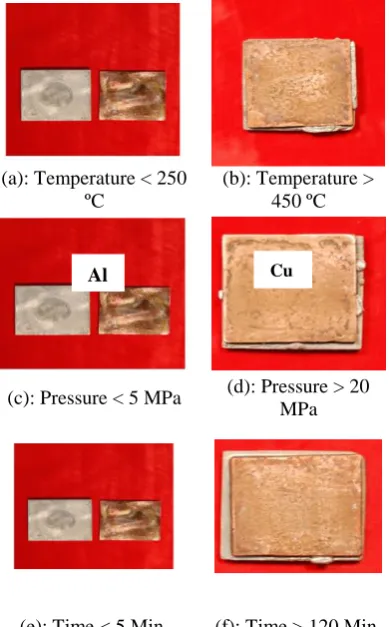
(i) When the bonding temperature was lower than 250 °C, the bonding was not occurred between Cu and Al plates since the above temperature was not sufficient to cause diffusion of atoms between these two materials (Fig. 1a).
(ii) When he bonding temperature was higher than 450 °C, the bonding was not occurred between these materials because of the melting of pure Cu at this temperature (Fig. 1b).
(iii) If the bonding pressure was below 5 MPa, the bonding was not occurred as less number of contact points through which diffusion of atoms occur between the materials (Fig. 1c).
(iv) If the bonding pressure was higher than 20 MPa, the materials got plastically deformation and bulging at the edges of the materials (Fig. 1d).
(v) If the bonding time was lesser than 5 minutes, bonding was not occurred because of the insufficient time for the diffusion atoms to take place between these materials (Fig. 1e).
(vi) If the bonding time was greater than 120inutes, excessive deformation occurred which led to the melting of pure Al (Fig. 1f).
Fig. 1: Photographs of fabricated bonds using lower and upper limit process parameter
2.2 Developing Experimental Design Matrix
The feasible limits of the variables were selected in such a way that all the combinations of the above materials should be bonded without any defects. As the limit of individual factor was wide, a central composite rotatable three-factors, five-level, central composite rotatable design matrix was chosen. The selected welding parameters and the levels are presented in Table 1. The experimental design matrix consisting 20 sets of coded condition and comprising a full replication three-factor factorial design of 8 points, 6 star points, and 6 center points was utilized
(Table 2). The method of designing such matrix is dealt elsewhere [13]. The upper and lower limits of the parameters were coded as +1.682 and –1.682, respectively. The coded values for intermediate levels can be calculated from the following relationship [13] Xi = 1.682 [2X - (Xmax + Xmin)] / (Xmax – Xmin).
(1) Where,
Xi is the required coded value of a variable X and X is any value of the variable from Xmin to Xmax. Xmin
(a): Temperature < 250 ºC
(b): Temperature > 450 ºC
(c): Pressure < 5 MPa (d): Pressure > 20 MPa
(e): Time < 5 Min.
(f): Time > 120 Min.
Al l
[image:2.595.333.528.123.437.2]235 is the lower level of the variable and Xmax; is the
highest level of the variable.
Table 2: Experimental design matrix and responses of Cu/Al bonds
2.3 Recording the Responses (diffusion layer thickness and interface hardness)
As per the design matrix, twenty bimetallic joints were fabricated. The joints were sliced using wire cut electric-discharge machining (WEDM) process. The microstructure analysis was carried out at the interface region and the diffusion layer thickness was measured using the scanning electron microscopy. The interface hardness was also measured by using Vicker’s hardness tester and the average of three values is presented in Table 2.
3. DEVELOPING EMPIRICAL
RELATIONSHIPS
The responses functions (Y) are diffusion layer thickness (DL) and interface hardness (IH) and they are function of bonding temperature (T), bonding pressure (P) and holding time (H) and it can be expressed as in the mathematical form as below
DL = f{T,H,P} ; IH = f{T,H,P}; (2)
The second order polynomial (regression) equation used to represent the response surface ‘Y’ and the selected polynomial could be expressed as;
Y=b0+b1(T)+b2(H)+b3(P)+b11(T2)+b22(H2)+b33(P2)+b12
(TH)+b13(TP)+b23(HP)
(3)
Table 1: Feasible working limits of diffusion bonding parameters of Cu/Al bonds
No Parameters Notations Units Levels
-1.682 -1 0 1 1.682
1 Bonding temperature
T
0C 266 300 350 400 434
2 Holding time H Minutes 30 45 60 75 90
3 Bonding pressure P MPa 10 12.5 15 17.5 20
Exp. No Coded values Original values
Diffusion Layer Thickness
Interface Hardness
T H P T H P DL IH
1 -1 -1 -1 300 45 13 17 68 45 13
2 1 -1 -1 400 45 13 26 92
3 -1 1 -1 300 75 13 22 83
4 1 1 -1 400 75 13 31 114
5 -1 -1 1 300 45 18 20 73
6 1 -1 1 400 45 18 31 114
7 -1 1 1 300 75 18 25 88
8 1 1 1 400 75 18 37 126
9 -2 0 0 266 60 15 16 61
10 2 0 0 434 60 15 35 116
11 0 -2 0 350 35 15 21 81
12 0 2 0 350 85 15 28 108
13 0 0 -2 350 60 11 25 86
14 0 0 2 350 60 19 32 118
15 0 0 0 350 60 15 31 114
16 0 0 0 35 60 15 30 110
17 0 0 0 350 60 15 31 114
18 0 0 0 350 60 15 30 110
19 0 0 0 350 60 15 30 110
236 where b0 is the average of responses and b1, b2,
b3…b23 are regression coefficients that depend on
respective linear, interaction, and squared terms of factors. The value of the coefficient was evaluated using Design Expert Software (DOE) .After determining the significant coefficients at the (95% confidence level), the final relationships were developed using these coefficients and the final empirical relationships were developed to estimate diffusion layer thickness and interface hardness of diffusion bonded Cu/Al dissimilar joints are given below:
DL = { -126.55+0.47194(T)+1.09755(H) +1.51759 (P) - 4(TH) - 3(TP) – 3(HP) - 4(T2) - 3(H2) -
0.087495(P2) } m (4)
IH ={-563.60 + 2.148(T)+3.892(H) +11.554(P) - 4(TH) + 0.024(TP) -0.033(HP) - 3( T2) - 0.026 (H2) -
0.503 (P2)} Hv (5)
4. CHECKING ADEQUACY OF THE
DEVELOPED RELATIONSHIPS
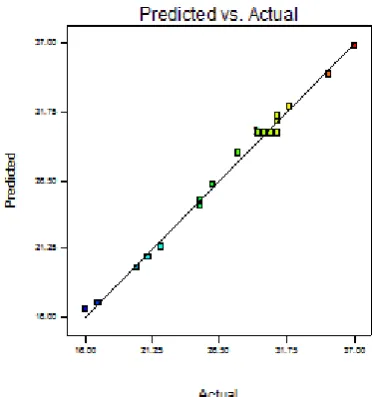
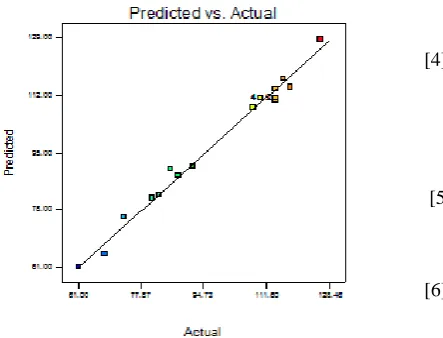
The adequacy of the developed relationships was tested by the analysis of variance (ANOVA) technique and the results of second order response surface model fitting in the form of analysis of variance are given in Tables 3. The determination coefficient (R2) indicates the goodness of fit for the model. In this case, the values of the determination coefficient (R2) indicate that the model does not explain only less than 5% of the total variations. The values of adjusted determination coefficient (adjusted R2) are also high, which indicates a high significance of the model. Predicted R2 is also made a good agreement with the adjusted R2. Adequate precision compares the range of predicted values at the design points to the average prediction error. The relationships between actual and predicted responses and each observed responses of Cu/Al bonds are compared with the predicted responses calculated from the model and their respective correlation graphs are shown in Fig. 2.
From the ANOVA table 3, the higher F ratio value implies that the respective term is more significant and vice versa. From the F ratio values it can be concluded that the bonding temperature is contributing more on diffusion layer thickness and interface hardness and it is followed by bonding pressure and holding time.
[image:4.595.314.501.527.726.2]Table 3. ANOVA test results for Cu/Al bonds (to identify significant factors)
Source
Diffusion layer thickness (DL)
Interface hardness (IH)
F
Value
p-value
Prob >F F
Value
p-value
Prob >F
Model 197.02 <0.0001* 83.70 <0.0001*
T 1118.94 <0.0001* 419.73 <0.0001*
H 225.80 <0.0001* 97.94 <0.0001*
P 174.05 <0.0001* 78.28 <0.0001
TH 0.36 0.5624 0.22 0.6466
HP 8.97 0.0134* 8.05 0.0177*
TP 0.36 0.5624 1.40 0.2646
T2 106.92 <0.0001* 100.92 <0.0001*
H2 159.13 <0.0001* 54.08 <0.0001*
P2 12.37 0.0056* 15.91 0.0026*
237
[image:5.595.94.316.110.279.2](a) Diffusion layer thickness and (b) Interface hardness
Fig. 3 Correlation graphs for Cu/Al diffusion bonds
5.CONCLUSIONS
(i) Empirical relationships were developed to predict the diffusion layer thickness and interface hardness of diffusion bonded bimetallic joints of pure Cu/Al incorporating important parameters such as bonding temperature, holding time and bonding pressure. The developed empirical relationships can be effectively used to predict the diffusion layer thickness and interface hardness of the above bimetallic joints at 95% confidence level.
(ii) Bonding temperature was found to have greater influence on diffusion layer thickness and interface hardness of bimetallic joints of pure Cu/Al followed by bonding pressure and holding time.
ACKNOWLEDGMENTS
The authors are grateful to the Centre for Materials Joining and Research (CEMAJOR), Department of Manufacturing Engineering, Annamalai University, Annamalai Nagar, India for extending the facilities of Materials Joining Laboratory and Material Testing Laboratory to carry out this investigation.
REFERENCES
[1] Sabetghadam, H., Zarei Hanzaki, A., Araee, A. and Hadian, A. (2010); Microstructural Evaluation of 410 SS/Cu Diffusion-Bonded Joint. Mater. Sci. Tech., 26(2), 163-169.
[2] Yeh, M. S.,Chuang, T. S. (1995); Low Pressure diffusion bonding of SAE 316 stainless steel by inserting a super plastic interlayer, Scr. Metall Mater., 33(8), 1277– 1281,
[3] Ho-Sung Lee, Jong-Hoon Yoon, Yeong-Moo Yi. (2007); Oxidation behavior of titanium
alloy under diffusion bonding, Thermochimica Acta, , 455,105-108, [4] Ho-Sung Lee, Jong-Hoon Yoon, Chan Hee
Park, Young Gun Ko, Dong Hyuk Shin, Chong Soo Lee. (2007); A study on diffusion bonding of superplastic Ti–6Al–4V ELI grade. Journal of Materials Processing Technology, 187-188, 526-529
[5] Hill, P. S., Todd, R. I., Ridley, N. (2003); Mechanism of HIP bonding of Zircaloy-4 in the α-phase field. Mat.Pro.Tech., 135, 131-136.
[6] Bulent Kurt, Nuri Orhan, Ertan Evin , Adnan Çalik.( 2007); Diffusion bonding between Ti–6Al–4V alloy and ferritic stainless steel. Materials Letters, 61, 1747–1750.
[7] Tanabe, J., Sasak, T., Kishi, S. (2007); Diffusion bonding of Ti/graphite and Ti/diamond by hot isostatic pressing method. Mat.Pro.Tech, , 192-193, 453- 458
[8] Howlader, M. M. R., Kaga, T., Suga, T. (2010); Investigation of bonding strength and sealing behavior of aluminum/stainless steel bonded at room temperature. Vacuum, 84, 1334 -1340.
[9] Mahendran, G., Balasubramanian, V., Senthilvelan, T. (2010); Influences of diffusion bonding process parameters on bond characteristics of Mg-Cu dissimilar joints. Trans. Nonferrous Met China, 20, 997-1005.
[10] Huang, Y., Ridley, N., Humphreys, F. J., Cui, J. Z. (1999); Diffusion bonding of superplastic 7075 aluminium alloy Materials Science and Engineering A, 266, 295-302.
[11] Kenevisi, M. S., Mousavi Khoie, S. M. (2012); A study on the effect of bonding time on the properties of Al7075 to Ti–6Al–4V diffusion bonded joint. Mat Letters, 76,144-146
[12] Mahendran, G., Balasubramanian, V. and Babu, S. (2010); Optimising Diffusion Bonding Process Parameters to Attain Maximum Strength in Al-Cu Dissimilar Joints Using Response Surface Methodology, Int. J.Manuf. Res., 5, p 181–198