Improving Calculation of Contextual Similarity for
Constructing a Bilingual Dictionary via a Third Language
Takashi Tsunakawa Yosuke Yamamoto Hiroyuki Kaji
Graduate School of Informatics, Shizuoka University
3-5-1 Johoku, Naka-ku, Hamamatsu, Shizuoka 432-8011, Japan
{tuna, kaji}@inf.shizuoka.ac.jp
Abstract
A novel method is proposed for measuring contextual similarity by “weighted overlap-ping ratio (WOR)” to construct a bilingual dic-tionary of a new language pair from two bilin-gual dictionaries sharing one language. The WOR alleviates the effect of a noisy seed dic-tionary resulting from merger of two bilingual dictionaries via a third language. Combined use of two word-association measures for ex-tracting contexts from corpora is also proposed to compensate their weaknesses. Experiments on constructing a Japanese-Chinese dictionary via English show that the proposed method outperforms the conventional method based on cosine similarity.
1
Introduction
With the growth of communication via the Inter-net, people have more chance to access docu-ments written in various languages. The number of Internet users in the Arabic, Russian, and Chi-nese languages have increased at least tenfold times in the last decade. It was sufficient in the past to bridge the gap between English and an-other language by using bilingual resources and services. For directly accessing Web contents written in various languages, however, multilin-gual dictionaries, translation, and information retrieval are required.
The present study focuses on a so-called trian-gulation approach for constructing a bilingual dictionary by merging two bilingual dictionaries sharing one language. For example, if Chinese-to-English and English-to-Arabic dictionaries are available, a Chinese-to-Arabic dictionary can be derived by collecting pairs of Chinese and Ara-bic terms (hereafter, “term pairs”) that have
common English translations. A serious problem with this approach, however, is how to filter out false term pairs, caused by polysemy of English terms. To validate each term pair as translations, we calculate the context similarity between the terms on the basis of the distributional hypothe-sis (Harris, 1954).
In triangulation approach, calculation of the context similarity in different languages is re-quired. Previous studies have calculated context similarities by context vector projection onto an-other language by using a seed bilingual diction-ary. Though this approach is effective, transla-tion perplexity caused by context vector projec-tion may cause negative effects described in Sec-tion 3.3. Instead of projecSec-tion, our proposed method avoids this problem by using a “weighted overlapping ratio,” which directly maps words in context vectors in different lan-guages.
2
Related work
Tanaka and Umemura (1994) proposed a triangu-lation method of constructing a bilingual diction-ary. Their method has been augmented by using semantic classes (Bond et al., 2001) and parts of speech and cognates (Zhang et al., 2005).
Several methods of constructing a bilingual dictionary from contextual similarity have been proposed (Rapp, 1995; Kaji and Aizono, 1996; Tanaka and Iwasaki, 1996; Fung and Yee, 1998; Rapp, 1999; Sammer and Soderland, 2007). Most of them are based on context vector projec-tion. Rapp (1999) replaced a word in the context vector with the translation first appeared in the dictionary, while Fung and Yee (1998) gave each translation a weight inversely proportional to the order of the translation in the dictionary. As an-other provision for translating context vectors,
mutual projection of context vectors was pro-posed (Fišer et al., 2011). Adapting a seed bilin-gual dictionary to the domain of comparable cor-pora has been proved to be effective (Kaji, 2005; Morin and Prochasson, 2011).
Other approaches (Déjean and Gaussier, 2002; Daille and Morin, 2005; Hazem et al., 2011) proposed methods based on identification of sec-ond-order affinities. Kaji et al. (2008) created a correlation matrix of context words versus trans-lations. Vulić and Moens (2012) proposed a bi-lingual LDA model in which the term pairs are obtained on the basis of similar distributions of language-independent latent topics.
3
Proposed method
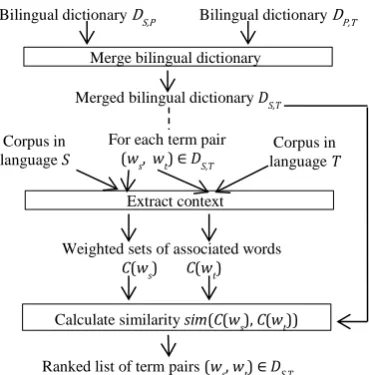
The proposed method is overviewed in Figure 1. Each step of the proposed method is described in the following subsections.
3.1 Merging bilingual dictionaries
It is supposed that a bilingual dictionary between a source language S and a target language T can be constructed via a third language P. A bilingual dictionary, DL,L’, between two languages, L and L’,
can be defined as a set of term pairs {(wl, wl’)} ⊆
L × L’, where term wl ∈ L can be translated as
term wl’ ∈ L’.1
It is assumed that two bilingual dictionaries,
DS,P and DP,T, are available. The merged bilingual
dictionary between S and T, namely, DS,T, is
ob-tained from
{(ws, wt)|∃wp: (ws, wp)∈DS,P ∧ (wp, wt)∈DP,T}.
Note that term ws cannot necessarily be translat-ed into term wt because of polysemy of term wp.
Such term pair (ws, wt) makes “noise” in the
merged dictionary.
DS,T is used as a candidate set of term pairs to be ranked. It is also used as a seed bilingual dic-tionary to calculate the similarity of contexts in languages S and T.
3.2 Extracting context
Spurious term pairs in the merged bilingual dic-tionary should be removed. The similarity of senses of each term pair is estimated by compar-ing their contexts. We represent the context of term w as a weighted set of associated words, i.e., words that are semantically or topically related with w. The weighted set of associated words,
1
We describe that the vocabulary set of a language L also as
L in short.
C(w), is denoted as {w1/α1, w2/α2, …, wK/αK}
where wk is an associated word of w, and αk is its
weight assigned by the word-association measure based on their co-occurrence frequencies.
(1) Using a single word-association measure
Among words that co-occur with w in the corpus, only words that have association measure scores in the top-M%2 are kept as associated words. The word-association measures employed are log-likelihood ratio (LLR), pointwise mutual infor-mation (MI), chi-squared score (χ2
), and dis-counted log-odds ratio (LOR) (Laroche and Langlais, 2010).
(2) Using combination of word-association measures
Each association measure has its own weakness in capturing word association. For example, LLR tends to overestimate frequent words, while MI tends to do infrequent ones. In general, infre-quent associated words have less possibility to be matched when comparing two sets of associated words. A combination of these measures is ex-pected to compensate for each weakness.
Associated words whose first association measure is in the top-M1% and second is in the top-M2% are kept. A weight corresponding to each associated word is given by the second measure. Two kinds of combinations are consid-ered: LLR-MI and LLR-LOR, which respective-ly represent the first and second measures.
3.3 Calculating similarity between weighted sets of associated words
2
A fixed threshold value of the association score was not used for keeping associated words because the proposed method obtained better results in our experiment.
Figure 1. Overview of proposed method
Merge bilingual dictionary
Extract context
Calculate similarity sim(C(ws), C(wt)) Bilingual dictionary DS,P Bilingual dictionary DP,T
Merged bilingual dictionary DS,T
Weighted sets of associated words
C(ws) C(wt)
For each term pair
(ws, wt) ∈ DS,T
Ranked list of term pairs (ws, wt) ∈ DS,T Corpus in language T Corpus in
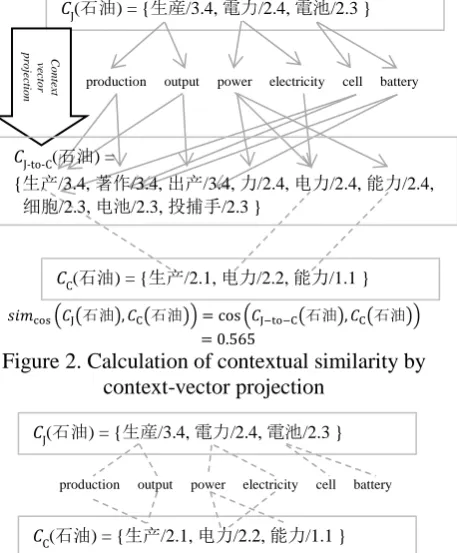
Figure 2. Calculation of contextual similarity by context-vector projection
( (石油) (石油)) ( (石油) (石油))
A problematic case of context vector projection is illustrated in Figure 2. For calculating contex-tual similarity, such as a cosine, the context vec-tors3 must be projected onto associated-word di-mensions in the same language. In this approach, associated words are duplicated by translation perplexity. In this example, each word associated with the Japanese word “石油” sekiyu ‘petrole-um’ has several possible English translations. It yields unnecessary Chinese associated words such as “力” li ‘power’ and “细胞” xibao ‘cell (in the biological sense),’ and then falsely de-creases the cosine value because the norm of the projected vector increases.4
To avoid this problem, two sets of associated words are directly compared. For two weighted sets of associated words, C(ws) = {wk/αk} and
C(wt) = {w'l/α'l}, a weighted overlapping ratio
(WOR) is defined as:
{∑ ∑
∑ ∑ }
where P = {k|∃w'l: (wk, w'l) ∈ DS,T}, Q = {l|∃wk :
(w'l, wk) ∈ DT,S}, and DS,T and DT,S are seed
bilin-gual dictionaries between languages S and T. Term pairs (ws, wt) in the merged dictionary are
ranked in order of their WORs. An example cal-culation of WOR is shown in Figure 3. The side effect from a noisy seed dictionary is considered to be moderated, since an unnecessary term is added only once per noisy term.
4
Experiments
Experiments on constructing a Japanese-Chinese bilingual dictionary via English as a third lan-guage were carried out. Note that this approach is applicable for any language combinations. We report three kinds of comparison: WOR vs. co-sine similarity, word-association measures, and newspaper corpus vs. Wikipedia corpus.
Window size W for counting co-occurrence frequencies was fixed to 10. Five-fold cross vali-dation was conducted for optimizing parameters for choosing associated words (M; M1 and M2).5
3
The weighted set of associated words is compatible to the context vector with dimensions of associated words in the vector space model.
4
Rapp (1999) substituted each associated word to only a single translation. In that case, however, a noisy seed dic-tionary significantly decreases the probability that the trans-lation is appropriate.
5
The optimized values were as follows: M = 1.02 (%) for LOR and M1 = 13.5, M2 = 9.4 (%)for MI-LLR.
The final evaluation score is output by averaging all five results.
4.1 Experimental settings
Two sets of comparable corpora were employed for our experiment: newspaper and Wikipedia. The newspaper set consists of the Mainichi Shimbun Corpus (2000-2010; 22.3GB) and the Xinhua News Corpus in LDC Chinese Gigaword (2000-2010; 4.24GB). The Wikipedia set con-sists of Japanese and Chinese Wikipedia articles dumped on September 2012 (Japanese: 821k ar-ticles; 3.1GB / Chinese: 520k arar-ticles; 0.7GB).
EDR Japanese-to-English/English-to-Japanese dictionaries and LDC Chinese-to-English dic-tionary6 were used as input dictionaries. Each EDR dictionary has 376k word pairs, including 161k English distinct words and 221k Japanese distinct words. The LDC dictionary consists of 82k distinct word pairs.
3,000 term pairs (each term occurs at least 2,500 times in the corpus) were randomly ex-tracted as the test data from the merged Japa-nese-Chinese dictionary. Each term pair was la-beled as translation or non-translation by
6
The English-to-Chinese dictionary was obtained by invers-ing the LDC dictionary.
(
)
simWOR(CJ(石油), CC(石油))
Figure 3. Calculation of WOR
CJ(石油) = {生産/3.4, 電力/2.4, 電池/2.3 }
production output power electricity cell battery
CC(石油) = {生产/2.1, 电力/2.2, 能力/1.1 }
CJ(石油) = {生産/3.4, 電力/2.4, 電池/2.3 }
CC(石油) = {生产/2.1, 电力/2.2, 能力/1.1 }
production output power electricity cell battery
C
ontex
t
ve
ctor
pr
ojec
ti
on
CJ-to-C(石油) =
jority decision of three human annotators. The test set consists of 1,053 translation pairs and 1,947 non-translation pairs.
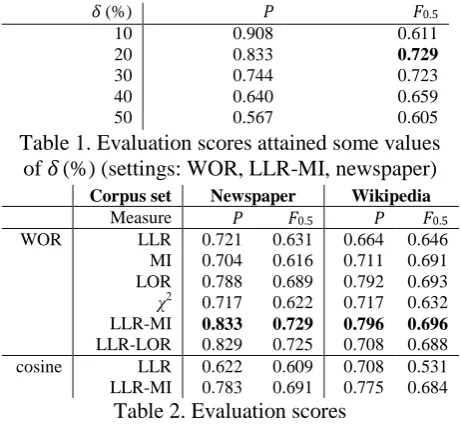
Precision P and recall R for the term pairs with the top-δ% of WORs or cosine values were cal-culated. Some translation term pairs could not be correctly judged because those terms are some-times only used for representing different senses from a sense in the comparable corpus. The re-call therefore does not reach a higher value com-pared with the precision value. For this reason, an Fβ-score with β = 0.5 was adopted as the final evaluation score so as to emphasize precision as twice as important as recall. The best F0.5-scores were obtained when δ = 20 (%) (see Table 1).
4.2 WOR vs. cosine similarity
To confirm the effect of WOR, it was compared with the conventional cosine by context vector projection. The best evaluation scores are listed in Table 2. WOR outperformed the cosine meas-ure on both corpus sets.
The merged dictionary for comparing associ-ated words can also be substituted by existing bilingual dictionaries between languages S and T if available. To examine the effect of using the noisy seed bilingual dictionary, additional exper-iments in using the EDR Japanese-Chinese dic-tionary (223k term pairs) as a seed dicdic-tionary were conducted. The F0.5-score by WOR with this setting was 0.743, while 0.721 by cosine measure. The drop in the F0.5-score by using the merged dictionary as the seed were 1.4 points by WOR, which were smaller than the drop (3.0 points) obtained by the cosine. This result shows that WOR is more robust than the cosine in the case that a noisy seed dictionary is used.
4.3 Single measure vs. combination of measures
Experiments on using all word association measures were carried out. Among the single word-association measure, the highest F0.5-score of 0.689 was obtained by LOR as listed in Table 2, and it confirmed a previous comparative ex-periment (Laroche and Langlais, 2010). Both combinations of the multiple association measures outperformed LOR on the newspaper set. These results indicate that the weakness that LOR covered could also be covered by LLR.
4.4 Newspaper vs. Wikipedia as the compa-rable corpus
The characteristics of the results obtained from
Table 1. Evaluation scores attained some values of δ(%) (settings: WOR, LLR-MI, newspaper)
Table 2. Evaluation scores
each comparable corpus set described in Section 4.1 were examined. As listed in Table 2, combi-nations of the multiple measures did not achieve significant improvement on the Wikipedia cor-pus set. Meanwhile, the overall performance of Wikipedia did not significantly degrade in com-parison with the newspaper set, although larger corpora give more appropriate associated word sets for each term pair. One reason for that result is the high comparability of Wikipedia data.
5
Concluding remarks
A novel method for constructing bilingual dic-tionaries via a third language is proposed. It ap-plies a novel context similarity criterion, namely, a “weighted overlapping ratio” (WOR) for alle-viating negative effects from translation per-plexity. In addition, a method for combining word-association measures is developed. Exper-iments demonstrated the effectiveness of the proposed method: the proposed method achieved the highest F0.5-score 0.729, thereby outperform-ing the F0.5-score 0.691 by the conventional co-sine-similarity method in the case of projecting context vectors onto English.
A future direction is applying word-sense-disambiguation techniques to associated words. By separating polysemous associated words into some classes corresponding to each sense, we could avoid the negative effect from unrelated senses of the associated words.
Acknowledgments
This work was partially supported by Grant-in-Aid for Scientific Research, MEXT (22300032). We thank Prof. Masanori Kato for proofreading.
δ (%) P F0.5
10 0.908 0.611 20 0.833 0.729
30 0.744 0.723 40 0.640 0.659 50 0.567 0.605
Corpus set Newspaper Wikipedia
Measure P F0.5 P F0.5
WOR LLR 0.721 0.631 0.664 0.646 MI 0.704 0.616 0.711 0.691 LOR 0.788 0.689 0.792 0.693 χ2 0.717 0.622 0.717 0.632 LLR-MI 0.833 0.729 0.796 0.696
LLR-LOR 0.829 0.725 0.708 0.688 cosine LLR 0.622 0.609 0.708 0.531
References
Bond, Francis, Ruhaida Binti Sulong, Takefumi Yamazaki, and Kentaro Ogura. 2001. Design and construction of a machine-tractable
Japanese-Malay dictionary. In Proceedings of MT Summit
XIII, pages 53–58.
Daille, Béatrice and Emmanuel Morin. 2005. French-English terminology extraction from comparable corpora. In Proceedings of the 2nd International
Joint Conference on Natural Language Processing,
Vol. 3651, pages 707–718.
Déjean, Hervé and Éric Gaussier. 2002. Une nouvelle approche à l’extraction de lexiques bilingues à
partir de corpus comparables. Lexicometrica,
Alignement lexical dans les corpus
multilingues, :1–22.
Fišer, Darja, Špela Vintar, Nikola Ljubešić, and Senja Pollak. 2011. Building and using comparable corpora for domain-specific bilingual lexicon
extraction. In Proceedings of the 4th Workshop on
Building and Using Comparable Corpora:
Comparable Corpora and the Web, pages 19–26.
Fung, Pascale and Lo Yuen Yee. 1998. An IR approach for translating new words from
nonparallel, comparable texts. In Proceedings of
the 36th Annual Meeting on Association for
Computational Linguistics, Vol. 1, pages 414–420.
Harris, Zellig. 1954. Distributional structure. Word, 10(23):146–162.
Hazem, Amir, Emmanuel Morin, and Sebastian Peña Saldarriaga. 2011. Bilingual lexicon extraction from comparable corpora as metasearch. In
Proceedings of the 4th Workshop on Building and
Using Comparable Corpora, pages 35–43.
Kaji, Hiroyuki. 2005. Extracting translation
equivalents from bilingual comparable corpora.
IEICE Transactions on Information and Systems,
E88-D(2):313–323.
Kaji, Hiroyuki and Toshiko Aizono. 1996. Extracting word correspondences from bilingual corpora based on word co-occurrence information. In
Proceedings of the 16th International Conference
on Computational Linguistics, pages 23–28.
Kaji, Hiroyuki, Shin’ichi Tamamura, and Dashtseren Erdenebat. 2008. Automatic construction of a Japanese-Chinese dictionary via English. In
Proceedings of the 6th International Conference on
Language Resources and Evaluation, pages 699–
706.
Laroche, Audrey and Philippe Langlais. 2010. Revisiting context-based projection methods for term-translation spotting in comparable corpora. In
Proceedings of the 23rd International Conference
on Computational Linguistics, pages 617–625.
Morin, Emmanuel and Emmanuel Prochasson. 2011. Bilingual lexicon extraction from comparable corpora enhanced with parallel corpora. In
Proceedings of the 4th Workshop on Building and Using Comparable Corpora: Comparable Corpora
and the Web, pages 27–34.
Rapp, Reinhard. 1995. Identifying word translations in non-parallel texts. In Proceedings of the 33rd Annual Meeting on Association for Computational
Linguistics, pages 320–322.
Rapp, Reinhard. 1999. Automatic identification of word translations from unrelated English and
German corpora. In Proceedings of the 37th
Annual Meeting of the Association for
Computational Linguistics, pages 519–526.
Sammer, Marcus and Stephen Soderland. 2007. Building a sense-distinguished multilingual lexicon from monolingual corpora and bilingual lexicons.
In Proceedings of MT Summit XI, pages 399–406.
Tanaka, Kumiko and Hideya Iwasaki. 1996. Extraction of lexical translations from non-aligned
corpora. In Proceedings of the 16th Conference on
Computational Linguistics, Vol. 2, pages 580–585.
Tanaka, Kumiko and Kyoji Umemura. 1994.
Construction of a Bilingual Dictionary
Intermediated by a Third Language. In
Proceedings of the 15th International Conference
on Computational Linguistics, pages 297–303.
Vulić, Ivan and Marie-Francine Moens. 2012. Detecting highly confident word translations from comparable corpora without any prior knowledge.
In Proceedings of the 13th Conference of the
European Chapter of the Association for
Computational Linguistics, pages 449–459.
Zhang, Yujie, Qing Ma, and Hitoshi Isahara. 2005. Construction of a Japanese-Chinese bilingual dictionary using English as an intermediary.
International Journal of Computer Processing of