Supervised Attention for Sequence-to-Sequence Constituency Parsing
Hidetaka Kamigaito†, Katsuhiko Hayashi, Tsutomu Hirao and Masaaki Nagata
NTT Communication Science Laboratories, NTT Corporation 2-4 Hikaridai, Seika-cho, Soraku-gun, Kyoto, 619-0237, Japan
Hiroya Takamura and Manabu Okumura
Tokyo Institute of Technology, Yokohama, Kanagawa 226-8503, Japan
Abstract
The sequence-to-sequence (Seq2Seq) model has been successfully applied to machine translation (MT). Recently, MT performances were improved by incorpo-rating supervised attention into the model. In this paper, we introduce supervised attention to constituency parsing that can be regarded as another translation task. Evaluation results on the PTB corpus showed that the bracketing F-measure was improved by supervised attention.
1 Introduction
The sequence-to-sequence (Seq2Seq) model has been successfully used in natural language genera-tion tasks such as machine translagenera-tion (MT) ( Bah-danau et al.,2014) and text summarization (Rush et al., 2015). In the Seq2Seq model, attention, which encodes an input sentence by generating an alignment between output and input words, plays an important role. Without the attention mecha-nism, the performance of the Seq2Seq model de-grades significantly (Bahdanau et al., 2014). To improve the alignment quality, Mi et al. (2016), Liu et al.(2016), andChen et al.(2016) proposed a method that learns attention with the given align-ments in a supervised manner, which is called su-pervised attention. By utilizing susu-pervised atten-tion, the translation quality of MT is improved.
The Seq2Seq model can also be applied to other NLP tasks. We can regard parsing as a transla-tion task from a sentence to an S-expression, and Vinyals et al.(2015) proposed a constituent pars-ing method based on the Seq2Seq model. Their method achieved the state-of-the-art performance.
<s> </s>
(S )S
(VP )VP
(NP )NP
XX
soup XX
the XX
cooks
(NP )NP
XX
chef XX
the
Figure 1: S-expression format for Vinyals et al. (2015)’s Seq2seq constituency parser. The Seq2seq model employs “<s>(S (NP XX XX )NP (VP XX (NP XX XX )NP )VP )S</s>” as output tokens. <s>and</s>are start and end of sen-tence symbols, respectively.
In their method, based on the alignment be-tween a nonterminal and input words, the attention mechanism has also an important role. However, since the attention is learned in an unsupervised manner, the alignment quality might not be opti-mal. If we can raise the quality of the alignments, the parsing performance will be improved. Un-like MT, however, the definition of a gold standard alignment is not clear for the parsing tasks.
In this paper, we define several linguistically-motivated annotations between surface words and nonterminals as “gold standard alignments” to en-hance the attention mechanism of the constituency parser (Vinyals et al., 2015) by supervised atten-tion. The PTB corpus results showed that our method outperformedVinyals et al.(2015) by over 1 point in the bracketing F-measure.
LSTM1 LSTM1 LSTM1 LSTM1 LSTM1 LSTM1
(SBARQ (WHADVP XX )WHADVP
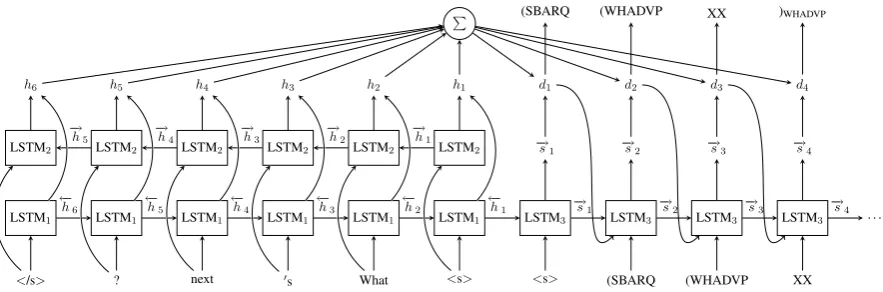
Figure 2: Network structure of our sequence-to-sequence model.
2 Sequence-to-Sequence based Constituency Parser on Supervised Attention Framework
The Seq2Seq constituency parser (Vinyals et al., 2015) predicts nonterminal
la-bels y = (y1, ..., ym), for input words
x = (x1, ..., xn), wheremandnare respectively
the lengths of the word and the label sequences. As shown in Fig. 1, we use normalized labels (Vinyals et al., 2015) in our Seq2Seq model, which consists of encoder and decoder parts. Its overall structure is shown in Fig.2.
The encoder part employs a 3-layer stacked bi-directional Long Short-Term Memory (LSTM) to encode input sentencexinto a sequence of hidden statesh= (h1, ..., hn). Eachhiis a concatenation
of forward hidden layer−→hi and backward hidden
layer ←−hi. ←−h1 is inherited by the decoder as an
initial state.
The decoder part employs a 3-layer stacked for-ward LSTM to encode previously predicted label
yt−1 into hidden statest.
For each time t, with a 2-layer feed-forward neural networkr, encoder and decoder hidden lay-ers h and−→st are used to calculate the attention
weight:
αit = ∑nexp(r(hi,−→st))
i′=1exp(r(hi′,−→st)).
Using attention weight αi
t and 1-layer
feed-forward neural network u, label probabilities are calculated as follows:
where V is the label size. Note that dt and the
embedding of labelytare concatenated and fed to
the decoder at timet+ 1.
In a supervised attention framework, attentions are learned from the given alignments. We denote a link on an alignment betweenytandxiasai
t= 1
(ai
t = 0 denotes that yt and xi are not linked.).
Following a previous work (Liu et al.,2016), we adopt a soft constraint to the objective function:
−
to jointly learn the attention and output distribu-tions. All our alignments are represented by one-to-many links between input wordsxand nonter-minalsy.
3 Design of our Alignments
In the traditional parsing framework (Hall et al., 2014; Durrett and Klein, 2015), lexical features have been proven to be useful in improving pars-ing performance. Inspired by previous work, we enhance the attention mechanism utilizing the linguistically-motivated annotations between sur-face words and nonterminals by supervised atten-tion.
<s>[<s>] </s>[</s>]
Figure 3: Example of our alignments. The word in[ ]is linked to each output token.
• Left word: In English, the syntactic head of a verb phrase is typically at the beginning of the span. Based on this notion, this method uses the identity of the starting word of a non-terminal span. Figure3ashows an alignment example where an output token is linked to its leftmost word of the span.
• Right word: On the contrary, the syntactic head of a simple English noun phrase is of-ten at the end of the span. The alignment ex-ample in Fig.3bis produced by this method, where an output token is linked to the right-most word of the span.
• Span word: Here, we unify the above two methods. All output tokens are linked to their leftmost word, except the ending bracket to-kens, which are linked to their rightmost word. Figure3c shows an alignment exam-ple produced by this method.
• Lexical head: Lexicalization (Eisner,1996; Collins, 1997), which annotates grammar nonterminals with their head words, is use-ful for resolving the syntactic ambiguities in-volved by such linguistic phenomena as
co-ordination and PP attachment. As shown in Fig.3d, this method produces alignments by linking an output token and its head word1.
4 Experimental Evaluation
4.1 Evaluation Settings
We experimentally evaluated our methods on the English Penn Treebank corpus (PTB), and split the data into three parts: The Wall Street Journal (WSJ) sections 02-21 for training, section 22 for development and section 23 for testing.
In our models, the dimensions of the input word embeddings, the fed label embeddings, the hidden layers, and an attention vector were respectively set to 150, 30, 200, and 200. The LSTM depth was set to3. Label setLcon had a size of 61. The input vocabulary size of PTB was set to 42393. Supervised attention rateλwas set to 1.0. To use entire words as a vocabulary, we integrated word dropout (Iyyer et al.,2015) into our models with smoothing rate 0.8375 (Cross and Huang,2016). We used dropout layers (Srivastava et al.,2014) to
1For head annotations, we used ptbconv 3.0 tool (Yamada and Matsumoto,2003), which is available fromhttp://
WSJ Section 22 WSJ Section 23
Setting P R F1 AER P R F1 AER
Seq2Seq 88.1 88.0 88.1 – 88.3 87.6 88.0 –
Seq2Seq+random 67.1 66.3 66.7 96.3 66.5 65.5 66.0 96.3
Seq2Seq+first 70.3 69.7 70.0 0.0 69.6 68.7 69.2 0.0
Seq2Seq+last 66.7 66.1 66.4 0.0 66.1 64.8 65.4 0.0
Seq2Seq+head 89.2 88.9 89.1 6.9 89.2 88.1 88.6 6.9
Seq2Seq+left 89.6 89.4 89.5 1.8 89.4 88.7 89.0 1.7 Seq2Seq+right 89.2 88.9 89.0 4.7 89.5 88.6 89.1 4.7
Seq2Seq+span 89.3 89.1 89.2 1.6 89.2 88.4 88.8 1.6
Vinyals et al.(2015) w att† – – 88.7 – – – 88.3 – Vinyals et al.(2015) w/o att† – – <70 – – – <70 –
Seq2Seq+beam 89.0 88.7 88.8 – 89.1 88.3 88.7 –
Seq2Seq+beam+random 71.0 69.9 70.4 96.3 69.4 68.1 68.7 96.3 Seq2Seq+beam+first 73.9 73.0 73.5 0.0 73.2 71.8 72.5 0.0 Seq2Seq+beam+last 70.5 69.6 70.0 0.0 69.7 68.1 68.9 0.0 Seq2Seq+beam+head 89.6 89.2 89.4 6.9 89.6 88.4 89.0 6.9 Seq2Seq+beam+left 89.9 89.6 89.8 1.8 89.8 89.0 89.4 1.7 Seq2Seq+beam+right 89.6 89.2 89.4 4.7 89.7 88.9 89.3 4.7 Seq2Seq+beam+span 89.6 89.4 89.5 1.6 90.0 89.0 89.5 1.6
Seq2Seq+ens(base) 90.5 90.1 90.3 – 90.6 89.6 90.1 –
Seq2Seq+ens(feat) 91.3 90.7 91.0 – 91.5 90.5 91.0 – Vinyals et al.(2015) w att+ens† – – 90.7 – – – 90.5 – Seq2Seq+beam+ens(base) 91.4 90.9 91.1 – 91.5 90.5 91.0 – Seq2Seq+beam+ens(feat) 91.9 91.4 91.7 – 92.1 91.0 91.5 –
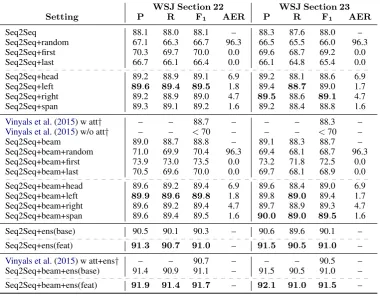
Table 1: Results of parsing evaluation: Seq2Seqindicates the Seq2Seq model on a single model with greedy decoding. +beam shows the beam decoding results. +lex, +left, +right and +span respectively show the results on our proposedlexical head,left word,right word, andspan wordalignments. +random, +first, and +last respectively show the results on the alignment of baselinesrandom,first word, andlast word. +ens(base) shows the ensemble results of five Seq2Seq models without the given alignments. +ens(feat) shows the ensemble results of a Seq2Seq model without a given alignment and Seq2Seq models withlexical head,left word,right wordandspan wordalignments.†denotes the scores reported in the paper.
each LSTM input layer (Vinyals et al.,2015) with a dropout rate of 0.3.
The stochastic gradient descent (SGD) was used to train models on 100 epochs. SGD’s learning rate was set to 1.0 in the first 50 epochs. After the first 50 epochs, the learning rate was halved after every 5th epoch. All gradients were averaged in each mini-batch. The maximum mini-batch size was set to 16. The mini-batch order was shuffled at the end of every epoch. The clipping threshold of the gradient was set to 1.0.
We used greedy and beam searches for the coding. The beam size was set to ten. The de-coding was performed on both a single model and five-model ensembles. We used the products of the output probabilities for the ensemble.
All models were written in C++ on Dynet ( Neu-big et al.,2017).
We compared Seq2Seq models with and
with-out our alignments. To investigate the influence of the supervised attention method itself, we also compared our alignments to the following align-ments:
• Random: Based on uniform distribution, each output token was randomly linked to at most one input token.
• First word: All output tokens were linked to the start of the sentence tokens in the input sentence.
• Last word: All output tokens were linked to the end of the sentence tokens in the input sentence.
We evaluated the compared methods using bracketing Precision, Recall and F-measure. We used evalb2as a parsing evaluation. We also
uated the learned attention using alignment error rate (AER) (Och and Ney, 2003) on their align-ments. Following a previous work (Luong et al., 2015), attention evaluation was conducted on gold output.
4.2 Results
Table 1 shows the results. All our lexical head,
left word, right word and span word alignments improved bracket F-measure of baseline on ev-ery setting. From the +random, +first, and +last results, only supervised attention itself did not improve the parsing performances. Furthermore, each AER indicates that the alignments were cor-rectly learned. These results support our expecta-tion that our alignments improve the parsing per-formance with Seq2Seq models.
5 Discussion
All of the baseline alignmentsrandom,first word
and last word, largely degraded the parsing per-formances. randomprevented the learning of at-tention distributions, andfirst wordandlast word
fixed the attention distributions. These resemble disable the attention mechanism. Vinyals et al. (2015) reported that the bracket F-measure of Seq2Seq without an attention mechanism is less than 70. Our evaluation results, which are con-sistent with their score, and it supports our expec-tation that the attention mechanism is critical for Seq2Seq constituency parsing.
Comparing the results of our proposed align-ments in Table 1, even though the bracket F-measure of the lexical headis lower than that of theleft word,right word andspan word, the lex-ical headis the most intuitive alignment. Except forrandom, the AER oflexical headis the highest in all the alignments. This means thatlexical head
is difficult to learn on attention distribution. The prediction difficulty may degrade the parsing per-formances. Our analysis indicates that an align-ment which can be easily predicted is suitable for the supervised attention of Seq2Seq constituency parsing.
6 Conclusion
We proposed methods that use traditional pars-ing features as alignments for the sequence-to-sequence based constituency parser in the super-vised attention framework. In our evaluation, the proposed methods improved the bracketing scores
on the English Penn Treebank against the baseline methods. These results emphasize, the effective-ness of our alignments in parsing performances.
Acknowledgement
We thank the anonymous reviewers for their care-ful reading and usecare-ful comments.
References
Dzmitry Bahdanau, Kyunghyun Cho, and Yoshua
Bengio. 2014. Neural machine translation by
jointly learning to align and translate. CoRR,
abs/1409.0473.
Wenhu Chen, Evgeny Matusov, Shahram Khadivi,
and Jan-Thorsten Peter. 2016. Guided alignment
training for topic-aware neural machine translation.
CoRR, abs/1607.01628.
Michael Collins. 1997. Three generative, lexicalised
models for statistical parsing. InProceedings of the
8th European chapter of the Association for Com-putational Linguistics, pages 16–23. Association for Computational Linguistics.
James Cross and Liang Huang. 2016.Span-based
con-stituency parsing with a structure-label system and
provably optimal dynamic oracles. InProceedings
of the 2016 Conference on Empirical Methods in Natural Language Processing, pages 1–11, Austin, Texas. Association for Computational Linguistics.
Greg Durrett and Dan Klein. 2015. Neural crf parsing.
In Proceedings of the 53rd Annual Meeting of the Association for Computational Linguistics and the 7th International Joint Conference on Natural Lan-guage Processing (Volume 1: Long Papers), pages 302–312, Beijing, China. Association for Computa-tional Linguistics.
Jason M Eisner. 1996. Three new probabilistic models
for dependency parsing: An exploration. In
Pro-ceedings of the 16th conference on Computational linguistics-Volume 1, pages 340–345. Association for Computational Linguistics.
David Hall, Greg Durrett, and Dan Klein. 2014. Less
grammar, more features. In Proceedings of the
52nd Annual Meeting of the Association for Com-putational Linguistics (Volume 1: Long Papers), pages 228–237, Baltimore, Maryland. Association for Computational Linguistics.
Mohit Iyyer, Varun Manjunatha, Jordan Boyd-Graber,
and Hal Daum´e III. 2015. Deep unordered
Lemao Liu, Masao Utiyama, Andrew Finch, and
Ei-ichiro Sumita. 2016. Neural machine translation
with supervised attention. InProceedings of
COL-ING 2016, the 26th International Conference on Computational Linguistics: Technical Papers, pages 3093–3102, Osaka, Japan. The COLING 2016 Or-ganizing Committee.
Thang Luong, Hieu Pham, and Christopher D.
Man-ning. 2015. Effective approaches to attention-based
neural machine translation. InProceedings of the
2015 Conference on Empirical Methods in Natu-ral Language Processing, pages 1412–1421, Lis-bon, Portugal. Association for Computational Lin-guistics.
Haitao Mi, Zhiguo Wang, and Abe Ittycheriah. 2016. Supervised attentions for neural machine translation. In Proceedings of the 2016 Conference on Empiri-cal Methods in Natural Language Processing, pages 2283–2288, Austin, Texas. Association for Compu-tational Linguistics.
Graham Neubig, Chris Dyer, Yoav Goldberg, Austin Matthews, Waleed Ammar, Antonios Anastasopou-los, Miguel Ballesteros, David Chiang, Daniel Clothiaux, Trevor Cohn, et al. 2017. Dynet: The
dynamic neural network toolkit. arXiv preprint
arXiv:1701.03980.
Franz Josef Och and Hermann Ney. 2003. A systematic comparison of various statistical alignment models.
Computational linguistics, 29(1):19–51.
Alexander M. Rush, Sumit Chopra, and Jason Weston.
2015. A neural attention model for abstractive
sen-tence summarization. In Proceedings of the 2015
Conference on Empirical Methods in Natural Lan-guage Processing, pages 379–389, Lisbon, Portugal. Association for Computational Linguistics.
Nitish Srivastava, Geoffrey Hinton, Alex Krizhevsky, Ilya Sutskever, and Ruslan Salakhutdinov. 2014. Dropout: A simple way to prevent neural networks
from overfitting. The Journal of Machine Learning
Research, 15(1):1929–1958.
Oriol Vinyals, Ł ukasz Kaiser, Terry Koo, Slav Petrov,
Ilya Sutskever, and Geoffrey Hinton. 2015.
Gram-mar as a foreign language. In C. Cortes, N. D.
Lawrence, D. D. Lee, M. Sugiyama, and R. Garnett,
editors,Advances in Neural Information Processing
Systems 28, pages 2773–2781. Curran Associates, Inc.
Hiroyasu Yamada and Yuji Matsumoto. 2003. Statis-tical dependency analysis with support vector
ma-chines. InProceedings of IWPT, volume 3, pages

![Figure 3: Example of our alignments. The word in [ ] is linked to each output token.](https://thumb-us.123doks.com/thumbv2/123dok_us/799942.1094116/3.595.97.502.70.366/figure-example-alignments-word-linked-output-token.webp)