A comparison and analysis of models for event trigger detection
Shang Chun Sam Wei School of Information Technologies
University of Sydney NSW 2006, Australia
Ben Hachey
School of Information Technologies University of Sydney
NSW 2006, Australia [email protected]
Abstract
Interpreting event mentions in text is cen-tral to many tasks from scientific research to intelligence gathering. We present an event trigger detection system and explore baseline configurations. Specifically, we test whether it is better to use a single multi-class classifier or separate binary classifiers for each label. The results sug-gest that binary SVM classifiers outper-form multi-class maximum entropy by 6.4 points F-score. Brown cluster and Word-Net features are complementary with more improvement from WordNet features.
1 Introduction
Events are frequently discussed in text, e.g., crim-inal activities such as violent attacks reported in police reports, corporate activities such as merg-ers reported in business news, biological processes such as protein interactions reported in scientific research. Interpreting these mentions is central to tasks like intelligence gathering and scientific re-search. Event extraction automatically identifies the triggers and arguments that constitute a textual mention of an event in the world. Consider:
Bobboughtthe book from Alice.
Here, a trigger – “bought” (Transaction.Transfer– Ownership) – predicates an interaction between the arguments – “Bob” (Recipient), “the book” (Thing) and “Alice” (Giver). We focus on the trig-ger detection task, which is the first step in event detection and integration.
Many event extraction systems use a pipelined approach, comprising a binary classifier to detect event triggers followed by a separate multi-class classifier to label the type of event (Ahn, 2006). Our work is different in that we use a single clas-sification step with sub-sampling to handle data
skew. Chen and Ji (2009) use Maximum Entropy (ME) classifier in their work. However, their ap-proach is similar to (Ahn, 2006) where they iden-tify the trigger first then classify the trigger at later stage. Kolya et al. (2011) employ a hybrid ap-proach by using Support Vector Machine (SVM) classifier and heuristics for event extraction.
We present an event trigger detection system that formulates the problem as a token-level clas-sification task. Features include lexical and syn-tactic information from the current token and sur-rounding context. Features also include addi-tional word class information from Brown clus-ters, WordNet and Nomlex to help generalise from a fairly small training set. Experiments explore whether multi-class or binary classification is bet-ter using SVM and ME.
Contributions include: (1) A comparison of bi-nary and multi-class versions of SVM and ME on the trigger detection task. Experimental results suggest binary SVM outperform other approaches. (2) Analysis showing that Brown cluster, Nom-lex and WordNet features contribute nearly 10 points F-score; WordNet+Nomlex features con-tribute more than Brown cluster features; and im-provements from these sources of word class in-formation increase recall substantially, sometimes at the cost of precision.
2 Event Trigger Detection Task
We investigate the event trigger detection task from the 2015 Text Analysis Conference (TAC) shared task (Mitamura and Hovy, 2015). The task defines 9 event types and 38 subtypes such as Life.Die, Conflict.Attack, Contact.Meet. An event trigger is the smallest extent of text (usually a word or short phrase) that predicates the occurrence of an event (LDC, 2015).
The explosionkilled7 andinjured20.
Note that an event mention can contain multiple events. Further, an event trigger can have multiple events. Consider:
Themurderof John.
where “murder” is the trigger for both a Con-flict.Attack event and a Life.Die event. Table 1 shows the distribution of the event subtypes in the training and development datasets.
3 Approach
We formulate event trigger detection as a token-level classification task. Features include lexical and semantic information from the current token and surrounding context. Classifiers include bi-nary and multi-class versions of SVM and ME.
As triggers can be a phrase, we experimented with Inside Outside Begin 1 (IOB1) and Inside Outside Begin 2 (IOB2) encodings (Sang and Veenstra, 1999). Table 2 contains an example il-lustrating the two schemes. Preliminary results showed little impact on accuracy. However, one of the issues with this task is data sparsity. Some event subtypes have few observations in the cor-pus. IOB2 encoding increases the total number of categories for the dataset. Thus make the data sparsity issue worse. Therefore we use the IOB1 encoding for the rest of the experiments.
Another challenge is that the data is highly un-balanced. Most of the tokens are not event trig-gers. To address this, we various subsets of nega-tive observations. Randomly sampling 10% of the negative examples for training works well here.
3.1 Features
All models used same rich feature sets. The fea-tures are divided into three different groups.
Feature set 1 (FS1): Basic features includ-ing followinclud-ing. (1) Current token: Lemma, POS, named entity type, is it a capitalised word. (2) Within the window of size two: unigrams/bigrams of lemma, POS, and name entity type. (3) Dependency: governor/dependent type, gover-nor/dependent type + lemma, govergover-nor/dependent type + POS, and governor/dependent type + named entity type.
Feature set 2 (FS2): Brown cluster trained on the Reuters corpus (Brown et al., 1992; Turian et
Event Subtype Train Dev
Business.Declare-Bankruptcy 30 3
Business.End-Org 11 2
Business.Merge-Org 28 0
Business.Start-Org 17 1
Conflict.Attack 541 253
Conflict.Demonstrate 162 38
Contact.Broadcast 304 112
Contact.Contact 260 77
Contact.Correspondence 77 18
Contact.Meet 221 23
Justice.Acquit 27 3
Justice.Appeal 25 12
Justice.Arrest-Jail 207 79
Justice.Charge-Indict 149 41
Justice.Convict 173 49
Justice.Execute 51 15
Justice.Extradite 62 1
Justice.Fine 53 2
Justice.Pardon 221 18
Justice.Release-Parole 45 28
Justice.Sentence 118 26
Justice.Sue 54 1
Justice.Trial-Hearing 172 24
Life.Be-Born 13 6
Life.Die 356 157
Life.Divorce 45 0
Life.Injure 63 70
Life.Marry 60 16
Manufacture.Artifact 18 4
Movement.Transport-Artifact 52 18 Movement.Transport-Person 390 125
Personnel.Elect 81 16
Personnel.End-Position 130 79
Personnel.Nominate 30 5
Personnel.Start-Position 60 17 Transaction.Transaction 34 17 Transaction.Transfer-Money 366 185 Transaction.Transfer-Ownership 233 46
Table 1: Event subtype distribution.
al., 2010) with prefix of length 11, 13 and 16.1
Feature set 3 (FS3): (1) WordNet features in-cluding hypernyms and synonyms of the current token. (2) Base form of the current token extracted from Nomlex (Macleod et al., 1998).2
1
http://metaoptimize.com/projects/wordreprs/
2
Word IOB1 IOB2
He O O
has O O
been O O
found I-Justice.Convict B-Justice.Convict guilty I-Justice.Convict I-Justice.Convict
for O O
the O O
murder I-Life.Die B-Life.Die
[image:3.595.72.293.63.202.2]. O O
Table 2: IOB1 and IOB2 encoding comparison. “B” represents the first token of an event trigger. “I” represents a subsequent token of a multi-word trigger. “O” represents no event.
3.2 Classifiers
We train multi-class ME and SVM classifiers to detect and label events. L-BFGS (Liu and No-cedal, 1989) is used as the solver for ME. The SVM uses a linear kernel. We also compare bi-nary versions of ME and SVM by building a single classifier for each event subtype.
4 Experimental setup
4.1 Dataset
The TAC 2015 training dataset (LDC2015E73) is used for the experiment. The corpus has a total of 158 documents from two genres: 81 newswire documents and 77 discussion forum documents. Preprocessing includes tokenisation, sentence splitting, POS tagging, named entity recognition, constituency parsing and dependency parsing using Stanford CoreNLP 3.5.2.3
The dataset is split into 80% for training (126 documents) and 20% for development (32 docu-ments. Listed in Appendix A).
4.2 Evaluation metric
Accuracy is measured using the TAC 2015 scorer.4
Precision, recall and F-score are defined as:
P = T P NS;R=
T P NG;F1 =
2P R P +R
whereT P is the number of correct triggers (true positives),NSis the total number of predicted sys-tem mentions, andNG is the total number of an-notated gold mentions. An event trigger is counted
3
http://nlp.stanford.edu/software/corenlp.shtml
4
http://hunterhector.github.io/EvmEval/
as correct only if the boundary, the event type and the event subtype are all correctly identified. We report micro-averaged results.
5 Results
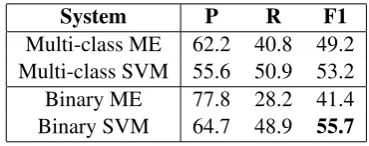
Table 3 shows the results from each classifier. The binary SVMs outperform all other models with an F-score of 55.7. The score for multi-class SVM is two points lower at 53.2. Multi-class and binary ME comes next with binary performing worst.
System P R F1
Multi-class ME 62.2 40.8 49.2 Multi-class SVM 55.6 50.9 53.2 Binary ME 77.8 28.2 41.4 Binary SVM 64.7 48.9 55.7
Table 3: System performance comparison.
5.1 Feature set
We perform a cumulative analysis to quantify the contribution of different feature sets. Table 4 shows that feature set 2 (Brown cluster) helped with recall sometimes at the cost of precision. The recall is further boosted by feature set 3 (WordNet and Nomlex). However, the precision dropped no-ticeably for SVM models.
System P R F1
Multi-class systems
ME FS1 54.1 16.9 25.8
ME FS1+FS2 57.8 21.3 31.1 ME FS1+FS2+FS3 62.2 40.8 49.2
SVM FS1 62.1 35.3 45.0
SVM FS1+FS2 60.9 39.3 47.8 SVM FS1+FS2+FS3 55.6 50.9 53.2 Binary systems
ME FS1 64.7 6.1 11.2
ME FS1+FS2 72.7 10.1 17.8 ME FS1+FS2+FS3 77.8 28.2 41.4
SVM FS1 71.0 34.2 46.2
[image:3.595.323.508.210.283.2]SVM FS1+FS2 70.5 38.4 49.7 SVM FS1+FS2+FS3 64.7 48.9 55.7
Table 4: Feature sets comparison.
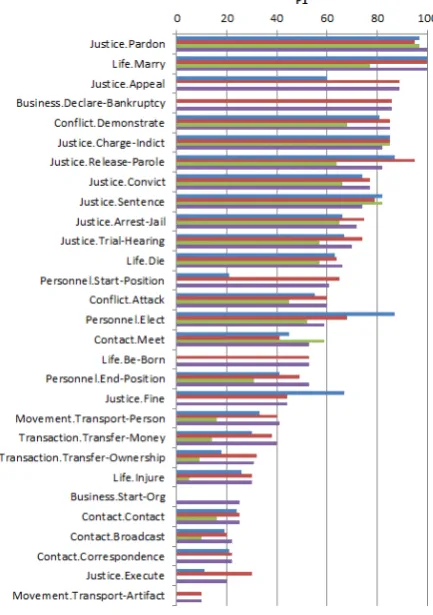
5.2 Performance by event subtype
[image:3.595.317.515.447.655.2]Figure 1: Performance by subtype.
5.3 Error analysis
We sampled 20 precision and twenty recall errors from the binary SVM classifier. 40% of preci-sion errors require better modelling of grammat-ical relations, e.g., labelling “focus has moved” as a transport event. 35% require better use of POS information, e.g., labelling “said crime” as a con-tact event. 65% of recall errors are tokens in multi-word phrases, e.g., “going to jail”. 45% are trig-gers that likely weren’t seen in training and require better generalisation strategies. Several precision and recall errors seem to actually be correct.
6 Conclusion
We presented an exploration of TAC event trigger detection and labelling, comparing classifiers and rich features. Results suggest that SVM outper-forms maximum entropy and binary SVM gives the best results. Brown cluster information in-creases recall for all models, but sometimes at the cost of precision. WordNet and Nomlex features provide a bigger boost, improving F-score by 6 points for the best classifier.
Acknowledgements
Sam Wei is funded by the Capital Markets Coop-erative Research Centre. Ben Hachey is the recip-ient of an Australian Research Council Discovery Early Career Researcher Award (DE120102900)
References
David Ahn. 2006. The stages of event extraction.
InCOLING-ACL Workshop on Annotating and
Rea-soning About Time and Events, pages 1–8.
Peter F. Brown, Peter V. deSouza, Robert L. Mer-cer, Vincent J. Della Pietra, and Jenifer C. Lai. 1992. Class-based n-gram models of natural lan-guage. Computational Linguistics, 18(4):467–479.
Zheng Chen and Heng Ji. 2009. Language specific is-sue and feature exploration in chinese event extrac-tion. InAnnual Conference of the North American Chapter of the Association for Computational Lin-guistics, pages 209–212.
Anup Kumar Kolya, Asif Ekbal, and Sivaji Bandy-opadhyay. 2011. A hybrid approach for event ex-traction and event actor identification. In Interna-tional Conference on Recent Advances in Natural
Language Processing, pages 592–597.
LDC, 2015. Rich ERE Annotation Guidelines
Overview. Linguistic Data Consortium. Version
4.1. Accessed 14 November 2015 from http: //cairo.lti.cs.cmu.edu/kbp/2015/ event/summary_rich_ere_v4.1.pdf.
Dong C. Liu and Jorge Nocedal. 1989. On the limited memory BFGS method for large scale optimization.
Mathematical Programming, 45:503–528.
Catherine Macleod, Ralph Grishman, Adam Meyers, Leslie Barrett, and Ruth Reeves. 1998. Nomlex: A lexicon of nominalizations. InEuralex International
Congress, pages 187–193.
Teruko Mitamura and Eduard Hovy, 2015.
TAC KBP Event Detection and
Corefer-ence Tasks for English. Version 1.0.
Ac-cessed 14 November 2015 from http: //cairo.lti.cs.cmu.edu/kbp/2015/ event/Event_Mention_Detection_and_ Coreference-2015-v1.1.pdf.
Erik F. Tjong Kim Sang and Jorn Veenstra. 1999. Rep-resenting text chunks. In Conference of the Euro-pean Chapter of the Association for Computational Linguistics, pages 173–179.
Appendix A: Development set document IDs
3288ddfcb46d1934ad453afd8a4e292f AFP_ENG_20091015.0364
AFP_ENG_20100130.0284 AFP_ENG_20100423.0583 AFP_ENG_20100505.0537 AFP_ENG_20100630.0660 APW_ENG_20090605.0323 APW_ENG_20090611.0337 APW_ENG_20100508.0084 APW_ENG_20101214.0097 CNA_ENG_20101001.0032 NYT_ENG_20130628.0102 XIN_ENG_20100114.0378 XIN_ENG_20100206.0090