© 2014, IJCSMC All Rights Reserved 127
Available Online atwww.ijcsmc.com
International Journal of Computer Science and Mobile Computing
A Monthly Journal of Computer Science and Information Technology
ISSN 2320–088X
IJCSMC, Vol. 3, Issue. 11, November 2014, pg.127 – 136
RESEARCH ARTICLE
A Quantitative Analysis and Behavioral
Study of Routing Protocols in MANET
Gyanendra Kumar Pallai
1, S Meenakshi
2,Amiya Kumar Rath
3, Bansidhar Majhi
4 ¹Research Scholar, Department of Computer Science and Engineering, ITER, S.O.A. University, BBSR, India2
Department of Humanities and Social Sciences, National Institute of Technology, Rourkela, India
3Department of Computer Science and Engineering, Veer Surendra Sai University of Technology, Burla, India 4Department of Computer Science and Engineering, National Institute of Technology, Rourkela, India
1 [email protected]; 2 [email protected]; 3 [email protected]; 4 [email protected]
Abstract— In this paper, we have performed a comparative analysis on three different MANET protocols with respect to packet delivery ratio (PDR), throughput, average end-to-end delay, routing overhead, normalized routing load (NRL), packet drop and packet loss metrics. The protocols considered are DSR, AODV and DSDV. The first two protocols fall under reactive whereas the third one is a proactive protocol. The performance differentials of the routing protocols are analyzed using NS-2.35 simulator. The simulation has been conducted with 100 numbers of mobile nodes (MNs) for constant bit rate (CBR) traffic and random waypoint mobility model with respect to varying pause time. Simulation analysis indicates that both reactive protocols perform quite similar in terms of throughput. However, DSR outperforms in terms of packet delivery ratio, routing overhead, normalized routing load, packet loss and packet drop than AODV. On the other hand, DSDV exhibits considerably less end-to-end delay among all the protocols due to its table-driven characteristics.
Keywords— AODV, CBR, DSR, DSDV, Mobile Ad-hoc Networks (MANETs), Mobile Nodes (MNs), Routing Protocols, Routing Table
I. INTRODUCTION
© 2014, IJCSMC All Rights Reserved 128
Therefore, the most fundamental and challenging issues in MANET is efficient packet routing. The purpose of routing is to route the packets from source to destinations.
In this paper, we have a made systematic performance comparison study on three prominent MANET routing protocols AODV, DSR and DSDV based on results analysis obtained by running simulations in network simulator tool NS-2 [7],[8] by varying pause time. Performance metrics based on which the comparison is performed are packet delivery ratio, throughput, average end-to-end delay, routing overhead, normalized routing load and packet loss. The rest portion of the paper is organized as follows: The related work is described in section II. Section III presents the brief discussion of on-demand and table-driven MANET routing protocols and its comparison. Overview of AODV, DSR and DSDV protocols are described in section IV. The simulation environment and performance comparisons are presented in Section V. Section VI summarizes the paper by conclusion.
II. RELATEDWORK
Several studies were done to assess the nature of routing protocols in MANET. Ginni Tonk et al.[10], have presented the performance comparison of DSDV, AODV and DSR routing protocols by varying pause time, number of nodes and maximum speed using network simulator NS-2.The comparison result shows that AODV has the highest packet delivery fraction and normalized routing load while DSR achieves the highest average end-to-end delay. DSDV provides the minimum delay among the three protocols because of its proactive nature. The performance comparison of the DSR, DSDV and AODV protocols for various test scenarios such as pause time, speed and number of nodes using NS-2 simulator under CBR traffic was carried out by Rahul et al. [12]. The experimental result from all the test scenarios summarize that AODV shows its superiority compared to other two protocols. DSR performs averagely and DSDV performs the worst. Shaily Mittal et al.[11], have compared the routing protocols (AODV, DSR and ZRP) using QualNet Simulator. The simulation was done with 50 nodes by varying pause times. The evaluation of AODV, DSR are done on the basis of average end to end delay, TTL based hop count and packet delivery ratio. The results show AODV having lowest end to end delay than DSR and ZRP when pause time is varied. And also, the hop count increases continuously for AODV as compared to DSR and ZRP. However, AODV and DSR deliver almost 90% of packets when compared with ZRP. Runcai Huang et al. [9] have simulated the DSDV, DSR and AODV protocols for 50 nodes by varying speed using NS2 simulator under CBR traffic. In higher-mobility, AODV proved to be more reliable and achieves the best packet delivery fraction. On the other hand, the performance of DSR is better in terms of average delay and packet loss under low-mobility scenario. In [13], the behavior of AODV, DSR, TORA and LAR routing protocols were studied using two simulators namely QualNet and the NS-2 for a large geographical network. LAR outperforms all the protocols in terms of all the performance metrics and found to be scalable. However, AODV performs poorly with respect to packet delivery fraction and DSR with respect to end-to-end delay. TORA is not suitable for larger networks. Ashish et al. [14], presented the performance comparison of AODV, DSR and DYMO with 50 nodes for CBR traffic by variable pause time. All the protocols ware simulated using Qualnet simulator for CBR traffic with respect to packet delivery fraction and average end-to-end delay both AODV and DYMO protocols performed better than DSR. Yin tan et al. [15], have examined the two on-demand protocols AODV and DSR with different pause time and traffic sources for 50 nodes using NS2 simulator. The performance evaluation results states that for low mobility scenarios, DSR outperforms AODV. However, AODV performs better than DSR for higher mobility.
III.CLASSIFICATIONOFROUTINGPROTOCOLS
© 2014, IJCSMC All Rights Reserved 129 TABLEI
COMPARISONOFTABLE-DRIVENANDON-DEMAND ROUTINGPROTOCOLS
Parameters Table-driven On-demand
Route finding Available in the routing table Computed when needed
Route latency Instantaneous Waits until valid route is
discovered.
Network organization Flat Flat
Topology
Dissemination Periodical updates No Periodical updates
Mobility handling Updates occur at regular
intervals Route maintenance
Communication
overhead High
Increases with mobility of active routes
Storage requirements Higher than On-demand Depends on the number of active
routes needed
Delay Less delay as routes are
predetermined High as routes are computed
Scalability Usually up to 100 nodes Usually higher
Power consumption Higher battery power Comparatively lesser than
table-driven
Bandwidth Increases with increase in
network size
Increases with increase in number of active routes
A. Proactive/Table-driven routing protocols
Table-driven routing protocols [18] [20] maintain consistent and fresh routing information regarding every node in the network. Every node maintains the network topology information in the form of routing tables (RTs) by periodically exchanging routing information. Examples of proactive routing protocols include Destination Sequence Distance Vector (DSDV), Wireless Routing Protocol (WRP), Optimized Link State Routing (OLSR) and the Fisheye State Routing (FSR).
B. Reactive/On-demand routing protocols
[16], [18], [20] is an improvement on table-driven routing that uses route discovery process only when desired by the source node. These routing protocols were designed to reduce the overheads in table-driven protocols by maintaining information for the active routes only. Both AODV and DSR are reactive routing protocols for MANET. Reactive protocols are classified into two categories, source routing and hop-by-hop routing. In source routing [24], each data packets carry the complete path from source to destination. Therefore, each intermediate node forwards these packets according to the information in the header of each packet. The major drawback with source routing protocols is that in large networks they do not perform well. In hop-by-hop routing each data packet only carries the destination address and the next hop address. Therefore, each intermediate node in the path to the destination uses its routing table to forward each data packet towards the destination. The advantage of this strategy is that routes are adaptable to the dynamically changing environment of MANETs. The disadvantage of this strategy is that each intermediate node must store and maintain routing information for each active route and each node may require being aware of their surrounding neighbours through the use of beaconing messages.
IV.ANOVERVIEWOFAODV,DSRANDDSDVPROTOCOLS
A. Ad Hoc On-demand Distance Vector Routing (AODV)
© 2014, IJCSMC All Rights Reserved 130
broadcast identifier number to ensure loop freedom [22] so that multiple broadcast of the same packet is prevented. To locate a route to the destination, a route request (RREQ) packet is broadcasted by the source across the network. The RREQ packet of AODV carries the broadcast identifiers and sequence numbers for both source and destination including time to live field. The destination node or the node that has new route to the destination receives RREQ packet and responds the source node by sending a route reply (RREP) packet. Otherwise, RREQ packet is rebroadcasted by the node to their neighbours. AODV broadcasts hello messages (a special RREP) periodically to the immediate neighbours. These hello messages are local advertisements that indicate the continued presence of the node.
B. Dynamic Source Routing (DSR)
DSR is a reactive routing protocol that uses source routing algorithm [17], [25]. In this methodology, the sender determines the entire hop-by-hop route to the destination and the routes are stored in a route cache [24]. If a source node wants know the route to its destination it initiate a route discovery process by flooding with route request (RREQ) packets in the network. Each node receiving an RREQ rebroadcast it, unless it is the destination or it has a routing path to the destination in its route cache. The RREQ builds up a path traversed across the network and the RREP routes itself back to the source by traversing this path backward. An intermediate node can use an alternate route form it own cache when a data packet is meets a failed link. DSR does not use hello-messages between the nodes to notify their neighbours about their presence unlike AODV. The route request packet (RREQ) of DSR contains the address of the destination node, the address of source node and a unique identification number. Intermediate node receiving the route request packet first checks for the route availability, if path not found then it append its own address and then redirects the packet along its outgoing links. The destination node or the node that has fresh route for the destination which receive RREQ packet responds by sending a RREP message. The destination node always appends the entire route information contained in the route request packet while sending RREP packet. If the route reply is sent by an intermediate node, its cached route is appended to the route record and then generates the route reply message.
C. Destination Sequence Distance Vector (DSDV)
DSDV [23] is a proactive MANET routing protocol and is based on the traditional Bellman-Ford algorithm. In DSDV, each node in the network holds a routing table that contains the next hop information and hop count of all possible destinations. A sequence number created by the destination node tags each entry to prevent loops [23]. The tables are exchanged between neighbours at regular intervals to get the current information of the network topology. The tables are also forwarded if a node finds a significant change in local topology. This exchange of table imposes a large overhead on the whole network. To reduce this potential traffic, routing updates are classified into two categories. The first is known as “full dump” which includes all available routing information. This type of updates should be used as infrequently as possible and only in the cases of complete topology change. In the cases of occasional movements, smaller “incremental” updates are sent carrying only information about changes from the time the last full dump occurred. All the updates should fit in a single network protocol data unit (NPDU) [23] and thus significantly decreasing the amount of traffic. Table updates are initiated by a destination with a new sequence number which is always greater than the previous one. On receiving the table updates, a node either renews its tables based upon the received information or maintains it for a while to choose the best metric received from multiple versions of the same update from various neighbours.
V. SIMULATIONRESULTSANDANALYSIS
A. Simulation Environment
© 2014, IJCSMC All Rights Reserved 131 TABLEIII
SIMULATIONPARAMETERS
Parameter Type Value
Network simulator NS - 2.35
Channel type Channel / Wireless channel
Routing protocols AODV, DSR, DSDV
Simulation duration 300 secs
MAC layer protocol 802.11
Topology size 500 m x 500m
Number of nodes 100
Traffic sources Constant- bit- rate(CBR)
Packet size 512 Bytes
Max number of CBR connections 10
Sending rate 4 packets /sec
Pause time 40 ,80 ,120,160, 200 secs
Speed 20 m/s
B. Mobility and Traffic Model
Mobility models are used to describe the movements of the mobile nodes at every moment, defining their position, speed and acceleration [26]. They provide a significant effect on the performance investigation of routing protocols. Random waypoint mobility Model (RWPMM) has been used to generate node movements. This mobility model is widely implemented & analysed in simulation of routing protocols which includes pause times between changes in direction and/or speed within the simulation area. In the RWPMM the mobile nodes are set free to move randomly where speed and direction is completely independent of the neighbour nodes. MNs are moved at a random speed distributed uniformly from V0 to Vmax where, V0 and Vmax represent the minimum and maximum node velocities. If the maximum node velocity Vmax of MNs is small and the pause time Tp is long then the network is said to be more stable and in reverse case it is dynamic. When Tp = 0, it represents a continuous mobility. The traffic model used in this work is Continuous Bit Rate (CBR) traffic sources. This type of traffic is predictable, but unreliable and undirected. A CBR stream is characterized by data being sent in packets of a fixed size with a fixed interval between each packet. The CBR source does not establish any connection with the destination and traffic is only flowing from the source to the destination with no feedback from the destination or from intermediate node.
C. Results and Analysis
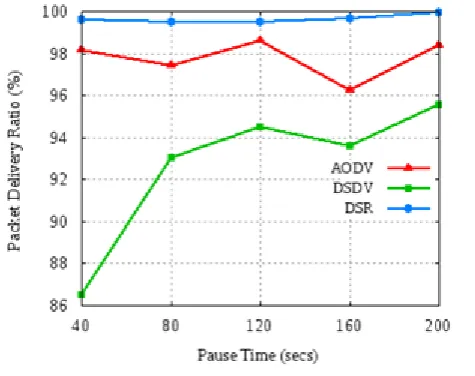
© 2014, IJCSMC All Rights Reserved 132 Fig. 1 Packet Delivery Ratio w.r.t. Pause Time
Fig. 1 shows a graphical representation of the experimental results of AODV, DSR and DSDV protocols with respect to packet delivery ratio. As expected, DSR outperforms the other two protocols but AODV shows better performance than DSDV. DSR has the highest PDR rate of 99.64% and proved to be more reliable and stable among all the protocols. The packet delivery rate of DSR is 1.8% higher than AODV and 7% higher than DSDV. The reason behind this is, as DSR uses source routing, the source determines the entire sequence of hops that each packet should traverse. The route discovery process is initiated only when the expected route is not found in the route cache. In DSR, using a single request-reply cycle, the source can learn routes to each intermediate node on the route in addition to the intended destination whereas AODV can gather only a very limited amount of routing information. The AODV protocol managed to achieve PDR about 97.76% even though more packets are dropped and more routing packets are generated. On the other hand, AODV maintains at most one entry per destination and initiates new route discoveries if link failures happen. At 40 pause time (higher mobility), the packet delivery rate of DSDV is 92.63% and its performance increases by 7.5% with pause time of 80. However, later it delivers consistent uniform rate of delivery with pause time variations and maintains the delivery rate between 93.04% to 95.54%.
The throughput results for three routing protocols from the simulations are presented in Fig. 2. This study clearly indicates that reactive routing protocols are superior in comparison to proactive one. AODV and DSR protocols have fairly high throughput. The throughput performance of DSR is 1.8% and 6.8% higher than AODV and DSDV respectively. AODV slightly suffers, since it maintains one route per destination. On the other hand, DSR, source routing reveals more information in one route discovery than AODV. Therefore, within the same time more routes are discovered and so more packets can be delivered. DSDV performs poorly especially at higher rate of mobility (low pause time) and increases gradually with increase in pause time. This is expected for DSDV, since it needs more time to update the routing tables of the nodes in the network during topology changes.
© 2014, IJCSMC All Rights Reserved 133 Fig. 3 End-to-End delay w.r.t. Pause Time
Average end-to-end delay is the average time consumed by a protocol to transmit a data packet from source to destination. Considering the Fig. 3, we observe that the average end-to-end delay of DSDV is less compared to AODV and DSR. Moreover, DSDV consistently presents the lowest delay independent of pause time. The reason for less delay for DSDV is, it proactively maintains the routes to all the destinations and does not initiate route discovery process as frequently as in on-demand routing protocols. Considering both the reactive protocols, the delay for AODV is much higher than DSR. AODV exhibits higher delay since for any network topology change, a new route discovery process has to be initiated by sending RREQ packets. On the other hand, DSR protocol performs better than AODV as it does not have to depend on periodical activities and it uses source routing and route cache property.
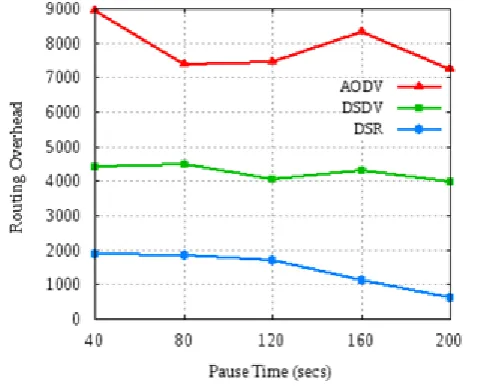
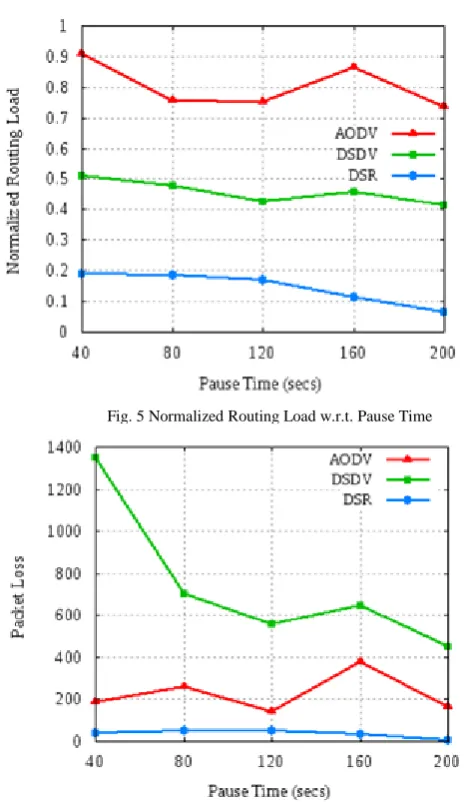
It can be determined from Fig. 4 that DSR protocol generates significantly less routing overhead compared to other two protocols. The reason is obvious because it does not depend on periodical activities. DSR uses route cache property and also maintains multiple routes per destination. The normalized routing load for three routing protocols is shown in Fig. 5. It can be noticed and expected that the NRL of AODV is always at high peak rate compared to other protocols as it maintains single route per destination. The reason for high routing overhead is that AODV periodically sends RREQ, RREP packets. Node movements lead to link failures, in order to establish a route, every time AODV generates route discovery process. The routing load for DSDV is 66.36% higher than DSR and 46% lower than AODV because of its table driven nature. It proactively holds routes to all destinations in its table regardless of topology changes.
© 2014, IJCSMC All Rights Reserved 134 Fig. 6 Packet Loss w.r.t. Pause Time
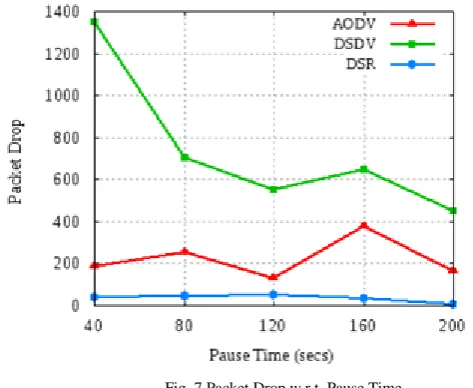
As shown in Fig. 6 and Fig. 7, DSR outperforms among all the protocols in terms of packet loss and packet drop followed by AODV while DSDV exhibits the worst results. Packet may lose due to broken link, congestions and no route to destination. A packet may be dropped at the source if route to destination is not available or the buffer that stores pending packet is full. As we know, finding a route is generally a costly operation in terms of time, bandwidth and energy. DSR uses source routing. As we know, finding a route is generally a costly operation in terms of time, bandwidth and energy. DSR uses source routing. One big advantage is that intermediate nodes can learn routes from the source routes in the packets they receive. Another advantage of source routing is that it avoids the need for up-to-date information in the intermediate nodes through which the packets forwarded since all necessary routing information is included in the packet. In addition to that DSR does initiate route discovery process less frequently than AODV and it also does not rely on any timer based activities but AODV does. On the other hand, AODV uses table-driven routing and also rely on any timer based activities. Mobility is the dominant cause for AODV, which is highly responsible for packet loss and packet drop. The results indicate that packet loss for AODV is 79% higher than DSR and 14% lesser than DSDV. If route failure happens frequently it initiates new route discoveries unlike DSR. This is expected for DSDV, since it needs more time to update the routing tables of the entire network. Such delay in updation leads to an increase in number of broken links and that result in high rate of dropped packets
.
© 2014, IJCSMC All Rights Reserved 135 TABLEIIIII
OVERALLPERFORMANCEANALYSIS
Metrics AODV DSR DSDV
Packet Delivery Ratio (%) 97.76 99.64 92.63
Throughput (Kbps) 4.90 4.99 4.65
Average End-to-End Delay 114.44 17.80 13.44
Routing Overhead 7863.8 1429.2 4249.6
Normalized Routing Load 0.80 0.14 0.45
Packet Drop 221.2 34.6 738.6
Packet Loss 224.4 35.8 739.2
VI.CONCLUSIONS
In this paper, a performance analysis of two reactive protocols namely, AODV and DSR and one proactive protocol DSDV has been made. Simulation is performed for a network size with 100 nodes under CBR traffic by varying pause time using network simulator NS-2.35 tool in an identical manner. The acquired results highlight the relative ranking of routing protocols based on their performances. Simulation results for throughput metric over three routing protocols demonstrate that AODV and DSR behave similarly. As DSR has plenty of cache routes to hold paths for multiple destinations, the reaction of DSR in case of route failures is mild. This property ultimately enhances the DSR performance in terms of all the performance metrics.DSR gives the optimum performance in all chosen matrices. AODV manage to give the second highest performance in terms of PDR about 97.67% even though more packets are dropped and more routing packets are generated. For AODV, mobility is still the major cause for packet loss. Due to table-driven nature of DSDV, it slightly suffers with respect to PDR but scales very well in terms of end to end delay. However, it performs averagely in terms of routing overhead and NRL but badly suffers in terms of packet loss and packet drop performance metrics. Overall, experimental results conclude that DSR proved to be good selection for CBR and reliable choice when packet delivery ratio, throughput, routing overhead, normalized routing load, packet loss and packet drop metrics are concerned. On-demand protocols attain high packet delivery ratio and thus more efficient and reliable in delivering the data packets to their respective destinations. In future we will be focusing on energy efficient routing with the protocols studied in this work when the network size, network load and mobility models are varied.
© 2014, IJCSMC All Rights Reserved 136
R
EFERENCES[1] I. Chlamtac, M. Conti, and J. Liu, “Mobile ad hoc networking: Imperatives and Challenges”, Ad-Hoc Networks Journal, vol. 1, pp. 13–64, July 2003.
[2] J. Broch, D. A. Maltz, D. B. Johnson, Y.-C. Hu, and J. Jetcheva, “A Performance Comparison of Multi-hop Wireless Ad hoc Network Routing Protocols,” in Proceedings of the 4th Annual ACM/IEEE International Conference on Mobile Computing and Networking(MOBICOM‟98), pp. 85–97, October 1998.
[3] C.S.R. Murthy and B.S. Manoj, Adhoc Wireless Networks - Architecture and Protocols, Pearson Education, 2007. [4] C K Toh, Ad Hoc Mobile Wireless Networks, Prentice Hall Publishers, 2002.
[5] Jeroen Hoebeke, Ingrid Moerman, Bart Dhoedt and Piet Demeester. “An Overview of Mobile Ad hoc Networks: Applications and Challenges”.
[6] Andrew S. Tanenbaum, Computer Networks, 3rd edition, Prentice Hall, 1996.
[7] Marc Greis‟ Tutorial for the UCB/LBNL/VINT network Simulator “ns”.http://www.isi.edu/nsnam/ns/tutorial/. [8] S. Floyd, Network Simulators, National Science Foundation, 2010.
[9] Runcai Huang, Yiwen Zhuang, Qiying Cao, “Simulation and Analysis of Protocols in Ad Hoc Network” in Electronic Computer Technology, pp.169 – 17, 2009.
[10] GinniTonk, InduKashyap, and S.S. Tyagi, “Performance Comparison of Ad-Hoc Network Routing Protocols using NS-2”, International Journal of Innovative Technology and Exploring Engineering (IJITEE), vol.1, June 2012.
[11] S.Mittal, P.Kaur, “Performance Comparison of AODV, DSR and ZRP Routing Protocols in MANET‟S” Advances in Computing, Control & Telecommunication Technologies, pp.165-168, 2009.
[12] Dr. Rahul Malhotra, BhawnaSachdeva,”Multilingual Evaluation of the DSR, DSDV and AODV Routing Protocols in Mobile Ad Hoc Networks”, The SIJ Transactions on Computer Networks & Communication Engineering (CNCE), vol. 1, July-August 2013. [13] IoannisBroustis, Gentian Jakllari, Thomas Repantis, “A Performance Comparison of Routing Protocols for Large- Scale Wireless
Mobile Ad Hoc Networks”, CS 204 – Advanced Computer Networks, fall 2003.
[14] Ashish K. Maurya, Dinesh Singh, Ajeet Kumar, Ritesh Maurya, ”Random Waypoint Mobility Model based Performance Estimation of On-Demand Routing Protocols in MANET for CBR Applications”, Computing for Sustainable Global Development (INDIACom), pp. 835- 839,2014.
[15] Yin Tan, Yingxiong Song, Shujia Zhou, “Simulation based comparative performance analysis of on-demand routing protocols”, Smart and Sustainable City (ICSSC 2011), pp. 1- 5, 2011.
[16] D. Maltz, J. Broch, J. Jetcheva, and D. Johnson, “The effects of on-demand behavior in routing protocols for multi-hop wireless ad hoc networks”, IEEE Journal on Selected Areas in Communication, vol.8, August 1999.
[17] C.E. Perkins, E.M. Royer, S.R. Das & M.K. Marina, “Performance Comparison of Two On-Demand Routing Protocols for Ad Hoc Networks”, IEEE Personal Communications Magazine, Special Issue on Mobile Ad Hoc Networks, vol. 8, No. 1, pp. 16–29,2001. [18] E.M. Royer, C-K. Toh, “A Review of Current Routing Protocols for Ad-Hoc Mobile Wireless Networks”, IEEE Personal
Communications Magazine, vol.6, pp.46-55, April 1999.
[19] P.Kuosmanen, “Classification of Ad hoc Routing Protocols”, Finnish Defence forces, Naval Academy, Finland, 2002. [20] Krishna Gorantala, “Routing Protocols in Mobile Ad-hoc Networks”, A Master‟ thesis in computer science, pp.1- 36, 2006. [21] C. E. Perkins and E. M. Royer, “Ad-hoc on demand distance vector routing,” in Proceedings of the 2nd IEEE Workshop on Mobile
Computing Systems and Applications (WMCSA‟99),vol. 3, pp. 90–100, February 1999.
[22] C. E. Perkins, E. M. Royer, I. D. Chakeres, “Ad hoc On-Demand Distance Vector (AODV) Routing Protocol”, draft-perkins-manet-aodvbis-00.txt, October 2003.
[23] C. E. Perkins and P. Begat, “Highly Dynamic Destination-Sequenced Distance-Vector Routing (DSDV) for Mobile Computers,” Proceedings of the ACM SIGCOMM„94 Conference on Communications Architectures, Protocols, and Applications, pp. 234-244, August 1994.
[24] D. Johnson and D. Maltz, “Dynamic source routing in ad hoc wireless networks”, In: Imielinski, Korth (eds.), Mobile Computing, Kluwer Academic Publishers, 1996.
[25] J. Broch, D. Johnson, and D. Maltz, “The dynamic source routing protocol for mobile ad hoc networks”, http://www.ietf.org/internet-drafts/draft-etf-manet-dsr-03.txt, Oct 1999.