Wordform- and class-based prediction of the components
of German nominal compounds in an AAC system
Marco Baroni Johannes Matiasek
Austrian Research Institute for Artificial Intelligence
Schottengasse 3, A-1010 Vienna, Austria {marco,john}@oefai.at
Harald Trost
Department of Medical Cybernetics and Artificial Intelligence, University of Vienna
Freyung 6/2 A-1010 Vienna, Austria [email protected]
Abstract
In word prediction systems for augmentative and al-ternative communication (AAC), productive word-formation processes such as compounding pose a serious problem. We present a model that predicts German nominal compounds by splitting them into their modifier and head components, instead of try-ing to predict them as a whole. The model is im-proved further by the use of class-based modifier-head bigrams constructed using semantic classes automatically extracted from a corpus. The eval-uation shows that the split compound model with class bigrams leads to an improvement in keystroke savings of more than 15% over a no split compound baseline model. We also present preliminary results obtained with a word prediction model integrating compound and simple word prediction.
1 Introduction
N-gram language modeling techniques have been successfully embedded in a number of natural lan-guage processing applications, including word pre-dictors for augmentative and alternative communi-cation (AAC). N-gram based techniques rely cru-cially on the assumption that the large majority of words to be predicted have also occurred in the cor-pus used to train the models.
Productive word-formation by compounding in languages such as German, Dutch, the Scandina-vian languages and Greek, where compounds are commonly written as single orthographic words, is problematic for this assumption.
Productive compounding implies that a sizeable number of new words will constantly be added to the language. Such words cannot, in principle, be contained in any already existing training corpus, no matter how large. Moreover, the training cor-pus itself is likely to contain a sizeable number of newly formed compounds that, as such, will have
an extremely low frequency, causing data sparse-ness problems.
New compounds, however, differ from other types of new/rare words in that, while they are rare, they can typically be decomposed into more com-mon smaller units (the words that were put together to form them). For example, in the corpus we an-alyzed, Abend ’evening’ and Sitzung ’session’, the two components of the German compound Abend-sitzung ’evening session’, are much more frequent words than the latter. Thus, a natural way to handle productively formed compounds is to treat them not as primitive units, but as the concatenation of their components.
A model of this sort will be able to predict newly formed compounds that never occurred in the train-ing corpus, as long as they can be analyzed as the concatenation of constituents that did occur in the training corpus. Moreover, a model of this sort avoids the specific type of data sparseness problems caused by newly formed compounds in the training corpus, since it collects statistics based on their (typ-ically more frequent) components.
Building upon previous work (Spies, 1995; Carter et al., 1996; Fetter, 1998; Larson et al., 2000), Baroni et al. (2002) reported encouraging results obtained with a model in which two-element nominal German compounds are predicted by treat-ing them as the concatenation of a modifier (left el-ement) and a head (right elel-ement).
Here, we report of further improvements to this model that we obtained by adding a class-based bi-gram term to head prediction. As far as we know, this it the first time that semantic classes auto-matically extracted from the training corpus have been used to enhance compound prediction, inde-pendently of the domain of application of the pre-diction model.
compound predictions and simple word predictions within the AAC word prediction task.
The remainder of this paper is organized as fol-lows. In section 2, we describe the AAC word pre-diction task. In section 3, we describe the basic properties of German compounds. In section 4, we present our split compound prediction model, focus-ing on the new class-based head prediction compo-nent. In section 5, we report the results of simu-lations run with the enhanced compound prediction model. In section 6, we report about our prelimi-nary experiments with the integration of compound and simple word prediction. Finally, in section 7, we summarize the main results we obtained and in-dicate directions for further work.
2 Word prediction for AAC
Word prediction systems based on n-gram statistics are an important component of AAC devices, i.e., software and possibly hardware typing aids for dis-abled users (Copestake, 1997; Carlberger, 1998).
Word predictors provide the user with a predic-tion window, i.e. a menu that, at any time, lists the most likely next word candidates, given the input that the user has typed until the current character. If the word that the user intends to type next is in the prediction window, the user can select it from there. Otherwise, the user will keep typing letters, until the target word appears in the prediction win-dow (or until she finishes typing the word).
The (percentage) keystroke savings rate (ksr) is a standard measure used in AAC research to evaluate word predictors. The ksr can be thought of as the percentage of keystrokes that a “perfect” user would save by employing the relevant word predictor to type the test set, over the total number of keystrokes that are needed to type the test set without using the word predictor.
Usually, the ksr is defined by
ksr= (1−ki+ks
kn
)∗100 (1)
where:kiis the number of input characters actually
typed,ks is the number of keystrokes needed to
se-lect among the predictions presented by the model andkn is the number of keystrokes that would be
needed if the whole text was typed without any prediction aid. Typically, the user will need one keystroke to select among the predictions , and thus we assume thatksequals 1.1
1In the split compound model, the user needs one keystroke
to select the modifier and one keystroke to select the head.
The ksr is influenced not only by the quality of the prediction model but also by the size of the pre-diction window. In our simulations, we use a 7 word prediction window.
Ksr is not a function of perplexity, but it is gener-ally true that there is an inverse correlation between ksr and perplexity (Carlberger, 1998).
3 Compounding in German
Compounding is an extremely common and produc-tive mean to form words in German.
In an analysis of the APA newswire corpus (a corpus of over 28 million words), we found that al-most half (47%) of the word types were compounds. However, the compounds accounted for a small por-tion of the overall token count (7%). This suggests that, as expected, many of them are productively formed hapax legomena or very rare words (83% of the compounds had a corpus frequency of 5 or lower).
By far the most common type of German com-pound is the N+N type, i.e., a sequence of two nouns (62% of the compounds in our corpus have this shape). Thus, we decided to limit ourselves, for now, to handling compounds of this shape.
In German, nominal compounds, including the N+N type, are right-headed, i.e., the rightmost ele-ment of the compound determines its basic semantic and morphosyntactic properties.
Thus, the context of a compound is often more informative about its right element (the head) than about its left element (the modifier).
In modifier context, nouns are sometimes fol-lowed by a linking suffix (Krott, 2001; Dressler et al., 2001), or they take other special inflectional shapes.
As a consequence of the presence of linking suf-fixes and related patterns, the forms that nouns take in modifier position are sometimes specific to this position only, i.e., they are bound forms that do not occur as independent words.
We did not parse special modifier forms in or-der to reconstruct their independent nominal forms. Thus, we treat all inflected modifier forms, includ-ing bound forms, as unanalyzed primitive nominal wordforms.
4 The split compound prediction model
are predicted by treating them as the sequence of a modifier and a head.
Modifiers are predicted on the basis of weighed probabilities deriving from the following three terms: the unigram and bigram training corpus fre-quency of nominal wordforms as modifiers or in-dependent words, and the training corpus type fre-quency of nominal wordforms as modifiers:2
Pmod(w) =λ1P(w) +λ2P(w|c) +λ3Pismod(w) (2) The type frequency of nouns as modifiers is de-termined by the number of distinct compounds in which a noun form occurs as modifier.
Heads are predicted on the basis of weighted probabilities deriving from three terms analogous to the ones used for modifiers: the unigram and bigram frequency of nouns as heads or independent words, and the type frequency of nouns as heads:
Phead(w) =λ1P(w) +λ2P(w|c) +λ3Pishead(w) (3) The type frequency of nouns as heads is de-termined by the number of distinct compounds in which a noun form occurs as head.
Given that compound heads determine the syn-tactic properties of compounds, bigrams for head prediction are collected by considering not the im-mediate left context of heads (i.e., their modifiers), but the word preceding the compound (e.g., die Abendsitzung is counted as an instance of the bi-gram die Sitzung).
For reasons of size and efficiency, single uni- and bigram count lists are used for predicting modifiers and heads.3 For the same reasons, and to minimize the chances of over-fitting to the training corpus, all n-gram/frequency tables are trimmed by removing elements that occur only once in the training corpus. We currently use a simple interpolation model, in which all terms are assigned equal weight.
4.1 Improving head prediction
While we obtained encouraging results with it (Ba-roni et al., 2002), we feel that a particularly unsat-isfactory aspect of the model described in the previ-ous section is that information on the modifier is not
2
Here and below,cstands for the last word in the left con-text ofw; wis the suffix of the word to be predicted minus the (possibly empty) prefix typed by the user up to the current point.
3This has a distorting effect on the bigram counts (words
occurring before compounds are counted twice, once as the left context of the modifier and once as the left context of the head). However, preliminary experiments indicated that the empirical effect of this distortion is minimal.
exploited when trying to predict the head of a com-pound. Intuitively, knowing what the modifier is should help us in guessing the head of a compound. However, constructing a plausible head-prediction term based on modifier-head dependencies is not straightforward.
The word-form-based compound-bigram fre-quency of a head, i.e., the number of times a specific head occurs after a specific modifier, is not a very useful measure: Counting how often a modifier-head pair occurs in the training corpus is equiv-alent to collecting statistics on unanalyzed com-pounds, and it will not help us to generalize beyond the compounds encountered in the training corpus. Moreover, if a specific modifier-head bigram is quent, i.e., the corresponding compound is a fre-quent word, it is probably better to treat the whole compound as an unanalyzed lexical unit anyway.
POS-based head-modifier bigrams are not going to be of any help either, since we are considering only N+N compounds, and thus we would collect a single POS bigram (N N) with probability 1.4
We decided instead to try to exploit a semantically-driven route. It seems plausible that modifiers that are semantically related will tend to co-occur with heads that are, in turn, semantically related. Consider for example the relationship between the class of fruits and the class of sweets in English compounds. It is easy to think of compounds in which a member of the class of fruits (bananas, cherries, apricots...) modifies a member of the class of sweets (pies, cakes, muffins...). Thus, if you have to predict the head of a compound given a fruit modifier, it would be reasonable, all else being equal, to guess some kind of sweet.
4.1.1 Class-based modifier-head bigrams While semantically-driven prediction makes sense in principle, clustering nouns into semantic classes is certainly not a trivial job, and, if a large input lex-icon must be partitioned, it is not a task that could be accomplished by a human expert. Drawing inspi-ration from Brown et al. (1990), we constructed in-stead semantic classes using a clustering algorithm extracting them from a corpus, on the basis of the average mutual information (MI) between pairs of words (Rosenfeld, 1996).5
4
Even if the model handled other compound types, very few POS combinations are attested within compounds.
5We are aware of the fact that other measures of lexical
MI values were computed using Adam Berger’s trigger toolkit (Berger, 1997).6 The same training corpus of about 25.5M words (and with N+N com-pounds split) that we describe below was used to collect MI values for noun pairs. All modifiers and heads of N+N compounds and all corpus words that were parsed as nouns by the Xerox morphological analyzer (Karttunen et al., 1997) were counted as nouns for this purpose.
MI was computed only for pairs that co-occurred at least three times in the corpus (thus, only a subset of the input nouns appears in the output list). Valid co-occurrences were bound by a maximal distance between elements of 500 words, and a minimal dis-tance of 2 words (to avoid lexicalized phrases, such as proper names or phrasal loanwords).
Having obtained a list of pairs from the toolkit, the next step was to cluster them into classes, by grouping together nouns with a high MI. For space reasons, we do not discuss our clustering algorithm in detail here (we motivate and analyze the algo-rithm in a paper currently in preparation).
In short, the algorithm starts by building classes out of nouns that occur with very few other nouns in the MI pair list, and thus their assignment to classes is relatively unambiguous, and it then adds progres-sively more ambiguous nouns (ambiguous in the sense that they occur in a progressively larger num-ber of MI pairs, and thus it becomes harder to deter-mine with which other nouns they should be clus-tered). Each input word is assigned to a single class (thus, we do not try to capture polysemy). More-over, not all words in the input are clustered (see step 5 below).7
Schematically, the algorithm works as follows (the input vocabulary of step 1 is simply a list of all the words that occur at least once in the MI pair
references quoted there) and are sometimes claimed to be more reliable than MI, and we are planning to run our clustering al-gorithm using alternative measures.
6The trigger toolkit returns directional MI values (i.e.,
sepa-rate MI values for the pairs N1 N2 and N2 N1). Since we were not interested in directional information, we merged pairs con-taining identical nouns by summing their MI. We realize that this is not mathematically equivalent to computing symmetric MI values, but it is a practical approximation that allowed us to use the trigger toolkit for our purposes.
7
We also experimented with an iterative version of the al-gorithm that tried to cluster all words, through multiple passes. The classes generated by the non-iterative procedure described in the text, however, gave better results, when integrated in the head prediction task, than those generated with the iterative ver-sion.
list):
• step 1: Rank words in input vocabulary on the basis of how often they occur in the MI pair list (from least to most frequent);
• step 2: Shift top word from ranked list and de-termine with the members of which existing class it has the highest average mutual infor-mation;
• step 3: If highest value found in step 2 is 0, assign current word to new class; else, assign it to class corresponding to highest value;
• step 4: If ranked list is not empty, go back to step 2;
• step 5: Discard all classes that have only one member.
This is a heuristic clustering procedure and there is no guarantee that it will construct classes that maximize MI. A cursory inspection of the output list indicates that most classes constructed by our algorithm are intuitively reasonable, while there are also, undoubtedly, classes that contain heteroge-neous elements, and missed generalizations. Table 1 reports a list of ten randomly selected classes that were constructed using this procedure.
Alleinstehende, Singles, Alben, Platten, Platte, Sound, Hits, Hit, Live, Songs, Single, Album, Pop, Studio, Rock, Fans, Band
Atrophie, Hartung, Neurologe Magische, Magie
Bilgen, Tivoli, Baur, Scharrer, Streiter, Winkel, Pfeffer, Schmid, M
Effizienz, Transparenz
Harm, Radar, Jets, Flugzeugen, Typs, Abwehr, Raketen, Maschinen, Angriffen, Flugzeuge, Kampf
Relegation, Birmingham, Stephen
Partnerschafts, Partnerschaft, Kooperation, Bereichen, Aktivit¨aten
Importeure, Z¨olle Labyrinths, Labyrinth
Table 1: Randomly selected noun classes
The algorithm generated 3744 classes, containing a total of 14059 nouns (about one third of the nouns in the training corpus).
Like the other tables, class-based bigrams were trimmed by removing elements with a frequency of 1.
4.1.2 The class-based head prediction model We compute the class-based probability of a com-pound head given its modifier in the following way:
Pclass(h|m) =P(Cl(h)|Cl(m))P(h|Cl(h)) (4) where
P(Cl(h)|Cl(m)) = count(Cl(m), Cl(h))
count(Cl(m)) (5)
and P(h
|Cl(h)) = 1
|Cl(h)| (6)
The latter term assigns equal probability to all members of a class, but lower probability to mem-bers of larger classes.
Class-based probability is added to the wordform-based terms of equation 3 obtaining the following formula to compute head probability:
Phead(w) = (7)
λ1P(w) +λ2P(w|c) +λ3Pishead(w) +λ4Pclass(w|m)
5 Evaluation
The new split compound model and a baseline model with no compound processing were eval-uated in a series of simulations, using the APA newswire articles from January to September 1999 (containing 25,466,500 words) as the training cor-pus, and all the 90,643 compounds found in the Frankfurter Rundschau newspaper articles from June 29 to July 12 of 1992 (in bigram context) as the testing targets.8
In order to train and test the split compound model, all words in both sets were run though the morphological analyzer, and all N+N compounds were split into their modifier and head surface forms.
We first ran simulations in which compound heads were predicted using each of the terms in equation 7 separately. The results are reported in table 2.
As an independent predictor, the class-based term performs slightly worse than wordform-based bi-gram prediction.
We then simulated head and compound predic-tion using the head predicpredic-tion model of equapredic-tion 7.
8In other experiments, including those reported in Baroni
et al. (2002), we tested on another section of the APA corpus from the same year. Not surprisingly, ksr’s in the experiments with the APA corpus were overall higher, and the difference between the split compound and baseline models was less dra-matic (because many compounds in the test set were already in the training corpus).
model P(w) P(w|c) Pishead Pclass(w|m)
head ksr 42.2 30.0 47.1 29.4
Table 2: Predicting heads with single term models
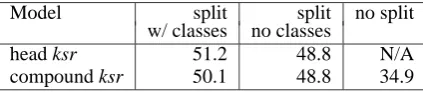
The results of this simulation are reported in table 3, together with the results of a simulation in which class-based prediction was not used, and the re-sults obtained with the baseline no-split-compound model.
Model split split no split
w/ classes no classes
head ksr 51.2 48.8 N/A
compound ksr 50.1 48.8 34.9
Table 3: Predicting heads and compounds
When used in conjunction with the other terms, class bigrams lead to an improvement in head pre-diction of more than 2% over the split compound model without class-based prediction. This trans-lates into an improvement of 1.3% in the prediction of whole compounds. Overall, the split compound model with class bigrams leads to an improvement of more than 15% over the baseline model.
The results of these experiments confirm the use-fulness of the split compound model, and they also show that the addition of class-based predic-tion improves the performance of the model, even if this improvement is not dramatic. Clearly, fu-ture research should concentrate on whether alterna-tive measures of association, clustering techniques and/or integration strategies can make class-based prediction more effective.
6 Preliminary experiments in integration
In a working word prediction system, compounds are obviously not the only type of words that the user needs to type. Thus, the predictions provided by the compound model must be integrated with predictions of simple words. In this section, we re-port preliminary results we obtained with a model limited to the integration of N+N compound predic-tion with simple noun predicpredic-tion.
the head prediction model is activated, and the user can start typing the prefix of the desired compound head, while the system suggests completions based on the head prediction model.
For example, if the user has just typed Abe, the prediction window could contain, among other things, the candidates Abend and Abend . If the user selects the latter, possible head completions for a compound having Abend as its modifier are pre-sented.
Modifier candidates are proposed on the basis of
Pmod(w)computed as in equation 2 above. Simple
noun candidates are proposed on the basis of their unigram and bigram probabilities (interpolated with equal weights).
We experimented with two versions of the inte-grated model.
In one, modifier and simple noun candidates are ranked directly on the basis of their probabilities. This risks to lead to over-prediction of modifier can-didates (recall that, from the point of view of token frequency, compounds are much rarer than simple words; the prediction window should not be clut-tered by too many modifier candidates when, most of the time, users will want to type simple words).
Thus, we constructed a second version of the in-tegrated model in whichPmod(w)is multiplied by a
penalty term. This term discounts the probability of modifier candidates built from nominal wordforms that occur more frequently in the training corpus as independent nouns than as modifiers (forms that are equally or more frequent in modifier position are not affected by the penalty).
The same training corpus and procedures de-scribed in section 5 above were used to train the two versions of the integrated model, and the baseline model that does not use compound prediction.
These models were tested by treating all the nouns in the test corpus as prediction targets. The integrated test set contained 90,643 N+N tokens and 395,731 more nouns. The results of the simulations are reported in table 4.
Model integrated integrated simple pred
no penalty w/ penalty only
compound ksr 47.6 45.9 34.9
simple n ksr 40.5 42.5 45.6
combined ksr 42.5 43.5 42.6
Table 4: Integrated prediction
Because of the simple noun predictions getting in
the way, the integrated models perform compound prediction worse than the non-integrated split com-pound model of table 3. However the integrated models still perform compound prediction consid-erably better than the baseline model.
The integrated model with modifier penalties per-forms worse than the model without penalties when predicting compounds. This is expected, since the modifier penalties make this model more conserva-tive in proposing modifier candidates.
However, the model with penalties outperforms the model without penalties in simple noun predic-tion. Given that in our test set (and, we expect, in most German texts) simple noun tokens greatly out-number compound tokens, this results in an overall better performance of the model with penalties.
The integrated model with penalties achieves an overall ksr that is about 1% higher than that achieved by the baseline model.
Thus, these preliminary experiments indicate that an approach to integrating compound and simple word predictions along the lines sketched at the be-ginning of this section, and in particular the version of the model in which modifier predictions are pe-nalized, is feasible. However, the model is clearly in need of further refinement, given that the improve-ment over the baseline model is currently minimal.
7 Conclusion
The main result concerning German compound pre-diction that was reported in this paper pertains to the introduction of class-based modifier-head bigrams to enhance head prediction.
We presented a procedure to cluster nominal wordforms into semantic classes and to extract class-based modifier-head bigrams, and then a model to calculate the class-based probability of candidate heads using these bigrams.
While we evaluated our system in the context of the AAC word prediction task, we believe that the class-based prediction model we proposed could be extended to any other domain in which n-gram-based compound prediction must be performed.
baseline model.
This result was presented in the context of the AAC word prediction task, but we believe that the class-based prediction model we proposed could be extended to any other domain in which n-gram-based compound prediction must be performed.
While the results we report are encouraging, the improvement obtained with the addition of the class-based model is hardly dramatic. It is clear that further work in this area is required.
In particular, we plan to experiment with different measures of association to determine the degree of relatedness of words, and with alternative clustering techniques.
Moreover, we hope to improve the overall perfor-mance of the compound predictor by resorting to a better interpolation strategy than the uniform weight assignment model we are currently using.
We also reported results obtained with a prelim-inary model in which split compound prediction is integrated with simple noun prediction. This model outperforms the baseline model without compound prediction, but only of about 1% ksr. Clearly, fur-ther work in this area is also necessary. In partic-ular, as suggested by a reviewer, we will try to ex-ploit morpho-syntactic differences between simple nouns and modifiers to help distinguishing between the two types.
Acknowledgements
We would like to thank an anonymous reviewer for helpful comments and the Austria Presse Agentur for kindly making the APA corpus available to us. This work was supported by the European Union in the framework of the IST programme, project FASTY (IST-2000-25420). Financial support for
¨
OFAI is provided by the Austrian Federal Ministry of Education, Science and Culture.
References
M. Baroni, J. Matiasek, and H. Trost, ‘Predict-ing the Components of German Nominal Com-pounds’, to appear in Proc. ECAI 2002.
A. Berger: Trigger Toolkit, publicly available soft-ware, 1997.
http://www-2.cs.cmu.edu/ aberger/software.html P. Brown, V. Della Pietra, P. DeSouza, J. Lai, and
R. Mercer, ‘Class-based n-gram models of nat-ural language’, Computational Linguistics 18(4), pp.467-479, 1990.
J. Carlberger, Design and Implementation of a
Prob-abilistic Word Prediction Program, Royal Insti-tute of Technology (KTH), 1998.
D. Carter, J. Kaja, L. Neumeyer, M. Rayner, F. Weng, and M. Wir`en, ‘Handling Compounds in a Swedish Speech-Understanding System’, Proc. ICSLP-96.
A Copestake, ‘Augmented and alternative NLP techniques for augmentative and alternative com-munication’, Proceedings of the ACL workshop on Natural Language Processing for Communi-cation Aids, 1997.
W. Dressler, G. Libben, J. Stark, C. Pons, and G. Jarema, ‘The processing of interfixed German compounds’, Yearbook of Morphology 1999, pp. 185-220, 2001.
S. Evert and B. Krenn, ‘Methods for the Qual-itative Evaluation of Lexical Association Mea-sures’, Proceedings of the 39th Annual Meeting of the Association for Computational Linguistics, Toulouse, France, 2001.
P. Fetter, Detection and Transcription of OOV Words, Verbmobil Report 231, 1998.
L. Karttunen, K. Gal, and A. Kempe, Xerox Finite-State Tool, Xerox Research Centre Europe, Grenoble, 1997.
A. Krott, Analogy in Morphology, Max Planck In-stitute for Psycholinguistics, Nijmegen, 2001. M. Larson, D. Willett, J. Kohler, and G. Rigoll,
‘Compound splitting and lexical unit recombi-nation for improved performance of a speech recognition system for German parliamentary speeches’, Proceedings of the 6th Interna-tional Conference of Spoken Language Pro-cessing (ICSLP-2000), October 16-20., Peking, China, 2000.
R. Rosenfeld, ‘A Maximum Entropy Approach to Adaptive Statistical Language Modeling’, Com-puter Speech and Language 10, 187–228, 1996. M. Spies, ‘A Language Model for Compound