Thesis by Joseph P . Lau
In Partial Fulfillment of the Requirements For the Degree of
Doctor of Philosophy
California Institute of Technology Pasadena, California
1968
-ii-ACKNOWLEDGMENT
The author wishes to express his profoundest gratitude to Professor T. Yao-Tsu Wu for the constant guidance and supervision
given him throughout the entire course of this research. He has benefited tremendously from Professor Wu1s valuable criticism, suggestions and encouragement.
The author is grateful to the California Institute of Technology for the award of Institute Scholarships, Ford Foundation Fellowships and Woodrow Wilson Fellowships during the years of his graduate study. Part of this investigation has been done under Contract Nonr 220(35) with the Office of Naval Research, Department of the Navy.
Abstract
The subject under investigation concerns the steady surface wave patterns created by small concentrated disturbances acting on a non-uniform flow of a heavy fluid. The initial value problem of a point disturbance in a primary flow having an arbitrary velocity distribution (U(y}, 0, 0) in a direction parallel to the undisturbed free surface is formulated. A geometric optics method and the clas
-sical integral transform method are employed as two different methods of solution for this problem. Whenever necessary, the
special case of linear shear (i. e. U(y)
=
U (1+
ey) ) is chosen for the 0purpose of facilitating the final integration of the solution.
The asymptotic form of the solution obtained by the method of integral transforms agrees with the leading terms of the solution obtained by geometric optics when the latter is expanded in powers of small Er.
The overall effect of the shear is to confine the wave field on the downstream side of the disturbance to a region which is smaller than the wave region in the case of uniform flows. If U(y)
vanishes, and changes sign at a critical plane y
=
y (e.g. erey
=
-1 for the case of linear shear), then the boundary of this erInside the wave field, as in the case of a point disturbance in a uniform primary flow, there exist two wave systems. The loci of
constant phases (such as the crests or troughs) of these wave sys-terns are not symmetric with respect to the x-axis. The geometric
optics method and the integral transform method yield the same result of these loci for the special case of U(y)
=
U (1+
E y) and for0 large K r ( E r
«
1« K
r ) .Chapter
I. II.
III.
IV.
V.
· Table of Contents
Page
Acknowledgment ii
Abstract iii
Introduction 1
General Formulation 7
'
1. Co-ordinate system and convention 7
2. Equations of motion 7
3. Boundary conditions 8
4. Linea:i:-ization 9
5. Review of steady wave pattern in a uniform
flow i 2
Method of Geometric Optics 1. Unsteady problem
2. Steady wave pattern 3. A perturbation expansion Integral Transform Method Discussion and Conclusion References
Figures Appendices
17 17 27
36
46
I. INTRODUCTION
In oceanography, the effects of strongly sheared ocean
cur-rents on the propagation of ocean waves present problems of
consider-able interest. Another example of water waves in shear flow is the
ship waves propagating in the wake and near the stern of a ship. A
steady wave pattern of surface wave is produced by a concentrated
stationary disturbance located either on the surface or submerged within a steady primary shear flow. This class of problems
is of basic academic interest as well as of great importance in ship
hydrodynamics because it can predict the main features of the system
of waves accompanying a ship moving through a sufficiently deep water.
There exists an extensive literature concerning the special
case when the primary flow is uniform. The classical method of
solution is discussed in Lamb's Hydrodynamics (Ref. 7) where applica -tion is made to gravity waves (Kelvin's ship wave-pattern) in §256 and to capillary and combined capillary-gravity waves in §272. The ex -tension of this classical. method to disturbances of variable or pulsat-ing strength and following an arbitrary path in a uniform primary flow
may be found in Wehausen and Laitone (Ref. 18) and Stoker (Ref. 14).
In contrast, the problem is much more difficult when the
primary flow is non-uniform. Several papers treating the problems of disturbances in a rotational flow are limited to two dimensional dis
lines in these flows are straight, remain parallel to one another, and
are not stretched during the motion. Hence they are relatively
easy to treat.
When the disturbance is three-dimensional, even though the undisturbed flow may still be unidirectional and does not possess a free surface, the stretching and bending of vortex lines must play an
important role. Certain outstanding papers on the theory of these
flows have appeared.
A basic theorem that two-dimensional disturbances become
unstable at a lower critical Reynolds number than three -dimensional disturbances has been given by Squire (Ref. 12 ).
Squire and Winter (Ref. 13) have investigated steady three-dimensional disturbances to a parallel shear flow with no free surface
by the so-called "secondary flow" method. In this treatment, no
restriction is placed on the disturbances but there is an assumption that the undisturbed stream is weakly sheared. The shear is usually
taken to be linear though this is not an essential limitation to the method. A difficulty arising in the application of this theory is that
the secondary flow disturbance due to the presence of an obstacle falls
off more slowly with distance than does the primary flow disturbance. This limits the validity of the solution to the region near the obstacle.
In an effort to clear up this difficulty Lighthill (Ref. 9) has studied the fundamental solution of a small steady three -dimensional disturbance in a two-dimensional parallel shear flow without a free
that the small perturbation theory based on neglecting the squares of
the perturbation velocities u, v and w is valid far from the obstacle
and overlaps the region where the secondary flow solution is valid.
The asymptotic behavior of this solution for large r shows that a
source in a shear layer produces in a region of uniform flow outside
the shear layer a disturbance equivalent to a source of different
strength at a different position. The strength of the equivalent source
can be predicted by an image method in which the shear layer is
rega:rded as a superposition of layers of piecewise uniform flows. The
displacement ineffective position is of the order of the width of the shear
layer. It is expected that such modification of source strength and
position will no longer be so simple in the presence of a free surface.
In fact, in the presence of a free surface, the difficulties of
treating the stretching and bending of the vortex lines are further en-hanced. If the undisturbed flow contains a vortex sheet i.e. a dis -continuity in velocity, perpendicular to the free surface, any
disturb-ance rnay produce wave motions both in the free surface and in the
vortex sheet. Development of a theory de scribing the interaction be
-tween the waves and these free surfaces is a difficult mathematical
task. For primary flows having a continuous horizontal velocity
distribution, the free surface waves produced by an obstacle will de-finitely be affected by the vorticity of the primary flow.
In spite of the difficulties described above, Ursell (Ref. 17)
irrotational and does not vary rapidly with distance, he has developed
a theory, for the steady wave pattern, based on the following assump-tions:
(i) The streaming velocity component normal to a
wave crest is equal to the phase velocity based
on the local wave length;
(ii) the separation between consecutive crests is
equal to the local wave length.
The purpose of the present study is to develop systematically
a theory for steady surface wave patterns due to a small concentrated
disturbance in a primary parallel rotational flow. In the construction of the phase curves by Ursell (reference 1 7) it was assumed that the
phase velocity relative to a si.ightly non-uniform stream of variable depth can be adequately approximated by the phase velocity obtained from constant depth theory. The validity of this implicit assumption
of adopting the original dispersion relationship for uniform flows of constant depth for rotational non-uniform primary flows is not im-mediately obvious. Indeed, our theory shows that if terms other
than the two lowest orders are kept, this is no longer valid.
By discarding the squares of the perturbation velocities u, v
and w of the velocity field (U(y)
+
u, v, w), we shall first formulate the problem for an arbitrary primary parallel shear flow U(y} withan undisturbed free surface at z
=
0, in Chapter II.A method based on the notion of group velocity and geometric
by Keller (reference 6) and by others, is applied to the problem of a small stationary concentrated surface disturbance on a primary parallel shear flow U(y) in Chapter III. In section 1, U(y) is kept arbitrary but in sections 2 and 3, solution for the special case of
U(y) = U (1
+
e y) is carried out while no restriction is placed on e 0It is believed that the true behavior of the flow far from the disturb-ance must be obtained from the full equations with the squares of the disturbance neglected. Such an approach results in a 11
small-perturbation11 solution. The region of validity of this result is at large distances from the disturbance and overlaps the region near the disturbance where a '1small- shear11 solution is valid. This over-lapping holds in the sense that the asymptotic behavior of the 11small shear11
solution is sim:.lar to the asymptotic behavior of a perturba-. -ti on expansion of the 11 small-perturbation11 solution for small er. This is, indeed, indicated by comparison of the results of
Chapter III, section 3, and Chapter IV.
The geometric optics method of Chapter III fails at the bound-ary of the wave region. For the special case of uniform primary flow, Ursell (reference 16) has determined the behavior of the waves near the boundary of the wave region by a modification of the prin-ciple of stationary phase. Thus showing that for dispersive waves, the integral transform method is the fundamental one. Therefore, in Chapter IV, we shall modify the classical integral transform method to treat a weak submerged source of constant strength in a primary linear shear flow, i.e. U
=
U11secondary flow'' method, we take the "primary flow" to coincide
with that in which the undisturbed stream is uniform and the
"secondary flow" to be a perturbation of the primary flow by allowing
a small shear ( e small) in the undisturbed stream. The resulting
"small shear" solution, obtained by applying the method of
stationary phase to evaluate the inverse transform, is valid for
1
large r (<-). However, a more elaborate asymptotic technique E
will have to be applied in order to deduce a solution valid near the
boundary of the wave region.
Although the velocity distribution U (1
+e
y) considered in 0Chapter III and Chapter IV may seem somewhat artificial, it
never-theless provides some insight to the problem of arbitrary U(y) as
well as a first approximation to the horizontal velocity distribuUon
of the ocean near the shore-line. In the present treatment, surface
tension and viscous terms in the equations are neglected. This is
known to be permissible except near the critical region where U(y)
is zero. Accordingly the theory developed here is limited to a region
II. GENERAL FORMULA TI ON
1. Co-ordinate system and convention
The problem in question concerns the propagation of surface
waves in a body of heavy fluid, of infinite depth, initially having a pre
-scribed non-uniform horizontal velocity distribution, due to a
station-ary disturbance. The fluid is taken to be inviscid and incompressible,
of constant density p. The resulting flow will be generally rotational;
the disturbance is however assumed to be so small that a linear theory
can be applied. Consider a righthanded rectilinear coordinate sys
-tern such that (Fig. 1 )
(i) the z -axis points vertically :ipward, with z
=
0coinciding with the undisturbed free surface, and the
grav-ity acting in the negative z -direction;
(ii) the x-axis is in the direction of the undisturbed stream
which is taken to be a function of y only; and
(iii) the y-axis completes the system.
The x, y, z-components of the velocity vector q are denoted by u, v,
w, the pressure by p, the density by p and the gravitational accel-eration by g. Other notations will be defined in the text as needed.
2. Equations of motion
The primary flow is unidirectional and has a prescribed shear
given by
q
0
=
(U(y), 0, 0)Po
= -pgz
where U(y) is an arbitrary function of y and is assumed to be at
least twice differentiable. With q,:, and p>:, representing the total
veloc-ity vector and pressure respectively, the momentum equation for an
inviscid, incompressible flow is
8q,:c
~
+
(q,:: \i' )q>!,The continuity equation is
\i'
P
,:,
= -
- -
-Y'gz p'V·q,;,
=
Q(x, t),where Q(x, t) represents a source in the fluid.
3. Boundary conditions
(2. 2)
(2. 3)
The boundary conditions on the free surface of the heavy fluid
can be stated as follows. Let the free surface be Sf: z -
t;
(x, y, t) = 0where
t;,
(x , y, t) is the vertical displacement of the free surface meas-ured from z = 0. The dynamic condition of constant pressure at the
free surface required
=
0 on z=t;,(x,y,t) (2. 4)The kinematic condition for the particles on the free surface is
z=t;,(x,y,t) (2. 5)
On solid surfaces with specified shapes S(x, y, z, t) = 0 the boundary
condition is
4. Linearization
The flow field maybe considered as a combination of the pr ima-ry shear flow (q
0 , p0 } and a perturbation (q , p) so that
q,:,
=
q0
+
q=
(U(y)+
u,v,w}, (2. 7)p ...,, .
=
p 0+
p= -
pgz+
pIf the departure from the primary flow is small, then by neglecting
the squares and products of u,v,w and their derivatives, Eqs. (2.2),
(2. 3) can be linearized to give
Du+ U'(y}v
+
a: {~
)
=
o
'
Dv
+
~
ay
(
E.
p)
=
0 ,Dw
+
a:
{
~
)
=
0'au
+
av
+
8w=
Q(x, t)ax
ay
8Z
-
a
where D
=
8t
+
U (y)ax'
a
and in the sequel D'=
U' (y)ax
8 and (2. 9) (2. 1 0)(2. 11 )
(2. 12)
D" :: U"(y)
0: The linearized free surface conditions can be readily
shown to be
-pgw
+
Dp=
0 (2.13)D
s
=
wwhereas the boundary condition on solid surface remains unchanged.
Elimination of p by cross differentiations of (2. 9), (2. 10) and (2. 11) gives
a
a
oy
Dw=
Daz
av
(2.16)Although from (2. 12), (2.15) and (2.16) a single equation for any
component of the perturbation velocity q
=
(u, v, w} can be obtained,the equation with v as the dependent variable is preferred. By
eliminating u and w, we obtain
[ DV'2 - D"] v =
0
~
DQ(x, t) (2. 1 7)Equation (2. 1 7) is the basic equation of motion. When v has been
solved together with appropriate boundary conditions, u and w may
be deduced from (2. 16) and the continuity equation. To obtain w, the
lower limit in the y-integral may be taken as either +«:> or -oo since
the disturbances are assumed to vanish at both limits. The result
obtained using either limit is the same. In integrating the continuity
equation with respect to x to obtain u, however, the lower limit
must be -oo because it is possible that the fluid at +«:> in which
region the vorticity may be permanently changed after the fluid has
passed the disturbance, may not have zero disturbance velocity i. e.
we shall only assume all disturbances vanish farup stream (at x
=
-oo ).The appropriate condition on the free surface for v can be
derived by differentiating (2. 13) giving
-g
~
oy
Dw+
~
D2 {E.)
= 0By
p (2.18)Eliminating w from (2. 18) and (2. 16), we obtain after som e manip
- g 88z Dv + D2
8
~
(~)
+ 2DD' (~)
=
o
By using (2. 10) in the second term and integrating the resulting
equa-tion once, we have
- g ov - D2v + 2D'(
E.)
=
08z p (2. 19)
Recalling D'
=
U'(y):x,
Eq. (2.9) can be used toeliminate(~),
yielding
+ g
~~
+
D2v + 2U1(y)(Du + U '(y)v )=
0 (2 .. 20)Finally,dividing(2.20)by U'(y), differentiatingitwithrespectto y, then
using (2. 15) to eliminate u, we obtain the free surface boundary
condition as
{
z
8v}
a
Dv+gaze
8y U I
(y
)
= -
2 8x Dv on z=O • (2.21)With appropriate initial and boundary conditions, v can be solved from
(2.17)and(2.21). Sofarnorestrictionhasbeenplacedon U(y). They
are linear partial differential equations with variable coefficients
which depend on y in such a complicated manner that it is quite
dif-ficult to obtain an analytical solution for the general case of arbitrary
U(y). In Chapter III a geometric optics method will be developed for
the case when the variation of U(y), otherwise arbitrary, is as
-sumed small. In Chapter IV an integral transform method will be
applied to solve (2. 17) and (2. 21) for v for a particular, although
somewhat artificial U(y), namely that of linear shear,
u (y)
=
u ( 1+ ~y)
It is obvious that this type of undisturbed parallel velocity distribution,
if exists at all, is rare. Nevertheless the solution may give some
in-sight to the much harder problem of arbitrary U(y).
5. Review of steady wave pattern in a uniform stream
The treatment of a stationary point source of strength m,
sub-merged in a uniform primary flow, by double Fourier transform and
asymptotic evaluation of certain integrals based on the principle of
stationary phase illustrates the characteristic difficulties involved
(Ref.18 ). We shall review this method briefly to fix ideas as well as
for discussion and comparison of the results with the case in which the
primary flow is non-uniform.
Let rectangular cartesian co-ordinates (x, y, z) be chosen with
the z -axis perpendicular to the undisturbed free surface, the x-axis
parallel to the stream velocity U,
0 and the y-axis completing the system. The gravity acts in the negative z-direction, with
gravitation-al acceleration g.. The origin is taken so that the point of disturbance is at (0, 0, - h). Polar co-ordinates (r,
a, z) are defined by
x
=
r cosa,
y=
r sina.
Our problem is to find the velocity potentialcp (x, y, z) based on the linearized theory that in the flow field z
<
0,0
cf> satisfies the Laplace equation 0
\72cp
=
00 except at (0,0, -h)
and the boundary condition at the free surface z = 0 that
(z
=
0)(2. 23)
where K
=
g/U 2 is a characteristic wave number. We further write 0m 1 ...,
q,
o (x' y' z )=
-
4nR
+
cf> (x' y' z) 'l
where
¢'
is a harmonic function, regular in the region z<
0, andRz
=
xz + yz + (z+h)zl
For the condition at infinity we require
lim grade/> = 0
0
z-+ -oo
lim grade/> = 0
(\ x-> -oo
Applying the double Fourier Transform,defined as
J{c/>)
=
s
oo dxs
oo dy ;i(ax+f3 y )cf> o. -IX> -00
(2.25)
(2. 26)
(2. 27)
(2. 28)
to (2. 23 ), we obtain a second order ordinary differential equation with
z as the only independent variable. The coefficients in the solution of
this transformed equation are determined by the transform of the
bound-ary conditions. The details of the method of solution can be found in
Havelock (Ref. 4 ) and elsewhere and will not be repeated here. With
the notatic:n
a = k cos
e
(2. 29)
f3
=
k sinecb
(x, y, z)0
m 1 m 1
=
-
4TI"R
+
4irR
1
z
'IT
+Re 1 ('
2
dB
s
00 dkeikr cos(B-a)ek(z-h) mK secie ,2'ITZ
j
'IT o k-K secZB(2. 3 0)
where Rz
=
xz+
yz +(z-h)z and "Re" denotes 11the real part of". Thez
physical significances of the terms on the right-hand side of (2. 30),
are respectively, the point source, its reflection into the plane z
=
0,and thE.: disturbance due to the free surface effects, including the sur
-face waves. By evaluating the k·-integral along an appropriate path, the
integral in (2. 30), for cos(B-a)
>
0, yields in the final result ofcb
a0
term of the following integral representation
e
i
j
'
·
7 da eirK secze cos(B-a) K seczB(z-h} zaRe 17 e mK sec 17
'IT
e
where
e
and for O"~
0+
O"This integral is in suitable form for the application of the method of
stationary phase. F or large Kr and for each particular a, the
sta-tionary points are given by the roots of
~
[ secze cos(B-a )]=
0or
Explicitly, there are two roots 8
tan
e
=±
and
e
+' given by-1±
J
1 -8 tan2cr4 tancr (2. 32)
The asymptotic form of the wave part of cf>
0 for large Kr follows from the principle of stationary phase to give
{ 2.
_1T4}
c/>
0
=
- A(8+)sin rKsece+ cos(8+-a)+-A(8_)sin+K sec28_cos(8_-a) -
~}
(2.33)where
[ .
-·- ( 1+4 tan 2 8±)
1/
4 A(8 ± ) -__z
rn_
mK sec ±e
I
( 1-2 tan2
e
±)1 2.(2. 34)
with 8 given by (2. 32). The above results show that the resultant
±
wave pattern of a subrnerged source is the superposition of two sys
-terns of wave which are confined in the wedge bo'..1nded by two vertical
planes
a
= ±a_.
...._
~,
a_,_
.. ,~ = 19. 5°. The general features of the curves of constant phase are shown in Fig. Sb.The variation of the amplitude is indicated by Eq. (2. 34). The
above expressions (2. 33) and (2. 34) break down when the second
deriv-ative of the phase function sec28 cos(8-cr) with respect to
e
vanishes;this occurs at the boundary
a
= ±a,:, of the wave region. By a moreelaborate asymptotic method, Ur sell ( 16) has shown that the leading
1
term of cf>
0 is of order O(Kr
)-3 in the region near la
I
=I
a,:,I
.
Inthis region, the m ethod of geometric optics to be discussed in Chapter
phase therefore seems more fundamental. But it can be seen that
this integral transform method, without modifications, fails when the
primary flow is non-uniform because Eqs. (2. 23) and (2. 24) are
re-placed by Eqs. (2. 17) and (2. 21) which have variable coefficients. We
shall show in Chapter IV, how this integral transform approach can be
Ill. METHOD OF GEOMETRIC OPTICS
1. Unsteady problem
The method of geometric optics has been developed and applied
to problems involving wave motions in anisotropic and dispersive
media by Landau and Lifshitz ( 8 ), Lighthill ( 10), Whitham ( 20),
Keller ( 6 ), and by others. The basic assumption necessary for
sue-cessfu1. application of this method is that the non-uniformity in the
dispersive medium in which the wave propagates does not change
sig-nificantly over distances comparable to the typical wave-length under
consideration. In our present problem of gravity waves, in a parallel
shear stream with free stream velocity U(y), this assumption may be
interpreted as
u
2I
gP.
«
1 0where U
0 is a characteristic constant velocity, U 0
2
I
g , is the typicalwave length, and l is a characteristic length over which the primary
parallel shear flow velocity, changes appreciably. For example, l
may be chosen to be U
I
(mean value of !duI
dyI )
.
In this section, the 0problem of a point disturbance applied on the surface of the fluid at
x
=
0, y=
0 for t>
0 is fir st formulated. The steady wave patterndue to a stationary point disturbance on the surface is then deduced
quite readily.
We consider here a general distribution of velocity U(y),
U(y)
=
U+ U
(y)0 l (3. 1 )
small compared to U . When the variations of U(y) are smooth, we
0
can keep a clear separation between the phase of a surface wave and
its amplitude. Thus we may write
~ ~ i</> (x t) ~
v(x, t)
=
A(x, t)e '=
A exp{i</>(x, t)+
L(x, t)}0 (3. 2)
where
L(x, t)
=
log[A(;,
t)/ A ]0
and A is a reference amplitude, A(x, t) is the amplitude function,
0
which is assumed to be slowly varying in x and t. The function
<f>(x t) in general may be complex, its imaginary part is determined by the differential equation goverr..i~g v. To represent a surface wave,
the real part of cf> as sum es the for:rri
Re{cf> (;, t)} = k
l\J (;,
t) = k '1r(x, t) - wt0 0 (3. Za)
where k is a constant reference wave number appropriate to the wave
0
motion in question, w
=
w(x, t) is the circular frequency, and the realfunction '1r(x, t) is the so-called eikonal function, which defines the
surfaces of equal phase.
For the geometric wave approximation we next introduce the
basic assumption that the characteristic wavelength Zn /k is assumed
0
to be small compared to the distance 1 over which U(y) changes
ap-preciably. Hence, if x is referred to l , and t to k l/w , as the
0 0
basic units, then from the above assumption it follows that the
[gradcp
I
=
O(k .l)0
(3. 3)
lgr_ad
LI
=
0(1)and the higher order derivatives of cf> with respect to x and t are
clearly also of order (k i). Since the geometric wave approximation
0
requires k I. to be large, the differential equations for cf> and L can
0
be derived by substituting v into the basic equation of motion (2. l 7)
and the boundary condition (2. 21 ), then expanding the equations for
small (1/k 1). Consequently, the terms in (2. 17) have the following
0
orders of magnitude:
IU11
v x I
=
O(IU"vl(k 1) )0
where the prime denotes differentiation with respect to y, as before.
Hence, up to the first two leading terms for k 1 large, we have
0
which holds true for arbitrary U(y) provided the variation of U(y) is
smooth, a factor of error
equation being under stood.
[l+O(k l)-2] for the left side of the above
0
This equation can be integrated once,
giv-ing "V2v
=
f(x - Ut), f(x) being an arbitrary function of x; but thisfunction must be zero since '\flv is required to vanish as y2
+
zz.-+ ooin the flow field. Whence
\lz.v
=
0 (3. 4)valid for the first two leading orders. The free surface condition (2. 21)
(3. 5)
It may be noted that the two terms on the left hand side of (3. 5) may be
regarded to be of the same order since the parameter gl/ U ~ , which
is the factor multiplying v
z in the dimensionless form of the equation,
can be very large. It is also noted that the terms on the right hand side
of (3. 5) enter in the calculation of the second order term.
By substituting (3. 2) into (3. 4) and retaining only the two
lead-ing orders, we obtain
and
2 (
ocb o
L+
ocb o
L -1..ocb o
L)+
o
2
:/J
o
2ef>ox ox
oy oy
·
az
oz
axz.
+
oyz.
From (3. 6),i
oc/l
az
(3. 6)
=
0 (3. 7)(3. 8)
Hence we observe that if the partial derivatives of
cp
with respect to x and y are real, as is required by the solution representing asur-face wave propagating in the x-y plane, then
oc/>/oz
will be purelyimaginary so that v will vary exponentially with respect to z. In
1
(3.6), an appropriate branch of the function (cf> z
+</>
2)2 is chosen to
x y
satisfy the boundary condition that v --+ 0 as z --+ - oo. By
differentiat-ing (3. 6) with respect to x, y, z, and by some substitutions, we find
ocp aq, o
2cp
+
(
ocp
}
2o
2cp }
By making use of (3.8) and (3.9), (3. 7) may be written as
ClL i
oL
az
=ax
1
+
2
eq,
aL
ay
+
ay
[l~~I'
+!~tJ')t
{
acf>
ax
)z.
ezq,
a
z.
-
2(3.10)
We also note that if A. A. L , and L are real, then
a
L/oz
'l'x' 'l'y' x y
must be purely imaginary. We shall henceforth regard l
8Z
acf>
andi
oL
8Z
as r eal.Next we substitute (3. 2) in (3. 5 ), again keeping only the two
leading orders, and separate the real and imaginary parts, to obtain
+
2('!1-_
at
+ u
(
acf>
at
+
u
~}z
ax
-
g[(eq,)z
ax
+(sq,
ay
)zl
J
~
= o
acf>
0cf>
)
u
I ( ) OX = 0ox
Y a<p (z = 0)ay
In (3.11), (3.8) has been used to replace i
~:
(z
=
0) (3.11)(3. 12)
used in (3. 12) which has been further simplified by subtraction of
(3. 11) and its first dBrivative with respect to y. The eikonal equation
(3.11) provides an equation for
q,
while the transport equation (3.12)is a fir st order partial differential equation for L. Since (3. 11) and
(3.12) are deduced from the linearized free surface condition (3. 2),
they are valid on z
=
0 only.To effect the integration of (3. 11) and (3. 12) we introduce the
frequency function w(x, t) and wave number k (x, t) =(k , k , 0) by
l 2
-w
aq,
ay -
-
k 2in terms of which (3. 11) becomes
1 F(-w,k ,k ,y)
=
(w-Uk )2 - g(k2+
k2 )2=
0l 2 l l 2
(3.13)
(3. 14)
By applying the theory of first order partial differential equations (e.g.
see Courant and Hilbert, (1962 ), Vol. 2 ), the characteristic equations
·may be written immediately. If we introduce a parameter A. along the characteristic curves the characteristic system of equations b.ecome
dt
oF
- 2(w-Uk )(3.15)
err.-
=-
aw-
=
l
dx
oF
- 2(w-Uk )U - gk /k (3.16)
dA.
=
8k=
1 11
dy 8F
- gk /k (3.17)
dA.
=
8k=
2 2drf>
BF+
kBF
BF
(w-Uk )2 (3.18)dA.
=
w
ow
lBk+
kz. 8k=
1dw
BF
BF
0dA.
=
- -at waq;-
=
(3. 1 9)dk
BF
BF
1 - k 0
dA.
=
-
ox
1Ff
=
(3. 20)
dk
oF
oF
l - k 2(w-Uk )k U'(y)
dA.
=
-
ay
laq;-
=
1 1 l (3. 21)Equations (3. 19) and (3. 20) show that w and k are constants along the 1
characteristics or ray paths though their constant values may be
dif-ferent for different characteristics.
By dividing (3. 16) and (3.17) by (3.15) and using (3.14), the components of the group velocity Cg
=
(Cgx,Q./
are deduced to givedx
OW
kCg
= ill=
Bk
=
u+
~fi-1
(3. 22)2 k k x
1
Cg
=
dy -ow
=
~fi-
kz (3. 23)y dt - ok 2.k k
l ~
The form of these group velocity components resembles those of the
waves propagating on the surface of a stream with a uniform velocity
except that in the present case U
=
U(y), and kl is no longer constant
on ray paths as can be seen by division of (3. 21) by (3. 15)
dk
dt z. = -
\U~(y)
(3. 24)which gives the rate of change of k along a ray path. This rate is
l
constant on each ray path for the special case of a primary parallel
flow of linear shear, that is, U1(y)
=
const. , but it may differ on differdx dy
=
u+~fi~
2
Jk.
k~fi.\
2J'k k
2U(gk~
2+
gzk l
= - - - -
(3. 25)from which the ray paths or group lines may be deduced. Equation
(3. 25) may be put into a form which can be readily integrated. From
(3.14),
Jgk
=
(w-Uk ) or1
/
(w-Uk
f
k
=
± . 1 - k2z gz i
(3. 26)
Substitution of (3. 26) in (3. 25) gives
dx
=
dy
2U(w- Uk
?
+
gzkl l
(3. 27)
of which the right hand side is a function of y only because k and w
1
are constant along each group line. For the special case of linear
shear primary flow, it is readily seen that the group lines may be
ex-pressed as the elliptic functions. Integration of (3. 27) for this
partic-ular case will be carried out for the steady problem in the next section.
To conclude this section we shall examine briefly the transport
equation (3. 12) governing the amplitude variation. In terms of the
where
g_
~ {~)}+
U'(y)2
ay
kk
(w-Uk )U
+
g_
-
1-1 2 k
k
(w-Uk ) 1
g_
i
2 k
Cgy
=
(w-Uk )1
(3. 28)
(3. 29)
(3. 30)
These expressions for the components of the group velocity are the
same as (3. 22) and (3. 23) by virtue of (3. 14). In order to express
(3. 28) in a physically more meaningful form, we shall first take the
partial derivatives of Cg and Cg with respect to x and y
respect-x
yively, giving, after som~ rearrangement 1
i
a
g_
a
i{
k }
(w-U\) U
ox
(w-U\)+
2ox
l11
=
8Cgx Cgx
--ax--
+
(w-Uk )and
1
g_
~
i=
___::_y:_
+
{
k }
ac.g
(w.,;U\) 2
oy
(
k)
oy
Cg
y
(w-Uk )
1
1
0
ox
(w-U\)(3.31)
(3. 32)
We recall that the total time d'!rivative of a function f(x, y, t), which
does not depend on k explicitly, along the group lines is
2
Hence,
df
d dU
dT
(w-U\) = - \dt
= -
k l l U'(y)~dt
= -
k l l U'(y)Cg y (3. 34)since w and k are constants on each group line. But by (3. 33), we
l
can also write
But the right hand sides of (3. 34) and (3. 35) must be identical, hence
Expressions (3. 31 ), (3. 32) and (3. 36) may now be used to rewrite
(3. 28) as
dL
+
.!__{~
cO'
+
o
c
}
,
(
\
1 _k_1 _c
)
dt 2 ox "'x oy gy
+
U (y) kz -2
w-Uk1
gy
=
O . (3.37)To display the physica~ significance of (3. 37), we recall
L(;, t)
=
log[ A(; , t)/ A1
so that in terms of A, one may obtain by0
multiplying (3. 37) by AZ the equation
-
d
-AZ + -Al { -0 Cg + -0 Ca }=
AzU'(y) _l_l_{k
k
dt 2 2 ox x oy '='y
4kl
(3. 38)
where (3. 14) and (3. 23) have been used to obtain the last term of (3. 38 ).
By using the explicit form (3. 33) for dAz / dt, (3. 38) may also be
writ-ten as
where 'Y = i
l
= __
U'(y) _1 i ll
Al) k (4k Z+3kl )2 kl 2kl (3. 39)
and U'(y)
:=
U'(y). Regarding the quantityl
along ray tubes, formed by adjacent group lines or rays, is not
con-stant. In the region where U1(y)
>
0, for the waves with k<
0,2.
(3. 39) indicates that the effect of shear is to introduce a fictitious
energy source while for k
>
0, a fictitious energy sink, We mayz
conclude that the primary parallel shear flow supplies energy to the
waves with k
<
0 and retrieves it from waves with k>
0, resultingl
z
in a net transfer of energy to different regions of the flow field. It
may be conjectured that the total energy of the waves are due entirely
to the disturbance at the origin so that, while the parallel shear flow
redistributes the energy, it does not supply its own energy to the
waves.
2. Steady wave pattern
The familiar steady ship wave pattern created by a stationary
point disturbance acting on the surface of a uniform stream will be
modified when the primary undisturbed flow has a non-uniform
hori-zontal velocity distribution, The steady wave pattern on the surface of
a parallel linear shear flow due to a disturbance at x
=
0, y=
0furnishes at least qualitative modifications one would expect of the
more general case of arbitrary shear; this special case will be
con-sidered in this section. When the wave pattern has reached a steady
state, the encounter frequency w relative to the disturbance must
vanish in the wave field, hence (3. 14) reduces to
w = I/
lgk
+ (
u+
u ( y) )k = 0'b"' 0 l l (3.40)
The result that k and w are constant along group lines must still be
true so that along each group line
dk2.
=
d(k2. +k2.)=
dk2.=
2k dk1 2. 2. 2. 2.
(3.41)
and k
=
k (y) on each group line. 2. 2.The slope of the group lines may be deduced from (3. 27) by
putting w
=
0, however, it can be put into a more useful form byderiving it again directly from the components of the group velocity.
From (3. 22) and (3. 23),
dx dy
which by (3.40) becomes
dx
dy (3.42)
Since the right-hand side of (3. 42) is a function of y only, we let
*
=
m(y)k
Upon solving for ~ from (3. 42) in terms of m(y),
1
-1
±Ji
-8mz.(y) 4m(y)(3.43)
(3. 44)
For the waves to exist, k and k must be real. Equation (3. 44)
1 2.
shows that this requirement is satisfied if and only if
(3.45)
This upper bound m,:, of the slope function m(y) will be used to deter
dies down very rapidly. Introducing polar coordinates (k, 8) in the
wave number plane by
k
=
k cose
l
k
=
k sine 2.we may write (3. 44) also as
tan8+
}·
(3. 46)(3. 4 7)
which will be used in the subsequent analysis. For the moment we
shall simply note that for each m(y) satisfying (3. 45) there exist two
angles of
e,
denoted bye+
ande _,
given by (3.47). Correspondingto
e
+' the value of k+ are determined by (3. 40) and (3. 46), to givesecz.e
+
where
U
(y) - U (y)/U , l I 0=
.JL
uz
0 (1
+u
l (y) >z.so that
k == k cos
e
i± ± ±
k
=
k sine2. ± ± ±
( 3. 48)
a result which shows the presence of two systems of waves inside the
wave region inferred by (3. 45 ).
By transferring the last term of (3. 40) to the right-hand side
and squaring, we obtain:
gk
=
k2[u
+u (y)J
2l 0 l Then
k2
=
[k~
(U+
U (y) )4:.l]
k2or
where we have defined
and
K -
_g_
u2
0u (y)
U -
-fr-
=
Ey 0(3. 49)
(3.50)
(3. 51)
In the last step the linear shear primary flow has been chosen specifica
l-ly for U(y) for the purpose of facilitating integration of the solution.
We shall now introduce a new variable
t,
Is
=
1+
u
(y)=
1+
EY- 0 l
so that (3. 49) becomes
k
k2
=±Is
4 - 1 1(3. 52)
(3.53)
Here the requirement of k and k to be real in order for waves to
1 2.
exist is satisfied if and only if s
>
1. On physical gr.ounds, we expectthe waves to appear in the downstream of the disturbance; this implies
that k
>
0. The+
or - sign in (3. 49), (3. 53), and in the sequel isl
taken according a s k is
>
or<
0. To show the equivalence of this 2.to (3.45), we may deduce from (3.42 ), (3.43) and (3.53) the expression
1
rn(s)
=+
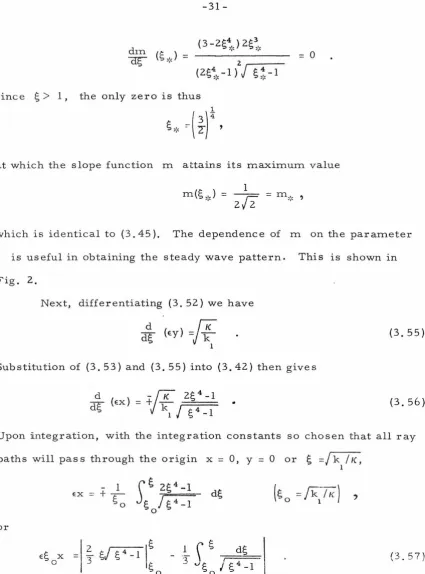
(s4 -1 )2 (2s4 -1)-1 (3. 54)dm ,.
crs
(s ,:,)=
=
0Since
s
>
l, the only zero is thusat which the slope function m attains its maximum value
1
m(s,J
=2(2
=m,~
'
which is identical to (3. 45 ), The dependence of m on the paran1eter
s
is useful in obtaining the steady wave pattern. This is shown inFig. 2.
Next, differentiating (3. 52) we have
d
[K
~
(ey)=rrz-:
1
(3.55)
Substitution of (3. 53) and (3. 55) into (3. 42) then gives
d -_
{K
2g 4 -1dS""
(ex) =+J
~
1
j
£
4-1(3. 56)
Upon integration, with the integration constants so chosen that all ray
paths will pass through the origin x
=
0, y=
0 oror
ES
x0
i
S
s
ds
-
3
s
/
s
4 -10
S
=
/k
/K,
1
'
(3. 57)
[image:36.553.70.495.53.627.2]wave disturbance indicates only positive Ex is required. The choice
of the lower limit of integration in (3. 57) arises from the assumption of
a point disturbance at x = 0, y = 0 so that all the group lines pass
through the origin. The integral in (3. 57) ·can be readily expressed in
terms of the elliptic integrals. Thus
ES x
=I~
[s/
£
4 -1-
s
Js
4 -1] - - 1 [F(cos-1(~)
_!_}-F(cos-1
(J_J
_ l)11
,
0 3 0 0 3/z
s.,1z
s--;}J/z.
'
J
(3.58)
where F('{, "-) is the elliptic function of the first kind whose integral
representation is
1
F ('{, 1'. ) (3. 59)
=
, 0
<
b<
µ
and 0<
a. This functionhas been studied extensively and its values for arbitrary arguments
have been tabulated (Ref. 3 ). Therefore, with the known properties of
F('{, 1'. ), (3. 58) and (3. 52) give a parametric r epresentation of the group
lines. The basic features of these two equations are shown in Fig. 3
for k
>
K and for k=
K. In each case, Ey is linear with a positivel 1
1
slope
r-so and inter sects the
s
-axis ats
0.
The behavior of EX ismore complicated. As
s
increases from unity, EX decreases fromto zero at
s
=s
(
>
1 ). Then it increases monotonically fors
>
s .
0 0
~(Ex)
for
s
>
1,point
>
=
so
1the branch of ex for
s
>
s
always lies above Ey,0
in Fig. 3 is particularly important.
The
It
corresponds to the point source of disturbance in the physical flow field
from which all group lines originate. Therefore, it is a natural
con-sequence from the requirement of
s
>
1 that the appropriate grouplines of the wave region are given by
from
s
=
1 0s
>
1. The limiting0
together with the line
s
=
1 for all k1
,
H
group line
~ 1 , thus
provide a bound for the wave region. This is shown in Fig. 4 in which
typical group lines and lines of constant
s
are plotted inside thewave region.
The group lines are obtained from (3. 58) and (3. 52.) with k (>K)
l
being kept constant on each line. In contrast to the case of stationary
point disturbance on a uniform flow where the group lines are straight
rays from the origin, in the present case of a linear shear stream,
aside from the line y
=
0 which remains straight, all the group linesare cubic far away from the origin. This is easily deduced from (3. 55)
and (3. 58) since for
s
large Ex exs
3 while EY exs
so that Ex ex (Eyf.When the equation of the grc•up lines are expressed in the form
Ey
=
fn(Ex)it can be shown that for y
>
0, they are monotonic increasing functionsextending from the origin to infinity in the fir st quadrant of the x -y
plane. For y
<
0, they decrease monotonically, terminating with zeroFrom (3. 58) and (3. 52), keeping s(~l) constant and varying
k (~K) we obtain the lines of constant
s.
With the exception of the1
line
s
= 1, eachs
=
£
=
constant(> 1) has two branches. For1
<
/
\
<
£
,
theposit~ve
branch starts from a point on the limitingK
cf'k:"
group line
V
-!;-,-1-=
1 and decreases, for increasing k towards theK 1
origin. For - >
s
,
as k increases, the negative branch whichK c 1
lies below ey = 0 decreases monotonically tending towards the asymp-tote ey = - 1 which also corresponds to
s
= 0. The negative branch ofs
= 1 has the same general behavior as the negative branches ofs
=s
{> 1 ), however, the positive branch is missing. This curvec
(s
=
1) warrants special attention because, though it is not a group line,it nevertheless provides a bound for the wave region. We observe that it may be viewed as a 11focal curve11 or "caustic" since it is an envelope of the one parameter family of group lines. Frorn (3. 52)
k
=
K -/: 0 fors
-
1 (3.60)(1-ky )2.
while (3. 5 3) shows
for
s
= 1 (3.61)Therefore, k
=
0 ons
=
1, implying that all the wave crests are2.
perpendicular to the x-axis there. Hence the net effect appears as if
the waves are reflected from this curve. Beyond s
=
1, it is con-jectured that edge waves, with their amplitudes decreasing exponentially, rnay exist but we shall leave this possibility for another investigation.constant phase, inside the wave region, we may use the following
procedure:
(i)
For a given point (x , y ) in the wave region we c cmay determine the line
s
=s
pas sing through cit from Fig. 4.
(ii) Either from Fig. 2, or from (3. 54) we obtain
m
=
+J
s 4 -1 (Zs 4 -1 )-1c c c
which when substituted in (3. 4 7) will give
e
.
c±
(iii) Then by using (3. 52) in (3.48) we arrive at:
k
=
±
K sec3 8
±
from which k may be deduced by evaluating
c±
the expression at
e
ands ·
Equation (3. 46)c± c
now gives explicitly the components of the wave
number k at (x , y ).
C± C C
(3. 62)
(3. 63)
With the knowledge that the constant phase lines are orthogonal
to k , we may graph the curves showing the traces of the wave
C±
crests. Typical traces are shown qualitatively in Fig. 5(a) for the case
of a stationary point disturbance on the surface of a linear shear flow.
The corresponding pattern for a point disturbance on the surface of a
uniform flow is reproduced in Fig. 5(b ), (Ref. 18 ) for comparison.
Apart from the shifting of the wave crests, it is immediately obvious
from Fig. 5(a) that the shear flow has the effect of suppressing the
region for a uniform flow. )
In summary, we observe that while two systems of waves, one
divergent and one transverse, exist inside the wave region produced by
a point disturbance on the surface of a linear shear flow, the traces of
the crests and the bounds to the wave region are no longer symmetric
with respect to the x-axis. In particular, the wave region boundary
approaches but never reaches the critical line ey
=
-
1 at whichU(y) = 0. The behavior of the wa·Fes near this critical line is not given
by our analysis and will be the subject of further investigation.
Final-ly, as a remark, it is quite obvious that essentially the same wave
pattern is produced by a stationary source below the surface of a
paral-lel linear shear stream.
3. A perturbation expansion
In order to make a comparison between the present geometric
optics method and the integral transform method, which will be dis
-cussed in Chapter IV, we shall consider here a perturbation expansion
in terms of a small
U
(y ),;, .l
By regarding
iu
(y)I
«
1,l we are actually
limiting the region of validity of the resulting solution to
IY
I
«
1E in
view of the definition of
U
(y), (3. 51 ), For a small shear gradientl
(i.e. E small) this may still represent an appreciably large region
in the physical space.
:::::
By expanding (3.49) in powers of
U
(y), we havel
k z
k
l
(3. 64)
whereas the reciprocal of (3. 64) is
{]
kz k4 kl.
l
2 _l_
+
u{is~
-r
(:~~
-
i1·
k
(± 1) Kz.
l O(U3
)
~
k
-;
k2.-
u,(k:-)
. l
J
2._l_ - 1 - -1
Kl Kz
(3. 65)
By substituting (3.64) and (3.65) in (3.42), we obtain
dx - <::!±
dy
kz kz.
3
_l_6
_1_(:: K:r'
t
/(
;K~l)
+
O(u: ) } , (3. 66)in which the
+
or - sign is taken according as y is>
or<
0.Using the known result that k and K are constant on each group
line and
u
(y)l =
ey,
±~I
k: I
x
-
y""
-!
)
\Kl.
we obtain by simple integration
ITT
k'[
1t2
t
Ey - 1-l';'
-Ir"+
f_:
Kl.K2
I
K2I
(:~
-r
'
kl.
2 _1_
Kl 4
- 3
2
l
-1
(3.67)
which is the required expansion of the group lines. In (3. 67), the
integration constant has been chosen for a point disturbance located at
x
=
0, y = 0, so that all the group lines pass through the origin of thex-y plane. Plotting of the group lines from (3. 67) is straightforward.
However, as the group lines over a m uch larger region have already
been traced in Fig. 4, we will not repeat this operation.
We proceed to determine the boundary of wave region and the
loci of constant phases (such as the wave crests) within the wave
r egion. The extent of the wave region can be deduced from Eq. (3. 67)
for the ray traces. To simplify writing, we introduce the parameter
so that (3. 67) becomes
1
13
=
(klI
K2 - 1 )25 6)
-
+ -
+
O(eyf,133
135
(3. 69)
where
M
=
x/
IYI
(3. 70)which may be regarded as a function of
(13;
ey), possessing theexpan-sion for (ey) small. Along each ray track, k '
l
and hence 13 remain
constant. It therefore follows that at the bounding ray track, which
envelopes the wave field, one must have (oM/ 813) = 0, the differentia-tion being for fixed y. Now, by (3. 69),
(
~ ~)
y =l
2-13
\ )
+
E yl
2 - 13\
+ :
J
+ } (
E y )2 ( 2
-13
~
-
~ ~
- :~
) = Q •(3.71)
The solution of (3. 71), say 13=13,:,(ey), is obtained to have the expan
-sion
(3. 72)
as can readily be verified. It may be remarked here that only the
positive branch of 13 ,:, is chosen since M, as defined by (3. 70), is
non-negative. Substituting 13 ,:, of (3. 72) for 13 in (3. 69), we obtain after some regrouping, the following result for the boundary of the
wave field,
(3. 73)
final result of x,:,(y); hence the boundary of wave region is symmetric
with respect to the x -axis up to O(ey)2• It is further noted that the
stationary waves exist in the region x:
>
x,:,(Y ), that is, on the down-stream side of x = x_._(.,.
y). Although the envelope of the wave field issymmetric in y, the detailed wave pattern is generally not
sym-metric with respect to the body trajectory y = O. Since, as indicated
by (3. 69),
f3 ,
and hence k ,1
are neither even or odd in y. In fact,
the value of k (x ... (y), y), which is the x-component of the wave
num-1 -~
ber at the boundary of the wave field, is different for different signs l
of y, as can be seen from k {x ... , y)
=
K ( 1+[3
z..
.J2
-1 ~ ~ and (3. 72). This also
implies that x = x,:,(y) and x = x,:,(-y) are no longer ray tracks.
The above result may be expressed alternately in terms of
cylindrical polar coordinates (r, a) defined by
x = r cos
a
y = r sina (3.74)so that at the boundary x = x,:,(y), the value of <J = a,:,(r;e) may be
expanded as
a
...
(
r ; e ) =a
(
r )+
e ra (
r )+
(er )z.a (
r )+
0 (er )3.,. 0 1 z. (3. 75)
Upon substitution of (3. 74) and (3, 75) in (3. 73), together with
neces-sary expansions,
a
o' a1, CYz. are readily determined; the final result
is
-1 1
-
1{
1 ) O" = tan - = sin3
O" = 0 02/ 2 1
(J =
-
3Jz
sin4 <J =-
12
~2 0 (3. 76)
in which the
+
or=±(sin-
1(1/3)-
~
(er)'+O(<r)1
(3. 77)
sign is for y
>
or<
0. This result shows thatthe over -all effect of the uniform shear is suppressing the wave field
to a smaller region than in the uniform flow case, the deviation being
of second order for (er) small, These salient features are shown in
Fig.
6
.
The contours of constant phases (such as the wave crests) can
be calculated as follows. We note first that the slope of a constant
phase line,
cp
=
canst. , at the free surface is given byacfl
I ax
04>
I
ay
k
l
=
-
k
2.
(3. 78)
by virtue of the characteristic equations, or more directly by the
definition of the phase function. The term k /k on the right hand
1
z
side of (3. 78) can be regarded as a known function of x and y in
view of (3, 68), (3.69) and (3.64). Consequently, the above first order
differential equation can, in principle, be integrated. However, the
actual calculation may prove formidable. In view of the complicated
nature of the functions k (x, y), k (x, y), it is best to seek a parametric
1 2.
integration. It turns out that a convenient parameter is @, defined by
k
/K
=
sec®1
Then (3. 69) becomes
or
1
13
=
(kz./Kz
-
1 )2=
tan@ 1(3. 80)
with
p(®) = 2 tan® + cot® q(@)
=
p(® ) - cot3®By making use of the expansion (3. 65 ), (3. 78) can be expressed in
terms of ® as
(
~)
=
(sgn y )I
:
2 \=
(sgn y)tan® {l + 2e.y cscz.® +e.z.y2 csc2(8:,(1-2 cot2®
)}.
Y
4>=
c
i(3. 81)
We assume that the integral of (3. 81) may be expressed in the following
form
2
y
=
!
.
e.nyn(® ) + O(e.3) (3. 82)n=o n=o
The two sets of functions {x (®)} and {y (® )} are not linearly
in-n n
dependent since they are related by (3. 80). In fact, upon substitution
of (3. 82) in (3. 80), we find that for y
>
0,x
=
y p+
yz q+
Yo3 sl 2 l (3. 83)
whereas for y
<
0 the signs of all the terms on the right hand sides of(3. 83) are changed. Furthermore, substituting (3. 82) in (3. 81) yields
x = ±
y
tan®0 0
.;._ =±
[y
+ 2yy
csc2®)tan®,l l 0 0
(3.84)
x =±
{y
+2yy
csc2®+y
[2y +y~l-2cot2®)]csc2®}tan®2 2 0 1 0 l 0
where ;;.
0 denotes dx0 (®)/d®, etc, and the + or sign is for
y
>
or<
0 respectively. Differentiating the first equation of (3. 83),we have
(2tan® + cot®)y + (2sec2® - csc2®)y
0 0
After x is eliminated by making use of (3, 84) we obtain the equation
0
for y as
0
which has the integral
(cot® - 2 tan®}y
0
y =A sin®cos2®
0 0
where A is an arbitrary constant of integration.
0
(3,85)
(3.86)
Similarly, from the second equation of (3. 83) and (3, 84) we
derive the differential equation for y
1
as
d ( yl ) •
d\85
=
2A ysin®cos2® 0 0
(3. 87)
This equation can be integrated explicitly, giving
y = A sin®cos2
®
+A 2 cos4®cos 2®A being another arbitrary constant. Integration of higher order
equations becomes increasingly tedious; the integral of y will not be 2.
given here.
Summarizing, we have determined the lines of constant phase
in the parametric forrn
x =A {cos@(l+sin?..@) + 2eA sin@cos5@+ O(eA )2.}
0 0 0
y =: A {sin@cosz.@ + eA cos4@ cos 2@ + O(eA )2}
0 0 0
(3.89)
(3. 90)
in which the constant A
1 has been absorbed into the higher order
terms. The constant A can be related to the phase i/> by noting that
0
the phase function
cp ;:;
xk+
y k=
A K { 1+
0 (EA } }l z 0 0 (3.91)
where in the last step use has been made of (3. 89), (3. 90) for x(@)
and y(@), and of (3. 81) for (k /k ),
2 l (3. 79) for k . l
Hence
(3. 92)
and from a wave crest to another,
cp
changes by 2mr(n=l, 2, . . . ).The leading terms of x(@) and y(@) are the well-known Kelvin
ship wave pattern in a uniform stream. There are two wave systems
within the region largtan(y/x)j
<
sin-1(1/3), one corresponding to therange 0 <@<@
~:::: ' (@ .. _
=
tan-1
13
.
.
.
=
tan-1(/2./2)) and the other to.. ,.. .., ..
®,
:
,<
@<TT/
2, called respectively the diverging and transverse waves.In the present case of a uniform shear, the position and wavelength of
these waves are shifted by an amount of order e. From (3. 90) it is
noted that \k \ increases for y
>
0 (in which region k<
0) anddecreases for y
<
0 (where k>
0) with increasing shear gradient2.
E, Thus the resulting configurations of constant phase lines are not
symmetric with respect to the x -axis; these qualitative features are
shown in Fig. 6. The perturbation expansion studied in this section
shows that the resulting steady wave pattern due to a point disturbance
on the surface of a linear parallel shear flow in the region y
«
1 / ehas essentially the same basic features as the solution of the previous
section. Thus, it constitutes a good approximation. The results
obtained here will be compared with that obtained by the method of
IV. INTEGRAL TRANSFORM METHOD
A combination of Fourier transform and Laplace transform
has been used by several writers (see DePrima and Wu (Ref. 2 ) and
Wu and Mei (Ref. 21) ) in dealing with problems of steady and unsteady
surface waves. A slight extension of the cla