A Lazy Learning Model for Entity Linking
Using Query-Specific Information
WeiZhang
1J ianSu
2Chew LimTan
1YunboCao
3ChinYew Lin
3(1) National University of Singapore (2) Institute for Infocomm Research, Singapore
(3) Microsoft Research Asia
{z-wei,tancl}@comp.nus.edu.sg, [email protected], {Yunbo.Cao,cyl}@microsoft.com
Abstract
Entity linking disambiguates a mention of an entity in text to a Knowledge Base (KB). Most previous studies disambiguate a mention of a name (e.g.“AZ”) based on the distribution knowledge learned from labeled instances, which are related to other names (e.g.“Hoffman”,“Chad Johnson”, etc.). The gaps among the distributions of the instances related to different names hinder the further improvement of the previous approaches. This paper proposes a lazy learning model, which allows us to improve the learning process with the distribution information specific to the queried name (e.g.“AZ”). To obtain this distribution information, we automatically label some relevant instances for the queried name leveraging its unambiguous synonyms. Besides, another advantage is that our approach still can benefit from the labeled data related to other names (e.g.“Hoffman”,“Chad Johnson”, etc.), because our model is trained on both the labeled data sets of queried and other names by mining their shared predictive structure.
1 Introduction
Recently, more and more knowledge bases (KB) which contain rich knowledge about the world’s entities such as Wikipedia1, OpenCyc2and KIM3(Popov et al., 2004) have become available. These knowledge bases have been shown to form a valuable component for many natural language processing tasks such as knowledge base population (Ji and Grishman, 2011), text classification (Wang and Domeniconi, 2008), and cross-document coreference (Finin et al., 2009). However, to be able to utilize or enrich these KB resources, the applications usually require linking the mentions of entities in text to their corresponding entries in the knowledge bases, which is called entity linking task and has been proposed and studied in Text Analysis Conference (TAC) since 2009 (McNamee and Dang, 2009).
Given a mention of an entity in text and a KB, entity linking is to link the mention to its corresponding entry in KB. The major challenges of this task are name variation and name ambiguity. Name variation refers to the case that more than one name variation such asalias, misspellingandacronym refers to the same entity. For example, both“48thState”and“The Grand Canyon State”refer tostate of Arizona, U.S.. Name ambiguity refers to the case that more than one entity shares the same name. For example,“AZ”may refer tostate of Arizona, the Italian airlineAlitalia, the country Azerbaijan, or other entries in KB that have the same name.
[image:2.420.55.345.306.440.2]Most previous studies on entity linking used annotated data to learn a classifier or ranker (Dredze et al., 2010; Lehmann et al., 2010; Zheng et al., 2010; Zhang et al., 2010; Ploch, 2011; Ratinov et al., 2011) or to estimate parameters (Gottipati and Jiang, 2011; Han and Sun, 2011). Besides, from the analysis by Ji et al. (2011), all of the top systems from the participants in the shared task of TAC-114used supervised learning approaches to solve this disambiguation problem.
Figure 1: The System Architecture for Traditional Approaches. (Mcontains a certain number of names.“Hoffman”and“Chad Johnson”are two examples of them.)
However, as there are infinite number of entity names, it is impossible to manually create the labeled
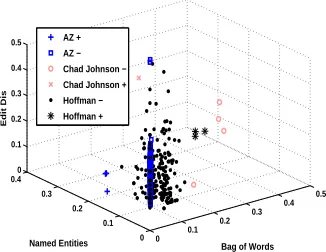
data set for each name. The available labeled data for entity linking is only for a certain number of names. Thus, as shown in Figure 1, the previous approaches disambiguate a mention of the name (e.g.“AZ") based on the distribution knowledge learned from the labeled mention-KB_entry pairs in the training setMrelated to other names (e.g.“Hoffman",“Chad Johnson", etc.). Given the query, the previous systems are static at evaluation time and their training does not depend on the input query. However, Figure 2 illustrates the distribution of the labeled instances related to the three names in a feature space (Bag of Words,Named EntitiesandEdit Distance, the popular features used in previous work). We can see that the width and location of the gap to separate positive and negative instances for different names vary widely. Moreover, the positive-negative instance ratio of each name is also very different from others. Thus, the entity linker generalized beyond labeled names (“Hoffman",“Chad Johnson", etc.) without considering the knowledge of the queried name (“AZ") suffers from this distribution problem.
0
0.1 0.2 0.3
0.4 0.5
0 0.1 0.2 0.3 0.4
0 0.1 0.2 0.3 0.4 0.5
Bag of Words Named Entities
Edit Dis
[image:3.420.131.294.211.337.2]AZ + AZ − Chad Johnson − Chad Johnson + Hoffman − Hoffman +
Figure 2: Instances Illustration in 3D Feature Space (Feature detail is in Table 2)
To narrow down the gap between the instance distributions related to labeled and queried names, this paper proposes a lazy learning model, in which generalization on the labeled data is delayed until a query is made. This allows the distribution information specific to queried name to be incorporated into the learning process. To obtain this distribution information, our lazy learning model automatically labels some relevant instances for the queried name leveraging its unambiguous synonyms.
In addition to the new notion of benefiting from the auto-generated instances related with the queried name, our approach further benefits from the manually labeled data related to other names. Specifically, the learned linker generalizes on the labeled data sets related to both queried and other names by exploiting the inherent predictive structure shared by these two data sets. We conduct evaluation onTACdata. Our experiments show that our proposed lazy learning model significantly improves entity linking over the state-of-the-art systems.
for a given mention. Section 4 presents our lazy learning for entity linking with query-specific information. Section 5 discusses a special case - NIL mentions . The experiments are shown in Section 6. Section 7 concludes the paper.
2 Related Work
As we have discussed, most of the previous entity linking work (Dredze et al., 2010; Lehmann et al., 2010; Zheng et al., 2010; Zhang et al., 2010; Ploch, 2011; Gottipati and Jiang, 2011; Han and Sun, 2011) fall into the traditional entity linking framework shown in Figure 1. Besides, the collaborative approach (Chen and Ji, 2011) tried to search similar queries as their query collaboration group by clustering texts. This differs from our method where we use the selective knowledge from unlabeled data.
In some other work, entity linking is also called named entity disambiguation using Wikipedia(Bunescu and Pasca, 2006; Cucerzan, 2007) orWikification(Mihalcea and Csomai, 2007; Milne and Witten, 2008; Ratinov et al., 2011). These two similar tasks link expressions in text to their referent Wikipedia pages. However, since Bunescu and Pasca (2006) used Wikipedia hyperlinks to train the SVM kernel, Cucerzan (2007) used Wikipedia collection and news stories as the development data, and all of the threeWikificationwork (Mihalcea and Csomai, 2007; Milne and Witten, 2008; Ratinov et al., 2011) generalized their ranker on the data generated from Wikipedia without considering the knowledge of the queried name, they also fall into the traditional entity linking framework and suffer from the distribution problem in the previous entity linking systems. Thus, we believe that our proposed lazy learning approach also can benefit these two tasks. In WePS-35, a task ofOnline Reputation Managementwas proposed (Amigo et al., 2010; Spina et al., 2011), which is the same with entity linking when KB only has one entry. Given a set of Twitter entries containing an ambiguous company name, and given the home page of the company, the task is to filter out Twitter entries that do not refer the company. Amigo et al. (2010) concluded that it was not viable to train separate system for each of the companies, as the system must immediately react to any imaginable company name. Thus, in this benchmark, the set of company names in the training and test corpora are different. However, the lazy learning approach proposed in this paper demonstrates that it is feasible to train separate system for each company, and the system can immediately react to any company name without manually labeling new corpora.
More generally, resolving ambiguous names in Web People Search (WePS) (Artiles et al., 2007) and Cross-document Coreference (Bagga and Baldwin, 1998) disambiguates names by clustering the articles according to the entity mentioned. This differs significantly from entity linking, which has a given entity list (i.e. the KB) to which we disambiguate the mentions.
3 Candidate Generation
Because the knowledge base usually contains millions of entries, it is time-consuming to apply the disambiguation algorithm to the entire knowledge base. Thus, the following pre-processing process is conducted to filter out irrelevant KB entries and select only a set of candidates that are potentially the correct match to the given query (a query consists of a name mention and its associated document text).
Because of name variation problem, it is ineffective to retrieve entity candidates by comparing the name strings of mention and KB entry. Thus, we need to use external world knowledge to build the name variation list for each KB entry. Since our experiment used a KB derived from Wikipedia, and
other KBs such asKIMandOpenCycusually can be mapped to Wikipedia (Nguyen and Cao, 2008), we find the variations for the entries in KB by leveraging name variation sources in Wikipedia: “titles of entity pages”,“disambiguation pages6”,“redirect pages7”and“anchor texts”. Then, the candidates can be selected by comparing the name string of the mention with the name strings in the variation list of each KB entry. The KB entry with a name string which matches the name of the mention is considered as a candidate. In addition, as a pre-processing step, we prefer a candidate set with high recall. Thus, to increase the recall, we find more candidates by selecting the KB entry if its name string contains the name string of the mention (e.g.“Cambridge, Massachusetts”contains “Cambridge”).
4 Lazy Learning for Linking
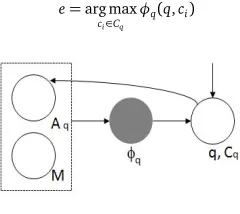
We formalize the disambiguation task as follows. We are given a queryq(i.e. a documentdqwith a mentionmq) and its associated KB candidatesCq={c1,..,cN}generated in Section 3, and our goal is to select the correct KB entryefrom the setCq. Specifically, letφq(q,ci)be a score function reflecting the likelihood that the candidateciis the correct KB entry forq. Then, a disambiguation model is to solve the following optimization problem:
e=arg max
ci∈Cq
[image:5.420.154.274.242.349.2]φq(q,ci) (1)
Figure 3: Lazy Learning Framework
In this section, we present our lazy learning model to solve this optimization problem. As shown in Figure 3, our process of the resolution is as follows:
1: Automatically label an instance setAqbased on the queryqand candidatesCq. 2: Generalize a functionφqon the data setAqrelated with the queried name and a manually labeled data setMrelated with other names.
3: Select the correct KB entryefrom the candidates using the functionφq.
As shown in Figure 1, previous approaches generalize a universal linkerφfor all of the queries on a labeled data setMrelated to irrelevant names (“Hoffman”,“Chad Johnson”, etc.), and they suffer from the distribution problem shown in Figure 2. In contrast, our lazy learning approach delays the model generalization until receiving the query. It can generalize a separate functionφq for each query leveraging the distribution knowledge learned from the instances inAq. AsAqis
automatically labeled for the queried name, it can be used to narrow down the gap of the instance distributions related to different names shown in Figure 2. Besides,φqalso benefits fromMin our model by mining its predictive information shared withAq. Now, let us elaborate the method for generatingAq, and the generalization ofφq, respectively.
4.1 Distribution Information
A
qfor Queried Name
In this section, we propose to obtain the distribution information for the queried name by automati-cally labeling some instancesAqfor it. Following our work Zhang et al. (2010), which automatically generates training data for entity linking, we automatically label the instances related to the queried name based on its unambiguous synonyms.
Given a documentdqwith a mentionmqand its associated KB candidatesCq, for example, dq(mq=“AZ”): ...We know that they looked at a house that they might purchase before they left Scottsdale,AZ. ...;
Cq: {c1: state of Arizona, c2: Azerbaijan, ..., cN: Alitalia},
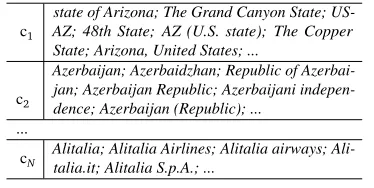
automatically creating the labeled setAqfor the name“AZ"requires automatically linking some mentions of“AZ"in text with the KB candidates inCq. Our approach performs this linking based on two facts: (a) the title of the KB entry is unambiguous (e.g.“state of Arizona”). (b) The name variations of KB entry derived from“redirect pages”of Wikipedia in Section 3 are unambiguous (e.g.“The Grand Canyon State”). Then, we can generate the unambiguous name variation list for each candidate inCq(see Table 1).
c1
state of Arizona; The Grand Canyon State; US-AZ; 48th State; AZ (U.S. state); The Copper State; Arizona, United States; ...
c2
Azerbaijan; Azerbaidzhan; Republic of Azerbai-jan; Azerbaijan Republic; Azerbaijani indepen-dence; Azerbaijan (Republic); ...
...
[image:6.420.110.297.295.389.2]cN Alitalia; Alitalia Airlines; Alitalia airways; Ali-talia.it; Alitalia S.p.A.; ...
Table 1: Unambiguous Variations for the Candidates of“AZ”
Because the unambiguous name only refers to one KB entry, we can link unambiguous name appearing in a document with the correct KB entry directly without human labor. Thus, we search the documents with these unambiguous name variations from a large document collection. Two examples of the retrieved documents are as below:
d1(m1=“The Grand Canyon State”): ...The Grand Canyon Statewill get its shot to host the big game a year from now, ...
d2(m2=“Azerbaijan Republic”): ... It is located 30 km east of Ardebil and on the borderline with Azerbaijan Republic. ...
As we need to label the instances related to the name“AZ”, we further replace the unambiguous names in the documents with their ambiguous synonyms“AZ”. Thend1andd2are converted to: d10(mq=“AZ”): ...AZwill get its shot to host the big game a year from now, ...
d20(mq=“AZ”): ...It is located 30 km east of Ardebil and on the borderline withAZ. ...
Finally, the labeled data setAqfor the queried name“AZ"is generated, whereAq={(d10, mq, c1, +1),(d10, mq, c2, -1), ...,(d10, mq, cN, -1),(d20, mq, c1, -1),(d20, mq, c2, +1), ...,(d20, mq, cN, -1) ...}. The data setAqcontains the query-specific information and such kind of information is not available in the training dataM, such as the query-specific context features: words “Airlines” and “State” learned fromAqwill be helpful for the disambiguation of “AZ”
4.2 Linear Function
φ
qIn this section, we formulate the disambiguation functionφqin Eq. 1 as follows,
φq(q,ci) =uTXi (2) where the documentdqwith a mentionmqand the candidateciinCqare represented as a feature vectorXi∈χ, anduis a weight vector.
EstimateuonAq. A popular method for findinguisempirical risk minimizationwithleast square
regularization. In this work, given a training setAq={(di, mq, ei, Yi)}i=1,...,n(q)(Y∈{+1,-1}) related
to the queried namemq, firstly we transfer the instance(di, mq, ei)to the feature vectorXqi. Then, Aq={(Xqi, Yqi)}i=1,...,n(q), (X∈χ,Y∈{+1,-1}). Finally, we aim to find the weigh vectoruthat
minimizes the empirical loss on the training data,
ˆ
u=arg min u
n1(q)
n(q)
X
i=1
L(uTXq
i,Yiq) +λkuk2
(3)
whereLis a loss function. We use a modification of the Huber’s robust loss function:L(p,y) = (max(0, 1−p y))2, ifpy≥-1; and-4pyotherwise. We fix the regularization parameterλto 10−4.
Transfer(q,ci)to Feature VectorX. The features we adopted to constructXifrom(q,ci)include
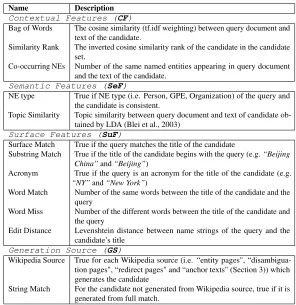
13 typical feature types used inTAC(Lehmann et al., 2010; Ji and Grishman, 2011), and the features are divided into four groups, contextual features (CF), semantic features (SeF), surface features (SuF) and generation source (GS) (see Table 2).
4.3 Incorporate
M
to
u
Estimation
Name Description
Contextual Features (CF)
Bag of Words The cosine similarity (tf.idf weighting) between query document and text of the candidate.
Similarity Rank The inverted cosine similarity rank of the candidate in the candidate set.
Co-occurring NEs Number of the same named entities appearing in query document and the text of the candidate.
Semantic Features (SeF)
NE type True if NE type (i.e. Person, GPE, Organization) of the query and the candidate is consistent.
Topic Similarity Topic similarity between query document and text of candidate ob-tained by LDA (Blei et al., 2003)
Surface Features (SuF)
Surface Match True if the query matches the title of the candidate
Substring Match True if the title of the candidate begins with the query (e.g.“Beijing China”and“Beijing”)
Acronym True if the query is an acronym for the title of the candidate (e.g. “NY”and“New York”)
Word Match Number of the same words between the title of the candidate and the query
Word Miss Number of the different words between the title of the candidate and the query
Edit Distance Levenshtein distance between name strings of the query and the candidate’s title
Generation Source (GS)
Wikipedia Source True for each Wikipedia source (i.e. “entity pages", “disambigua-tion pages", “redirect pages" and “anchor texts" (Sec“disambigua-tion 3)) which generates the candidate
[image:8.420.54.350.68.373.2]String Match For the candidate not generated from Wikipedia source, true if it is generated from full match.
Table 2: Feature Set for Disambiguation.
of China" and the second mention “NY" refers to entity “the city of New York", they have similar surface features (e.g. feature “acronym" is true), certain surface features effective for linking to “Communist Party of China" may be also effective for disambiguating “NY", and vice versa
However, with the gap in other aspects between the distributions ofAqandMshown in Section 1, directly addingMto our training set will produce a lot of noise with respect to the queried name. Thus, instead of using all the distribution knowledge inM, we propose to only incorporate the shared knowledge withAqfromMintouestimation based onstructural learning.
The Structural Learning Algorithm.Structural learning(Ando and Zhang, 2005b) is a
multi-task learning algorithm that takes advantage of the low-dimensional predictive structure shared by multiple related problems. Let us assume that we haveKprediction problems indexed by l∈ {1, ..,K}, each withn(l)instances (Xl
Kproblems. Then, we decompose the weight vectorulfor problemlinto two parts: one part that models the distribution knowledge specific to each problemland one part that models the common predictive structure,
ul=wl+ ΘTvl (4)
wherewlandvlare weight vectors specific to each prediction probleml. Then, the parametersΘ,
wlandvlcan be learned byjoint empirical risk minimization, i.e., by minimizing the joint empirical loss of the predictors for theKproblems on the training instances as Eq. 5,
arg min Θ,wl,vl
K X
l=1 n1(l)
n(l)
X
i=1
Lwl+ ΘTvl T
X(l)
i ,Yi(l)
+λkwlk2
(5)
It shows thatwlandvl are estimated onn(l)training instances of probleml. In contrast,Θis estimated on all the training instances of theKproblems. This is the key reason why structural learning is effective for learning the predictive structure shared by multiple prediction problems.
Alternating Structure Optimization. TheΘoptimization problem in Eq. 5 can be approximately
solved by the following alternating structure optimization procedure (Ando and Zhang, 2005a),
1: LearnKweight vectorsu0
lfor all theKproblems on their corresponding instances independently usingempirical risk minimization(similar with Eq. 3).
2: LetU0= [u0
1,...u0K]be thep×Kmatrix formed from theKweight vectors. 3: Perform Singular Value Decomposition onU0:U0=V
1DV2T. The firsthcolumn vectors ofV1are stored as rows ofΘˆ
Structural Learning for Entity Linking: IncorporateMtouEstimation. As previous entity
linking systems do not consider the information of the queried name, they usually use all the instances inMwithout any difference to train the linker. However, in data setM, some instances related with some particular names may share more predictive information with the queried name than other instances. Thus, in this work, we group the instances inMbased on the “name", and then learn the shared information from the “name" group instead of individual instance. As shown in Figure 1, the data setMfor entity linking usually has a certain number of names (e.g.“Hoffman",“Chad Johnson", etc.), each with some labeled instances. Then, we treat each “name” and its associated instances in Mas a prediction problem ofstructural learning. Besides, the queried name (e.g.“AZ"in Figure 1) with auto-labeled instancesAqis our target prediction problem, which is the problem we are aiming to solve.
partitioning to perform these two selection processes. This empirical method for selection will be elaborated in Section 6.3.
Let us assume that we have selected relevant names from data setM, which together with the queried name can be used as theKrelated prediction problems instructural learning. Applying structural learningto theKproblems, we can obtain the shared structureΘˆbyalternating structure optimization. Then, the weight vectorufor the queried name in Eq. 2 can be approximately solved by the following procedure:
1: Learnwˆandˆvfor the queried name by minimizing the empirical risk on data setAq:
arg min w,v
n1(q)
n(q)
X
i=1
L(w+ ˆΘTv)Xqi,Yiq
+λkwk2
2: The estimated weight vectorufor the queried name is:
ˆ
u= ˆw+ ˆΘTˆv
TheΘˆTˆvpart is learned from the selected names inMand all the instances inA
q, and therefore it can model the shared predictive structure betweenMandAq, and remove the noises inMas we expected. Thewˆpart is learned from the data setAq, which can tackle the distribution problem (see Figure 2) in the previous work only usingM.
5 Predicting NIL Mentions
So far we have assumed that each mention has a correct KB entry; however, when we run over a large corpus, a significant number of entities will not appear in the KB. In this situation, the documentdqwith mentionmqshould be linked to NIL. Traditional approaches usually need an additional classification step to resolve this problem (Zheng et al., 2010; Lehmann et al., 2010). In contrast, our approach seamlessly takes into account the NIL prediction problem. As we defineY∈ {+1,-1}to denote whether the pair of the mention and KB entry can be linked together, the median 0
can be assigned toφq(q,NIL). Then Eq. 1 is extended to:
e=arg max
ci∈Cq∪N I Lφq(q,ci) (6)
6 Experiments and Discussions
6.1 Experimental Setup
In our study, we useTAC-108KB and document collection to evaluate our approach for entity linking. The KB is derived from Wikipedia, which contains 818,741 different entries and the document collection contains 1.7 million documents from newswire and blog text. Each KB entry consists of the Wikipedia Infobox9and the corresponding Wikipedia page text.
The test set ofTAC-10has 2,250 mentions across three named entity (NE) types: Person (PER), Geo-Political Entity (GPE) and Organization (ORG). The documents containing these mentions are from the document collection above. The training set ofTAC-10consists of 5,404 mentions. Among them, 3,404 mentions are used as the data setMin our approach and the remaining 2,000 mentions are used as development set in our experiments.
We adopt micro-averaged accuracy officially used inTAC-10evaluation for our experiments, i.e. the number of correct links (includingNIL) divided by the total number of the mentions.
6.2 Statistics of Data Set
A
qTo minimize the distribution gap discussed in Section 1, we incorporate the distribution knowledge learned fromAqto the learning process. Thus, one of the key factors for the success of our lazy learning model is whether we can obtainAqfor the queries.
Therefore, firstly we investigate the amount of the labeled instances created for each query. When our model runs over the test data set, we find that 359 queries are assigned empty candidate sets (i.e. Cq=;) by the process described in Section 3. For these queries, we can directly link them withNIL without disambiguation. Thus, we only need to createAqfor the remaining 1,891 queries. Figure 4 compares the proportions of the queries in differentAqsize ranges. It shows that we have successfully created non-emptyAqfor 96%of the 1,891 queries. This proves that our approach learning the distribution knowledge for the queried name from the automatically labeled instances Aqis feasible in practice. This also supports our assumption about the existence of the document with unambiguous synonyms in the document collection.
[image:11.420.150.283.344.405.2]We also note that 49%of the queries have 10 to 99 labeled instances inAqand 37%have 100 to 999 instances for each linker . In contrast, previous approaches usually trained their model on thousands of labeled instances. Thus, it suggests that we need more labeled instances for some queries and it is necessary to still leverage the manually labeled data setMin our learning process.
Figure 4: Proportions of the Queries Based on the Sizes of their CorrespondingAq
6.3 Exploring
Θ
Configuration
Because our lazy learning model generalizes on both the distribution knowledge learned fromAq and the predictive structureΘshared byAqandM, the effectiveness of such shared structureΘis another key factor for the success of our lazy learning model. Thus, inspired by the work (Ando, 2006) for WSD, we design a set of experiments to investigate the configuration ofΘ.
city of New York”, and vice versa. However, with respect to the semantic features, these two disambiguation problems may not have much in common. This is because“Communist Party of China"is likely related with the topic “politics", but“the city of New York"does not have such particular topic. That is, shared structureΘbetween different names may depend on feature
types, and in that case, seekingΘfor each of feature groups (CF, SeF, SuFandGSin Table 2) separately may be more effective. Hence, we experimented with bothΘconfiguration in Eq. 5 and
Θconfiguration, learning aΘjfor each feature groupjseparately in Eq. 7.
K X
l=1 n1(l)
n(l)
X
i=1
L wT
lX(il)+ X
j∈F
v(j)T
l ΘjX(il,j),Yi(l) +λkwlk2
(7)
whereFis a set of disjoint feature groups, andX(j)(orv(j)) is a portion of the feature vectorX(or weight vectorv) corresponding to feature groupj, respectively.
The NE types of the instances inAqandMarePER, GPEandORG. Intuitively, the predictive structures of the names with the same NE type may be more similar than those of cross-NE-type names. Therefore, except for the feature split discussed above, we explore another twoΘ
configurations. One learnsΘfromAqand the wholeMfor each query. The other learnsΘfromAq and the subset ofM, where the instances have the same NE type with the query.
Thus, we experimented on our development data set with the combinations of the two types ofΘ
[image:12.420.105.307.152.184.2]configuration, i.e. configuration of feature splitFand configuration for partitioning of data setM. Figure 5 compares the performance using the variousΘconfigurations, and the results are in line with our expectation.F={CF+SeF+SuF+GS}treats the features of these four types as one group. It is equivalent to theΘconfiguration without feature split in Eq. 5. Comparison ofF={CF, SeF, SuF, GS}
(learningΘjfor these four feature groups separately by Eq. 7) andF={CF+SeF+SuF+GS}indicates that use of the feature split indeed improves disambiguation performance. We are also interested in whether all the feature groups are suitable for learningΘj. Thus, we further experimented with F={SeF, SuF, GS},F={CF, SuF, GS},F={CF, SeF, GS}andF={CF, SeF, SuF}. Figure 5 shows that these different subsets of feature groups do not improve the performance over using all the feature groups, and it proves that all the feature groups contribute to the learning ofΘ. Besides, this figure also shows that learningΘfromAqand the subset ofM(i.e. instances have the same NE type with the query) usually performs better than learning it fromAqand the wholeM. At last, asΘhas one parameter - its dimensionalityh, the performance shown in this figure is the ceiling performance on the development set obtained at the best dimensionality (in {10, 50, 100,...}).
6.4 Evaluation Results for Lazy Learning
The experiments in this section evaluate our lazy learning model on the test data set ofTAC-10. Our experiments used the best dimensionalityh=150ofΘtuned on the development set in Section 6.3. Table 3 shows the performances of three baseline methods and our approach with overall accuracy as well as accuracy on five subsets of the test set.
Figure 5: Accuracy on Development Set (AsΘhas one parameter - its dimensionalityh, the perfor-mance here is the ceiling perforperfor-mance obtained on the development set at the best dimensionality in {10, 50, 100,...})
knowledge learned from other labeled names. Row 5 (or 6)Aq+Θ(orΘj)shows the accuracy of our lazy learning model, which generalized the linker on both the distribution knowledge learned fromAqand the predictive structureΘshared byAqandM. Row 5 does not use feature split or data setMpartitioning for learningΘ, but Row 6 uses them. Comparison of Row 6 and Row 2, 3 indicates our lazy learning model achieves significant improvements of 4.1%and 3.8%, respectively (ρ <0.05,χ2statistical significance test). This significant improvement obtained by our approach is from solving the distribution problem (see Section 1) of previous methods.
Besides, Row 4 (M+Aq) usedempirical risk minimizationto estimateuon the data setMand Aqdirectly. Comparing it with our lazy learning model, the idea to learn the shared predictive informationΘachieves significant (ρ <0.05) gain. This is because, rather than directly usingM with a lot of noise, we only incorporate the useful information inMshared with Aqto our learning process.
ALL inKB NIL PER ORG GPE
M(Eq.3) 83.7 81.1 85.9 92.0 82.1 76.9 M(SVM) 84.0 78.5 88.6 92.1 84.0 76.0 M+Aq 84.5 81.4 87.1 92.7 82.7 78.1 Aq+Θ 86.6 84.5 88.3 94.8 85.2 79.7 Aq+Θj 87.8 85.5 90.0 96.1 86.3 80.9 Table 3: Micro-averaged Accuracy on Test Set
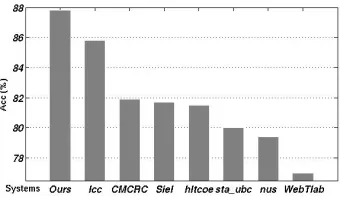
6.5 Comparison with State-of-the-Art Performance
[image:13.420.125.307.368.439.2]problem in the previous work and indeed improved the disambiguation systems. On theTAC-11data set, we obtain the similar result. We apply our method in this paper to our system inTAC-11(Zhang et al., 2011), which achieves 87.6% with a 1.3% improvement.
Figure 6: A Comparison withTAC-10Systems
6.6 Response Time
Our lazy learning delays the generalization on the labeled data until receiving the query. Hence, comparing with previous work, it increases the response time of the system for each query. However, many of the entity linking applications such asknowledge base populationdo not require real-time user interaction, and therefore they are insensitive applications. For those potential time-sensitive applications, we can calculateu0
i(i=1,...,K) in the optimization procedure of Eq. 5 before receiving the query and extract the features from the candidates in parallel. In our experiment, when using 8CPUs(1.86GHz) for the multi-thread configuration and using Lemur/Indri10to index and search document for generatingAq, our approach can disambiguate the mentions in an article as fast as the baseline method (M (Eq.3)) using a singleCPU.
7 Conclusions and Future Work
With the goal of achieving higher disambiguation performance, our focus was to solve the distribution problem in previous approaches. We have presented a lazy learning model, which can incorporate the distribution knowledge of the queried name to the learning process. To obtain this distribution knowledge, we proposed to automatically label relevant instancesAqfor the queried name. Besides, instead of using or combining labeled data setMdirectly to train the linker, we proposed to use the predictive structureΘshared byMandAq. Our experiment showed that the best configuration of
Θwas to use feature split over all the feature groups and use data setMpartitioning according to NE type. Finally, our experiments also proved that previous approaches for entity linking can be significantly improved.
In the future, to further improve the disambiguation performance, we would like to explore more methods to learn the knowledge fromMandAq.
Acknowledgments
This work is partially supported by Microsoft Research Asia eHealth Theme Program.
References
Amigo, E., Artiles, J., Gonzalo, J., Spina, D., Liu, B., and Corujo, A. (2010). Weps3 eval-uation campaign: Overview of the on-line reputation management task. InCLEF (Notebook Papers/LABs/Workshops) 2010.
Ando, R. K. (2006). Applying alternating structure optimization to word sense disambiguation. In Conference on Natural Language Learning (CoNLL).
Ando, R. K. and Zhang, T. (2005a). A framework for learning predictive structures from multiple tasks and unlabeled data. InJournal of Machine Learning Research, 6(Nov):1817–1853.
Ando, R. K. and Zhang, T. (2005b). A high-performance semi-supervised learning method for text chunking. InAnnual Meeting of the Association for Computational Linguistics (ACL).
Artiles, J., Gonzalo, J., and Sekine, S. (2007). The semeval-2007 web evaluation: Establishing a benchmark for the web people search task. Inthe Fourth International Workshop on Semantic Evaluations (SemEval-2007).
Bagga, A. and Baldwin, B. (1998). Entity-based cross-document coreferencing using the vector space model. Injoint conference of the International Committee on Computational Linguistics and the Association for Computational Linguistics (COLING-ACL).
Blei, D., Ng, A. Y., and Jordan, M. I. (2003). Latent dirichlet allocation. InJournal of Machine Learning Research 3:993-1022, 2003.
Bunescu, R. and Pasca, M. (2006). Using encyclopedic knowledge for named entity disambiguation. Inthe 11th Conference of the European Chapter of the Association for Computational Linguistics.
Chen, Z. and Ji, H. (2011). Collaborative ranking: A case study on entity linking. Inthe Conference on Empirical Methods in Natural Language Processing.
Cucerzan, S. (2007). Large-scale named entity disambiguation based on wikipedia data. Inthe Conference on Empirical Methods in Natural Language Processing.
Dredze, M., McNamee, P., Rao, D., Gerber, A., and Finin, T. (2010). Entity disambiguation for knowledge base population. In23rd International Conference on Computational Linguistics.
Finin, T., Syed, Z., Mayfield, J., McNamee, P., and Piatko, C. (2009). Using wikitology for cross-document entity coreference resolution. InAAAI Conference on Artificial Intelligence.
Gottipati, S. and Jiang, J. (2011). Linking entities to a knowledge base with query expansion. In the Conference on Empirical Methods in Natural Language Processing.
Han, X. and Sun, L. (2011). A generative entity-mention model for linking entities with knowledge base. Inthe 49th Annual Meeting of the Association for Computational Linguistics (ACL).
Herbrich, R., Graepel, T., and Obermayer, K. (2000). Large margin rank boundaries for ordinal regression. InAdvances in Large Margin Classifiers (pp. 115-132).
Ji, H., Grishman, R., and Dang, H. T. (2011). An overview of the tac2011 knowledge base population track. InText Analytics Conference.
Lehmann, J., Monahan, S., Nezda, L., Jung, A., and Shi, Y. (2010). Lcc approaches to knowledge base population at tac 2010. InText Analysis Conference 2010 Workshop.
McNamee, P. and Dang, H. (2009). Overview of the tac 2009 knowledge base population track. In Text Analysis Conference.
Mihalcea, R. and Csomai, A. (2007). Wikify!: linking documents to encyclopedic knowledge. In the sixteenth ACM conference on Conference on information and knowledge management.
Milne, D. and Witten, I. H. (2008). Learning to link with wikipedia. Inthe ACM Conference on Information and Knowledge Management.
Nguyen, H. T. and Cao, T. H. (2008). Named entity disambiguation on an ontology enriched by wikipedia. InResearch, Innovation and Vision for the Future. RIVF.
Ploch, D. (2011). Exploring entity relations for named entity disambiguation. In49th Annual Meeting of the Association for Computational Linguistics (ACL).
Popov, B., Kiryakov, A., Ognyanoff, D., Manov, D., and Kirilov, A. (2004). Kim - a semantic platform for information extraction and retrieval. InJournal of Natural Language Engineering.
Ratinov, L., Roth, D., Downey, D., and Anderson, M. (2011). Local and global algorithms for disambiguation to wikipedia. Inthe 49th Annual Meeting of the Association for Computational Linguistics.
Spina, D., Amigo, E., and Gonzalo, J. (2011). Filter keywords and majority class strategies for company name disambiguation in twitter. InCLEF.
Wang, P. and Domeniconi, C. (2008). Building semantic kernels for text classification using wikipedia. In14th ACM SIGKDD international conference on Knowledge discovery and data mining.
Zhang, W., Su, J., Chen, B., Wang, W., Toh, Z., Sim, Y., Cao, Y., Lin, C. Y., and Tan, C. L. (2011). I2r-nus-msra at tac 2011: Entity linking. InText Analysis Conference.
Zhang, W., Su, J., Tan, C., and Wang, W. (2010). Entity linking leveraging automatically generated annotation. In23rd International Conference on Computational Linguistics.