Weight Training
FOR
DUMmIES
‰3
RD EDITION
Wiley Publishing, Inc.
111 River St.
Hoboken, NJ 07030-5774
www.wiley.com
Copyright © 2006 by Wiley Publishing, Inc., Indianapolis, Indiana Published by Wiley Publishing, Inc., Indianapolis, Indiana Published simultaneously in Canada
No part of this publication may be reproduced, stored in a retrieval system, or transmitted in any form or by any means, electronic, mechanical, photocopying, recording, scanning, or otherwise, except as permit-ted under Sections 107 or 108 of the 1976 Unipermit-ted States Copyright Act, without either the prior written permission of the Publisher, or authorization through payment of the appropriate per-copy fee to the Copyright Clearance Center, 222 Rosewood Drive, Danvers, MA 01923, 978-750-8400, fax 978-646-8600. Requests to the Publisher for permission should be addressed to the Legal Department, Wiley Publishing, Inc., 10475 Crosspoint Blvd., Indianapolis, IN 46256, 317-572-3447, fax 317-572-4355, or online at
http://www.wiley.com/go/permissions.
Trademarks: Wiley, the Wiley Publishing logo, For Dummies, the Dummies Man logo, A Reference for the Rest of Us!, The Dummies Way, Dummies Daily, The Fun and Easy Way, Dummies.com and related trade dress are trademarks or registered trademarks of John Wiley & Sons, Inc. and/or its affiliates in the United States and other countries, and may not be used without written permission. All other trademarks are the property of their respective owners. Wiley Publishing, Inc., is not associated with any product or vendor mentioned in this book.
LIMIT OF LIABILITY/DISCLAIMER OF WARRANTY: THE PUBLISHER AND THE AUTHOR MAKE NO REP-RESENTATIONS OR WARRANTIES WITH RESPECT TO THE ACCURACY OR COMPLETENESS OF THE CONTENTS OF THIS WORK AND SPECIFICALLY DISCLAIM ALL WARRANTIES, INCLUDING WITHOUT LIMITATION WARRANTIES OF FITNESS FOR A PARTICULAR PURPOSE. NO WARRANTY MAY BE CRE-ATED OR EXTENDED BY SALES OR PROMOTIONAL MATERIALS. THE ADVICE AND STRATEGIES CON-TAINED HEREIN MAY NOT BE SUITABLE FOR EVERY SITUATION. THIS WORK IS SOLD WITH THE UNDERSTANDING THAT THE PUBLISHER IS NOT ENGAGED IN RENDERING LEGAL, ACCOUNTING, OR OTHER PROFESSIONAL SERVICES. IF PROFESSIONAL ASSISTANCE IS REQUIRED, THE SERVICES OF A COMPETENT PROFESSIONAL PERSON SHOULD BE SOUGHT. NEITHER THE PUBLISHER NOR THE AUTHOR SHALL BE LIABLE FOR DAMAGES ARISING HEREFROM. THE FACT THAT AN ORGANIZATION OR WEBSITE IS REFERRED TO IN THIS WORK AS A CITATION AND/OR A POTENTIAL SOURCE OF FUR-THER INFORMATION DOES NOT MEAN THAT THE AUTHOR OR THE PUBLISHER ENDORSES THE INFORMATION THE ORGANIZATION OR WEBSITE MAY PROVIDE OR RECOMMENDATIONS IT MAY MAKE. FURTHER, READERS SHOULD BE AWARE THAT INTERNET WEBSITES LISTED IN THIS WORK MAY HAVE CHANGED OR DISAPPEARED BETWEEN WHEN THIS WORK WAS WRITTEN AND WHEN IT IS READ. SOME OF THE EXERCISES AND DIETARY SUGGESTIONS CONTAINED IN THIS WORK MAY NOT BE APPROPRIATE FOR ALL INDIVIDUALS, AND READERS SHOULD CONSULT WITH A PHYSICIAN BEFORE COMMENCING ANY EXERCISE OR DIETARY PROGRAM.
For general information on our other products and services, please contact our Customer Care Department within the U.S. at 800-762-2974, outside the U.S. at 317-572-3993, or fax 317-572-4002. For technical support, please visit www.wiley.com/techsupport.
Wiley also publishes its books in a variety of electronic formats. Some content that appears in print may not be available in electronic books.
Library of Congress Control Number: 2005937354 ISBN-13: 978-0-471-76845-6
ISBN-10: 0-471-76845-6
Manufactured in the United States of America 10 9 8 7 6 5 4 3 2 1
About the Authors
Liz Neporent:Liz’s first set of weights (actually, her brother’s) were made of blue plastic and filled with sand; when they started leaking sand all over the house, her mother relegated all weight lifting activities to the basement. Since that time, Liz has graduated into a well-known corporate fitness consul-tant, designing and managing fitness centers worldwide. Along the way, Liz also was a personal trainer, received a master’s degree in exercise physiol-ogy, and got certified by the American College of Sports Medicine, National Strength and Conditioning Association, American Council of Exercise, and the National Academy of Sports Medicine. She is coauthor and author of several books, including Fitness For Dummiesand Fitness Walking For Dummiesand writes frequently for the New York Times, Family Circle, Shape, and others. She currently hosts a daily internet show on eyada.com.
Suzanne Schlosberg: Suzanne’s writing career began her freshman year in college when she was assigned to cover a pre-season NBA game and found herself in a locker room interviewing a dozen, tall, muscular, naked Boston Celtics. She decided she liked this writing stuff. Suzanne went on to become a newspaper reporter and magazine writer. Now a contributing editor to Shape and Healthmagazine, Suzanne is the coauthor, with Liz Neporent, of Fitness For Dummiesand the author of The Ultimate Workout Log.She is also an instructor in the UCLA Extension Certificate in Journalism program. Always happy when she has a barbell in hand, Suzanne has lifted weights in Zimbabwe, Morocco, Iceland, and Micronesia, among other locales. She is the women’s record holder in the Great American Sack Race, a quadrennial event held in Yerington, Nevada, in which competitors must run 5 miles while carrying a 50-pound sack of chicken feed.
Shirley Archer:Shirley is a former New York City attorney who traded the fast life for the fit life. A survivor of Chronic Fatigue Syndrome from stress and overworking, her recovery helped her to become a champion of fitness for health and to live fully in body, mind and spirit. She’s now a health educa-tor and fitness specialist at the Health Improvement Program at Stanford University School of Medicine in Palo Alto, the author of ten fitness and well-ness books, an international trainer of fitwell-ness instructors, and a frequently quoted media spokesperson worldwide. Her master’s degree is in East Asian Studies from Harvard University, and she has special expertise in mind-body exercise. She’s a mind-body spokesperson for IDEA, author of a monthly mind-body news column, and a spokesperson for the American Council on Exercise. She’s certified by the American College of Sports Medicine, American Council on Exercise, and National Strength and Conditioning Association, among others. She’s also a certified Pilates teacher and yoga instructor. She’s created a number of corporate fitness programs, including
Authors Acknowledgments
The authors wish to thank Richard Miller and The Gym Source of New York City for providing exercise equipment for many of our photos. We’re also grateful to Zoran Popovic, Arthur Belebeau and Daniel Kron for their wonder-ful and speedy photography, and to Chris Gristanti, who generously donated several photos. Trotter Fitness Equipment provided additional photographs. Many thanks to all the models who appeared in this book. Your time, patience, and of course, images are much appreciated. The models are Georgia Archer, Shirley Archer, Patty Buttenheim, Aja Certain, Terry Certain, Katherine Cole, James Gaspard, Debbie-Deb Hanoka, James Jankiewicz, Spike Jozzino, Erica Kraus, Subhash Mandal, Amy Ngai, Alicia Racela, Fred Reid, Doris Shafran, Jay Shafran, Bob Weiter, Carrie Wujeik, and Norman Zinker. Thanks also to Reebok for providing clothing and shoes. Some additional clothing was provided by Marirose Charbonneau, M.Rose Sportswear, Everlast, Nike, and Brooks.
Acknowledgments from Liz
Much gratitude goes to my family, especially my husband Jay Shafran, who is supportive beyond belief. Thanks to Suzanne Schlosberg, the best writing partner ever. Ever! I would also like to acknowledge the following people who are forced to put up with me in some way: John Buzzerio, Nancy Ngai, Linda Strohmeyer, Patricia Buttenheim, Jimmy Buff, Jimmy Rotolo, Stephen Harris, James Jankiewicz, Bob Welter, Subhash Mandal, Holly Byrne, Grace De Simine, and Zoomer.
Acknowledgments from Suzanne
Acknowledgments from Shirley
Publisher’s Acknowledgments
We’re proud of this book; please send us your comments through our Dummies online registration form located at www.dummies.com/register/.
Some of the people who helped bring this book to market include the following:
Acquisitions, Editorial, and Media Development
Project Editor: Natalie Faye Harris
(Previous Editions: Leah P. Cameron, Colleen Williams Esterline)
Acquisitions Editor: Kathy Cox
(Previous Editions: Stacy S. Collins)
Copy Editor: Carrie A. Burchfield
(Previous Editions: Michael Simsic, Colleen Williams Esterline)
Editorial Program Coordinator: Hanna K. Scott
Technical Editors: Gina Allchin, Marlisa Brown, John Buzzerio, Holly Byrne, Grace De Simone, Brooke Spindler
Editorial Manager: Christine Beck
Editorial Assistants: Erin Calligan, Nadine Bell, David Lutton
Cover Photos: © Marc Romanelli/Getty Interior Photos: Arthur Belebeau,
Chris Gristanti, Daniel Kron, Zoran Popovic, Trotter Fitness Equipment
Cartoons: Rich Tennant (www.the5thwave.com)
Composition Services
Project Coordinator: Jennifer Theriot
Layout and Graphics: Carl Byers, Andrea Dahl
Proofreaders: Laura Albert, TECHBOOKS Production Services
Indexer:TECHBOOKS Production Services
Publishing and Editorial for Consumer Dummies
Diane Graves Steele, Vice President and Publisher, Consumer Dummies
Joyce Pepple, Acquisitions Director, Consumer Dummies
Kristin A. Cocks, Product Development Director, Consumer Dummies
Michael Spring, Vice President and Publisher, Travel
Kelly Regan,Editorial Director, Travel
Publishing for Technology Dummies
Andy Cummings,Vice President and Publisher, Dummies Technology/General User
Composition Services
Gerry Fahey,Vice President of Production Services
Contents at a Glance
Introduction ...1
Part I: Before You Pick Up a Weight ...7
Chapter 1: Weight Training for Life ...9
Chapter 2: Workout Lingo and Proven Training Concepts ...15
Chapter 3: Testing Your Strength, Setting Goals, and Tracking Progress ...29
Chapter 4: Examining Tools of the Weight-Training Trade ...43
Chapter 5: How to Avoid Dropping a Weight on Your Toe (and Other Safety Tips)...57
Part II: Weighing In with Weight Training Wisdom ...73
Chapter 6: Exercising at Home: Setting Up Your Own Gym ...75
Chapter 7: Exercising Away from Home: Clubs, Trainers, and Classes ...85
Chapter 8: Stretching: The Truth ...101
Chapter 9: Avoiding Common Weight Lifting Mistakes ...115
Part III: Tackling the Exercises ...129
Chapter 10: Interpreting the Exercise Instructions...131
Chapter 11: Working Your Back ...139
Chapter 12: Working Your Chest ...163
Chapter 13: Working Your Shoulders...181
Chapter 14: Working Your Arms ...197
Chapter 15: Working Your Abdominals...215
Chapter 16: Working Your Butt and Legs ...229
Chapter 17: Working Your Core ...259
Part IV: Setting Up Your Workout Programs...271
Chapter 18: Basic Workouts to Get Started...273
Chapter 19: Quickie Workouts for Busy Days ...283
Chapter 20: Core Programs for Good Balance and a Healthy Back ...295
Chapter 21: Tackling More Advanced Programs ...307
Chapter 22: Workouts for Special Needs ...319
Part V: The Part of Tens ...341
Chapter 24: Ten (Okay, Eleven) G-Rated Things You Can Do with Latex Rubber ....343 Chapter 25: Ten Ways to Have a Ball (Almost Literally)...357 Chapter 26: Ten Thoughts on Supplements, Diets, and Healthy Eating...371
Table of Contents
Introduction...1
About This Book...2
Foolish Assumptions ...3
How This Book Is Organized...4
Part I: Before You Pick Up a Weight ...4
Part II: Weighing In with Weight Training Wisdom ...4
Part III: Tackling the Exercises...4
Part IV: Setting Up Your Workout Programs ...5
Part V: The Part of Tens...5
Icons Used in This Book...5
Where to Go from Here...6
Part I: Before You Pick Up a Weight...7
Chapter 1: Weight Training for Life . . . .9
Weight Training for All Bodies...9
Fitness Testing and Goal Setting for Success ...10
Safety First to Enjoy Training ...11
Choosing Your Training Equipment...11
Selecting the Right Exercises, Routines, and Training Settings for You...13
Living a Healthy Lifestyle ...13
Pumping up your heart and lungs...14
Improving your flexibility ...14
Balancing options and training your brain ...14
Chapter 2: Workout Lingo and Proven Training Concepts . . . .15
Defining Key Weight Training Jargon...16
Understanding Rep(etition)s ...18
Getting Acquainted with Sets ...19
Previewing Weight Routine Essentials...20
Working all of your major muscle groups ...20
Doing exercises in the right order...20
Appreciating the Value of Rest and Recovery ...22
Resting a trained muscle at least one day...22
Avoiding overtraining ...22
Getting enough sleep ...23
Putting Your Mind into Your Muscle...24
Understanding the body-mind connection ...24
Psyching up and visualizing yourself strong ...25
Organizing Your Long-Term Training: Seeing the Big Picture...25
Chapter 3: Testing Your Strength, Setting Goals,
and Tracking Progress . . . .29
Testing Your Strength and Endurance...30
Comparing your upper-body strength...32
Comparing your abdominal strength...33
Goal-Setting for Success ...34
Identifying why your goals are important...34
Using S.M.A.R.T. goals ...34
Getting the support that you need...35
Tracking Your Progress ...36
Recording information in your log ...36
Analyzing your workout log ...37
Being All That You Can Be...39
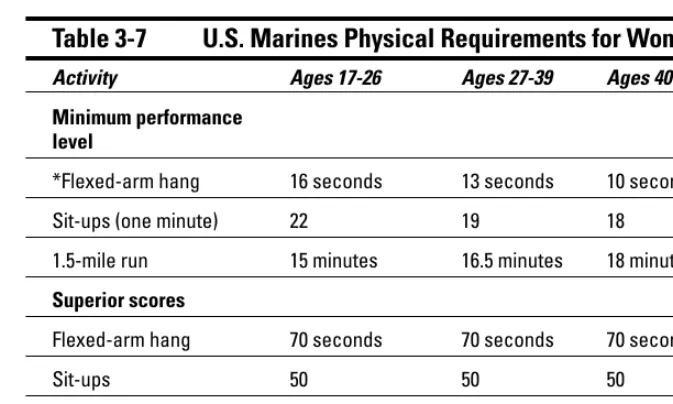
U.S. Marines ...39
The United States Air Force ...40
The Seattle Fire Department ...41
Chapter 4: Examining Tools of the Weight-Training Trade . . . .43
Getting Comfortable with Free Weights ...44
Knowing the value of free weights ...44
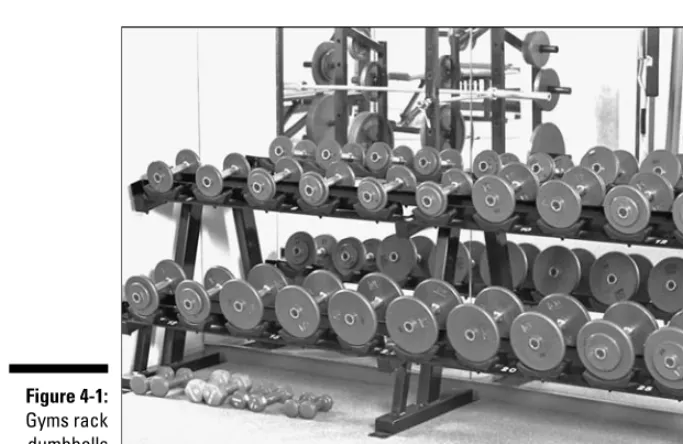
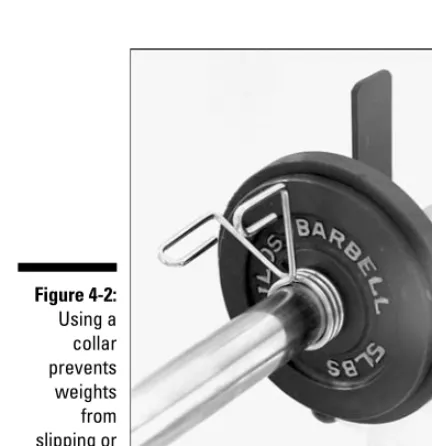
Making the choice, knowing the difference: Dumbbells versus barbells ...45
Using a Weight Bench ...48
Don’t Be Afraid of Weight Machines! ...50
Making weight machines work for you...50
Examining specific weight machines ...51
Cable machines: A different breed ...53
Buckling Down on Bands and Tubing...54
Chapter 5: How to Avoid Dropping a Weight
on Your Toe (and Other Safety Tips) . . . .57
Remembering the Safety Laws of Weight Lifting ...57
Warming up before you lift...58
Starting with lighter weights...58
Breathing properly ...59
Using proper form ...60
Cooling down ...61
Resting your muscles...61
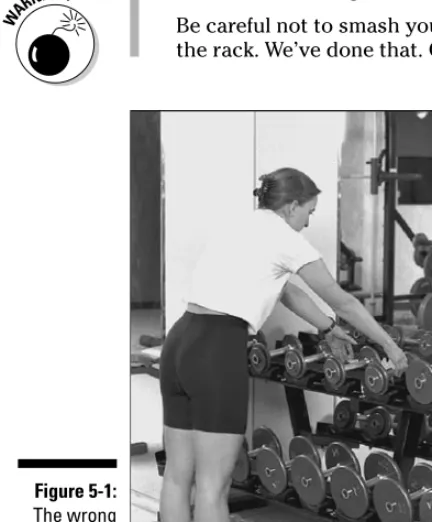
Heeding Some Advice: Weight Lifting Safety Tips...62
Free weight safety tips ...62
The Art of Spotting...65
Briefing your spotter...66
Being the spotter ...66
Common Weight Training Injuries ...68
Overcoming Injuries ...70
Part II: Weighing In with Weight Training Wisdom ...73
Chapter 6: Exercising at Home: Setting Up Your Own Gym . . . .75
Lifting Weights at Home ...75
Designing a Home Gym...76
Choosing Free Weights ...77
Buying dumbbells...79
Buying barbells ...81
Buying a bench ...81
Investing in Weight Machines ...82
Buying Bands or Tubing ...83
Chapter 7: Exercising Away from Home:
Clubs, Trainers, and Classes . . . .85
Deciding to Join the Club ...85
Choosing a Health Club ...86
Researching Trainers...89
Finding fitness help: What a trainer can do for you...89
Finding a qualified trainer ...90
Being on your best behavior...92
Working in a Group: An Introduction to Weight Training Classes ...93
Conditioning your muscles ...94
Expecting quality from your instructor...94
Mastering Gym Training Etiquette ...96
Sharing equipment ...97
Unloading your weight bar...97
Putting weights back where you found them ...97
Keeping your sweat to yourself ...98
Helping the flow of traffic ...98
Hogging the drinking fountain ...98
Toting around your gym bag...99
Treating the locker room like your own bathroom...99
Chapter 8: Stretching: The Truth . . . .101
Knowing Why and When to Stretch ...101
Lengthening your muscles ...102
Alleviating muscular tension ...102
Preventing injuries ...102
Celebrating Traditions: Traditional Stretching ...104
Stretching with Assistance...109
Proprioceptive Neuromuscular Facilitation (PNF) ...111
Active Isolated (AI) Stretching ...112
Chapter 9: Avoiding Common Weight Lifting Mistakes . . . .115
Cheating Your Abs...115
Crunching incorrectly...116
Crunching properly ...116
Squatting Too Far ...117
Squatting incorrectly ...117
Squatting properly ...117
Arching Your Back...118
Bench-pressing the wrong way...118
Bench-pressing the right way ...119
Lowering Your Elbows Too Far...119
Lowering your arms the wrong way ...119
Lowering your arms the right way ...120
Pulling a Fast One...120
Pulling down a bar the right way ...120
Pulling down a bar the wrong way ...121
Letting Your Butt Stick Up in the Air ...121
Using the leg curl machine the wrong way ...122
Using the leg curl machine the right way...122
Exaggerating the Row ...123
Rowing the wrong way...123
Rowing the right way ...123
Sitting Up Improperly from a Weight Bench ...123
Sitting up the wrong way ...124
Sitting up the right way ...125
Spotting Too Much — Or Not Enough ...125
Spotting the wrong way ...125
Spotting the right way ...126
Carrying a Weight Plate Too Casually ...126
Carrying a weight plate the wrong way ...126
Carrying a weight plate the right way ...127
Part III: Tackling the Exercises ...129
Chapter 10: Interpreting the Exercise Instructions . . . .131
Tackling the Basic Info...131
Explaining Our Favorite Phrases...134
Pull in your abdominals...134
Stand up tall with square shoulders and a lifted chest ...135
Don’t lock your joints ...135
Keep your shoulders and neck relaxed ...135
Don’t shoot your knees past your toes ...136
Don’t bend your wrists ...136
Maintain proper posture ...136
Studying Breathing Techniques for Exercise...137
Chapter 11: Working Your Back . . . .139
Understanding Upper Back Muscle Basics ...139
Getting an Upper Back Workout...141
Avoiding Mistakes When Working Your Upper Back ...142
Becoming Skilled at Upper Back Exercises...143
One-arm dumbbell row ...143
Dumbbell pullover...145
Dumbbell shrug ...147
Machine row...149
Lat pulldown ...150
Cable row...152
Assisted pull-up ...154
Understanding Lower Back Muscle Basics ...156
Enjoying a Strong Lower Back ...156
Getting a Lower Back Workout ...157
Avoiding Mistakes When Training Your Lower Back...158
Becoming Skilled at Lower Back Exercises...158
Pelvic tilt...158
Back extension...160
Chapter 12: Working Your Chest . . . .163
Understanding Chest Muscle Basics ...163
Enjoying Strong Pecs ...164
Getting a Chest Workout ...164
Avoiding Mistakes When Pumping Your Pecs ...166
Becoming Skilled at Chest Exercises ...167
Modified push-up ...167
Bench press...169
Dumbbell chest press ...172
Incline chest fly...173
Vertical chest press machine...174
Cable crossover ...177
Assisted dip...179
Chapter 13: Working Your Shoulders . . . .181
Understanding Shoulder Muscle Basics...182
Enjoying Strong Shoulders...183
Getting a Great Shoulder Workout ...183
Avoiding Mistakes When Training Your Shoulders...184
Exaggerating the movement ...185
Arching your back ...185
Rocking back and forth...185
Practicing Shoulder Exercises ...186
Dumbbell shoulder press ...186
Lateral raise ...188
Front raise ...189
Back delt fly...191
External rotation...193
Internal rotation...194
Shoulder press machine ...195
Chapter 14: Working Your Arms . . . .197
Understanding Arm Muscle Basics ...197
Enjoying Strong Arms ...199
Getting a Great Arm Workout ...199
Avoiding Mistakes When Training Your Arms ...200
Practicing Arm Exercises ...201
Barbell biceps curl ...201
Dumbbell reverse biceps curl...203
Concentration curl ...204
Arm curl machine ...206
Triceps pushdown...207
Triceps kickback...209
Bench dip ...210
Triceps dip machine ...212
Wrist curl and reverse wrist curl...213
Chapter 15: Working Your Abdominals . . . .215
Introducing Abdominal Muscle Basics...216
Enjoying Strong Abdominals ...217
Getting Past the Myths of Abdominal Workouts...218
Myth #1: Abdominal exercises get rid of the blubber around your middle...218
Myth #2: Everyone can develop washboard abs if they try hard enough ...218
Myth #3: For best results, you should do several hundred repetitions of abdominal exercises ...218
Myth #4: You need to work your abs every day...219
Myth #5: The front of your stomach has two separate muscles: The upper abs and lower abs ...219
Myth #6: You need a gadget to train your abs ...219
Myth #7: Sit-ups are better than crunches...219
Avoiding Mistakes When Training Your Abdominals ...220
Discovering Exercises in This Chapter...220
Basic abdominal crunch ...221
Reverse crunch...222
Oblique crunch ...224
Bent knee side crunch ...224
Chapter 16: Working Your Butt and Legs . . . .229
Understanding Butt and Leg Muscle Basics ...229
Enjoying a Strong Lower Body ...231
Getting a Great Lower Body Workout...233
Avoiding Mistakes When Working Your Lower Body ...234
Learning Lower Body Exercises ...235
Squat ...235
Lunge...237
Leg press machine...238
Kneeling butt blaster ...240
Quad press ...243
Leg extension machine ...245
Kneeling leg curl ...247
Leg curl machine ...248
Inner/outer thigh machine ...249
Side-lying leg lift...252
Inner thigh lift ...253
Standing calf raise ...255
Toe lift ...256
Chapter 17: Working Your Core . . . .259
Introducing Core Stabilizer Muscle Basics ...259
Enjoying a Strong Core ...261
Getting a Core Workout ...261
Avoiding Mistakes When Training Your Core ...262
Performing Exercises in This Chapter...263
Plank...263
Side plank ...265
All fours spinal stabilization ...266
Reverse plank...267
The slide ...269
Part IV: Setting Up Your Workout Programs ...271
Chapter 18: Basic Workouts to Get Started . . . .273
Custom-designing a Routine ...273
Identifying why you want to train ...274
Your equipment ...275
Your exercise preferences ...276
Your lifestyle ...276
Your current level of fitness...277
Reviewing Your Program Variables...277
Doing exercises in the right order...277
Choosing the right weight ...278
Trying Sample Beginner Routines...279
Doing circuits at the gym ...279
Doing circuits at home...280
Dumbbells-and-a-bench routine for the gym or home...281
The mix ’n’ match routine at the gym...281
Chapter 19: Quickie Workouts for Busy Days . . . .283
Making the Most of Quickie Training...284
Putting Together Your Quickie Routine ...284
Doing 15-minute Workouts...285
15-minute gym total body workouts ...285
15-minute at home total body workouts ...286
Doing 15-minute upper or lower body workouts ...288
Exercising with the Ten-Minute Routines ...289
Home gym ten-minute mix ’n’ match routines...290
Doing ten-minute upper or lower body workouts...291
Enjoying a ten-minute stretch workout ...292
Chapter 20: Core Programs for Good Balance
and a Healthy Back . . . .295
Saying Goodbye to Back Pain ...296
Evaluating Your Posture ...297
Benefiting from Good Posture ...298
Keeping Your Balance...299
Practicing Yoga, Tai Chi, or Qigong...300
Balance-specific Exercises ...301
Previewing Balance Gadgets...303
Putting Together Back Health and Balance Routines...304
Sampling Healthy Back and Balance Routines ...304
20-minute routine ...305
15-minute routine ...305
Ten-minute routine...306
Chapter 21: Tackling More Advanced Programs . . . .307
Understanding Progression ...308
Split Routines...308
The upper body/lower body split ...309
Push/pull split routine ...312
Vary Your Daily Workout ...314
Super sets ...314
Giant sets...315
Circuits...316
Advanced Training Techniques...317
Pyramids...317
Breakdowns...318
Chapter 22: Workouts for Special Needs . . . .319
Training Tips for Kids and Teens ...319
Benefiting from youth resistance training...320
Knowing what is age appropriate...320
Trying a sample kid or teen routine...322
Lifting Weights Before and After Baby...322
Benefiting from prenatal and postpartum resistance training ...323
Modifying exercise routines for safety ...323
Trying a sample routine ...324
Training Big, Beautiful Bodies ...325
Understanding why all shapes and sizes benefit from stronger muscles ...325
Considering safety guidelines and other tips ...326
Trying a sample routine ...327
Building and Keeping Strong Bones...328
Lifting into the Golden Years ...329
Reaping rewards from training as an older adult...329
Observing safety guidelines and training tips ...330
Chapter 23: Adding Yoga and Pilates for
Flexible Strength and Coordination . . . .331
Examining Yoga and Pilates ...331
Harmonizing with yoga ...332
Moving with Pilates ...332
Benefiting from Yoga and Pilates ...333
Engaging your whole body with yoga and Pilates...333
Increasing your flexibility with yoga and Pilates ...334
Improving your balance, coordination, and concentration with yoga and Pilates...334
Can Yoga and Pilates Replace Weight Training? ...336
Fitting Yoga and Pilates into Your Fitness Program...336
Diving into Yoga...337
Different styles of yoga ...337
Finding a qualified yoga instructor ...339
Getting the Lowdown on Pilates ...339
Part V: The Part of Tens ...341
Chapter 24: Ten (Okay, Eleven) G-Rated Things
You Can Do with Latex Rubber . . . .343
Before You Start, Get a Big Rubber Band! ...343
Preparing for Your Band Workout...344
Band Squat ...345
Band Butt Blaster ...346
Band Outer Thigh Lift ...348
Band Lat Pulldown ...350
Band Push-up...350
Band One-arm Shoulder Press...352
Band External Rotation ...353
Band Internal Rotation ...353
Band Double Biceps Curl ...355
Band Triceps Extension ...356
Chapter 25: Ten Ways to Have a Ball (Almost Literally) . . . .357
Picking Out the Right Ball ...357
Using Exercise Balls Safely...358
Ball Crunch ...359
Ball March ...360
Ball Oblique Crunch...361
Ball Extension ...362
Ball Plank...363
Ball Push-up ...364
Ball Leg Lift ...365
Ball Bridge...366
Ball Side-Lying Outer Thigh Lift ...367
Ball Side-Lying Double Leg Lift ...369
Chapter 26: Ten Thoughts on Supplements,
Diets, and Healthy Eating . . . .371
Understanding Why Supplement and Diet Ads Are Confusing ...371
Overdoing Supplements ...372
Uncovering the Fat-burner Chitin ...373
Understanding a Muscle-builder: Creatine ...374
Unraveling the High-protein Craze...374
Blaming insulin for weight problems ...375
Reducing saturated fat...376
Depriving your body of calories ...376
Building Muscle with Protein...377
Finding Healthy Energy Bars ...377
Eating Chocolate for a Healthy Snack...378
Enjoying a Variety of Whole Foods ...379
Choosing Organic and Free-Range Products ...380
Introduction
W
hen the first edition of Weight Training For Dummieswas published, lifting weights was on the verge of becoming a mainstream phenome-non. Women, Baby Boomers, seniors — all these groups were starting to get the message: Hoisting hunks of iron benefits everyone, not just bodybuilders with shoulders wider than the wingspan of a DC-10.Now, four years later, weight training has become even more popular. Some 87 percent of all health clubs now offer personal training, compared to 66 percent in 1996. In the same period, four million women have started using weight machines. Health club memberships have more than doubled for people over age 55. One gym in Palm Springs, California, has even stopped playing rap music because of complaints from the gym’s increasingly gray-haired membership.
However, just because weight training has become more popular doesn’t mean it has become any less intimidating for novices. It’s only natural for a beginner to be baffled by the equipment and the lingo. You may look at a bar-bell and wonder how you’re going to lift the thing while remaining on good terms with your lower back muscles. You may stare at a weight machine and wonder which end the homemade pasta comes out of. You may wonder what it means when a trainer says, “Do three sets of eight reps on the lat pulldown and then super set with the seated row.”
In this book, we give you the knowledge and confidence to start a weight-training program, either at home or at the gym. We describe exercises suit-able for rookies and veterans alike. We’ve added new information regarding how to train over a lifetime and feel comfortable around weight training equipment. Training tips for youth, teens, prenatal and postpartum moms, and older adults are included. Additional information for people who are larger sized is presented. And, the latest trends in fitness, core training, yoga, and Pilates are all demystified. You’ll find this edition packed with workouts for every circumstance; whether you are on vacation or only have ten min-utes to spare, you can fit a weight training workout into your day. New equip-ment that enhances balance and stability training is introduced and an entire chapter is devoted to stability ball exercises.
About This Book
We all have different reasons for wanting to lift weights. Undoubtedly, many of these reasons have to do with looking better. Sculpted arms and toned abs have become somewhat of a fashion statement among certain age groups. But many of us can think of more compelling and, ultimately, more satisfying reasons to lift weights. Here’s a reminder of how much weight training can benefit you:
⻬Keep your bones healthy.The average woman loses about 1 percent of her bone mass each year after age 35. Men are susceptible to brittle bones, too. Lifting weights can drastically slow the rate of bone loss and may even reverse the process. With strong bones, you won’t become hunched over as you age, and you’ll lower your risk of life-threatening fractures. No matter your age, it’s never too late to start strengthening your bones.
⻬Help control your weight.When you lose weight through dieting alone or together with some aerobic exercise (such as walking or bicycling), you lose muscle along with fat. This can be a problem: When you lose muscle, your metabolism slows down, so you’re more likely to regain the weight. By adding weight training to the mix, you can maintain (or increase) your muscle and thereby maintain (or even boost) your metabolism. Although weight training is no magic bullet for weight loss, many obesity experts consider it to be an essential part of any weight-control program.
⻬Increase your strength.Lifting the front end of a fire truck may not be among your goals in life, but a certain amount of muscle strength does come in handy. Weight training makes it easier to haul your stacks of newspaper to the recycling bin and carry and put away your groceries. It can also keep you out of nursing care homes in your older age and help you maintain your independence. Studies show that even 90-year-olds can gain significant strength from lifting weights and regain the ability to walk and dress themselves.
⻬Boost your energy.Forget about hokey dietary supplements. One of the best energy boosters around comes not in a bottle but on a weight rack. When you lift weights, you have more pep in your step. You can bound to the bus stop, sail through your company’s annual charity walk-a-thon, and make it to the end of the day without feeling exhausted.
lifting weights can lower your risk of having a heart attack or stroke by lowering your LDL (“bad”) cholesterol and reducing blood pressure.
⻬Improve your quality of life.Any activity that accomplishes all the above has to make you a happier, more productive, and more self-confident person. (Research suggests that weight training can even relieve clinical depression.) Of course, hoisting hunks of steel is no instant cure-all, but you’d be surprised how much satisfaction a pair of 10-pound dumbbells can bring into your life, which also improves the lives of everyone else around you.
To gain these and other benefits of weight training, you can use this book in several ways:
⻬If you’re a novice, we suggest you start by reading Parts I and II. These parts get you comfortable with the equipment, the lingo, the safety basics, and the etiquette. Then skip to Part IV, which explains how to design a weight routine that meets your needs. (You may want to refer back to this part every now and then.) Then go back to Part III, which shows you the exercises. In your spare time, like when you’re not busy lifting weights, hit Part V.
⻬If you already know an E-Z Curl bar from a horseshoe grip, and know that in the weight training world, a circuit has nothing to do with electri-cal currents, you can go straight to Part III and find numerous exercises for each body part. You may also want to focus on Part IV, which describes how to combine these exercises into a variety of routines that fit your schedule and your equipment preferences.
⻬No matter what your level of knowledge about weight training, you can always use this book as a reference. Flip to the index and look up any specific topic, such as personal training, hamstring stretches, fitness magazines, or high-protein diet.
Foolish Assumptions
While each of us owns a body, we do not necessarily understand how best to train it. To write this book and make it truly friendly to anyone new to weight training, we assume that you are completely unfamiliar with weight training. Some of the information presented, therefore, may be review for people with more experience.
How This Book Is Organized
Weight Training For Dummiesis divided into five parts. In general, you can read each part or any chapter within it without having to read what came before. When you come to a section that does require prior knowledge, we refer you to the chapter that provides the background. Here’s a rundown of each part.
Part I: Before You Pick Up a Weight
Lifting isn’t one of those activities like, say, checkers, that you can compe-tently engage in after a one-minute explanation. Before you hop aboard the Leg Press, you need to know a bit of weight training jargon and understand key safety precautions. This part explains terms such as power cage, spotter, and plate-loaded weight machine — terms that you can use to impress guests at your next cocktail party. This part also shows you how to test your own strength and chart your progress in a weight-training diary.
Part II: Weighing In with
Weight Training Wisdom
In this part, we offer insight into the less technical aspects of weight lifting. We clue you in to equipment bargains, help you size up health clubs, and warn you about high-pressure salespeople. We tell you which video instruc-tors to invite into your living room, which group strength training classes to avoid, and how to recognize a quality trainer. We also fill you in on the finer points of weight training etiquette, like what to do when a gym member is hogging the Butt Blaster.
Part III: Tackling the Exercises
Part IV: Setting Up Your
Workout Programs
You can’t combine any dozen exercises and call them a workout any more than you can throw various foods and spices in a pot and call it a stew. To get good results and avoid injury, you need to carefully select your exercises. In this part, we explain the essential elements of any weight routine. We explain how to custom design a program so that it suits your goals and your sched-ule. We also explain how to balance your weight workouts with the other important components of fitness. We introduce you to other disciplines that can complement your strength workouts, show you several exercises to improve your balance and lower back strength, and also help you tailor your exercise program for special situations, such as prenatal and postnatal con-siderations, training tips for kids and teens, and more.
Part V: The Part of Tens
This part is a hodgepodge of important weight training subjects. We recom-mend ways to educate yourself about dieting and taking supplements while weight training, and give you tips on using latex rubber and exercise balls to complement and add fun to your weight-training regimen.
Icons Used in This Book
The icons are the small drawings in the margins of this book. They’re designed to draw your attention to specific topics, and they serve as guides to the kind of information being provided.
When you see the Tip icon, you know that we’re pointing out an especially helpful weight training hint or giving you a heads-up on an effective strategy. The Warning icon cautions you of potential dangers to beware while weight training, including the hucksters lurking at the depths of the fitness industry, hawking useless gadgets like electronic muscle stimulators. We also use this icon to signal mistakes that can cause injury, such as bending your knees too far or lifting too much weight.
This icon reminds you about good technique so that you don’t become the victim of an 11-80 (that’s police code for “Accident – Major Injuries”). It points out when to keep your shoulders relaxed, your abdominal muscles tight, and your knees bent.
This icon suggests that you skip or modify the exercise if you’ve ever injured the joint indicated, such as the knee or lower back. Even if you’ve never suf-fered an injury, pay special attention to the joints in question and make sure that you don’t feel any discomfort.
Where to Go from Here
Part I
In this part . . .
P
art I takes the intimidation out of weight lifting. First, you discover all the benefits of incorporating a weight training program into your life regardless of your age, level of ability, or individual goals. If you want to become an Olympic champion or simply have more energy to get through each and every day, weight training benefits you. You get an overview of key weight training terms and important training concepts that are validated by research. After you understand training concepts, you realize how to assess your current level of muscle power on a variety of equipment, how to set goals successfully, and how to track your progress. And for the few, the proud, and the ambi-tious, you can check out the physical requirements for entrance into several fire and military academies.Chapter 1
Weight Training for Life
In This Chapter
䊳Discovering why all bodies needs weight training
䊳Assessing your fitness and setting goals
䊳Choosing the correct tools to get you in shape
䊳Training safely to enjoy a lifetime of strength and well-being
䊳Deciding which exercises and routines help you best achieve your goals
䊳Finding out how weight training fits into an overall wellness lifestyle
B
eginning a weight training program is one of the best decisions to make for your health, well-being, physical, and mental performance. Weight training on a regular basis improves your strength, endurance, confidence, appearance, health, longevity, and quality of daily living. Consistent weight training helps reduce your stress, manage your weight, strengthen your bones, lower your risk of injury, and gives you a competitive edge in all aspects of life.In this chapter, you find out why weight training benefits all bodies at every age and fitness level; why it’s important to assess your fitness and set goals; what tools to use; why safety measures are essential for a lifetime of enjoy-able training; how to decide which exercises, routines, and training settings are right for you; and how to achieve total wellness beyond simply lifting weights. If you want to find out more, each section tells you which chapters provide the necessary details.
Weight Training for All Bodies
People of all ages — kids, teens, young adults, pregnant women, older adults, and people with special needs — benefit from weight training (see Chapter 22). The risks of doing nothing are greater than the risks of injury from exercise — even for the frail and elderly. Whether you’re a beginner who wants to get started safely or you’re already fit and want to improve your performance, weight training improves your current condition (whatever that is) and helps you achieve your goals of feeling stronger and better about yourself.
Strong muscles help us move better and avoid pain and injury at all stages of life. Weight training provides the following benefits:
⻬Increased strength and endurance
⻬Improved sleep
⻬Reduced stress
⻬Enhanced feelings of confidence and well-being
⻬Reduced risk of falls
⻬Strengthened bones
⻬Boosted metabolism for more energy burn around the clock
⻬Full, independent living
Because weight training strengthens your muscles and improves your muscu-lar endurance, you’ll naturally have more energy to be more active through-out the day. When you’re physically tired, you’re able to fall asleep more easily and enjoy a deeper, better quality of sleep. As you’re more refreshed and energetic, you feel better and accomplish more, which improves your mood and confidence level. In this manner, your consistent training stimu-lates an upward cycle of well-being.
Don’t wait. Absorb everything you need to know from this book to get going with a program that is perfect for you. Keep taking the steps you need to achieve stronger, more toned muscles for a fuller, more enjoyable and active life.
Fitness Testing and Goal Setting
for Success
Fifty percent of all people who begin a new training program quit in the first six to eight weeks. Most people say that the reason for quitting is that they don’t have enough time. A research study of prison inmates, who had all the time in the world for their exercise program, showed the same dropout rate. Leading behavioral scientists conclude that the real reason people don’t stick to new exercise programs isn’t lack of time — it’s hard to change your habits for something new.
To keep this from happening to you, strategies to avoid dropping off the weight lifting wagon are discussed further in Chapter 2.
Safety First to Enjoy Training
Before beginning any exercise program, ensure that you’re both ready and able. Get clearance from a healthcare professional if necessary. Study and apply the safety tips discussed in Chapter 5 to avoid common mistakes that cause injuries.
Take time to discover the correct use of equipment (Chapter 4) and to per-form exercises by using good per-form and technique (see Part III, “Tackling the Exercises”). Regular weight training improves muscle balance, posture, move-ment efficiency, stability, and body awareness. All these qualities reduce the likelihood of injury, as well as the onset of typical aches and pains such as those associated with the lower back, knees, shoulders, or hips.
Choosing Your Training Equipment
In fitness magazines, health clubs, and videos or DVDs, you often hear weight equipment referred to as resistance equipment. We hate to clutter your brain with jargon right off the bat, but resistance is a word you need to know. Resistance is an opposing force, like a weight or gravity; in order for your muscles to get stronger, you must work against resistance. Resistance equip-ment is actually a more accurate term than weight equipmentbecause you can build muscle without using weights at all. Rubber exercise bands (cov-ered in Chapter 24), for example, don’t weigh more than a couple of ounces, but they provide enough resistance to strengthen your muscles. Throughout this book, we use the terms resistance training, weight training, strength train-ing, andweight liftinginterchangeably.
were born with a body. Many people have the misconception that because they live in a body, they know how to train it. You’ll benefit significantly by taking the time to study and acquire the skills from qualified professionals. Finding out how to use equipment properly is an early step in this process. In this book, we do our best to break this information down in a way that is complete and easy to follow. Take your time. Be patient with yourself. Soon, you’ll be lift-ing like a pro. Chapter 4 outlines all the information that you need to know to demystify the weight room. Refer back to Chapter 4 as often as you need. Give yourself time to experience the equipment and absorb the information. Resistance training equipment falls into many common categories:
⻬Free weights:Free weights include dumbbells, barbells, bars, and weight plates. These come in a variety of shapes, sizes, materials, and weights (see Chapter 4 for more information).
⻬Machines:Weight machines generally include a seat, a cable or pulley, a variety of weight plates for adjustable resistance, and movable bars. Similar to free weights, machines vary widely in design (see Chapter 4). Newer machines come equipped with computerized programming fea-tures and may even talk back at you while you’re training.
⻬Resistance bands and tubing:Rubber bands and tubes provide oppor-tunities for strength training any time and any place. Bands are flat and wide. Tubes are round and were initially used by doctors in surgery. Cheap, lightweight, and portable bands and tubes are the training tool of choice for frequent travelers. Latex-free versions are available for people with allergies (bands and tubes are discussed in Chapter 24).
While not strictly in the category of resistance training equipment, the follow-ing tools provide means to enhance your weight trainfollow-ing programs.
⻬Balls and foam rollers:Add balls and foam rollers into many exercises to provide an unstable surface on which to work. Incorporating this ele-ment of instability increases the difficulty of the exercise by requiring the use of deeper abdominal and back muscles (see Chapter 25).
⻬Body weight:Your body may not feel like a training tool, but use your own body weight to provide effective resistance in a number of exer-cises such as the squat and lunge (see Chapter 16), and the push-up (see Chapter 14).
Selecting the Right Exercises, Routines,
and Training Settings for You
Deciding whether to train at home or at the gym, to take a group exercise class or to hire a personal trainer, or to practice with a DVD or by yourself are tough questions to evaluate. Chapter 6 provides clear guidelines on how to determine whether training at home is right for you and how to set up a home gym. If you decide that working with a DVD at home is best, Chapter 6 also gives you a lot of practical advice for how to follow along.
Chapter 7 helps you select a gym that meets your needs and sets forth every-thing you need to know on how to fit in and follow the rules of gym etiquette. If you’re thinking that a personal trainer may be your best option, check out Chapter 7 — it shows you how to pick a trainer to meet your needs. Chapter 7 also tells you how to select a group fitness instructor who makes you feel comfortable.
Getting started with your weight training program means selecting the right exercises and routines that meet your goals and fit your personality and lifestyle. The perfect program is the one that fits you. Part III describes all the exercises that you need. Part IV offers a variety of workout programs that fea-ture the exercises.
Weight training today is for all bodies, not only the bodybuilders of previous eras. Whether you’re a mom supervising your kid’s fitness program or an older adult with special needs, find a program that suits you. There’s no reason not to get started right away and to enjoy the many benefits weight training gives you.
Living a Healthy Lifestyle
Pumping up your heart and lungs
Aerobic exercise or cardio training is necessary to keep your heart and lungs healthy and to reduce the risk of diseases such as heart disease, hyperten-sion, and diabetes, as you age. The best form of cardio exercise for most people is walking — it’s cheap and easy, and walking requires little planning and offers a low risk of injury.
Make time for cardio activity on most days of the week — anywhere from 4 days of the week to every day — for at least 30 minutes. Your efforts count even if you only walk ten minutes at a time, three times a day. To find out more about increasing your cardio activity through walking, read Fitness Walking For Dummies (Wiley).
Improving your flexibility
Stretching is one of the most enjoyable, feel-good exercises that improves your ease of movement and reduces your risk of injury. Stretching to improve flexibility is best at the end of your workout when your muscles are warm. See Chapter 8 for up-to-date information on the whys and how-tos of stretching.
Balancing options and training your brain
Twenty five percent of Americans who fall and break a hip after the age of 50 die within the first year after their accident. Balance training, while not sexy, can save your life. Like most aspects of fitness, if you don’t practice balance, you lose your ability to maintain your balance and this loss increases the chance of falling. Certain sports, such as skiing, skating, and surfing, also require good balance for effective performance.
Chapter 2
Workout Lingo and Proven
Training Concepts
In This Chapter
䊳Understanding key weight training vocabulary
䊳Understanding essential elements of a weight routine
䊳Appreciating the importance of rest
䊳Putting your mind into your muscle
䊳Looking at the big picture of training long term
W
eight training is a lot like baking: part science, part art. Certain immutable rules govern baking. For instance, you can’t bake oatmeal cookies without flour. However, you can add to your oatmeal cookies any ingredients — raisins, cinnamon, chocolate chips, coconut, or nutmeg. The cookie recipe you choose on a given day depends on a lot of factors, includ-ing your taste and nutritional preferences, the includ-ingredients you have in the house, and how much time you have.Defining Key Weight Training Jargon
Weight training has its fair share of gobbledygook. You don’t need to be fluent in the language spoken at bodybuilding competitions and physiology confer-ences; but to design an effective workout, you do need to know the basics to better understand your trainer or training materials. In this section, key strength training terminology and training principles are defined.
⻬Strength:Muscular strength is the maximum amount of weight that you can lift one time — also called your one-rep max.For example, if you can squeeze out only one shoulder press with 45 pounds, that’s your one-rep max for that exercise.
⻬Endurance:Muscular endurance refers to how many times you can lift a sub-maximal weight over a period of time. Muscular strength and endurance are related, but aren’t the same. Muscular endurance is handy for everyday tasks like carrying a heavy box from your house to the car. Don’t confuse muscular endurance with cardiovascular endurance,which is the stamina of your heart and lungs. Muscular endurance affects only the muscle in question and lasts only a minute or two; you improve the staying power of one muscle rather than the stamina of your entire body.
⻬Specificity:Your muscles develop specifically in response to how you train them. For example, if you want to get stronger hips and legs, you should do squats, not push-ups. Similarly, if you want to become a better runner, ultimately you need to practice running. Weight training can complement your running program, but can’t replace the hours you need to spend at the track.
⻬Overload:To increase your strength or endurance, you need to train by pushing your muscles to do more than what they’re used to. You can overload your muscles by lifting a challenging weight load, doing a lot of reps and sets, or increasing how many times per week that you train.
⻬Repetition:This term, often shortened to rep,refers to a single rendition of an exercise. For example, pressing two dumbbells straight above your head and then lowering them back down to your shoulders constitutes one complete repetition of the dumbbell shoulder press, as shown in Chapter 13.
to avoid using momentum, instead of your muscles, to power you through. Don’t pause for more than a split second at the end of a repetition — otherwise, it becomes a rest. Each rep should flow seamlessly into the next. Athletes and those who’re lifting for extreme strength or bulk may do slower or faster reps depending on their goals.
⻬Failure:To achieve overload, you need to take your muscles to failure. That is the level of fatigue where you can’t do one more repetition with good form. For instance, when you can’t complete the full ROM or lift your fist all the way up one more time when performing biceps curls, you can’t do one more rep. Time to end your set.
⻬Recovery: When your muscles reach failure at the end of a set, you need to recover or rest before you can challenge that muscle to work again. This is also referred to as the rest period. Similarly, after you’ve worked a muscle group in your workout, you need to allow it to recover for at least 48 hours before you train it again. You’ll understand more about why rest and recovery is so important later in this chapter.
⻬Set:A set is a group of consecutive reps that you perform without rest-ing. When you’ve done 12 repetitions of the dumbbell shoulder press to failure and then put the weights down, you’ve completed one set. If you rest for a minute and then perform 12 more repetitions, you’ve done two sets.
⻬Routine:This term encompasses virtually every aspect of what you do in one weight lifting session, including the type of equipment you use; the number of exercises, sets, and repetitions you perform; the order in which you do your exercises; and how much rest you take between sets. By varying the elements of your routine — say, decreasing the number of reps or adding new exercises — you can significantly change the results you get from weight training because of the principle of speci-ficity. Your routine (also referred to as your program or your workout) can change from one exercise session to the next, or it can stay the same over a period of weeks or months.
⻬Progression:Overloading your muscles by lifting a weight to muscular failure stimulates your muscles to get stronger. This is the principle of specificity in action. To continue to overload your muscles and keep making progress, you need to find new ways to challenge your muscles. This is why you need to change up your program or routine. In general, wait six to eight weeks to see visible results from your training when you’re new. Internal changes start to occur immediately in response to your first training session.
Understanding Rep(etition)s
The number of repetitions, or reps, you perform matters a lot. In general, if your goal is to build the largest, strongest muscles that your genetic makeup allows, perform relatively few repetitions, about four to six (perhaps even as few as one to two). Remember, this refers to lifting a heavy enough weight so that by the end of the last repetition, you can’t do another one with good form. If you’re seeking a more moderate increase in strength and size — for example, if your goal is to improve your health or shape your muscles — aim for 8 to 12 repetitions to failure.
The American College of Sports Medicine (ACSM) recommends repetitions for different people.
⻬High intensity:Perform 6 to 12 reps. Higher-intensity training poses a greater risk of injury. This approach to training is suitable for athletes and experienced exercisers.
⻬Moderate intensity:Perform 8 to 12 repetitions because this is the ideal number to strike a balance between building muscular strength and endurance and has a lower risk of injury.
⻬Low intensity:For older adults, the ACSM recommends doing between 10 to 15 repetitions, an even lower intensity.
Why does performing 6 reps result in more strength than doing 15 reps? Because the number of reps you perform links to the amount of weight you lift. So when you perform 6 reps, you use a much heavier weight than when you perform 15 reps of the same exercise. Always use a weight that’s heavy enough to make that last repetition a real challenge, if not an outright struggle.
Weight training isn’t an exact science so don’t take these rep numbers too literally. It’s not as if performing six repetitions transforms you into Xena: Warrior Princess, whereas performing ten reps makes you look like Angelina Jolie. Everyone’s body responds a bit differently to weight training. Genetic factors play a significant role in determining the ultimate size that your mus-cles can develop.
Bodybuilders (who aim for massive size) and powerlifters (who aim to lift the heaviest weight possible) often train by hoisting so much poundage that they can perform only one or two reps. You may not desire to lift hundreds of pounds of weight over your head, so your goals are best served by doing between 6 and 15 repetitions. Doing more than 15 reps is generally not effec-tive for building strength, but can improve muscular endurance.
between 6 to 12 reps, but more sets — anywhere from three to six. To increase muscular strength, you want to do fewer reps, no more than six, and any-where from two to six sets each.
Getting Acquainted with Sets
Beginners should start with one set for each of the major muscle groups listed under “Previewing Weight Routine Essentials: Working all of your major muscle groups.” That’s roughly 11 sets per workout. The ACSM recommends one-set training because most of your gains occur from that first set. You’ll, of course, gain more strength and faster results with more sets, but your pro-gram takes more time. After a month or two, you may want to increase the number of sets. But then again, you may not. If your goal is to gain moderate amounts of strength and maintain your health, one set may be as much as you ever need to do.
If you want to continue to increase your strength over time, studies show that trained individuals require multiple-set training of at least three or more. A trained person is someone who’s been lifting consistently for at least three months. In addition to increasing the number of sets, you should also vary your training volume and intensity over time with periodized training as explained later in this chapter. Increases in training should be gradual to avoid injury from overtraining.
However, if your goal is to become as strong as you can or reshape an area of your body, you need to perform more than three sets per muscle group. Some serious weight lifters perform as many as 20. (However, they don’t do 20 sets of the same exercise; they may do 5 sets each of 4 different exercises that work the same muscle.) See Chapter 21 for more guidelines on how many sets to perform if you’re an experienced lifter.
Previewing Weight Routine Essentials
If an orchestra were to play Vivaldi’s Four Seasonsminus the string section, the piece would lack a certain vitality and depth. Likewise, if you leave out a key element of your weight workout, you may end up with disappointing results. So follow the guidelines in this section.
Working all of your major muscle groups
Be sure that your routines include at least one exercise for each of the follow-ing muscle groups. (In Part III, we show you precisely where each muscle is located.)
⻬Butt or buttocks (glutes)
⻬Front thighs (quadriceps)
⻬Rear thighs (hamstrings)
⻬Calves
⻬Chest (pecs)
⻬Back
⻬Abdominals (abs)
⻬Shoulders (delts)
⻬Front of upper arm (biceps)
⻬Rear of upper arm (triceps)
In Part III, you have exercises for additional muscle groups, such as the wrist and shin muscles and inner and outer thighs. But for general fitness, the pre-ceding muscles should be your highest priorities. If you neglect any of these muscle groups, you’ll have a gap in your strength, and you may set yourself up for injury.
If you avoid training any particular muscle group, you also may end up with a body that looks out of proportion. You don’t need to hit all your muscle groups on the same day — just make sure that you work each group twice a week. In Chapter 21, you find out several ways you can split up your workouts.
Doing exercises in the right order
press, shown in Chapter 12. This exercise primarily works your chest muscles, but your pecs do require assistance from your shoulders and triceps. If you were to work these smaller muscles first, they’d be too tired to help the chest. On occasion, however, you may specifically want to target a smaller muscle group, like your shoulders, because they’re lagging behind in development compared to other parts of your body. If that’s the case, you may want to design a program where you do shoulder exercises first one or two days a week for several weeks to build them up. In general, follow the rule of training larger to smaller.
In order to perform your exercises in the right order, you need to understand which exercises work which muscle groups. Many people do their routines in the wrong sequence because they don’t realize the purpose of a particular exercise (the purpose isn’t always obvious). When you pull a bar down to your chest, as in the lat pulldown (see Chapter 11), you may think that you’re doing an arm exercise when, in fact, the exercise primarily strengthens your back. So, make a point to understand which muscles are involved in each move that you do. In addition, studies show that concentrating on the spe-cific muscle that you’re working and visualizing it becoming stronger
increases the effectiveness of your training. You definitely want to make sure that you’re focusing on the right muscles to get the best results.
When choosing the sequence of a workout, imagine your body splitting into three zones: upper, middle, and lower. Within each zone, do your exercises in the following order. Feel free to mix exercises from the upper and lower body. It’s a good idea to train your middle body or core stabilizer muscles last as they stabilize your body during all the preceding exercises and help to pre-vent injury.
Upper body
1. Chest and back (It doesn’t matter which comes first.) 2. Shoulders
3. Biceps and triceps (It doesn’t matter which comes first.) 4. Wrists
Middle body
You can perform your abdominal and lower back muscle exercises in any order you want.
Lower body
1. Butt 2. Thighs
Appreciating the Value
of Rest and Recovery
When it comes to training, like many other aspects of life, more isn’t neces-sarily better. Moderation and balance, as well as gradual progression, are crit-ical to getting the best possible results and avoiding injury. When you train, you stress or overload your muscles. Microscopic tears occur in the muscle fibers. When you rest, your body repairs these tears and your muscles become stronger. Rest and good nutrition, therefore, are just as important to your training as your workouts.
Resting a trained muscle at least one day
Always let a muscle rest at least one day between workouts. This doesn’t pre-clude you from lifting weights two days in a row; you could work your chest and back one day and then your legs the next. But if you’re doing a full-body routine, don’t lift weights more than three times a week and don’t cram your three workouts into one weekend.
Avoiding overtraining
As unbelievable as it may sound to a beginner, many exercisers become overly enthusiastic after they start getting results and think that if a little is good, even more has to be great. Researchers have dedicated a lot of time to studying this topic and the ACSM even has a comment paper on the subject entitled, “Overtraining with Resistance Exercise.”
Overtraining typically occurs in the following scenarios:
⻬Training too many times per week
⻬Doing too many exercises per session
⻬Lifting excessive numbers of sets
⻬Lifting too heavy a weight over too long a period of time
Avoid overtraining by following a periodized training program. See the last section of this chapter for more information.
Signs and symptoms of overtraining include, but aren’t limited to, the following:
⻬Loss of strength
⻬Poor sleep or eating habits
⻬Reduced appetite
⻬Excess muscle soreness
⻬Mood changes
⻬Loss of interest in training
⻬Increased frequency of illness combined with slow rate of healing Be sure to avoid overtraining through the following strategies:
⻬Use periodized training.
⻬Avoid monotonous training that lacks variety.
⻬Don’t perform every single set of every exercise of every session to absolute failure without variation.
⻬Avoid overusing certain muscles or joints.
⻬Balance your weight training with your other sports activities or cardio-training.
Weight training provides so many benefits to your life. While the risk of over-training isn’t high, it’s important to mention so you can appreciate the impor-tance of variety in your program, of incorporating rest, and of ultimately listening to your body.
Getting enough sleep
Detraining: When you’re
too busy to work out
Last but not least, while you need to make rest a part of your training pro-gram, you need to avoid resting too much. Unfortunately for all of us, we can’t save or store our fitness. Research evidence suggests that detraining occurs slowly. For example, two weeks after training stopped, study subjects maintained most of their strength and power. However, after eight months of no training, study subjects had lost most, but not all, of their training results. Hear the good news: Maintaining a reduced program can significantly slow detraining.
When your schedule is exceptionally busy and you find it difficult to do your full routine, remember that something is always better than nothing. Even training one day a week, especially if performed at a higher intensity, can be very valuable to prevent a loss of strength over time. Check out Chapter 19 for how to fit in a few exercises on those time-crunched days.
Putting Your Mind into Your Muscle
Shirley is the mind-body spokesperson for IDEA, the largest trade association for fitness professionals in the world. She also writes a monthly column on mind-body news for IDEA Fitness Journal. The evidence of the importance of the relationship between the mind and body is strong and clear. In other words, your thoughts and feelings have a significant impact on your physical and mental well-being. Physical and mental well-being have an important bearing on weight training.
Understanding the body-mind connection
Have you ever had an argument with someone and then been so flustered that you stubbed your toe on a footstool in the room? This example shows how your feelings affect your movements. Because you’re upset, your heart is racing, your breath is shallow and rapid, and you may even be sweating. That’s an example of your mind-body connection.
stages of training, before you start seeing visible external results, your body is laying down this neural network. The more extensive your neural network, the more individual muscle fibers contract.
Studies show that by concentrating on the muscles that you’re training, you can get results faster. In one study, a group of people performed a simple exercise, another group of people imagined doing the exercise but didn’t actually do it, and a third group served as the control and didn’t do anything. Of course, participants who actually lifted the weight gained the most strength. However, the people who simply imagined doing the exercise had more gains than those who did nothing.
Physical therapists are also conducting studies on the use of motor imagery with patients who’ve lost neuromuscular control due to stroke or Parkinson’s disease. Patients visualize walking with a perfect gait, as well as practice specific gait exercises. Studies show that this visualization helps improve performance. The bottom line, therefore, is that you have nothing to lose and possibly more effective training results to gain by focusing your mind on your target muscles as you do your exercises.
Psyching up and visualizing
yourself strong
Studies also show that psyching up before you perform a weight training exercise can improve performance for people with at least one year of train-ing experience. Psychtrain-ing up strategies include the use of imagery, positive self-talk, affirmations, and focusing attention. So, when you’re ready to train, clear your mind, see yourself going through your workout smoothly and suc-cessfully, visualize your strong and toned body, and believe in your ability to lift your weights. It makes a difference.
Organizing Your Long-Term Training:
Seeing the Big Picture
Studies show that the most effective method to progress your program is through a process called periodization (another bit of weight training jargon that we feel compelled to foist upon you). Periodizationinvolves varying volume and training intensity and simply means organizing your program into different periods,each lasting about four to eight weeks. Each period has a different theme. For example, one month you may use weight machines, and the next month you may switch to dumbbells and barbells. Or you can change the number of sets, repetitions, and exer