Volume 2008, Article ID 362809,10pages doi:10.1155/2008/362809
Research Article
Power-Efficient Relay Selection in Cooperative Networks Using
Decentralized Distributed Space-Time Block Coding
Lu Zhang and Leonard J. Cimini Jr.
Department of Electrical and Computer Engineering, University of Delaware, Newark, DE 19716, USA Correspondence should be addressed to Lu Zhang,[email protected]
Received 1 May 2007; Accepted 8 September 2007
Recommended by R. K. Mallik
Distributed space-time block coding (Dis-STBC) achieves diversity through cooperative transmission among geographically dis-persed nodes. In this paper, we present a power-efficient relay-selection strategy for decentralized Dis-STBC in a selective decode-and-forward cooperative network. In particular, for a two-stage network, each decoded node broadcasts a small amount of infor-mation with limited power. This node then utilizes its own and its neighbors’ inforinfor-mation to decide whether or not to act as a relay for the source information. In this way, only part of the decoded set will act as relays. Further, by applying the idea of this relay-selection strategy to each relaying hop in a multihop network, a power-efficient hop-by-hop routing strategy is formulated. The outage analyses and simulations are presented to illustrate the advantage of these strategies.
Copyright © 2008 L. Zhang and L. J. Cimini Jr.. This is an open access article distributed under the Creative Commons Attribution License, which permits unrestricted use, distribution, and reproduction in any medium, provided the original work is properly cited.
1. INTRODUCTION
Cooperative diversity is a set of techniques that exploits the spatial diversity available among a collection of distributed single-antenna terminals (e.g., see [1]). In most proposed co-operative systems, a two-stage relaying strategy is used. In the first stage, a source transmits and all the other nodes lis-ten; in the second stage, the relays cooperate to retransmit the source message to the destination. Several relay manage-ment strategies can be employed. In selective decode-and-forward relaying, a node is called a decoded node if it can correctly decode the source message; then some subset of the decoded nodes is selected to act as the relay set. In [2], a dis-tributed space-time block code (Dis-STBC) was proposed in which each relay transmits one unique column of the under-lying STBC matrix. So that each relay knows which column to transmit, most of the proposed Dis-STBC schemes [2–8] require a central control unit or full internode negotiations.
Several decentralized Dis-STBC schemes have been pro-posed to implement code assignment at the relays without control signaling (e.g., see [9, 10]). In decentralized Dis-STBC, one possible relay-selection strategy is for all the nodes in the decoded set to act as relays for the source informa-tion; we call this the all-select approach. For decentralized
Dis-STBC, it has been observed [11] that, when the num-ber of relays is much greater than the numnum-ber of columns in the underlying STBC matrix, any further increase in the number of relays, although consuming more power, will not result in additional diversity benefit. Obviously, then, such a strategy, where all the nodes in the decoded set retransmit the source message, might be wasteful of power, especially when the number of decoded nodes is large.
In this paper, we propose a more power-efficient relay-selection strategy for decentralized Dis-STBC. In the pro-posed relay-selection strategy, each decoded node broadcasts a small amount of information with limited power, then uti-lizes its own and its local neighbors’ information to decide whether to act as a relay or not. Based on this information, only a subset of the nodes in the decoded set will act as relays. In order to incur the least overhead while also being robust when a deep fade occurs over some internode channels, we do not require that each decoded node can correctly receive the information from all of the other decoded nodes. In par-ticular, as an example, we focus onm-group Dis-STBC [9], in which each relay randomly and independently chooses one column from the underlying STBC matrix.
using m-group Dis-STBC as an example, we propose a power-efficient relay-selection strategy for decentralized Dis-STBC. InSection 4, an asymptotic upper bound on the out-age for the m-group Dis-STBC is derived, and the power-efficiency advantage of the proposed relay-selection strat-egy is illustrated. Simulation results in a two-stage network are given in Section 5. In Section 6, by extending the idea of the proposed relay-selection strategy and also using m -group Dis-STBC as an example, a power-efficient hop-by-hop routing strategy is formulated for a multihop-by-hop network that uses decentralized Dis-STBC at each relaying hop. Fi-nally,Section 7provides concluding remarks.
2. SYSTEM MODEL
We assume a two-stage protocol that uses a selective decode-and-forward relaying strategy, as illustrated inFigure 1. In particular, we consider a network with M single-antenna nodes. When one source-destination pair, (s,d), is active, all the remainingM−2 nodes can serve as potential relays. De-fine the decoded set as the set ofN (N≤M−2) nodes that can correctly decode the transmitted signal from the source. Note that the decoded set is random, varying with the instan-taneous channel gains.K (K ≤N) decoded nodes are then selected to relay the source message. We assume that nodes cannot transmit and receive simultaneously. In addition, we assume perfect synchronization and a quasi-static propaga-tion environment.
When using the all-select relay-selection strategy,K=N; however, this decentralized relay-selection strategy might be inefficient. Each relay must also determine which column of the code matrix to transmit. Generally, the code assignment among the relays requires a central control unit or full intern-ode negotiations. Several decentralized Dis-STBC schemes have been proposed to implement code assignment without control signaling (e.g., see [9,10]). In this paper, we will fo-cus onm-group Dis-STBC [9] which is described next.
Inm-group Dis-STBC, each relay independently chooses one column at random out of theLcolumns in the underly-ing STBC matrix. Specifically, denoteSas the underlyingL -column STBC matrix, where the row ofSindicates the time index and the column indicates the transmit antenna index. WhenShasmcolumns (i.e.,L=m), it is equivalent to divid-ing the relays intomgroups, where the relays within a certain group choose the same column. However, since some groups might be empty, this scheme does not ensure the maximum possible diversity order,L. In particular, the number of dis-tinct columns randomly selected by theK (K≤N) relays is denoted asV (1≤V ≤L). Then, denoteBv (v=1,. . .,V)
as thevth subset of the set ofKrelays, andKvas the
num-ber of relays inBv. The relays withinBvwill transmit thevth
column out of theVrandomly selected distinct columns. This scheme is a special case of the randomized Dis-STBC proposed in [10]. LetR = [r1,r2,. . .,rK] represent
the randomized matrix withLrows andK columns, where rj =[r1,j,. . .,rL,j]T is the randomized coefficient vector
in-dependently generated by relay j (j =1,. . .,K). In them -group scheme, the random coefficientsri,j are drawn from
the discrete-element set {0, 1}. In this case, rj belongs to
Source
Decoded set
Destination
Figure 1: A two-stage selective decode-and-forward cooperative network.
{di,i = 1,. . .,L}, wherediis the vector of all zeros except
for theith position which is 1. Let the instantaneous chan-nel coefficientsαi,j capture the effects of path loss and flat
Rayleigh fading between node i and node j. Denot α =
[α1,d,. . .,αK,d]T as the channel coefficient vector for
trans-missions from theKrelays to the destination, andZas addi-tive white Gaussian noise with the varianceN01per complex dimension. Further, letβi,d =ri,1α1,d+· · · +ri,KαK,d (i =
1,. . .,L) represent the equivalent instantaneous channel co-efficients andβ=[β1,d,. . .,βL,d]T. Then, the received signal Yat the destination is
Y=SRα+Z=Sβ+Z. (1)
Based on (1), by estimating the equivalent channel coef-ficientsβ, the conventional coherent detection algorithm of STBC can still be used for randomized Dis-STBC.
3. POWER-EFFICIENT RELAY-SELECTION STRATEGY For decentralized Dis-STBC, the all-select relay-selection strategy might result in a substantial waste of power. If only a subset of the decoded nodes is selected to act as relays, good performance might be achieved with much less power con-sumption in the second stage.
In the m-group scheme, the number of randomly se-lected distinct columns V (1 ≤ V ≤ L) determines the achieved diversity benefit. If the random column selection is performed after the relay selection, only selecting part of theNdecoded nodes as relays might result in a decrease inV
(i.e., a decrease in the diversity gain). Thus, the challenge is to effectively select a subset of the decoded nodes as relays to try to maintain the same diversity gain as the all-select strat-egy, while introducing sufficiently small overhead. In what follows, by using power-limited one-way control signals, a power-efficient relay-selection strategy is presented for the
m-group Dis-STBC. We call this strategy local-k-best relay selection, and it works as follows.
(i) Each decoded node randomly chooses a column so thatV (1≤V ≤ L) becomes the number of distinct columns randomly selected by theNdecoded nodes.
1Without loss of generality,N
(ii) Each decoded node broadcasts the local mean power gain of the channel from itself to the destination and the index of its randomly selected column, by using a low transmit powePbc. The broadcast transmissions by all the decoded nodes use a multichannel CSMA MAC protocol [12], which provides “soft” channel reserva-tion by combining CSMA with CDMA, for example. By using this MAC protocol, the control signaling is one-way traffic (no response is required for broadcast-ing). The effect of the hidden-node problem could also be reduced well.
(iii) At each decoded node, if it finds that there exist at least
k (k≥1) neighbors which have the same selected col-umn as itself and which have larger local mean power gain than itself, then this decoded node will not act as a relay.
In this strategy, for any particular random selection of columns by the Ndecoded nodes (i.e., for any given value ofV), each of theVrandomly selected distinct columns will be transmitted by at least one relay such thatV ≤ K ≤ N. Thus, when only a subset of all the decoded nodes is selected as relays, the achieved diversity gain is the same as using the all-select strategy. In addition, since theKselected relays have relatively larger local mean power gains, better performance will be achieved.
The power overhead of the local-k-best strategy isNPbc. In order to incur the least possible overhead and also to be ro-bust when a deep fade occurs over some internode channels, we do not require each decoded node to correctly receive the information from all of the other decoded nodes. With a low transmit power for the broadcast signal, the neighbors of each decoded node will only be a subset of the decoded set. Since the amount of the local information required to be broadcasted by each decoded node is quite small, by further using a multichannel CSMA MAC protocol [12] for broad-castings by all the decoded nodes, the resulting time overhead should be negligible when compared with the time used for the transmission of data packets.
4. PERFORMANCE ANALYSIS
In this section, we illustrate the power-efficiency advantage of the local-k-best strategy by deriving an asymptotic upper bound on the outage probability for them-group Dis-STBC.
4.1. Asymptotic upper bound on the outage form-group
Assume that the all-select or local-k-best strategy is used such thatK (V ≤K≤N) decoded nodes are selected as relays. A two-stage transmission is in outage if the receive SNR at the destination is below a given SNR thresholdηt. The outage
probability at the destination is denoted aspout,d. DenotePs
as the transmit power of the source node andPras the
trans-mit power of each relay. (When coding is used and the code rate is not equal to one,PsandPrrepresent the power per
in-formation symbol.) Denote the mean values of the channel
power gains|αs,d|2and|αj,d|2asμs,dandμj,d (j=1,. . .,K),
respectively. Further, denote μmin,v as the minimum value
amongμj,d,j∈Bv(v=1,. . .,V). Next, an asymptotic
up-per bound onpout,dis obtained.
Theorem 1. For any given decoded set and particular random column selection by all of the decoded nodes, an asymptotic up-per bound onpout,dfor them-group Dis-STBC is given by
pout,d ≤
ηV+1
t /(V+ 1)!
Psμs,d×PrV×(μmin ,1× · · · ×μmin ,V)
. (2)
This asymptotic upper bound is tight whenPsμs,dandPrμmin ,v
are sufficiently large for allv∈ {1,. . .,V}.
Proof. For any particular random column selection by theN
decoded nodes, the nonzero equivalent channel coefficients
βv,d (v=1,. . .,V) can be expressed as
βv,d = j∈Bv
αj,d (v=1,. . .,V). (3)
Based on (3), it can be seen that the β1,d,. . .,βV,d are
dependent complex Gaussian variables since there is no in-tersection amongBv (v = 1,. . .,V). Thus, the power gains
of the nonzero equivalent channels |βv,d|2 (v = 1,. . .,V)
are independent exponential random variables with means
j∈Bvμj,d. By applying the conventional coherent detection
algorithm for STBC [13] and combining the received signals from the two stages, the outage probability at the destination
pout,dis
pout,d=Pr
Psαs,d2+ V
v=1
Prβv,d
2
≤ηt
. (4)
It can be seen that, for a particular random column se-lection by any givenNdecoded nodes, them-group scheme is equivalent to formulating V (1 ≤ V ≤ L) “virtual re-lays,” each of which transmits one distinct column out of theV selected columns. Here, the equivalent channel coef-ficients between the virtual relaysvand the destination are
βv,d (v = 1,. . .,V), which are independent complex Gaus-sian variables. Thus, it can be viewed as applying the central-ized Dis-STBC [2] with aV-column code matrix to theV
“virtual relays.” By exploiting the results in [14] for the out-age analysis of centralized Dis-STBC, for any given decoded set and particular random column selection by all the de-coded nodes, we can express the upper bound on pout,d for
them-group Dis-STBC as
pout,d≤
ηV+1
t /(V+ 1)!
Psμs,d×Pr
j∈B1μj,d× · · · ×Pr
j∈BVμj,d
.
(5)
This upper bound is tight whenPsμs,d andPr
j∈Bvμj,d are
sufficiently large for allv. Clearly,μmin,v ≤
j∈Bvμj,d (v =
4.2. Advantage of local-k-best
With the given total power consumption in a two-stage transmission, the asymptotic upper bound on pout,d can be
optimized by using the local-k-best strategy when the values ofPbcandk(k≥1) are properly chosen such thatK < N. This is shown in the following theorem.
Theorem 2. With a given source powerPsand a given power
consumption in the second stageP2, for them-group Dis-STBC,
the asymptotic upper bound on pout,d when using the local-k
-best strategy is smaller than or equal to that when using the all-select strategy.
Proof. With a given power consumption P2 in the second stage, we have Pr = P2/N for the all-select strategy and
Pr = P2/K (V ≤K ≤ N) for the local-k-best strategy. For any given decoded set and particular random column selec-tion by theN decoded nodes, denoteDv(v = 1,. . .,V) as
thevth subset of the decoded set. The randomly selected col-umn by the decoded nodes inDvis thevth column out of the
V randomly selected distinct columns. Obviously,Bv⊆Dv.
Further, denoteεmin,vas the minimum value amongμj,d,j∈
Dv(v = 1,. . .,V). Clearly, when the all-select strategy is
used,K =NandBv =Dvso thatμmin,v =εmin,v. Since (2)
is obtained for generalK (V ≤K ≤N) andBv (Bv ⊆Dv),
according to (2), we get all-select:
pout,d≤
ηV+1
t /(V+ 1)!
Psμs,dP2V(1/N)V(εmin,1× · · · ×εmin,V)
, (6)
local-k-best:
pout,d≤ η V+1
t /(V+ 1)!
Psμs,dPV2 (1/K)V(μmin,1× · · · ×μmin,V)
. (7)
When the local-k-best strategy is used but some inap-propriate values are set up forPbcandk(k ≥ 1) such that
K = N, we haveBv = Dv so thatμmin,v = εmin,v for all
v. In this case, the local-k-best strategy is equivalent to the all-select strategy; in particular, this might result whenPbcis very small or whenkis large.
The values ofPbcandk(k ≥1) could be properly cho-sen such thatK < N (the optimal values ofPbcandkwill be investigated by simulations). In this case,Bv ⊂Dvfor at
least onev∈ {1,. . .,V}. As we know, the local-k-best strat-egy is designed to selectKvdecoded nodes fromDvto act as
relays (v =1,. . .,V), and it also tries to choose theKv
re-lays that have larger local mean power gains when compared with the other decoded nodes inDv. For anyvwithBv⊂Dv,
in the worst case, theKv selected relays include the
“poor-est” decoded node inDv(i.e., the node having the smallest
local mean power gain among all the decoded nodes inDv)
so thatμmin,v=εmin,v. This situation might happen when the
“poorest” decoded node inDvhas no neighbors or all of its
neighboring decoded nodes choose different columns from itself. In the other situations, clearly,μmin,v > εmin,v. Thus,
whenK < N, we haveμmin,v ≥ εmin,v (v = 1,. . .,V).
Ac-cording to (6) and (7), whenK < N, the asymptotic upper
bound onpout,dwith the local-k-best strategy is smaller than
that with the all-select strategy.
4.3. Key parameters in the local-k-best strategy
Based on the discussion in the previous subsection,Pbcand
kare the two key parameters in the local-k-best strategy.Pbc is the power used by each decoded node to broadcast its lo-cal information. If one decoded node finds that there exist at leastk (k ≥1) neighbors which are better relay candidates than itself, it will not act as a relay. The value ofPbcwill affect the number of neighbors for each decoded node and, sub-sequently, affect the number of relays K (V ≤ K ≤ N). If
Pbcis large, the power overhead might be too large. On the other hand, ifPbcis too small, the number of neighbors of each decoded node might be zero so thatK=N. In the next section, we will use simulations to investigate the effect on performance for different values ofPbcto obtain an appro-priate range of values.
With an increase in k(k ≥ 1), at each decoded node the possibility that there exist at least k neighbors which are better relay candidates decreases; then, the number of relaysK increases. This will result in an increase in power consumption in the second stage. However, for them-group scheme with the local-k-best strategy, whatever the value of
k is, all V (1 ≤ V ≤ L) distinct columns which are ran-domly selected by allN decoded nodes will be transmitted byK (V ≤K ≤ N) relays. That is to say, an increase ink
will not provide more diversity benefit. Intuitively, whenkis smaller, the power efficiency is better. In the next section, we will use simulations to show the effect on performance when varyingk.
5. SIMULATION RESULTS
In this section, under realistic propagation conditions, in-cluding the effects of path loss and flat Rayleigh fading, the outage performance of them-group Dis-STBC is evaluated with different relay-selection strategies, including the
local-k-best and all-select strategies.
5.1. Simulation environment
We consider a square coverage area with diagonal dimen-siondmaxandMuniformly distributed single-antenna half-duplex nodes. To implement power allocation in a decen-tralized way, it is assumed that constant transmit powerPt
is used for each node, that is,Ps = Pr =Pt.2 Thus, for the
all-select strategy, the total power to transmit one message isP = Ps+NPr =(1 +N)Pt; for the local-k-best (k ≥ 1)
strategy, the power overhead resulting from broadcasting lo-cal information is included in the performance evaluation such that the total power to transmit one message isP =
Ps+KPr+NPbc=(1 +K)Pt+NPbc. Here, the time overhead
2Two ad hoc, yet more efficient, power allocation strategies are suggested
resulting from broadcasting local information is not consid-ered since it could be negligible when compared with the time used for transmitting data packets.
The outage probability of the farthest (s,d) pair is evalu-ated. To determine the SNR thresholdηt, we follow a similar
argument as in [16]; that is,ηt is determined asb×(22r− 1) for two-stage cooperative transmission. The parameterr
(bps/Hz) is the achieved spectral efficiency of the noncoop-erative direct transmission. The parameterbranges from 1 to about 6.4, depending on the degree of used coding [17].
To evaluate the performance in a more realistic environ-ment, the wireless channels include the effects of path loss and flat Rayleigh fading. In addition, the geographic dis-tributions of the potential relays are random. The outage probability is obtained by averaging over node locations and Rayleigh fadings. As in [16], the powers are normalized by
Pmaxwhich is the transmit power required, for the maximal possible separation of source and destinationdmax, to achieve a given spectral efficiencyr in direct transmission without shadow fading and Rayleigh fading. The outage curves are plotted as a function of the normalized average powerPav, which is the average consumed power per two-stage trans-mission.
5.2. Outage probability
Here, we use the parameterξ=Pbc/Pmaxto investigate the ef-fect on outage performance when varyingPbc. This is shown in Figure 2 for the two-group scheme with local-one-best strategy when there areM = 16 nodes in the network and
L=2 columns in the STBC matrix. In particular, we use an Alamouti code [18]. It can be observed that a ratioξin the interval [0.09, 0.11] achieves the optimal performance. Sim-ilarly, whenM=16 andL=2, the optimalξ,ξopt, is around 0.1 for the two-group scheme with local-two-best strategy. In addition, whenM = 32 and L = 2, theξopt is around 0.05 for the two-group scheme with local-k-best (k = 1, 2) strategy. As an empirical result,ξoptis approximately equal to 1/(M−2). Recall thatM−2 is the number of all poten-tial relays in the network; thus,M−2 is also the maximum possible number of the decoded nodes.
With the empirically optimal value forPbc/Pmax, the out-age performance of them-group scheme with local-k-best strategy is investigated when varyingk. Simulation results are shown inFigure 3for the two-group scheme with the
local-k-best (k = 1, 2) strategy and the all-select strategy, when
M=16 nodes andL=2 using an Alamouti code. Clearly, it can be seen that, even with the overhead included, the local-one-best strategy is much more power-efficient than the all-select strategy. In particular, a 2 dB advantage can be ob-served at an outage probability of 10−2. WhenPav is large, the local-two-best strategy is also more power-efficient than the all-select strategy. Obviously, the advantage of the
local-k-best strategy decreases with an increase ink. This is because an increase inkwill not provide additional diversity benefit but will result in an increased power consumption in the sec-ond stage.
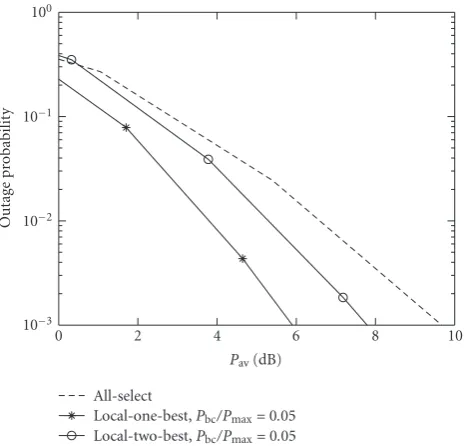
Results are shown in Figure 4when M = 32. Clearly, it can be seen that, as the number of nodes M increases,
0.5 0.4
0.3 0.2
0.1 0
Pbc/Pmax
Pav=3 dB
Pav=6 dB
10−3
10−2
10−1
100
Outage
pr
obabilit
y
Figure2: Outage probability as a function ofPbc/Pmaxfor the two-group scheme with the local-one-best strategy withM=16,L=2 (r=2 bps/Hz).
10 8
6 4
2 0
Pav(dB)
All-select
Local-one-best,Pbc/Pmax=0.1
Local-two-best,Pbc/Pmax=0.1
10−3
10−2
10−1
100
Outage
pr
obabilit
y
Figure3: Outage probability as a function of the total transmission power of the two stages,Pav, for the two-group scheme withM=16, L=2 (r=2 bps/Hz).
10 8
6 4
2 0
Pav(dB)
All-select
Local-one-best,Pbc/Pmax=0.05
Local-two-best,Pbc/Pmax=0.05
10−3
10−2
10−1
100
Outage
pr
obabilit
y
Figure4: Outage probability as a function of the total transmission power of the two stages,Pav, for the two-group scheme withM=32, L=2 (r=2 bps/Hz).
6. EXTENSION TO MULTIHOP NETWORK
There has been growing interest in applying Dis-STBC to a multihop wireless network to achieve cooperative diversity by using a virtual antenna array at each relaying hop [19–23]. In these works, it has been shown that this type of ST-coded cooperative routing has much better performance than tra-ditional node-by-node single-relay routing. However, just as for a two-stage network, in most of these works, for a mul-tihop network, the implementation of Dis-STBC at each re-laying hop requires a central control unit or full internode negotiations so that every selected relay knows which col-umn of the underlying STBC matrix to transmit. Obviously, this could require significant overhead. In this section, we will investigate applying decentralized Dis-STBC to a mul-tihop network. In particular, by extending the idea of the power-efficient relay-selection strategy in a two-stage net-work and also using m-group Dis-STBC as an example, a power-efficient routing strategy will be proposed for a multi-hop network that uses decentralized Dis-STBC at each relay-ing hop. In the multihop case, since each relay might have multiple local mean power gains to the multiple receiving nodes, some modification must be done when utilizing the local mean power gain information at relays.
In a decode-and-forward multihop network, since a suc-cessful end-to-end transmission requires the source message to be correctly decoded by some node(s) at each hop, the des-tination will be in outage if any one certain hop is in outage. Thus, the end-to-end outage performance is determined by the outage performance of each single hop. In particular, we consider aJ-hop (J >2) network. If we denote pout,nas the
outage probability at hopn(n = 0,. . .,J−1) andpout,das
the outage probability at the destination, then we have
pout,d=1− J−1
n=0
1−pout,n
≈ J−1
n=0
pout,n. (8)
In the decentralized scenario, it is difficult to obtain global channel information. Thus, it is desirable to design a hop-by-hop routing strategy which optimizepout,dby optimizing
pout,nfor everyn∈ {0,. . .,J−1}.
When designing a hop-by-hop routing strategy for a multihop network that uses selective decode-and-forward re-laying, the relay selection at each relaying hop is the key to the design. Since we could optimize the performance indepen-dently for each single hop, the power-efficient relay-selection strategy in a two-stage network can be naturally applied to each relaying hop with appropriate modification. Then, the power efficiency of the routing can be improved. Note that, in this paper, a routing strategy just means a path-selection strategy; it is not a real routing protocol.
6.1. Multihop network system model
We consider a J-hop (J > 2) network that uses a selec-tive decode-and-forward relaying strategy, as illustrated in Figure 5. The J−1 node setsS1,. . .,SJ−1 are located from the source to the destination. The source is denoted asS0and the destination is denoted asSJ. TheWnnodes in Sn(n =
1,. . .,J−1) are potential forwarding relays at relaying hop
n. Here, as an example, it is assumed that the node sets
Sn(n=1,. . .,J−1) are formulated through a
destination-initiated power-limited flooding. As in a two-stage network, we assume that the instantaneous channel between any two single-antenna half-duplex nodes captures the effects of path loss and flat Rayleigh fading. In addition, we assume perfect synchronization and a quasi-static environment. Finally, we assume that the receiving nodes at each hop can only utilize the transmission in the current hop to make a decision.
At relaying hopn(n = 1,. . .,J −1), the transmitting node set isSn; the decoded set withinSnis defined as the set
ofNn (Nn ≤Wn) decoded nodes that can correctly decode
the transmission from hopn−1. Note that the decoded sets are random, varying with the instantaneous channel gains. At relaying hopn(n=1,. . .,J−1),Kn(Kn≤Nn) decoded
nodes are selected to relay the source message. In particular, whenm-group Dis-STBC is used at each relaying hop, the number of distinct columns randomly selected by theNn
de-coded nodes inSn is denoted asVn (1 ≤ Vn ≤ L). Then,
denoteBn,v (v = 1,. . .,Vn) as the vth subset of the set of
Kn(Kn≤Nn) selected relays, andKn,vas the number of
re-lays inBn,v. The relays withinBn,vwill transmit thevth
col-umn out of theVnrandomly selected distinct columns.
6.2. Power-efficient hop-by-hop routing strategy
When m-group Dis-STBC is used, the all-select relay-selection strategy can be used at each relaying hop. In this case, at relaying hopn(n = 1,. . .,J−1), all Nn decoded
Hop 0 Hop 1
Source
Decoded set
S1
· · ·
Hopn Hopn+ 1
Decoded set
Sn
Decoded set
Sn+1
HopJ−1
Decoded set
Destination
SJ−1 · · ·
Figure5: AJ-hop selective decode-and-forward cooperative network.
message. We call this all-select routing. This routing strat-egy might result in a substantial waste of power, similar to the all-select relay-selection strategy in a two-stage network.
If the local-k-best (k≥1) relay-selection strategy is used at each relaying hop, a power-efficient hop-by-hop routing strategy might be formulated. However, in the multihop case, each relay inSn(n = 1,. . .,J−1) might have multiple
lo-cal mean power gains to the Wn+1 (Wn+1 ≥ 1) receiving nodes inSn+1. Thus, we cannot directly use the local-k-best
(k ≥ 1) relay selection. Intuitively, a good measurement of the channel power gain at each relay inSnis an average over
its local mean power gains to theWn+1 receiving nodes in
Sn+1. Here, we choose the geometric average and denote this
as thelocally averaged mean power gain to the next node set. Then, the local-k-best relay-selection strategy for a two-stage network can be simply modified by letting each decoded node inSn(n = 1,. . .,J−1) broadcast its locally averaged
mean power gain to Sn+1, instead of broadcasting its local mean power gain to the destination. By applying the mod-ified local-k-best (k ≥1) relay-selection strategy to each re-laying hop, a power-efficient hop-by-hop local-k-best rout-ing is formulated.
When using the local-k-best routing strategy, the achieved diversity gain at each relaying hop is the same as using the all-select routing strategy; however, less power is used to relay the source message. In addition, at relaying hop
n(n=1,. . .,J−1), since theKn(Vn≤Kn≤Nn) selected
re-lays have relatively larger locally averaged mean power gains to the receiving node set Sn+1, better performance will be achieved.
6.3. Performance analysis
Based on (8), the end-to-end outage performance pout,d is
determined by the outage probability at each hop. In this section, we illustrate the power-efficiency advantage of the local-k-best routing strategy by deriving an asymptotic up-per bound on the outage probability at relaying hopn(n=
1,. . .,J−1).
“Relaying hopnis in outage” means that all nodes within
Sn+1cannot correctly decode the source message forwarded by theKnselected relays withinSn. DenotePt as the
trans-mit power of each node. At relaying hopn(n=1,. . .,J−1), denoteμi,jas the mean value of the channel power gain from
the selected relayi in Snto node j inSn+1 (i = 1,. . .,Kn,
j = 1,. . .,Wn+1). Further, denote gmin,v as the minimum
value amongj∈Sn+1μi,j,i ∈Bn,v (v = 1,. . .,Vn). Next, an
asymptotic upper bound on pout,n(n= 1,. . .,J−1) is
ob-tained.
Theorem 3. Whenm-group Dis-STBC is used at relaying hop
n(n=1,. . .,J−1), for any given decoded set inSnand
par-ticular random column selection by theNndecoded nodes, an
asymptotic upper bound onpout,nis given by
pout,n≤ η VnWn+1
t /(Vn!)Wn+1
PVnWn+1
t ×gmin ,1× · · · ×gmin ,Vn
. (9)
This asymptotic upper bound is tight whenPWn+1
t gmin ,vis suffi
-ciently large for allv∈ {1,. . .,Vn}.
The proof ofTheorem 3can be done through the quite similar way used in the proof ofTheorem 1; thus, it is omit-ted for the sake of brevity.
With a given power consumption at relaying hopn, the asymptotic upper bound onpout,ncan be optimized by using
the local-k-best routing strategy when the values ofPbcand
k (k ≥ 1) are properly chosen such thatKn < Nn. This is
shown in the following theorem.
Theorem 4. With a given power consumptionPnfor the
trans-mission at relaying hopn(n = 1,. . .,J−1), whenm-group Dis-STBC is used at relaying hop n, the asymptotic upper bound onpout,nwhen using the local-k-best routing strategy is
smaller than or equal to that when using the all-select routing strategy.
The proof ofTheorem 4can be done through the quite similar way used in the proof ofTheorem 2; thus, it is omit-ted for the sake of brevity.
Sincepout,nfor eachn∈ {1,. . .,J−1}can be improved
by using the local-k-best routing strategy, based on (8), the end-to-end outage performancepout,dcan be improved.
6.4. Simulation results
routing strategies, including the local-k-best routing and all-select routing strategies.
As for a two-stage network, we consider a square cov-erage area with diagonal dimensiondmax andM uniformly distributed single-antenna half-duplex nodes. Thex- andy -coordinates of all nodes are i.i.d. uniformly distributed ran-dom variables on the interval [0,dmax/
√
2]. Denote dist{i,j}
as the distance between nodeiand node j. In simulations, when using destination-initiated power-limited flooding to form the node setsSn(n=1,. . .,J−1), we simply usedinthop to represent the reliable coverage range resulting from a lim-ited flooding power. For every particular geographic distri-bution of theMnodes, the node sets for a given (s,d) pair in aJ-hop (J >2) network are formulated as
SJ = {destination},
SJ−1=
i|dist{i, destination} ≤dinthop
,
SJ−2=
i|dist{i,j} ≤dinthop, j∈SJ−1,i ∈SJ∪SJ−1
,
. . . . Sn−1=
i|dist{i,j}≤dinthop, j∈Sn,i ∈SJ∪SJ−1∪· · ·∪Sn
,
. . . .
(10)
The processing stops when the source is found such that
S0= {source}. In simulations, for a given (s,d) pair, the ge-ographic distributions of all the otherM−2 potential relays are randomly generated and a large number of realizations are considered. Thus,Jis a dynamic value for a given (s,d) pair and particulardinthop. DefineJavas the average hop num-ber where the average is taken over all considered realizations of random geographic distributions.
In particular, we evaluate the end-to-end outage per-formance for the (s,d) pair with source = (0, 0.5dmax/
√
2) and destination = (dmax/
√
2, 0.5dmax/
√
2). It is assumed that the constant transmit powerPt is used for each node.
Thus, the total power to transmit one message overJhops is P = n=0∼J−1Pn, where Pn is the power consumption
at hop n(n = 0,. . .,J −1). For both routing strategies,
P0 =Pt. For the all-select routing strategy,Pn=NnPt (n=
1,. . .,J−1); for the local-k-best routing strategy, the power overhead resulting from broadcasting local information is in-cluded in the performance evaluation such thatPn=KnPt+
NnPbc (n = 1,. . .,J−1). Similar toSection 5.1, in aJ-hop (J > 2) network, the SNR threshold ηt is determined as
b×(2Jr−1) since theJ-hop cooperative transmission has a 1 :Jbandwidth penalty compared to the direct transmission. The powers are normalized byPmax. The definitions ofr,b, andPmaxare the same as inSection 5.1. The outage curves are plotted as a function of the normalized average power
Pav, which is the average consumed power perJ-hop trans-mission.
As in a two-stage network, here, we also use the param-eter ξ = Pbc/Pmax to investigate the effect of varying the broadcast powerPbcon the end-to-end outage performance. This is shown inFigure 6for the local-one-best routing when there areM=100 nodes in the network,dinthop/dmax=1/6, andL = 2 columns in the underlying STBC matrix of the
m-group Dis-STBC. It can be observed that a ratioξ in the
0.5 0.4
0.3 0.2
0.1 0
Pbc/Pmax
Pav=4 dB
Pav=7 dB
10−3
10−2
10−1
100
Outage
pr
obabilit
y
Figure 6: Outage probability as a function of Pbc/Pmax for the local-one-best routing using the two-group scheme withM=100, dinthop/dmax=1/6,Jav≈5.11,L=2 (r=2 bps/Hz).
interval [0.05, 0.1] achieves the optimal performance. Simi-larly,ξoptis in the interval [0.05, 0.1] for the local-two-best routing whenM = 100,dinthop/dmax = 1/6, andL = 2. In these simulations,Jav ≈ 5.11. Then, on average, the num-ber of the relaying node sets isJav−1. Thus, on average, the maximum possible number of the decoded nodes per relay-ing hop is (M−2)/(Jav−1). As an empirical result,ξopt is approximately equal to 1/[(M−2)/(Jav−1)].
According to the obtained range of values forξopt, with choosingPbc/Pmax=0.08 and using them-group Dis-STBC, the end-to-end outage performance of the local-k-best rout-ing is investigated when varyrout-ing k. Simulation results are shown in Figure 7for the local-k-best (k = 1, 2) routing and all-select routing whenM =100 nodes,dinthop/dmax = 1/6, andL = 2 using an Alamouti code. Clearly, it can be seen that, even with the overhead included, the local-one-best routing is much more power-efficient than the all-select routing. In particular, a 2.5 dB advantage can be observed at an outage probability of 10−2. As in a two-stage network us-ing local-k-best relay selection, the advantage of the local-k -best routing decreases with an increase ink.
7. CONCLUSIONS AND FUTURE WORKS
In this paper, for a two-stage network that uses selective decode-and-forward relaying, we presented a power-efficient relay-selection strategy for a particular decentralized Dis-STBC scheme (m-group). The power-efficiency advantage
of the proposed local-k-best (k ≥ 1) relay-selection strat-egy was illustrated through the outage analysis. Under re-alistic propagation conditions, including the effects of path loss and flat Rayleigh fading, we evaluated the outage perfor-mance of them-group scheme with different relay-selection
10 8
6 4
2 0
Pav(dB)
All-select routing
Local-one-best routing,Pbc/Pmax=0.08
Local-two-best routing,Pbc/Pmax=0.08
10−3
10−2
10−1
100
Outage
pr
obabilit
y
Figure7: Outage probability as a function of the total transmission power of theJhops,Pav, for the two-group scheme withM=100, dinthop/dmax=1/6,Jav≈5.11,L=2 (r=2 bps/Hz).
strategy is much more power-efficient even with the addi-tional power overhead included. In addition, by using the modified local-k-best relay-selection strategy at each relaying hop, a power-efficient hop-by-hop routing strategy was pro-posed for a multihop, selective, decode-and-forward network that uses them-group Dis-STBC at each relaying hop. Un-der realistic propagation conditions, the end-to-end outage performance was evaluated for different routing strategies. It was found that, when compared with the all-select rout-ing strategy, the local-k-best routing strategy is much more power-efficient even with the additional power overhead in-cluded. Although, in this paper, the local-k-best (k ≥ 1) relay-selection/routing strategies were presented by using the
m-group Dis-STBC as an example, these strategies can be naturally extended to other decentralized Dis-STBC schemes (such as the continuous randomized scheme [10]).
To implement the local-k-best strategies, the implemen-tation for all decoded nodes to broadcast local information is important. In a cooperative network with half-duplex lim-itation of nodes, since we try to implement the broadcastings of decoded nodes with incurring small overhead, the one-way control traffic is preferred. In addition, the local-k-best strategies would like to let the broadcasting by each decoded node reach all neighboring decoded nodes. Based on the con-siderations described above, when using a random access protocol to implement the broadcastings by all the decoded nodes, we would not like to utilize CSMA combined with the RTS/CTS mechanism. Instead, we currently consider us-ing a multichannel CSMA MAC protocol [12]. This protocol combines CSMA with CDMA, for example; it reduces the ef-fect of the hidden-node problem elegantly and is quite suit-able for the scenario where the broadcastings are intended to reach all neighbors. Of course, other approaches will also be
investigated. Furthermore, in the multihop case, the distri-bution for the local mean power gains of all interhop chan-nels might be another implementation issue worthy of con-cern. It is advisable to combine this information distribution into the process of forming and maintaining relay clusters (i.e., node sets defined in this paper). Besides the destination-initiated power-limited flooding scheme used for simulations in this paper, so many other proposed (distributed) cluster-ing schemes could be explored in further research. In the fu-ture, by paying more attention to these implementation is-sues, we will try to implement local-k-best strategies in prac-tical communication protocols for wireless cooperative net-works.
ACKNOWLEDGMENTS
This material is based on research sponsored by the Air Force Research Laboratory, under Agreement no. FA9550-06-1-0077. The US government is authorized to reproduce and distribute reprints for governmental purposes notwithstand-ing any copyright notation thereon.
REFERENCES
[1] J. N. Laneman, D. N. C. Tse, and G. W. Wornell, “Cooperative diversity in wireless networks: efficient protocols and outage behavior,”IEEE Transactions on Information Theory, vol. 50, no. 12, pp. 3062–3080, 2004.
[2] J. N. Laneman and G. W. Wornell, “Distributed space-time-coded protocols for exploiting cooperative diversity in wireless networks,”IEEE Transactions on Information Theory, vol. 49, no. 10, pp. 2415–2525, 2003.
[3] S. Barbarossa and G. Scutari, “Distributed space-time cod-ing for multihop networks,” inProceedings of the IEEE Inter-national Conference on Communications (ICC ’04), vol. 2, pp. 916–920, Paris, France, June 2004.
[4] S. Barbarossa and G. Scutari, “Distributed space-time coding for regenerative relay networks,”IEEE Transactions on Wireless Communications, vol. 4, no. 5, pp. 2387–2399, 2005.
[5] H. T. Cheng, H. Mheidat, M. Uysal, and T. M. Lok, “Dis-tributed space-time block coding with imperfect channel es-timation,” inProceedings of the IEEE International Conference on Communications (ICC ’05), vol. 1, pp. 583–587, Seoul, Ko-rea, May 2005.
[6] A. Stefanov and E. Erkip, “Cooperative space-time coding for wireless networks,”IEEE Transactions on Communications, vol. 53, no. 11, pp. 1804–1809, 2005.
[7] P. A. Anghel, G. Leus, and M. Kaveh, “Distributed space-time cooperative systems with regenerative relays,”IEEE Transac-tions on Wireless CommunicaTransac-tions, vol. 5, no. 11, pp. 3130– 3141, 2006.
[8] J. Mietzner and P. A. Hoeher, “Improving the performance of mobile broadcasting systems using multiple base stations and distributed space-time codes,”IET Communications, vol. 1, no. 3, pp. 348–353, 2007.
[10] B. Sirkeci-Mergen and A. Scaglione, “Randomized space-time coding for distributed cooperative communication,” IEEE Transactions on Signal Processing, vol. 55, no. 10, pp. 5003– 5017, 2007.
[11] L. Zhang, L. J. Cimini Jr., L. Dai, and X.-G. Xia, “Relaying strategies for cooperative networks with minimal node com-munications,” inProceedings of the Military Communications Conference (MILCOM ’06), pp. 1–7, Washington, DC, USA, October 2006.
[12] A. Nasipuri, J. Zhuang, and S. R. Das, “A multichannel CSMA MAC protocol for multihop wireless networks,” in Proceed-ings of Wireless Communications and Networking Conference (WCNC ’99), vol. 3, pp. 1402–1406, New Orleans, La, USA, September 1999.
[13] E. G. Larsson and P. Stoica,Space-Time Block Coding for Wire-less Communications, Cambridge University Press, Cambridge, UK, 2003.
[14] J. Luo, R. S. Blum, L. J. Cimini Jr., L. J. Greenstein, and A. Haimovich, “Power allocation in a transmit diversity system with mean channel gain information,”IEEE Communications Letters, vol. 9, no. 7, pp. 616–618, 2005.
[15] L. Zhang and L. J. Cimini Jr., “Efficient power allocation for decentralized distributed space-time block coding,” submitted toIEEE Transactions on Wireless Communications, 2007. [16] J. Luo, R. S. Blum, L. J. Cimini Jr., L. J. Greenstein, and A. M.
Haimovich, “New approaches for cooperative use of multiple antennas in ad hoc wireless networks,” inProceedings of the 60th IEEE Vehicular Technology Conference (VTC ’04), vol. 4, pp. 2769–2773, Los Angeles, Calif, USA, September 2004. [17] S. Catreux, P. F. Driessen, and L. J. Greenstein, “Data
through-puts using multiple-input multiple-output (MIMO) tech-niques in a noise-limited cellular environment,”IEEE Trans-actions on Wireless Communications, vol. 1, no. 2, pp. 226–235, 2002.
[18] S. M. Alamouti, “A simple transmit diversity technique for wireless communications,”IEEE Journal on Selected Areas in Communications, vol. 16, no. 8, pp. 1451–1458, 1998. [19] L. Liu and H. Ge, “Space-time coding for wireless sensor
net-works with cooperative routing diversity,” inProceedings of the 38th Asilomar Conference on Signals, Systems and Computers (ACSSC ’04), vol. 1, pp. 1271–1275, Pacific Grove, Calif, USA, November 2004.
[20] T. Miyano, H. Murata, and K. Araki, “Cooperative relaying scheme with space time code for multihop communications among single antenna terminals,” inProceedings of the IEEE Global Telecommunications Conference (GLOBECOM ’04), vol. 6, pp. 3763–3767, Dallas, Tex, USA, November-December 2004.
[21] T. Miyano, H. Murata, and K. Araki, “Space time coded co-operative relaying technique for multihop communications,” inProceedings of the 60th IEEE Vehicular Technology Confer-ence (VTC ’04), vol. 7, pp. 5140–5144, Los Angeles, Calif, USA, September 2004.
[22] T. Koike, M. Tanaka, and S. Yoshida, “System-level evalua-tion of STC cooperative relaying scheme in multihop IVC networks,” inProceedings of the 2nd IEEE VTS Asia Pacific Wireless Communications Symposium (APWCS ’05), pp. 60– 64, Hokkaido University, Japan, August 2005.