Cryptanalysis of a New Signal Security System
for Multimedia Data Transmission
Chengqing Li
Department of Mathematics, Zhejiang University, Hangzhou 310027, China Email:[email protected]
Shujun Li
Department of Electronic Engineering, City University of Hong Kong, Kowloon, Hong Kong Email:[email protected]
Guanrong Chen
Department of Electronic Engineering, City University of Hong Kong, Kowloon, Hong Kong Email:[email protected]
Gang Chen
Department of Mathematics, Zhejiang University, Hangzhou 310027, China Email:[email protected]
Lei Hu
State Key Laboratory of Information Security, Graduate School of Chinese Academy of Sciences, Beijing 100049, China Email:[email protected]
Received 23 August 2004; Revised 4 January 2005; Recommended for Publication by C. C. Jay Kuo
Recently, a new signal security system called TDCEA (two-dimensional circulation encryption algorithm) was proposed for real-time mulreal-timedia data transmission. This paper gives a comprehensive analysis on the security of TDCEA. The following security problems are found: (1) there exist some essential security defects in TDCEA; (2) two known-plaintext attacks can break TDCEA; (3) the chosen-plaintext and chosen-ciphertext versions of the aforementioned two known-plaintext attacks can break TDCEA even with a smaller complexity and a better performance. Some experiments are given to show the security defects of TDCEA and the feasibility of the proposed known-plaintext attacks. As a conclusion, TDCEA is not suitable for applications that require a high level of security.
Keywords and phrases:TDCEA, image encryption, chaos, cryptanalysis, known/chosen-plaintext attack, multimedia.
1. INTRODUCTION
In today’s digital world, the security of multimedia data, for example, digital speech, image and video files, becomes more and more important due to their frequent transmis-sion over open networks. In some real applications, such as pay-TV, medical imaging systems, military image/database communications, and confidential video conferences, highly secure and reliable storage and transmission of multime-dia data are needed. To fulfill such a demand, many en-cryption schemes have been proposed as possible solutions [1, 2, 3, 4, 5, 6, 7, 8, 9, 10, 11, 12, 13, 14]. Meanwhile, cryptanalysis work has also been developed, and some of the
proposed schemes have been found to be insecure [9,10,15, 16,17,18,19,20,21,22,23,24,25]. For a comprehensive survey of the state-of-the-art of image and video encryption, see [26].
TDCEA is more complicated than BRIE by using 2D per-mutations, this paper will point out that such a 2D general-ization cannot enhance the security of BRIE against known-/chosen-plaintext and chosen-ciphertext attacks. In addition, it will be shown that the security of TDCEA against brute-force attack was much overestimated in [1,2]. Essentially, TDCEA is a permutation-only image cipher, which has been known to be insecure against known-/chosen-plaintext at-tacks [15,16,23,25].
The rest of this paper is organized as follows. The next section briefly introduces TDCEA and its 1D version BRIE. Section 3discusses some general security defects of TDCEA. Two known-plaintext and chosen-plaintext attacks are given in Sections4and5, respectively, with some experimental re-sults for verification.Section 6briefly discusses the chosen-ciphertext attack, a natural and simple generalization of the chosen-plaintext attack.Section 7concludes the paper.
2. TDCEA
The basic idea used in TDCEA is secret bit rotations of every 64 consecutive bits (of 8 consecutive pixels), which are con-trolled by a chaotic pseudorandom binary sequence (PRBS). BRIE is the simplified version of TDCEA, by rotating only 8 bits in each pixel. To facilitate the description of TDCEA and BRIE, it is assumed that the plain image has sizeM×N, whereMis the height andNis the width of the image.
2.1. Definitions and notations
First, some definitions and notations are given in order to introduce TDCEA and BRIE. Assuming two matricesMand
Mof sizem×n, wheremis the height andnis the width, two mapping operations are defined as follows.
(i) The horizontal rotation mapping, RotateXip,r : M → M(0≤i≤m−1), is defined to circularly rotate the
ith row ofM, in the left (whenp=1) or right (when
p=0) direction, byrelements.
(ii) The vertical rotation mapping, RotateYjq,s : M → M (0≤ j≤n−1), is defined to circularly rotate thejth column ofM, in the up (whenq=1) or down (when
q=0) direction, byselements.
WhenMis a 1×nvector, the 1D version of the above 2D rotation mapping is denoted by ROLRqp : M → M, which is defined to circularly rotateMin the left (whenp =0) or right (whenp=1) direction, byqelements.
2.2. The 1D version of TDCEA-BRIE
Assuming the plain image is f =[f(x,y)]xM=−0,1,yN=−01and the
cipher image is f=[f(x,y)]xM=−0,1,yN=−01, BRIE is described as follows [3,4].
(i) The secret key: two integersα,β, and the initial condi-tionx(0)∈(0, 1) of the following chaotic logistic map:
x(k+ 1)=µ·x(k)·1−x(k). (1)
(ii) The initialization procedure: run the chaotic logis-tic map from x(0) to generate a chaotic sequence,
{x(k)}k(=MN0 +1)/8−1, whereadenotes the smallest in-teger that is not less thana. From the 8-bit binary rep-resentation ofx(k) as
x(k)= 7
i=0
b(8k+i)·2−i−1
=0.b(8k+ 0)b(8k+ 1)· · ·b(8k+ 7),
(2)
a PRBS is derived,{b(k)}MNk=0.
(iii) The encryption procedure : for the plain pixel f(x,y)= 7
i=0bi·2i, the corresponding cipher pixel f(x,y)= 7
i=0bi·2iis determined by the following equation: M=ROLRq
p(M), (3)
wherep=b(N·x+y),q=α+β·b(N·x+y+ 1), and
M,Mare two 1×8 bit matrices:M=[b7,b6,. . .,b0], M=[b
7,b6,. . .,b0].
(iv) The decryption procedureis denoted by
M=ROLRq1−p(M)=ROLR8p−q(M). (4) In [19], BRIE was successfully cryptanalyzed and the fol-lowing security problems were pointed out.
(1) The key space is too small and the security against the brute-force attack was much overestimated.
(2) There exist some essential defects, which makes it pos-sible for an attacker to get some visual information of the plain image by observing the cipher image. (3) BRIE is not secure against known-/chosen-plaintext
attacks, since only one known/chosen plain image is enough to get an equivalent key, a mask arrayQ =
[q(x,y)]xM=−0,1,yN=−01, whereq(x,y) satisfies
M=ROLRq(x,y) 0 (M), M=ROLRq1(x,y)(M)=ROLR
8−q(x,y) 0 (M).
(5)
(4) It is easy to get the subkeysα,βand the most signif-icant 8 bits of the chaotic statex(k), as a replacement of the subkeyx(0), from the mask array Qobtained above.
2.3. TDCEA
TDCEA [1,2] is an enhanced version of BRIE, by extending the bit rotation operations from one pixel to 8 consecutive pixels, and from two directions (left and right) to four direc-tions (left, right, up, and down).
TDCEA encrypts a plain image block by block, where each block contains 8 consecutive pixels. To simplify the fol-lowing description, without loss of generality, assume that
MN can be divided by 8. Consider the 2D plain image
{f(x,y)}M−1,N−1
(a) (b)
Figure1: A special test image, “test pattern,” encrypted by TDCEA. (a) The plain image. (b) The cipher image.
in raster order.1 Then, the plain image can be divided into MN/8 blocks:
f(8)(0),. . .,f(8)(k),. . .,f(8) MN
8 −1
, (6)
where
f(8)(k)= f(8k+ 0),. . .,f(8k+i),. . .,f(8k+ 7). (7)
Rewrite each block f(8)(k) as an 8×8 bit matrix M
k =
[Mk(i,j)]7,7i=0,j=0, by assigning the 64 bits in the current block in the raster order f(8k+i)=7j=0Mk(i,j)·2j. In the same
way, the 8 pixels of each block of the cipher image can be rep-resented by an 8×8 bit matrixMk=[Mk(i,j)]7,7i=0,j=0, where
f(8k+i)=7
j=0Mk(i,j)·2j. Based on the matrix
represen-tations of the plain/cipher images, the working mechanism of TDCEA can be described as follows.
(i) The secret key: two integersα,β, the initial condition
x(0), and the control parameterµof the logistic map (1), where 0< α <8, 0≤β <8 and 0< α+β <8. (ii) The initialization procedure: run the logistic map
starting from x(0) to generate a chaotic sequence,
{x(k)}MN/8−1
k=0 , and then extract the 17-bit
representa-tion ofx(k) to yield a PRBS, {b(i)}17MN/8−1
i=0 . In the
hardware implementation given in [1,2], the logistic map is realized in 17-bit fixed-point arithmetic. (iii) The encryption procedure.
Step (1). Horizontal rotations: fori=0∼7 (i.e., for each value ofifrom 0 to 7, the same hereinafter) do
M∗
k = RotateXip,r(Mk), where p = b(17k+i)
andr=α+β·b(17k+i+ 1).
Step (2). Vertical rotations: for j = 0 ∼ 7 do Mk =
RotateYjq,s(Mk∗), whereq =b(17k+ 8 +j) and
s=α+β·b(17k+ 9 +j).
(iv) The decryption procedureis a simple reversion of the above encryption procedure, as follows.
1Note that in [1,2] TDCEA is described directly for 1D signals. In this paper, we prefer to explicitly mention the transform from 2D images to 1D signals, so as to emphasize the relation between BRIE and TDCEA (which is not mentioned in [1,2]).
Step (1). Vertical rotations: for j = 0 ∼ 7 do M∗k = RotateYjq,s(Mk), whereq = 1−b(17k+ 8 +j) ands=α+β·b(17k+ 9 +j).
Step (2). Horizontal rotations: fori = 0 ∼ 7 doMk =
RotateXip,r(Mk∗), where p=1−b(17k+i) and
r=α+β·b(17k+i+ 1).
3. SOME SECURITY DEFECTS OF TDCEA
3.1. Essential defects of circulations
In [19], some essential defects of the ROLR operation were found: (1) some plain pixels may keep unchanged after en-cryption, so the plain image will roughly emerge if there are too many such pixels; (2) for a subregion in the plain im-age with a fixed gray value, at most eight gray values2will be
contained in the corresponding subregion of the cipher im-age, which will lead the edge of this subregion to appear in the cipher image. The second fact is also true for subregions with close pixel values.
Although TDCEA extends the shift operation to two di-mensions, the above defects of ROLR cannot be completely removed. As an extreme example, when all elements in Mk are 0-bits or 1-bits, it is obvious that Mk ≡ Mk, which
means TDCEA cannot encrypt blocks with fixed pixel value 0 (black) or 255 (white) at all. To test the performance of TDCEA compared with BRIE, we have encrypted the same test image used in [19] for BRIE, with the following pa-rameters: (α,β) = (2, 4), x(0) = 34816/217 ≈ 0.2656, µ = 128317/215 ≈ 3.9159. The encryption result is shown
in Figure 1, from which one can see that the 16 squares in the plain image remain fixed in the cipher image, though the fixed gray values have been changed for most squares. Com-paring this result with those given in [19, Figure 1], it is ob-vious that the security defects of BRIE are not enhanced by TDCEA.
As a second example to test the possible enhancement of TDCEA on the BRIE security, we also tested the encryp-tion performance of TDCEA on some general natural images
(a) (b)
(c) (d)
Figure 2: Two natural images, House and Cameraman, encrypted by TDCEA, with (α,β) = (5, 1), x(0) = 33578/217 ≈ 0.2562, and µ=129518/215≈3.9526. (a) House. (b) Encrypted House. (c) Cameraman. (d) Encrypted Cameraman.
containing many smooth areas. As known, the pixels within a smooth area generally have close pixel values, which are found similar to the squares with fixed gray values shown in Figure 1 when TDCEA is applied for encryption. Two im-ages, “House” and “Cameraman,” are selected for testing. The experimental results are shown inFigure 2, from which one can see many important edges of the plain images emerg-ing in the cipher images. In this experiment, the parameters of TDCEA are as follows: (α,β)=(5, 1),x(0)=33578/217≈
0.2562, andµ=129518/215≈3.9526.
3.2. Security problem ofα,β
In [1,2], the values ofαandβare constrained by 0< α <8, 0≤β <8, and 0< α+β <8. Thus, the number of all pos-sible values of (α,β) is 7 + 6 +· · ·+ 2 + 1 = 28. However, similar to the case of BRIE,αandβshould also obey the fol-lowing rule pointed out in [19]:α = 1, 7 orα+β = 1, 7. If this rule is not satisfied, then there only exist 1-bit circu-lar rotation operations, since RotateXip,1=RotateXip,7and RotateYqj,1 = RotateYjq,7. Generally speaking, 1-bit circu-lar rotations are not good enough to effectively encrypt the plain image, and some visual information may leak from the cipher image. When (α,β) = (1, 6), x(0) = 33578/217 ≈
0.2562, µ = 129518/215 ≈ 3.9526, the encryption results
of two plain images, House and Cameraman, are shown in Figure 3. It can be seen that the visual information contained in the cipher images is so much (even more than that in Figure 2) that the plain images can be obviously guessed. Ex-cluding the three values of (α,β) that violate the above rule, (1, 0), (1, 6), (7, 0), the number of all “good” values of (α,β) is only 25 (=28−3).
3.3. Low practical security against brute-force attacks
In [1, 2], it was claimed that the complexity of TDCEA against brute-force attack isO(217MN/8) since 17MN/8 secret
bits are used in the encryption/decryption procedures. How-ever, this statement is not true due to the following reason: all 17MN/8 bits are uniquely determined by the initial con-ditionx(0) and the control parameterµof the logistic map (1), which have only 34 secret bits. Moreover, not all values ofµcan ensure the chaoticity of the logistic map [27], so we can assure that the number of possible different chaotic bit sequences is smaller than 234.
Considering that the computational complexity of TD-CEA is O(MN), that is, 49MN operations of all kinds [1, Section 2.5], and the number of all possible values of (α,β) is 25, the total complexity against the brute-force attack is
O(234·25·49MN) ≈ O(244MN). For a typical image of
size 256×256, the complexity is about O(260), which is
much smaller thanO(217MN/8)=O(2139264), the complexity
claimed in [1,2]. Obviously, the security of TDCEA against brute-force attacks was overestimated too much in [1,2].
4. KNOWN-PLAINTEXT ATTACKS
(a) (b)
Figure3: Two natural images, House and Cameraman, encrypted by TDCEA, when (α,β) = (1, 6),x(0) = 33578/217 ≈ 0.2562, and µ=129518/215≈3.9526. (a) Encrypted House. (b) Encrypted Cameraman.
4.1. Known-plaintext attack 1: getting permutation matrices as an equivalent key
The insecurity of BRIE against known-/chosen-plaintext at-tacks is caused by the fact that the ROLR operation is ac-tually composed of secret permutations of all 8 bits of each pixel value. As shown in [25], all permutation-only ciphers are not secure against known-/chosen-plaintext attacks. Ap-parently, TDCEA falls into the category of permutation-only ciphers, since the circulation rotations are actually secret per-mutations of all 64 bits of each 8-pixel block. As a result, if an attacker knows (or chooses) a number of plain blocks and ci-pher blocks at the same position,k, it is possible for him to partially (or even completely) reconstruct the bit permuta-tion by comparingMkandMk. This is the basic principle of the first type of known-/chosen-plaintext attacks to be dis-cussed below.
Apparently, for the kth pixel block f(8)(k) and its
ci-pher block f(8)(k), the encryption transformation can
be represented by an 8 × 8 permutation matrix Wk =
[Wk(i,j)]7,7i=0,j=0, where Wk(i,j) = (i,j) denotes the
se-cret position of the plain bitMk(i,j) inMk. Since there are
MN/8 different blocks, the encryption of f can be repre-sented by MN/8 permutation matrices:{Wk}MN/8−1
k=0 . Once
the attacker gets theMN/8 permutation matrices and their inverses,{Wk−1}MN/k=08−1, he can use these matrices as an equiv-alent key to decrypt any cipher image encrypted with the same key.
In [25], a general algorithm was proposed for deriving the secret permutations (i.e., the permutation matrices) from a number of known plain images and their corresponding ci-pher images. This algorithm depends on the fact that the se-cret permutations do not change the values of the permuted elements. As a result, one can compare the values of the ele-ments of the plain images and the cipher images to reveal the secret permutations. Here, we show how to optimally realize the general algorithm for TDCEA and discuss the breaking performance.
Givennknown plain images f0 ∼ fn−1 and their
corre-sponding cipher images f0 ∼ fn−1, denoting thekth 8×8
bit matrix of thelth plain image and cipher image byMl,k=
[Ml,k(i,j)]7,7i=0,j=0,Ml,k = [Ml,k(i,j)]7,7i=0,j=0, respectively, the
algorithm of deriving the permutation matrix Wk is
de-scribed as follows.
(i) Step (1a). Calculate a generalized bit matrix Mk =
[Mk(i,j)]7,7i=0,j=0, whereMk(i,j)= n−1
l=0 Ml,k(i,j)·2l.
Apparently,Mk(i,j) is ann-bit integer.
Note. Whennis larger than the word length of the longest integer (which is 32 or 64 for most computers), it may be im-possible to storeMk(i,j) as a normal integer in a computer. In this case, one has to divideMk(i,j) into multiple short in-tegers for storage and computation (i.e., to use long-integer techniques). Since the long-integer technique is easy for im-plementations andnis generally smaller than 32 in most at-tacking scenarios,3 here we do not pay special attention to
this issue.
(ii) Step (1b). Calculate a generalized bit matrix Mk =
[Mk(i,j)]7,7i=0,j=0, in the same way as Step (1a).
(iii) Step (2).Get multivalued permutation matrix,Wk =
[Wk(i,j)]i7,7=0,j=0, whereWk(i,j)= {(i,j)|Mk(i,j)=
M
k(i,j)}.
(iv) Step (3).Derive an estimation of the permutation ma-trixWkfromWk.
Apparently, if and only if each element ofWk contains only one pixel position, that is, the measure of every element ofWkis 1, one can uniquely get the permutation matrixWk; otherwise, only an estimated versionWkcan be derived. In other words,Wk=Wkholds if and only if the cardinality of
Wk = {Wk(0, 0),. . .,Wk(7, 7)}is 64, that is, #(Wk) = 64. When #(Wk) = P < 64, with ni (i = 1 ∼ P) denoting the measure of thePdifferent elements inWk, one can eas-ily deduce that there are Pi=1(ni!) possible estimations of
Wk in total. Thus, the task of Step (3) is to determine one
estimated permutation matrix from all possible Pi=1(ni!). Although many different methods can be used to realize Step (3), the following simple algorithm is enough in most cases to achieve an acceptable performance.
(a) (b)
(c) (d)
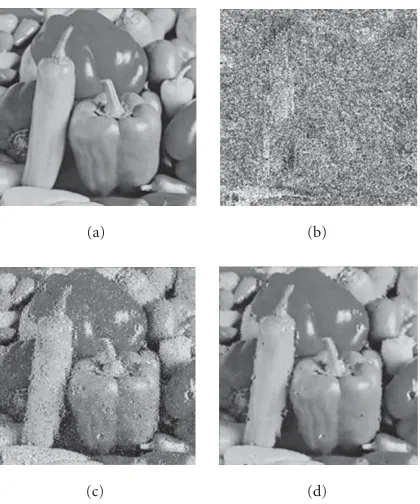
Figure4: The image Peppers recovered by the first known-plaintext attack. (a) Peppers. (b) Encrypted Peppers. (c) Recovered Peppers via {Wk}MN/8−1
k=0 . (d) Enhanced Peppers by a 3×3 median filter.
(i) Initialize all elements of an 8×8 flag matrix,Fk =
[Fk(i,j)]7,7i=0,j=0, to zeros.
(ii) Fori=0∼7 and j =0 ∼7, determine the value of
Wk(i,j) as follows:
(1) find the first position (i,j) satisfyingMk(i,j)=
M
k(i,j) andFk(i,j)=0;
(2) setWk(i,j)=(i,j) andFk(i,j)=1.
Note that Step (2) is also incorporated into the above algo-rithm, which is very useful in reducing the total complexity.
Next, we will see how many known plain images are enough to achieve an acceptable breaking performance. Roughly, the larger the n, the less thePi=1(ni!), the more accurate the estimated permutation matrixWk, and so the better the breaking performance will be. As a result, by esti-mating the mathematical expectation ofni, one can concep-tually derive a lower bound forn. To simplify the following analyses, we assume that each element inMl,kdistributes
uni-formly over{0, 1}and any two elements are independent of each other. Then, one can see that there are two types of ele-ments in eachWk(i,j):
(i) the only real position, which absolutely occurs; (ii) other fake positions, each of which occurs inWk(i,j)
with a probability of 1/2n, since any two bits in a bit matrix are identical with a probability of 1/2.
Thus, it follows that the average cardinality of Wk(i,j) is
ni=1+(64−1)/2n=1+63/2n, which approaches 1
exponen-tially asnincreases. Generally speaking, when 1+63/2n<1.5, that is, about half elements inWkare correct, the decryption
performance will be acceptable.4Solving this inequality, one
has
n≥1 +log263=1 +5.9773 =7. (8)
This theoretical result has been verified by experiments as shown in Figures4and5. Note that the above analysis can also be derived from the general result given in [25]. Though the above result is deduced under the assumption that{Ml,k}
is an i.i.d. sequence, it can be qualitatively generalized to other distributions of{Ml,k}. Our experiments show that the
above theoretical result essentially holds for most natural im-ages.
For a randomly selected key, (α,β) = (2, 2), x(0) =
33578/217 ≈ 0.2562, µ = 129518/215 ≈ 3.9526, a set of
known plain images (all natural images) are randomly se-lected for testing. When n = 8, the plain image “Peppers” (Figure 4a) and its cipher image (Figure 4b) are used to verify the breaking performance based onMN/8 estimated permu-tation matrices, {Wk}MN/k=08−1. The recovered plain image is
shown inFigure 4c. It is found that almost all visual informa-tion contained in the original plain image has been success-fully recovered, though only 38012/65536 = 58% of plain pixels are correct in value. With some noise reduction algo-rithms, one can further enhance the recovered plain image. One enhanced result with a 3×3 median filter is shown in Figure 4d.
1 0.9 0.8 0.7 0.6 0.5 0.4 0.3 0.2 0.1 0
1 4 8 12 16 20
Natural image Noise image
Pc
n0
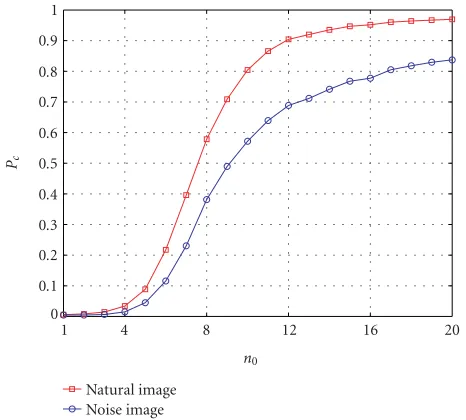
Figure5: The percentage of correctly recovered pixels,Pc, with re-spect to the number of known plain images,n0.
Figure 5 shows the percentage of correctly recovered plain pixels with respect to n, the number of known plain images. One can see that the breaking performance is good whenn≥8. Also, it is found that the breaking performance of the natural image is better than the noisy image under the same condition, which is attributed to the correlation exist-ing in the natural image for decryption as discussed in [25]. It can also be observed that the slope of the two lines inFigure 5 are very flat whenn≥16, this is also due to the correlation of the known images (e.g., the MSBs of adjacent pixels are the same with a high probability).
The complexity of this attack is rather small. For each block, the time complexity consumed in Step (1a) and Step (1b) is O(2·64·(n−1)), and the average complexity in Step (2) isO(64·32), so the total attack complexity is only
O((2·64·(n−1) + 64·32)·MN/8)=O(16(n+ 15)MN). This known-plaintext attack has two disadvantages: (1) the number of required known plain images is somewhat large; (2) withnknown plain images of sizeM×N, this at-tack can only decrypt cipher images of size not greater than
M×N. In the following subsection, we will introduce another known-plaintext attack, by which we can get the secret keys with only one known plain image (but with a larger complex-ity).
4.2. Known-plaintext attack 2: getting the secret key from one known plain image
The known-plaintext attack introduced in this subsection is actually an optimized brute-force attack. By utilizing the correlation information existing between two consecutive chaotic states and the control parameterµ, the multiplicative search of the two subkeysx(0) andµcan be reduced to be the additive search of two chaotic statesx(k) andx(k+ 1). This can dramatically reduce the attack complexity. Also, since
1020 1018 1016 1014 1012 1010 108 106 104 102 100
0 8 16 24 32 40 48 56 64
↑Ns=217×25
C
(
t
)
(t)
Figure6:C(t)=64!/(t!(64−t)!) with respect tot.
each guessed chaotic state can be verified by a few number of 8-pixel blocks, not by the whole known plain image, the attack complexity can be further reduced.
The basic idea of this attack is based on the following facts: (1) each permutation matrix Wk is uniquely deter-mined by the current chaotic statex(k) and the two subkeys
α,β; (2) two consecutive chaotic statesx(k) andx(k+ 1) sat-isfyx(k+ 1)≈µ·x(k)·(1−x(k)). Once an attacker gets the right values of any two consecutive chaotic states, he can im-mediately get an estimation ofµ, and then completely break TDCEA ifαandβare also known.
To get the right value of a chaotic statex(k) correspond-ing to thekth bit matrixMk, one can use the permutation information existing inMkandMk. When there aret0-bits and (64−t) 1-bits inMk, one can calculate that the number of all possible values ofMkisC(t)=64
t
=64!/t!(64−t)!. In comparison, the number of all possibilities of each permu-tation matrix is equal to the number of all possible values of the 3-tuple data (x(k),α,β), which is less thanNs=217·25.
When 5 ≤ t ≤59, one hasC(t) Ns(seeFigure 6). This
means that the probability that a wrong value of (x(k),α,β) coincides withWkis close to zero, that is, one can exhaus-tively search all possible values of (x(k),α,β) to find a few number of candidates of the right value. Apparently, such an exhaustive searching procedure is optimized when t =
32.
Carrying out the above procedure on two consecutive bit matrices, one can find some candidates of two consecutive chaotic states,x(k)=0.b(17k+ 0)· · ·b(17k+ 16) andx(k+ 1)=0.b(17k+ 17)· · ·b(17k+ 33). Then, an estimated value of the subkeyµcan be derived as
µ=x x(k+ 1)
(k)·1−x(k). (9)
soµ=µ. Fortunately, following the error analysis ofµgiven in [22, Appendix], it has been shown that whenx(k+ 1)≥ 2−n (n = 1 ∼ 17), |µ−µ| < 2n+3 ·2−17. For example,
when x(k+ 1) ≥ 2−1 = 0.5, one can exhaustively search
24 = 16 values in the neighborhood ofµto find the right
value of µ. To verify whether µ = µ, one can iterate the logistic map from x(k + 1) until x(MN/8−1) and then check the coincidence between each bit matrixMiandMi,
i =k+ 2,. . .,MN/8−1. Once a mismatch occurs, the cur-rent guessed value is discarded, and the next value is tested. To minimize the verification complexity, one can check only a number of chaotic states sufficiently far fromx(k+ 1) to eliminate most (if not all) wrong values of µ, and verify a few left ones by checking all chaotic states fromx(k+ 2) to
x(MN/8−1).
The proposed known-plaintext attack can be concretized step by step as follows.
(i) Step (1). Find the first two consecutive plain blocks
f(8)(k) and f(8)(k+ 1), whose corresponding bit
ma-tricesMkandMk+1both have about 32 0-bits. Note. Assuming that each bit in Mk distributes uniformly and independently, one can deduce that
Ps=Prob|t−32| ≤s=
32+s
i=32−s
64
i
264 , (10)
wheretis the number of nonzero elements ofMk and 0 ≤ s≤32. Whens=4,Ps≈0.7396, which is sufficiently large for an attacker to find valid plain-blocks within all theMN/8 blocks.
(ii) Step (2). Exhaustively search all possible values of (x(k),α,β) and record those coinciding withMk and
M
k. Assume thatm1candidates are recorded in total: {xi(k),α∗i,βi∗}mi=10−1.
(iii) Step (3).Search all possible values ofx(k+ 1) and all values of (α,β) in{α∗i,β∗i}m1−1
i=0 and record those
co-inciding withMk+1andMk+1. Assume thatm2
candi-dates are recorded in total:{xj(k+ 1),α∗∗j ,β∗∗j }m2−1
j=0 .
(iv) Step (4).Fori=0∼m1−1 and j=0∼m2−1, do
the following operations.
Step (4a).If α∗i = α∗∗
j andβ∗i = β∗∗j , then
cal-culate µ = xj(k+ 1)/xi(k)·(1−xi(k)) and con-tinue to execute Step (4b); otherwise, go to the next loop.
Step (4b).Assuming thatxj(k+ 1)≥2−n, exhaus-tively search all possible 2n+3values ofµwithin the
neighborhood ofµ. For each searched value, iter-ate the logistic map fromxi(k+1) toxi(MN/8−1). If every chaotic statexi(l) and (α∗i,β∗i) agree with
MlandMl(l=k+ 2∼MN/8−1), then the attack completes.
The time complexity of this attack can be calculated as follows.
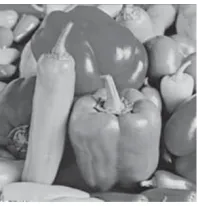
Figure7: The recovered plain image Peppers by the second known-plaintext attack.
(i) The average complexity of Step (2) is 217·25·(14·8 +
(1/2)·8·8)<229.
(ii) The complexity of Step (3) is obviously less than that of Step (2).
(iii) The average number of exhaustive searching loops in Step (4) is (m1·m2·Cx), where
Cx=
17
n=1
2n+3·Prob2−n≤x
j(k+ 1)<2−(n−1), (11)
which is the mathematical expectation of the space size of the searching neighborhood of µ. Consider-ing the computational complexity for each searchConsider-ing loop, the average complexity of Step (4) is of order (m1·m2·Cx/2)·49MN. Without loss of generality,
assume thatxj(k+1) distributes uniformly over the in-terval [0, 1], that is, Prob[2−n≤xj(k+ 1)<2−(n−1)]=
2−n. Thus,Cx=17
n=12n+3·2−n=23·17=136. Then,
the average complexity becomesO(833m1m2MN/2).
Since, in most cases,MN≤4096·4096=224andm 1, m2are generally very small, the complexity is generally
not greater thanO(236).
Combining the above results, one concludes that the total complexity isO(236), which is practically small even for a PC
and much smaller thanO(260), the complexity of the simple
brute-force attack shown inSection 3.3.
Figure 7shows an experimental result of the recovered plain image “Peppers,” where the fifth and sixth pixel blocks are chosen to exhaustively search the secret key. As a result, all chaotic states fromx(5) are successfully derived and only (5·8=40) leading plain pixels at the left-bottom corner are not recovered correctly.
5. CHOSEN-PLAINTEXT ATTACKS
5.1. Chosen-plaintext attack 1: getting permutation matrices as an equivalent key
As discussed inSection 4.1, if #(Wk)=64, the permutation
matrixWkcan be uniquely determined. Apparently, it is easy to ensure #(Wk) = 64 by choosing the following six plain
images for allk=0∼MN/8−1,i=0∼7,j=0∼7:
f0:M0,k(i,j)=
(8i+j)
32
mod 2;
f1:M1,k(i,j)=
(8i+j)
16
mod 2;
f2:M2,k(i,j)=
(8i+j)
8
mod 2;
f3:M3,k(i,j)=
(8i+j) 4
mod 2;
f4:M4,k(i,j)=
(8i+j) 2
mod 2;
f5:M5,k(i,j)=(8i+j) mod 2.
(12)
With the above six chosen plain images, #(Wk)=64 holds so allMN/8 permutation matrices can be uniquely determined, which can then be used to decrypt any cipher image of size not greater thanMN.
The time complexity of such an attack is of the same or-der as the known-plaintext attack withn = 6 known plain images, that is,O(16(6 + 15)MN)=O(336MN).
In fact, due to a special weakness of TDCEA, even two chosen plain images are enough to completely reconstruct each 8×8 permutation matrix. Recalling the encryption procedure of TDCEA, one can see that 2D secret rotations are merely a simple combination of 1D rotations in two di-rections: 8 horizontal rotations followed by 8 vertical rota-tions. Such a property makes the division of the 2D secret rotations possible in chosen-plaintext attacks with only two plain images. In cryptanalysis, we call such attacks divide-and-conquer (DAC) attacks. The DAC chosen-plaintext at-tack can be described as follows.
(i) Break the 8 vertical secret rotations. Choose a plain im-age f0as follows: for allk=0∼MN/8−1,f0(8)(k)= {255, 0, 0, 0, 0, 0, 0, 0}, that is,
M0,k=
1 1 1 1 1 1 1 1 0 0 0 0 0 0 0 0 0 0 0 0 0 0 0 0 0 0 0 0 0 0 0 0 0 0 0 0 0 0 0 0 0 0 0 0 0 0 0 0 0 0 0 0 0 0 0 0 0 0 0 0 0 0 0 0
. (13)
It is obvious that the 8 horizontal secret rotations have no influence on the above plain image. That is, the 2D TDCEA is reduced to the 1D BRIE in the verti-cal direction. Since each column ofM0,khas only one
1-bit, by comparingM0,k andM0,k one can uniquely
get 8 values,sk(j) (j = 0 ∼7), which satisfyM0,k =
RotateYj0,sk(j)(M0,k) and serves as the equivalent
rota-tion parameter of thejth column.
(ii) Break the 8 horizontal secret rotations. Choose a plain imagef1as follows: for allk=0∼MN/8−1,f1(8)(k)= {1, 1, 1, 1, 1, 1, 1, 1}, that is,
M1,k=
1 0 0 0 0 0 0 0 1 0 0 0 0 0 0 0 1 0 0 0 0 0 0 0 1 0 0 0 0 0 0 0 1 0 0 0 0 0 0 0 1 0 0 0 0 0 0 0 1 0 0 0 0 0 0 0 1 0 0 0 0 0 0 0
. (14)
Since the 8 vertical secret rotations have been obtained viaf0, one can remove all the 8 vertical rotations from M
1,k to get the intermediate bit matrix M1,∗k. Then,
by comparing M1,∗k and M1,k, one can similarly get
another 8 values,rk(i) (i = 0 ∼ 7), whereM∗1,k =
RotateX0,rk(i)
i (M1,k). Here,rk(0)∼rk(7) are the
equiv-alent rotation parameters of theith line.
Apparently, after revealing the horizontal and vertical se-cret rotations, the permutation matrixWk can be immedi-ately reconstructed by simply combining the 16 rotations. In this case, the time complexity is onlyO((4 + 1 + 4 + 8)MN)= O(17MN).
5.2. Chosen-plaintext attack 2: getting the secret key
In the first chosen-plaintext attack, one can get 16 values,
sk(0)∼sk(7) andrk(0)∼rk(7), for each pixel block f(8)(k).
Based on the 16 values, the second known-plaintext attack discussed in Section 4.2 can be dramatically enhanced in most cases by introducing a much more effective way of de-riving the 17 secret bits, b(17k+ 0) ∼ b(17k+ 16), of the chaotic statex(k).
To simplify the following discussions, create a new vector,
rsk(i) (i = 0 ∼ 15), which satisfies that for alli = 0 ∼ 7,
rsk(i)=rk(i) and for alli=8∼15,rsk(i)=sk(i−8).
Recalling the encryption procedure of TDCEA, it is ob-vious that the 16 values{rsk(i)}15
i=0have a deterministic
rela-tion with the 17 secret bitsb(17k+ 0)∼b(17k+ 16). Such a relation can be used to facilitate an exhaustive search of the 17 secret bits, that is, the search of thekth chaotic state
x(k)=0.b(17k+ 0)· · ·b(17k+ 16).
Considering the fact that RotateXi0,r = RotateXi1,8−r, RotateY0,js=RotateYj1,8−s, one can see that for alli=0∼
15, k = 0 ∼ MN/8−1,rsk(i) must be a value in the set S= {α,α+β, 8−α, 8−(α+β)}.
For each guessed value (α,β), one can determine 16 bits, denoted byb(17k+1)∼b(17k+16), as estimations ofb(17k+ 1)∼b(17k+ 16), as follows: for alli=1∼16,
b(17k+i)=
0, rsk(i−1)∈ α, 8−α,
Note that the above equation is invalid when α= α+βor
α=8−(α+β), that is,β=0 or 2α+β=8. Similarly, one has another equation for estimating the values ofb(17k+ 0) ∼ b(17k+ 15): for alli=0∼15,
b(17k+i)=
0, rsk(i)∈ {α,α+β} ,
1, rsk(i)∈ 8−α, 8−(α+β). (16)
The above equation is invalid whenα = 4,α+β = 4 or 2α+β=8.
According to how much information one can get from
{rsk(i)}15i=0, all values of (α,β) can be divided into the
follow-ing classes in the chosen-plaintext attack.
(C1) α = 4,α+β= 4,β = 0and2α+β = 8:b(17k+ 1)∼b(17k+ 16) andb(17k+ 0)∼b(17k+ 15) can be uniquely determined by (15) and (16), respectively, so all the 17 bits,b(17k+0)∼b(17k+16), can be uniquely recovered.
There are 12 (C1)-values of (α,β), as follows: (1, 1), (1, 2), (1, 4), (1, 5), (2, 1), (2, 3), (2, 5), (3, 3), (3, 4), (5, 1), (5, 2), (6, 1).
(C2) 4∈ {α,α+β} andβ=0(which ensures2α+β=8):
b(17k+ 1)∼b(17k+ 16) can be uniquely determined by (15), butb(17k+ 0) has to be guessed.5
There are 6 (C2)-values of (α,β), as follows: (1, 3), (2, 2), (3, 1), (4, 1), (4, 2), (4, 3).
(C3) α=4andβ=0(which ensures2α+β=8):b(17k+ 0)∼b(17k+ 15) can be uniquely determined by (16), butb(17k+ 16) has to be guessed.
There are 6 (C3)-values of (α,β), as follows: (1, 0), (2, 0), (3, 0), (5, 0), (6, 0), (7, 0).
(C4) 2α+β = 8: all the 17 bits has to be exhaustively guessed, as in the second known-plaintext attack dis-cussed inSection 4.2.
There are 4 (C4)-values of (α,β), as follows: (1, 6), (2, 4), (3, 2), (4, 0).
The above four different cases correspond to different values of #(S) as follows:
(i) #(S)=4: (α,β) is one of the 12(C1)-values; (ii) #(S)=3: (α,β) is one of the 6(C2)-values;
(iii) #(S) = 2: (α,β) is one of the 6(C3)-values and the following(C4)-values:{(1, 6), (2, 4), (3, 2)};
(iv) #(S)=1: (α,β)=(4, 0) (a(C4)-value).
5Note thatb(17k+ 0) can be uniquely determined in the following two subcases: (a) whenα=4 andb(17k+ 1)=1, one can uniquely determine
b(17k+ 0) by (16) sinceα+β=4; (b) whenα=4 andb(17k+ 1)=0, one can also uniquely determineb(17k+ 0) by (16). The two subcases occur with a probability of 0.5 when{b(i)}distributes uniformly over{0, 1}.
Since one can guess the value of #(S) by observing the car-dinality of the set {rsk(0),. . .,rsk(15)} ⊆ S, it is possi-ble to search (α,β) in part of all possible values to reduce the attack complexity. Apparently, the success probability of such a guess is Pe = Prob[S = {rsk(0),. . .,rsk(15)}].
Since the theoretical deduction of Pe is rather difficult, experiments are performed to test all 217 possible values
of b(17k + 0) ∼ b(17k + 16). It results in that Pe =
122684/217 ≈ 0.936, which is sufficiently large. Note that
it is easy to further increase the success probability of the guess, by observing n > 1 blocks at the same time. In doing so, the success probability will be greater than
P(n)
e =1−(1−Pe)nunder the assumption that the chaotic
bits for different blocks distribute uniformly and indepen-dently. As n increases, Pe(n) will approach 1 exponentially. In real attacks, even n = 2 is enough in almost all cases, since P(2)e ≈ 0.996. If all guessed values determined by #({rsk(0),. . .,rsk(15)}) fail to pass the verification, it means that the rare event{rsk(0),. . .,rsk(15)} ⊂ Soccurs.6In this
case, one has to continue to exhaustively search all other val-ues of (α,β).
When the real value of (α,β) belongs to(C1),(C2),(C3)
classes, the complexity of the chosen-plaintext attack will be much smaller than the complexity of its known-plaintext counterpart, due to the following reasons:
(i) the exhaustive searching procedure for the 17 bits of each chaotic state is simplified to be a determin-istic calculation procedure dominated by (15) and/or (16);
(ii) the number of guessed values of (α,β) is reduced from 28 to 12 for(C1), 6 for(C2)and(C3);
(iii) some values of (α,β) can be verified by checking whether or not{rsk(0),. . .,rsk(15)} ⊆ {α,α+β, 8−
α, 8−(α+β)};
(iv) one can intentionally choose the second chaotic state to ensurex(k+ 1)≥0.5, that is,b(17(k+ 1) + 0)=1, so as to reduceCx, the average searching complexity of
µ, from 136 to 21+3=16;
(v) the exhaustive search ofµcan be validated by just com-paring the calculated chaotic state with the bits derived by (15) and/or (16).
When the real value of (α,β) belongs to(C4)class, the aver-age complexity of the chosen-plaintext attack is also smaller than the one of its known-plaintext counterpart, since the value of (α,β) can be immediately determined7with a suffi
-ciently high probability,Pe(n)≈1, that is, only when the rare event{rsk(0),. . .,rsk(15)} ⊂Soccurs, one needs to exhaus-tively search the value of (α,β).
6Note that the occurrence probability is not zero, though it is very close to zero whennis sufficiently large.
6. CHOSEN-CIPHERTEXT ATTACKS
Chosen-ciphertext attacks are mirror versions of chosen-plaintext attacks, in which a cryptanalyst attempts to deter-mine the secret key from knowledge of plaintexts that cor-respond to ciphertexts chosen by the attacker [28]. For TD-CEA, due to the symmetry of the encryption and decryption procedures, one can carry out chosen-ciphertext attacks, in very much the same way as the chosen-plaintext attacks dis-cussed inSection 5.
7. CONCLUSIONS
In this paper, the security of the recently proposed encryp-tion scheme for multimedia transmission, called TDCEA [1, 2], has been analyzed carefully. Some defects existing in TDCEA have been found and diagnosed. Two methods of known-plaintext attacks and their chosen-plaintext at-tack counterparts have been proposed to break the scheme. In addition, a chosen-ciphertext attack has been mentioned briefly. Both theoretical and experimental analyses have been given to demonstrate the defects of TDCEA and to verify the feasibility of the proposed known-plaintext attacks. In con-clusion, TDCEA is not suggested for applications that require a high level of security level.
ACKNOWLEDGMENTS
This research was partially supported by the National Natu-ral Science Foundation, China, under Grants no. 60373041, no. 90104034, and no. 60202002, and by the Applied R&D Centers of the City University of Hong Kong under Grants no. 9410011 and no. 9620004.
REFERENCES
[1] H.-C. Chen, J.-I. Guo, L.-C. Huang, and J.-C. Yen, “Design and realization of a new signal security system for multime-dia data transmission,” EURASIP J. Appl. Signal Process., vol. 2003, no. 13, pp. 1291–1305, 2003.
[2] J.-C. Yen and J.-I. Guo, “Design of a new signal security system,” inProc. IEEE International Symposium on Circuits and Systems (ISCAS ’02), vol. 4, pp. 121–124, Scottsdale, Ariz, USA, May 2002.
[3] J.-C. Yen and J.-I. Guo, “A new image encryption algorithm and its VLSI architecture,” inProc. IEEE Workshop on Sig-nal Processing Systems (SiPS ’99), pp. 430–437, Taipei, Taiwan, October 1999.
[4] J.-C. Yen and J.-I. Guo, “A new MPEG/encryption system and its VLSI architecture,” inProc. International Symposium on Communications, pp. 215–219, Kaohsiung, Taiwan, Novem-ber 1999.
[5] K.-L. Chung and L.-C. Chang, “Large encrypting binary im-ages with higher security,”Pattern Recognition Letters, vol. 19, no. 5-6, pp. 461–468, 1998.
[6] N. Bourbakis and C. Alexopoulos, “Picture data encryption using scan patterns,” Pattern Recognition, vol. 25, no. 6, pp. 567–581, 1992.
[7] C. Alexopoulos, N. Bourbakis, and N. Ioannou, “Image en-cryption method using a class of fractals,” J. of Electronic Imaging, vol. 4, no. 3, pp. 251–259, 1995.
[8] L. Tang, “Methods for encrypting and decrypting MPEG video data efficiently,” inProc. 4th ACM International Con-ference on Multimedia, pp. 219–229, Boston, Mass, USA, November 1996.
[9] H. C. H. Cheng, “Partial encryption for image and video com-munication,” M.S. thesis, Department of Computing Science, University of Alberta, Edmonton, Alberta, Canada, 1998. [10] L. Qiao, Multimedia security and copyright protection, Ph.D
dissertation, Department of Computer Science, University of Illinois at Urbana-Champaign, Urbana, Ill, USA, 1998. [11] S. U. Shin, K. S. Sim, and K. H. Rhee, “A secrecy scheme
for MPEG video data using the joint of compression and en-cryption,” inProc. 2nd International Information Security Workshop (ISW ’99), vol. 1729 ofLecture Notes in Computer Science, pp. 191–201, Kuala Lumpur, Malaysia, November 1999.
[12] J.-C. Yeo and J.-I. Guo, “Efficient hierarchical chaotic im-age encryption algorithm and its VLSI realisation,” IEE Proceedings-Vision, Image and Signal Processing, vol. 147, no. 2, pp. 167–175, 2000.
[13] W. Zeng and S. Lei, “Efficient frequency domain selective scrambling of digital video,” IEEE Trans. Multimedia, vol. 5, no. 1, pp. 118–129, 2003.
[14] B. Bhargava, C. Shi, and S.-Y. Wang, “MPEG video encryption algorithms,”Multimedia Tools and Applications, vol. 24, no. 1, pp. 57–79, 2004.
[15] J.-K. Jan and Y.-M. Tseng, “On the security of image encryp-tion method,” Inform. Process. Lett., vol. 60, no. 5, pp. 261– 265, 1996.
[16] L. Qiao, K. Nahrstedt, and M.-C. Tam, “Is MPEG encryption by using random list instead of zigzag order secure?,” inProc. IEEE International Symposium on Consumer Electronics (ISCE ’97), pp. 226–229, Singapore, December 1997.
[17] L. Qiao and K. Narhstedt, “Comparison of MPEG encryption algorithms,” Comput. Graphics, vol. 22, no. 4, pp. 437–448, 1998.
[18] T. Uehara and R. Safavi-Naini, “Chosen DCT coefficients at-tack on MPEG encryption schemes,” inProc. IEEE Pacific Rim Conference on Multimedia (PCM ’00), pp. 316–319, Sydney, Australia, December 2000.
[19] S. Li and X. Zheng, “On the security of an image encryption method,” inProc. IEEE International Conference on Image Pro-cessing (ICIP ’00), vol. 2, pp. 925–928, Rochester, NY, USA, September 2002,http://www.hooklee.com/pub.html. [20] S. Li and X. Zheng, “Cryptanalysis of a chaotic image
encryp-tion method,” inProc. IEEE International Symposium on Cir-cuits and Systems (ISCAS ’02), vol. 2, pp. 708–711, Phoenix-Scottsdale, Ariz, USA, May 2002, http://www.hooklee.com/ pub.html.
[21] C.-C. Chang and T.-X. Yu, “Cryptanalysis of an encryption scheme for binary images,” Pattern Recognition Letters, vol. 23, no. 14, pp. 1847–1852, 2002.
[22] C. Li, S. Li, D. Zhang, and G. Chen, “Cryptanalysis of a chaotic neural network based multimedia encryption scheme,” in Ad-vances in Multimedia Information Processing, Proc. 5th Pacific Rim Conference on Multimedia (PCM ’04), part III, vol. 3333 ofLecture Notes in Computer Science, pp. 418–425, Springer, Tokyo, Japan, November-December 2004.
[23] X.-Y. Zhao, G. Chen, Zhang D., X.-H. Wang, and G.-C. Dong, “Decryption of pure-position permutation algorithms,” J. Zhejiang Univ. SCIENCE, vol. 5, no. 7, pp. 803–809, 2004. [24] S. Li, C. Li, G. Chen, and X. Mou, “Cryptanalysis of the
[25] S. Li, C. Li, G. Chen, D. Zhang, and N. G. Bourbakis, “A gen-eral cryptanalysis of permutation-only multimedia encryp-tion algorithms,” 2004, Cryptology ePrint Archive: Report 2004/374,http://eprint.iacr.org/2004/374.
[26] S. Li, G. Chen, and X. Zheng, “Chaos-based encryption for digital images and videos,” in Multimedia Security Hand-book, B. Furht and D. Kirovski, Eds., chapter 4, CRC Press, LLC, Boca Raton, Fla, USA, 2004, http://www.hooklee.com/ pub.html.
[27] H. Bai-Lin,Starting with Parabolas: An Introduction to Chaotic Dynamics, Shanghai Scientific and Technological Education Publishing House, Shanghai, China, 1993.
[28] B. Schneier, Applied Cryptography–Protocols, Algorithms, and Souce Code in C, John Wiley & Sons, New York, NY, USA, 2nd edition, 1996.
Chengqing Li received his B.S. degree in pure mathematics from the XiangTan Uni-versity, Xiangtan, Hunan, China, in 2002. He is currently pursuing his M.S. degree in Zhejiang University, Hangzhou, Zhejiang, China. His current research interests in-clude image/video encryption, image pro-cessing, and watermarking.
Shujun Lireceived his B.S. degree in in-formation science and engineering, and his Ph.D. degree in information and commu-nication engineering, both from the Xi’an Jiaotong University, Xi’an, China, in 1997 and 2003, respectively. Currently he is a Se-nior Research Assistant with the Center for Chaos Control and Synchronization, City University of Hong Kong, Hong Kong. His current research interests are in the fields of
chaotic encryption, image and video encryption, statistical aspects of digital chaotic systems, secure human-computer identification, and visual/graphical passwords.
Guanrong Chen received the M.S. degree in computer science from Zhongshan Uni-versity, China and the Ph.D. degree in ap-plied mathematics from Texas A&M Uni-versity, USA. Currently he is a Chair Profes-sor and the Founding Director of the Centre for Chaos Control and Synchronization at the City University of Hong Kong. He has been a Fellow of the IEEE since 1996 for his fundamental contributions to the theory
and applications of chaos control and bifurcation analysis. Profes-sor Chen has (co)authored 15 research monographs and advanced textbooks, more than 300 SCI journal papers, and about 200 ref-ereed conference papers, published since 1981 in the fields of non-linear system dynamics and controls. He is serving as an Editor for 8 international journals including IEEE Transactions on Circuits and Systems, IEEE Transactions on Automatic Control, and Inter-national Journal of Bifurcation and Chaos, and received three best journal paper awards. He is an Honorary Professor of the Central Queensland University, Australia, and of more than ten Universities in China.
Gang Chen received his Bachelor of Sci-ence degree from Anqing Teachers College in 1983 and his Ph.D. degree from the De-partment of Applied Mathematics, Zhejiang University in 1994. Between 1994 and 1996, he was a Postdoctoral Researcher in elec-trical engineering at Zhejiang University. From 1997 to 1999, he worked as a Visiting Researcher in the Institute of Mathematics at the Chinese University of Hong Kong and
the Department of Electronic and Information Engineering at The Hong Kong Polytechnic University. Since 2001, he has been a Pro-fessor at Zhejiang University. He has been the Director of the Insti-tute of DSP and Software Techniques at Ningbo University since 2002. His research interests include applied mathematics, image processing, fractal geometry, wavelet analysis, and computer graph-ics. Dr. Chen has coauthored three books and coedited five techni-cal proceedings. He has published more than 80 technitechni-cal papers.