The Best Lexical Metric for
Phrase-Based Statistical MT System Optimization
Daniel Cer, Christopher D. Manning and Daniel Jurafsky
Stanford University Stanford, CA 94305, USA
Abstract
Translation systems are generally trained to optimize BLEU, but many alternative metrics are available. We explore how optimizing toward various automatic evaluation metrics (BLEU, METEOR, NIST, TER) affects the re-sulting model. We train a state-of-the-art MT system using MERT on many parameteriza-tions of each metric and evaluate the result-ing models on the other metrics and also us-ing human judges. In accordance with popular wisdom, we find that it’s important to train on the same metric used in testing. However, we also find that training to a newer metric is only useful to the extent that the MT model’s struc-ture and feastruc-tures allow it to take advantage of the metric. Contrasting with TER’s good cor-relation with human judgments, we show that people tend to prefer BLEU and NIST trained models to those trained on edit distance based metrics like TER or WER. Human prefer-ences for METEOR trained models varies de-pending on the source language. Since using BLEU or NIST produces models that are more robust to evaluation by other metrics and per-form well in human judgments, we conclude they are still the best choice for training.
1 Introduction
Since their introduction, automated measures of ma-chine translation quality have played a critical role in the development and evolution of SMT systems. While such metrics were initially intended for eval-uation, popular training methods such as minimum error rate training (MERT) (Och, 2003) and mar-gin infused relaxed algorithm (MIRA) (Crammer
and Singer, 2003; Watanabe et al., 2007; Chiang et al., 2008) train translation models toward a specific evaluation metric. This makes the quality of the re-sulting model dependent on how accurately the au-tomatic metric actually reflects human preferences.
The most popular metric for both comparing sys-tems and tuning MT models has been BLEU. While BLEU (Papineni et al., 2002) is relatively simple, scoring translations according to theirn-gram over-lap with reference translations, it still achieves a rea-sonable correlation with human judgments of trans-lation quality. It is also robust enough to use for au-tomatic optimization. However, BLEU does have a number of shortcomings. It doesn’t penalizen-gram scrambling (Callison-Burch et al., 2006), and since it isn’t aware of synonymous words or phrases, it can inappropriately penalize translations that use them.
Recently, there have been efforts to develop bet-ter evaluation metrics. Metrics such asTranslation
Edit Rate(TER) (Snover et al., 2006; Snover et al.,
2009) and METEOR1(Lavie and Denkowski, 2009) perform a more sophisticated analysis of the trans-lations being evaluated and the scores they produce tend to achieve a better correlation with human judg-ments than those produced by BLEU (Snover et al., 2009; Lavie and Denkowski, 2009; Przybocki et al., 2008; Snover et al., 2006).
Their better correlations suggest that we might obtain higher quality translations by making use of these new metrics when training our models. We ex-pect that training on a specific metric will produce the best performing model according to that
met-1
METEOR: Metric for Evaluation of Translation with Ex-plicit ORdering.
ric. Doing better on metrics that better reflect human judgments seems to imply the translations produced by the model would be preferred by human judges.
However, there are four potential problems. First, some metrics could be susceptible to systematic ex-ploitation by the training algorithm and result in model translations that have a high score according to the evaluation metric but that are of low qual-ity.2 Second, other metrics may result in objective functions that are harder to optimize. Third, some may result in better generalization performance at test time by not encouraging overfitting of the train-ing data. Finally, as a practical concern, metrics used for training cannot be too slow.
In this paper, we systematically explore these four issues for the most popular metrics available to the MT community. We examine how well models per-form both on the metrics on which they were trained and on the other alternative metrics. Multiple mod-els are trained using each metric in order to deter-mine the stability of the resulting models. Select models are scored by human judges in order to deter-mine how performance differences obtained by tun-ing to different automated metrics relates to actual human preferences.
The next sections introduce the metrics and our training procedure. We follow with two sets of core results, machine evaluation in section 5, and human evaluation in section 6.
2 Evaluation Metrics
Designing good automated metrics for evaluating machine translations is challenging due to the vari-ety of acceptable translations for each foreign sen-tence. Popular metrics produce scores primarily based on matching sequences of words in the system translation to those in one or more reference trans-lations. The metrics primarily differ in how they ac-count for reorderings and synonyms.
2.1 BLEU
BLEU (Papineni et al., 2002) uses the percentage ofn-grams found in machine translations that also occur in the reference translations. These n-gram precisions are calculated separately for different
n-2
For example, BLEU computed without the brevity penalty would likely result in models that have a strong preference for generating pathologically short translations.
gram lengths and then combined using a geometric mean. The score is then scaled by a brevity penalty if the candidate translations are shorter than the ref-erences, BP = min(1.0, e1−len(R)/len(T)). Equa-tion 1 gives BLEU usingn-grams up to lengthN for a corpus of candidate translations T and reference translationsR. A variant of BLEU called the NIST metric (Doddington, 2002) weightsn-gram matches by how informative they are.
BLEU:N =
N Y
n=1
n-grams(TT R)
n-grams(T)
!N1
BP (1)
While easy to compute, BLEU has a number of shortcomings. Since the order of matchingn-grams is ignored,n-grams in a translation can be randomly rearranged around non-matching material or other n-gram breaks without harming the score. BLEU also does not explicitly check whether information is missing from the candidate translations, as it only examines what fraction of candidate translation n-grams are in the references and not what fraction of references n-grams are in the candidates (i.e., BLEU ignores n-gram recall). Finally, the metric does not account for words and phrases that have similar meanings.
2.2 METEOR
into to allow them to be rearranged with no crossing alignments,Pβ,γ= 1−γ matcheschunks
β .
Fα=
P R
αP + (1−α)R (2)
METEORα,β,γ =Fα·Pβ,γ (3)
Equation 3 gives the final METEOR score as the product of the unigram harmonic mean,Fα, and the fragmentation penalty,Pβ,γ. The free parametersα, β, and γ can be used to tune the metric to human judgments on a specific language and variation of the evaluation task (e.g., ranking candidate transla-tions vs. reproducing judgments of translatransla-tions ade-quacy and fluency).
2.3 Translation Edit Rate
TER (Snover et al., 2006) searches for the shortest sequence of edit operations needed to turn a can-didate translation into one of the reference transla-tions. The allowable edits are the insertion, dele-tion, and substitution of individual words and swaps of adjacent sequences of words. The swap opera-tion differentiates TER from the simpler word error rate (WER) metric (Nießen et al., 2000), which only makes use of insertions, deletions, and substitutions. Swaps prevent phrase reorderings from being exces-sively penalized. Once the shortest sequence of op-erations is found,3 TER is calculated simply as the number of required edits divided by the reference translation length, or average reference translation length when multiple are available (4).
TER = min edits
avg ref length (4)
TER-Plus (TERp) (Snover et al., 2009) extends TER by allowing the cost of edit operations to be tuned in order to maximize the metric’s agreement with human judgments. TERp also introduces three new edit opertions: word stem matches, WordNet synonym matches, and multiword matches using a table of scored paraphrases.
3
Since swaps prevent TER from being calculated exactly us-ing dynamic programmus-ing, a beam search is used and this can overestimate the number of required edits.
3 MERT
MERT is the standard technique for obtaining a ma-chine translation model fit to a specific evaluation metric (Och, 2003). Learning such a model cannot be done using gradient methods since the value of the objective function only depends on the transla-tion model’sargmax for each sentence in the tun-ing set. Typically, this optimization is performed as a series of line searches that examines the value of the evaluation metric at critical points where a new translationargmaxbecomes preferred by the model. Since the model score assigned to each candidate translation varies linearly with changes to the model parameters, it is possible to efficiently find the global minimum along any given search direction with only O(n2)operations whenn-best lists are used.
Using our implementation of MERT that allows for pluggable optimization metrics, we tune mod-els to BLEU:N for N = 1. . .5, TER, two con-figurations of TERp, WER, several concon-figurations of METEOR, as well as additive combinations of these metrics. The TERp configurations include the default configuration of TERp and TERpA: the configuration of TERp that was trained to match human judgments for NIST Metrics MATR (Matthew Snover and Schwartz, 2008; Przybocki et al., 2008). For METEOR, we used the standard ME-TEOR English parameters (α = 0.8, β = 2.5, γ = 0.4), and the English parameters for the ranking ME-TEOR (α = 0.95, β = 0.5, γ = 0.5),4 which was tuned to maximize the metric’s correlation with WMT-07 human ranking judgements (Agarwal and Lavie, 2008). The default METEOR parameters fa-vor longer translations than the other metrics, since highαvalues place much more weight on unigram recall than precision. Since this may put models tuned to METEOR at a disadvantage when being evaluated by the other metrics, we also use a variant of the standard English model and of ranking ME-TEOR withα set to0.5, as this weights both recall and precision equally.
For each iteration of MERT, 20 random restarts were used in addition to the best performing point discovered during earlier iterations of training.5
4
Agarwal and Lavie (2008) reportγ = 0.45, however the 0.8.2 release of METEOR usesγ= 0.5for ranking English.
5
Since MERT is known to be sensitive to what restart points are provided, we use the same series of ran-dom restart points for each model. During each it-eration of MERT, the random seed is based on the MERT iteration number. Thus, while a different set of random points is selected during each MERT iter-ation, on any given iteration all models use the same set of points. This prevents models from doing better or worse just because they received different starting points. However, it is still possible that certain ran-dom starting points are better for some evaluation metrics than others.
4 Experiments
Experiments were run using Phrasal (Cer et al., 2010), a left-to-right beam search decoder that achieves a matching BLEU score to Moses (Koehn et al., 2007) on a variety of data sets. During de-coding we made use of a stack size of 100, set the distortion limit to 6, and retrieved 20 translation op-tions for each unique source phrase.
Using the selected metrics, we train both Chi-nese to English and Arabic to English models.6 The Chinese to English models are trained using NIST MT02 and evaluated on NIST MT03. The Arabic to English experiments use NIST MT06 for train-ing and GALE dev07 for evaluation. The resulttrain-ing models are scored using all of the standalone metrics used during training.
4.1 Arabic to English
Our Arabic to English system was based on a well ranking 2009 NIST submission (Galley et al., 2009). The phrase table was extracted using all of the al-lowed resources for the constrained Arabic to En-glish track. Word alignment was performed using the Berkeley cross-EM aligner (Liang et al., 2006). Phrases were extracted using the grow heuristic (Koehn et al., 2003). However, we threw away all phrases that have aP(e|f)<0.0001in order to re-duce the size of the phrase table. From the aligned data, we also extracted a hierarchical reordering model that is similar to popular lexical reordering models (Koehn et al., 2007) but that models swaps containing more than just one phrase (Galley and
returned during an earlier iteration of MERT. 6
Given the amount of time required to train a TERpA model, we only present TERpA results for Chinese to English.
Manning, 2008). A 5-gram language model was cre-ated with the SRI language modeling toolkit (Stol-cke, 2002) using all of the English material from the parallel data employed to train the phrase table as well as Xinhua Chinese English Parallel News (LDC2002E18).7The resulting decoding model has 16 features that are optimized during MERT.
4.2 Chinese to English
For our Chinese to English system, our phrase ta-ble was built using 1,140,693 sentence pairs sam-pled from the GALE Y2 training data. The Chinese sentences were word segmented using the 2008 ver-sion of Stanford Chinese Word Segmenter (Chang et al., 2008; Tseng et al., 2005). Phrases were extracted by running GIZA++ (Och and Ney, 2003) in both directions and then merging the alignments using the grow-diag-final heuristic (Koehn et al., 2003). From the merged alignments we also extracted a bidirectional lexical reordering model conditioned on the source and the target phrases (Koehn et al., 2007). A 5-gram language model was created with the SRI language modeling toolkit (Stolcke, 2002) and trained using the Gigaword corpus and English sentences from the parallel data. The resulting de-coding model has 14 features to be trained.
5 Results
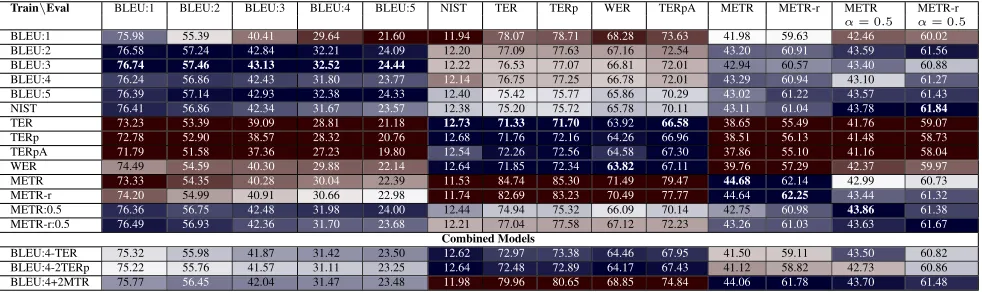
As seen in tables 1 and 2, the evaluation metric we use during training has a substantial impact on per-formance as measured by the various other metrics. There is a clear block structure where the best class of metrics to train on is the same class that is used during evaluation. Within this block structure, we make three primary observations. First, the best performing model according to any specific metric
configurationis usually not the model we trained to
that configuration. In the Chinese results, the model trained on BLEU:3 scores 0.74 points higher on BLEU:4 than the model actually trained to BLEU:4. In fact, the BLEU:3 trained model outperforms all other models on BLEU:N metrics. For the Arabic results, training on NIST scores 0.27 points higher
Train\Eval BLEU:1 BLEU:2 BLEU:3 BLEU:4 BLEU:5 NIST TER TERp WER TERpA METR METR-r METR METR-r α= 0.5 α= 0.5 BLEU:1 75.98 55.39 40.41 29.64 21.60 11.94 78.07 78.71 68.28 73.63 41.98 59.63 42.46 60.02
BLEU:2 76.58 57.24 42.84 32.21 24.09 12.20 77.09 77.63 67.16 72.54 43.20 60.91 43.59 61.56
BLEU:3 76.74 57.46 43.13 32.52 24.44 12.22 76.53 77.07 66.81 72.01 42.94 60.57 43.40 60.88 BLEU:4 76.24 56.86 42.43 31.80 23.77 12.14 76.75 77.25 66.78 72.01 43.29 60.94 43.10 61.27
BLEU:5 76.39 57.14 42.93 32.38 24.33 12.40 75.42 75.77 65.86 70.29 43.02 61.22 43.57 61.43
NIST 76.41 56.86 42.34 31.67 23.57 12.38 75.20 75.72 65.78 70.11 43.11 61.04 43.78 61.84
TER 73.23 53.39 39.09 28.81 21.18 12.73 71.33 71.70 63.92 66.58 38.65 55.49 41.76 59.07
TERp 72.78 52.90 38.57 28.32 20.76 12.68 71.76 72.16 64.26 66.96 38.51 56.13 41.48 58.73
TERpA 71.79 51.58 37.36 27.23 19.80 12.54 72.26 72.56 64.58 67.30 37.86 55.10 41.16 58.04
WER 74.49 54.59 40.30 29.88 22.14 12.64 71.85 72.34 63.82 67.11 39.76 57.29 42.37 59.97
METR 73.33 54.35 40.28 30.04 22.39 11.53 84.74 85.30 71.49 79.47 44.68 62.14 42.99 60.73 METR-r 74.20 54.99 40.91 30.66 22.98 11.74 82.69 83.23 70.49 77.77 44.64 62.25 43.44 61.32
METR:0.5 76.36 56.75 42.48 31.98 24.00 12.44 74.94 75.32 66.09 70.14 42.75 60.98 43.86 61.38
METR-r:0.5 76.49 56.93 42.36 31.70 23.68 12.21 77.04 77.58 67.12 72.23 43.26 61.03 43.63 61.67
Combined Models
[image:5.612.66.557.60.206.2]BLEU:4-TER 75.32 55.98 41.87 31.42 23.50 12.62 72.97 73.38 64.46 67.95 41.50 59.11 43.50 60.82 BLEU:4-2TERp 75.22 55.76 41.57 31.11 23.25 12.64 72.48 72.89 64.17 67.43 41.12 58.82 42.73 60.86 BLEU:4+2MTR 75.77 56.45 42.04 31.47 23.48 11.98 79.96 80.65 68.85 74.84 44.06 61.78 43.70 61.48
Table 1: Chinese to English test set performance on MT03 using models trained using MERT on MT02. In each column, cells shaded blue are better than average and those shaded red are below average. The intensity of the shading indicates the degree of deviation from average. For BLEU, NIST, and METEOR, higher is better. For edit distance metrics like TER and WER, lower is better.
Train\Eval BLEU:1 BLEU:2 BLEU:3 BLEU:4 BLEU:5 NIST TER TERp WER METR METR-r METR METR-r α= 0.5 α= 0.5 BLEU:1 79.90 65.35 54.08 45.14 37.81 10.68 46.19 61.04 49.98 49.74 67.79 49.19 68.12 BLEU:2 80.03 65.84 54.70 45.80 38.47 10.75 45.74 60.63 49.24 50.02 68.00 49.71 68.27
BLEU:3 79.87 65.71 54.59 45.67 38.34 10.72 45.86 60.80 49.18 49.87 68.32 49.61 67.67
BLEU:4 80.39 66.14 54.99 46.05 38.70 10.82 45.25 59.83 48.69 49.65 68.13 49.66 67.92 BLEU:5 79.97 65.77 54.64 45.76 38.44 10.75 45.66 60.55 49.11 49.89 68.33 49.64 68.19 NIST 80.41 66.27 55.22 46.32 38.98 10.96 44.11 57.92 47.74 48.88 67.85 49.88 68.52
TER 79.69 65.52 54.44 45.55 38.23 10.75 43.36 56.12 47.11 47.90 66.49 49.55 68.12 TERp 79.27 65.11 54.13 45.35 38.12 10.75 43.36 55.92 47.14 47.83 66.34 49.43 67.94 WER 79.42 65.28 54.30 45.51 38.27 10.78 43.44 56.13 47.13 47.82 66.33 49.38 67.88 METR 75.52 60.94 49.84 41.17 34.12 9.93 52.81 70.08 55.72 50.92 68.55 48.47 66.89
METR-r 77.42 62.91 51.67 42.81 35.61 10.24 49.87 66.26 53.17 50.95 69.29 49.29 67.89 METR:0.5 79.69 65.14 53.94 45.03 37.72 10.72 45.80 60.44 49.34 49.78 68.31 49.23 67.72
METR-r:0.5 79.76 65.12 53.82 44.88 37.57 10.67 46.53 61.55 50.17 49.66 68.57 49.58 68.25
Combined Models
BLEU:4-TER 80.37 66.31 55.27 46.36 39.00 10.96 43.94 57.46 47.46 49.00 67.10 49.85 68.41
BLEU:4-2TERp 79.65 65.53 54.54 45.75 38.48 10.80 43.42 56.16 47.15 47.90 65.93 49.09 67.90 BLEU:4+2METR 79.43 64.97 53.75 44.87 37.58 10.63 46.74 62.03 50.35 50.42 68.92 49.70 68.37
Table 2: Arabic to English test set performance on dev07 using models trained using MERT on MT06. As above, in each column, cells shaded blue are better than average and those shaded red are below average. The intensity of the shading indicates the degree of deviation from average.
on BLEU:4 than training on BLEU:4, and outper-forms all other models on BLEU:N metrics.
Second, the edit distance based metrics (WER, TER, TERp, TERpA)8 seem to be nearly inter-changeable. While the introduction of swaps al-lows the scores produced by the TER metrics to achieve better correlation with human judgments, our models are apparently unable to exploit this dur-ing traindur-ing. This maybe due to the monotone
na-8
In our implementation of multi-reference WER, we use the length of the references that result in the lowest sentence level WER to divide the edit costs. In contrast, TER divides by the average reference length. This difference can sometimes result in WER being lower than the corresponding TER. Also, as can be seen in the Arabic to English results, TERp scores sometimes differ dramatically from TER scores due to normalization and tokenization differences (e.g., TERp removes punctuation prior to scoring, while TER does not).
ture of the reference translations and the fact that having multiple references reduces the need for re-orderings. However, it is possible that differences between training to WER and TER would become more apparent using models that allow for longer distance reorderings or that do a better job of cap-turing what reorderings are acceptable.
Third, with the exception of BLEU:1, the perfor-mance of the BLEU, NIST, and the METEORα=.5
[image:5.612.65.531.267.411.2]on other edit distance based metrics, while perform-ing poorly on all the other metrics except NIST. While less pronounced, the same trend is also seen in the Arabic data. Interestingly enough, while the TER, TERp and standard METEOR metrics achieve good correlations with human judgments, models trained to them are particularly mismatched in our results. The edit distance models do terribly on ME-TEOR and MEME-TEOR ranking, while MEME-TEOR and METEOR ranking models do poorly on TER, TERp, and TERpA.
Training Itr MERT Training Itr MERT
Metric Time Metric Time
BLEU:1 13 21:57 NIST 15 78:15
BLEU:2 15 32:40 TER 7 21:00
BLEU:3 19 45:08 TERp 9 19:19
BLEU:4 10 24:13 TERpA 8 393:16
BLEU:5 16 46:12 WER 13 33:53
BL:4-TR 9 21:07 BL:4-2TRp 8 22:03
METR 12 39:16 METR 0.5 18 42:04
[image:6.612.74.295.219.330.2]METR R 12 47:19 METR R:0.5 13 25:44
Table 3: Chinese to English MERT iterations and training times, given in hours:mins and excluding decoder time.
5.1 Other Results
On the training data, we see a similar block struc-ture within the results, but there is a different pattern among the top performers. The tables are omitted, but we observe that, for Chinese, the BLEU:5 model performs best on the training data according to all higher order BLEU metrics (4-7). On Arabic, the BLEU:6 model does best on the same higher order BLEU metrics (4-7). By rewarding higher order n-gram matches, these objectives actually find minima that result in more 4-gram matches than the mod-els optimized directly to BLEU:4. However, the fact that this performance advantage disappears on the evaluation data suggests these higher order models also promote overfitting.
Models trained on additive metric blends tend to smooth out performance differences between the classes of metrics they contain. As expected, weighting the metrics used in the additive blends re-sults in models that perform slightly better on the type of metric with the highest weight.
Table 3 reports training times for select Chinese to English models. Training to TERpA is very com-putationally expensive due to the implementation of
the paraphrase table. The TER family of metrics tends to converge in fewer MERT iterations than those trained on other metrics such as BLEU, ME-TEOR or even WER. This suggests that the learning objective provided by these metrics is either easier to optimize or they more easily trap the search in local minima.
5.2 Model Variance
One potential problem with interpreting the results above is that learning with MERT is generally as-sumed to be noisy, with different runs of the al-gorithm possibly producing very different models. We explore to what extent the results just presented were affected by noise in the training procedure. We perform multiple training runs using select evalua-tion metrics and examining how consistent the re-sulting models are. This also allows us to deter-mine whether the metric used as a learning criteria influences the stability of learning. For these experi-ments, Chinese to English models are trained 5 times using a different series of random starting points. As before, 20 random restarts were used during each MERT iteration.
In table 4, models trained to BLEU and METEOR are relatively stable, with the METEOR:0.5 trained models being the most stable. The edit distance models, WER and TERp, vary more across train-ing runs, but still do not exceed the interesttrain-ing cross metric differences seen in table 1. The instability of WER and TERp, with TERp models having a stan-dard deviation of 1.3 in TERp and 2.5 in BLEU:4, make them risky metrics to use for training.
6 Human Evaluation
pro-Train\Evalσ BLEU:1 BLEU:3 BLEU:4 BLEU:5 TERp WER METEOR METEOR:0.5
BLEU:1 0.17 0.56 0.59 0.59 0.36 0.58 0.42 0.24
BLEU:3 0.38 0.41 0.38 0.32 0.70 0.49 0.44 0.33
BLEU:4 0.27 0.29 0.29 0.27 0.67 0.50 0.41 0.29
BLEU:5 0.17 0.14 0.19 0.21 0.67 0.75 0.34 0.17
TERp 1.38 2.66 2.53 2.20 1.31 1.39 1.95 1.82
WER 0.62 1.37 1.37 1.25 1.31 1.21 1.10 1.01
METEOR 0.80 0.56 0.48 0.44 3.71 2.69 0.69 1.10
[image:7.612.73.546.60.182.2]METEOR:0.5 0.32 0.11 0.09 0.11 0.23 0.12 0.07 0.11
Table 4: MERT model variation for Chinese to English. We train five models to each metric listed above. The collection of models trained to a given metric is then evaluated using the other metrics. We report the resulting standard devation for the collection on each of the metrics. The collection with the lowest varience is bolded.
Model Pair % Preferred p-value
Chinese
METR Rvs. TERp 60.0 0.0028
BLEU:4vs. TERp 57.5 0.02
NIST vs. TERp 55.0 0.089
NIST vs. TERpA 55.0 0.089
BLEU:4 vs. TERpA 54.5 0.11
BLEU:4 vs. METR R 54.5 0.11 METR:0.5 vs. METR 54.5 0.11 METR:0.5 vs. METR R 53.0 0.22
METR vs. BLEU:4 52.5 0.26
BLEU:4 vs. METR:0.5 52.5 0.26
METR vs. TERp 52.0 0.31
NIST vs. BLEU:4 52.0 0.31
BLEU:4 vs. METR R:0.5 51.5 0.36
WER vs. TERp 51.5 0.36
TERpA vs. TERp 50.5 0.47
Arabic
BLEU:4vs. METR R 62.0 <0.001
NIST vs. TERp 56.0 0.052
BLEU:4 vs. METR:0.5 55.5 0.069
BLEU:4 vs. METR 54.5 0.11
METR R:0.5 vs METR R 54.0 0.14
NIST vs. BLEU:4 51.5 0.36
WER vs. TERp 51.5 0.36
METR:0.5 vs METR 51.5 0.36
TERp vs. BLEU:4 51.0 0.42
BLEU:4 vs. METR R:0.5 50.5 0.47
Table 5: Select pairwise preference for models trained to different evaluation metrics. For A vs. B,preferred indi-cates how often A was preferred to B. We bold the better training metric for statistically significant differences.
duced by experts by having multiple workers com-plete each HIT and then combining their answers (Snow et al., 2008; Callison-Burch, 2009).
We perform a pairwise comparison of the trans-lations produced for the first 200 sentences of our Chinese to English test data (MT03) and our Arabic to English test data (dev07). The HITs consist of a pair of machine translated sentences and a single hu-man generated reference translation. The reference is chosen at random from those available for each sentence. Capitalization of the translated sentences is restored using an HMM based truecaser (Lita et al., 2003). Turkers are instructed to “. . . select the machine translation generated sentence that is eas-iest to read and best conveys what is stated in the reference”. Differences between the two machine translations are emphasized by being underlined and bold faced.9 The resulting HITs are made available only to workers in the United States, as pilot experi-ments indicated this results in more consistent pref-erence judgments. Three prefpref-erence judgments are obtained for each pair of translations and are com-bined using weighted majority vote.
As shown in table 5, in many cases the quality of the translations produced by models trained to dif-ferent metrics is remarkably similar. Training to the simpler edit distance metric WER produces transla-tions that are as good as those from models tuned to the similar but more advanced TERp metric that al-lows for swaps. Similarly, training to TERpA, which makes use of both a paraphrase table and edit costs
9
[image:7.612.72.279.291.596.2]tuned to human judgments, is no better than TERp. For the Chinese to English results, there is a sta-tistically significant human preference for transla-tions that are produced by training to BLEU:4 and a marginally significant preferences for training to NIST over the default configuration of TERp. This contrasts sharply with earlier work showing that TER and TERp correlate better with human judge-ments than BLEU (Snover et al., 2009; Przybocki et al., 2008; Snover et al., 2006). While it is as-sumed that, by using MERT, “improved evaluation measures lead directly to improved machine trans-lation quality” (Och, 2003), these results show im-proved correlations with human judgments arenot alwayssufficient to establish that tuning to a metric will result in higher quality translations. In the Ara-bic results, we see a similar pattern where NIST is preferred to TERp, again with marginal signficance. Strangely, however, there is no real difference be-tween TERp vs. BLEU:4.
For Arabic, training to ranking METEOR is worse than BLEU:4, with the differences being very sig-nificant. The Arabic results also trend toward sug-gesting that BLEU:4 is better than either standard METEOR and METEOR α 0.5. However, for the Chinese models, training to standard METEOR and METEOR α 0.5 is about as good as training to BLEU:4. In both the Chinese and Arabic results, the METEORα0.5 models are at least as good as those trained to standard METEOR and METEOR rank-ing. In contrast to the cross evaluation metric results, where the differences between theα0.5 models and the standard METEOR models were always fairly dramatic, the human preferences suggest there is of-ten not much of a difference in the true quality of the translations produced by these models.
7 Conclusion
Training to different evaluation metrics follows the expected pattern whereby models perform best on the same type of metric used to train them. How-ever, models trained using then-gram based metrics, BLEU and NIST, are more robust to being evaluated using the other metrics.
Edit distance models tend to do poorly when eval-uated on other metrics, as do models trained using METEOR. However, training models to METEOR can be made more robust by settingαto 0.5, which
balances the importance the metric assigns to preci-sion and recall.
The fact that the WER, TER and TERp models perform very similarly suggests that current phrase-based translation systems lack either the features or the model structure to take advantage of swap edit operations. The situation might be improved by us-ing a model that does a better job of both captur-ing the structure of the source and target sentences and their allowable reorderings, such as a syntac-tic tree-to-string system that uses contextually rich rewrite rules (Galley et al., 2006), or by making use of larger more fine grained feature sets (Chiang et al., 2009) that allow for better discrimination be-tween hypotheses.
Human results indicate that edit distance trained models such as WER and TERp tend to pro-duce lower quality translations than BLEU or NIST trained models. Tuning to METEOR works reason-ably well for Chinese, but is not a good choice for Arabic. We suspect that the newer RYPT metric (Zaidan and Callison-Burch, 2009), which directly makes use of human adequacy judgements of sub-strings, would obtain better human results than the automated metrics presented here. However, like other metrics, we expect performance gains still will be sensitive to how the mechanics of the metric inter-act with the structure and feature set of the decoding model being used.
BLEU and NIST’s strong showing in both the ma-chine and human evaluation results indicates that they are still the best general choice for training model parameters. We emphasize that improved metric correlations with human judgments do not imply that models trained to a metric will result in higher quality translations. We hope future work on developing new evaluation metrics will explicitly explore the translation quality of models trained to them.
Acknowledgements
References
Abhaya Agarwal and Alon Lavie. 2008. METEOR, M-BLEU and M-TER: Evaluation metrics for high-correlation with human rankings of machine transla-tion output. InStatMT workshop at ACL.
Chris Callison-Burch, Miles Osborne, and Philipp Koehn. 2006. Re-evaluating the role of BLEU in ma-chine translation research. InEACL.
Chris Callison-Burch. 2009. Fast, cheap, and creative: Evaluating translation quality using Amazon’s Me-chanical Turk. InEMNLP.
Daniel Cer, Michel Galley, Christopher D. Manning, and Dan Jurafsky. 2010. Phrasal: A statistical machine translation toolkit for exploring new model features. InNAACL.
Pi-Chuan Chang, Michel Galley, and Christopher D. Manning. 2008. Optimizing chinese word segmen-tation for machine translation performance. InStatMT workshop at ACL.
David Chiang, Yuval Marton, and Philip Resnik. 2008. Online large-margin training of syntactic and struc-tural translation features. InEMNLP.
David Chiang, Kevin Knight, and Wei Wang. 2009. 11,001 new features for statistical machine translation. InNAACL.
Koby Crammer and Yoram Singer. 2003. Ultraconserva-tive online algorithms for multiclass problems. JMLR, 3:951–991.
George Doddington. 2002. Automatic evaluation of ma-chine translation quality using n-gram co-occurrence statistics. InHLT.
Michel Galley and Christopher D. Manning. 2008. A simple and effective hierarchical phrase reordering model. InEMNLP.
Michel Galley, Jonathan Graehl, Kevin Knight, Daniel Marcu, Steve DeNeefe, Wei Wang, and Ignacio Thayer. 2006. Scalable inference and training of context-rich syntactic translation models. InACL.
Michel Galley, Spence Green, Daniel Cer, Pi-Chuan Chang, and Christopher D. Manning. 2009. Stanford university’s arabic-to-english statistical machine trans-lation system for the 2009 NIST evaluation. InNIST Open Machine Translation Evaluation Meeting.
Philipp Koehn, Franz Josef Och, and Daniel Marcu. 2003. Statistical phrase-based translation. InNAACL. Philipp Koehn, Hieu Hoang, Alexandra Birch, Chris Callison-Burch, Marcello Federico, Nicola Bertoldi, Brooke Cowan, Wade Shen, Christine Moran, Richard Zens, Chris Dyer, Ondrej Bojar, Alexandra Con-stantin, and Evan Herbst. 2007. Moses: Open source toolkit for statistical machine translation. InACL.
Alon Lavie and Michael J. Denkowski. 2009. The METEOR metric for automatic evaluation of machine translation.Machine Translation, 23.
Percy Liang, Ben Taskar, and Dan Klein. 2006. Align-ment by agreeAlign-ment. InNAACL.
Lucian Vlad Lita, Abe Ittycheriah, Salim Roukos, and Nanda Kambhatla. 2003. tRuEcasIng. InACL. Bonnie Dorr Matthew Snover, Nitin Madnani and
Richard Schwartz. 2008. TERp system description. InMetricsMATR workshop at AMTA.
Sonja Nießen, Franz Josef Och, and Hermann Ney. 2000. An evaluation tool for machine translation: Fast eval-uation for MT research. InLREC.
Franz Josef Och and Hermann Ney. 2003. A system-atic comparison of various statistical alignment mod-els. Computational Linguistics, 29(1):19–51.
Franz Josef Och. 2003. Minimum error rate training in statistical machine translation. InACL.
Kishore Papineni, Salim Roukos, Todd Ward, and Wei-Jing Zhu. 2002. BLEU: a method for automatic eval-uation of machine translation. InACL.
M. Przybocki, K. Peterson, and S. Bronsart. 2008. Official results of the “Metrics for MAchine TRans-lation” Challenge (MetricsMATR08). Techni-cal report, NIST, http://nist.gov/speech/
tests/metricsmatr/2008/results/.
Matthew Snover, Bonnie Dorr, Richard Schwartz, Lin-nea Micciulla, and John Makhoul. 2006. A study of translation edit rate with targeted human annotation. InAMTA.
Matthew Snover, Nitin Madnani, Bonnie J. Dorr, and Richard Schwartz. 2009. Fluency, adequacy, or HTER?: exploring different human judgments with a tunable MT metric. InStatMT workshop at EACL). Rion Snow, Brendan O’Connor, Daniel Jurafsky, and
An-drew Ng. 2008. Cheap and fast – but is it good? Eval-uating non-expert annotations for natural language tasks. InEMNLP.
Andreas Stolcke. 2002. SRILM – an extensible language modeling toolkit. InICSLP.
Huihsin Tseng, Pichuan Chang, Galen Andrew, Daniel Jurafsky, and Christopher D. Manning. 2005. A con-ditional random field word segmenter. InSIGHAN. Taro Watanabe, Jun Suzuki, Hajime Tsukada, and Hideki
Isozaki. 2007. Online large-margin training for statis-tical machine translation. InEMNLP-CoNLL. Omar F. Zaidan and Chris Callison-Burch. 2009.