Improving PP Attachment Disambiguation
in a Rule-based Parser
Yoon-Hyung Roha, Ki-Young Leea, and Young-Gil Kima a
Natural Language Processing Research Team, Electronics and Telecommunications Research Institute, 161 Gajeong-dong, Yuseong-gu, Daejeon, 305-350, Korea
{yhroh, leeky, kimyk}@etri.re.kr
Abstract. This paper deals with how to enhance the performance of a rule-based parser using statistical Information. PP (Prepositional Phrase) attachment ambiguity is one of the main ambiguities found in parsing. We therefore conducted some experiments on extracting statistical information for PP attachment from a corpus, and on applying such information to a rule-based parser. Two types of information are used: supervised learning data and unsupervised learning data. In this paper, we show how we apply these types of information and to what degree they contribute to the PP attachment as well as to the overall parsing performance. The final results show a 5.42% performance improvement in PP attachment, with an 8.7% error reduction ratio in the overall parsing performance.
Keywords: PP attachment, rule-based parsing, syntactic ambiguity, statistical information, lexical dependency
The work reported in this paper was supported by the IT R&D program of MKE, “Development of Machine Translation Technology for Korean/Chinese/English Spoken Language and Business Documents”.
Copyright 2011 by Yoon-Hyung Roh, Ki-Young Lee and Young-Gil Kim
1
Introduction
For a rule-based parser using CFG as its grammar, syntactic ambiguity is a challenging problem as it becomes more difficult to resolve conflicts between rules as the number of rules increases. Certain methods to solve this problem have been suggested, and have generally introduced statistical approaches (Sagae and Lavie, 2003; Foth and Menzel, 2006).
Many recent parsing technologies have also taken statistical approaches, as we can get more linguistic data, such as the Penn Treebank (Collins, 1999; Collins, 2000; Charniak, 2000). These technologies have shown encouraging performances. But practically speaking, statistical parsing has efficiency and scalability problems. As a statistical parser generally uses a significant number of parameters, and the search space is large, the parsing speed is relatively low and is not adequate for a real-time application. In our previous research, we conducted some experiments on applying statistical information to a rule-based parser (Roh, 2009). The parsing performance was affected mainly in the attachment performance and by the attachment information. Therefore, we do not need to apply full statistical information.
The scalability problem indicates the difficulty in incorporating other types of knowledge for use in parsing. Usually, a practical parser uses various types of additional knowledge for parsing, such as lexical patterns or semantic patterns. However, it is not easy to incorporate other knowledge into a parsing system based on probability. It is also difficult to tune the parser minutely with respect to each sentence. Thus, we want to use a rule-based parser as a base parsing system, and selective statistical information for ambiguity resolution.
prohibiting implausible syntactic structures and prioritizing the rules. These parsing rules are initially extracted from the Brown Corpus in the Penn Treebank. Not only have the syntactic tags and bracketing style been modified, but the rules have also been revised and enlarged in the course of extending the target domain of the parser. Our parser shows a competitive performance in rule-based parsing. However, the parsing performance remains at a standstill, and we now need to resolve syntactic ambiguity for additional improvements in performance.
In the next section, we briefly introduce a PP attachment task, and in sections 3 and 4, we present ways to apply supervised learning data and unsupervised learning data for a PP attachment, respectively. In section 5, we show a method for applying two types of data. Finally, we conclude this paper with several remarks on our future work.
2
PP attachment Disambiguation
PP attachment disambiguation is a task used to determine which site a PP is attached to while parsing. There have been many researches regarding PP attachment disambiguation (Ratnaparkhi, 1998; Stetina and Nagao, 1997; Olteanuand and Moldovan, 2005; Foth and Menzel, 2006). The main issues are mainly concerned with data extraction, learning methods, disambiguation models, and the treatment of the data sparseness problem.
Most of them simplify the problem into selecting an attachment site between a noun and a verb. However, in real parsing, the situation is more complicated. There can be more attachment sites, and the impact of a PP attachment on the other part has to be considered.
A few researchers have dealt with multiple PP attachments (Merlo, 1997; Bharati, 2005). Foth and Menzel (2006) presented a more comprehensive disambiguation method using Lexical Attraction, which is a type of mutual information.
We solve this problem by simply giving an attachment weight to the existing chart weight. We focus on how we can calculate the attachment weight when a PP is attached to some other constituent.
3
Supervised Learning
In conducting supervised learning, we consider a PP attachment task as a process of full syntactic analysis, and we use the statistical model typically used in statistical parsing.
There are two different probabilistic models depending on how the probability is conditioned. One is a bilexical model (Collins, 1996), which is a kind of discriminative model,
and the other is a generative model (Collins, 1999). In the bilexical model, given two words wi
and wh, the probability that wi is dependent on wh is expressed as follows.
)
,
|
(
D
w
iw
hP
, (1)where D represents a dependency relation between wi and wj.
In the generative model, given a head, wh, the probability that a dependent wi will be
generated is expressed as follows.
)
|
(
w
iw
hP
(2)3.1
Generative Model
The state of the art model in statistical parsing is the generative model (Collins, 2000; Charniak, 2000). Therefore, we first consider this model in our analysis. The generative probability that
the i-th dependent (child) di is dependent on head child h in a chart generated in chart parsing is
expressed as follows.
))
(
),
(
),
(
|
)
(
),
(
(
)
|
(
d
h
P
t
d
l
d
t
h
l
h
dist
i
P
i
i i , (3)where t(x) represents the tag of x, l(x) represents the lexical root of x, and dist(i) represents
(NP (PRP$ his) (NN! attention) ) (PP (TO! to)
(NP (DT the) (NN! matter) ))) (. .) ))
For example, from the parse tree below, “President/NNP Bush/NNP called/VBD his/PRP$ attention/NN to/TO the/DT matter/NN” is extracted.
Conduct word/tag normalization, where the words are stemmed, and those tagged with
“CD, NNP” are replaced by their tags, while the tags are replaced by their parent tags: (Bush/NNP called/VBD!) => (NNP/NNP called/VBD!)
Count all the events of word pairs with the distance feature.
From (call/VP! attention/NP to/PP), the following are generated. 000 call/VP! attention/NP
100 call/VP! to/PP 100 call/VP
Calculate all the lexical dependency weights according to the formulas used for the
dependency weight.
3.4
Experiments
For the experiment, we use the standard data division (Collins, 1999). The lexical data was extracted from section 02-21 of the WSJ corpus. In addition, section 23 was reserved for the evaluation, and section 00 was used as a development set.
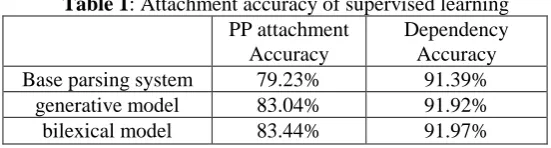
The common method used to evaluate the CFG style parsing performance is through matching bracketing. However, this method is heavily affected by the tags and bracketing style. Therefore, we use the dependency accuracy between words. Except for the headword of a sentence as a whole, all words in the sentence have their own headword. Therefore, the dependency accuracy is measured by obtaining and matching the headwords. The usual dependency accuracy includes the match of the relation between the head and its dependents (Lin, 1998). However, we do not consider the tags or any relation due to the tag disagreement and bracketing style. The dependency performance is measured by obtaining how many words are attached to its correct headword. Table 1 shows the results.
Table 1: Attachment accuracy of supervised learning
PP attachment Accuracy
Dependency Accuracy
Base parsing system 79.23% 91.39%
generative model 83.04% 91.92%
bilexical model 83.44% 91.97%
Table 1 shows that the bilexical model is slightly better than the generative model. This is considered reasonable since the PP attachment problem is to find the attachment site when a sentence is given, and is better described by the bilexical model. The baseline for the experiments in this paper is our base parsing system, as our main concern is not PP attachment itself, but how we can improve the parsing performance using a statistical PP attachment disambiguation method.
4
Unsupervised Learning
4.1
Data Extraction
data, the raw corpus is tagged and chunked, and all chunked NPs are replaced with their head
words. Next, 4-tuples (v, n, p, n2) are extracted, where v is the closest verb occurring on the left
of preposition p, and there is no conjunction except for a coordinate conjunction between v and
p. In addition, n is the closest noun occurring on the left of preposition p with no verb between
n and p. Finally, n2 is the object noun of p. If there is not either v or n, it is denoted as NULL.
For example, the sentence “A man in the park saw a girl with a telescope” is tagged and chunked as follows:
A/DT man/NN in/IN the/DT park/NN saw/VBD a/DT girl/NN with/IN a/DT telescope/NN ./. =>
man/NN in/IN park/NN saw/VBD girl/NN with/IN telescope/NN ./.
4-tuples: (NULL, man, in, park), (see, girl, with, telescope)
The number of triple (v/n, p, n2) is then counted as follows according to the ambiguity.
1) If a 4-tupe has the form of (v, NULL, p, n2), then add 1 to the number of triple (v, p, n2).
2) If a 4-tupe has the form of (NULL, n, p, n2), then add 1 to the number of triple (n, p, n2).
3) If a 4-tupe has the form of (v, n, p, n2), then several counting methods are considered.
Counting method 1: Add 0.5 to the number of triple (v, p, n2) and 0.5 to the number of triple
(n, p, n2).
Counting method 2: Add P(D|VERB, PREP) to the number of triple (v, p, n2) and
P(D|NOUN, PREP) to the number of triple (n, p, n2).
Counting method 3: Add P(D|VERB, p) to the number of triple (v, p, n2) and P(D|NOUN, p)
to the number of triple (n, p, n2).
Counting method 4: Add P(D|v, p) to the number of triple (v, p, n2) and P(D|n, p) to the
number of triple (n, p, n2).
In the above example sentence, the numbers of triples are as follows. Counting method 1:
(man, in, park):1, (see, with, telescope):0.5, (girl, with, telescope): 0.5 Counting 2:
(man, in, park):1, (see, with, telescope):P(D|VERB, PREP) = 0.395, (girl, with, telescope): P(D|NOUN, PREP) = 0.691
Counting 3:
(man, in, park):1, (see, with, telescope): P(D|VERB, with) = 0.527, (girl, with, telescope): P(D|NOUN, with) = 0.632
For the linguistic source, the BLLIP WSJ corpus was used, which is composed of about 1.8 million automatically tree-tagged sentences. The pos-tagged results were extracted, the results of which were used to extract the triples. The number of triples extracted was 1,466,472.
4.2
Model
For the attachment weight, we used the generative model and its ratio to a more general case conditioned on tags as follows.
)) ( | (
) | ( ) 1 ( )) ( | 2 , (
) | 2 , ( )
| 2 , (
w t p P
w p P w
t n p P
w n p P w
n p
W
, (11)where w is a verb or a noun, t(w) is the tag of w, and λ is an interpolation constant for data
sparseness. The method used to apply the weight is similar to that of the supervised learning.
i
w
n
p
W
r
P
r
W
(
)
(
)
*
(
,
2
|
)
, (12)where α is a proportional constant used for scaling the PP attachment weight in order to adjust
4.3
Experiments
As in the experiments on supervised learning, the evaluation was conducted using section 23 of the WSJ corpus. Table 2 shows the results.
Table 2: Attachment accuracy of unsupervised learning according to the counting methods of
ambiguous data PP attachment
Accuracy
Dependency Accuracy
Base parsing system 79.23% 91.39%
Counting method 1 82.33% 91.70%
Counting method 2 81.26% 91.65%
Counting method 3 81.71% 91.69%
Counting method 4 81.68% 91.70%
(v, p, n2): (n, p, n2) = 0.7:0.3 82.95% 91.78%
One puzzling result is that counting method 1 is better than the other cases where supervised learning data are applied. We assumed that a more informed case would have better results than the case of simply giving one half. Therefore, we conducted additional experiments, changing
(v, p, n2) using the constant values of 0.6, 0.7, and 0.8. As a result, 0.7 gives the best results,
and was thus selected as the final value. However, further analysis regarding these results is needed.
5
Combination
We considered two methods in combining supervised and unsupervised learning data.
1) We applied supervised learning data when supervised learning data was available for the
attachment weight, and we applied unsupervised learning data only when there was no supervised learning data available (super > unsuper).
2) We applied the attachment weight using both supervised and unsupervised learning data at
the same time (super + unsuper).
Table 3 shows the results.
Table 3: Attachment accuracy of combining supervised and unsupervised learning methods.
PP attachment Accuracy
Dependency Accuracy
Base parsing system 79.23% 91.39%
supervised 83.44% 91.97%
unsupervised 82.95% 91.78%
super > unsuper 84.06% 92.09%
super + unsuper 84.65% 92.14%
Volk (2002) took the “super > unsuper” approach. It seems that these cases are different as they deal with PP attachment as a classification problem, while we deal with it as a weighting problem. Finally, using statistical information, the PP attachment performance was enhanced by 5.42% with an 8.7% error reduction ratio in the overall parsing performance.
6
Conclusion
supervised learning. We also applied the unsupervised learning method of PP attachment to the rule-based parser. The results show a 3.73% improvement in performance.
We also conducted simple experiments on combining two types of learning methods, the final results of which show a 5.42% performance improvement in PP attachment, with an 8.7% error reduction ratio in the overall parsing performance.
For future work, we obviously need to conduct more analysis and experiments on adding counts to ambiguous 4-tuples by applying the supervised learning method. In addition, we need a more elaborate method to combine the supervised and unsupervised learning methods. Finally, we plan to devise an efficient way to build a tagged corpus for PP attachment.
References
Bharati, A., U. Rohini, P. Vishnu, S. Bendre, and R. Sangal. 2005. A hybrid approach to single
and multiple PP attachment using WordNet. Proceedings of International Joint Conference
on Natural Language Processing (IJCNLP) 2005, pp. 211–222.
Charniak, E. 2000. A maximum-entropy-inspired parser. Proceedings of the North American
Chapter of the Association for Computational Linguistics, pp. 132-139.
Collins, M. 2000. Discriminative Reranking for Natural Language Parsing. Proceedings of the
Seventeenth International Conference on Machine Learning, pp. 175–182.
Collins, M. 1996. A New Statistical Parser based on Bigram Lexical Dependencies.
Proceedings of ACL’96, pp. 184–191.
Collins, M. 1999. Head-Driven Statistical Models for Natural Language Parsing. Ph.D. thesis,
University of Pennsylvania.
Foth, K. and W. Menzel. 2006. The benefit of stochastic PP attachment to a rule-based parser.
Proceedings of the COLING/ACL, pp. 223–230.
Lin, D. 1998. A Dependency-based Method for Evaluating Broad-coverage Parsers. Natural
Language Engineering, 4(2), 97-114.
Marcus, M. P., B. Santorini, and M. A. Marcinkiewics, 1993. Building a large annotated corpus
of English: The Penn Treebank. Computational Linguistics, 19.
Merlo, P., M. W. Crocker, and C. Berthouzoz. 1997. Attaching multiple prepositional phrases:
Generalized backed-off estimation. Proceedings of the 2nd Conference on Empirical
Methods in Natural Language Processing (EMNLP-97), pp. 149–155.
Olteanu, M. and D. Moldovan, 2005. PP-attachment Disambiguation Using Large Context. Proceedings of the conference on Human Language Technology and Empirical Methods in
Natural Language Processing, pp. 273-280.
Ratnaparkhi, A. 1998. Statistical Models for Unsupervised Prepositional Phrase Attachment.
Proceedings of the 36th conference on Association for Computational Linguistics, pp. 1079–
1085.
Roh, Y.-H., K.-Y. Lee, and Y.-G. Kim, 2009. Incorporating Statistical Information of Lexical
Dependency into a Rule-Based Parser. Proceedings of the 23th Pacific Asia Conference on
Language, Information and Computation, pp. 493–500.
Sagae, K. and A. Lavie, 2003. Combining Rule-based and Data-driven Techniques for
Grammatical Relation Extraction in Spoken Language. Proceedings of the Eighth
International Workshop in Parsing Technologies.
Stetina, J. and M. Nagao. 1997. Corpus Based PP Attachment Ambiguity Resolution with a
Semantic Dictionary. Proceedings of the Fifth Workshop on Very Large Corpora, pp. 66–80.
Volk, M. 2002. Combining unsupervised and supervised methods for PP attachment
disambiguation. Proceedings of the 19th International Conference on Computational