LAMP: A Multimodal Web Platform for Collaborative Linguistic Analysis
Kais Dukes and Eric Atwell
I-AIBS Institute for Artificial Intelligence and Biological Systems, School of Computing, University of Leeds, United Kingdom.
E-mail: [email protected], [email protected]
Abstract
This paper describes the underlying software platform used to develop and publish annotations for the Quranic Arabic Corpus (QAC). The QAC (Dukes, Atwell and Habash, 2011) is a multimodal language resource that integrates deep tagging, interlinear translation, multiple speech recordings, visualization and collaborative analysis for the Classical Arabic language of the Quran. Available online at http://corpus.quran.com, the website is a popular study guide for Quranic Arabic, used by over 1.2 million visitors over the past year. We provide a description of the underlying software system that has been used to develop the corpus annotations. The multimodal data is made available online through an accessible cross-referenced web interface. Although our Linguistic Analysis Multimodal Platform (LAMP), has been applied to the Classical Arabic language of the Quran, we argue that our annotation model and software architecture may be of interest to other related corpus linguistics projects. Work related to LAMP includes recent efforts for annotating other Clas-sical languages, such as Ancient Greek and Latin (Bamman, Mambrini and Crane, 2009), as well as commercial systems (e.g. Logos Bible study) that provide access to syntactic tagging for the Hebrew Bible and Greek New Testament (Brannan, 2011).
Keywords: Arabic Corpus, Treebank, Quran, Collaborative Annotation
1. Introduction
Over the last several decades, the development and use of annotated corpora has grown to become a major focus of research for both linguistics and computational natural language processing. Annotated corpora provide the em-pirical evidence that is used to advance various theories of language (Sampson and McCarthy, 2005). Annotated data is also used by computational linguists to engineer state-of-the-art natural language systems and resources includ-ing electronic lexicons (Kucera and Francis, 1967; Hajic, et al., 2007; Brierley and Atwell, 2008), part-of-speech taggers (Leech, et al., 1983; Brants, 2000; Spoustová et al., 2009; Søgaard, 2011) and syntactic parsers (Atwell, et al., 1984; Collins, 1999; Charniak, 2000; Nivre, et al., 2007).
Two of the main challenges that arise when developing annotated corpora are the often prohibitively high costs required to manually construct the annotated data, as well as the extra effort required to make this data easily availa-ble and accessiavaila-ble. This is especially important for popular texts that are studied in detail by members of the general public, such as central religions texts. The fact that texts such as the Quran, Hebrew Bible and Greek New Testa-ment are written in ancient classical languages and are of wide public interest makes them an important dataset for linguistic annotation and natural language processing.
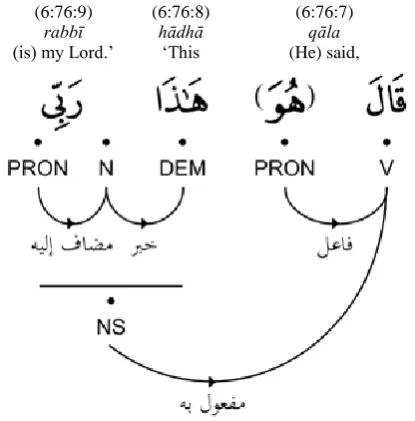
The Quranic Arabic Corpus was developed through a model of collaborative annotation, where volunteers proo-fread part-of-speech tagging and syntactic analysis, and then suggest corrections through an online message-board forum (Dukes, Atwell and Habash, 2011). Figure 1 shows an example sentence annotated using a hybrid dependen-cy-constituency syntactic tagging scheme. The first line indicates the chapter, verse and word numbers from the Quran (sequenced from right to left, in line with the
Arab-ic script), followed by an interlinear word-by-word trans-lation into English. Part-of-speech tags are assigned to the morphemes that form each word. Finally, syntactic depen-dencies between words and phrases are annotated using Arabic syntactic dependency labels. The annotated corpus also includes further additional tagging, including named entity references, an ontology of semantic concepts and an automatically generated phonetic transcription. For further details on the full annotation scheme used in the Quranic Arabic Corpus, see (Dukes et al., 2011).
(6:76:9) rabbī (is) my Lord.’
(6:76:8) hādhā
‘This
(6:76:7) qāla (He) said,
Figure 1: Morphological and syntactic annotation for the Quranic verse: He said, ‘This is my Lord.’
used by Classical scholars and Computational Linguistics researchers. However, the Quranic Arabic Corpus is dif-ferent in attracting much wider interest from Muslims worldwide wanting to use the resource to help them un-derstand and appreciate the Quran. This has enabled us to benefit from several hundred volunteers who have cross-checked the annotation in the QAC against historical works based on the traditional Arabic grammar known as i’rāb (ةارعإ) (Salih, 2007). To encourage volunteer anno-tation, and to provide a high quality resource, accessibility and usability of the Quranic Corpus were key concerns in its design. The resource is intended not only as a computa-tional dataset, but also as a learning and study guide for the Quran. In order to meet the two challenges of dealing with large scale volunteer annotation and building a high-ly accurate, useful study and educational tool, we decided to develop a custom software architecture to annotate the QAC, and decided to make the annotations freely availa-ble online.
2. Linguistic Analysis Multimodal Platform
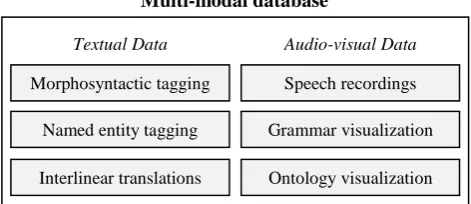
Although our LAMP architecture has been used success-fully for the Quranic Arabic Corpus website, we argue that the technology concepts we present are a general model of online corpus development, applicable to related datasets. In order to support a reusable design and effi-ciently handle a large number of users, LAMP is imple-mented as a set of layered Java modules. Figure 2 shows the three layers used in LAMP: a multimodal database, a set of computational-linguistic components, and an online web interface. These three layers are used for data storage, data processing, and data access respectively.
3. Multimodal Linguistic Data
The multimodal database stores annotated text in XML format, as well as media files for audio and video, and scanned manuscripts that have not yet been converted into text using OCR. The most important data is the Arabic text of the Quran itself. However, given that the Quran is primarily an oral tradition, the database also includes sev-en audio recitations of the Quran. These differsev-ent recita-tions reflect different readings of the text, each with subtle differences in prosodic stress. In addition to speech re-cordings, the latest version of the corpus (version 0.5) is planned to include video recordings of Quranic recitation as part of the multimodal data
The database also stores seven parallel translations of the Quran into English, as well as an interlinear translation (see http://corpus.quran.com/wordbyword.jsp). Whereas Christians usually read the Bible translated into their na-tive language, by tradition all Muslims are encouraged to study and appreciate the Quran in its original Classical Arabic form. The seven verse-by-verse English transla-tions and the interlinear word-by-word literal translation are popular and useful aids for the large proportion of readers who speak English as a first or second language.
Figure 2: LAMP architecture diagram, illustrating the three layers of the software design.
All of the multimodal data has been aligned at sentence-level. For each 6,236 verses in the Quran, a hyperlinked page on the website gives access to the original Arabic script, audio, video and English translations. The multi-modal data is also hyperlinked to annotations for morpho-logical segmentation, part-of-speech tagging and syntactic analysis (Dukes and Buckwalter, 2010), which reference historical works of Quranic grammar. Multimodal data is especially useful for an educational study guide such as the QAC, to help engage the student, and to allow the stu-dent to choose from a range of different viewpoints of the core text
To efficiently allow the data to be quickly accessed on-line, several indexes have been added to the database. For fast web search, the Quranic text has been indexed by keywords for English, and by morphological stems and roots for Arabic. In addition, the Quranic script has been indexed by chapter, verse and word number.
For displaying online, the database stores snapshots of automatically generated visualizations of annotated tree-bank sentences and ontological data. The multimodal da-tabase is not static. As linguistic annotations are improved through new user suggestions, updated tags are stored together with snapshots of updated visualizations for the corrected sentences in the corpus.
Morphosyntactic tagging Speech recordings
Named entity tagging Grammar visualization
Interlinear translations Ontology visualization Textual Data Audio-visual Data
Multi-modal database
Morphological analyzer NL grammar summarizer
Syntactic parser Grammar tree visualizer
Ontology tagger Ontology visualizer Text Analytics Data Presentation
Computational-linguistic components
Cross-referenced pages User registration
Morphological search Messageboard Corpus Access Collaborative Annotation
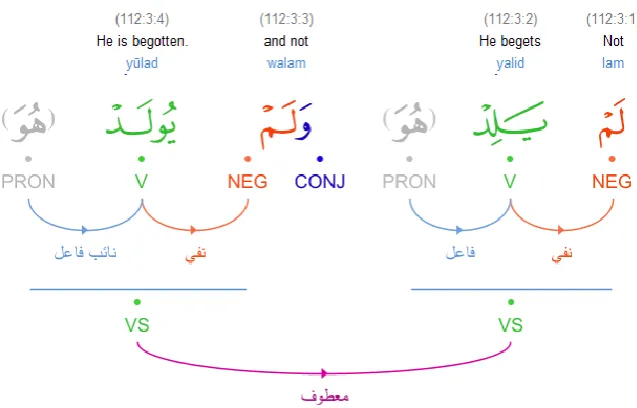
Figure 3. Graphical color-coded representation of treebank syntax in the Quranic Arabic Corpus.
4. Computational Linguistic Components
The second layer in LAMP is a set of computational lin-guistic components for both analysis of Quranic text, as well as tools that make use of the resulting annotated data. A morphological analyzer (Dukes and Habash 2010) and a syntactic parser (Dukes and Habash, 2011) were designed specifically for the Classical Arabic language of the Quran and have been used for initial development of the corpus annotations, before online proofreading by volunteers.
To produce the graphical representation of syntax in the treebank (Figures 1 and 3), we use custom visualization algorithms to illustrate the sentence structure of Arabic dependency grammar through color-coded links between words. These diagrams are hyperlinked to the rest of the annotated data (Dukes, Atwell and Sharaf, 2010a).
Of possible interest to related projects is our use of natural language generation (NLG). The database stores POS tags and syntactic disambiguation as a sequence of abbreviated machine-readable tags. We apply tools to publish annota-tions as concise grammatical summaries. For example, the Classical Arabic word fafataqnāhumā (بمهبنقتفف) may be translated as ‘then we parted them both’. A grammatical description is produced using NLG (Figure 4).
Figure 4: Automatic natural language generation of grammatical summaries using morphosyntactic tagging.
5. Quranic Arabic Corpus Website
The third and final layer of LAMP is the web interface. We publish the data stored in the multimodal database online and make use of the linguistic software tools to enrich the data and make it more easily accessible. Each word in the Quran has several layers of annotation includ-ing phonetic transcription, morphological segmentation, part-of-speech tagging and syntactic analysis.
(21:70:4) faja'alnāhum but We made them
CONJ – prefixed conjunction fa (but) V – 1st person masculine plural perfect verb
PRON – subject pronoun
PRON – 3rd person masculine plural object pronoun
Figure 5. Linguistic ‘breakdown’ of an Arabic word in the Quran showing multiple levels of annotation.
Each of these layers is shown on a single ‘word break-down’ webpage with multiple hyperlinks to further de-tailed information (see Figure 5). The QAC website also offers a morphological search feature, not available on other related Quranic study sites. This feature is made possible by the richly annotated data stored in the linguis-tic database.
For example, the word تهذ in Classical Arabic has two readings, as either the noun ‘gold’ or the verb ‘go’. Searching using by POS tag and root, the occurrences of the correct reading can be easily found in the corpus. The tenth word of verse (21:30) is divided into 4
Figure 6. The Quranic Arabic Corpus website (http://corpus.quran.com).
The Quranic Arabic Corpus website also supports colla-borative annotation. While browsing the annotated corpus, users are encouraged to submit corrections and sugges-tions for improvements. Our model for online annotation is supervised collaboration. The website includes a set of annotation guidelines that new visitors are encouraged to read (Dukes, Atwell and Sharaf, 2010b). If the online an-notation does not match the guidelines, or appears to be in error, corrections can be suggested using an online mes-sage board. A few select supervisors, chosen for consis-tently making high-quality corrections, review the sugges-tions on the message board and discuss these with other members of the website. If consensus is reached on a cor-rection or improvement, the database is updated with the new tagging (Dukes, Atwell and Habash, 2011).
Figure 6 shows the homepage of the Quranic Arabic Cor-pus The left-hand navigation pane lists QAC features in order of popularity of use: Word by Word, Quran Dictio-nary, English Translations, Syntactic Treebank, Ontology of Concepts, Documentation, Quranic Grammar, Message Board, Resources, Feedback, Java API.
5.1 Word by Word
The Quranic Arabic Corpus started out as a research project in morphological and syntactic analysis and anno-tation of the source Arabic text, and we added the word-by-word English translation initially to accommodate non-Arabic-speaking AI research collaborators. However, it soon became clear that this is the most popular ‘annotation level’ for non-research users, as it gives a more literal access to the source Arabic words to members of the
gen-eral public who speak English as a first or second lan-guage. Furthermore, in the feedback section of the site, a frequently-requested extension to the current web-site is the addition of word-by-word translations into other languages, such as French, German, Urdu, Malay.
5.2 Quran Dictionary
The user can select an Arabic root, and see the inflected and derived forms used in the Quran (see Figure 7).
Figure 7. Quran Dictionary: root bā hamza sīn (س أ ب) occurs 73 times in the Quran, in six derived forms.
The Quran dictionary also offers:
Verb Concordance: a list of verbs grouped by root and form, and sorted by frequency.
Kais Dukes and Nizar Habash. (2010). Morphological Annotation of Quranic Arabic. In Proceedings of the Language Resources and Evaluation Conference (LREC). Valletta, Malta.
Kais Dukes and Nizar Habash. (2011). One-step Statistical Parsing of Hybrid Dependency-Constituency Syntactic Representations. In Proceedings of the International Conference on Parsing Technologies (IWPT). Dublin, Ireland.
Jan Hajic, Jarmila Panevová, Zdenka Urešová, Alevtina Bémová, Veronika Kolárová and Petr Pajas. (2003). PDT-VALLEX: Creating a Large-coverage Valency Lexicon for Treebank Annotation. In Proceedings of the Second Workshop on Treebanks and Linguistic Theo-ries. Växjö, Sweden.
Henry Kucera and Nelson Francis. (1967). Computational Analysis of Present-Day American English.
Goeffrey Leech, Roger Garside, Eric Atwell. (1983) The Automatic Grammatical Tagging of the LOB Corpus ICAME Journal of the International Computer Archive of Modern English Vol.7.
Joakim Nivre, Johan Hall, Sandra Kübler, Ryan McDo-nald, Jens Nilsson, Sebastian Riedel and Deniz Yuret. (2007). The CoNLL 2007 Shared Task on Dependency Parsing. In Proceedings of EMNLP-CoNLL.
Bahjat Salih. (2007). i'rāb mufassal li-kitāb allāh al-murattal (‘A Detailed Grammatical Analysis of the Re-cited Quran using i'rāb’). Dar Al-Fikr, Beirut.
Geoffrey Sampson and Diana McCarthy. (2005). Corpus Linguistics: Readings in a Widening Discipline. Conti-nuum.
Anders Søgaard. (2011). Semi-Supervised Condensed Nearest Neighbor for Part-of-Speech Tagging. In Pro-ceedings of the 49th Annual Meeting of the Association for Computational Linguistics: Human Language Tech-nologies (ACL-HLT). Portland, Oregon.