© 2018 IJSRCSEIT | Volume 3 | Issue 5 | ISSN : 2456-3307
Integrating Human Conversation Models Towards Improving
Interaction In Text Based Dialog Systems
K. Mugoye*, Dr. H. O. Okoyo, Dr. S. O. McOyowo
Department of Computer Science, Maseno University, Private Bag, Maseno, Kenya
ABSTRACT
This paper envisions dialog system that can interact with human users in a more natural and easier way. The dialog system would support some pattern of conversation with a human partner. The paper describes human conversation, discusses available conversation model(s) in human conversation and bespeak the value of conversation. It emphasizes the need for interaction and highlights dialog systems point of departure from achieving human-like conversation. It then suggests inclusion of appropriate conversation model(s) in the design of dialog systems, to bring forth a desired conversational behaviour (pattern), with specific bias to task oriented dialog systems.
Keywords: Dialog System, Task Oriented Dialog System, Artificial Intelligence, Human-Like Conversation, Interaction
I.
INTRODUCTION
Today, most dialog systems do not interact with people. They react. When a dialog system (DS) receives a specific cue, it returns a pre-programmed response. In contrast, people interact through conversations. Human conversation is considered an artificial intelligence (AI)-Hard problem – something that cannot be done without first solving all the problems of AI [1]. Researchers would argue that a detailed understanding of every activity in the brain is needed first, but as has been seen since AI was founded, most problems seem to be solvable independently of the entire solution. The problems of conversation can be broken down so this paper will look at a piece of the puzzle along with its possible solution.
Developers and programmers need to understand and appreciate human conversation, so that they can develop and use models which can enable dialog systems to interact with a human user, that is, support some pattern of conversation. While a lot has
been mentioned in the study and progress of spoken dialog systems, their textual counterparts seem to have been forgotten. The vast majority of users only relate conversational user interfaces to spoken dialog systems, however, text in-text out dialog systems still do exist. The idea here is not to compare or contrast spoken versus textual systems, but to point out that there are circumstances where textual systems may be preferred over spoken systems and vice versa. This paper seeks to solicit attention to bring conversation to text in-text out dialog systems. We argue that there’s need to design and develop interfaces or systems that support the conversation, regardless of the output characteristics, whether spoken or textual. The emphasis on text-in, text-out, dialog systems (textual interaction) is justifiable, that is, so that they can serve in situations and circumstances where spoken may be deemed unsuitable, such as noisy industrial settings, or to overcome other barriers to universal voice processing.
conversation. It may be difficult to address all possible patterns of conversation; therefore, we focused on a pattern at a time. The pattern we are currently addressing is ―peer to peer exchanges‖ within a domain, also known as the progression of exchanges. In order to achieve this, it is important first, to understand the human conversation and possible models of the conversation. The information obtained from understanding the desired conversational model (e.g. in [2]) will enable highlight the gap in dialog systems and would inform the basis for integrating such model(s) to dialog systems development so that the anticipated behaviour becomes a true reflection of the model. The main contribution of this work is to provide better insight on the human conversation so that developers can adopt correct model(s) to the design of dialog systems. Moreover, to emphasize on adoption and reference to user-centered design to justify the need to craft the desired behaviour for future dialog systems.
II.
CONVERSATION
There exist different models of interaction which may be based on the internal capacity of the systems doing the interacting [2]. At one extreme, is a simple reactive system, such as a search engine that returns results when you submit a query. At the other extreme is the conversation. In this paper, a Conversation is defined as a progression of exchanges among participants. Each participant is a ―learning system,‖ that is, a system that changes internally as a consequence of experience. To add depth to the understanding of human conversation we interrogate known models in the conversation.
III. MODELS OF CONVERSATION USEFUL FOR
INTERACTION DESIGN
Shannon’s model provides a basis for machine communication but captures a fundamental limit of nearly all human-to-computer interaction. The
limitation of this model inspires ―conversation‖. The cybernetic models of conversation theory and Gordon Pask [3] provide a good reference because they are based on a deep study of human-to-human and human-to-machine interaction [4, 5].
A. Simple model of conversation
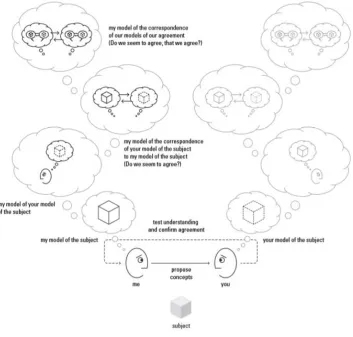
Conversation is a means to propose concepts, test understanding, and confirm the agreement. Participants agree on their understanding of a concept when they share a similar model, and they believe that they agree. An agreement may then be the basis for action. (see figure 1):
It is possible for HCI designers or programmers to use communication, and conversation interchangeably to mean the same in dialog systems. This paper separates communication from conversation by looking at Shannon’s model of communication and a simple model in conversation [2]. Whereas Shannon’s model shows it is impossible in communication to say something novel to another, simple conversation model acknowledges learning of new concepts, sharing and evolving knowledge, and confirms agreement.
B. Conversation for learning
Conversation builds on shared context and prior agreement. Participant A, proposes a new distinction; Participant B, integrate it into his/her mental model and reflect it back to Participant A. Likewise, Participant B, might propose new distinctions. The process continues with testing, confirmation, and iteration. Any consequent changes in the mental models are learning. (see figure 2):
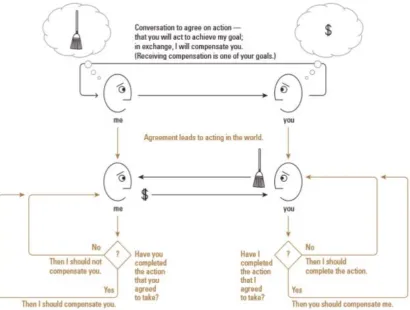
C. Conversation to coordinate
acknowledge this and compensate Participant A as agreed. Compensation may be monetary, return of favour, etc. (see figure 3):
D. Process of the conversation
It should be possible to equip a DS with ability to construct meaning, evolve, converge on agreement, and act or transact, as Dubberly et.al [2] suggests on the process of the conversation.
(1) Construct meaning: Conversation enables us to construct (or reconstruct) meaning, including meaning that is new to the destination. Conversation theory has a highly detailed model that we must leave to other descriptions though it is useful even in this skeletal form [4]. Messages are composed with topics or distinctions that are already shared, on the basis of prior conversation or shared contexts, such as common language and social norms. Participant A uses the message channel to propose what these topics are and how they are distinct from one another (descriptive dynamics), along with a kind of ―glue‖ that explains just how these topics interact to make up the new concept (prescriptive dynamics). Participant B ―takes all this in‖ and ―puts it all together‖ to reproduce A’s meaning (or something close enough).
(2) Evolve: Participant A or B (or both) are different after the interaction. Either or both hold new beliefs, make decisions, or develop new relationships, with others, with circumstances or objects, or with themselves.
(3) Act or transact: Sometimes one or more of the participants agrees to perform an action as a result of, and beyond, the conversation that has taken place. For example, they may agree to enter into a relationship. Or they may agree to a transaction, as when money is traded for a product or service.
(4) Converge on agreement: Participant B may wish to confirm understanding of A’s concept. To do so, B
must create and propose a different formulation of the topic(s) under discussion, one that captures his model of the concept. On receipt, participant A attempts to make sense of B’s formulation and compares it with her original intention. This may lead to further exchanges. When both A and B judge that the concepts match sufficiently, they have reached ―an agreement over an understanding.‖
IV. DESIGNING FOR CONVERSATION IN
DIALOG SYSTEMS
The Conversation matters to any ―community‖ of interest, but nowhere is the value of conversation more clear than in commerce, because commerce cannot flourish, or even exist, without conversation. In this context we describe the requirements for conversation to be: - (1) Establish environment and mind set—context; (2) Use shared language; (3) Engage in mutually beneficial; (4) peer-to-peer exchange; (5) Confirm shared mental models; (6) Engage in a transaction—execute cooperative actions. Although this may differ in other settings, one resilient and essential characteristic that persist across all settings for conversation is the presence of peer-to-peer exchange. This peer-to-peer exchange has been a missing piece with digital systems or machine interaction because it not only requires the understanding of what is said but also must address what else is going on at that moment.
Taking cognizance of UCD goal - which is to produce products that have a high degree of usability. Our focus shifts to three important usability objectives, i.e. usefulness, effectiveness and attitude [6, 7]. We highlight the significance of usability from two perspectives;
1-user’s perspective, usability is important because it can make the difference between performing a task accurately and completely or not, and enjoying the process or being frustrated.
2-developer’s perspective, usability is important because it can mean the difference between the success or failure of a system.
The motivation is to profit from UCD which yields system that offers a more satisfying user experience [8].
V.
INTEGRATING CONVERSATION MODEL
TO TODS
Our literature suggests a TODS inability to support a progression of exchanges (peer-to-peer exchange) within a domain, hinders its capability to advance done right the first time. In this paper, we argue that in order to profit from these models, adopting a suitable model(s) is key. We further that adopting the appropriate model of conversation in the design of a DS would yield one with the enhanced capability to handle a conversation. But first, there is need to identify a pattern of interest in the conversation, then selection of a suitable model that corresponds to the identified pattern, finally use of
supportive tools and technologies to ―glue‖ everything together to realize a DS.
VI. SUPPORTIVE TECHNOLOGY(S)
Most predictions of 1956 Dartmouth conference that coined the term ―artificial intelligence‖ [1], such as general robotics and conversation with machines have yet to eventuate because the technology was initially immature, but that’s no longer the case, we need to exploit today’s technology to cater to the constraints. To profit from today’s technology, a careful choice of tools and technology is suggested. In this paper, we suggest the use of multiple intelligent interacting agents in Multi-agent systems (MAS). MAS can offer a better representation of the conversation model(s) and the exploitation of reinforcement learning will make the intelligent agents interact and understand their environment. This is just one example of technologies to think about. Intelligent agents may be used to track the state of conversation and deal with structure (especially in sentences).
This would yield support to moving the conversation forward. This approach tends to emulate the human conversation model where the participants maintain focus on the context by continuously tracking the state of the exchanges while internalizing the relationship as the conversation moves forward.
VII.
CONCLUSION AND FUTURE WORK
Figure 1. simple model of conversation
Figure 3. conversation to coordinate
VIII.
REFERENCES
[1]. H.Dubberly, U.Haque and P.Pangaro, "What is interaction? Are there different types?," interactions, vol. 16, no. 1, pp. 69-75, 2009. [2]. G. M.Boyd, "Reflections on the conversation
theory of Gordon Pask. In R. Glanville & B. Scott (Eds.)," The International Journal of Systems and Cybernetics, vol. 30, no. 5-6, p. 560-570, 2001.
[3]. G.Pask, "The Cybernetics of Human Learning and Performance," in Hutchinson, London, 1975.
[4]. G.Pask, "An Essay on the Kinetics of Language, Behavior and Thought," in Silver Anniversary International Meeting of Society for General Systems Research, London, 1979.
[5]. J.Rubin, Handbook of Usability Testing: How to Plan, Design, and Conduct Effective Tests, John Wiley and Sons, 1984.
[6]. H. Lawton and J. Thorp, "Notes on User Centered Design Process (UCD)," 31 3 2004.
[Online]. Available:
https://www.w3.org/WAI/redesign/ucd. [Accessed 28 April 2018].
[7]. F. Labs, "Introduction to User-Centered Design," 2015. [Online]. Available:
http://www.usabilityfirst.com/about- usability/introduction-to-user-centered-design/. [Accessed 28 April 2018].