Proceedings of Recent Advances in Natural Language Processing, pages 601–609,
Using Gaze Data to Predict Multiword Expressions
Omid Rohanian, Shiva Taslimipoor, Victoria Yaneva and Le An Ha
Research Group in Computational Linguistics, University of Wolverhampton, UK
{omid.rohanian,shiva.taslimi,v.yaneva,ha.l.a}@wlv.ac.uk
Abstract
In recent years gaze data has been increas-ingly used to improve and evaluate NLP models due to the fact that it carries in-formation about the cognitive processing of linguistic phenomena. In this paper we conduct a preliminary study towards the automatic identification of multiword ex-pressions based on gaze features from na-tive and non-nana-tive speakers of English. We report comparisons between a part-of-speech (POS) and frequency baseline to: i) a prediction model based solely on gaze data and ii) a combined model of gaze data, POS and frequency. In spite of the challenging nature of the task, best per-formance was achieved by the latter. Fur-thermore, we explore how the type of gaze data (from native versus non-native speak-ers) affects the prediction, showing that data from the two groups is discriminative to an equal degree. Finally, we show that late processing measures are more predic-tive than early ones, which is in line with previous research on idioms and other for-mulaic structures.
1 Introduction
In order to alleviate the burden that language com-prehension poses on the short-term memory, the human brain uses frequently occurring formulaic sequences such as multiword expressions, collo-cations and idioms, among others, and stores them as units in the long-term memory (Conklin and Schmitt, 2012). As a result of the efficacy of this approach, a large proportion of the spoken and written language is formulaic, with some cor-pus studies claiming that between 52% and 58% of the language in the analysed corpora falls into
this category (Erman and Warren,2000), and other studies claiming that this figure is around 32% (Foster, 2001). Given the frequency with which this phenomenon occurs, the automatic identifica-tion of formulaic language is of paramount impor-tance for a number of Natural Language Process-ing (NLP) tasks and applications.
Conklin and Schmitt (2012) argue that our brains store and process very frequent and highly fixed combinations as “wholes” as opposed to sin-gle words being added together and that this dif-ference in processing is reflected in eye tracking data. A number of eye tracking studies discussed in Section2show that there is a processing advan-tage for formulaic sequences for both native and native speakers compared to controlled non-formulaic sequences. Based on this evidence, it could be concluded that the characteristics of for-mulaic language could be captured through dif-ferences in the gaze patterns between formulaic and non-formulaic sequences. In a similar way, gaze data has previously been successfully used in other NLP tasks such as part-of-speech tagging (Barrett et al.,2016a) and evaluation of word em-beddings (Søgaard,2016), and it has been shown that gaze signals transfer across languages (Barrett et al.,2016b). In this sense, automatically identi-fying formulaic sequences based on gaze features could not only contribute to potentially improving classification accuracy and gaining insight into the cognitive processing of such units, but can also provide a language-independent approach to iden-tification of formulaic phrases. However, it is im-portant to note that almost all studies using gaze data to investigate formulaic language focus solely on idioms and that other types of formulaic units have been significantly understudied.
In the present research we conduct a prelim-inary study towards the identification of multi-word expressions (MWEs) based on gaze features.
An MWE is commonly known as a combination of two or more words, not necessarily continu-ous, that pose difficulties on language processing (Sag et al.,2002) and that typically have syntactic and semantic idiosyncrasies (Fazly and Stevenson, 2006). In particular, we focus on two common types of MWEs, namely, Verb-Particle (e.g. give up) and Verb-Noun (e.g. take place) constructions. We use the GECO corpus (Cop et al., 2016), a monolingual and bilingual corpus of the eye-tracking data from participants reading a complete novel. The use of this data allowed comparison between the gaze patterns of native and non-native English speakers, as well as a comparison of the predictive power of data obtained from these two groups. Furthermore, we explore a range of early and late measures of cognitive processing in order to determine which of the two groups of features carries more important linguistic information. In order to account for the fact that MWEs are often processed as unified structures, we used Condi-tional Random Fields (CRF) classifier to label se-quences of words, together with a variety of early and late gaze features.
The contributions of this work are as follows:
• We explore a novel approach to MWE iden-tification based on gaze data. We compare a POS+Frequency baseline to: i) a predic-tion model based solely on gaze features and ii) a prediction model based on gaze features, POS, and frequency.
• A comparison between the predictive power of gaze data from native and non-native speakers of English in the context of MWE identification.
• A comparison between the predictive power of a number of early and late gaze features in the context of our current task.
The code used in the experiments and the an-notation of the MWEs are made freely avail-able1. The GECO corpus could be down-loaded freely at:http://expsy.ugent.be/ downloads/geco. For an investigation dis-cussing the cognitive processing of the MWEs in the corpus, refer to (Yaneva et al.,2017).
The rest of this paper is organised as follows. Section2presents related work from the fields of
1https://github.com/omidrohanian/ gaze-mwe-ranlp2017
eye tracking and MWEs research, while Section3 describes the data used in this study and Section4 describes the gaze features. The experimental ap-proach and the actual experiments conducted are presented in Section5, and are then reported and discussed in Sections 6 and 7, respectively. Fi-nally Section8contains the main conclusions and avenues for future work.
2 Related Work
This section presents related work from the fields of eye tracking research and automatic identifica-tion of multiword units.
2.1 Eye Tracking and Formulaic Language
Eye tracking is a process where an eye-tracking device measures the point of gaze of an eye (gaze fixation) or the motion of an eye (saccade) relative to the head and a computer screen (Duchowski, 2009). Fixations are eye movements which sta-bilise the retina over a stationary object of interest, which, in the case of reading research, is the writ-ten text and its units (letters, words, phrases, etc). Gaze fixations and revisits (go-back fixations to a previously fixated object) have been widely used as measures of cognitive effort by taking into ac-count their durations and the places in text where longer fixations occur (Duchowski,2009). Early gaze measures such as first fixation duration give information about the early stages of lexical access and syntactic processing, while late gaze measures such as total dwell time or total number of fix-ations give information about late stages of pro-cessing (e.g. late syntactic propro-cessing, textual in-tegration processes, lexical and syntactic/semantic processing and disambiguation in general). A se-ries of studies on eye tracking during reading show that gaze data is sensitive to linguistic phenom-ena such as word frequency, verb complexity and lexical ambiguity, as well as contextual effects on word perception (Rayner, 1975; Rayner and Duffy,1986;Rayner,2009;Rayner et al.,2012).
that the last word of the idiom was read faster than the last word in the control condition. Sim-ilarly, non-native readers produced fewer fixa-tions when reading idioms than when reading con-trol phrases but there were no differences in the durations of those fixations (Underwood et al., 2004). Siyanova-Chanturia et al. (2011) corrob-orated the processing advantages of idioms over novel phrases and showed that idioms required less re-reading and less re-analysis. Interestingly, there were no significant differences in the early gaze measures, suggesting that early eye-tracking measures may not be suitable for investigation of formulaic language (Siyanova-Chanturia et al., 2011). This result may be explained with previous research on predictability of single words showing strong effects in terms of shorter first fixation du-rations and greater likelihood of skipping (Rayner and Well, 1996). However, Carrol and Conklin (2015) argue that this effect may not scale up to formulaic units in a simple fusion and suggest tak-ing an approach balanctak-ing between local, lexical context and global discourse context. Assuming that the case of formulaic language is that “the whole is greater than the sum of the parts”,Carrol and Conklin(2015) suggest the use of ahybrid ap-proach where formulaic language is analysed both as a whole and at the level of individual words. In order to partly account for this effect we use an algorithm which represents the data as a sequence of words considering their neighbouring word fea-tures.
2.2 Identification of MWEs
MWEs have been investigated in computational linguistics based on their many different char-acteristics such as fixedness (Fazly and Steven-son, 2008), non-compositionality (Baldwin and Kim,2010), and semi-productivity (Villavicencio, 2003). We have used these properties as the main guidelines for annotating MWEs, specifically fol-lowing the guidelines provided by the PARSEME project on identifying verbal MWEs.2 High fre-quency of MWEs and in particular, the principle that MWEs usually are constructed from high fre-quency word components have been studied exten-sively in computational linguistics (Granger and Meunier,2008;Fazly,2007).
In the most recent MWE workshop (Savary 2https://typo.uni-konstanz.de/
PARSEME/images/shared-task/guidelines/ PARSEME-ST-annotation-guidelines-v6.pdf
et al., 2017), several language-independent sys-tems have been proposed for identifying or ex-tracting MWEs. When used in conjunction with CRF models (Scholivet and Ramisch, 2017) or structured perceptrons (Schneider et al., 2014), Part-of-Speech (POS) tags have been shown to be useful features (especially when parsing informa-tion is not available) to identify MWEs. Schnei-der et al.’s (2014) statistical sequence model has achieved the best F1-score of 60% in identifying all heterogeneous types of MWEs and truly shows how challenging the task is.
3 Eye Tracking Data
The GECO corpus (Cop et al.,2016) used in this study is, to the best of our knowledge, the most recent eye tracking corpus for English, which: i) contains gaze data from a natural reading task (as opposed to e.g. single sentences), ii) is long enough to contain a sufficient number of MWEs, and iii) contains paired gaze data from native and non-native readers. Eye tracking data was col-lected for both the English version of the novel and its translation in Dutch; however, in the cur-rent study we only focus on the English part of the data.
The text of the corpus is a novel by Agatha Christie entitled “The Mysterious Affair at Styles”, the English version of which contains 54,364 tokens and 5,012 unique types. The novel was selected based on the fact that its word fre-quency distribution had considerable similarity to the one in natural language use, as observed in the Subtlex database (Cop et al.,2016). The novel was read by 14 English monolingual undergraduates from the University of Southampton and 19 Dutch (L1) - English (L2) bilingual students at Ghent University (intermediate and advanced). The two groups were matched on age and education level. The monolingual participants read only the En-glish version of the novel, which amounted to a total of 5,031 sentences. The bilingual participants read chapters 1 - 7 in one language and 8 - 13 in the other in a counterbalanced order, thus reading 2,449 English sentences. The eight bilingual par-ticipants who read the first part of the novel in En-glish read 2,852 EnEn-glish sentences.
4 Gaze Features
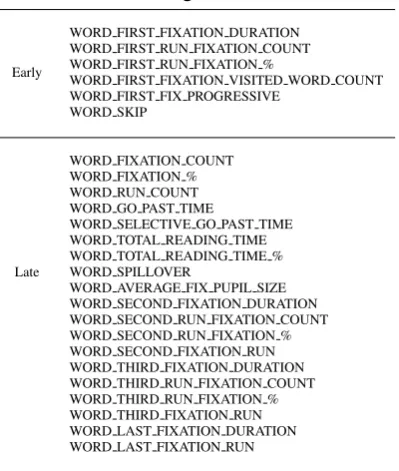
A number of gaze features were selected for the corpus and are listed in Table 1. All gaze fea-tures were averaged over 14 native readers for one set and 19 non-native readers for another set of data. We divided the features into early and late processing measures. Early measures cap-ture processes such as lexical access and syntac-tic processing, as well as oculomotor processes and visual properties of the region. An example of such a measure isfirst fixation duration( Dem-berg and Keller,2008). Late measures account for late syntactic processing, textual integration pro-cesses, lexical and syntactic/semantic processing and disambiguation in general. An example of a late measure is thetotal reading timeof a region, which is the sum of all fixations on a region, in-cluding refixations of the region after it was left (Demberg and Keller,2008).
Table 1: Categorised Gaze Features
Early
WORD FIRST FIXATION DURATION WORD FIRST RUN FIXATION COUNT WORD FIRST RUN FIXATION %
WORD FIRST FIXATION VISITED WORD COUNT WORD FIRST FIX PROGRESSIVE
WORD SKIP
Late
WORD FIXATION COUNT WORD FIXATION % WORD RUN COUNT WORD GO PAST TIME
WORD SELECTIVE GO PAST TIME WORD TOTAL READING TIME WORD TOTAL READING TIME % WORD SPILLOVER
WORD AVERAGE FIX PUPIL SIZE WORD SECOND FIXATION DURATION WORD SECOND RUN FIXATION COUNT WORD SECOND RUN FIXATION % WORD SECOND FIXATION RUN WORD THIRD FIXATION DURATION WORD THIRD RUN FIXATION COUNT WORD THIRD RUN FIXATION % WORD THIRD FIXATION RUN WORD LAST FIXATION DURATION WORD LAST FIXATION RUN
5 Experiments
This section presents the annotation procedure, method, and setup used to conduct the experi-ments, as well as the definition of the baseline.
5.1 Annotation
Two annotators with linguistic background la-belled the GECO corpus for Verb + Noun and Verb + Particle constructions. The procedure was as follows. Both annotators read the entire corpus
(as opposed to annotating automatically extracted cases) and marked both types of MWEs by con-sidering cases where the components of an MWE can occur with at most three words in between. All Verb + Noun and Verb + Particle expressions (with or without gaps) irregardless of whether they were annotated as MWE or not are considered for eval-uating the agreement between the annotators. The kappa inter-annotator agreement is k = 0.7864. Furthermore, we have resolved the annotation dif-ferences by employing a third annotator to decide in cases of disagreement.
In order to prepare sequences to be trained by the CRF model, we extract from the corpus all patterns of Verb + Noun and Verb + Prepositions (and Verb + a list of other particles such as up, down, over, etc) with at most three words be-tween the components. MWEs are tagged using the IOB format based on the annotations. The (B) tag stands for words appearing at the beginning, (I) for words occurring inside, and (O) for words that are outside of an MWE (Sang, 2002). Verb + Noun and Verb + Particle patterns, with a win-dow of one word before and one word after, are fed into the CRF model as input sequences. In to-tal, there are 381 sequences that contain MWEs and5,837which do not. Two examples of anno-tated sequences are as follows. The first sequence contains an MWE while the second does not.
1)have knocked us all down with a
O B O O I O O
2)have been asked both by my
O O O O O O
5.2 Method
For our task of sequence labelling with sparse data, we use Conditional Random Fields (CRFs). CRFs are capable of relaxing the strong indepen-dence assumptions present in similar models like HMMs, which make them a suitable choice in a structured prediction task where context is of im-portance (Lafferty et al.,2001).
We use Pycrfsuite3 which is a freely available Python wrapper around the crfsuite toolkit4. For the training algorithm we use Adaptive Regulari-3https://python-crfsuite.readthedocs. io/en/latest/
Algorithm 1Bootstrap aggregating on CRF labels
1: procedureBAGGING 2: []←result 3: ntest← 15kMWk 4: ntrain ← 45kMWk 5: subIter ← kMWk−ntest
ntrain 6: for100 timesdo
7: test←(sample of size ntestfrom MW)∪(sample of size ntestfrom nonMW) 8: fori = 1 to subIterdo
9: train←(sample of size ntrainfrom (nonMW −test))∪(MW −test)
10: Ci ←CRF(train, test)
11: C∗←[
y∈Y
argmax
i:Ci[0] P
1, ...,
y∈Y
argmax
i:Ci[2∗ntest] P
1] 12: result.add(Eval(C∗))
returnmean(result), std(result)
sation Of Weight Vector (AROW) that is suitable for handling inherently noisy labels in the training set (Crammer et al.,2009).
In order to extract features for the CRF model, given each sequence:
1. gaze features of each word in the sequence are added;
2. for the verb part of the sequence, we also add the features of the last component of the pat-tern (Verb + Noun or Verb + Particle);
3. for all other words of the sequence, on the other hand, we add the features of the verb component of the pattern.
The gaze features of the GECO corpus, used in this study are listed in Table1.
5.3 Setup
In order to tackle the imbalance of data, we em-ploy a bootstrap aggregating strategy (Breiman, 1996). We first randomly select one fifth of the MWEs and the same number from non-MWEs as the test data. Then, we divide the remaining non-MWEs to several different sections with the same size as the remaining MWEs. We train the model on each section of non-MWEs and the whole train-ing set of MWEs. We test the model on the held-out test data by obtaining the majority votes of dif-ferent training models over the test sample. This process is performed 100 times and the average and standard deviations of the precision, recall and F1-score measures are reported. The formalised approach is presented in Algorithm 1.
5.4 Baseline
We apply the same CRF and aggregating approach only with lexical features as the baseline. POS and word frequency are used as the features. The GECO data is provided with the POS tags for the words, while word frequencies are derived from the BNC corpus (Leech,1992).
In the case of these lexical features, given each word feature fw present in the input sequence,
contextual featuresfw−1 andfw+1 are
automati-cally retrieved and added to the feature set. This informs the model of what is happening in the im-mediate neighbourhood of each word in the se-quence.
6 Results
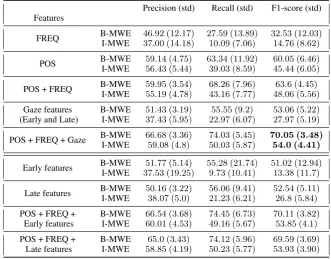
We report the results of CRF labeling using differ-ent sets of features, including POS tags, Frequency (referred to as FREQ), Early and Late gaze mea-sures (Table2).
Since most of the data are not MWEs and are thus irrelevant to the task, we report the re-sults exclusively for the words at the beginning of the MWEs (B-MWE) and other words occurring within and at the end of the expressions (I-MWE). In Table 2, we have first shown that augment-ing the lexical features (POS and FREQ) with Gaze has slightly improved the performance (F
lexi-Table 2: The performance (%) and Standard Deviation (std) (%) of CRF labeling models using different sets of features.
Precision (std) Recall (std) F1-score (std) Features
FREQ B-MWEI-MWE 3746..92 (1200 (14..17)18) 2710..59 (1309 (7.06).89) 3214..53 (1276 (8.62).03)
POS B-MWEI-MWE 5659..14 (443 (5..75)44) 6339..34 (1103 (8.59).92) 4560..44 (605 (6..46)05)
POS + FREQ B-MWEI-MWE 5559..95 (319 (4..54)78) 6843..16 (726 (7..77)96) 4863..06 (56 (4..45)56)
Gaze features B-MWE 51.43 (3.19) 55.55 (9.2) 53.06 (5.22) (Early and Late) I-MWE 37.43 (5.95) 22.97 (6.07) 27.97 (5.19) POS + FREQ + Gaze B-MWEI-MWE 6659..68 (308 (4..36)8) 7450..03 (503 (5..87)45) 7054..05 (30 (4.41).48)
Early features B-MWEI-MWE 3751..53 (1977 (5..14)25) 559.73 (10.28 (21.41).74) 5113..02 (1238 (11.94).7)
Late features B-MWEI-MWE 5038..16 (307 (5..22)0) 2156..06 (923 (6..21)41) 5226..54 (58 (5..84)11)
POS + FREQ + B-MWE 66.54 (3.68) 74.45 (6.73) 70.11 (3.82) Early features I-MWE 60.01 (4.53) 49.16 (5.67) 53.85 (4.1) POS + FREQ + B-MWE 65.0 (3.43) 74.12 (5.96) 69.59 (3.69)
Late features I-MWE 58.85 (4.19) 50.23 (5.77) 53.93 (3.90)
cal features and the gaze information outperforms the baseline model and the model that uses Gaze features alone (Early and Late) (F=53.06 for B-MWE andF=27.97 for I-MWE).
We also compare the performance of Early and Late features in identifying MWEs in the second part of the table. We note that Late features ap-pear to be more discriminative than Early features in identifying MWEs. Although in case of the B-MWE, the improvement over Early features is minimal, the difference is more contrastive for I-MWE. Also the standard deviation for the model using Late features confirms its superior reliabil-ity. We see these improvements when using Early or Late features by themselves and not in conjuc-tion with POS+FREQ.
Furthermore, we have conducted an experi-ment with gaze features extracted from non-native speakers of English. Table3presents a compari-son between the F1 scores obtained from training on L1 and L2 gaze data. There were no signifi-cant differences between the two groups in terms of precision and recall, hence, for the purpose of brevity, we present the comparison only in terms of F1 scores. The better performance when using Late gaze features over Early is well reiterated in the data extracted for non-native speakers in this table.
Table 3: The performance (F1-score%) compari-son between data from native (L1) and non-native (L2) speakers.
Features L1 L2
Gaze B-MWEI-MWE 5327..06 (597 (5..22)19) 2654.66 (5.26 (4..11)8) POS + FREQ B-MWE 70.05 (3.48) 69.66 (3.07) + Gaze I-MWE 54.0 (4.41) 52.84 (3.89)
Early Gaze B-MWEI-MWE 5113..02 (1238 (11..94) 5107) 11.63 (11.69 (13.66).3)
Late Gaze B-MWEI-MWE 5226..54 (58 (5.84).11) 2754..24 (595 (5..04)78)
7 Discussion
In this section we discuss the results presented above with regards to: i) MWEs identification accuracy, ii) comparison between the predictive power of gaze data of native versus non-native speakers, and iii) the predictive power of Early versus Late gaze features.
model of Gaze + Freq + POS outperformed the baseline and achieved a performance comparable to the state-of-the-art in the field (Section 2.2). The lower values for the standard deviations in the combined model for both B-MWE and I-MWE also show that it is more reliable than the baseline in its prediction over 100 iterations. Furthermore, the fact that gaze features improve the classifi-cation accuracy means that readers process these structures differently.
We do not observe significant differences in model accuracy when running parallel models on the data from the native speakers and the one from the non-native speakers, which indicates that both data sets are discriminative to an equal extent. It is important to note that the non-native speakers were highly proficient in English and that this re-sult may not be replicated with gaze data from less proficient readers. From a practical perspective this is important with regards to the type of eye-tracking corpora which could be used in similar experiments in the future. Since such resources are scarce and expensive to obtain, it is reassuring to know that data from non-native speakers could be used equally well for the purpose of automati-cally identifying MWEs. From a psycholinguistic perspective however, this finding is not in line with previous research on the differences in gaze pat-terns between native and non-native speakers read-ing formulaic language (Section 2.1). One rea-son for this could be that previous research using gaze data to explore the processing of formulaic language has focused predominantly on idioms, while we discuss MWEs. Another reason for this could be the different data sets used in these stud-ies and conclusive results can only be drawn if id-iom research is performed using the GECO corpus or vice-versa.
Finally, much in line with previous studies (e.g. Siyanova-Chanturia(2013)) we observe that early gaze features are not useful metrics for investigat-ing formulaic language. It is important to note that late features were more discriminative even with-out using the entire Late feature set; there were no significant differences in performance when re-moving late features related to the third run and last runs (F = 0.52 for B-MWE and F = 0.23 for I-MWE). In our experiments the late features were particularly better at identifying the words inside the MWEs and we hypothesise that this ef-fect could be due to the fact that given our
pat-tern of Verb + Noun and Verb + Particle construc-tions, these were the disambiguation regions of the MWEs. Another possible explanation for the superiority of late features could be that mental processing of MWEs occurs after the fact, mean-ing, after the word is first encountered in reading. Therefore, early gaze features are not expected to contain much information about whether a partic-ular sequence of tokens are MWE or not.
Some of the limitations of this research are re-lated to averaging of data from multiple partici-pants and the fact that the newly-released GECO corpus (Cop et al., 2016) has not yet been stud-ied in detail and thus it is possible that it con-tains inaccuracies yet to be spotted. We plan to address the first limitation by conducting a study where separate models are built for each individ-ual participant. This would allow analysis of in-dividual differences and the effects they have on the robustness of the model. We chose to use the GECO corpus since it was the only corpus avail-able which allowed comparison of gaze data from native versus non-native speakers. Nevertheless, it would be interesting to compare our current re-sults on the GECO data to rere-sults from more es-tablished eye tracking corpora such as the Dundee corpus (Kennedy et al., 2013) in order to further assess the validity of our findings.
8 Conclusions
This paper presents preliminary research towards using gaze data to automatically identify multi-word expressions. We show that MWEs are in-deed viewed differently and that best classifica-tion performance is achieved by a combined model of gaze features, frequency and POS tags, which outperform models based on frequency and POS only and on gaze features only. Furthermore, we show that there is no statistically significant dif-ference between the performance of models using gaze data from native versus highly proficient non-native speakers of English, suggesting that data from both reader groups could be used for sim-ilar tasks in the future. Finally, consistent with previous research in the field, we show that late gaze features are better predictors of formulaic language.
Agata Savary, Carlos Ramisch, Silvio Cordeiro, Fed-erico Sangati, Veronika Vincze, Behrang Qasem-izadeh, Marie Candito, Fabienne Cap, Voula Giouli, Ivelina Stoyanova, et al. 2017. The parseme shared task on automatic identification of verbal multiword expressions. InProceedings of the 13th Workshop on Multiword Expressions (MWE 2017). pages 31– 47.
Nathan Schneider, Emily Danchik, Chris Dyer, and Noah A. Smith. 2014. Discriminative lexical se-mantic segmentation with gaps: Running the mwe gamut. Transactions of the Association for Compu-tational Linguistics2:193–206.
Manon Scholivet and Carlos Ramisch. 2017. Identi-fication of ambiguous multiword expressions using sequence models and lexical resources. In Proceed-ings of the 13th Workshop on Multiword Expressions (MWE 2017). Association for Computational Lin-guistics, Valencia, Spain, pages 167–175.
Anna Siyanova-Chanturia. 2013. Eye-tracking and erps in multi-word expression research: A state-of-the-art review of the method and findings. The Men-tal Lexicon8(2):245–268.
Anna Siyanova-Chanturia, Kathy Conklin, and Nor-bert Schmitt. 2011. Adding more fuel to the fire: An eye-tracking study of idiom processing by na-tive and non-nana-tive speakers. Second Language Re-search27(2):251–272.
Anders Søgaard. 2016. Evaluating word embeddings with fmri and eye-tracking. ACL 2016page 116. Geoffrey Underwood, Norbert Schmitt, and Adam
Galpin. 2004. The eyes have it. Formulaic se-quences: Acquisition, processing, and use9:153. Aline Villavicencio. 2003. Verb-particle constructions
and lexical resources. In Proceedings of the ACL 2003 Workshop on Multiword Expressions: Analy-sis, Acquisition and Treatment - Volume 18. Asso-ciation for Computational Linguistics, Stroudsburg, PA, USA, MWE ’03, pages 57–64.