Smart Home Technology
Subhash khalkho & Sunny kumar
Department of IT, 3rd sem,DCE, Gurgaon,Haryana
[email protected] ; [email protected]
Abstract
In this paper we describe how smart home technology can contribute towards a way of independent living. This paper shows how to take home automation to the next level, using state of the art technologies such as tablets, smart phones, and the Internet in conjunction with the latest wireless home automation standards, it has been written for anyone who wants to use their smart phones control to automate a building or a residential home but with safety measures provided to it because without safety it is nothing there to feel safe for a resident.
1.Introduction
Home automation, is an intersection to an increasingly developing technologies such as Internet, mobile communication, and renewable energies which has changed considerably over the course of the past years. The developments relate to all major aspects of a smart home, such as
Capabilities of home infrastructure and controlled device
Usability of mobile and stationary user interfaces
Motivation for investing in automation and control technologies
Home automation was mainly focused on installing controllable power-outlets or light switches and wiring infrared (IR) controls around the house. Technologies that developed in the early seventies of the past century, which from today’s perspective are slow, unreliable, and insecure, were at the heart of building
control. The rapid developments in mobile communications have introduced a technological level forward in home automation. Wireless networks (3G, 4G, Wi-Fi) and smart devices, with wireless communication interfaces (Bluetooth, ZigBee, Wi-Fi), are omnipresent, and allow the user to take home control and building automation to the next level. Instead of simply switching power outlets on and off, specific and meaningful functions of consumer electronics, household devices, or infrastructure components can be stirred. As a result, instead of rudimentary functionality, home automation today can deliver capabilities that have a real impact on comfort, security, and energy conservation in residential and industrial buildings. Of similar significance to the changes in what is possible in home automation have been the advances in user interface. The smart phone and tablet revolution has finally brought the personal, universal remote control device to the home. Proprietary, stationary panels and control devices are phasing out, being replaced by apps, which are easy to operate, to maintain, and to upgrade. With the improved usability and capabilities, the motivations for installing home intelligence have become broader as well. The vision of a green building, capable of significantly reducing energy and water consumption, is finally becoming real.Other new
2. Wireless Technologies used in smart homes
The wireless technology standards are everywhere. Bluetooth, Zigbee, RFID, WiFi, and cellular technologies are the most well known standards. A combination of these standards is envisaged to be used to construct the smart home. Effectively all wireless technologies that can support some form of remote data transfer, sensing and control are candidates for inclusion in the smart home portfolio. This section discusses some of these key wireless technologies.
2.1 Bluetooth
Bluetooth is a universal radio interface that enables various electronic devices, including mobile phones, sensors… etc, to communicate wirelessly through a short range radio connection. The introduction of this technology eliminated the requirement for wired connections, eased the connectivity process between devices, and enabled the formation of personal networks. The pervasiveness of Bluetooth enabled electronic devices is enabling ubiquitous connectivity and hence allowing the development of many applications.
A Bluetooth device uses a license-free frequency band at 2.45 GHz. This band is also known as the Industrial-Scientific-Medical (ISM) band and has a range of 2.4 GHz to 2.4835 GHz. As this band is a free one, and hence gets used by other applications such as cordless phones, Bluetooth radio transceivers use frequency-hopping spread-spectrum to avoid interference. Depending on the Bluetooth class, the communication range varies from 1 meter for Class 3 to 100 meters for Class 1. The most common range is 10 meters for Class 2. The data rate of devices in a Bluetooth network varies from 1 Mbps to 24 Mbps. In a Bluetooth network, there are two types of devices: a slave and a master. Each
Bluetooth device has the ability to be either a slave or a master or both at the same time. In general, a Bluetooth network consists of small subnets or piconets. A piconet is formed by two or more connected devices sharing the same channel.In every piconet,there is only one master and upto 7slaves. The communication between the slaves goes all time through the master. When two or more piconets are connected they form a scatternet. The connection between piconets can be done by having a device in common. This device may be a slave in one piconet and a master in another piconet as shown in Fig. 1.
Fig.1. An example of Bluetooth
scatter-net
2.2 ZigBee(IEEE 802.15.4)
It is a standard low cost low power wireless communication standard for Personal Area Network (PAN). The low cost makes it suitable for remote control and monitoring applications. The low power makes it suitable to operate on batteries for long life. It reduces the cost of hardware and consuming power by lowering its data rate. The specifications define only the lowest two layer of the OSI networking reference model: the physical and Media Access Control (MAC) layers. The data rate, operating frequency, and network size are defined by the standard. The achieved data rate between IEEE 802.15.4 compliant devices varies from 250 kbit/s to 20 kb/s depending on the distance between devices and the transmission power. These devices may operate in one of the following three RF bands: 868 MHz (Europe), 915 MHz (North America), and 2400 MHz (worldwide). The 2.4 GMhz band is used more often than the other bands since it is available worldwide for unlicensed operation. In addition to that, the performance of products developed for that band is better when compared to the other bands with respect to data rate. The size of the network is not limited by the standard. However, network address are stored and sent using 16 bit or 64 bit numbers, which limits the network size to 264 devices. IEEE 802.15.4 standard defines Star, Cluster Tree and Mesh networks as possible topologies for the wireless network. However, mesh networks enable high levels of reliability and longer coverage range by providing more than one path through the network for any wireless link. Note that in any ZigBee network there are three types of ZigBee devices PAN coordinator: There is only one coordinator in a network that is responsible for starting the network, binding together devices. Also it routes data between different devices. It is a Full Function Device (FFD) and it is usually
mains powered device. A router: It cannot start the network however it scans a network to join it. Once it is in the network it can route data between Reduced Function Devices (RFD). It is a FFD and it is usually mains powered device. An end device: It cannot start a network however it scans a network to join it. It can be either a RFD or FFD and it is usually battery powered device.
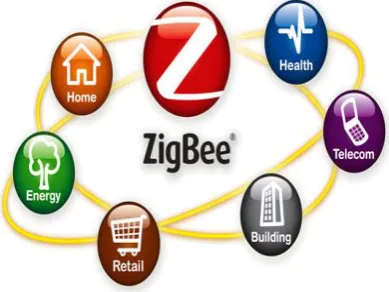
The protocol stack of Zigbee defines only some functionality in layers on top of the physical and MAC layers which are defined in the IEEE 802.15.4 standard. It provides the set of programming tools for the intended market. Furthermore, ZigBee technology defines a set of applications profiles to facilitate the development and deployment of ZigBee devices from different manufacturers as shown in Fig. 2.
Fig. 2. ZigBee Applications Profiles
2.3 RFID
passive tag uses the reader’s magnetic field and converts it to DC voltage to power up its circuitry. Consequently, the passive tags are cheaper and have lower range when compared to active tags. RFID systems can be categorized based on the used frequency ranges. The Low-Frequency (LF) systems use signals with a frequency between 124-135KHz. The High-Frequency (HF) systems use a 13.56MHz and the Ultra-High-Frequency (UHF) systems use a frequency between 860-960MHz. In general, the LF RFID systems have short reading ranges and lower system costs. In case longer reading range is required, HF RFID systems can be used however their cost is higher.
RFID systems can be used in smart homes where every single object can be connected to the Home Area Network (HAN) through a virtual wireless address and unique identifier. This can be used to keep an updated database holding information about objects’ locations. Accordingly, the smart home can be asked to provide information about a specific object that you are looking for such as your car’s key or your remote control. Furthermore, RFID system can be used to track smart home occupants, where a number of studies have been reported in the literature that use RFID concept to track smart home occupants. By the attachment of a RFID tag to each smart home user and the deployment of RFID readers at different places in the home, the location of each user can be identified. This information can be used to adapt services in the smart home based on each user preferences. One of the problems of using RFID tags to track people in smart homes is that the readability of RFID tags is difficult near water or a sheet of metal. The human body consists primarily of liquid which makes it difficult to scan a RFID tag attached to human body. However, researchers are looking for new ways to improve the readability of RFID tags in these difficult environments.
2.4 GSM/GPRS
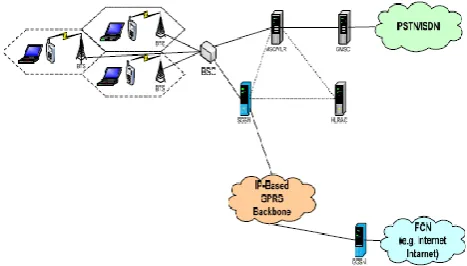
The GSM (Global System Mobile) is the technology that generated a revolution in the field of mobile communications. New generations of GSM were introduced over the past decade that includes GPRS, UMTS... etc in order to improve the transmission rates, and offer new types of services. The GSM which is also known as the cellular network is based on frequency reuse. To that effect a particular geographical area gets divided into cells. The size of the cell is normally dependent on the local traffic distribution and demand. A high level architectural view of GSM/GPRS is shown in Fig. 3. The mobile wireless system such as GSM/GPRS is used to deliver both voice and data communications. One of the cost effective services that is delivered by the network and can be used for smart homes applications is the SMS (short message service). The SMS is a text message whose content can be processed using an appropriate program in order to execute commands for monitoring and control operations. Such programs are normally written using Java language. The ability to use the GSM network basically means that remote access and control to a smart home is possible.
Fig. 3. GSM–GPRS System Architecture
2.5 WiFi (IEEE 802.11)
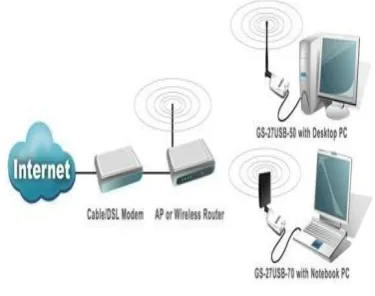
area networks (WLAN) in the 2.4, 3.6 and 5 GHz frequency bands. Network users, when using WiFi technology, can move around without restriction and access the network from almost anywhere. Also it can provide a cost- effective network setup for hard-to-wire locations such as old buildings. Two types of devices are considered in the WiFi standard: an access point (AP) and a wireless device which could be a laptop equipped with a wireless network interface. The main function of an AP is to bridge the information between the fixed wired network and the wireless network. An AP can support up to 30 wireless devices and can cover a range of 33–50 meters indoors and up to 100 meters outdoors. The wireless devices can be possibly connected together using infrastructure topology or an ad hoc mode topology. The infrastructure topology is sometime called an AP topology since the wireless network consists of at least an AP and a set of wireless devices. In this topology, the system is divided into basic cells, where each cell is controlled by an AP.
Fig. 4. A typical WLAN
In general, wireless networks should be able to reach fixed Local Area Network (LAN) services such as file servers, printers and Internet access. This is achieved by the distribution system (DS) connecting the different APs together. The
connection between the APs can be done using either a cable connecting them together or using a wireless connection. The data transfer between wireless devices within a basic cell and the distribution system occur via an AP. The distribution system is responsible for transferring the data packets between various cells within the wireless network. It is also responsible for address mapping and internetworking functions. To cover an extended area, basic cells may sometimes partially overlap. On the other hand, the ad hoc topology represents a group of WiFi devices that have the ability to dynamically form connections with each other to create a network. This ad-hoc network does not require a connection to either an AP or to fixed network. It can grow, shrink and fragment without having to make any requests to a central authority. It is useful for setting up a wireless network quickly and easy.
wireless technology. Since the existing 802.11a/b/g standards were created to serve the PC applications domain, they have substantial limitations for real-time and high bandwidth requirements from consumer electronics applications. Even though the 802.11g has a maximum data rate of 54Mb/s, in practice it achieves 20Mb/s with difficulty, especially when the signal has to penetrate walls. With the improvements in codec technologies such as MPEG4, H.264 and WMV9 the required bandwidth to stream video is reduced. However, other requirements are driving to increase the required streaming bandwidth such as high definition video, the Voice over Internet Protocol (VoIP), networked audio devices, etc.
3. Safety Management
Another application for state of the art home automation is remote building control and safety management with features such as – Controlling the vacant home (temperature, energy, gas, water, smoke, wind) – Feeding and watching pets – Watering plants indoors and outdoors – Presence simulation to keep out intruders – Assistive living systems (assistive domotics), allowing elderly and handicapped people to stay home safe through reminder systems, medication dispensing, blood pressure and pulse monitoring and emergency notification.
3.1 Appliance monitoring and control
By exploiting sensors in smart home appliances and connecting them in smart home network, they can operate in a much more sophisticated and intelligent ways. They could be controlled easily from any place in the house by switching them ON or OFF from rooms in the house. The remote control and monitoring of these appliances can be performed remotely via the Internet or GSM mobile phones. Furthermore, some machine can act smartly by reporting their problems to the service company. For example, the
refrigerator might report a cooling problem to the maintenance company; this is much needed in case smart home inhibitors are in holiday. Furthermore, by exploiting electronic tags in food’s packages, clothes, dishes, etc smart home appliance can operate in intelligent ways. White goods companies such as Merloni Elettrodomestici, are introducing appliances that communicates with objects using RFID. Washing machine can scan the load in it to adjust the wash cycle to be suitable for the fabrics used. The refrigerator also might warn the user about the expiry dates of some of the products inside it. In addition to that it can send automatically a shopping list to some home delivery services.
3.2 Safety and Security
be in his house, the main gate can be opened to allow the postman to deliver the package. He can also close the doors and the main gate after the postman leaves the house. Via the Internet or his mobile phone, he could also switch on or off the heating/cooling system for a specific part of his home. In case the smart home occupants are in holiday, they could program the system to simulate the owner presence inside the home by switching on the home lights and switching them off at regular times.
3.3 Tele-health Care
The cost of providing health care particularly in developed countries continues to rise. This is attributed to many factors that include an increase in peoples’ life expectancy coupled with a decline in birth rates which are resulting in an aging population. Add to this is the general increase in the salaries of health professionals and the cost of medication and diagnostic equipment. All these costs are putting a huge strain on the health budgets of the various government departments and agencies. This means that the provisions for long-term health care within hospitals and clinics are severely restricted. However, those patients who may need long-term health care, such as elderly persons with heart problems, may not have people to look after them once they go home or they may simply prefer to live within their own normal environment for psychological, social or other similar reasons. The availability of a smart living environment, in the form of a smart home, will help alleviate some aspects of this problem and hence release resources that would otherwise go to long-term health support of an individual patient to other patients, enable early diagnosis of chronic health conditions, and make clinical visits more efficient due to the availability of objective information prior to the such visits. A number of studies have been reported in the literature that applies the smart home
concept to deliver various aspects of telemedicine or tele-health. The general architecture of a system that delivers the required health-care services would consist of an appropriate set of sensors that monitor specific medical conditions or situations and communicates it to a local server and then transmits it to the entity assigned to look after the patient. Many of the proposed telehealth system use multi-agent technology to arrive at an intelligent decision regarding the health state of the person being monitore. The system described in uses a set of cameras to form a distributed vision processing setup. Analysis of the occupant’s posture is then used to detect if the person suffered a fall. The assessment is based on a set of rules and once a fall situation is asserted an alarm gets sent to a call centre. A voice link can then be established between the occupant and the care centre.
3.4 Energy Metering
response mechanism where customers are informed about TOU rates. This will encourage the customers to manage their energy usage efficiently. These actions will help utility companies in reducing their peak demands and users to reduce their utility bills. The use of smart electricity meters in smart homes will definitely be able to communicate with utility companies for the purpose of load control and demand response. Through Home Area Network (HAN), smart meters can communicate and control other appliances in the smart home, such as the HVAC system. In addition to that the smart home owner can take voluntary actions during demand/response periods to reduce his/her home consumption by turning off appliances, lights, etc. Having the household appliances interconnected will facilitate load control and demand response. For example, a dishwasher can be given the command to delay its start time to a time that has lower utility rate.
3.5 Environmental Control
Heating and cooling a house is the major post in the houses’ utility bill, therefore, they deserve special attention when designing smart homes. Choosing good isolation materials for constructing homes that are suitable for their environment is the foundation to reduce these costs. By the deployment of smart sensors inside and outside the house, the houses’ energy consumption can be managed efficiently. By collecting information from the distributed sensors inside the house such as thermostats, humidity, airflow, etc and from sensors outside the house such as thermostats, humidity, sunshine, wind speed meter etc, these information can be processed to control HVAC units and blinds/shades/ rollers/windows. For example, in case that a window is opened for a pre-specified period while the HVAC unit was on for that specific room, a decision can be made to stop that unit or to alarm user about this inefficient use of energy. In addition to that, an advice can
be given to the user to shut the curtains in the night when the temperature outside is much lower than the one inside the house while the heating system was on. The renewable sources of energy available to smart homes depend on their geographical locations. For example, in locations where the sun shines most of the year, it is advisable to have solar panels installed on its roof. In other locations where you have windy climate, it is advisable to have wind turbines installed in garden. By monitoring the environmental conditions inside and outside the house and the current home load condition, decisions can be made how to use the generated electricity. In case that the house is connected to smart electricity grid, the extra electricity can be fed back to the grid.
3.6 Information Access
The smart home should respond to the inhibitors needs and the change of these needs in unobtrusive and invisible way while remaining under the control of the users . By identifying the location of a person inside the house and by sensing his activity the environment can be adapted to suit his wishes. In case the person requires information it will be forwarded to the nearest display based on his location. Also his preferences and the accessed information should move with him when he changes his location. In case the smart home inhibitor was watching the news while he was shaving in the bath room, the same news channel will be displayed in the kitchen when he moved there to drink his coffee. In case the smart home inhibitor is reading a novel, the information related to novel could be retrieved from the Internet and displayed on the nearest display scree.
4. Conclusion
fundamental part of the infrastructure of modern smart homes. Some of those technologies are integrated within sensing and networking devices such as Zigbee, Bluetooth, RFID, and WiFi. Other wireless technologies, such as the GSM, are more of a wider format that can form large network and yet can integrate with the other ones dedicated for short range. The paper also briefly discussed some of the modern sensors that can be used in smart homes. Many of them are of the embedded ubiquitous type that is equipped with wireless communication capabilities and can connect to other devices. The application areas discussed include appliances monitoring and control, safety and security, telehealth care, energy saving, environmental control, and information access.
5. References
1. Robles, R. J., & Kim, T. H. (2010). Applications, systems and methods in smart home technology: a review.
2. Dewsbury, G. (2001). The social and psychological aspects of smart home technology within the care sector. New Technology In The Human Services,
14(1/2), 9-17.
3. Demiris, G., Rantz, M. J., Aud, M. A., Marek, K. D., Tyrer, H. W., Skubic, M., & Hussam, A. A. (2004). Older adults' attitudes towards and perceptions of'smart
home'technologies: a pilot study.
Informatics for Health and Social Care, 29(2), 87-94.
4. Wu, C. L., Liao, C. F., & Fu, L. C. (2007). Service-oriented smart-home architecture based on OSGi and mobile-agent technology. Systems, Man, and Cybernetics, Part C:
Applications and Reviews, IEEE Transactions on, 37(2), 193-205.
5. Rialle, V., Duchene, F., Noury, N., Bajolle, L., & Demongeot, J. (2002). Health" smart" home: information technology for patients at home.
Telemedicine Journal and E-Health,
8(4), 395-409.
6. Meyer, S., & Mollenkopf, H. (2003). Home technology, smart homes, and the aging user. Aging independently: Living arrangements and mobility, 148-161.
7. Tomita, M. R., Mann, W. C., Stanton, K., Tomita, A. D., & Sundar, V. (2007). Use of currently available smart home technology by frail elders: process and outcomes. Topics in geriatric rehabilitation, 23(1), 24-34.
8. Courtney, K. L., Demiris, G., Rantz, M., & Skubic, M. (2008). Needing smart home technologies: the perspectives of older adults in continuing care retirement
communities. Informatics in primary care, 16(3), 195-201.
9. Dewsbury, G., Clarke, K., Rouncefield, M., Sommerville, I., Taylor, B., & Edge, M. (2003). Designing acceptable'smart'home technology to support people in the home. Technology and Disability,
15(3), 191-199.
10. Ricquebourg, V., Menga, D., Durand, D., Marhic, B., Delahoche, L., & Loge, C. (2006, December). The smart home concept: our immediate future. In E-Learning in Industrial
Electronics, 2006 1ST IEEE