Design and Implementation of an IOT based
Efficient and Intelligent Smart Bins by using
Raspberry Pi
K.Parvateesam1, B.Divakar2
Assistant Professor, Dept. of ECE, Aditya College of Engineering & Technology, Kakinada, Andhra Pradesh, India1
Assistant Professor, Dept. of ECE, Aditya College of Engineering & Technology, Kakinada, Andhra Pradesh, India2
ABSTRACT: Nowadays people are using smart phone to pay their electricity bills, buy vegetables, book transport ticket. Order accessories. But those are all done for an individual need. In this paper we used that smart for the welfare of the society. Overflowing garbage bins is a cause of concern for residents in developing countries. With the existence of many deceases in our nation, the open containers are proving to be a breeding place for germs. Traditionally municipalities operate on weekly routes to pick up wastes in the garbage bin on designated days but regardless of whether the containers re full or not. This paper aims to optimize waste collection and to maintain the cleanliness of the area. The aim of the paper is to control the waste management system by using internet. Internet of things (IOT) is the concept of basically connecting any device with an on and off switch to the internet. This project connects the trash can to the internet. It will update the status of the trash can to the user so that the garbage will be cleaned earlier to the overflow stage. This smart trash can has two ultrasonic sensors. Which are used to find the level of the garbage in the trash can. If the level reaches the threshold value then the Raspberry Pi model will send message to a mobile application as well as to an IOT cloud.
KEYWORDS: Raspberry Pi, IOT cloud, Smart bin.
I. INTRODUCTION
II. HARDWARE DESIGN OF THE SYSTEM
Fig 1 Block diagram of the System.
1) HC-SR04 ULTRASONIC SENSOR - WORKING
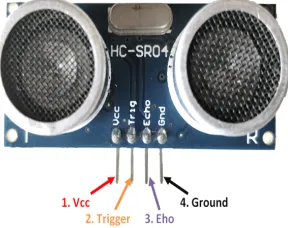
As shown above the HC-SR04 Ultrasonic (US) sensor is a 4 pin module, whose pin names are Vcc, Trigger, Echo and Ground respectively. This sensor is a very popular sensor used in many applications where measuring distance or sensing objects are required. The module has two eyes like projects in the front which forms the Ultrasonic transmitter and Receiver. The Ultrasonic transmitter transmits an ultrasonic wave, this wave travels in air and when it gets objected by any material it gets reflected back toward the sensor this reflected wave is observed by the Ultrasonic receiver module as shown in the picture below.
Fig 2 HC-SR04 Ultrasonic Sensor – Working
Fig 3 Ultrasonic Sensor
2) RASPBERRY PI
The Raspberry Pi is a series of small single-board computers developed in the United Kingdom by the Raspberry Pi Foundationto promote the teaching of basic computer science in schools and in developing countries. The original model became far more popular than anticipated, selling outside its target market for uses such as robotics. It does not include peripherals (such as keyboards, mice and cases). However, some accessories have been included in several
Power Supply
Device With WiFi Internet For IOT Result
Raspberry Pi Module
Ultrasonic Sensor-II Ultrasonic
Sensor-I
official and unofficial bundles. The Raspberry Pi 3 uses a Broadcom BCM2837 SoC with a 1.2 GHz 64-bit quad-core ARM Cortex-A53 processor, with 512 KB shared L2 cache
Fig 4 Raspberry Pi
3) GPIO PIN CIRCUITRY
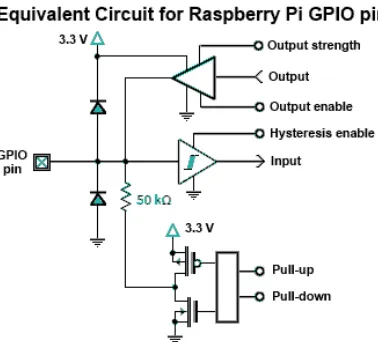
The Raspberry Pi's GPIO pins are quite versatile, and you can modify many of their characteristics from software. You can turn on/off input pin hysteresis, limit output slew rate, and control source and sink current drive capability from 2 mA to 16 mA in 2 mA increments. These properties are set for the GPIO block as a whole, not on a pin-by-pin basis. Source/sink current capability does not limit the current into or out of the pin, but only specifies the maximum current for which the output signal high/low voltage specifications will be met. If misused, output pins can be damaged by excessive current irrespective of the source/sink current programmed. After a reset, the RPi comes up with the GPIO outputs set to 8 mA drive capability. The following diagram shows a simplified schematic of the I/O pin circuitry:
4) CIRCUIT DIAGRAM
The above circuit consists of two ULTRASONIC SENSORS, BREAD BOARD and RASBERRY-PI module.
Fig. 6Circuit Diagram
The circuit configuration is as follows:
Ultrasonic seonsor1: Echo pin is connected to pin_23 and Tagger pin is connected to pin_24 of raspberry-pi. Ultrasonic seonsor2: Echo pin is connected to pin_27 and Trigger pin is connected to pin_22 of raspberry-pi.
5) GARBAGE CONTAINER
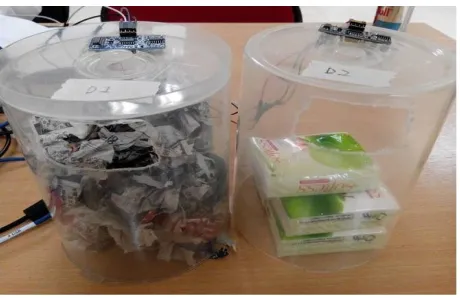
A waste container is a container for temporarily storing waste, and is usually made out of metal or plastic. The curbside dustbins usually consist of three types: trash cans (receptacles made of metal or plastic), dumpsters and wheelie bins (light, usually plastic bins that are mobile). All of these are emptied by collectors, who will load the contents into a garbage truck and drive it to a landfill, incinerator or consuming crush facility to be disposed of.
Fig 7 Dustbins
III. WORKING OF THE SYSTEM
built to show the status to the user monitoring it. The application gives a view of the garbage bins and highlights the garbage collected in color in order to show the level of garbage collected.. Thus this system helps to keep the city clean by informing about the garbage levels of the bins by providing image of the bins via IOT application development platform. The authorized person receives the indication of garbage dustbin is full through the application and then inform the concerned person who is responsible for the collection of garbage where the garbage bin is full in particular areas. The data get stored in the database created and than the data is retrieve In IoT applied to external and public environments, communication is important for service provisioning. In particular, since this type of IoT has a wide service domain, reliable communication is necessary for devices to communicate with each other. Therefore, the SGBs utilized in the proposed system communicate with each other based on a wireless mesh network , securing communication reliability. IoT devices in an external environment may need to move on occasion. With a battery-based power supply, the mobility of the proposed system is secured. In IoT with a wide service domain, data exchanges and services should be conducted seamlessly at any time and any location. User convenience has been enhanced with the advent of IoT.
IV. SOFTWARE IMPLEMENTATION
In the software implementation of the system we used Python programming for the accessing of the information to IOT. The OS initialization also done for the Pi board. The following flow chart can explain the major working principle of the system. For IOT results we have used MQTT open source server as a broker connection between client system and internet server. We have used TWILIO to receive phone calls and messages by its web serviceAPIs.
NO
YES
Fig 8 Flowchart of the system. Start
Set Gpio Pins Echo: Input Trig:Output
Set Trig High
Wait For Signalto Receive
If Received?
Calculate Distance& send to IOT cloud
1) MQTT
MQTT stands for MQ Telemetry Transport. It is a publish/subscribe, extremely simple and lightweight messaging protocol, designed for constrained devices and low-bandwidth, high-latency or unreliable networks. The design principles are to minimize network bandwidth and device resource requirements whilst also attempting to ensure reliability and some degree of assurance of delivery. These principles also turn out to make the protocol ideal of the emerging “machine-to-machine” (M2M) or “Internet of Things” world of connected devices, and for mobile applications where bandwidth and battery power are at a premium. MQTT (MQ Telemetry Transport or MessageQueuing Telemetry Transport) is an ISO standard (ISO/IEC PRF 20922) publish-subscribe-based messaging protocol. It works on top of the TCP/IP protocol. It is designed for connections with remote locations where a "small code footprint" is required or the network bandwidth is limited. The publish-subscribe messaging pattern requires a message broker. Andy Stanford-Clark and Arlen Nipper of Cirrus Link authored the first version of the protocol in 1999. The specification does not specify the meaning of "small code footprint" or the meaning of "limited network bandwidth". Thus, the protocol's availability for use depends on the context. In 2013, IBM submitted MQTT v3.1 to the OASIS specification body with a charter that ensured only minor changes to the specification could be accepted. MQTT-SN is a variation of the main protocol aimed at embedded devices on non-TCP/IP networks, such as ZigBee. Historically, the "MQ" in "MQTT" came from IBM's MQ Series message queuing product line. However, queuing itself is not required to be supported as a standard feature in all situations. Alternative protocols include the Advanced Message Queuing Protocol (AMQP), Streaming Text Oriented Messaging Protocol (STOMP), the IETF Constrained Application Protocol, XMPP, DDS, OPC UA, and Web Application Messaging Protocol (WAMP).Mqtt Publish Subscribe Architecture: The MQTT messages are delivered asynchronously (“push”) through publish subscribe architecture. The MQTT protocol works by exchanging a series of MQTT control packets in a defined way. Each control packet has a specific purpose and every bit in the packet is carefully crafted to reduce the data transmitted over the network. A MQTT topology has a MQTT server and a MQTT client. MQTT client and server communicate through different control packets. Table below briefly describes each of these control packets. MQTT control packet headers are kept as small as possible. Each MQTT control packet consist of three parts, a fixed header, variable header and payload. Each MQTT control packet has a 2 byte Fixed header. Not all the control packet have the variable headers and payload. A variable header contains the packet identifier if used by the control packet. A payload up to 256 MB could be attached in the packets. Having a small header overhead makes this protocol appropriate for IoT by lowering the amount of data transmitted over constrained networks.
Fig 9MQTT Publish ans Subscribe Model
2) TWILIO
expedites IoT by connecting humans to the machine network. Twilio has worked with a number of IoT companies including Smart Thing and Uber. Using Twilio, Smart Things will text you if you leave your garage door open. And you can set it up to trigger any sort of notifications you want such as intimation of an unlocked door at a particular time. Similarly, Uber is using Twilio to scale its operations globally. Being a cloud-based platform, Twilio helps Uber in setting up mobile communication infrastructure. Twilio made communication secure by masking driver’s and rider’s phone number from each other.
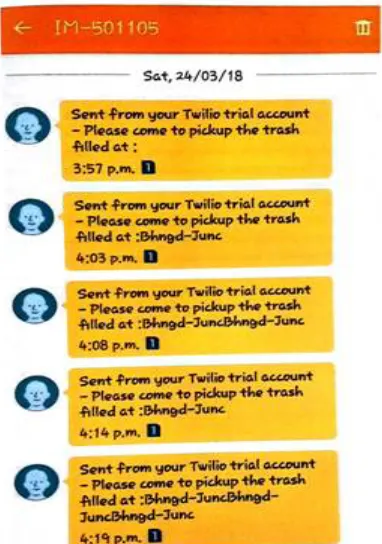
Fig 10 Output in the user’s Mobile about the status of the dust bin.
V. CONCLUSION
We have implemented real time waste management system by using smart dustbins to check the fill level of smart dustbins whether the dustbins are full or not. In this system the information of all smart dustbins can be accessed from anywhere and anytime by the concern person and he/she can take a decision accordingly. By implementing this proposed system the cost reduction, resource optimization, effective usage of smart dustbins can be done. This system indirectly reducing traffic in the city. In major cities the garbage collection vehicle visit the area’s everyday twice or thrice depends on the population of the particular area and sometimes these dustbins may not be full. Our System will inform the status of each and every dust bin in real time so that the concerned authority can send the garbage collection vehicle only when the dustbin is full. The scope for the future work is this system can be implemented with time stamp in which real-time clock shown to the concern person at what time dust bin is full and at what time the waste is collected from the smart dustbins.
REFERENCES
1. Kanchan Mahajan, “Waste Bin Monitoring System Using Integrated Technologies”, International Journal of Innovative Research in Science, Engineering and Technology, Issue 3, Issue 7, July 2014.
3. Raghumani Singh, C. Dey, M. Solid waste management of Thou bal Municipality, Manipur- a case study Green Technology and Environmental Conservation (GTEC 2011), 2011 International Conference Chennai 21 – 24
4. Vikrant Bhor, “Smart Garbage management System International Journal of Engineering Research & Technology (IJERT), Vol. 4 Issue 03, March-20152000.
5. ] Narayan Sharma,, “Smart Bin Implemented for Smart City”, International Journal of Scientific & Engineering Research, Volume 6, Issue 9, September-2015
6. Md.Abdulla Al Mamun, Mahammad A.Hannan, Aini Hussain, and Hassan Basri "Integrated Sensing Systems and Algorithms for Solid Waste Bin State Management Automation" IEEE Trans on Sensors journal, January2015
7. Twinkle Sinha, K.Mugesh Kumar, P.Saisharan "Smart Dustbin" International Journal of Industrial Electronics and Electrical Engineering" vol-3, May2015
8. Andrea Zanella, Nicola Bui, Angelo Castellani, Lorenzo Vangelista, and Michele Zorzi, Fellow "Internet of Things for Smart Cities" IEEE INTERNET OF THINGS JOURNAL, VOL. 1, NO. 1, FEBRUARY2014
9. Dr.N.Sathish Kumar, B.Vijayalakshmi, R.Jenifer Prarthana, A.Shankar "IOT Based Smart Garbage alert system using Arduino UNO" IEEE Trans,2016
10. Jetendra Joshi, Joshitha Reddy, Praneeth Reddy, Akshay Agarwal, Rahul Agarwal, Amrit Bagga, and Abhinandan Bhargava "Cloud Computing Based Smart Garbage Monitoring System" International conference on Industrial Design IEEE Trans,2016
11. Saurabh Dugdhe, Pooja Shelar, Sajuli Jire, and Anuja Apte "Efficient Waste Collection System" International conference on (IOTA), JAN2016 12. S.S.Navghane "IOT Based Smart Garbage and Waste Collection Bin" paper on (IJARECE), MAY2016
13. Abhimanyu Singh, Pankhuri Aggarwal, Rahul Arora "IOT based Waste Collection System using Infrared Sensors" Paper on (ICRITO), September2016