The Impact Of Electronic Customer Relationship
Management (E-Crm) On Customer Loyalty In Banking
Sector
Shamini Newton
Department of Management, Eastern University, Sri Lanka
[email protected]
Abstract:
Managing customer relationship has become one of the most important strategy for an organization to create and retain the loyal customers. Thus, organizations are seeking for effective relationship activities to enhance customer relationship by delivering better relationship benefits to the target customers. In such a way, Electronics customer relationship management (E-CRM) is an effective mechanism for measuring the performance of an organization and enhance customer loyalty towards the company product. The objective is to identify the level, relationship and impact of E-CRM on Customer loyalty (CL). Data were obtained from the sample of 177 customers in Batticaloa and convenience sampling was used. The descriptive statistics, correlation and regression analysis were used to analyze the data. The results revealed that CRM has strong positive relationship with CL and E-CRM was significantly impacted on CL. Further to that through the ANOVA analysis study confirmed that the impact of E-CRM on Customer loyalty (CL) vary depends on the name of the banks. This study can enhance the understanding of Electronic Customer Relationship Management (E-CRM) in e-banking. The present study can help managers get better understanding about retaining valuable customers, increasing customers' commitment and customer satisfaction with their employees behaviour, reducing dissatisfied customers, making trust on organizational activities and finally, improving the quality of service.
.
Keywords
E-CRM, Customer Loyalty, Banking industry
1.
Introduction
Electronic business revolution has changed the landscape of running a business. At the same time, the electronic Customer Relationship Management
(E-CRM) applications have developed quickly in recent decades. By the application of information technology (IT), firms are moving toward the intellectual and knowledge oriented based methods and CRM is getting more effective. Electronic Customer Relationship Management (E-CRM) is vital in an organization in the current context of information era, since it provides benefits to customers and organizations.
Kennedy[1] defines that, “E-CRM is considered as strategic technology centric relationship marketing business framework”. E-CRM practices
have simplified the life of the customers in modern banking system in many ways. Customer needs to increase his/her transactional dealings with the service provider. If the transactions are made more convenient, useful and less expensive for the customer, it is likely that such customer can offer service provider repeat business. It could be highly possible through the implementation of E-CRM.
This implies that creating CL from an organizational point of view is important for successful operation of a business. Hence, this study investigates the impact of the E-CRM on CL from the customers’ perspective point of view. This study particularly in the Sri Lankan context empirically investigates the impact of E-CRM to CL in banking sectors, since the banking sector has intensified with diverse electronic banking systems, thus needing to explore the extent to which the E-CRM has impacts on creating CL in Sri Lanka.
1.2
problem statement
those applications has negative impacts on CL. They indicate this conflicting negative relationship of E-CRM to CL from their theoretical positive relationship is due to the lack of understanding about E-CRM applications and features. This implies that the empirical evidence of the relationship between E-CRM and CL is not consistent with the theoretical explanations. This study explores this as the problem attempt to investigate empirically with the general research question:
Whether Electronic Customer Relationship Management has a relationship to Customer Loyalty?
Similar to this study, many investigations on this relationship of E-CRM to customer loyalty are carried out in different countries like Taiwan, Jordan, Romania and Logas [3] based on different banks. However, it is not identical whether this relationship is investigated in the Sri Lankan context, particularly in Batticaloa Manmunai North Divisional Secretariat. This study addresses this as the literature gap and fills such literature gap with this investigation.
1.3
RESEARCH QUESTIONS
1. What is the level of E-CRM and Customer Loyalty among the customers of selected banks?
2. Is there any difference between E-CRM and Customer Loyalty towards the name of the banks?
3. What is the relationship between E-CRM on Customer Loyalty among the customers of selected banks?
4. What is the impact of E-CRM on Customer Loyalty among the customers of selected banks?
1.4
Objective of the study
In relation to selected banks customers in Batticaloa, the main objectives of this study to explore are:
1. To identify the level of E-CRM and Customer Loyalty among the customers of selected banks.
2. Identify the relationship and the impact of E-CRMon Customer LoyaltySecond and Following Pages
2. Literature review
2.1Customer loyalty
Customer Loyalty is considered as one of the key contributing factors to the success of an organization. Gaining customer loyalty becomes a key objective for banking organizations which decide to adopt a relationship marketing perspective [4]. Liu [5] by citing Oliver [6] indicate that CL is a deep commitment to make repurchase products (of goods or services) continuously even in the future. CL defined by Oliver’s as:
“A deeply held commitment to re-buy or reuse a preferred product/service consistently in the future”
A complete definition of bank loyalty views the construct as “the biased (nonrandom) behavioural response (revisit), expressed over time, by some decision-making unit with respect to one bank out of a set of banks, which is a function of psychological (decision-making and evaluative) process resulting in brand commitment” [7]. Ostrom&Iacobucci [8] believe that customer loyalty which is increases the customers’ overall assessment of the product price, the product quality, the company’s internal operating efficiency and service system, the staff’s service attitude, professional knowledge, and ability, the company’s overall performance, and the company’s closeness to being an ideal company.
2.2 Electronic Customer Relationship
Management E-CRM
Almir and Andela [9] point out that Electronic customer relationship management system (E-CRM) is acknowledged today as an essential concept of building customer relationship management in the world of services, E-CRM represents an upgrade of Customer Relationship Management (CRM) technologies and its usages to manage the relationship with customers.
Pelsemacker et al., [10]defined that E‐CRM means
“shift from the practice that employees directly take care of customers to the one where a buyer is enabled to use the self‐service tools and become active participants in buying and services process”.
[13] identified that E-CRM influenced by four major dimensions such as organizational factors, environmental factors, customer commitment and perceived risk. This study also adopt these four factors as study dimension .Figure and Table Captions.
2.3 Relationship of E-CRM and
Customer Loyalty
Bavarsad and Hosseinipour [14] claimed that business can implement E-CRM as an integral part of their business processes for help to create E-loyalty. E-CRM can improve understanding of customer behaviour and delivering personal services to make customer loyalty and retention. Fjermestadand Romano[15] presented that the important benefit of successful E-CRM implementation such as increased customer loyalty, more useful customer information using, producing the suitable campaigns for customer, predicting purchasing behaviour and tracking any necessary information.
3.0. Methodology
Descriptive research design was adopted for the study. The type of research is deductive and variables are measured with quantitative analysis. Based on the duration period each bank has different amount of customers but this study selected its customer by asking an individual respondent whether you are an online user or not. If the respondent answer positively the questionnaire was issued to that particular respondent. Therefore the sample selection is based on convenience sampling by considering the activities of banks with the latest E-CRM practices. This study intends to consider about 200 sample respondents (customers) from Bank of Ceylon, People’s Bank, Commercial Bank, Hutton National Bank, Seylan Bank and Sampth Bank in Batticaloa. As there are about more than 12 banks with branches in Batticaloa region, this study considers only selected (6) banks, since these are the leading high tech users to create relationship with customers in Batticaloa region (source: The Sri Lankan Banking Sector, 2012). Each customers investigated through structured questionnaires with closed statements measured with Likert’s scale, was issued which was properly filled and returned. The data analysis done by the SPSS. As illustrated on the literature the following hypothesis formulated and assessed through the regression analysis.
H1: The E-CRM has effect on customer loyalty
3.1
Conceptual Model
Electronic Customer Relationship Management
(E-CRM)
Customer Loyalty
(CL)
Figure1-Conceptual model
Source: Developed for the study purpose
04. Data analysis and results
4.1 Reliability analysis
Table1-Reliability analysis for E-CRM and CL
All attributes of the E-CRM were tested for reliability analysis. The Cronbach’s Alpha coefficient value for all E-CRM attributes was 0.761 and customer loyalty (CL) attributes was 0.867 which indicates a strong internal consistency among the attributes. Therefore, the variables used were concluded as reliable.
4.2 SAMPLE PROFILE
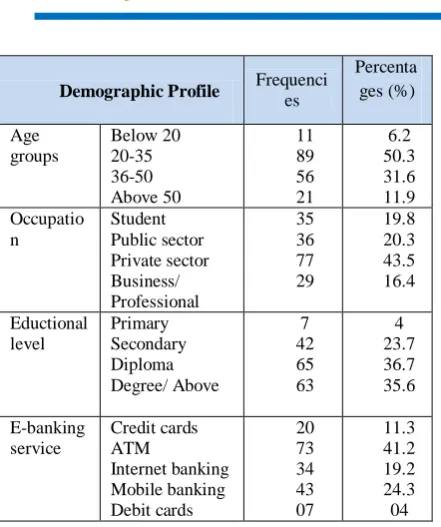
Descriptive statistical analysis was run on respondents’ demographic variables. The results are shown in Table2.
Table 2: Summary of demographic information
Variable Cronbach’s
Alpha coefficient Organizational Factors 0.672 Environmental Factors 0.624 Customer Commitment 0.759 Perceived Risk 0.686
Overall E-CRM 0.761
As per the table 2, the choice of e-banking service of the respondents for this study is represented by 177 respondents. The choice of e-banking service of respondents were classified into five categories on which most of the respondents(41.2%) accessing ATM service.
Table-3 Level of overall E-CRM and CL
in Banks
Dimension Mean Standard
Deviation
Decision Attribute
Organizational Factors
3.7062 0.603 High Level
Environmental Factors
3.5164 0.565 High Level
Customer Commitment
3.6271 0.875 High Level
Perceived Risk 3.2288 0.731 Moderate Level
E-CRM 3.5196 0.459 High Level
Customer Loyalty
3.7066 0.47807 High Level
This gives clear picture about the level of E-CRM and CL of the samples of selected banks in Manmunai North of Batticaloa. Overall E-CRM found to be High Level (see Table3). It is also well-known that only Perceived Risk found to be moderate level and other three dimensions were found to be high level separately. To conclude E-CRM and CL found to be High Level at selected banks in Manmunai North of Batticaloa district that
means there has high level attention in conducting the E-CRM mechanism.
4.3 ANOVA
To assess whether E-CRM and CL will vary across in the name ofselected banks in Manmunai North Batticaloadistrict, the following hypothesis have been formulated;
Hypotheses 02: Assess the differences between name of the organization and two variables(E-CRM and CL)
H0: There are no differences across name of the
organization towardsE-CRM and CL (p ≥ 0.05)
H1: There are differences acrossname of the
organization towards E-CRM and CL (p <
0.05)
Table-4 One- way ANOVA: Name of the organization
Variable F P-Value
E-CRM 7.125 0.000
CL 6.708 0.000
P-values from the above ANOVA table indicate that there are differences toward E-CRM and CL across name of the organization. Therefore it can be concluded as follows;
As the P-value, 0.000 of the ANOVA test for E-CRM and CL are less than the significance level of 0.05, it can be concluded that “there are differences across name of the organization towards E-CRM and CL”. To find out detail variations in E-CRM and CL across name of the banks, Post Hoc analysis was also used.
1.4 Relationship between Electronic
Customer Relationship Management and Customer Loyalty (E-CRM and CL)
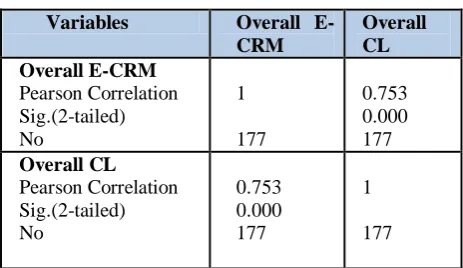
Correlation analysis of this study is used to measure the relationship between the dependent variables of E-CRM and independent variables of CL.
Table 5-Correlation Analysis
Demographic Profile Frequenci
The Pearson correlation analysis revealed the relationship between E-CRM and CL. The correlation of coefficient (r) was 0.753, which was significant at 0.000 levels. In addition, there is a higher level of E-CRM likewise higher level of CL in selected banks in Manmunai North of Batticaloa district. Thus the result interpreted as there is strong positive correlation(r˃ 0.5) between E-CRM and CL.
1.5
Regression Analysis
Table 6- Regression analysis of variables
Model R R Square Adjusted R
Square
Std. Error of the
Estimate
1 0.753 0.566 0.564 0.316
According to the regression analysis the r square is 0.566; it indicated that 57% of customer loyalty has been influence by E-CRM. That means if any increase in E-CRM will increase the customer loyalty by 57% and if any decrease in E-CRM that leads to decrease the customer loyalty by 57%.
05. Conclusions and suggestions
After successively collected and analyzed the data the research concluded thatE-CRM has strong positive relationship with CL.Further, drawing from the findings of this research, both e-CRM implementation and customer loyalty showed stronger positive influence on selected banks. Thus, in today’s competitive and constantly changing business market, Sri Lankan operators must consider e-CRM implementation as very critical issues and constantly attempt to expand their e-CRM.
Thus, the study suggest that banking industry should design and provide high quality electronic services to its customers by understanding their needs, giving individual attention and carry out their given promises to the customers. And also they should
design E-CRM tools and systems more flexibility in order to create satisfied customers. This research only focuses on the banking industryin Batticaloa. Additional studies need to be undertaken to examine E-CRM and customer loyalty in other regions and with larger samples. However, this can be further expanded into fields such as insurance, leasing and other financial sectors.
References
[1]
Kennedy, A. (2006). Electronic
Customer Relationship Management
(e-CRM): Opportunities And Challenges in a
Digital World,
Irish Marketing Review
,
Vol. 18, No. 1-2.
[2]
Khalifa,
M.
&Shen,
N.
(2005).Effects of electronic customer
relationship management on customer
satisfaction:
a
temporal
model.
Proceedings
of
the
38th
Hawaii
International
Conference
on
System
Sciences,
Vol. 5, pp. 171-178.
[3]
Melodi,
O.,
Olufayo,
O.
&Gbadamosi, T. (2012).Appraisal of
Customer Relationship Management in
the Banking Sector: A study of four
selected
Banks
in
Lagos
State.
International
Journal
of
Arts
and
Commerce,
Vol. 1 No. 5.
[4]
Filip,
A.
&Anghel,
D.
L.
(2009).Customer
Loyalty
and
its
Determinants in a Banking Services
Environment.
Quality
Management
in
Services
, Vol. 11, No. 26, pp. 1-10
[5]
Liu, Y. (2007). The Long-Term
Impact of Loyalty Programs on Consumer
Purchase Behavior and Loyalty.
Journal of
Marketing
, Vol. 71, pp. 19–35.
[6]
Oliver
&
Richard
L.
(1999).Whence
Consumer
Loyalty.
Journal of Marketing
, Vol. 63,
pp. 33–44.
[7]
Bloemer, J. de Ruyter, K. and Peeters,
P. (1998), “Investigating Drivers of Bank
Loyalty: The Complex Relationship between
Image, Service Quality and Satisfaction”,
International Journal of Bank Marketing,
Vol. 16, No. 7, PP. 276 – 86
Variables Overall
E-CRM
Overall CL Overall E-CRM
Pearson Correlation Sig.(2-tailed) No
1
177
0.753 0.000 177 Overall CL
Pearson Correlation Sig.(2-tailed) No
0.753 0.000 177
1