Realization of Panoramic Image Model of
Aerial Data using Stitching Technique
Dr R Athi lingam1
Associate Professor, Department of Electronics and Communication Engineering, Nadar Saraswathi College of
Engineering and Technology, Theni, Tamilnadu, India1
ABSTRACT: Panoramic view is recent area of research based on needs in the field of aerial surveillance. Multiple images taken by Unmanned Aerial Vehicles (UAV) which possess mutual object of interest is to be stitched together in order to obtain the panoramic view of the survey area. Panoramic image stitching is mainly used to create virtual environment for many applications. It is a key technology in 3D realization, Geo referenced mapping and target localization and lots of stitching algorithms are being under development in recent years.
This paper proposes a panorama image stitching system which combines an image matching algorithm based on corner detection and backward image blending algorithm. The application is focused towards generation of panoramic view of the images captured by the Unmanned Aerial Vehicle. The algorithm is designed to be extremely efficient and fast in its execution and is intended for use in stitching images captured by UAV. The algorithm works by extracting informations in the corners of the two images to be stitched. To get the scene image of wide view field, firstly block matching based on corner detection is applied to estimate the motion vector field, and then the parameters of transformation model can be calculated with the backward algorithm to implement image sequence stitching. The efficiency is higher in our approach than traditional techniques since our approach can stitch more than two images
KEYWORDS: Image Stitching, Panorama view , UAV , corner detection, block matching, Aerial Surveillance
I.INTRODUCTION
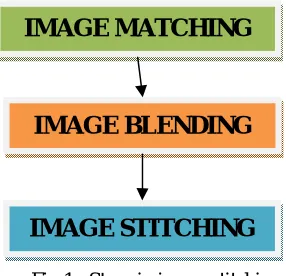
Image stitching is a technology that carries on image matching and blending to image sequences which are overlapped with one other, and finally builds a high quality panorama photo with high resolution and wide field view [1,2]. The image stitching process mainly includes image matching and image blending.
The key problem of image stitching is how to realize the image matching, by which find the matching parameters among the images. At present, image matching can be categorized two methods namely region-based method and feature-based method. Region-based method [3, 4] is to use the image grey-scale information to determine the matching parameters between images, which make full use of the image information but it involves amount of calculation. Moreover, in the presence of image noise, image distortion and large scaling and rotation between images, the obtained stitching results are often not the correct. Feature-based method [5, 6] makes use of the distinct image features such as image contours and corners to realize the image matching with less calculation, further this method have higher robustness in case of the scaling and rotation between images, the correct feature extraction of images is very important to match the image to stitch rightly. The concept of processing between two consequent frames is described in [10]. The description about design mechanism of quadcopter (UAV) and its aerodynamic derivations are described in [11].
The paper is organized as follows. In Section II image matching technique is discussed. In section III blending and stitching techniques are discussed. In section IV, the implementation of the proposed work is done and finally in Section V the results are discussed. The conclusions are made in section VI.
II.IMAGE MATCHING BASED ON CORNER DETECTION
matching algorithm is divided into feature-based image matching and region-based image matching two broad categories. Region-based image matching uses regions of the pixel correlation and others to get match. The feature-based image matching uses image of the different feature to estimate the transformation relations between the images, rather than uses the image all the information.
a. Image Registration- One of the images is then deformed according to the computed transformation, Image Warping, thereby changing the spatial relationship between pixels coordinates. That is, image coordinates [x,y]T are mapped into a new set of coordinates [x’ ,y’ ]T.
Fig 1 : Steps in image stitching
Once corners in each picture have been associated we now have the necessary elements to compute the geometric transformation matrix, which is given by the following relation.
(1)
Pixel coordinates on the original image are given by [x/w, y/w]T and are mapped into [x’ /w /w’]T after image warping. For reverse mapping, without loss of generality, assign w’ to 1. Point [xi ,yi]T is then mapped into the correlation point in the other image [ui ,vi]T. It is said that the minimum number of correspondences to make the perspective transformation possible is four. By this method, when more than four correspondences are identified defined, solution in the least squares are understood to the determined system of equations is computed, thus improving the quality of the perspective transformation.
III.IMAGE BLENDING
The final step of a image mosaicing operation is image blending, which consists of making the two pictures together into one. It involves evaluating the adjustments in the calibration stage, remapping of the images to an output projection. Colors are adjusted to compensate for exposure differences
IMAGE MATCHING
IMAGE BLENDING
Our paper describes average weighed method which is simple and fast for blending, which can be described as figure 2.
Fig 3 concept of finding key point
Hat function is chosn as the blending method , which is considered as a specific case of bilinear blending as it alculates a weight for every pixel in each image based on the following relation
(2)
The final output intensity of the pixels of the mosaic is by the relation below, where x and y denote the initial coordinates, before the warping operation, and i is the image index.
(3) Ii(x,y) is referred to the intensity value of the ith image pixel [x, y]T
In the average weighted blending, the values of features in overlap region are equal to the weighted average values of matching images, which can be shown as following:
--- (4)
where dl(d1) is the distance between the pixel in overlap region to the border of the left matching image, and dr (d2)is the distance between the pixel in overlap to the border of the right matching image
IV.IMPLEMENTATION
1.Choose one image as the reference frame.
2. Estimate matching between each of the remaining images and the reference image. To estimate matching between two images use the following procedure:
a. Detect local features in each image.
V. RESULTS AND DISCUSSION
The videos obtained from the surveillance of UAV are considered for analysis. The videos are transmitted with the transmission frequency of 1.2 GHz from quadcopter[11] with altitude ranging from 5 to 80 meters. The surveillance is made at Ponneri – andaarkuppam (Chennai). Few samples were considered for processing and the results are obtained.
LOCATION 1:
Fig 4 : No of images stitched - 6 Fig 5 : No of images stitched - 7
Fig 8 : No of images stitched - 7 Fig 9 : No of images stitched - 8
VI.CONCLUSION
Thus the novel approach for stitching images to obtain panoramic view is presented. The algorithm works by extracting the corners of the two images to be stitched. To get the scene image of wide view field, firstly block matching based on corner detection is applied to estimate the motion vector field, and then the parameters of
tansformation model can be calculated with the backward algorithm to implement image sequence stitching. Our method is not vulnerable to orientation, scaling, ordering and illumination, its stitching precision is much higher than many other methods.
REFERENCES
[1] H.Y. Shum and R. Szelishi, “Panoramic Image Mosaics, Technical Report”, Microsoft Research,2008 [2] G. Kang, “Virtual Environment Touring based on image, master thesis”, Nanjing Institute of Technology ,2007. [3] R. HartleyˈA. Zisserman, “ Multiple View Geometry in Computer Vision”,ˈAnHui University Press, 2002.
[4] H.Y. Shum and R. Szelishi, “Construction of Panoramic Image Mosaics with Global and local Alignment”,International Journal of Computer Vision 36(2) , 101-130, 2000.
[5] Y. Li, L. Ma, “A Fast and Robust Image Stitching Algorithm”, in proceeding of the 6th World Congress on Intelligent Control and Automation, 2008.
[6] Hui Zhao, “Matching Technology based on SIFT Features”, Shan Dong University, Institute of Information Science and Engineering, 2006. [7] D. Lowe, “Distinctive image features from scale-invariant keypoints”. Int. Journal of Computer Vision, 60(2):91–110, 2004.
[8] Forsyth, David A, et al, “Computer Vision – A Modern Approach,” Prentice-Hall of India, 2006.
[9] R. Szeliski, “Image Alignment and Stitching, A Tutorial,” Technical Report MSR-TR-2004-92, Microsoft Research, Microsoft Corporation, 2004.
[10] Athilingam R , K. Senthil Kumar, Thillainayagi R and Nuzrath Hameedha A, “Moving Target Detection Using Adaptive Background Segmentation Technique for UAV based Aerial Surveillance”, Journal of Scientific & Industrial Research ( ISSN - 0022-4456) - Vol. 73, April 2014, pp. 247- 250