ISSN (Print) : 2320 – 3765 ISSN (Online): 2278 – 8875
I
nternational
J
ournal of
A
dvanced
R
esearch in
E
lectrical,
E
lectronics and
I
nstrumentation
E
ngineering
(An ISO 3297: 2007 Certified Organization)
Vol. 5, Issue 4, April 2016
Design of PID Controller for Non-Linear
Systems Using Lévy Flight Based Heuristic
Algorithms
C. Vignesh1, J. Sriram2, G.Hari Hara Sudhan3
UG Student, Dept. of EIE, St. Joseph’s College of Engineering, Chennai, Tamil Nadu, India1
UG Student, Dept. of EIE, St. Joseph’s College of Engineering, Chennai, Tamil Nadu, India2
UG Student, Dept. of EIE, St. Joseph’s College of Engineering, Chennai, Tamil Nadu, India3
ABSTRACT: In this work, tuning of classical PID controller is proposed for highly non-linear systems such as the benchmark bioreactor and Magnetic Levitation System (MLS)using Lévy flight based Cuckoo Search (CS)/Firefly Algorithm (FA). A weighted sum of cost function comprising the overshoot, settling time, integral square error (ISE) and integral absolute error (IAE) is considered to guide the heuristic search in order to discover three controller parameters such as Kp, Ki, and Kd. In the proposed work, the major aim is to compare the performance of the
considered CS and FA on the controller design problem. The simulation work is implemented using the Matlab software and the performance of this study is validated by measuring the ISE and IAE values. This study confirms that, both the algorithms offers approximately similar result on the considered bioreactor and MLS systems.
KEYWORDS: Bioreactor, Magnetic levitation system, PID controller, Cuckoo search, Firefly algorithm.
I. INTRODUCTION
From control literature, PID and customized forms of PID controllers are still extensively used because of its structural simplicity, reputation and easy implementation, despite the significant developments in advanced process control schemes. It isalso observed that, heuristic algorithm based PI/PID controller design iswidely employed by the researchers to discover optimal solutions for a class of linear and non-linear systems [1-6]. Even though a substantialamount of algorithms are available in the literature, choice of a particular algorithm for an optimization problem mainly depends on : (i) Number of parameters to be optimized (dimension), (ii) Convergence speed, (iii) optimization accuracy , and (iv) Number of initial algorithm parameters to be assigned.
Controller design problem existing for the stable and the linear system are very simple compared with the unstable and the non-linear systems. The number of traditional controller design procedure existing for the unstable and non-linear systems are also very few [6]. Hence, in recent days, heusristic algorithm based PID [5,6], IPD [7], fractional order PID and setpoint weighted PID controller [8] design procedures are widely proposed by the researchers.
ISSN (Print) : 2320 – 3765 ISSN (Online): 2278 – 8875
I
nternational
J
ournal of
A
dvanced
R
esearch in
E
lectrical,
E
lectronics and
I
nstrumentation
E
ngineering
(An ISO 3297: 2007 Certified Organization)
Vol. 5, Issue 4, April 2016
II. PROCESS DESCRIPTION
In order to implement the CS/FA based PID controller, the following non-linear process models are adopted:
2.(a) Bioreactor
Bioreactor plays a vital role in chemical process industries to produce important chemical and biochemical compounds. In this system, living organisms, known as microbes are converted into marketable products such as beverages, antibiotics, vaccines and industrial solvents [17,18]. The quality of the final product from a bioreactor depends mainly on the control loop employed to monitor and control the microbial growth based on the reference input [19,20].
Bioreactor can be defined as a reactor system employed to execute a number of biological reactions in a liquid medium to form intermediate and final products. Fig.1 shows the schematic diagram of the bioreactor. The dynamic behaviour of the reactor is complex and a number of vital manufacturing processes belong to this group.
Fig.1 Scheme of a benchmark bioreactor
The basic reaction inside the bioreactor is
A
kP
(1) where ‘A’ is the reactant, ‘k’ is reaction rate constant and ‘P’ is the product.Biosynthesis is widely utilized to convert the living cells (biomass / microbes) into marketable chemical, pharmaceutical, food and beverage products. Eqn.1 shows the operation performed during biosynthesis. In this operation, the biomass/microbes consume nutrients from the substrate (feed) to cultivate and to produce more cells and important products. During this operation the bioreactor is kept under a controlled environment with constant pH, temperature, agitation rate and dissolved oxygen level to attain better growth of microbes [20].
A number of studies are available in the literature for model based control of bioreactor. The following mathematical equations considered in this research work, can describe a variety of industrial bioreactors [4,18];
Cell balance : (μ D)X dt
dX
(2)
Substrate balance :
Y
μX
S) f D(S dt dS
(3)
Product balance : DP (αμ β)X dt
dP
(4)
Monod kinetics :
S m K
S max
μ μ
(5)
where, ‘µ’ is the specific growth rate, ‘X’ the biomass concentration, ‘S’ the substrate concentration and ‘α’ and ‘β’ are yield parameters for the product. At steady state, the variables will be; X = Xs, S = Ss, and P = Ps.The nominal parameter
and constant values considered in the mathematical equations are presented in Table 1.
Product
Out (X)
M Air In
Air Out Feed
In (S)
Effluent Out PID
Xsp
e(t)
-
Uc(s)
ISSN (Print) : 2320 – 3765 ISSN (Online): 2278 – 8875
I
nternational
J
ournal of
A
dvanced
R
esearch in
E
lectrical,
E
lectronics and
I
nstrumentation
E
ngineering
(An ISO 3297: 2007 Certified Organization)
Vol. 5, Issue 4, April 2016
Table 1 Parameters of benchmark bioreactor [4]
Parameter Values
X1(s) Biomass Concentration
0; g / L – lag phase
0.9951; g / L – growth phase
1.5302; g / L – stationary phase
X2(s) Substrate Concentration
4.0; g / L – lag phase
1.5122; g / L – growth phase
0.1746; g / L - stationary phase
D Dilution rate 0.3 ; hr-1
Xfs Feed substrate concentration 4.0 g / L
µmax Maximum specific growth rate 0.53; hr-1
Km Substrate saturation constant 0.12; g / L
Y Cell mass yield 0.4
K1 Substrate inhibition constant 0.4545; L / g
In this work, the growth phase and the stationary non-linear models are considered to analyse the controller performance. The PID controller is designed and its performance verified separately for the growth phase and the stationary phase.
2.(b) Magnetic Levitation System
MLS is an electro-mechanical system and the construction detail is depicted in Fig 2. In this system, a controller is used to regulate the electric current (i) until the electromagnetic force (f) equals to the weight of the steel ball (m*g). When the above condition is reached, the ball will levitate in an equilibrium state [21].
The mathematical model of the MLS is described below;
Voltage applied to the coil :
dt i(t) d L i(t) R
V(t) (6)
Fig. 2Construction of Magnetic Levitation System
Current Controller
Position sensor
f
m*g Feedback Y(s)
-
Xm
Xg
Ball R(s)
Ground Electromagnet i
ISSN (Print) : 2320 – 3765 ISSN (Online): 2278 – 8875
I
nternational
J
ournal of
A
dvanced
R
esearch in
E
lectrical,
E
lectronics and
I
nstrumentation
E
ngineering
(An ISO 3297: 2007 Certified Organization)
Vol. 5, Issue 4, April 2016
Force by the electromagnet is :
2 ) , ( x i c i x
f ; and
2
0 0X
L
c (7)
Mechanical force on the ball : 2
2 2 ) x i ( c g) * m ( dt x d
m (8)
Where x = Xm is the distance between ball and magnet, i = current through coil, L = inductance of the coil, R= internal
resistance of the coil, m= mass of the ball, g = acceleration due to gravity, L0 is the additional inductance of the
magnetic coil due to the ball placed at the equilibrium position x0.
From Eqn. 9, coil inductance (L) is a nonlinear function and it is a function of ball position x.
The approximate inductance is
x x L L
L(x) 0 0 (9)
Linear form of Eqn.3 can be written as ;
mg x x(t) i i(t) 2 1 x i c dt dx m 0 0 2 0 0 2 (10)
When m g
x i c * 2 0 0
, Eqn.10 can be written as:
) ( 2 ) ( 2 3 0 2 0 2 0 0 2 t x x c i t i x c i dt dx
m (11)
In Eqn.11, x(t) and i(t) are the incremental displacement and incremental magnet current around their nominal values x0
and i0. The linearized state model of the system around the point x1 =x01 is presented below;
The state vector for the system is X0 = [x01 x02 x03] T (12)
At equilibrium, x02 =0 and
c mg x
x03 01 . (13)
The linearized state model of the system is;
A = L R Lx Cx 2 0 Mx Cx 2 0 Mx Cx 0 1 0 2 01 03 2 01 03 3 01 2
03 ; B =
L 1 0 0
; C =
1 0 0
(14)The MLS parameters are assigned as m = 0.05kg, g = 9.81 m/s2, L = 0.01H, R = 1Ω, C = 0.0001, x01 = 0.012 M, x02 = 0 M/s, and x03 = 0.84A [21].
ISSN (Print) : 2320 – 3765 ISSN (Online): 2278 – 8875
I
nternational
J
ournal of
A
dvanced
R
esearch in
E
lectrical,
E
lectronics and
I
nstrumentation
E
ngineering
(An ISO 3297: 2007 Certified Organization)
Vol. 5, Issue 4, April 2016
A = 100 116.66 0 33 . 23 0 1633.33 0 1 0
; B = 100 0 0
; C =
1 0 0
(15)III. HEURISTIC ALGORITHMS
In the proposed work the recent heuristic algorithms discussed below are considered.
3. (a) Cuckoo Search
CS is one of the successful algorithms, proposed by Yang [11]. This algorithm is based on the breeding tricks of parasitic cuckoos.
The mathematical expression of the CS considered in this study is given below [15,16]:
) ( Levy ) t ( i X ) 1 t ( i
X (16)
whereXi(t)is the initial position, Xi(t1)is the updated position, is chosen as 1.2 and is the symbol for entry wise multiplication.
In this work, Levy Flight (LF) based search methodology is considered to update the position of the agents. LF is a random walk in which the search steps can be drawn using the following Levy distribution[13].
) 3 (1 for t u ~
Levy (17)
3.(b) Firefly algorithm
The classical FA was initially discussed by Yang [12]. It is a nature-inspired meta-heuristic algorithm, in which flashing illumination patterns generated by invertebrates, such as glowworms and fireflies, were at the essence of its creation.The traditional FA is developed by considering the following conditions. Recently, FA based approach is implemented for the gray scale and RGBimage segmentation by the researchers.
The movement of the attracted firefly i towards a brighter firefly j can be determined by the following position update equation: ) ( Levy ) 2 1 -(rand sign . 1 ) t i X t j X ( d γ e 0 β t i X 1 t i X 2 ij
(18)
whereXit1is theupdated position of firefly, Xitis theinitial position of firefly,and (Xtj Xit) 2 ij d γ e 0 β
may be considered
as the attractive force between fireflies [11,13,14]. 3. (c) PID controller
Industrial PID controllers typically accessible as a packaged form and to perform well with the industrial process problems, the PID controller requires optimal tuning. In this research work, a non-interacting form of PID controller structure is considered. A low pass filter is used with the derivative term to reduce the effect of measurement noise. The PID structure is defined below [3]:
1 N s d T s d T s i T 1 1 p K (s) c
G (19)
ISSN (Print) : 2320 – 3765 ISSN (Online): 2278 – 8875
I
nternational
J
ournal of
A
dvanced
R
esearch in
E
lectrical,
E
lectronics and
I
nstrumentation
E
ngineering
(An ISO 3297: 2007 Certified Organization)
Vol. 5, Issue 4, April 2016
Cost function considered in this study is presented below:
AE I . w4 SE I . w3 p M . 2 w ISE . 1 w ) d K , i K , p K ( max
J (20)
Where
T0 (t)dt 2 e
ISE ;
T0 e(t) dt
IAE ; e – the error between the setpoint and process response, Mp – the
overshoot, ts- the settling time, w1=w2 = 2 and w3=w4=1.
IV. RESULTS AND DISCUSSIONS
This section presents the results of the simulation study obtained using the Matlab 2010a software. During the simulation study, the following algorithm parameters are assigned: number of agents (N) is chosen as 20, number of iteration is chosen as 1000, the dimension of search (D) is assigned as 3 and the algorithm is allowed to search the controller parameters till the Jmaxis reached. This controller design procedure is repeated 10 times and the average
value is recorded as the optimal controller parameter.
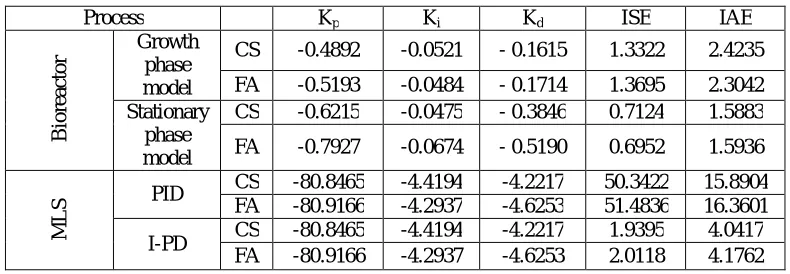
Initially, the controller design procedure is implemented on the non-linear bioreactor model discussed in [4,18] using the CS algorithm. Firstly, the PID design is implemented for the growth phase model by assigning the process parameters as discussed in Table 1. Secondly, the same procedure is repeated with the stationary phase model. The average of the controller parameters and its corresponding ISE and IAE values are depicted in Table 2. Similar procedure is repeated with the FA algorithm and the corresponding values are also in Table 2. Later, this procedure is implemented for the unstable MLS system. From Table 2, it can be noted that, even though CS and FA offers different
Kp, Ki and Kd values, the ISE and IAE values are approximately similar.
Table 2. Controller parameters and its corresponding error values
Process Kp Ki Kd ISE IAE
Bi
ore
a
ct
or
Growth phase model
CS -0.4892 -0.0521 - 0.1615 1.3322 2.4235
FA -0.5193 -0.0484 - 0.1714 1.3695 2.3042 Stationary
phase model
CS -0.6215 -0.0475 - 0.3846 0.7124 1.5883
FA -0.7927 -0.0674 - 0.5190 0.6952 1.5936
M
L
S PID
CS -80.8465 -4.4194 -4.2217 50.3422 15.8904 FA -80.9166 -4.2937 -4.6253 51.4836 16.3601
I-PD CS -80.8465 -4.4194 -4.2217 1.9395 4.0417 FA -80.9166 -4.2937 -4.6253 2.0118 4.1762
The superiority of the proposed approach is confirmed with a simulation study using Matlab software. Fig.4 and Fig.5 depicts the servo response for the growth phase of the nonlinear bioreactor model. Fig.6 and Fig.7 shows the servo
Fig. 3 Parallel PID structure
Gp(s)
Y(s) R(s)
+ _
Kp
Ki / s
Kd s / (Tf s+1)
Uc(s)
Gc(S)
E(s) +
ISSN (Print) : 2320 – 3765 ISSN (Online): 2278 – 8875
I
nternational
J
ournal of
A
dvanced
R
esearch in
E
lectrical,
E
lectronics and
I
nstrumentation
E
ngineering
(An ISO 3297: 2007 Certified Organization)
Vol. 5, Issue 4, April 2016
response for the stationary phase. From these figures, it can be confirmed that, the PID controlled designed with the CS and FA offers approximately similar result.
Fig.4Biomass value for grown phase
Fig.5Substrate value for grown phase
Fig.6 Biomass value for stationary phase
Fig.7Substrate value for stationary phase
0 5 10 15 20 25 30 35 40 45 50
0 0.5 1 1.5
Time; sec
X
1
(t
)
Setpoint CS-PID FA-PID
0 5 10 15 20 25 30 35 40 45 50
0 0.5 1 1.5 2
Time; sec
X
2
(t
)
CS-PID FA-PID
0 5 10 15 20 25 30 35 40 45 50
0 0.5 1 1.5 2
Time; sec
X
1
(t
)
Setpoint CS-PID FA-PID
0 5 10 15 20 25 30 35 40 45 50
0 0.5 1 1.5 2
Time; sec
X
2
(t
)
ISSN (Print) : 2320 – 3765 ISSN (Online): 2278 – 8875
I
nternational
J
ournal of
A
dvanced
R
esearch in
E
lectrical,
E
lectronics and
I
nstrumentation
E
ngineering
(An ISO 3297: 2007 Certified Organization)
Vol. 5, Issue 4, April 2016
Fig. 8 Servo response of MLS with PID controller
Fig.9Servo response of MLS in the presence of measurement noise
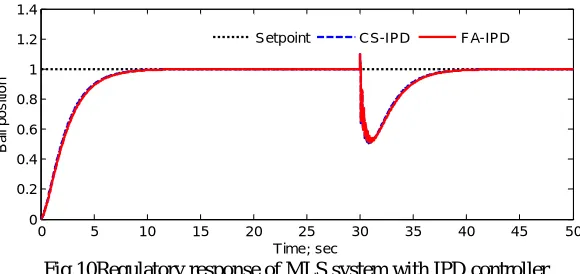
Fig.10Regulatory response of MLS system with IPD controller
Proposed controller design procedure is then implemented on the MLS system. Fig. 8 shows the servo response of the MLS model. In order to test the robustness of this PID controller is validated by introducing a measurement noise (white noise with zero mean) is the feedback loop. Fig. 9 confirms the robustness of the CS and FA designed PID. The above figures shows a larger overshoot, which can be minimized using an I-PD controller [22]. From Fig.10 it is noted that, the I-PD controller offers better reference tracking and disturbance rejection for the MLS system.
V. CONCLUSIONS
In this work, design of PID controller is proposed for bioreactor and Magnetic Levitation System using Lévy flight based Cuckoo Search (CS) algorithm and Firefly Algorithm (FA). In the proposed work, a weighted sum of objective function is considered and maximization of this objection function is chosen as the terminating criteria for heuristic
0 5 10 15 20 25 30 35 40 45 50
0 1 2 3 4 5 6
Time; secc
R
e
s
p
o
n
s
e Setpoint CS-PID FA-PID
0 5 10 15 20 25 30 35 40 45 50
0 1 2 3 4 5 6 7
Time; sec
R
e
s
p
o
n
s
e
CS-PID FA-PID
0 5 10 15 20 25 30 35 40 45 50
0 0.2 0.4 0.6 0.8 1 1.2 1.4
Time; sec
B
a
ll
p
o
s
iti
o
n
ISSN (Print) : 2320 – 3765 ISSN (Online): 2278 – 8875
I
nternational
J
ournal of
A
dvanced
R
esearch in
E
lectrical,
E
lectronics and
I
nstrumentation
E
ngineering
(An ISO 3297: 2007 Certified Organization)
Vol. 5, Issue 4, April 2016
search. Proposed simulation work is implemented using the Matlab software and the performance of servo operationis verified. The result confirms that, the controller designed with the CS and FA offers similar result.
REFERENCES
1. Rajinikanth, and K. Latha, “Identification and control of unstable biochemical reactor”, International Journal of Chemical Engineering and
Applications, vol.1, no.1, pp.106-111, 2010.
2. V. Rajinikanth and K. Latha, “Controller Parameter Optimization for Nonlinear Systems Using Enhanced Bacteria Foraging
Algorithm,” Applied Computational Intelligence and Soft Computing, vol. 2012, Article ID 214264, 12 pages, 2012.
3. K. Latha, V. Rajinikanth, and P. M. Surekha, “PSO-Based PID Controller Design for a Class of Stable and Unstable Systems,” ISRN Artificial
Intelligence, vol. 2013, pp. 1–11, 2013.
4. V. Rajinikanth and K. Latha, “Modeling, Analysis, and Intelligent Controller Tuning for a Bioreactor: A Simulation Study,” ISRN Chemical
Engineering, vol. 2012, Article ID 413657, 15 pages, 2012.
5. V. Rajinikanth and K. Latha, “Tuning and Retuning of PID Controller for Unstable Systems Using Evolutionary Algorithm,” ISRN Chemical
Engineering, vol. 2012, Article ID 693545, 11 pages, 2012.
6. V Rajinikanth, and K Latha, “Optimization of PID controller parameters for unstable chemical systems using soft computing technique”,
International Review of Chemical Engineering, vol.3, no.3, pp. 350-358, 2011.
7. V. Rajinikanth, and K. Latha, “Internal model control-proportional integral derivative controller tuning for first order plus time delayed unstable
systems using bacterial foraging algorithm,” Scientific Research and Essays, vol.7, no.40, pp. 3406-3420, 2012.
8. V. Rajinikanth, and K. Latha, “Setpoint weighted PID controller tuning for unstable system using heuristic algorithm”, Archives of Control
Sciences, vol.22, no.4, pp. 481-505, 2012.
9. O'Dwyer, Handbook of PI and PID Controller Tuning Rules, Imperial College Press, London, UK, 3rd edition, 2009.
10. X.S Yang, “Firefly algorithm, stochastic test functions and design optimization”, International Journal of Bio-inspired Computation, vol. 2,
No.2, pp. 78–84,2010.
11. X.S Yang. Nature-Inspired Metaheuristic Algorithms. Luniver Press, UK, 2008.
12. X.S Yang, “Firefly algorithms for multimodal optimization,” Lecture Notes in Computer Science, vol.5792, pp.169–178, 2009.
13. N.S.M. Raja, K. Suresh Manic, and V. Rajinikanth, “Firefly algorithm with various randomization parameters: an analysis,” Lecture Notes in
Computer Science, vol.8297, pp.110–121, 2013.
14. V. Rajinikanth, and M.S. Couceiro, “RGB Histogram Based Color Image Segmentation Using Firefly Algorithm,” Procedia Computer Science,
vol.46, pp. 1449–1457, 2015.
15. V. Rajinikanth, N.S.M. Raja, and S.C. Satapathy, “Robust Color Image Multi-thresholding Using Between-Class Variance and Cuckoo Search
Algorithm. Advances in Intelligent Systems and Computing, vol.433, pp.379-386, 2016.
16. B. Abhinaya, and N.S.M. Raja, “Solving Multi-level Image Thresholding Problem—An Analysis with Cuckoo Search Algorithm,” Advances in
Intelligent Systems and Computing, vol.339, pp. 177-186, 2015.
17. Z. K. Nagy, “Model based control of a yeast fermentation bioreactor using optimally designed artificial neural networks,” Chemical
Engineering Journal, vol. 127, no. 1–3, pp. 95–109, 2007.
18. B. Wayne Bequette, Process Control: Modeling, Design and Simulation, Prentice Hall, 2003.
19. R. Padma Sree, and M. Chidambaram, Control of Unstable Systems, Narosa Publishing House, New Delhi, India, 2006.
A. K. Jana, Chemical Process Modeling and Computer Simulation, Prentice-Hall, New Delhi, India, 2008.
20. V. Rajinikanth, and K. Latha, “PID Controller Tuning for Magnetic Suspension System Using Evolutionary Algorithm”, International Review
of Mechanical Engineering, vol.6, no.5, pp. 988-995,2012.
21. V. Rajinikanth and K. Latha, “I-PD Controller Tuning for Unstable System Using Bacterial Foraging Algorithm: A Study Based on Various
![Table 1 Parameters of benchmark bioreactor [4]](https://thumb-us.123doks.com/thumbv2/123dok_us/7778381.1283690/3.595.111.485.186.412/table-parameters-of-benchmark-bioreactor.webp)