DRJI VALUE: 5.9 (B+)
Constraints in Development of Rural Libraries in
India with Special Reference to Madhya Pradesh:
a Critical Study
PRABHAT PANDEY Department of Library and Information Science Sarojini Naidu Govt. Girls PG Auto. College Bhopal (M.P.) India
Abstract:
The study examines the Constraints in Rural Libraries Development in India with special reference to M. P. to find the hurdles in development of Libraries in M. P. by using survey method. The study also highlights the uses of Libraries, problems and some suggestions for solutions.
Key words: Rural libraries, Constraints, Rural Libraries Development, Hurdles.
Introduction
In view of the Indian context, the majority of Indians are living in rural areas, engaged in agriculture or small scale industry. In India, 74.3 percent of the population lives in rural areas and 25.7 percent of the population lives in urban areas. The agriculture sector provides livelihood to 64 percent of the labour force and its contribution to gross national product is 27.4 percent.
Information is one of the most important factors for the process of development of any sector. If we want development of the rural community, we must emphasize the communication of information. People should be made aware of the latest developments relating to their field, e.g. latest developments in irrigation, storage facility, new forming techniques and new methods adopted in animal husbandry. Therefore, libraries play an important role in educating people. Unfortunately, in India, there are many problems in the development of libraries in rural areas.
Some of the constraints that arise in the free flow of information are as follows:
Culture:
Culture is also a constraint in the establishment and the development of rural libraries in the rural areas. There is no cultural motivation, especially in Madhya Pradesh. Book reading or promotion activities are at a low level due to various reasons. Some book fairs have been seen at district or tehsil level, organized by the government agencies or non-governmental organizations, but masses are required to promote library activities.
Motivation to Participate:
Lack of Knowledge:
In rural areas, people are suffering due to poor knowledge. "Knowledge is power" when people take its advantage. In the rural areas, people do not know the benefit of libraries and information centres, hence due to lack of knowledge, the progress of libraries suffers as well. In the rural areas the literacy rate is very low and, due to lack of knowledge, people cannot take decisions and act accordingly.
Low Trust:
Trust is a very relative subjective term. During the research it has been found that people have low trust on various schemes, and due to low trust, libraries are suffering accordingly.
High Costs of Knowledge:
Today, due to ICT, information and knowledge have become universal. But the cost of equipments is high and rural libraries are not able to meet the expanses in this regard.
Self-interest:
There is a lack of self-interest. Rural people do not take interest in rural library establishment and development, because they are unaware of the benefits of library. It is observed in rural areas that people are not interested in academic activities. Even government has established rural community and library centres in rural areas but due to meagre interest, these schemes have not succeeded as per plan.
Know-it-all Attitude:
Physical Distance:
Physical distance is also a hurdle in the dissemination of information in rural areas. Villages are scattered in distant places and also far from district or tehsil headquarters. Rural libraries are established at main places and rural people reside at distant places. Hence they cannot take the benefit of the library. The solution of this hurdle is to take initiation in the direction of e-governance.
Language:
For smooth flow of information a common language should be used between the source and the user. The information should be given in simple language. If given in local language, it is best for them to understand. And even if they face problem in understanding the information, it is advisable to appoint a person in public library, who can translate and explain the information needed, in their own language.
Nowadays most of the literature is available in English. So there is a great problem of information flow between English speaking and non-English speaking world. Particularly the rural Indian Hindi belt people are suffering a lot due to the problem of English based literature.
Financial Constraints:
people to go to district headquarter to get the required information.
Educational Factors:
Illiteracy is a big problem in India. One third of the illiterate people of the world live in India. Illiteracy is one of the major obstacles for the rural folk. People in villages are illiterate. They are unable to get information by reading newspapers, magazines and books. They cannot take advantage of public libraries. Analyzing the behaviour of rural people, Bikka Tariang Laloo says "the educated and uneducated may have differing methods of seeking information, the educated person resorting to more formal means (information system) while the uneducated depending more on informal methods (i.e. other people)."
Geographical Factors:
The geographical aspect is an important factor, coming in the way of free flow of information. Particularly in rural areas, distance has become a big problem. Most of the people are not aware of the facilities and schemes of the government for their development because all government offices or zila panchayats or janpad panchayats are established at district or tehsil level. Those who are residing at far off places from district headquarters cannot come to these offices regularly.
They also have conveyance problem, as many villages are not connected to the cities by roads. They also do not have sufficient money to purchase vehicles for traveling.
Lack of Library and Information Centres:
need of information is not satisfied. Under Madhya Pradesh Panchayat Raj Act, there is no specific provision provided for the establishment and development of libraries in villages. Maintenance and upkeep of libraries involve considerable expenditure on the part of the state. They need recurring grants. Without statutory basis, libraries cannot be developed. Public Library Act provides proper governance and management. In India, 15 states have public library act, but in Madhya Pradesh there is no public library act and without such an act, libraries cannot get sufficient financial support. In Madhya Pradesh Panchayati Raj Act, there should be provision for financial clauses. Ministry of Social Welfare, Government of Madhya Pradesh order No. F-2/5/95/26-2 dated 21.11.1996 states that it gives grant to panchayats for the development of rural libraries. Panchayats can apply for this grant, but it is very nominal. A shortcoming of library services according to H.N. Prasad is the "existence of barriers that serve to diminish or deter the effective linkage between information provider and seeker."
Lack of Access to Technologies:
Apart from illiteracy, people suffer a lot due to the lack of technology. It plays an important role in social, economical and political sphere of everyday life. Professor P. Purushotham says "an essential step in this regard is redesigning the rural education and vocational training so that school drop-outs and undergraduates acquire basic skill in IT applications leading to their productivity enhancement and better employability."
Cultural Differences:
differences do not allow grasping available information or taking benefit of information.
Social Problems:
Information relating to topics such as sex education, fashion, music etc. (openly available in other societies), is not considered good in villages due to backwardness and narrow attitude. In this regard, Dr. K. Sarada highlights that, "rural citizens have several situational and human handicaps that will not help them to use library services." So, people of rural areas are in need of better library services.
Lack of Time:
Villagers are engaged in agricultural activities, and so they have acute shortage of time. It is not possible for them to go to cities and gather relevant information due to lack of time and due to their hectic schedule of agrarian activities.
Electricity Factor:
In urban areas 75.93 percent households have electricity facility. As compared to it, in rural areas only 31.10 percent households have electricity. So information available through telecommunication, radio or other means like internet facility etc. is inaccessible for them.
Inability to Join Telecommunication Network:
Irresponsibility on Librarian's Part:
The librarians in rural service are unaware of the needs of rural people. Rural people, due to lack of education are unable to express their requirements. Therefore, it is the duty of libraries to analyze their needs and give suitable material.
Lack of Awareness:
One of the major stumbling blocks among the rural people is lack of awareness about the benefits of information. They do not know what crucial role is played by information even in their daily life and needs. People must be motivated and made aware of the importance of information in their life.
S.N. Khanna says in this regard, "motivation and awareness in nearby rural areas was therefore, first necessity in the month following libraries establishment."40
Negative Attitude of Personnel:
The persons who are responsible for information communication among the rural people are not doing their duty honestly. Generally people do not want to share information with others, especially with the socially and economically backward classes. Persons who are responsible for the dissemination of information must change their attitude towards rural people, so that these people may be benefited from policies and schemes of government, designed especially for them.
Objectives of Study
1. To know the status of rural libraries in India.
2. To identify the main hurdles in developments of rural libraries in M.P.
3. To suggest measures to make rural libraries more useful.
Research Methodology
The problem for the present study is “Constraints in development of Rural libraries in India with special reference to M.P.: a survey”. The collected data is organized and tabulated by using tables and graphs, the analysis and interpretation of the data collected through literature reviews, Questionnaire and Interview method.
Area of Study
Selected libraries of Northern part of M.P., Southern part of M.P., Eastern part of M.P. and Western part of M.P.
Analysis and Findings
Rural Libraries Survey Status of Rural Libraries
The main purpose of any library is to serve the reader to fulfill the information demand as well as conserve local social, cultural and literary resources. These libraries collect and disseminate the primary or basic information regarding or pertaining to rural people. The status of libraries is the one under Panchayati Raj Institutions and Sarva Shiksha Abhiyan of Northern, Southern, Eastern and Western part of Madhya.
Table 1
Status of Libraries which Responded S.
No.
Region Size of the
Sample
Total No. Schedules Received Back
%age of Total No.
1. Northern Part of MP 60 57 23.75%
2. Southern Part of MP 60 50 20.83%
4. Western Part of MP 60 49 20.41%
Total 240 203 84.58%
For this study, 240 questionnaires were sent to 60 selected libraries of four regions mentioned as above. Out of these only 203 (84.58%) libraries responded. Region wise data analysis (Table 1) shows 57 (23.75%) from the northern area; 50 (20.83%) in the southern area; 47 (19.58%) in eastern and 49 (20.41%) in the western part of Madhya Pradesh responded.
Problems in Library Development
The nature and environment of any rural library depends on its aims and objectives, resources and associated users. Every library and its services are organized and maintained to fulfill the readers' demands and efforts are made for the development of their personality. In present scenario, data reveals that such rural library are facing so many hurdles like lack of finance, lack of reading interest and awareness among readers, scarcity of text material and untrained librarian in charge.
Table 2
Hurdles in Library Development S.
No.
Hurdles Northern
Part of MP
Southern Part of MP
Eastern Part of MP Western Part of MP
Total %age
1. Lack of finance
55 47 40 44 186 91.62%
2. Lack of trained human resource
12 15 13 14 54 26.60%
3. Lack of interest in gaining knowledge information
26 20 14 33 93 45.81%
4. Lack of reading materials
38 31 27 44 140 68.96%
5. No provision of public act library
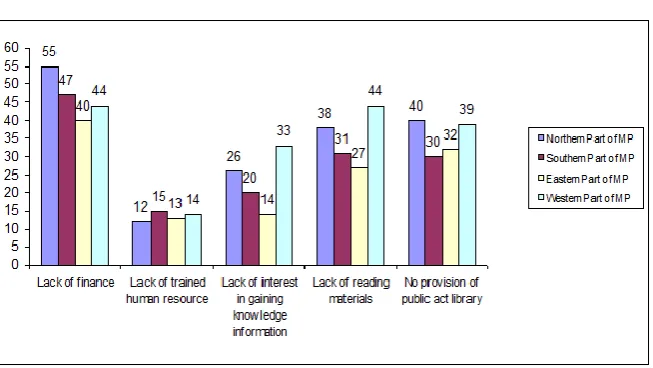
Fig. : Hurdles in Library Development
From Table 2, it is clear that in library development lack of finance (91.62%) is the main hurdle, followed by lack of public library act (69.45%), lack of reading materials (68.96%) and so on. Region wise trend can also be seen in the above table.
Suggestions
Some suggestions are made on the basis of the empirical background of present study.
1. Raja Ram Mohan Roy Library Foundation should come forward to establish and organize rural libraries services in MP. Local authority of panchayati raj institution at rural level should also be approached for the development of rural library.
3. In MP library legislation should be passed, so that expected rural library infrastructure and fundamental resources could be availed.
4. Well qualified staff should be appointed in rural libraries for better and effective library's activities and services.
5. Non-government organizations, other public and private sectors should also get involved for the betterment of rural libraries.
6. Donation tendency of individuals should be encouraged at rural library for strengthening infrastructure and resources.
7. Local cooperation of rural public should be availed and utilized in the development of rural library.
8. Rural library should act as cultural and social centres for rural community and guide them for over all personality development.
9. Demand of rural information should be assessed by different techniques and be fulfilled for the welfare of rural society.
10. Rural library should acquire and collect the information about local and other agriculture resources, climatic resources, geographical resources etc for their proper exploitation, for the progress of rural society.
11. Development of rural libraries is lacking due to poor infrastructure. So the government should take immediate initiatives to improve the poor infrastructure of rural areas.
Conclusion
According to the present investigation it is felt that the status, resources activities, services rendering towards users, etc. are much limited due to fulfillment and dependent on its parent institutions motives. The basic objectives, activities and services towards its users are yet to be achieved. In this direction, planners, policy makers, administrators and concerned professionals should come forward so that it could strengthen for a proper functioning in the right direction for the rural society. In Panchayati Raj governance should also be able to cover and do the needful action within possible approach and local resources. In such way at local level, rural library activities and services should be organized and managed for rural society.
For the socio-economic development of every citizen of the rural areas, it is necessary to provide required information at a right time. It is not one time need, it is a continuous process, and therefore it is an urgent need to ensure proper free flow of information in rural areas by enactment of law. What happens sometimes is that the government or other agencies launch one scheme for rural development, then without getting feedback, they launch again a similar scheme, hence there being no coordination between the schemes. Public library act should be passed and implemented in the state strictly to fulfill the information needs, particularly of the rural people.
BIBLIOGRAPHY:
Dutta, B.K. 1970. Libraries and Librarianship of
Ancient and Medieval India. New Delhi : Atma Ram. p. 100.
http://www.knowledgecommission.gov.in/downloads/docu ments/nkc_library.pdf
India. Ministry of Education. 1961. Report of Advisory Committee for Libraries. New Delhi: Manager. p. 126.
Jeevan, V.K.J. 2004. “Information Dissemination Media for Rural Development: Need for Reorientation.” Kolkata: IASLIC National Seminar. XXI. p. 119.
Khanna, S.N. 1995. “Rural Community Library Services of Delhi Public Library.” In Libraries and Rural Community
Centres, edited by C.P. Vashistha. New Delhi: B.E.
Publications. p. 113.
Kumar, S. 2003. Rural Library and Community Resource Centres (RLCs) in India with Special Reference to States having Library Legislation: Problem and Prospects. Ph.D. Thesis, Jiwaji University. p. 130.
Panda, B.D. 1993. Hand Book of Public Library System. New Delhi: Anmol. pp. 35 – 36.
Planning Commission India. 1956. Second Five Year Plan. New Delhi. Planning Commission. p. 522.
Purushotham, P. 2003. “Information Technology in Rural Employment.” Employment News. 9 –15 August, 2003. p. 10.
Sarda, K. 1986. Rural Library Services in India. New Delhi: Ess Ess Publications. p. 142.
Sharma, A.K. 2008. Information Seeking Behaviour of
Rural People: A Study of Gwalior District of Madhya Pradesh.
New Delhi: Classical Publishing Company. p. 56.
Sharma, P.S.K. 1985. Public Libraries in India. New Delhi: Ess Ess Publications. pp. 77 – 78.
Thomas, V.K. 1997. Public Libraries in India: Development and Finance. New Delhi: Vikas Publications. p. 30.