ISSN (Print) : 2320 – 3765 ISSN (Online): 2278 – 8875
I
nternational
J
ournal of
A
dvanced
R
esearch in
E
lectrical,
E
lectronics and
I
nstrumentation
E
ngineering
(An ISO 3297: 2007 Certified Organization)
Vol. 5, Issue 2, February 2016
Review of RFID & GSM Based
Automatic Ration Distribution System
Prof.Vikram M Kakade1, Jagruti Utane2 , Priti Pachare3
Lecturer, Dept. of EXTC, PRMCEAM, Badnera-Amravati, Maharashtra, India1
UG Student [EXTC], Dept. of EXTC, PRMCEAM, Badnera-Amravati, Maharashtra, India2
UG Student [EXTC], Dept. of EXTC, PRMCEAM, Badnera-Amravati, Maharashtra, India3
ABSTRACT: In this paper we proposed public distribution system i.e. rationing distribution is one of the widely controversial issues that involves corruption and illegal Smuggling of goods. In this paper we provide analysis of used of GSM and RFID in automatic Ration Distribution System The proposed automatic ration shop for public distribution system is based on Radio Frequency Identification (RFID) technology that replaces conventional ration cards. The RFID tags are provided instead of conventional ration cards. Customer’s database is stored in microcontroller which is provided by Government Authority. Customer needs to scan tag to RFID reader, and then microcontroller checks customer’s details with stored to distribute material in ration shop. After successful verification, customer needs to enter type of material as well as quantity of material using keypad. After delivering proper material to consumer, the microcontroller sends the information to customer as well as PDS authorities using Global System for Mobile (GSM) technology.
KEYWORDS: Efficient Communication, GSM, RFID RS-232.
I.INTRODUCTION
India’s Public Distribution System (PDS) is the largest retail system in the world . Public distribution system provides a ration card issued under an order or authority of the State Government for the purchase of essential consumer materials like rice, wheat, kerosene and oil. State Government issues distinctive ration cards like yellow ration card, saffron ration card, and white ration card depending on family annual income. The consumer material is supplied to ration card holders in the first week of every month by ration shopkeeper.
ISSN (Print) : 2320 – 3765 ISSN (Online): 2278 – 8875
I
nternational
J
ournal of
A
dvanced
R
esearch in
E
lectrical,
E
lectronics and
I
nstrumentation
E
ngineering
(An ISO 3297: 2007 Certified Organization)
Vol. 5, Issue 2, February 2016
II.BLOCK DIAGRAM AND SPECIFICATIONS
Fig. 1 Block Diagram of the System
BLOCK SPECIFICATIONS
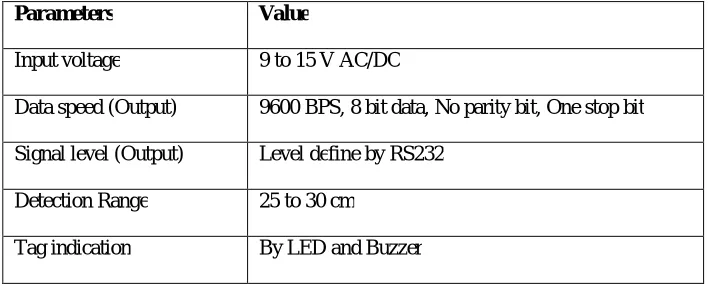
1. RFID Reader: When a user swipes the smart card, and provides the password (i.e. AADHAR number) to the system, it is a smart card reader (electronic device) which detects and reads the RFID Tag (or smart card) and forward the details to the interfaced microcontroller module for further processing. Specifications of RFID Reader is shown in table1.
2. RS232: This protocol provides the required interfacing between RFID reader and microcontroller, also the required interfacing between GSM module and microcontroller.
3. GSM Module: It is a device which serves a connection to exchange information/data between automatic rationing system and the central database provided by the Government. Specifications of GSM module is shown in table 2.
Table 1 Specifications of RFID Reader
Parameters Value
Input voltage 9 to 15 V AC/DC
Data speed (Output) 9600 BPS, 8 bit data, No parity bit, One stop bit
Signal level (Output) Level define by RS232
Detection Range 25 to 30 cm
ISSN (Print) : 2320 – 3765 ISSN (Online): 2278 – 8875
I
nternational
J
ournal of
A
dvanced
R
esearch in
E
lectrical,
E
lectronics and
I
nstrumentation
E
ngineering
(An ISO 3297: 2007 Certified Organization)
Vol. 5, Issue 2, February 2016
Table 2 Specifications of GSM Module
Parameters Value
Data rate 9600 baud CSD
Service Support GSM data transmission, SMS
Status Indicator 1 LED, Alarm
Antenna Impedance 50
Digital Input/Output 8 TTL outputs, 8 TTL inputs with 10 k pull-down
III.RFID INTERFACING WITH MICROCONTROLLER
Each transponder tag contains a unique identifier (one of 240 or 1,099,511,627,776 possible combinations) that is read by the RFID Card Reader and transmitted to the host via a simple serial interface. It means no two tags are same. Each tag has diffierent value. This value if read by reader. When the RFID Card Reader is active and a valid RFID transponder tag is placed within range of the activated reader, the unique ID will be transmitted as a 12-bit printable ASCII string serially to the host in the format shown in figure 2.
Table 3 AT Commands for Writing and Sending Messages
AT Commands Meaning
+CMGS Send message
+CMSS Send message from storage
+CMGW Write message to memory
+CMGD Delete message
+CNMI SMS alert
+CMMS More message to send
Fig. 2 12-bit printable ASCII string
ISSN (Print) : 2320 – 3765 ISSN (Online): 2278 – 8875
I
nternational
J
ournal of
A
dvanced
R
esearch in
E
lectrical,
E
lectronics and
I
nstrumentation
E
ngineering
(An ISO 3297: 2007 Certified Organization)
Vol. 5, Issue 2, February 2016
All communication is 8 data bits, no parity, 1 stop bit, and least significant bit first (8N1). The baud-rate is configured for 9600 bps, a standard communications speed supported by most any microprocessor or PC, and cannot be changed. The RFID Card Reader initiates all communication. This allows easy access to the serial data stream from any programming language that can open a COM port.
IV. MODULE WORKING PRINCIPLE
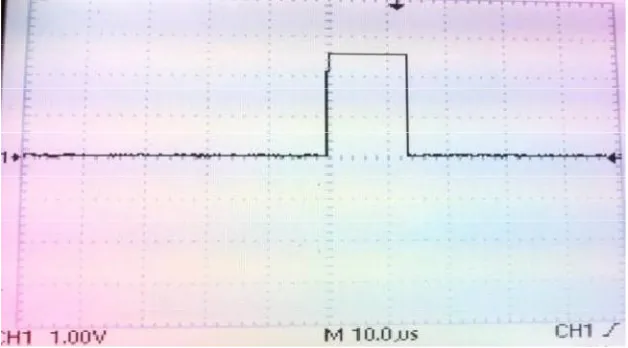
1) First to start ranging, 10 μs high level input signal is given to trigger pin of the ultrasonic sensor.
2) As soon as module is triggered, it automatically sends eight 40 kHz and detect whether there is pulse signal reflected back.
3) If signal returns, echo pin will rise i.e. it will become high to certain duration which is equal to the time taken by wave to reach the object and to coming back.
4) Test distance = (high level time × velocity of sound (340m/s)/ 2
Practically, timing diagram of HC-SR04 module is shown in figure 3 and figure 4.
Fig. 3 Triggering pulse
ISSN (Print) : 2320 – 3765 ISSN (Online): 2278 – 8875
I
nternational
J
ournal of
A
dvanced
R
esearch in
E
lectrical,
E
lectronics and
I
nstrumentation
E
ngineering
(An ISO 3297: 2007 Certified Organization)
Vol. 5, Issue 2, February 2016
V. RESULT
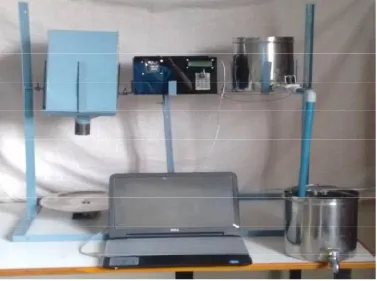
Fig. 5 Final Working Setup
ISSN (Print) : 2320 – 3765 ISSN (Online): 2278 – 8875
I
nternational
J
ournal of
A
dvanced
R
esearch in
E
lectrical,
E
lectronics and
I
nstrumentation
E
ngineering
(An ISO 3297: 2007 Certified Organization)
Vol. 5, Issue 2, February 2016
ISSN (Print) : 2320 – 3765 ISSN (Online): 2278 – 8875
I
nternational
J
ournal of
A
dvanced
R
esearch in
E
lectrical,
E
lectronics and
I
nstrumentation
E
ngineering
(An ISO 3297: 2007 Certified Organization)
Vol. 5, Issue 2, February 2016
Fig. 9 Consumer received message from ration shop after material delivered from system
VI.CONCLUSION
. To overcome above problems, automatic ration shop played important role. The automatic ration shop involved RFID as well as GSM technology to distribute the kerosene or grain material. Ration card is replaced by RFID and information is sent to consumer using GSM module. The proposed system creates the transparency in public distribution system as the work becomes automatic. With the help of this system, it is possible to make public distribution system efficient and free from malpractices. The proposed system has advantages like it is helpful to prevent malpractices at ration shop, maintain data properly, reduces paper work, time saving approach and cost effective.
REFERENCES
[1] Z.Zyonar, Karl Kammelander, Peter Jung, Evolution Towards 3rd Generation Systems, (1988).
[2] Jorg Eberspacher, Hans-Joerg Vogel, Christian Bettstetter, GSM Architec-ture, Protocols and Services, (2008).
[3] Dhanoj Mohan, Rathikarani, Gopakumar, “Automation of Ration Shop Using PLC” International Journal of Modern Engineering Research, 2013, Vol. 3, Issue. 5, pp. 2971-2977.
[4] S.Valarmathy, R.Ramani, “Automatic Ration Material Distributions Based on GSM and RFID Technology” International Journal Intelligent Systems and Applications, 2013, Vol. 11, pp. 47-54.
[5] Rajesh C. Pingle and P. B. Boroley, “Automatic Rationing for Public Distribution System (PDS) using RFID and GSM Module to Prevent Irregularities” HCTL Open International Journal of Technology Innovations and Research, 2013, Vol. 2, pp. 102-111.
[6] S. Sukhumar, K. Gopinathan, “Automatic Rationing System Using Embedded System Technology” International Journal of Innovative Research in Electrical, Electronics, Instrumentation and Control Engineering, 2013, Vol. 1, Issue 8, pp. 339-342.