An Efficient Matrix Factorization for
Dynamic Background Subtraction
Banothu Satyanarayana
Assistant Professor, Dept. of ECE, Sri Indu College of Engineering and Technology(A), Sheriguda, Ibrahimpatnam, R.R. Dist, Telangana, India
ABSTRACT:Detection of moving objects in a video sequence is a difficult task and robust moving object detection in video frames for video surveillance applications is a challenging problem. Object detection is a fundamental step for automated video analysis in many vision applications. Object detection in a video is usuallyperformed by object detectors or background subtraction techniques. Werecommend an effective online background subtraction method, which can be robustly applied to practical videos that have variations in both foreground and background. Different from previous methods which often model the foreground as Gaussian or Laplacian distributions, we prototypical the foreground for each frame with a specific mixture of Gaussians (MoG) distribution, which is updated online frame by frame. Particularly, MoG model in each frame is regularized by the learned foreground/background knowledge in previous frames. This makes online MoG model highly robust, stable and adaptive to practical foreground and background variations. The recommended model can be formulated as a brief probabilistic MAP model, which can be voluntarily solved by EM algorithm. We additional embed an affine transformation operator into the recommended model, which can be automatically accustomed to fit a wide range of video background transformations and make the method more robust to camera movements.
KEYWORDS:Background subtraction, mixture of Gaussians, low-rank matrix factorization, subspace learning
I.INTRODUCTION
Detection of motion is very essential and common step in many surveillance system applications. In these applications, the goal is to obtain very high sensitivity in detection of moving objects with less possible false alarm rates. Background segmentation is one of the famous techniques that are commonly used. It works on the intensity difference of the current frame with the background frame. Moving object detection and tracking (D&T) are important steps in object recognition, context analysis and indexing processes for visual surveillance systems etc. It is a big challenge for researchers to prepare algorithms on which detection and tracking is more suitable for background situation, environment conditions and to determine how accurately D&T object (real-time or non-real-time) is made. There are variety of object D&T algorithms and publications available. On that basis we can compare their performance and evaluate via performance metrics. This report provides a systematic review of these algorithms, their brief description and performance analysis and effectiveness in terms of execution time and memory requirements. When the camera is fixed and the number of targets is small, objects can easily be tracked using simple methods. Computer vision-based methods often provides non-invasive solution. Their applications can be divided into three different groups: Surveillance, control and analysis. The object detection and tracking (D&T) process is a necessary requirement for surveillance applications. The control applications, which uses some parameters to control motion calculations and estimation. These parameters are used to control the relevant vision system. The analysis applications are generally automatic, and used to optimize and diagnose system’s performance. For well predefined (namely, annotated) datasets, the object recognition algorithms give good accuracy.
videos involves verifying the presence of an object in image sequences and possibly locating it precisely for recognition. Object tracking is to monitor an object spatial and temporal changes during a video sequence, including its presence, position, size, shape, etc.
In recent years, with the latest technological advancements, off-the-shelf cameras became vastly available, producing a huge amount of content that can be used in various application areas. Among them, visual surveillance receives a great deal of interest nowadays. Until recently, video surveillance was mainly a concern only for military or large-scale companies. However, increasing crime rate, especially in metropolitan cities, necessitates taking better precautions in security-sensitive areas, like country borders, airports or government offices. Even individuals are seeking for personalized security systems to monitor their houses or other valuable assets. So, our objective is to develop some sort of algorithm that will satisfy human requirements in future.
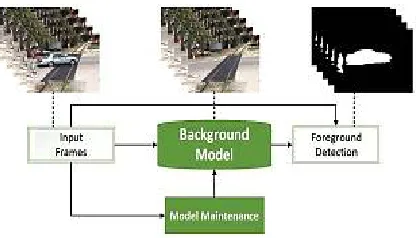
Background subtraction or foreground detection is theprinciple task of almost every video inspection algorithmbefore operating further processing designed for a particular computer vision application. In essence, a robust background subtraction is achieved by creating a model of thebackground, as depicted in Fig. 1. The performance ofthe background subtraction algorithm depends on how wellthe background model can adapt to the slight and suddenchanges of the background scenes. Recently, a huge bodyof work in this area has focused on modeling the background as a low-dimensional subspace in the high low-dimensional space of video frames.
Figure 1: Standard structure common in the majority of the robust background subtraction methods.
The main research objectives to designthe project are
o To improve the accuracy detecting the object in video and cut down the cost of computations using the process of optimization.
o To handle static background and dynamic background while process the video. o To detecting and removing the outliers present in sequence of frames
II.LITERATURE SURVEY
Avery popular background subtraction approach is to modeleach pixel with a mixture of Gaussians [2], proposed by Stauffer and Grimson. Due to its effectiveness in sustainingbackground variations, a large amount of further developments[3]–[5] have been proposed. In [6], Elgammal et al. proposeda non-parametric kernel density estimate (KDE) method forbackground modeling. In [7], the Principle Component Analysis (PCA) method for background modeling was proposed. Inthis method, the new frame was projected onto the subspacespanned by the trained principle components, and the residuesindicate the presence of new foreground objects. In [8],Li et al. utilize spatio-temporal features (color co-occurrence)to model complex backgrounds. The method in [9] madeuse of prior information of the neighborhood spatial contextby a MAP-MRF framework. Heikkilä and Pietikäinen [10]developed an efficient texture-based method by using adaptiveLocal Binary Pattern (LBP) histograms to capture background
theViBe [15] and PBAS [16], background modeling is based onthe collection and update pixel samples. In [17], foregrounddetection was cast as an outlier signal estimation problem in alinear regression model. A more detailed discussion of theseconventional techniques can be found in recent surveys [18],[19].
Low Rank Matrix Factorization: Low rank matrix factorization (LRMF) is one of themost normally exploited subspace learning methods forbackground subtraction. The main indication is to extract the low rank approximation of the data matrix from the productof two smaller matrices, corresponding to the basis matrixand coefficient matrix, respectively.
Background subtraction: Background subtraction means that firstly constructing a background image or a background model with information of the historic frames then generating the background subtraction for the current frame by some calculation rules. Finally the method defines whether moving objects exist in the current frame based on the result in the previous step and some judgment rules. Background subtraction method can extract the whole contour of the moving object and has a good performance under a relatively stable scene. So far, the background subtraction method can be divided into two categories:
1) Background reconstruction and 2) Background modeling.
The initial strategies mainly assumed that the distribution (along time) of background pixels can be distinguished from that of foreground ones. Thus by judgingif a pixel is significantly deviated from the backgroundpixel distribution, we can easily categorize if a pixel islocated in background/foreground.
Online Subspace Learning:An increasing attention to design online subspace learning method to handle real-time background subtraction issues. The basic idea is to calculate only one frame at a time, and gradually better the background based on the real-time video variations.
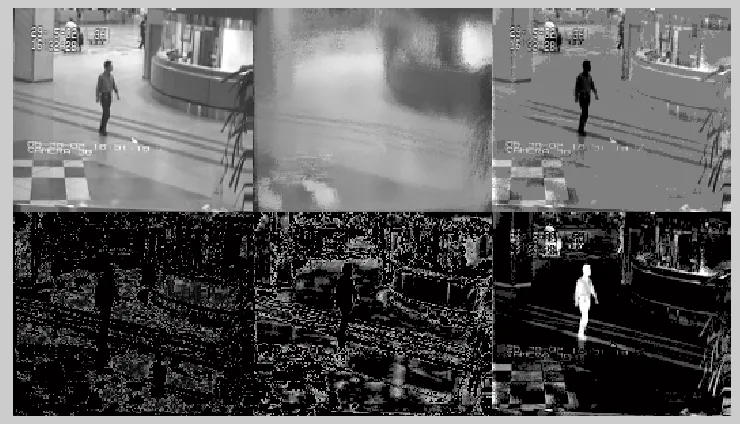
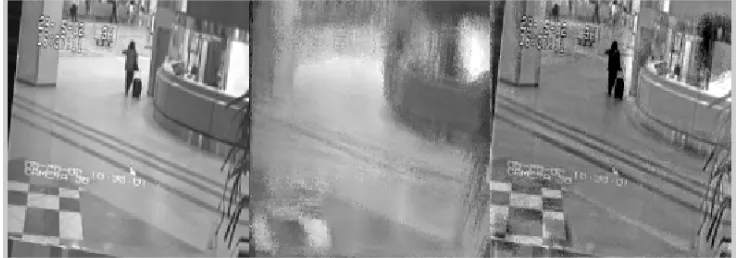
Robust Subspace Alignment: Recently, multiple subspace learning strategies have been constructed to learn transformation operators on video frames to make the methods robust to camera jitters.Laplacian cannot finely reflect the complex configurations ofvideo foregrounds. This shortage inclines to degenerate itsperformance on online background subtraction. Moderately, our proposed method fully encodes both dynamicbackground and foreground variations in videos, and thusis always expected to attain a better background subtractionperformance, as depicted in Fig. 2.
III.PROPOSED ALGORITHM Online MOG-LRMF
We first briefly introduce the MoG-LRMF method [16],which is closely related to the modeling strategy for foreground variations in this method.
Let = [ , … , ] ℜ × be the given data matrix,where d; n denote the dimensionality and number of data,respectively, and each column xi is a d-dimensional measurement. A general LRMF problem can be formulated as
. || ⊙( − )|| ………. (1) = ( ) + , ………. (2)
Fig. 3. The graphical model for OMoGMF[20]
To make a completeBayesian model, we also set a non-informative prior p(v) forv, which does not essentially inspiration the calculation. Thefull graphical model is depicted as Fig. 3.
As above-mentioned, we need a warm-start stage ona mini-batch of video frames for subspace initialization.We thus also need to pre-align these starting frames tofacilitate a good starting point for the following onlineimplementation. To this aim we extend Algorithm 2 asa frame-recursive-updating version (we call it as iterativet-OMoGMF or it-OMoGMF) as follows: first easily set themean or the median of all starting frames as an initialsubspace, and then iterate the following two steps: runAlgorithm 2 throughout all these frames and then return to the first frame and rerun the algorithm. Duringthis process, the separated foreground and background areexpected to be more and more accurate due to the gradually ameliorated transformation operators on all frames.
Performance Evaluation:
To get an accurate evaluation of the proposed method, thecriteria of recall and precision [19] are employed:In the reminiscence calculation, TP is the total number of appropriatelyclassified foreground (true positives), and FN is the totalnumber of false negatives, which interpretations for the incorrectnumber of foreground pixels classified as background. Inprecision calculation, FP is the total number of false positives, which means the pixels are incorrectly classified asforeground.
The F-measure is utilized asthe quantitative metric for performance evaluation. TheF-measure is calculated as follows:
− = 2 × .
+ ′
Where precision= | ∩ |
| | and recall= =
| ∩ |
| | ,
IV . RESULT AND DISCUSSION
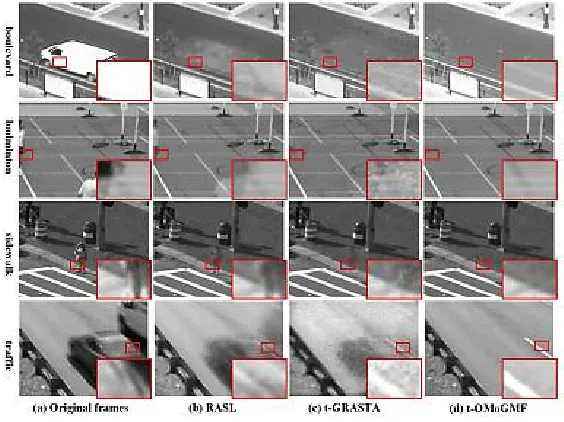
Fig. 5. From upper to lower: original frames in airport video; alignedframes, backgrounds and foregrounds obtained by t-OMoGMF.
For improved opinion, Fig.5 displaysthe outcome of t-OMoGMF on multiple frames of transformedairport sequence. It is easy to see that t-OMoGMF canwell line up video frames, which obviously indications to its enhancedforeground/background separation.
VI.CONCLUSION
In this paper, we have recommended a new online subspace learning method pointing to make background subtraction available in practical videos both in speed andaccuracy. On one hand, the computational speed of thenew method reaches the real-time requirement for videoprocessing (more than 25 FPS), and on the other hand,the method can adaptively fit real-time dynamic variationsin both foreground and background of videos. In specific, through specifically learning a foreground distributionand a background subspace normalized by the beforehandlearned knowledge for each video frame, the method canproperly deliver variations of video foreground and background along the video sequence.
REFERENCES
[1] C. Beleznai, B. Fruhstuck, and H. Bischof, “Multiple object tracking using local PCA,” in Pattern Recognition, 2006. ICPR 2006. 18th International Conference on, vol. 3. IEEE, 2006, pp. 79–82
[2] C. Stauffer and W. E. L. Grimson, “Adaptive background mixture models for real-time tracking,” in Proc. IEEE Comput. Soc. Conf. Comput. Vis. Pattern Recognit., vol. 2. pp. 246–252, Jun. 1999.
[3] Z. Zivkovic, “Improved adaptive Gaussian mixture model for background subtraction,” in Proc. 17th Int. Conf. Pattern Recognit. (ICPR), vol. 2. Aug. 2004, pp. 28–31.
[4] H.-H. Lin, J.-H. Chuang, and T.-L. Liu, “Regularized background adaptation: A novel learning rate control scheme for Gaussian mixture modeling,” IEEE Trans. Image Process., vol. 20, no. 3, pp. 822–836, Mar. 2011.
[5] X. Liu and C. Qi, “Future-data driven modeling of complex backgrounds using mixture of Gaussians,” Neurocomputing, vol. 119, pp. 439–453, Nov. 2013.
[6] A. Elgammal, D. Harwood, and L. Davis, “Non-parametric model for background subtraction,” in Proc. Eur. Conf. Comput. Vis., 2000, pp. 751– 767.
[7] N. M. Oliver, B. Rosario, and A. P. Pentland, “A Bayesian computer vision system for modeling human interactions,” IEEE Trans. Pattern Anal. Mach. Intell., vol. 22, no. 8, pp. 831–843, Aug. 2000.
[8] L. Li, W. Huang, I. Y.-H. Gu, and Q. Tian, “Statistical modeling of complex backgrounds for foreground object detection,” IEEE Trans. Image Process., vol. 13, no. 11, pp. 1459–1472, Nov. 2004.
[9] Y. Sheikh and M. Shah, “Bayesian modeling of dynamic scenes for object detection,” IEEE Trans. Pattern Anal. Mach. Intell., vol. 27, no. 11, pp. 1778–1792, Nov. 2005.
[10] M. Heikkilä and M. Pietikäinen, “A texture-based method for modeling the background and detecting moving objects,” IEEE Trans. Pattern Anal. Mach. Intell., vol. 28, no. 4, pp. 657–662, Apr. 2006.
[11] K. Kim, T. H. Chalidabhongse, D. Harwood, and L. Davis, “time foreground-background segmentation using codebook model,” Real-Time Imag., vol. 11, no. 3, pp. 172–185, Jun. 2005.
[12] J.-M. Guo, Y.-F. Liu, C.-H. Hsia, M.-H. Shih, and C.-S. Hsu, “Hierarchical method for foreground detection using codebook model,” IEEE Trans. Circuits Syst. Video Technol., vol. 21, no. 6, pp. 804–815, Jun. 2011.
[14] L. Maddalena and A. Petrosino, “The SOBS algorithm: What are the limits?” in Proc. IEEE Comput. Soc. Conf. Comput. Vis. Pattern Recognit. Workshops, Jun. 2012, pp. 21–26.
[15] O. Barnich and M. Van Droogenbroeck, “ViBe: A universal background subtraction algorithm for video sequences,” IEEE Trans. Image Process., vol. 20, no. 6, pp. 1709–1724, Jun. 2011.
[16] M. Hofmann, P. Tiefenbacher, and G. Rigoll, “Background segmentation with feedback: The pixel-based adaptive segmenter,” in Proc. IEEE Comput. Soc. Conf. Comput. Vis. Pattern Recognit. Workshops (CVPRW), Jun. 2012, pp. 38–43.
[17] G. Xue, L. Song, and J. Sun, “Foreground estimation based on linear regression model with fused sparsity on outliers,” IEEE Trans. Circuits Syst. Video Technol., vol. 23, no. 8, pp. 1346–1357, Aug. 2013.
[18] A. Bugeau and P. Pérez, “Detection and segmentation of moving objects in complex scenes,” Comput. Vis. Image Understand., vol. 113, no. 4, pp. 459–476, Apr. 2009.
[19] S. Brutzer, B. Hoferlin, and G. Heidemann, “Evaluation of background subtraction techniques for video surveillance,” in Proc. IEEE Conf. Comput. Vis. Pattern Recognit., Jun. 2011, pp. 1937–1944.
[20] Hongwei Yong, Deyu Meng, Wangmeng Zuo, Lei Zhang, “Robust Online Matrix Factorization for Dynamic Background Subtraction,” IEEE transactions on pattern analysis and machine intelligence, 2017.
BIOGRAPHY
![Fig. 3. The graphical model for OMoGMF[20]](https://thumb-us.123doks.com/thumbv2/123dok_us/7765750.1276682/4.595.61.419.278.509/fig-graphical-model-omogmf.webp)