Dynamic Movement based Performance Analysis
of EDSR with Different Protocols
C.Mari venkatesth. 1, R. Kanaga sundar1,V. Jefrins1 M.Ashok Kumar. 2
1
M.E Student, 2 Assistant Professor
Dept of ECE , Chandy College of Engineering, Tuticorin, Tamilnadu.
Abstract- Mobile Ad Hoc Network (MANET) is an autonomous, dynamic changed topology, self-healing and self configurable network of mobile nodes with wireless links providing connections among them. According to this network structure has many challenges in the routing for sending and receiving the information from one node to another node. At that time mobile nodes consuming some large amount of energies owing to the control packet overhead, delay, delivery ratio and packet drop. In this paper based on protocol comparison by packet drop, delay, control overhead and energy consumption in both static and dynamic. The DSDV, AODV, DSR and EDSR protocol’s comparison done using NS-2 simulation. Simulation results shows that EDSR protocol makes an improvement in control packet overhead, delivery ratio, energy consumption and packet losses compared to AODV, DSDV and DSR protocols in both static and dynamic node movement.
Keywords: AODV, DSDV, DSR, delay, delivery ratio, EDSR, energy consumption, overhead, packet drop.
I. INTRODUCTION
A mobile ad hoc network consists of a group of mobile nodes that communicate with each other without the presence of infrastructure. Mobile Ad hoc Networks (MANETs) are used in failure revival, salvage operations, armed forces communication and many other applications. In order to make available communication all over the network, the mobile nodes must assist to handle network functions, such as packet routing. The wireless mobile hosts communicate in a multi hop fashion. In multi-hop wireless ad-hoc networks, designing of energy-efficient routing protocols is critical since nodes have very limited energy, computation power and communication capabilities. So need to make efficient routing protocols for making the efficient network. That efficient routing protocols mainly based on its routing and other parameters. Such as energy, packet loss, control overhead, delivery ratio. These comparisons are based on the Ad-hoc On-demand Distance Vector (AODV), Dynamic Source Routing (DSR), Destination Sequence Distance Vector (DSDV) and Efficient Dynamic Source Routing (EDSR) protocols and its parameters .Each protocols differentiate based on its own routing process. In this comparison proposed the EDSR protocol for efficient routing and also it gives the better performance compare to DSDV, AODV, and DSR routing protocols by various pass time.
II. RELATED WORK
MANET routing protocol parameters and performance can be evaluated by various research persons. The
uniqueness of the routing protocols screening based on routing process, packet size, traffic model, and network range and node compactness. Prokopios.C et al have evaluated the performance of the AODV and DSDV protocols depend on the node movement. In [9] particular comparison AODV is better than DSDV when continuous node movement otherwise DSDV is better. Taehong kim et al have compared zig bee tree(ZTR) , short cut tree(STR) and Ad hoc On-demand Distance Vector (AODV) routing protocols in[13] that depends on route discover, packet delivery ratio, hop count, and over head.Samyak Shah, et al was presented [10] the comparisons between AODV, DSR and DSDV based on the network range, movement of the node and network load. Abolhasan, et al[1] examine the contrast between the performance of OLSR, B.A.T.M.A.N, and BABEL based on multi hopping and route recovery. Mamoun Hussein Mamoun et al,[5] presents the new routing algorithm for MANET called as NPR . NPR used for discovery, maintenance, and improvement. It compared with AODV with the help of delivery ratio and end to end delay. Humayun Bakht et al,[3] proposed various scheme of routing protocols based on available literature for discover the problem. Selvi, et al [11] examine the DSR and AODV protocols performance based on packet length, mobility and delay. This examine gives the AODV as the best one for large network.Natarajan, et al[7] proposed the comparison between seven routing protocols DSR, AODV, DSDV, TORA, FSR,CBRP and CGSR based on its performance.Pragya Gupta, et al[8] investigate the effect of movement in the routing protocols AODV, DSR, DSDV and OLSR depends on packet delivery ratio, average end to end delay, and average routing load. Mohammed A.Miki et al [6] proposed new EDSR protocol algorithm to reduce the energy consumption, packet delivery ratio and overhead.
III. ROUTING PROTOCOLS
In Ad hoc network routing protocol has three types; the types are Proactive, Reactive and Hybrid. Proactive means that contain the routing table for every node. In particular routing based on the nearest node routing table. It also called as table driven routing protocols. Reactive referred as on demand routing because it discover the route when source needs to sends the data to the destination so it called as on –demand routing protocols. Hybrid protocol contains combination of both proactive and reactive protocols. A. DSDV (Destination Sequence Distance Vector)
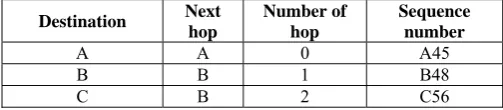
this routing the node A taken as the source node and it communicate with destination node C at that time node A looks up the routing table and it follows the route according to the table. In table (1) contains the destination address, next hop information, hop count and sequence number. According to the routing table the node A forwards the packet to next hop B with appropriate sequence number. Then the node B asks to forward the packets to the node C with sequence number. In that similar manner each node transmits the packet with the help of the routing table. In DSDV make the sequence number for every entry in the routing table for avoid the looping condition.
Fig 1: DSDV Communication
Table 1: Routing table of A nodein DSDV
There are two types of packets used for transmitting the information. The packets are (i) full dump, (ii) incremental packet. In DSDV the full dump information packet are used at that time of first meet between the two nodes. The next time onwards it shares the incremental packets only to reduce the packet size. The incremental packet contains only the route table changes. Each and every node in DSDV sends the modified routing information periodically. In this exposed route it selects the larger sequence number. Suppose the two routes are denoted by the same sequence number means that time smaller hop count route will be chosen.
The reactive routing protocol initiate the route determine progression when the two nodes planned to transmit the data between them. So only it called as on demand routing protocols. Some on demand routing protocols are AODV and DSR.
.
B. AODV (Ad hoc On-Demand Distance Vector)
Ad hoc on demand distance vector routing (AODV) is the combination of both DSDV and DSR. In AODV each node manages a one routing table. Route table entry contains[12]:
Dynamic neighbor list: a list of neighbor nodes that are dynamically using this route entry.
Once the connection in the entry is broken, neighbor nodes in this list will be informed.
Destination address
Next-hop address toward that destination
Number of hops to destination
Sequence number: for choosing route and prevent loop
Lifetime: time when that entry expires
The AODV consists of two phases: Route Discovery and Route Maintenance. A node communicates with a help of routing table to achieve the destination. Once the destination was obtained, then node transmits data in the way of DSDV. Otherwise the route discovery mechanism was used to discover the route to achieve the destination. Source node send out the route request packet to the neighbor nodes, which in turns retransmit this request to their neighbor nodes until discover the sufficient way to reach the destination.
When the in-between node receive a RREQ (Route Request), then it updates the route and check the two conditions: (i) Check the presented entry which has the same destination for corresponding RREQ (ii) The sequence number is greater or equal to sequence number of RREQ. The condition not satisfied means, it retransmits RREQ. Otherwise the node generates a RREP message to the source node. When RREP is routed reverse, the routing table updates the reverse routing path with new next hop information. If source node receives more than one RREP means the greater sequence number will be chosen. The two RREPs had the same sequence number, which one had less number of hops to achieve the destination that one will be chosen for supplementary process. When a route is found, at that time onwards that routes are maintained by route maintenance mechanism. Every node periodically sends the hello packet to neighbor nodes for confirm its accessibility. When hello packet is not received by a node in a particular time, that link of the node considered as busted. The source node still want to transmit data to the destination should restart route discovery and obtain a fresh path. The main benefit of the AODV is to decrease the overhead of the control messages, low processing, quick adapt to network topology change, more scalable up to 10000 mobile nodes .The disadvantage of AODV is to increase delay when it initiates a route discover, recovery of the broken link and it worked in bi directional link only[12].
C. DSR (Dynamic Source Routing)
DSR is one of the reactive routing based protocols which is able to manage a mobile ad-hoc network without the use of episodic table-up gradation process, such as DSDV protocols. DSR was purposely designed for use in multi-hop wireless ad hoc networks. According to the structure of Ad-hoc network need to restricting the bandwidth during the dynamic topology changes. In this method to find a route is only after the demand receiving from the source. DSR has two phases[12];
Path finding
Path main tance 1) Path finding process
In DSR path finding process, the source nodes discover the complete pathway from the source to the destination node and update the data related to the in-between route nodes. This path finding process done with the help of route request and route reply process.
2) Path maintenance
In [12] DSR every node confirms its existence and also knows the next hop information. In this process each node
Destination Next hop Number of hop Sequence number
A A 0 A45
B B 1 B48
C B 2 C56
forwards the information only once. Suppose a packet not reach the desire node, then that packet is retransmitted after the long times until an authentication is received from the next hop. The retransmission gets failure response means that a route error message is sent to the source node that can remove route from source route cache. So the source node needs to determine another route to achieve the target with the help of route cache. The route not presents in the route cache means that it broadcast the route error message [12].
IV. PROBLEM DESCRIPTIONS
DSDV face the following problems. (i) A large overhead caused by periodical update. (ii) Wastage of resource increased for finding all possible routes between each pair, but only one route was used for achieve the destination. In [2][3][6]DSR has the Route Maintenance protocol does not locally repair a broken link. The broken link is only communicated to the initiator. The DSR protocol is only efficient in MANETs with less than 200 nodes. Problems appear by fast moving of more hosts, so that the nodes can only move around in this case with a moderate speed. Flooding the network can cause collusions between the packets. Also there is always a small time delay at the begin of a new connection because the initiator must first find the route to the target.
V. PROPOSED METHOD OF ROUTING PROTOCOL
Proposed Efficient Dynamic Source Routing (EDSR) protocol approach based on the mobility of the node. The proposed protocol is a modification to the ad hoc routing protocol DSR. EDSR utilizes location information of mobile nodes with the goal of decreasing routing-related overhead in mobile and ad hoc networks. It uses location information of the mobile nodes to limit the search for a new route to a smaller area of the ad hoc network which results in a significant reduction in the number of routing messages and therefore the energy consumption of the mobile nodes batteries is decreased significantly. In order to reduce the control overhead due to broadcast storm in the network when control packets are flooded into whole network.
A. Structure of EDSR
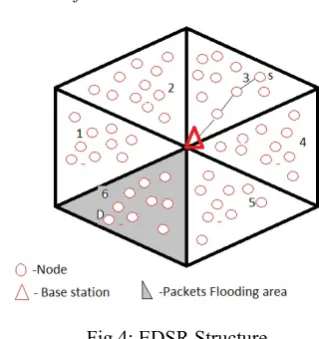
Fig 4: EDSR Structure
EDSR uses a wireless base station (BS) that covers all mobile nodes in the network. BS divides the network into
six areas as shown in Fig.4 In order for BS to efficiently route packets among mobile nodes, it keeps a Position Table (PT) that stores locations of all mobile nodes PT is built by BS through broadcasting small BEACON packets to all mobile nodes in the network. Mobile nodes local positions are estimated from directional antennas, the distance between the mobile nodes and BS is estimated using the strength of the signal from mobile nodes to BS, and the angle of arrival (AoA); θ (which is the angle of the mobile node from which the packet arrives to BS) is estimated using directional antenna of the mobile node. Based on the AoA, BS can determine the network area in which each mobile node is located.
B. Range of angle
Table (2) Shows angle and the area ID of each mobile node. When a source mobile node needs to transmit data, it first queries BS about the area id of the destination mobile node, and then data packets are flooded into that area only. The use of location information of the destination mobile node limits the search for a new route to one of the six areas of the ad hoc network
Table 2: Range of angle
VI. EXPERIMENTAL RESULTS
Table 3: NS2 simulation environment settings
Overview of result
The result of this comprehensive performance analysis based on the routing method of the routing protocols and its parameters. The parameters are speed, mobility of the node, and pass time. But this analysis entirely based on the pass time variation for static nodes and dynamic nodes. This performance analysis evaluated by using packet drop, packet delay, control overhead, energy consumption, delivery ratio, and throughput. The evaluation of these
Area ID Range of angle
1 0≤Θ≤π/3
2 π/3≤Θ≤2π/3
3 2π/3 ≤Θ≤π
4 π≤Θ≤ 4π/3
5 4π/3 ≤Θ≤ 5π/3
6 5π/3 ≤Θ≤ 2π
Parameter Setting Value
Simulation duration 500 sec
Network area 1500 m x1500 m Number of mobile nodes 50
Mobility model Random way point model Pause time 10, 20,40,80,100 ms Node transmission range 250 m
protocols proved the EDSR gives the best performance compared to other protocols.
A. Node arrangement and packet sending process
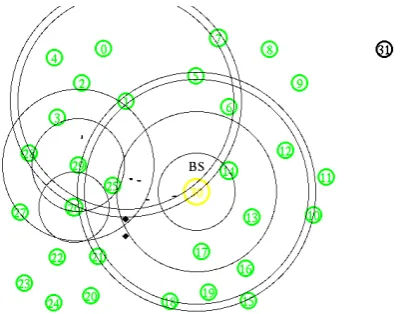
Fig (5) shows the nodes are arranged like, the EDSR
model. As EDSR the total area can be divided into six equal parts based on the distance and then range of angle
Fig 5. Node arrangement and packet sending process
And also the operations based on the base station .The base station only store the information about the nodes and its location that base station mainly used for finding the route of the node. The packet should send through the base station only because it has the location details of the all parts.
B. Comparison of the throughput & delivery ratio
Fig (6) shows the comparison analysis of the three
protocols AODV, DSDV, DSR. These three protocols analysis by using various pass time 20,40,60,80,100. Based on this pass time the throughput should be calculated. Number of packets received per milliseconds in that particular pass time that called throughput. In that analysis AODV, DSR produce the little different throughput like 27, 28, at 20ms and for 100 ms. It produce 26 but DSDV produce the poor throughput (below 25) compare to these two protocols. In that same manner calculate the throughput comparison for EDSR with AODV, DSR, DSDV. The performance shows below fig (6).
Fig 6. Throughput for AODV, DSR, DSDV
Fig 7. Throughput for AODV, DSR and DSDV with EDSR
In fig (7) shown the comparison based on the particular time period. The EDSR produce the 98% to 100% delivery ratio. The DSR and AODV produce the 92% to 100% delivery ratio. But DSDV produce the 92% to 97% delivery ratio. This analysis proved the best performance of the EDSR.
C. Comparison of the delay
In fig (8) shows the comparison .This analysis had done
by various pass time 20,40,60,80,100 for AODV, DSR, DSDV. Based on pass time and the initial interval time and packet receiving time, the delay should be calculated. In that particular pass time need to calculate the difference between packet receiving time and initial time interval it produce the delay of the transmission. In that analysis AODV, DSDV produce the little different delay like .003ms, .003ms, at 20ms and for 100 ms it produce .15ms and .1ms but DSR produce the poor end to end delay .005 and.35 ms.
Fig 8. End to end delay for AODV, DSR and DSDV
Fig(9).Show average delay for particular time period. The EDSR produce the .03ms,.005ms,00ms delay for 12 ms, 15 ms, 21 ms . The AODV and DSDV produce the respectively .005ms,.012ms , 000ms and .040ms, .075ms, 000ms delay .But DSR produce the.075ms, .005ms, 000ms.This comparison proved the EDSR produce the less delay.
D. Comparison of the packet loss
In this comparison shows the fig.(10) AODV, DSDV, DSR, is analyzed by various pass time 20,40,60,80,100. Packet loss calculated based on various pass time and the initial interval time, packet receiving time, the delay. In that particular pass time need to calculate the difference between packet receiving and sending it produce the packet losses of the transmission. In this analysis AODV, DSR produce the little different in the packet losses. AODV, DSR produce the respective losses 31, 26 for 20 ms and 141,359. for 100 ms pass time produce . DSDV produce the poor packet loss 390 and.410.
Fig .10. Packet loss for AODV, DSR and DSDV
Fig.11. Packet loss for AODV, DSR and DSDV with EDSR
fig (11).Show the packet loss of the protocols. EDSR produce the 5,0, 2, packet loss for 8 ms, 12 ms, 18 ms . The AODV and DSDV produce the respectively 9, 26,3 and .11, 33,2 packet losses. But DSR produce the 18, 52, 5, packet losses. EDSR produce the less packet losses.
E. Comparison of the energy consumption
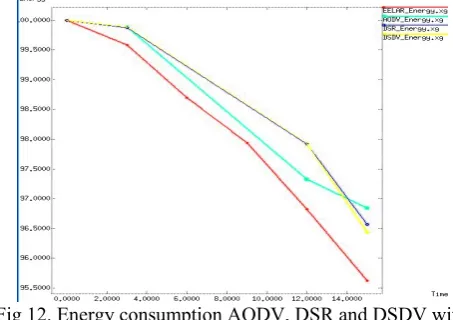
In fig (12) shown the comparison based on the energy consumption. The AODV, DSR, DSDV, protocols and
EDSR protocols are compared in this section. In that particular time period and based on the routing method. Mobile node consumes some energy for sending and receiving the packets and request process. The energy consumption reduced by making the efficient protocols. From this comparison we produce the efficient routing protocol. EDSR makes significant reduction in the energy consumption of the mobile nodes batteries through limiting the area of discovering a new route to a smaller zone.
Fig 12. Energy consumption AODV, DSR and DSDV with EDSR
From that above fig (12) the AODV consume 98, 97.5,97 for 8, 10, 15 mile sec. DSR consume 99, 98.50, 96.70, DSDV consume 99, 98, 96.50 and EDSR consume 98, 96.70, 95.50. Based on this comparison EDSR produce the less energy consumption compared to other protocols.
VII. CONCLUSION AND FUTURE WORK
Conclusion
This proposed an Efficient Dynamic Source Routing Protocol (EDSR) EDSR makes significant reduction in the energy consumption of the mobile nodes batteries through limiting the area of discovering a new route to a smaller zone. Thus, control packets overhead are significantly reduced and the mobile nodes life time is increased. To show the efficiency of the proposed protocol presented through the simulations using NS2 in both static and dynamic node movement. Simulation results show that the proposed EDSR protocol leads to an improvement in control overhead and delivery ratio compared to AODV, DSDV, and DSR protocols.
Future work
Suggestions for future work include developing a method to adaptively use one of the forwarding methods of the position-based routing protocol based on the surrounding environments and also need to concentrate for secure routing of EDSR.
REFERENCE
[1].M Abolhasan, B Hagelstein & JC-P Wang,(2009), “Real- world performance of current proactive multihop mesh protocols”,
IEEE APCC, Shanghai,China.
[2].J. Broch, D. B. Johnson, and D. A. Maltz(Oct. 1999.) “The- dynamic source routing protocol for mobile ad-hoc networks”, draft-IETF-manet-dsr-03.txt,Internet Draft.
[4].B. Karp, and H. T. Kung, Aug. 2000 “GPSR: Greedy PerimeterStateless routing for wireless networks”, in Proc.
IEEE/ACMMOBICOM, Boston, MA,. p.243–254.
[5]. Mamoun hussein mamoun,(Aug. 2000), “A new proactive Routing Algorithm for manet”, International journal of academic
research,vol. 2. No 2.
[6].Mohammed A.Miki,( 2009), “Energey efficient location aided routing protocol for wireless MANET”, published in IJCSIS, vol 4 , no 1 & 2.
[7].K. Natarajan, Dr. G. Mahadevan,( 2013) “A succinct Comparative analysis and perform evaluation of MANET routingprotocols “,Published In Iccci On 04– 06.
[8].Pragya Gupta, Sudha Gupta(2013), “Performance Evaluation of Mobility models on manet routing protocols”,Third International Conference On Advanced Computing &
CommunicationTechnologies.
[9].Prokopios C. Karavetsios and Anastasios A.Economides, (May2004)“Performance Comparison of Distributed Routing Algorithms in Ad-Hoc Mobile Networks”,WSEAS Transactionson
Communications, Cancun, Mexico, Vol. 3, Issue 1,15
[10].Samyak Shah, Amit Khandre, Mahesh Shirole &Girish Bhole(2008)“Performance evaluation of ad hoc routing protocols usingns2simulation”,Compc.
[11].M.Selvi, Dr. Joe Prathap.P.M,N.Yuvaraj (May2013). ,“SurveyOn Energy efficiency in dsr/aodv protocols in wireless network”Published InIjecct..
[12] K. Sivakumar, Dr. T. Ravichandran, , (July 2012) “Efficient Data Aggregation for Mobile Sampling in Wireless Sensor Networks”, IJEST, Vol. 4 No.07, pp-3531-3536..