Performance Analysis of SOA Using XPM
Based Wavelength Converter for All Optical
Networks
Rajni1, Anu Sheetal2
M.Tech Student, Department of ECE, GNDU-Regional Campus, Gurdaspur, Punjab, India1
H.O.D, Department of ECE, GNDU-Regional Campus, Gurdaspur, Punjab, India2
ABSTRACT: Wavelength converter plays an important role for increasing the capacity and flexibility of future broadcast network. The cross phase modulation (XPM) based converter has high conversion efficiency at low input powers. In this paper, investigations are made on performance analysis of the semiconductor optical amplifier (SOA) using cross phase modulation based wavelength converter. This analysis is done at 10Gb/s in terms of shifted wavelength conversion efficiency and quality factor for up and down conversions. The investigations are carried out by varying the probe signal wavelength and bias current of SOA. It has been observed that down-conversion efficiency is more than up-conversion efficiency and it starts decreasing at larger wavelengths. It is found that maximum XPM conversion efficiency is around 0.53dB and 9.09dB at 1550.1nm and 1530nm for up and down conversion respectively for 10Gb/s. The XPM using SOA based wavelength converter is improved by increasing the active region length and bias current of SOA.
KEYWORDS: XPM, SOA, FWM, XGM, SOA-MZI.
I.INTRODUCTION
Optical wavelength converters are the key components for multi wavelength optical transfer networks and offer wavelength conversion in optical domain without deformation of input signals [1]. Wavelength converters increase the flexibility and ability of networks for a permanent set of wavelengths. The electro-optic converter support wavelength conversion, But has limitations such as large power consumption and complexity. Wavelength converters based on SOA and semiconductor lasers have been focusing on research during the last few years [1, 2]. SOA used in cross gain modulation (XGM), cross phase modulation (XPM) and four wave mixing (FWM) mode for wavelength conversions. Seo et al. [3] reported that all optical up conversion used XGM based SOA with high conversion efficiency. But, it requires a large input optical power to saturate the gain of the SOA.
optimized the bias current, optical filter bandwidth and pump intensity in SOA-MZI provision to achieve high OSNR. This wavelength conversion can be achieved for up and down conversions up to 2nm for non-return to zero (NRZ) signal at 10Gb/s [9]. Song et al. [11] reported the maximum up conversion efficiency of 7dB, but this can be possible at very low optical power. In this paper the effort has been made to extend the wavelength for up and down wavelength conversion range and improvement in conversion efficiency.
Studies on XPM-based wavelength converters in SOAs have been undertaken in much previous work. For example, Ye et al. [12] claimed that the performance of the converted signal depends on both the phase arm bias current and its operation. In other work, Singh et al. [13] improved the conversion efficiency and wideband conversion range by increasing the active region length and bias current of the SOA. They found that at high active region length and bias current, the converter provides a conversion band more than 15 nm, for both up and down conversions, while exhibiting conversion efficiency of more than 8 dB. The formula of conversion efficiency is given by
η=Pout/Pin
where Pout is output power of converted probe and Pin is input power of pump signal
It is apparent from the above literature that the methods to reduce the congestion level by the use of SOA based wavelength converter in the optical communication system have been comprehensively studied in the past decade. However, the techniques to preserve the pattern of XPM based SOA for wavelength converter application is still being explored and accessed quantitatively.
In this paper, they optimized the bias current, optical filter bandwidth and pump intensity by using two channels in SOA-MZI provision to achieve high OSNR. This wavelength conversion can be achieved for up and down conversion at 10Gb/s. Further, the work has been extended by using 4 channels XPM in SOA based wavelength converter for improving the conversion efficiency. After introduction in Section 1, Section 2 presents the wavelength converter set-up based on XPM and system description. The optimization of SOA parameters are explained in Section 3.The results are discussed in Section 4 and conclusions are summarized in Section 5.
II. WAVELENGTH CONVERTER SET-UP BASED ON XPM
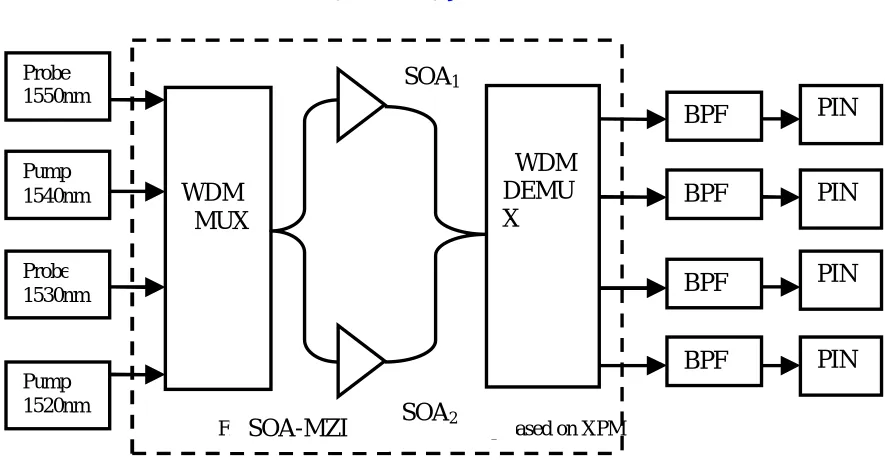
The model of four channels wavelength converter is shown in Fig.1. The optical pulse generated signal is formed by encoding CW signal with wavelength into the amplitude modulator. The signal with wavelength 1550nm is sent to lower port of SOA and pump is applied at upper port with desired wavelength, which is vital at the output. To generate the SOA-MZI configuration, wavelength division multiplexer (WDM) is used. The formation of the SOA-MZI configuration is optimized so that maximum XPM produces the requirement inside the SOA-MZI. The upper semiconductor optical amplifier represented by SOA1 and lower is represented by SOA2.
Fig. 1 Wavelength converter set-up based on XPM
III. OPTIMIZATION OF SOA PARAMETERS FOR ENHANCEMENT OF XPM
SOA-MZI configuration has been shown in Fig. 1, where SOA2 is taken as ordinary practical and another SOA1
structure is optimized for improvement of the XPM in SOA-MZI configuration.
Table1.Variation in active length of SOA1 due to Q-factor and Pin for converted signal wavelength of 1550nm.
Active region length (μm)
Q-factor at different signal input power (dBm) -8dBm (dB) -5dBm (dB) -3dBm (dB) 0dBm (dB)
500 20.31 20.82 20.80 20.36
600 20.29 20.80 20.77 20.34
700 20.28 20.82 20.80 20.38
800 20.32 20.86 20.85 20.45
1000 18.93 19.11 19.08 18.93
For input wavelength 1550nm, XPM down converted wavelength obtained is 1540nm for the support of SOA1. The
simulation set-up is shown in Fig. 1 is used to verify the parameters of SOA1, for enhancing the performance of XPM.
Table 1 shows that as we enhance the active region length of SOA1, Q-factor goes on decreasing up to saturation power
of SOA1. Also, it is observed that variation in Q-factor is insignificant for the variation of the input signal and the active
region length of SOA1is 1000μm which shows the minimum Q-factor.
SOA-MZI
Probe 1550nm m Pump 1540nm Probe 1530nm Pump 1520nmWDM
MUX
SOA
1SOA
2WDM
DEMU
X
BPF
PIN
BPF
PIN
BPF
PIN
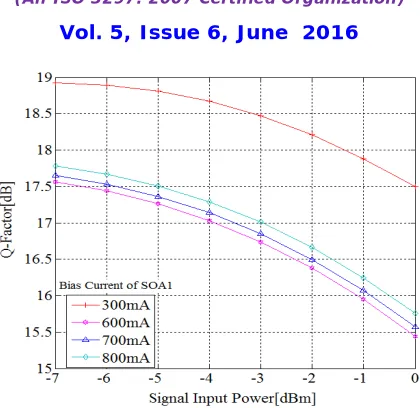
Fig.2. Q-factor variation with signal input power for different bias current.
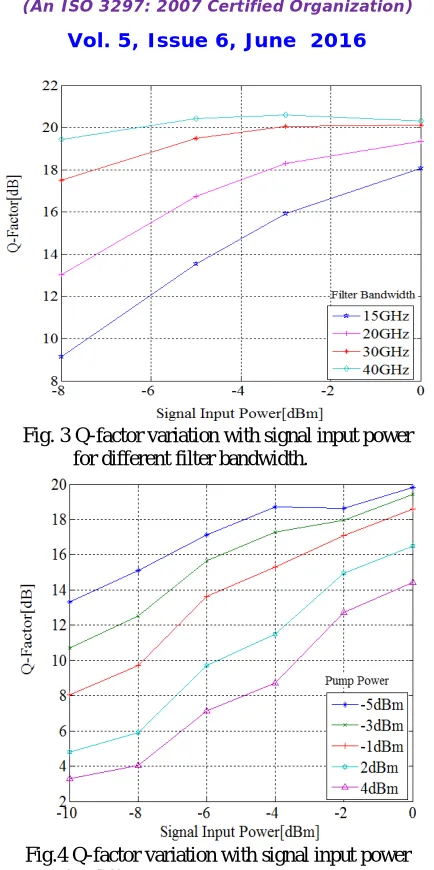
Fig.3. Q-factor variation with signal input power for different filter bandwidth.
Table 2. Optical filter bandwidth variation with input signal for converted wavelength of 1550nm
Optical filter bandwidth (GHz)
Q-factor at different Pin (dBm)
-8dBm (dB)
-5dBm (dB)
-3dBm (dB)
0dBm (dB)
15 9.14 13.53 15.92 18.08
20 13.02 16.75 18.31 19.36
30 17.52 19.50 20.07 20.12
40 19.44 20.44 20.60 20.30
Optimization of the bias current of SOA1 is also done for boosting the XPM. As shown in Fig. 2, by enhancing the bias
current from 300 to 600mA, the Q-factor continuously declines [9, 10]. It is clearly seen that minimum Q-factor is observed at 700mA bias current, before the saturation of SOA1. If there is further raise the bias current, then large
Q-factor is obtained. Table 2 shows the optimized optical filter bandwidth by using optimum bias current 700mA and
. Fig. 3 Q-factor variation with signal input power for different filter bandwidth.
Fig.4Q-factor variation with signal input power for different pump power.
At 40GHz, optical filter bandwidth of the raised cosine filter shows maximum Q-factor for all input signals. Table 3 shows the optimized parameters of the SOA-MZI for wavelength converters based on the XPM. It is observed that longer length of active region and high bias current of the SOA leads to faster response and small gain variation of SOA device [11]. Higher bias current of the SOA provides the best gain by wider spectrum bandwidth of the SOA [14].
V. RESULT AND DISCUSSION
In order to examine the performance of wavelength converter, the Q-factor verses signal input power for different pump power as shown in Fig.4. The input signal wavelength 1550nm is converted to 1540nm. The Q-factor goes on diminishing with the increase in the pump power. This shows good agreement with result reported Ref. [14]. At 4dBm pump power, the minimum Q-factor is 3.29dB. It is also observed that as we enhance the input signal power, Q-factor is decreased up to saturation of the SOA1. After saturation power of the SOA1, Q-factor goes on increasing. The
Parameters SOA1 SOA2
Bias current (mA) 250 500
Length of active region (μm) 500 300
Width of active region (μm) 3 1.5
Thickness of active region (μm) 0.08 0.15
Confinement factor 0.3 0.3
Transparency carrier density (m3) 1.4x1024 1x1024
Line enhancement factor 3 3
Input & output coupling loss 0 0
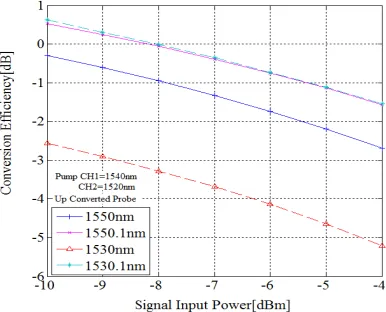
Fig. 5 Conversion efficiency as the function of signal input power for down conversion wavelengths.
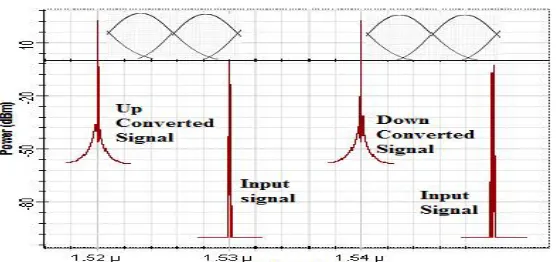
It shows that highest value of conversion efficiency is just about 9 for down conversion and 0.62dB.The efficiency of down converted signal is high as compared to up conversion efficiency. The best result is examined at low pump power of 4dB. This shows an upgrading over results reported in Ref. [15]. The conversion efficiency goes on decreasing with the increase in signal input power for both up and down conversion. The optical power spectrums versus conversion range for both up and down conversions are shown in Fig. 7. The apparent eye patterns are also observed at converted signal wavelength 1530 to 1560nm.
Fig. 7 Optical power spectrum for up converted and down converted signals.
VI.CONCLUSION
The wavelength conversion using XPM in SOA-MZI configuration with large band of up and down conversion. It is observed that high active region length and bias current in the SOA leads to XPM in SOA-MZI configuration. For this, low pump power of 4dB observed is best. The efficiency of down converted signal is high as compare to up converted signal. This wavelength converter provides conversion band additional than 15nm for both up and down conversions. This wavelength conversion increases the ability of future optical network.
REFERENCES
[1] M. Kovacevic, A. Acampora, “Benefits of wavelength translation in all optical clear channel networks”, IEEE J. Sel. Area Comm. vol.14, pp. 69–79, 1996.
[2] T. Durhuus, B. Mikkelson, C. Joergensen, S.L. Danielson, K.E. Stubkjaer, “ All optical wavelength conversion by semiconductor optical amplifiers”, J. Lightwave Technol. vol.14,pp. 942–953, 1996.
[3] Y.K. Seo, C.S. Choi, W.Y. Choi, “All optical signal up conversion for radio to fiber application using cross gain modulation in semiconductor optical amplifier”, IEEE Photon. Technol. Lett. vol. 14, pp. 1448–1450, 2002.
[4] Farah Diana Mahad, Abu Sahmah M.Supa’at. “Comparative performance testing of SOA wavelength conversion techniques for future all- optical systems,” International Journal for Light and Electron Optics (Optik), April 2012.
[5] D.D. Marcenac, D. Nesset, A.E. Kelly, D. Gavrilovic, “40 Gb/s transmission over 103 km of NDSF using polarization independent mid-span spectral inversion by four-wave mixing in a semiconductor optical amplifier”, Electron. Lett. vol. 34, no. 1 , pp. 100–101, 1998.
[6] S. Singh, R.S. Kaler, “Wide band optical wavelength converter based on four wave mixing using optimized semiconductor optical amplifier”, J. Fiber Integr. Opt. vol. 25 , no. 3, pp. 213–230, 2006.
[7] D.M. Patrick, R.J. Manning, “20 Gb/s wavelength conversion using semiconductor nonlinearity”, Electron. Lett. vol. 30,pp. 252–253, 1994. [8] S.P. Majumder, B.C. Sarkar, T. Yoshino, “Performance analysis of an all optical wavelength converter based on XPM in SOAs”, J. Opt. Laser Technol. vol. 35, pp. 261–265, 2003.
[9] S.P. Majumder, B.C. Sarkar, T. Yoshino, “Performance evaluation of a wavelength converter based on SOA as asymmetrical-MZ1 configuration”, J. Opt. Fiber Technol.vol. 11, pp. 146–158, 2005.
[10] S. Singh, R.S. Kaler, “1190Km WDM transmission of 20_10 Gb/s RZ-DPSK signals using cascaded in-line semiconductor optical amplifier”, In: Proceedings of International Conference on Optics & Optoelectronics, IRDE, Dehradun, Uttaranchal (INDIA), Paper No. PP-FIO-42, December 2005.
[11] S. Singh, R.S. Kaler, “Receiver sensitivity improvement using polarization insensitive semiconductor optical z amplifier”, Proc. SPIE 6014, pp. 365–376, 2005.
[12] Y. Ye, X. Zheng, H. Zhang, Y. Li, Y. Guo, Theoretical study on wavelength conversion based on cross phase modulation using semiconductor optical amplifiers, Int. J. Infrared Millimeter Waves 22 (12) (2001) 1785–1793.
[13] S. Singh, R.S. Kaler, All optical wavelength converters based on cross phase modulation in SOA-MZI configuration, J. Opt. 118 (8) (2006) 390– 394.
[14] T. Durhuus, B. Mikkelson, C. Joergensen, S.L. Danielson, n K.E. Stubkjaer, “All optical wavelength conversion by semiconductor optical amplifiers”, J. Lightwave Technol. vol. 14, pp. 942–953, 1996.