Running head: Breaking the tyranny of learning
Breaking the tyranny of learning:
A broad-coverage distributed connectionist model of visual word recognition
Ferm´ın Moscoso del Prado Mart´ınaand R. Harald Baayenb,c
aMRC Cognition and Brain Sciences Unit, Cambridge, U.K.
bInterfaculty Research Unit for Language and Speech, University of Nijmegen, The
Netherlands
cMax Planck Institute for Psycholinguistics, Nijmegen, The Netherlands
Address all correspondence to: F. Moscoso del Prado Mart´ın
MRC Cognition and Brain Sciences Unit 15 Chaucer Road
CB2 2EF Cambridge United Kingdom
e-mail: [email protected] tel: +44 1223 355 294 X294
Abstract
Introduction
Morphological paradigms
Words in human languages often exhibit some degree of internal structure, which is char-acterized by morphological constituents. Morphological constituents – morphemes – are traditionally considered as the minimal meaningful units in human languages. For in-stance, the English word unbreakablecan be decomposed into the morphemes un-, break,
and -able, each of them having a partial contribution to the meaning and to the
ortho-graphical and phonetic forms of the word. In this respect, the vocabulary of any human language can be viewed as being structured into hierarchically organized kindreds of words that share part of their constituent morphemes. We refer to these hierarchically organized ‘bins’ asmorphological paradigms.1 A great amount of research using behavioral and neurophysiological techniques has shown that these morphological paradigms have implications for the ways in which words are stored and processed in the mental lexicon.
Effects of morphological paradigms on lexical processing
Schulpen, Schreuder, & Baayen, 2005). In addition, the size of morphological paradigms has been shown to affect reaction times also in priming (Feldman & Pastizzo, 2003), and Pylkk¨anen, Feintuch, Hopkins, and Marantz (2004) reported neurophysiological corre-lates of this effect using magnetoencephalography (MEG).
The degree of semantic relatedness between a word and the members of its morpho-logical paradigms also has consequences for its processing. Schreuder & Baayen (1997) and Bertram, Schreuder, & Baayen (2000) noted that the exclusion of semantically un-related items from morphological family size counts improved the correlation between morphological family size and response latencies. For instance, not counting casualtyin the morphological family size ofcasual, improves the correlation between the family size
ofcasualand the times it takes to recognize it. In the same direction, Moscoso del Prado
Mart´ın et al. (2005; in press) showed that, in extreme cases, highly unrelated paradigm members can even to a complete reversal of the family size effect, with the number of unrelated members of the paradigm correlatingpositivelywith response latencies in He-brew visual lexical decision. Kosti´c, Markovi´c, and Baucal (2003) reported similar ef-fects for Serbian inflectional paradigms, indicating that semantic context in which a word appears can restrict the effective contribution of each of the members of an inflectional paradigm. Ford (2004) showed that the density of the clustering of the Latent Semantic Analysis representations (Landauer & Dumais, 1997) of the members of a morphological paradigm correlates with the lexical decision RTs to those words, with words belonging to ‘denser’ (i.e., more homogenuous) paradigms being recognized faster than words from more heterogeneous paradigms.
members – the paradigmatic entropy. This measure is calculated over a predefined tree-like structure in which inflected forms are linked to their base forms, which, if morpholog-ically complex, are themselves linked to the simpler words from which they are derived.
Models of morphological processing
On the other hand, non-decompositional DCMs have the advantage of being able to capture various graded effects arising from systematic pairings between form and mean-ing that do not constitute morphological relations in the traditional sense. For instance, Bergen (2004) reports that groups of words that are systematically related in form and meaning, but not morphologically related (e.g., the cluster of English words all relating to LIGHT and starting with the letter sequence ‘gl’ such as glitter, glow, glimmer, glisten, . . . ) prime each other in a way similar to the priming effects that have been observed between morphologically related words. Bergen shows that this effect is not solely due to orthographic or semantic similarity between the prime-target pairs, but that it depends on the consistency of the form-meaning relations across the lexicon. Boudelaa and Marslen-Wilson (2001) report a similar priming effect for Arabic words that share groups of two consonants. These groups of two consonants by themselves do not constitute a full mor-phological unit in the Arabic lexicon, at least in the same sense that the three-consonantal roots do (Bentin & Frost, 2001). These findings suggest that the mental lexicon is sensitive to systematic correspondences between form and meaning, even when these do not come in the form of clearly decomposable units that could be clearly classified as morphemes. Non-decompositional theories of lexical processing such as DCMs or Bybee’s discrete net-work model (Bybee, 1985; 1988) are better suited to account for these graded effects, as they do not depend on the explicit decomposition of a complex word into discrete mor-phemes.
em-ployed and with respect to the size of the sample in comparison to human vocabularies. As a consequence, we will show that the adequacy of discrete structures to describe the effects of morphological structures that are reported in the literature should not be taken as evidence for a direct isomorphism between these descriptive linguistic structures and the underlying mental processes and structures. In addition, we will also explore the pre-dictions that a model based on plain form-meaning associations makes for another debate that has generated considerable discussion in the literature: that of processing of English regular and irregular past-tenses.
English past-tense
The processing of English past-tense forms has given rise to a heated debate in the psy-cholinguistic literature over the las two decades. On the one hand, a large group of authors have argued for a dual-route system in which irregulars would be stored in an associative memory system in a non-decompositional fashion, while regulars would be processed by application of a symbolic rule (e.g., Clahsen, 1999; Pinker, 1997, 1999). The proponents of the dual-route processing model base their arguments on differences found in the processing of regular and irregular past-tense forms in behavioural studies (e.g., Clahsen, 1999), neuro-psychological double dissociations (e.g., Miozzo, 2003), and brain-imaging studies (e.g., Ullman, Bergida, & O’Craven, 1997; Indefrey, Brown, Ha-goort, Sach, & Seitz, 1997). On the other hand, another group of authors have proposed a ‘single-route’ approach, by which both regulars and irregular verbs would be processed by the same basic mechanism (e.g., MacWhinney & Leinbach, 1991; Moscoso del Prado Mart´ın, Ernestus, & Baayen, 2004; Plunkett & Marchman, 1993; Plunkett & Juola, 1999; Rumelhart & McClelland, 1986).
pseudo-verb is presented influences people’s choices of the past-tense form for that pseudo-pseudo-verb. Ramscar noted that this fact is problematic for dual route theories. More recently, Baayen and Moscoso del Prado Mart´ın (in press) have added a new dimension to the debate by showing that distinction between regular and irregular and irregular verbs correlates with subtle differences in the semantic properties of both types of verbs. The authors ar-gue that these differences might partially explain the differences observed between these two types of verbs in behavioural and neuroimaging experiment. More recently, Tabak, Schreuder, and Baayen (2005) report that the differences in the visual lexical decision RTs that are observed between regular and irregular past-tense forms appear also when the targets are fully regular present-tense forms of those same verbs. This constitutes a chal-lenge for the dual route mechanism in that, according to that theory, there should be no such differences, as in this case both regulars and irregulars should be processed using the same mechanism. These results raise the question of whether a single-route connec-tionist model of lexical processing might mirror the experimental processing differences observed for the uninflected stems of regular and irregular verbs. These results are con-sistent with the view that morphology arises as the convergence between representations of form and meaning (Seidenberg & Gonnerman, 2000). Therefore, a model that is trained on performing the mapping from orthography to word meaning should also be sensitive to such differences in the formal and semantic properties of regular and irregular verbs. This would provide additional support for the presence of such differences, that would also be difficult to explain within a ‘dual-route’ framework, thus casting doubts on the architectural conclussions on the cognitive system that have been drawn on the basis of such differences.
Overview of the paper
Baayen, Feldman, and Schreuder (submitted). In this study, the authors provide a de-scription of the effects of a very large set of variables on lexical decision latenicies from the Balota database. Using the same materials, we investigate which of these effects arise also in our network, and which ones do not appear. Finally, we conclude by outlining the implications of our model for current research on visual lexical processing.
Modelling Lexical Processing: General Considerations
Large vocabularies
to an environment that is not only quantitatively, but also qualitatively different from that of realistic language processing. This makes it dangerous to extrapolate from one case to the other.
Representation of word meaning
The key importance that semantic factors have on the effects of morphological paradigms, indicates that a connectionist model of morphological processing should include some re-alistic representation of word meaning. However, it is not feasible to hand-code a rere-alistic representation of the meaning of all words, that is at the same time well-suited to be used in a connectionist model. For this reason most studies have been restricted to using ran-domly generated vectors as representations of the meaning of words (e.g., Plaut & Booth, 2000). A key problem with this approach is that, by definition, random vectors overlook the finely structured semantic properties of real morphological paradigms. An interest-ing alternative that has not been sufficiently explored in connectionist models of lexical processing, is the use of semantic vectors derived from co-occurrence statistics over large corpora (e.g., Sch ¨utze, 1992). These vectors provide detailed encodings of the meanings of all the words of a language, and can be automatically extracted from unlabelled cor-pora. In this study we will represent the meanings of words using a variant of the word co-occurrence technique that captures the co-occurrence between words as the activation patterns from a simple recurrent network (for more details, see Moscoso del Prado Mart´ın & Sahlgren, 2002).
Representation of word form
for a large-scale model. First, and most obviously, it assumes a predetermined maxi-mum length for the words that can be fitted into the template. Second, and of key im-portance for modelling morphological processing, these templates require taking crucial decisions on how words should be aligned in the pattern. Normally, this is done in an ad-hoc manner, depending of the particular task that is going to be performed by the network. For instance, networks that concentrate on the processing of suffixes, such as the English regular past tense-ed, tend to align words at their right, making sure that the
-ed suffix appears on the same position for each word. This comes at the cost of loos-ing information on possible overlaps that might be occurrloos-ing at the beginloos-ing or centre of the word. Formal overlap between morphologically related words can occur simulta-neously at different positions. Consider once more the word unbreakable. A decision to align words on their right, would loose information about other words sharing the
un-prefix, such as unstoppable, and words sharing the break stem as could be unbreakability
or breaking. And third, these ad-hoc decisions on word alignment have been criticized
for implicitely hardwiring morphological decomposition rules into the system by means of making a particular morphological pattern more salient (Pinker & Prince, 1988). For instance, models of English past-tense formation that manually align the inflectional-ed
recur-rence directly in the model tends to increase network unstability and training times. As an alternative Moscoso del Prado Mart´ın, Schreuder, & Baayen (2004), proposed the Accu-mulation of Expectations (AoE) technique. AoE uses the same simple recurrent networks employed by Elman (1990; 1993) and Norris (1990) to derive ‘flat’ representations of word orthography and phonology. The technique is based on summing the activation values on the hidden layer of an SRN, and later using the obtained vector as a representation of a word’s form. Moscoso del Prado Mart´ın, Ernestus, & Baayen (2004) showed that these AoE vectors are adequate for building large-scale connectionist models of morphological processing.
The tyranny of learning
drawback for a DCM. Even in the case when a connectionist system does achieve an ac-ceptable performance in a task, it is still controversial to accept the model as a low-level description of the corresponding biological systems. Few connectionist models of com-plex cognitive tasks use architectures and learning mechanisms that approximate those employed in the human brain. Therefore the inferences that can be drawn from the mod-els concern only the statistical regularities that exist in the environment, and the sources of information that are relevant, or sufficient, for the task. As we will show below, models of this kind can still provide useful insights on the possible causes of behavioural effects. The observation of a behavioural effect often leads the researchers to posit the presence of additional mechanism to account for it. However, in some cases, the models would allow us to see that the effects could also be direct consequences of the complex statistical regu-larities present in the environment, thus making the additional mechanisms superfluous (on the lack of any additional support for them). DCMs are particularly well suited to detect this type of covert – sometimes counterintuitive – patterns. In summary, the relax-ation of the accuracy requirement makes it possible to train connectionist models on very large datasets, without it being a problem that the network may not be very succesful at retrieving particular instances on which it was trained.
Technical Specifications of the Model
Network Architecture
We built a three-layered backpropagation network (Rumelhart, Hinton, & Williams, 1986) whose general architecture is shown in Figure 1. The network consisted of 40 ortho-graphic input units, 120 “hidden” units, and 150 semantic output units. The units in the input layer had all-to-all connections to the units in the hidden layer, which themselves had all-to-all connections to the units in the output layer.
Training Data
The training set consisted of 48,260 English words. These corresponded to those English words that appear with a frequency higher than 10 in the first 20 million words (following the file order on a Linux directory) of the British National corpus and were also listed in the English part of the CELEX lexical database (Baayen, Piepenbrock, & Gulikers, 1995). For each of these words, we employed the English orthographic AoE vectors described by Moscoso del Prado Mart´ın, Schreuder, and Baayen (2004), and we associated them with the co-occurrence vectors for English words described by Moscoso del Prado Mart´ın and Sahlgren (2002).
Training Procedure
The network was presented with a word’s orthographic vector at its input layer, and was trained to produce the corresponding semantic vector at its output layer. We trained the network with 64·106 words that were chosen randomly from the 48,260 words in
the example set, each word being chosen a number of times directly proportional to its frequency of occurrence in the corpus from which the semantic vectors were built. The network was trained using the backpropagation, using the modified momentum descent algorithm (Rohde, 1999) with the cosine distance as the error measure. We used a momen-tum of 0.9 and an initial learning rate of0.1. Five times during training (each12.8·106
words), the learning rate was divided by two. After training, the network showed an average cosine error of0.0370on the words present in the training set.
Experiment 1: Network errors and RTs
Method
We selected all the monomorphemic nouns and verbs from the Balota et al. (1999)’s young participants visual lexical decision dataset that were also present in our training corpus. This set consisted of 2,090 words (1,295 verbs and 795 nouns), for which we also obtained the visual lexical decision RTs.
For each of these words, we calculated the cosine error produced by the network, that is, one minus the cosine between the vector output by the network on presentation of the form of the word, and the semantic vector corresponding to the word.
Results and Discussion
From the original dataset, we excluded nine words that elicited RTs or network cosine errors above or below three standard deviations from the mean. The analyses were per-formed on the remaining 2,081 words.
Figure 2 plots the relationship between the network cosine errors (horizontal axis) and the visual lexical decision RTs from the young participants in Balota et al. (1999) dataset (vertical axis).
INSERT FIGURE 2 APPROXIMATELY HERE
As it can be appreciated in Figure 2, there is a quasi-linear relationship between the network errors and the participants’ response latencies. Indeed, the network’s cosine er-rors by themselves account for approximately 30% of the variance in the RTs (r = 0.55, p <
To address this issue, we need to ensure that the RTs correlate with the nework errors
afterthe contribution of frequency to the errors is partialled out. To assess this, we
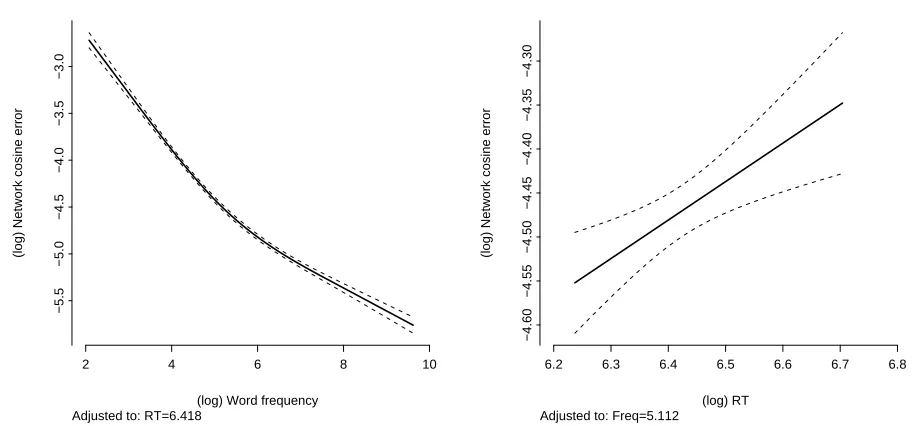
per-formed a sequential analysis of variance on a least-squares regression, with the network’s cosine error as dependent variable, and the word’s frequency and RT as independent predictors. In our regressions, we assesed the non-linearity of the effects by including restricted cubic splines (Baayen, Feldman, & Schreuder, 2005) for each predictor in the regression. This analysis revealed significant linear and non-linear effects of word fre-quency (linear: t(2077) = −34.576, p < 0.0001; non-linear: t(2077) = 13.356, p < 0.0001), and a an additional significant linear effect of the RTs (t(2077) = 3.235, p = 0.0012). The effect of RTs did not have any significant non-linear component. We tested the stability of the regression using a fast backwards elimination of factors (Lawless & Singhal, 1978). This method enables us to decide which factors should be removed from the regression (i.e., they do not have significant independent effects once the effects of the other predic-tors are partialled out). All values reported in the analyses are calculated after removing all non-significant components (factors or non-linear components). The fast backward elimination on factors did not delete any of the factors in the regression. The adjusted
R2 for the regression was 0.71. Figure 3 shows the linear relation between RTs and net-work errors (right panel), after the contribution of frequency has been partialled out (left panel).
INSERT FIGURE 3 APPROXIMATELY HERE
Experiment 2: Morphological structures
Having ascertained that there is a significant correspondence between our network’s er-rors and RTs, we now turn to investigate whether the network has created representations of the discrete tree-like structures that are characteristic of English morphology. In order to explore whether these lattice structures have been captured by the network, we test whether the network cosine error to a word correlates with the paradigmatic entropy of the morphological paradigms to which the word belongs.
Moscoso del Prado Mart´ın, Kosti´c, and Baayen (2004) introduced a single measure of the complexity of the morphological paradigms in which a word is embedded – the entropy of its morphological paradigms orparadigmatic entropy.
Given a morphological paradigmP(s) ={w1, w2, . . . , wn}, were thewiare the different
words or stems that can be directly derived – i.e., by adding a single morpheme – from the stems, the entropyHof the morphological paradigm ofsis defined as:
H(s) =− X
wi∈P(s)
P(wi|s) log2P(wi|s). (1)
In this equation, P(wi|s) represents the probability of the word being wi given that the
stem is known to be s. If F(wi) is the frequency with which wi occurs in a corpus, and
F(s) = Pn
j=1F(wj) is the frequency of the stem s (the sum of the frequencies of all the
words or stems that are directly derived from it), then the probability of the word wi
occurring in the paradigm ofsis given by the expressionP(wi|s)'F(wi)/F(s).
If a word is simulataneusly belongs to a series of nested morphological paradimgs (s1, . . . , sn), its total paradigmatic entropy (H(s1, . . . , sn)) is defined as the sum of the
en-tropies of the different paradimgs:
H(s1, . . . , sn) = n
X
s=1
H(si), (2)
where theH(si)are computed using (1). For instance, in order to compute the
The total paradigmatic entropy of the morphological paradigms to which a word be-longs is negatively correlated with response latencies in visual lexical decision (Moscoso del Prado Mart´ın, Kosti´c, & Baayen, 2004). All other factors being equal, words that are embedded in ‘heavy’ paradigms (high entropy), are recognised faster than words that be-long to ‘lighter’ paradigms (low entropy). By analogy, if the structure of morphological paradigms has been captured and is being exploited by our network, we would expect that words from high entropy paradigms elicit less error than word from low entropy paradigms.
In this experiment, we compare the effects of paradigmatic entropy on the cosine er-rors of our network, with the effect of the same measure on visual lexical decision la-tencies. In order to assess that any possible effect of of the paradigmatic entropy is not solely due to the orthographic similarity between the word and its morphological rela-tives, we also need to take orthographic neighborhood size (Coltheart, Davelaar, Jonas-son, & Besner, 1977) into account in our analyses.
Method
From the dataset employed in Experiment 1, we selected all the words that had additional members of their morphological paradigms present on the network’s training corpus. In this way we obtained 2,009 words. As in Experiment 1, we removed from this dataset thirteen outliers that were above or below three standard deviations from the mean reac-tion time or network cosine error.
For each of the 1,996 remaining words we calculated the paradigmatic entropy using (1) and (2). For each word, we also computed the orthographic neighborhood size using the definition provided by Coltheart et al. (1977): For each word, we counted the number of other existing words in the Celex database that could be obtained by changing a single letter. The calculation of the paradigmatic entropy size was performed considering only those words that were present in the network’s training set.
word frequency, paradigmatic entropy, and orthographic neighborhood size as indepen-dent predictors, and the logarithm of the Balota et al. (1997)’s visual lexical decision RTs as dependent variable. On the second one we used the (log) network cosine errors as dependent variable, and (log) word frequency, paradigmatic entropy, and orthographic neighborhood size as independent variables. Possible non-linearities in the effects were investigated by including three restricted cubic spline term for each of the predictors in the regressions. The significance of the non-linear components was assessed using a se-quential analysis of variance. For simplicity, we will only report the values of those non-linear components that reached significance in the analyses. We tested the decided which factors to keep in the regressions using fast backwards elimination of factors. All val-ues reported in the analyses are calculated after removing all non-significant components (factors or non-linear components).
Results and Discussion
The regression of the RTs revealed significant main effects of word frequency (linear:
t(1989) = −18.387, p < 0.0001; non-linear: t(1989) = 6.668, p < 0.0001), orthographic neighborhood size (linear: t(1989) =−2.220, p = 0.0265; non-linear: t(1989) = 2.133, p= 0.0331), and paradigmatic entropy (linear: t(1989) = −7.406, p < 0.0001; non-linear:
t(1989) = 4.701, p < 0.0001). The fast backward elimination of factors did not delete any of the predictors. The adjustedR2for this regression was0.40.
The regression of the network errors showed significant main effects of word fre-quency (linear: t(1991) = −37.535, p < 0.0001; non-linear: t(1991) = 13.115, p < 0.0001), a linear effect orthographic neighborhood size (t(1991) = 4.242, p < 0.0001), and a lin-ear effect of paradigmatic entropy (t(1991) = −5.511, p < 0.0001). Neither the effect of orthographic neighborhood size, nor that of paradigmatic entropy showed significant non-linear components. As above, a fast backward elimination of factors did not delete any of the predictors. The adjustedR2for this regression was0.71.
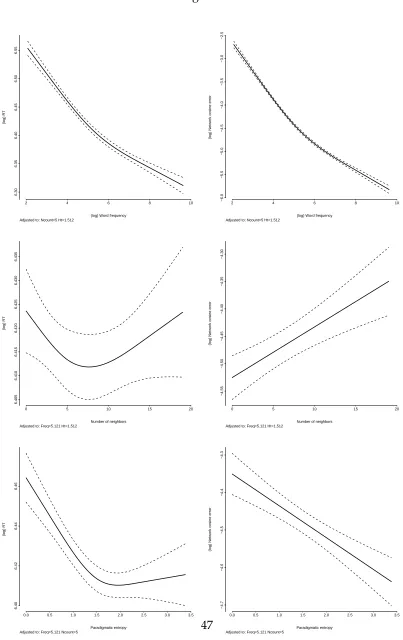
en-tropies have significant independent contributions both to the RTs and to the network cosine errors. Figure 4 provides a summary of each of the effects in both regrassions. The left panels illustrate the effects found in the regression on the RTs, while the right panels illustrate the effects of the three predictors on the network cosine errors.
INSERT FIGURE 4 APPROXIMATELY HERE
The top two panels of figure 4 plots the effects of frequency on the RTs and on the network errors. In both cases, frequency has a strong facilitatory effect; high frequency words are responded to faster and elicit less network error than low frequency words. Notice the similarity between the slight non-linear smoothings of the frequency effect in both regressions (RTs and network errors).
The middle two panels plot the effects of orthographic neighborhood size in both re-gressions. The figures show a non-linear U-shaped effect of neighborhood size on the response latencies, contrasting with a small linear inhibitory effect of neighborhood size on the network errors. This dissimilarity is possibly due to our network not capturing the sequential properties of visual word recognition. Our network receives the whole word form of the word at once, whereas in reality, the form of the word would be obtained through groups of several letters in one or more eye-fixations. Orthographic representa-tions using the AoE paradigm give rise to reversed word-length effects, by which longer words will generally produce less error than shorter words (Moscoso del Prado Mart´ın, Ernestus, & Baayen, 2004). In any case, the inhibitory effect of orthographic neighborhood size found in the network errors is in line with the inhibitory effects of neighborhood size that are usually found in visual lexical decision (e.g., Coltheart et al., 1977). At least for the upper neighborhood size half of the dataset, the network behaviour seems to be repli-cating that observed in the RTs for the Balota et al. (1999) dataset.
errors: βˆ = −0.0849), high entropy words are recognized faster and elicit less network error than low entropy words. However, in the case of the RTs there is a significant non-linear smoothing of the effect on the high-entropy words. This non-non-linearity is not present in the network errors. There is no straightforward explanation for this difference, but we believe it might be a side-effect of the nature of our paradigmatic entropy counts: On the one hand, the paradigmatic entropy counts are exact in the case of the network, i.e., they were calculated only considering the words that are present in the training set, and using the precise frequency counts with which the network was trained. On the other hand, in the case of the RTs, these counts represent only a rough estimation, since many other words that are members of the paradigm have not been considered, and their frequencies are also an estimation.
Crucially, on the network errors, neighborhood size and paradigmatic entropy have effects of opposite direction. While the paradigmatic entropy has a facilitatory effect, which is in line with the effect reported on Dutch lexical decision latencies by Moscoso del Prado Mart´ın, Kosti´c, & Baayen (2004), the effect of neighborhood size is inhibitory. This rules out the possibility of the effect of paradigmatic entropy arising from form similarity alone, as it shows that effects of pure, non-morphological form similarity have the oppo-site effect on the network. Moreover, as we mentioned above, the effect of orthographic neighborhood size in visual lexical decision is reported to be inhibitory (e.g., Coltheart et al., 1977). This contrasts with thefacilitatoryeffects of orthographic neighborhood size that are reported in tasks with a lesser semantic component, such as word naming (e.g., Andrews, 1989; 1992).
vectors that we have used in the network output, are by themselves – without any or-thographic information – capable of reliably detecting inflectional relations between the words. They also report that these vectors alone do not suffice to capture derivational re-lations reliably. If the effect is solely due to the semantic similarity within the members of the inflectional paradigm, one would expect only the entropy of the inflectional paradigm to have an effect on the network errors. The paradigmatic entropy measure that we have used is computed as the sum of the entropy of an inflectional paradigm plus the entropy of a derivational paradigm. Therefore, it could be the case that it is only the inflectional entropy that is giving rise to the effect, without any significant contribution of the entropy of the derivational paradigm.
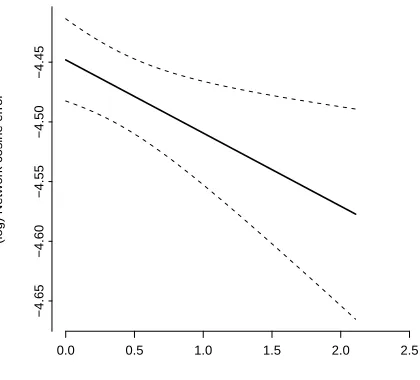
We addressed this possible confound by decomposing the total paradigmatic entropy into two measures – the entropy of the inflectional paradigm, and the entropy of the derivational paradigm – and entering these measures separately into the regression in-stead of the total paradigmatic entropy. We performed a new regression with the (log) network cosine errors as the dependent variable, and (log) word frequency, neighborhood size, entropy of the inflectional paradigm, and entropy of the derivational paradigm as independent predictors. The regression revealed the effects of frequency and neighbor-hood size (as described above), and significant linear effects of the inflectional entropy (t(1990) = −5.167, p < 0.0001), and the derivational entropy (t(1990) = −2.572, p = 0.0102). As expected, both sub-effects were facilitatory (inflectional: βˆ = −0.10; deriva-tional: βˆ=−0.06; see Figure 5). Once more, none of the predictors was deleted by a fast backward elimination of factors. The adjustedR2 of this regression was also0.71.
INSERT FIGURE 5 APPROXIMATELY HERE
In sum, our analyses have shown that the complexity of the morphological paradigms to which a word belongs is a significant predictor for both human RTs, and the amount of error produced by our model. As we have also shown, these effect cannot be attributed neither to form similarity nor to semantic similarity. Therefore the paradigmatic structure of the paradigms is arising from the regularities in the mapping from orthography to meaning.
Experiment 3: Regular and Irregular Verbs
Method
From the dataset of Experiment 1, we selected 250 monomorphemic present-tense verbal forms. Of these, 125 corresponded to verbs with an irregular past-tense, and 125 were of completely regular verbs. The two subsets (regular and irregular verbs) were matched for word length in the mean (regulars: 4.34±0.80; irregulars: 4.32±0.89) and median (4
in both subsets).
We performed to least squares-regressions, one on the Balota et al. (1999) RTs, and another on the BC-DC cosine errors. We included as an independent the verb’s regularity (regular vs. irregular). In addition, we also included log word frequency and inflectional entropy as covariates, since both of these factors tend to be significantly different between regular and irregular verbs (cf., Baayen & Moscoso del Prado Mart´ın, in press). As in the previous experiments, the independent contribution of the factors was assessed using fast backwards elimination of factors.
Results and Discussion
The regression on the RTs revealed only a main effect of word frequency (linear:t(247) =
−10.516, p < 0.0001; non-linear: t(247) = 5.763, p < 0.0001). The fast backwards elimi-nation of factors recommended removing inflectional entropy and verb regularity as pre-dictors from this regression. The R2 for the regression (after having removed the
non-significant predictors) was0.45.
The regression on the BC-DC errors revealed main significance main effects of word frequency (linear: t(245) = −12.563, p < 0.0001; non-linear: t(245) = 4.219, p < 0.0001), inflectional entropy (linear: t(245) = −2.707, p = 0.0073), and a small effect of verb reg-ularity (t(245) = −1.824, p = 0.0693), by which regular verbs elicited less errors than irregular verbs (βˆ= 0.14±0.07for irregular verbs). Although the effect of verb regularity appeared to be only marginally significant, the fast backwards elimination of factors did not recommend deleting it from the regression. TheR2 for this regression was0.70.
their present-tense forms, the mapping between orthography and word meaning tends to be more consistent for regular than for irregular verbs. As shown by the regression, these differences cannot be fully attributed to the differences found in the frequencies or inflectional entropies of these verbs. Although the analysis of the RTs did not replicate this effect of verb regularity, the results of the regression on the network errors are fully in line with the results reported by Tabak and colleages: irregular verbs are more difficult to process than regular verbs, even in their present-tense forms.
Experiment 4: XXXXXXXXXXXXXXXXXXX
XXXXXXXXXXXXXXXXXXXXXXXXXXXX
Method
We added the network cosine error to the words in lexical decision dataset of Baayen et al. (2005) that were also present in our training set. In this way we obtained a list of 2178 words (1317 nouns and 861 verbs), together with their lexical decision RTs (from the Balota database) and the cosine errors produced by the model for those words. In addition, for each word we also had the measures of phonological consistency (the PC1 measure from Baayen et al., 2005), voicing of the first phoneme, log surface frequency from CELEX, written-to-spoken frequency ratio, gramatical category (Noun vs. Verb), nominal-to-verbal frequency ratio, derivational entropy, inflectional entropy, and log num-ber of complex synsets from the WordNet database (Miller, 1990).
factors in both regressions was assessed using fast backwards elimination of factors. The significance of non-linear contributions to the effects was assesed by means of sequential analyses of variance on the restricted cubic splines.
Results and Discussion
All factors mentioned above had significant independent contributions on the regression on the lexical decision RTs, thus replicating the results reported by Baayen et al. (2005) for the slightly larger dataset. The sequential analysis of variance on the network error scores did not reveal any significant non-linear components of the effect of Derivational entropy, thus this component was removed from the analyses. The fast backwards elimination of factors on the network error’s regresion suggested deleting from the regression the factors phonological consistency, voicing of the first phoneme, and gramatical category. After re-moving the non-linearity of the derivational entropy effect, and the gramatical category, phonological consistency, and voicing of the first phoneme, the adjustedR2of the
regres-sion on the network errors was of 65%. All other factors had significant main effects on the regression. The lack of effect of the two phonological variables (phonological con-sistency and voicing of the first phoneme) is not surprising, given that our model lacked any representation of the words’ phonological properties. In addition, our model failed to show the effect of gramatical category reported by Baayen and colleagues for the lexical decision RTs.
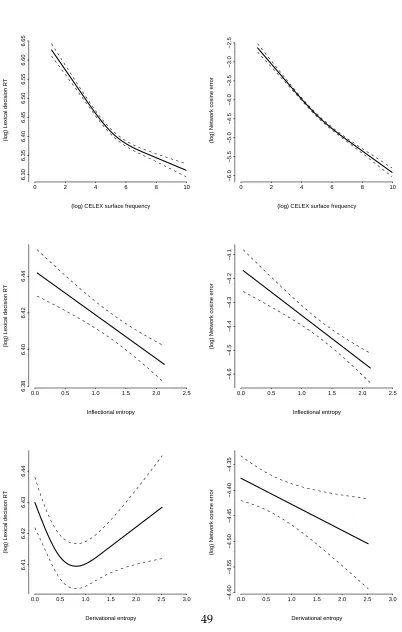
As it can be observed in Figure 6, the effects of word frequency (top panels), inflec-tional entropy (middle panels), and derivainflec-tional entropy (bottom panels). This confirms the robustness of the independent effects on the network errors of word frequency (lin-ear: t(2169) = −26.505, p < 0.0001; non-linear: t(2169) = 6.382, p < 0.0001), inflec-tional entropy (linear: t(2169) = −6.194, p < 0.0001), and derivational entropy (linear:
While the latter is a linear inhibitory effect (see bottom-right panel of Figure 6), that suf-fers a non-linear threshold effect on the high end of the derivational entropy range, the former is just linear across the whole range of derivational entropy values.2
INSERT FIGURE 6 APPROXIMATELY HERE
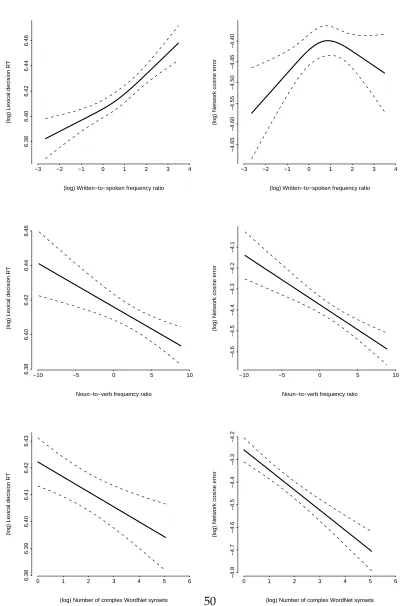
Figure 7 plots the effects of the additional variables from the Baayen et al. (2005) study that had significant effects on the network error scores: the written-to-spoken frequency ratio (Top panels. Linear: t(2169) = 2.914, p = 0.0036; non-linear: t(2169) = −2.560, p = 0.0105), the noun-to-verb frequency ratio (Mid panels. Linear: t(2169) = −5.039, p <
0.0001), and the number of complex WordNet syntets (Bottom panels. Linear: t(2169) =
−7.519, p < 0.0001). The general pattern that these effects show on the network (right panels) is very reminiscent of the pattern observed on the RTs (left panels), except for the thresholding of the effect of the written-to-spoken frequency ratio observed on the network errors (top-left panel), that is unparalleled on the RTs (top-right panel).
Finally, we believe that the effect of spoken-to-written frequency on the network errors and partially on the reaction times is a reflection of the greater abundance of simple, prototypical concepts, in spoken language, whereas very specific complex concepts might be more common in written language. However, as we mentioned above, the effect is clearly more marked on the RTs than on the network, where it dissappears in the higher (more abundant in spoken language) range. This thresholding might reflect the presence of additional factors that arise in people as a result of the diffenrent properties of the written and spoken modalities of language, and the differences in frequency distributions across both modalities at are present in the human environment but not in the network’s training regime.
INSERT FIGURE 7 APPROXIMATELY HERE
General Discussion
In this study, we have presented the BC-DC model of visual word recognition. The model was trained to map distributed representation of word orthography onto distributed rep-resentations of a word’s meaning (co-occurrence patterns). After training, we compared the model’s cosine distances with the response latencies of participants performing visual lexical decision for large sets of English monomorphemic nouns and verbs. We found that, in both cases, the model produced output patterns that were remarkably similar to the pattern of responses of actual participants.
words to which an average adult is exposed.
We have used a neural network to assess the importance of the statistical correspon-dence between form and meaning. Note here that we are not claiming that our network reproduces the mechanism employed by the brain to capture these regularities. In this sense, the neural network that we have used is nothing more than a sofisticated form of re-gression analysis (see McKay, 2003 for more details on this usage of neural networks), that enables us to explore the complex statistical correspondences in a very high-dimensional space.
The key to this broad coverage lies in the use of truly distributed representations for word forms, as provided by the AoE representational paradigm (Moscoso del Prado Mart´ın, Schreuder, & Baayen, 2004), and the realistic semantic vectors based on co-occurrence statistics. A corpus-based co-occurrence approach to semantic representation relues only on the realistic assumption that word co-occurrence is one of the main sources of infor-mation employed by humans to determine the meaning of a word (Boroditsky & Ram-scar, 2003; McDonald & RamRam-scar, 2001). The combination of these techniques, together with the relaxation of the requisite on accuracy of the system’s output, overcome the bottleneck for building models of lexical processing on a realistic scale. In addition, the coding scheme used for word forms presents the advantage of obviating the need for slot-based templates. The use of these templates for the coding of word forms, together hand-crafted representations to code meaning has been criticized for assuming a great amount of hard-wired symbolic information about orthographic and semantic structure (e.g., Pinker & Ullman, 2002b).
model of word recognition should be viewed as a two-stage process. In the first stage, the orthographic representations of the words are built by accumulating the activations of an SRN’s hidden layer that receives the letters of a word in sequential order. In the second stage, illustrated by the network presented here, these representations are mapped into word’s meaning. If one included in the analyses the results of the first phase, we would expect to replicate also the aspects of visual word-form recognition that are overlooked by the system. We have not integrated these data on our analyses because this would require taking a decission on whether these two stages are sequential or cascaded, and to what degree there is feedback from the second to the first stage. This constitutes a independent debate in itself. Addressing it at the same time would obscure the central question that we are addressing in this study: whether complex morphological structures naturally arise as a by-product of the associations between word form and word meaning. With the variables that we have used in our study, we are able to account for more than two thirds of the variance present in the model’s errors. This suggests that further research is necessary to understand the source of the remaining one third of the model’s variance. In particular, we expect this additional variance to be related to additional factors that we have not explored, such as purely semantic issues and the integration with the processes involved in creating the distributed represetation of word form. We leave those for further research.
do not constitute a problem for distributed connectionist models of lexical processing. In fact, we believe that such effects are a fundamental property of neural processing systems (e.g., Deco & Obradovi´c, 1996).
Our model also illustrates how the differences found in the processing of the present-tense forms of regular and irregular verbs arise naturally in a single-route model of lexical processing. The fact that this model was never actually trained on the past-tense forma-tion task confirms the results of Baayen and Moscoso del Prado Mart´ın (in press) and Tabak et al. (2005), in that there are significant differences between both the orthographic and semantic properties of regular and irregular verbs. It is not unlikely that these dif-ferences underlie many of the double dissociations and processing difdif-ferences that have been found between these two kinds of verbs. Additionally, it is not clear how the dual-route models could account for the differences in processing the present tense, especially since their proponents explicitly deny any possible influence of verbal semantics in the selection of a verb’s past-tense form (e.g., Pinker & Ullman, 2002a).
Acknowledgements
The authors are indebted to Mirjam Ernestus, William Marslen-Wilson, Robert Schreuder, and
Maarten van Casteren for comments in earlier versions of this manuscript. This research was
made possible by aPIONIER grant of the Dutch Science Foundation (NWO) to the second author.
During the last stages of preparation of this manuscript, the first author has been supported by
References
Andrews, S. (1989), ‘Frequency and neighborhood size effects on lexical access: Activation or search?’, Journal of Experimental Psychology: Learning, Memory, and Cognition 15, 802– 814.
Andrews, S. (1992), ‘Frequency and neighborhood size effects on lexical access: Similarity or orthographic redundancy?’, Journal of Experimental Psychology: Learning, Memory, and
Cognition18(2), 234–254.
Baayen, R. H. (2001),Word Frequency Distributions, Kluwer Academic Publishers, Dordrecht. Baayen, R. H. & Moscoso del Prado Mart´ın, F. (in press), ‘Semantic density and past-tense
formation in three Germanic languages’,Language.
Baayen, R. H., Dijkstra, T. & Schreuder, R. (1997), ‘Singulars and plurals in Dutch: Evidence for a parallel dual route model’,Journal of Memory and Language37, 94–117.
Baayen, R. H., Piepenbrock, R. & Gulikers, L. (1995), The CELEX lexical database (CD-ROM), Linguistic Data Consortium, University of Pennsylvania, Philadelphia, PA.
Balota, D. A., Cortese, M. J. & Pilotti (1999), Item-level analyses of lexical decission perfor-mance: Results from a mega-study, in ‘Abstracts of the 40th Annual Meeting of the Psychonomics Society’, Los Angeles, CA, p. 44.
Bentin, S. & Frost, R. (2001), ‘Linguistic theory and psychological reality: a reply to Boudelaa and Marslen-Wilson’,Cognition81(1), 113–118.
Bergen, B. K. (2004), ‘The psychological reality of phonaesthemes’, Manuscript submitted for
publication, University of Hawai’i at Manoa.
Boroditsky, L. & Ramscar, M. (2003), ‘Guilt by association: Gleaning meaning from contextual co- occurrence’,Manuscript, Massachusetts Institute of Technology.
Boudelaa, S. & Marslen-Wilson, W. D. (2001), ‘Morphological units in the Arabic mental lexi-con’,Cognition81(1), 65–92.
Burani, C. & Laudanna, A. (1992), Units of representation for derived words in the lexicon,
Bybee, J. L. (1985), Morphology: A study of the relation between meaning and form, Benjamins, Amsterdam.
Bybee, J. L. (1988), Morphology as lexical organization, inM. Hammond & M. Noonan, eds, ‘Theoretical Morphology: Approaches in Modern Linguistics’, Academic Press, Lon-don, pp. 119–141.
Chialant, D. & Caramazza, A. (1995), Where is morphology and how is it processed? the case of written word recognition, in L. B. Feldman, ed., ‘Morphological Aspects of Language Processing’, Lawrence Erlbaum Associates, Hillsdale, N. J., pp. 55–78. Clahsen, H. (1999), ‘Lexical entries and rules of language: a multi-disciplinary study of
Ger-man inflection’,Behavioral and Brain Sciences22, 991–1060.
Cleveland, W. S. (1979), ‘Robust locally weighted regression and smoothing scatterplots’,
Jour-nal of the American Statistical Association74, 829–836.
Coltheart, M., Davelaar, E., Jonasson, J. T. & Besner, D. (1977), Access to the internal lexicon,in
S. Dornick, ed., ‘Attention and performance’, Vol. VI, Erlbaum, Hillsdale, New Jersey, pp. 535–556.
De Jong, N. H., Schreuder, R. & Baayen, R. H. (2003), Morphological resonance in the mental lexicon, in R. H. Baayen & R. Schreuder, eds, ‘Morphological structure in language processing’, Mouton de Gruyter, Berlin, pp. 65–88.
Deco, G. & Obradovi´c, D. (1996), An Information-Theoretic Approach to Neural Computing, Springer Verlag, New York.
Devlin, J. T., Gonnerman, L. M., Andersen, E. S. & Seidenberg, M. S. (1997), ‘Category-specific semantic deficits in focal and widespread brain damage: A computational account’,
Journal of Cognitive Neuroscience10(1), 77–94.
Dijkstra, T., Moscoso del Prado Mart´ın, F., Schulpen, B., Schreuder, R. & Baayen, R. (2005), ‘A roommate in cream: morphological family size effects on interlingual homograph recognition’,Language and Cognitive Processes20(1), 7–42.
Elman, J. L. (1990), ‘Finding structure in time’,Cognitive Science14, 179–211.
small’,Cognition48, 71–99.
Feldman, L. B. & Pastizzo, M. J. (2003), Morphological facilitation: the role of semantic trans-parency and family size,inR. H. Baayen & R. Schreuder, eds, ‘Morphological structure in language processing’, Mouton de Gruyter, Berlin, pp. 233–258.
Ford, M. A. (2004), Morphology in the mental lexicon: Frequency, productivity and derivation, PhD thesis, University of Cambridge, UK.
Ford, M. A., Marslen-Wilson, W. D. & Davis, M. H. (2003), Morphology and frequency: Con-trasting methodologies,inR. H. Baayen & R. Schreuder, eds, ‘Morphological structure in language processing’, Mouton de Gruyter, Berlin, pp. 89–124.
Frauenfelder, U. H. & Schreuder, R. (1992), Constraining psycholinguistic models of morpho-logical processing and representation: The role of productivity, in G. E. Booij & J. v. Marle, eds, ‘Yearbook of Morphology 1991’, Kluwer Academic Publishers, Dordrecht, pp. 165–183.
Gaskell, M. G. & Marslen-Wilson, W. (1997), ‘Integrating form and meaning: A distributed model of speech perception’,Language and Cognitive Processes12, 613–656.
Hay, J. B. & Baayen, R. H. (in press), ‘Shifting paradigms: gradient structure in morphology’,
Trends in the Cognitive Sciences.
Indefrey, P., Brown, M. C., Hagoort, P., Sach, S. & Seitz, R. J. (1997), ‘A PET study of cerebral activation patterns induced by verb inflection’,Neuroimage5, 548.
Khmaladze, E. V. (1987), The statistical analysis of large number of rare events, Technical Re-port ReRe-port MS-R8804, Dept. of Mathematical Statistics, CWI. Amsterdam: Center for Mathematics and Computer Science.
Kosti´c, A., Markovi´c, T. & Baucal, A. (in press), Inflectional morphology and word meaning: orthogonal or co-implicative domains?,inR. H. Baayen & R. Schreuder, eds, ‘Morpho-logical structure in language processing’, Mouton de Gruyter, Berlin.
Landauer, T. & Dumais, S. (1997), ‘A solution to Plato’s problem: The latent semantic analysis theory of acquisition, induction and representation of knowledge’,Psychological Review
Lawless, J. F. & Singhal, K. (1978), ‘Efficient screening of nonnormal regression models’,
Bio-metrics34, 318–327.
L ¨udeling, A. & De Jong, N. H. (2002), German particle verbs and word-formation,inN. Deh´e, R. Jackendoff, A. McIntyre & S. Urban, eds, ‘Verb-particle explorations’, Mouton de Gruyter, Berlin, pp. 315–333.
MacWhinney, B. & Leinbach, J. (1991), ‘Implementations are not conceptualizations: revising the verb learning model’,Cognition40, 121–157.
Marslen-Wilson, W. D., Tyler, L. K., Waksler, R. & Older, L. (1994), ‘Morphology and meaning in the English mental lexicon’,Psychological Review101, 3–33.
McDonald, S. & Ramscar, M. (2001), Testing the distributional hypothesis: The influence of context judgements of semantic similarity,in‘Proceedings of the 23rd Annual Confer-ence of the Cognitive SciConfer-ence Society’.
McKay, D. J. (2003),Information Theory, Inference, and Learning Algorithms, Cambridge Univer-sity Press, Cambridge, U.K.
Miller, G. A. (1990), ‘Wordnet: An on-line lexical database’,International Journal of Lexicography
3, 235–312.
Miozzo, M. (2003), ‘On the processing of regular and irregular forms of verbs and nouns: evidence from neuropsychology’,Cognition87, 101–117.
Moscoso del Prado Mart´ın, F. & Sahlgren, M. (2002), An integration of vector-based semantic analysis and simple recurrent networks for the automatic acquisition of lexical rep-resentations from unlabeled corpora, in A. Lenci, S. Montemagni & V. Pirrelli, eds, ‘Proceedings of the LREC’2002 Workshop on Linguistic Knowledge Acquisition and Representation: Bootstrapping Annotated Language Data’, European Linguistic Re-sources Association, Paris.
Moscoso del Prado Mart´ın, F., Bertram, R., H¨aiki ¨o, T., Schreuder, R. & Baayen, R. H. (2005), ‘Morphological family size in a morphologically rich language: The case of Finnish compared to Dutch and Hebrew’,Journal of Experimental Psychology: Learning, Memory,
Moscoso del Prado Mart´ın, F., Deutsch, A., Frost, R., Schreuder, R., De Jong, N. H. & Baayen, R. H. (in press), ‘Changing places: A cross-language perspective on frequency and family size in Hebrew and Dutch’,Journal of Memory and Language.
Moscoso del Prado Mart´ın, F., Ernestus, M. & Baayen, R. H. (2004), ‘Do type and token effects reflect different mechanisms: Connectionist modelling of Dutch past-tense formation and final devoicing’,Brain and Language90, 287–298.
Moscoso del Prado Mart´ın, F., Kosti´c, A. & Baayen, R. H. (2004), ‘Putting the bits together: An information theoretical perspective on morphological processing’,Cognition94, 1–18. Moscoso del Prado Mart´ın, F., Schreuder, R. & Baayen, R. H. (2004), Using the structure found
in time: Building real-scale orthographic and phonetic representations by Accumula-tion of ExpectaAccumula-tions, in H. Bowman & C. Labiouse, eds, ‘Models of Cognition, Per-ception and Emotion. Proceedings of the VIII Neural Computation and Psychology Workshop’, World Scientific, Singapore, pp. 264–272.
Norris, D. G. (1990), A dynamic-net model of human speech recognition,inG. Altmann, ed., ‘Cognitive Models of Speech Processing: Psycholinguistic and cognitive perspectives’, MIT Press, Cambridge, MA.
Pinker, S. (1997), ‘Words and rules in the human brain’,Nature387, 547–548.
Pinker, S. (1999),Words and Rules: The Ingredients of Language, Weidenfeld and Nicolson, Lon-don.
Pinker, S. & Prince, A. (1988), ‘On language and connectionism’,Cognition28, 73–193.
Pinker, S. & Ullman, M. (2002a), ‘Combination and structure, not gradedness, is the issue: Reply to McClelland and Patterson’,Trends in the Cognitive Sciences6(11), 472–474. Pinker, S. & Ullman, M. (2002b), ‘The past and future of the past tense’,Trends in the Cognitive
Sciences6(11), 456–462.
Plaut, D. C. & Booth, J. R. (2000), ‘Individual and developmental differences in semantic prim-ing: Empirical and computational support for a single mechanism account of lexical processing’,Psychological Review107, 786–823.
incompat-ible with a distributed connectionist approach to lexical processing?’, Language and
Cognitive Processes15(4/5), 445–485.
Plunkett, K. & Juola, P. (1999), ‘A connectionist model of English past tense and plural mor-phology’,Cognitive Science23(4), 463–490.
Plunkett, K. & Marchman, V. (1993), ‘From rote learning to system building: acquiring verb morphology in children and connectionist nets’,Cognition48, 21–69.
Prince, A. & Pinker, S. (1988), ‘Wickelphone ambiguity’,Cognition30, 189–190.
Pylkk¨anen, L., Feintuch, S., Hopkins, E. & Marantz, A. (2004), ‘Neural correlates of the effects of morphological family frequency and family size: an MEG study’,Cognition91, B35– B45.
Ramscar, M. (2002), ‘The role of meaning in inflection: Why the past tense doesn’t require a rule’,Cognitive Psychology45, 45–94.
Rueckl, J. G., Mikolinski, M., Raveh, M., Miner, C. S. & Mars, F. (1997), ‘Morphological prim-ing, fragment completion, and connectionist networks’,Journal of Memory and Language
36(3), 382–405.
Rumelhart, D. E. & McClelland, J. L. (1986), On learning the past tenses of English verbs, in
J. L. McClelland & D. E. Rumelhart, eds, ‘Parallel Distributed Processing. Explorations in the Microstructure of Cognition. Vol. 2: Psychological and Biological Models’, The MIT Press, Cambridge, Mass., pp. 216–271.
Rumelhart, D. E., Hinton, G. E. & Williams, R. J. (1986), Learning internal representations by error propagation, in D. E. Rumelhart & J. L. McClelland, eds, ‘Parallel Distributed Processing. Explorations in the Microstructure of Cognition. Vol. 1: Foundations’, The MIT Press, Cambridge, Mass., pp. 318–364.
Schreuder, R. & Baayen, R. H. (1997), ‘How complex simplex words can be’,Journal of Memory
and Language37, 118–139.
Sch ¨utze, H. (1992), Dimensions of meaning,in‘Proceedings of Supercomputing ’92’, pp. 787– 796.
convergence of codes’,Trends in Cognitive Sciences4(9), 353–361.
Seidenberg, M. S. & McClelland, J. L. (1989), ‘A distributed, developmental model of word recognition and naming’,Psychological Review96, 523–568.
Tabak, W., Schreuder, R. & Baayen, R. H. (2005), Lexical statistics and lexical processing: se-mantic density, information complexity, sex, and irregularity in dutch, in S. Kepser & M. Reis, eds, ‘Linguistic evidence – Empirical, Theoretical and Computational Per-spectives’, Mouton de Gruyter, Berlin.
Taft, M. (1979), ‘Recognition of affixed words and the word frequency effect’, Memory and
Cognition7, 263–272.
Ullman, M., Bergida, R. & O’Craven, K. M. (1997), ‘Distinct fMRI activation patterns for regu-lar and irrguregu-lar past tense’,NeuroImage5, 549.
Wickelgren, W. A. (1969), ‘Context-sensitive coding, associative memory, and serial order in (speech) behavior’,Psychological Review76, 1–15.
Zipf, G. K. (1949),Human Behavior and the Principle of the Least Effort. An Introduction to Human
Notes
1Throughout this paper, we will use the term morphological paradigm to denote the
set of words or stems that share a particular morpheme, be it an inflectional suffix (e.g.,
the-ed inloaded), a derivational prefix (e.g.,un- inunload), a derivational suffix (e.g., -er
inloader), or a stem (e.g.,-load-inworkload, unload, orloader). Our usage of this term is a
generalization of the more traditional ‘inflectional paradigm’. The later being restricted to denote the set of different inflectional variations of a given word. According to our loose definition of morphological paradigm, any given word in a language will simultaneusly belong to at least as many different paradigms as different morphemes it contains. See Moscoso del Prado Martin, Kosti´c and Baayen (2004) for more details on this usage of the term.
2The non-linear component of the effect of derivational entropy on the RTs appears to
List of Figure Captions
Figure 1: General architecture of the model. The lines represent trainable all-to-all con-nections between the units in two layers.
Figure 2: Comparison (in bi-logarithmic scale) between the young participants’ average reaction time to English monomorphemic nouns and verbs (vertical axis) provided by Balota et al. (1999), with the model’s cosine distance for those same nouns (hori-zontal axis). The line represents a non-parametric regression (Cleveland, 1979). Figure 3: Left panel: Plot (in bi-logarithmic scale) of the non-linear effect of word
fre-quency on the network’s cosine errors in Experiment 1. As estimated by a least-squares regression. Right panel: Plot (in bi-logarithmic scale) of the relationship between the RTs and the network’s cosine errors in Experiment 1. As estimated by a least-squares regression, after partialling out the effect of word frequency. The discontinuous lines represent the standard deviations of the effect estimates.
Figure 4: Plots comparing the effects observed in Experiment 2 for word frequency (top
panels), orthographic neighborhood size (middle panels), and paradigmatic entropy
(bottom panels) on the Balota et al. (1999) lexical decision RTs (left panels) and on the
error scores of the network (right panels). All effects were estimated using least-squares regressions, including non-linear components when necesary. Each effect is plotted at the mean of the other variables. The discontinuous lines represent the standard deviations of the effect estimates.
Figure 6: Plots comparing the effects observed in Experiment 2 for word frequency (top
panels), inflectional entropy (middle panels), and derivational entropy (bottom panels)
on the Baayen et al. (2005) lexical decision RTs (left panels) and on the error scores of the network (right panels). All effects were estimated using least-squares regressions, including non-linear components when necesary. Each effect is plotted at the mean of the other variables. The discontinuous lines represent the standard deviations of the effect estimates.
Figure 1:
150 output units (co-occurrence vectors)
120 “hidden” units
Figure 2: + + + + + + ++ + + + + + + + + + + + + + + + + + + + + + + + + + + + + + + + + + + + + + + + + + + + + + + + + + + + + + + + + + + + + + + + + + + + + + + + + + + + + + + + + + + + + + + + + + + + + + + + + + + + + + + + + + + + + + + + + + + + + + + + + + + + + + + + + + + + + + + + + + + + + + + + + + + + + + + + + + + + + + + + + + + + + + + + + + + + + + + + + + + + + + + + + + + + + + + + + + + + + + ++ + + + + + + + + + + + + + + + + + + + + + + + + + + + + + + + + + + + + + + + + + + + + + + + + + + + + + + + + + + + + + + + + + + + + + + + + + + + + + + + + + + + + + + + + + + + + + + + + + + ++ + + + + + + + + + + + + + + + + + + + + ++ + + + + + + + + + + + + + + + + + + + + + + + + + + + + + + + + + + + + + + + + + + + + + + + + + + + + + + + + + + + + + + + + + + + + + + + + + + + + + + + + + + + + + + + + + + + + + + + + + + + + + + + + + + + + + + + + + + + + + + + + + + + + + + + + + + + + + + + + + + + + + + + + + + + + + + + + + + + + + + + + + + + + + + + + + + + + + + + + + + + + + + + + + + + + + + + + + + + + + + + + + + + + + + + + + + + + + + + + + + + + + + + + + + + + + + + + + + + + + + + ++ + + + + + + + + + + + + + + + + + + ++ + + + + + + + + + + + + + + + + + + + + + + + + + + + + + + + + + + + + + + + + + + + + + + + + + + + + + + + + + + + + + + + + + + + + + + + + + + + + + + + + + + + + + + + + + + + + + + + + + + + + + + + + + + + + + + + + + + + + + + + + + + + + + + + + + + + + + + + + + + + + + + + + + + + + + + + + + + + + + + + + + + + + + + + + + + + + + + + + + + + + + + + + + + + + + + + + + + + + + + + + + + + + + + + + + + + + + + + + + + + + + + + + + + + + + + + + + + + + + + + + + + + + + + + + + + + + + + + + + + + + + + ++ + + + + + + + + + ++ + + + + + + + + + + + + + + + + + + + + + + + + + + + + + + + + + + + + + + + + + + + + + + + + + + + + + + + + + + + + + + + + + + + + + ++ + + + + + + + + + + + + + + + + + + + + + + + + + + + + + + + + + + + + + + + + + + + + + + + + + + + + + + + + + + + + + + + + + + + + + + + + + + + + + + + + + + + + + + + + + + + + + + + + + + + + + + + + + + + + + + + + + + + ++ + + + + + + + + + + + + + + + + + + + + + + + + + + + + + + + + + + + + + + + + + + + + + + ++ + + + + + + + + + + + + + + + + + + + + + + + + + + + + + + + + + + + + + + + ++ + + + + + + + + + + + + + + ++ + + + + + + + + + + + + + + + + + + + + + + + + + + + + + + + + + + + + + + + + + + + + + + + + + + + + + + + + + + + + + + + + + + + + + + + + + + + + + + + + + + + + + + + + + + ++ + + + + + + + + + + + + + + + + + + + + + + + + + + + + + + + + + + + + + ++ + + + + + + + + + + + ++ + + + + + + + + + + + + + + + + + + + + + + + + + + + + + + + + + + + + + + + + + + + + + + + + + + + + + + + + + + + + + + + + + + + + + + + + ++ + + + + + + + + + + + + + + + + + + + + + + + + + + + + + + ++ + + + + + + + + + + + + + + + + + + + + + + + + + + + + + + + + + + + + + + + + + + + + + + + + + + + + + ++ + + + + + + + + + + + + + + + + + + + + + + + + + + + + + + + + + + + + + + + + + + + + + + + + + + + + + + + + + + + + + + + + + + + + + + + + + + + + + + + + + + + + + + + + + + + + + + + + + + + + + + + + + + + + + + + + + + + + + + + + + + + + + + + + + + + + + + + + + + + + + + + + + + + + + + + + + + + + + + + + + +++ + + + + + + + ++ + + + + + + + + + + + + + + + + + + + + + + + + + + + + + + + + + + + + + + + + + + + + + + + + + + + + + + + + + + + + + + + + + + + + + + + + + + + + + + + + + + + + + + + + + + + + + + + + + + + + + + + + + + + + + + + + + + + + + + + + + + + ++ + + + + + + + + + + + + + + + + + + + + + + + + ++ + + + + + + + + + + + + + + + + + + + + + + + + + + + + + + + + + + + + + + + + + + + + + + + + + + + + + + + + + + + + + + + + + + + + + + + + + + + + + + + + + + + + + + + + + + + + + + + + + + + + + + + + + + + + + + + + + + + + + + + + + + + + + + + + + + + + + + + + + + + + + + + + + + + + + + + + + + + + + + + + + + + + + + + + + + + + + + + + + + + + + + + + + + + + + + + + + + + + + ++ + + + + + + + + + + + + + + + + + + + + + + + + + + + + + + + + + + + + + + + + + + + + + + + + + + + + + + + + + + + + + + + + + + + + + + + + + + + + + + + + + + + + + + + + + + + + + + +
−7 −6 −5 −4 −3 −2
6.2 6.3 6.4 6.5 6.6 6.7 r=0.55, p<0.0001
(log) Network cosine error
Figure 3:
(log) Word frequency
(log) Network cosine error
2 4 6 8 10
−5.5
−5.0
−4.5
−4.0
−3.5
−3.0
Adjusted to: RT=6.418
(log) RT
(log) Network cosine error
6.2 6.3 6.4 6.5 6.6 6.7 6.8
−4.60
−4.55
−4.50
−4.45
−4.40
−4.35
−4.30
Figure 4:
(log) Word frequency
(log) RT
2 4 6 8 10
6.30
6.35
6.40
6.45
6.50
6.55
Adjusted to: Ncount=5 Ht=1.512
Number of neighbors
(log) RT
0 5 10 15 20
6.405
6.410
6.415
6.420
6.425
6.430
6.435
Adjusted to: Freq=5.121 Ht=1.512
(log) RT
6.40
6.42
6.44
6.46
(log) Word frequency
(log) Network cosine error
2 4 6 8 10
−6.0
−5.5
−5.0
−4.5
−4.0
−3.5
−3.0
−2.5
Adjusted to: Ncount=5 Ht=1.512
Number of neighbors
(log) Network cosine error
0 5 10 15 20
−4.55
−4.50
−4.45
−4.40
−4.35
−4.30
Adjusted to: Freq=5.121 Ht=1.512
(log) Network cosine error
−4.7
−4.6
−4.5
−4.4
Figure 5:
Inflectional entropy
(log) Network cosine error
0.0 0.5 1.0 1.5 2.0 2.5
−4.60
−4.55
−4.50
−4.45
−4.40
−4.35
−4.30
Adjusted to: Freq=5.121 Ncount=5 H=0.1433
Derivational entropy
(log) Network cosine error
0.0 0.5 1.0 1.5 2.0 2.5
−4.65
−4.60
−4.55
−4.50
−4.45
Figure 6:
(log) CELEX surface frequency
(log) Lexical decision RT
0 2 4 6 8 10
6.30
6.35
6.40
6.45
6.50
6.55
6.60
6.65
Inflectional entropy
(log) Lexical decision RT
0.0 0.5 1.0 1.5 2.0 2.5
6.38
6.40
6.42
6.44
(log) Lexical decision RT
0.0 0.5 1.0 1.5 2.0 2.5 3.0
6.41
6.42
6.43
6.44
(log) CELEX surface frequency
(log) Network cosine error
0 2 4 6 8 10
−6.0
−5.5
−5.0
−4.5
−4.0
−3.5
−3.0
−2.5
Inflectional entropy
(log) Network cosine error
0.0 0.5 1.0 1.5 2.0 2.5
−4.6
−4.5
−4.4
−4.3
−4.2
−4.1
(log) Network cosine error
0.0 0.5 1.0 1.5 2.0 2.5 3.0
−4.60
−4.55
−4.50
−4.45
−4.40
Figure 7:
(log) Written−to−spoken frequency ratio
(log) Lexical decision RT
−3 −2 −1 0 1 2 3 4
6.38
6.40
6.42
6.44
6.46
Noun−to−verb frequency ratio
(log) Lexical decision RT
−10 −5 0 5 10
6.38
6.40
6.42
6.44
6.46
(log) Lexical decision RT
0 1 2 3 4 5 6
6.38
6.39
6.40
6.41
6.42
6.43
(log) Written−to−spoken frequency ratio
(log) Network cosine error
−3 −2 −1 0 1 2 3 4
−4.65
−4.60
−4.55
−4.50
−4.45
−4.40
Noun−to−verb frequency ratio
(log) Network cosine error
−10 −5 0 5 10
−4.6
−4.5
−4.4
−4.3
−4.2
−4.1
(log) Network cosine error
0 1 2 3 4 5 6
−4.8
−4.7
−4.6
−4.5
−4.4
−4.3