10
Journal of Advanced Research in
Business and Management Studies
Journal homepage: www.akademiabaru.com/arbms.html ISSN: 2462-1935
A case study on the link of gender diversity towards
organizational effectiveness
Lim Mei Ling1,∗, Robiah Ahmad2, Norzaida Abas2
1 Technip Malaysia, Wisma Technip, 241 Jalan Tun Razak, 50400, Kuala Lumpur, Malaysia
2 UTM Razak School of Engineering and Advanced Technology Universiti Teknologi Malaysia, 54100 Jalan Sultan Yahya Petra, Kuala Lumpur,
Malaysia
ARTICLE INFO ABSTRACT
Article history:
Received 16 May 2017
Received in revised form 14 July 2017 Accepted 3 August 2017
Available online 8 August 2017
Gender diversity especially in engineering field has been an interest in recent years. Studies claimed the benefit reaped with gender diversity is important in terms of growth of an organization such as the statistics from Credit Suisse on the number of women on the board which has shown upward trends on market shares. Institution of Engineers Malaysia (IEM) publication on the career success among engineers in Malaysia has made emphasis on the importance of women participation in the professional field especially among the decision makers. Other critical findings such as the majority of women feel welcome in the oil and gas industry and would encourage other females to join, however, 45% said they do not get the same recognition as men in terms of opportunities. Therefore, this paper attempts to investigate the perception of employees in an Oil and Gas company operating in Malaysia towards gender diversity and its relationship with attributes falling under Organizational Effectiveness by using a mixed method approach where samples selected for quantitative study were engineers from an oil and gas company. The findings indicated that there are positive perceptions from engineers regarding gender diversity, however implementation in the company is still lacking. The gap is identified and a framework is presented as an integrated approach to gender diversity and emphasize that the context could only be achieved if all aspects are carried out strategically in an organization, as a whole.
Keywords:
Gender, diversity, organizational effectiveness,
engineering, oil, gas Copyright © 2017 PENERBIT AKADEMIA BARU - All rights reserved
1. Introduction
In organizations, the number of female engineers participating in the work force has increased substantially [1]. Despite the increased rate of women in the technical jobs, Ministry of Women, Family, and Community Development of Malaysia in 2010 filed about 70 per cent of women that have science, engineering, and technology related degrees were not working in the sectors that uses these
∗Corresponding author.
E-mail address: M L Lim ([email protected])
Penerbit
Akademia Baru
11 skills. A study suggested that regardless of whether women know how to demonstrate expected leadership behaviours, they may still be ignored or not recognized by others as a leader [2].
The emergence of gender diversity in corporate organizations are recently gaining popularity, knowing that organizations must adapt to change and improve their goals by creating awareness, quality decision making and by changing the process as well as integration of teams. An appropriately configured and supportive organizational environment may need to be in place before the beneficial aspects of gender equality and diversity can be fully realized [3]. Many gender diversity policies failed to address the issues of biasness and cultural change in the workplaces where numbers of women are made importance rather than equal opportunities of both genders [4-6]. Participation and talents are hardly retained throughout women’s career progression [2]. Leaders and management will first have to understand why and how mixture of gender affects the workplace behaviour in terms of integration among engineers. The focus is on the foundation of an engineering organization in understanding the relationship on how gender diversity promotes Organizational Effectiveness, which in turns lead to better Organizational Performance [7].
The main objective of this study is to investigate the relationship between gender diversity in the effectiveness of an engineering organization in terms of its implementation and perception of employees and will be presented as a framework at the end of this study. The study was conducted with both quantitative survey and qualitative methods by having interview sessions with managerial level engineers within the company. The paper will assist the organization to fully appreciate and communicate the role of gender diversity among their engineers. The execution of this study could benefit the industry by increase in awareness among engineers on the value and importance of cultivating gender diversity.
2. Gender Diversity Impacts in Organizations 2.1 Gender Diversity
Gender diversity is usually regarded as ‘women’ cause and men were more or less isolated from the whole agenda and process. However, the concept of gender diversity emphasized the principle of shared power and responsibilities between women and men which could only be achieved when men and women worked together in partnerships, and that the principles of equality of women and men had to be integral to the socialization process [8].
Since women make up roughly half of the global population, unlocking talents through gender diversity and inclusion initiatives could be the differentiating factor or a competitive advantage for the growth of companies [9]. Companies operating in Malaysia have begun to adapt the concept and provide encouragement to female engineers. The popularity of gender diversity does have its importance and has been proven by several studies as well as audit reports. Studies suggest that a diverse workforce will have a greater potential to thrive in certain organizational cultures and goals by having different viewpoints, ideas and market insights as well as understanding diverse customer groups [10].
12 just to move out [11]. Other career barriers such as commitment to the family are proven in a study conducted in Malaysia [12].
Table 1
Proportion of companies with of women among board members (2005-2011)
% with 1 or more women on the board
% Change Number of
companies in the sample
2005 2011 2011 vs. 2005
Developed Asia
Australia 60.9 88.2 27.3 68
Hong Kong 28.8 51.6 22.9 93
Japan 2.9 11.2 8.3 312
New Zealand 80.0 100.0 20.0 5
Singapore 25.0 48.4 23.4 31
Emerging Asia
China 6.5 50.0 43.5 58
India 30.4 46.5 16.0 71
Indonesia 8.3 24 15.7 25
Malaysia 4.3 42.9 38.5 42
Philippines 58.8 38.9 19.9 18
South Korea 0.0 3.8 3.8 105
Taiwan 4.3 9.2 4.9 98
Thailand 44.4 80.0 35.6 20
2.2 Organizational Effectiveness
Organizational performance gained popularity among researchers due to its tangible and quantifiable determinants rather than the effectiveness of an organization as it depends merely on perceived context of the employees. Though Organizational Effectiveness comes secondary, however, it is a fundamental concern, which all in all will impose effects onto the Organizational Performance of a company [13].
Competing Values Framework (CVF) provides a platform of dimensions and as a diagnostic tool to measure, understand and further develop an Organization’s Effectiveness [14]. In this study, however, measurement of Organizational Effectiveness will not be carried out. However, dimensions from CVF will be used as attributes to measure if gender diversity affects these determinants. There are 14 dimensions, which are Collaboration, Engagement, Innovation, Adaptation, Control, Efficiency, Consistency, Aggressiveness, Customer Focus, Stability, Harmonious Relations, New Resources, Competitiveness, and Achievement [15].
Fig. 1. Competing Values Framework [15]
Control Efficiency Consistency Aggressiveness Achievement Customer Focus Competitiveness Collaboration Engagement Harmonious Relations Innovation Adaptation New Resources Internal Maintenance Stability External Positioning Flexibility
Q1 Q2
13 The horizontal axis in Figure 1, along the external positioning–internal maintenance dimension, the organization emphasizing its function and development within a larger environment such as Petronas branding and advertising, or focus internally, emphasizing the function and development of people within the organization, such as developing Business models for efficiency and improvement. The vertical axis on the other hand, along the stability–flexibility dimension, the organization might emphasize control, focusing on structure, consistency and predictability such as manufacturing procedures or emphasize flexibility, focusing on innovation and adaptability, which caters more towards research and development [16]. Table 2 summarizes the meaning for all four quadrants from Figure 1 above.
Table 2
Description of CVF Quadrants [17]
Quadrant Description
1 Human Relations Model: Cooperating members of a common community and
common target or goals. People are seen as a team rather than individuals.
2 Open Systems Model: People are not controlled but inspired to grow and
adapt with new changes.
3 Rational Goal Model: Targets are clear with planned actions taken diligently
and rationally, usually based directly on profit and productivity.
4 Internal Process Model: Structure such as procedures and KPI is important
where it brings stability and control. Hierarchies are an important factor.
Organizational effectiveness comes into picture whereby the fundamental ground of the organization should be assessed, i.e. the people of the company. Human capital is one of the critical and universally acknowledge element in the effectiveness of organizations and a key source of competitive advantage [18]. One competitive advantage dive deeper is on the diversified culture in an organization in terms of gender.
3. Methodology
3.1 Research Design and Data Collection
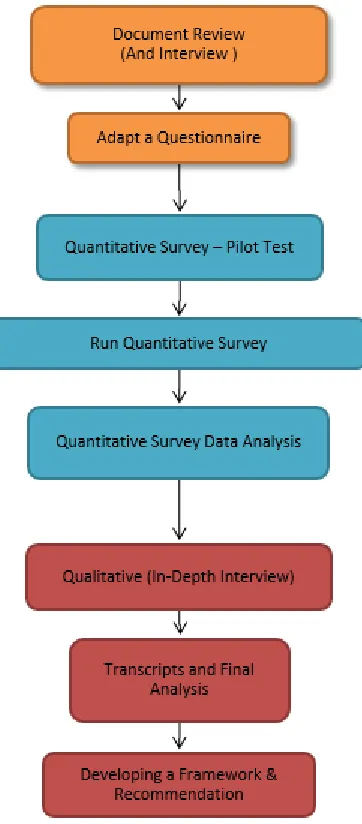
Research designed employed was a mixed method of quantitative and qualitative tools as shown in Figure 2. The questionnaire is divided into 2 sections, the first section is regarding demographic and scope of respondents and Part 2 consist of adaptation of questions from an establish instrument by K. S. Cameron and Quinn [19]. The six point Likert scale was used to avoid neutral answers due to the subjectivity of the topic [20]. Population of engineers in Company A consist of roughly 800 engineers. A targeted sample size of about 250 respondents was chosen for this study [21]. Simple random sampling was used and 250 employees were randomly invited to participant in the survey, however only 77 survey forms could be used after filtration. The rule of thumb or a reasonable sample size for a correlation study was about 50 samples and therefore is acceptable for this study [22].
14 Fig. 2. Research Methodology
3.3 Data Analysis Methods
Data from the survey are analysed using Minitab 17 statistical software. Descriptive statistics and Spearman-Rho Correlation are used to assess the relationship between variables. The overall Cronbach’s Alpha of the variables under study is 0.9372 and is considered acceptable for further analysis [23]. Thematic analysis was used on transcribed recordings.
4. Results and Discussion
4.1 Employees Perspective on Gender Diversity
15 from 41 to 50 years old while only 2 respondents are above 51 years old. Table 3 clustered the respondents by gender and age group. The characteristics of the respondent’s frequency show that they have roughly 6 to 7 years working experience and are aware of their daily work routine. Another observation from Table 3 is very few females among the respondents who are aged 41 and above.
Table 3
Tabulation of Respondents by Age and Gender
The means for all 14 attributes are summarized in Table 4 below. Means above 4.0 shows strong agreement of engineers in the organization towards their perception that gender diversity could enhance these criteria in their work place and means less than 4.0 shows that engineers in Company A perceives that gender diversity has less or no effect on these attributes.
Table 4
Mean Scores for Organizational Effectiveness Attributes
Average Means above 4.0 Average Means equals or below 4.0
Collaboration (V1) Control (V4)
Engagement (V2) Achievement (V8)
Competitiveness (V3) Stability (V9)
Innovation (V5) Harmonious Relations (V10)
Efficiency (V6) Aggressiveness (V11)
Adaptation (V7) New Resources (V12)
Customer Focus (V13) Consistency (V14)
4.2 Relationship between Variables of Organizational Effectiveness
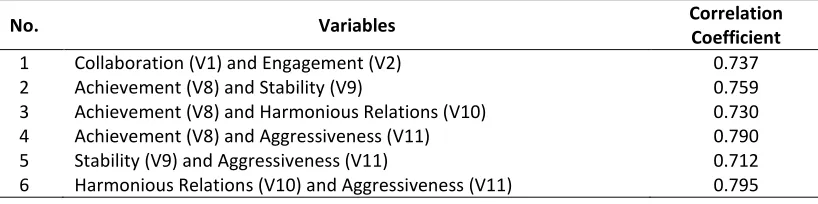
Fourteen attributes of Organizational Effectiveness were assessed for associations. There were six significant relationships, with correlation coefficient of 0.71 and above, was found from Spearman’s Rho correlation matrix and is summarized in Table 5. These were further probed during semi-structured interviews with managers in the company.
Table 5
Variables with Strong Correlation Coefficient
No. Variables Correlation
Coefficient
1 Collaboration (V1) and Engagement (V2) 0.737
2 Achievement (V8) and Stability (V9) 0.759
3 Achievement (V8) and Harmonious Relations (V10) 0.730
4 Achievement (V8) and Aggressiveness (V11) 0.790
5 Stability (V9) and Aggressiveness (V11) 0.712
6 Harmonious Relations (V10) and Aggressiveness (V11) 0.795
Age Male % Female %
23 – 30 years’ old 22 28.6 15 19.5
31 – 40 years’ old 24 31.1 8 10.4
41 – 50 years’ old 5 6.5 1 1.3
51 and above 2 2.6 0 -
Mean 33.5 - 30.3 -
16 4.3 Gender Diversity and the attributes of Organizational Effectiveness
Based on the interviews, 3 main categories of 8 themes were identified and summarized in Table 6 to Table 8. There was a clear distinction between the participants whereby female participants were more receptive of the gender diversity efforts and programs in the company, whilst the male participants showed little interest. For them, it was merely a context and salience of views between both groups of participants varied considerably.
Table 6
Summary Table for Category I
Category Sub-Themes Summary
Category I: Manager’s Perception on gender equality and gender diversity
Respect and Acknowledgement
Values and strength that each gender could provide in a work force
Local and International Organizations
Culture which was adapted since this organization is a Multi-National Company and is directed by the main office in Europe
When prompted, most of them understood that the context of Gender Diversity was to provide a platform to balance the gender either men or women as they see a positive energy could be beneficial to the organization. The statement below shows an example of their understanding. “A male dominant industry, when you gender diverse it, you actually, encourage opposite gender to come into the industry to work and to improve the market. So, gender equality is more on equal rights. Gender diversity is when you want to attract the opposite gender to come into the industry.” Therefore, with this understanding, there is a practice in the organization where they will spot talented engineers in any functions and they will use this concept to increase either the men or women in that particular function. An example given by one of the participants was when there are 2 candidates of the same capability, and then the promotion of the women would be favoured. He however, believes that there are no two people with the same and equal capabilities. Another participant criticizes the concept, which was brought up by the organization and thinks that it is just another “hype” by the organization.
Table 7
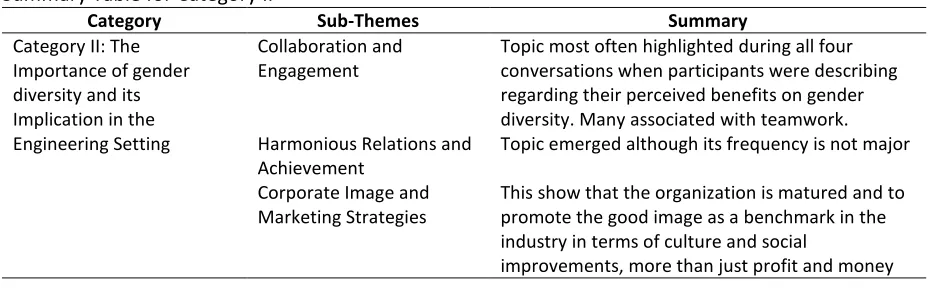
Summary Table for Category II
Category Sub-Themes Summary
Category II: The Importance of gender diversity and its Implication in the Engineering Setting
Collaboration and Engagement
Topic most often highlighted during all four conversations when participants were describing regarding their perceived benefits on gender diversity. Many associated with teamwork. Harmonious Relations and
Achievement
Topic emerged although its frequency is not major
Corporate Image and Marketing Strategies
This show that the organization is matured and to promote the good image as a benchmark in the industry in terms of culture and social
improvements, more than just profit and money
Collaboration was unanimously defined as working closely towards a goal and engagement as a part of the communication process during the process of collaborating with each other. One participant links strongly of Collaboration and Engagement as the statement follows.
17 communication and style that we have. Gender diversity sort of forms a complement each other from the best.”
This particular organization has taken the initiative to attain EDGE Certification from the Global Business Certification for Gender Equality which strives to achieve and capture an organization’s opportunities to attract, develop motivate and retain a gender-balanced pool of talent. Two main objectives were quantitatively measured on gender balance on all levels of the organization as pay equity, and another two objectives were based on qualitative aspects of frameworks on the organization practices as well as an inclusive culture in gender equality. One participant believes that with this certification, the image of the company in the industry will be marked up another higher level, especially in terms of people development.
Table 8
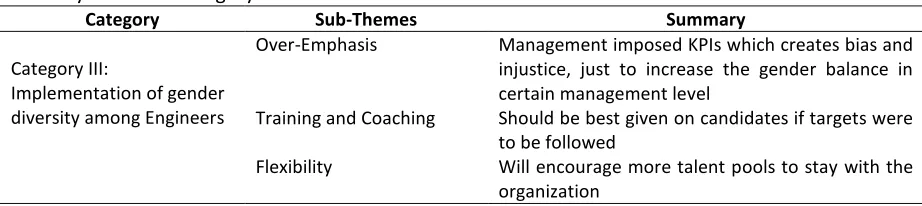
Summary Table for Category III
Category Sub-Themes Summary
Category III:
Implementation of gender diversity among Engineers
Over-Emphasis Management imposed KPIs which creates bias and
injustice, just to increase the gender balance in certain management level
Training and Coaching Should be best given on candidates if targets were
to be followed
Flexibility Will encourage more talent pools to stay with the
organization
An example given was “Having at least 2 Head of Departments in Engineering Disciplines by the year 2020”. It was highlighted that this may create biases, just to achieve the organization’s KPI. Another participant highlighted that if gender balances KPI were to be implemented in such a way, training and coaching should be a part before one person takes up a certain position in the company. They should be guided to contribute to the company. He mentioned that this company doesn’t have a clear career path, and that was one of the problems, which may affect the efforts of Gender Diversity as well.
From the results, it is indicative that engineers do have that perception that gender diversity brings benefit during their daily work, majorly in terms of Collaboration and Engagement during the process of working together. This is in concurrence with other studies which supports the effect gender diversity brings onto a collaborative team, perhaps not only in engineering field, but in any situation involving discussions and decision making processes [15] [24].
However, it is imperative that the organization should implement the context of gender diversity carefully. Results shows that some managers still have the idea that gender diversity is designed and catered for women only. In fact, the efforts work both ways especially for functional engineering departments, which has more women than men. There were many gaps emerged from the conversations with managers such as the training for a certain level of positions only and the implementation of KPI which indirectly induces biases. It is obvious that changes have created some disagreements internally in the company, perhaps due to the haste implementation towards certain targets in the company.
18
Fig. 3. Gender Diversity and Organizational Effectiveness as Drivers
Fig. 4. Implementation plan framework of gender diversity
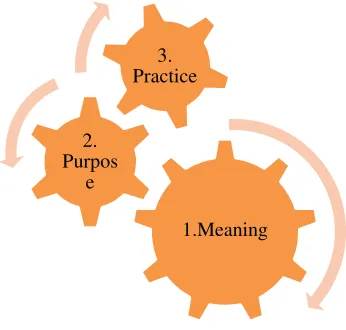
Figure 4 is the suggested implementation plan framework of gender diversity towards Organizational Effectiveness where if the foundation is strong, the Drivers will increase an organization’s performance.
From Figure 4 above:
1. Meaning is the perception and understanding of engineers on gender diversity, 2. Purpose is the importance of implementing gender diversity and
3. Practices are the efforts and implementation made by the organization.
All three categories interlock each other which means it is vital for all three aspects to be made clear towards engineers as the largest population in Company A to understand, acknowledge and thus implement such context. Without any one, the context remains a context and implementation may fall short. It is important for one organization to properly educate and made aware of gender diversity as it is a construct, which embeds deeply into working culture. More initiatives should be carried out by the organization in order to implement gender diversity, not only in certain levels of the organization but the organization as a whole, including junior engineers.
D
ri
v
er
s
F
o
u
n
d
at
io
n
1.Meaning 2.
Purpos e
19 5. Conclusion
Based on the findings, this paper presents an understanding of the current perception of engineers on the role of gender diversity in a company and its importance in an organization especially in an engineering environment of the oil and gas industry, which was usually highly regarded as male domineering. The results from Section 4.1 confirm that engineers do perceive the benefits of gender diversity, however understanding of its concept and importance is still vague based on the interviews. Through surveys and interviews, it was prevalent that there are correlations on gender diversity and the way it affects engineers at workplace. Therefore, it is of much importance for an organization to properly build the awareness to achieve and reap the benefits of gender diversity.
References
[1] Johari, Husna, Norsiah Mat, Norazuwa Mat, Siti Norezam Othman, and Aini Hayati Mohamed. "Exploring career
success among women engineers: The Malaysian case." International Journal of Education and Research (2013). [2] Walker, Robyn C., and Jolanta Aritz. "Women Doing Leadership Leadership Styles and Organizational
Culture." International Journal of Business Communication (2015).
[3] Dwyer, Sean, Orlando C. Richard, and Ken Chadwick. "Gender diversity in management and firm performance:
the influence of growth orientation and organizational culture." Journal of Business Research 56, no. 12 (2003): 1009-1019.
[4] Cech, Erin, Brian Rubineau, Susan Silbey, and Caroll Seron. "Professional role confidence and gendered persistence in engineering." American Sociological Review 76, no. 5 (2011): 641-666.
[5] Krizsan, Andrea, and Emanuela Lombardo. "The quality of gender equality policies: A discursive approach." European Journal of Women's Studies 20, no. 1 (2013): 77-92.
[6] Sharp, Rhonda, Suzanne Franzway, Julie Mills, and Judith Gill. "Flawed policy, failed politics? Challenging the sexual politics of managing diversity in engineering organizations." Gender, Work & Organization 19, no. 6 (2012): 555-572.
[7] Robertson, Ivan T., Militza Callinan, and Dave Bartram. Organizational effectiveness: the role of psychology. John Wiley & Sons, 2003.
[8] Marinova, Jivka. “Gender stereotypes and the socialization process.” Brasilia, Brazil: United Nations and International Labour Organizations (2013).
[9] Badal, Sangeeta, and James K. Harter. "Gender diversity, business-unit engagement, and performance." Journal of Leadership & Organizational Studies 21, no. 4 (2014): 354-365.
[10] Adler, Emily Stier, and Roger Clark. An invitation to social research: How it's done. Cengage Learning, 2014. [11] Miller, Gloria E. "Frontier masculinity in the oil industry: The experience of women engineers." Gender, Work &
Organization 11, no. 1 (2004): 47-73.
[12] Ismail, Maimunah, and Mariani Ibrahim. "Barriers to career progression faced by women: Evidence from a Malaysian multinational oil company." Gender in Management: An International Journal 23, no. 1 (2008): 51-66. [13] Richard, Pierre J., Timothy M. Devinney, George S. Yip, and Gerry Johnson. "Measuring organizational
performance: Towards methodological best practice." Journal of management (2009).
[14] Ashraf, Giti. "A Review on the Models of Organizational Effectiveness: A Look at Cameron's Model in." International Education Studies 5, no. 2 (2012): 80.
[15] Cameron, Kim. Organizational Effectiveness Wiley Encyclopedia of Management. John Wiley & Sons, Ltd., 2015. [16] Grabowski, Louis, Cathy Neher, Timothy Crim, and Lars Mathiassen. "Competing values framework application to
organizational effectiveness in voluntary organizations: A case study." Nonprofit and Voluntary Sector Quarterly 44, no. 5 (2015): 908-923.
[17] Quinn, Robert E., and John Rohrbaugh. "A spatial model of effectiveness criteria: Towards a competing values approach to organizational analysis." Management science 29, no. 3 (1983): 363-377.
[18] Lawler, Edward E. "Built to change: How to achieve sustained organizational effectiveness." Strategic Direction 23, no. 4 (2007).
[19] Cameron, Kim S., and Robert E. Quinn. Diagnosing and changing organizational culture: Based on the competing
values framework. John Wiley & Sons, 2005.
20
[21] Krejcie, Robert V., & Daryle W. Morgan. “Determining Sample Size for Research Activities.” Educational and Psychological Measurement 30, no. 3 (1970): 607-610.
[22] VanVoorhis, Carmen R. Wilson, and Betsy L. Morgan. "Understanding power and rules of thumb for determining sample sizes." Tutorials in Quantitative Methods for Psychology 3, no. 2 (2007): 43-50.
[23] Tavakol, Mohsen, and Reg Dennick. "Making sense of Cronbach's alpha." International journal of medical education 2 (2011): 53.
![Fig. 1. Competing Values Framework [15]](https://thumb-us.123doks.com/thumbv2/123dok_us/1202125.1150939/3.595.107.490.157.353/fig-competing-values-framework.webp)