ABSTRACT
SREE RAMOJU, SRIKANTH. An In-Depth Analysis of Characteristics of Different RAP Sources. (Under the direction of Dr. N. Paul Khosla).
Recycling of asphalt pavements is crucial to alleviating the growing demand for paving materials including both asphalt binder and aggregates. For this reason many states have adopted specifications for the use of reclaimed asphalt pavement (RAP) in hot mix asphalt (HMA). These specifications, however, are based on the percentage weight of RAP in the total mix. Because, RAP binder is usually much stiffer than virgin binders and contributes largely to the increased stiffness of the recycled mixture placing emphasis on the recycled binder content would be a more efficient way to optimize use of RAP. North Carolina Department of Transportation (NCDOT) conducted projects RP 2012-04 and RP 2013-06 that studied recycled materials with the objective of placing limits on percentage of binder contributed by RAP, instead of percentage by weight of mix replaced. As part of the research, one RAP material was selected and tested with different virgin binders and limits were derived. Since, recycled binders from different RAP sources exhibit different properties, the limits determined for binder from a single RAP source are not directly applicable to all RAP sources.
degrees and would differ in their properties. Therefore, the need exists to investigate the variability in the properties of recycled binder from different sources of RAP and design a framework for accounting for this variability while recommending a set of specifications for designing recycled mixtures.
An In-Depth Analysis of Characteristics of Different RAP Sources
by
Srikanth Sree Ramoju
A dissertation submitted to the Graduate Faculty of North Carolina State University
in partial fulfillment of the requirements for the degree of
Doctor of Philosophy
Civil Engineering
Raleigh, North Carolina 2017
APPROVED BY:
_______________________________ ______________________________
Dr. N. Paul Khosla Dr. Akhtarhusein A. Tayebali
Chair of Advisory Committee
_______________________________ ______________________________
ii DEDICATION
Dedicated To
iii BIOGRAPHY
Srikanth Sree Ramoju was born on the 9th of May 1985 in a small town in the state of Andhra
iv ACKNOWLEDGMENTS
It is my honor to have worked under the guidance of Dr. N. Paul Khosla who has been my advisor throughout the duration of the research. I thank him for the confidence he has bestowed upon me, the guidance and support he has provided me with over the past three years and finally the independence that he has granted me for conducting this research. I would also take this opportunity to thank Dr. Akhtarhusein Tayebali for his supervision, advice and guidance on many occasions. I express my sincere gratitude to Dr. M. Shamimur Rahman and Dr. Min Liu for having them as members of this advisory committee.
v TABLE OF CONTENTS
CHAPTER 1 : - INTRODUCTION AND PROBLEM STATEMENT ... 1
CHAPTER 2 : - LITERATURE REVIEW ... 4
CHAPTER 3 : - RESEARCH APPROACH AND METHODOLOGY ... 12
3.1. Specific Research Objectives ... 12
3.2. Research Methodology ... 13
CHAPTER 4 : - RAP BINDER CHARACTERISTICS ... 18
4.1. RAP Binders in Unaged Conditions ... 19
4.1.1. Source of RAP – Wilmington ... 19
4.1.2. Source of RAP – Pineville ... 22
4.1.3. Source of RAP – Maymead ... 25
4.1.4. Source of RAP – Sunrock ... 28
4.1.5. Source of RAP – Sims ... 30
4.1.6. Source of RAP – Weaverville ... 32
4.1.7. Source of RAP – Highland ... 35
4.1.8. Source of RAP – Harrison ... 38
4.1.9. Source of RAP – Burlington ... 40
vi
4.2.1. Source of RAP – Wilmington ... 43
4.2.2. Source of RAP – Pineville ... 45
4.2.3. Source of RAP – Maymead ... 48
4.2.4. Source of RAP – Sunrock ... 51
4.2.5. Source of RAP – Sims ... 53
4.2.6. Source of RAP – Weaverville ... 56
4.2.7. Source of RAP – Highland ... 58
4.2.8. Source of RAP – Harrison ... 60
4.2.9. Source of RAP – Burlington ... 63
4.3. RAP Binders in PAV Aged Conditions ... 65
4.3.1. Source of RAP – Wilmington ... 66
4.3.2. Source of RAP – Pineville ... 68
4.3.3. Source of RAP – Maymead ... 71
4.3.4. Source of RAP – Sunrock ... 73
4.3.5. Source of RAP – Sims ... 76
4.3.6. Source of RAP – Weaverville ... 78
4.3.7. Source of RAP – Highland ... 81
vii
4.3.9. Source of RAP – Burlington ... 86
4.4. Summary ... 88
CHAPTER 5 : - ANALYSIS OF RAP BINDERS ... 95
5.1. Statistical Analysis of RAP Binder Data ... 95
5.2. Selection of RAP Stockpiles for Blending ... 98
CHAPTER 6 : - VIRGIN AND BLENDED BINDER CHARACTERIZATION ... 101
6.1. Virgin Binders ... 101
6.1.1. Virgin Binders in Unaged Conditions ... 101
6.1.2. Virgin Binders in RTFO Aged Conditions ... 103
6.1.3. Virgin Binders in PAV Aged Conditions ... 105
6.2. Blended Binders ... 107
6.2.1. Blended Binders in Unaged Conditions ... 108
6.2.2. Blended Binders in RTFO Aged Conditions ... 119
6.2.3. Blended Binders in PAV Aged Conditions ... 131
CHAPTER 7 : - BLENDING CHARTS AND ANALYSIS OF RESULTS ... 146
7.1. Blending Charts with PG 58-28 as Virgin Binder ... 147
7.2. Blending Charts with PG 64-22 as Virgin Binder ... 153
viii
7.4. Comparison with Existing NCDOT Specifications ... 167
CHAPTER 8 : - SUMMARY, CONCLUSIONS AND RECOMMENDATIONS ... 170
8.1. Summary ... 170
8.1.1. RAP Binder Rheology ... 171
8.1.2. Virgin and Blended Binder Rheology ... 173
8.1.3. Blending Charts ... 175
8.2. Conclusions ... 178
8.3. Recommendations ... 180
REFERENCES ... 181
APPENDICES ... 183
APPENDIX A ... 184
ix LIST OF TABLES
Table 2-1: Continuous High PG Grade of RAP & Blended Binders [4] ... 8
Table 4-1: List of Selected Stockpiles ... 18
Table 4-2: DSR Results of Unaged RAP Binder (Wilmington – 1) ... 20
Table 4-3: DSR Results of Unaged RAP Binder (Wilmington – 2) ... 20
Table 4-4: DSR Results of Unaged RAP Binder (Wilmington – 3) ... 21
Table 4-5: DSR Results of Unaged RAP Binder (Pineville – 1) ... 22
Table 4-6: DSR Results of Unaged RAP Binder (Pineville – 2) ... 23
Table 4-7: DSR Results of Unaged RAP Binder (Pineville – 3) ... 23
Table 4-8: DSR Results of Unaged RAP Binder (Maymead – 1) ... 25
Table 4-9: DSR Results of Unaged RAP Binder (Maymead – 2) ... 26
Table 4-10: DSR Results of Unaged RAP Binder (Maymead – 3) ... 26
Table 4-11: DSR Results of Unaged RAP Binder (Sunrock – 1) ... 28
Table 4-12: DSR Results of Unaged RAP Binder (Sunrock – 2) ... 28
Table 4-13: DSR Results of Unaged RAP Binder (Sunrock – 3) ... 29
Table 4-14: DSR Results of Unaged RAP Binder (Sims – 1) ... 30
Table 4-15: DSR Results of Unaged RAP Binder (Sims – 2) ... 31
x
Table 4-17: DSR Results of Unaged RAP Binder (Weaverville – 1) ... 33
Table 4-18: DSR Results of Unaged RAP Binder (Weaverville – 2) ... 33
Table 4-19: DSR Results of Unaged RAP Binder (Weaverville – 3) ... 34
Table 4-20: DSR Results of Unaged RAP Binder (Highland – 1)... 35
Table 4-21: DSR Results of Unaged RAP Binder (Highland – 2)... 36
Table 4-22: DSR Results of Unaged RAP Binder (Highland – 3)... 36
Table 4-23: DSR Results of Unaged RAP Binder (Harrison – 1) ... 38
Table 4-24: DSR Results of Unaged RAP Binder (Harrison – 2) ... 38
Table 4-25: DSR Results of Unaged RAP Binder (Harrison – 3) ... 39
Table 4-26: DSR Results of Unaged RAP Binder (Burlington – 1) ... 40
Table 4-27: DSR Results of Unaged RAP Binder (Burlington – 2) ... 41
Table 4-28: DSR Results of Unaged RAP Binder (Burlington – 3) ... 41
Table 4-29: DSR Results of RTFO Aged RAP Binder (Wilmington – 1) ... 43
Table 4-30: DSR Results of RTFO Aged RAP Binder (Wilmington – 2) ... 44
Table 4-31: DSR Results of RTFO Aged RAP Binder (Wilmington – 3) ... 44
Table 4-32: DSR Results of RTFO Aged RAP Binder (Pineville – 1) ... 46
Table 4-33: DSR Results of RTFO Aged RAP Binder (Pineville – 2) ... 46
xi
Table 4-35: DSR Results of RTFO Aged RAP Binder (Maymead – 1)... 48
Table 4-36: DSR Results of RTFO Aged RAP Binder (Maymead – 2)... 49
Table 4-37: DSR Results of RTFO Aged RAP Binder (Maymead – 3)... 49
Table 4-38: DSR Results of RTFO Aged RAP Binder (Sunrock – 1) ... 51
Table 4-39: DSR Results of RTFO Aged RAP Binder (Sunrock – 2) ... 51
Table 4-40: DSR Results of RTFO Aged RAP Binder (Sunrock – 3) ... 52
Table 4-41: DSR Results of RTFO Aged RAP Binder (Sims – 1) ... 53
Table 4-42: DSR Results of RTFO Aged RAP Binder (Sims – 2) ... 54
Table 4-43: DSR Results of RTFO Aged RAP Binder (Sims – 3) ... 54
Table 4-44: DSR Results of RTFO Aged RAP Binder (Weaverville – 1) ... 56
Table 4-45: DSR Results of RTFO Aged RAP Binder (Weaverville – 2) ... 56
Table 4-46: DSR Results of RTFO Aged RAP Binder (Weaverville – 3) ... 57
Table 4-47: DSR Results of RTFO Aged RAP Binder (Highland – 1) ... 58
Table 4-48: DSR Results of RTFO Aged RAP Binder (Highland – 2) ... 59
Table 4-49: DSR Results of RTFO Aged RAP Binder (Highland – 3) ... 59
Table 4-50: DSR Results of RTFO Aged RAP Binder (Harrison – 1) ... 61
Table 4-51: DSR Results of RTFO Aged RAP Binder (Harrison – 2) ... 61
xii
Table 4-53: DSR Results of RTFO Aged RAP Binder (Burlington – 1) ... 63
Table 4-54: DSR Results of RTFO Aged RAP Binder (Burlington – 2) ... 64
Table 4-55: DSR Results of RTFO Aged RAP Binder (Burlington – 3) ... 64
Table 4-56: DSR Results of PAV Aged RAP Binder (Wilmington – 1) ... 66
Table 4-57: DSR Results of PAV Aged RAP Binder (Wilmington – 2) ... 67
Table 4-58: DSR Results of PAV Aged RAP Binder (Wilmington – 3) ... 67
Table 4-59: DSR Results of PAV Aged RAP Binder (Pineville – 1) ... 69
Table 4-60: DSR Results of PAV Aged RAP Binder (Pineville – 2) ... 69
Table 4-61: DSR Results of PAV Aged RAP Binder (Pineville – 3) ... 70
Table 4-62: DSR Results of PAV Aged RAP Binder (Maymead – 1) ... 71
Table 4-63: DSR Results of PAV Aged RAP Binder (Maymead – 2) ... 72
Table 4-64: DSR Results of PAV Aged RAP Binder (Maymead – 3) ... 72
Table 4-65: DSR Results of PAV Aged RAP Binder (Sunrock – 1) ... 74
Table 4-66: DSR Results of PAV Aged RAP Binder (Sunrock – 2) ... 74
Table 4-67: DSR Results of PAV Aged RAP Binder (Sunrock – 3) ... 75
Table 4-68: DSR Results of PAV Aged RAP Binder (Sims – 1) ... 76
Table 4-69: DSR Results of PAV Aged RAP Binder (Sims – 2) ... 77
xiii
Table 4-71: DSR Results of PAV Aged RAP Binder (Weaverville – 1) ... 79
Table 4-72: DSR Results of PAV Aged RAP Binder (Weaverville – 2) ... 79
Table 4-73: DSR Results of PAV Aged RAP Binder (Weaverville – 3) ... 80
Table 4-74: DSR Results of PAV Aged RAP Binder (Highland – 1)... 81
Table 4-75: DSR Results of PAV Aged RAP Binder (Highland – 2)... 82
Table 4-76: DSR Results of PAV Aged RAP Binder (Highland – 3)... 82
Table 4-77: DSR Results of PAV Aged RAP Binder (Harrison – 1) ... 84
Table 4-78: DSR Results of PAV Aged RAP Binder (Harrison – 2) ... 84
Table 4-79: DSR Results of PAV Aged RAP Binder (Harrison – 3) ... 85
Table 4-80: DSR Results of PAV Aged RAP Binder (Burlington – 1) ... 86
Table 4-81: DSR Results of PAV Aged RAP Binder (Burlington – 2) ... 87
Table 4-82: DSR Results of PAV Aged RAP Binder (Burlington – 3) ... 87
Table 4-83: Summary of DSR Test Results on RAP Binders ... 90
Table 5-1: Summary of DSR Test Results on PAV Aged RAP Binders for Statistical Analysis ... 96
Table 5-2: ANOVA Table of Model Fit for PAV Aged RAP Binders ... 97
Table 5-3: Quartiles for |G*|sinδ Values of RAP Binders at 25oC ... 99
xiv
Table 6-1: DSR Results of PG 64-22 Binder (Unaged) ... 102
Table 6-2: DSR Results of PG 58-28 Binder (Unaged) ... 102
Table 6-3: DSR Results of PG 64-22 Binder (RTFO Aged) ... 104
Table 6-4: DSR Results of PG 58-28 Binder (RTFO Aged) ... 104
Table 6-5: DSR Results of PG 58-28 Binder (PAV Aged) ... 106
Table 6-6: DSR Results of PG 64-22 Binder (PAV Aged) ... 106
Table 6-7: DSR Results of PG 58-28 + 30% Harrison 1 RAP (Unaged) ... 108
Table 6-8: DSR Results of PG 58-28 + 30% Harrison 2 RAP (Unaged) ... 109
Table 6-9: DSR Results of PG 58-28 + 30% Harrison 3 RAP (Unaged) ... 109
Table 6-10: DSR Results of PG 58-28 + 30% Highland 1 RAP (Unaged) ... 110
Table 6-11: DSR Results of PG 58-28 + 30% Highland 2 RAP (Unaged) ... 110
Table 6-12: DSR Results of PG 58-28 + 30% Highland 3 RAP (Unaged) ... 110
Table 6-13: DSR Results of PG 58-28 + 30% Sims 1 RAP (Unaged) ... 111
Table 6-14: DSR Results of PG 58-28 + 30% Sims 2 RAP (Unaged) ... 111
Table 6-15: DSR Results of PG 58-28 + 30% Sims 3 RAP (Unaged) ... 112
Table 6-16: DSR Results of PG 64-22 + 30% Harrison 1 RAP (Unaged) ... 114
Table 6-17: DSR Results of PG 64-22 + 30% Harrison 2 RAP (Unaged) ... 114
xv
Table 6-19: DSR Results of PG 64-22 + 30% Highland 1 RAP (Unaged) ... 115
Table 6-20: DSR Results of PG 64-22 + 30% Highland 2 RAP (Unaged) ... 115
Table 6-21: DSR Results of PG 64-22 + 30% Highland 3 RAP (Unaged) ... 116
Table 6-22: DSR Results of PG 64-22 + 30% Sims 1 RAP (Unaged) ... 116
Table 6-23: Results of PG 64-22 + 30% Sims 2 RAP (Unaged) ... 117
Table 6-24: Results of PG 64-22 + 30% Sims 3 RAP (Unaged) ... 117
Table 6-25: DSR Results of PG 58-28 + 30% Harrison 1 RAP (RTFO Aged) ... 120
Table 6-26: DSR Results of PG 58-28 + 30% Harrison 2 RAP (RTFO Aged) ... 120
Table 6-27: DSR Results of PG 58-28 + 30% Harrison 3 RAP (RTFO Aged) ... 120
Table 6-28: DSR Results of PG 58-28 + 30% Highland 1 RAP (RTFO Aged) ... 121
Table 6-29: DSR Results of PG 58-28 + 30% Highland 2 RAP (RTFO Aged) ... 121
Table 6-30: DSR Results of PG 58-28 + 30% Highland 3 RAP (RTFO Aged) ... 122
Table 6-31: DSR Results of PG 58-28 + 30% Sims 1 RAP (RTFO Aged) ... 123
Table 6-32: DSR Results of PG 58-28 + 30% Sims 2 RAP (RTFO Aged) ... 123
Table 6-33: DSR Results of PG 58-28 + 30% Sims 3 RAP (RTFO Aged) ... 123
Table 6-34: DSR Results of PG 64-22 + 30% Harrison 1 RAP (RTFO Aged) ... 125
Table 6-35: DSR Results of PG 64-22 + 30% Harrison 2 RAP (RTFO Aged) ... 125
xvi
Table 6-37: DSR Results of PG 64-22 + 30% Highland 1 RAP (RTFO Aged) ... 127
Table 6-38: DSR Results of PG 64-22 + 30% Highland 2 RAP (RTFO Aged) ... 127
Table 6-39: DSR Results of PG 64-22 + 30% Highland 3 RAP (RTFO Aged) ... 127
Table 6-40: DSR Results of PG 64-22 + 30% Sims 1 RAP (RTFO Aged) ... 128
Table 6-41: DSR Results of PG 64-22 + 30% Sims 2 RAP (RTFO Aged) ... 129
Table 6-42: DSR Results of PG 64-22 + 30% Sims 3 RAP (RTFO Aged) ... 129
Table 6-43: DSR Results of PG 58-28 + 30% Harrison 1 RAP (PAV Aged) ... 132
Table 6-44: DSR Results of PG 58-28 + 30% Harrison 2 RAP (PAV Aged) ... 132
Table 6-45: DSR Results of PG 58-28 + 30% Harrison 3 RAP (PAV Aged) ... 132
Table 6-46: DSR Results of PG 58-28 + 30% Highland 1 RAP (PAV Aged) ... 133
Table 6-47: DSR Results of PG 58-28 + 30% Highland 2 RAP (PAV Aged) ... 134
Table 6-48: DSR Results of PG 58-28 + 30% Highland 3 RAP (PAV Aged) ... 134
Table 6-49: DSR Results of PG 58-28 + 30% Sims 1 RAP (PAV Aged) ... 135
Table 6-50: DSR Results of PG 58-28 + 30% Sims 2 RAP (PAV Aged) ... 136
Table 6-51: DSR Results of PG 58-28 + 30% Sims 3 RAP (PAV Aged) ... 136
Table 6-52: DSR Results of PG 64-22 + 30% Harrison 1 RAP (PAV Aged) ... 138
Table 6-53: DSR Results of PG 64-22 + 30% Harrison 2 RAP (PAV Aged) ... 138
xvii
Table 6-55: DSR Results of PG 64-22 + 30% Highland 1 RAP (PAV Aged) ... 140
Table 6-56: DSR Results of PG 64-22 + 30% Highland 2 RAP (PAV Aged) ... 140
Table 6-57: DSR Results of PG 64-22 + 30% Highland 3 RAP (PAV Aged) ... 140
Table 6-58: DSR Results of PG 64-22 + 30% Sims 1 RAP (PAV Aged) ... 141
Table 6-59: DSR Results of PG 64-22 + 30% Sims 2 RAP (PAV Aged) ... 142
Table 6-60: DSR Results of PG 64-22 + 30% Sims 3 RAP (PAV Aged) ... 142
Table 6-61: Summary of DSR Test Results on Blended Binders... 145
Table 7-1: Parameter Estimates and Minimum Binder Limits (PG 58-28) ... 151
Table 7-2: Parameter Estimates and Maximum Binder Limits (PG 58-28)... 153
Table 7-3: Parameter Estimates and Maximum Binder Limits (PG 64-22)... 155
Table 7-4: Summary Statistics for RAP Binder Limits ... 156
Table 7-5: Confidence Intervals for RAP Binder Limits ... 158
Table 7-6: Modified RAP Binder Limits with 95% Reliability ... 161
Table 7-7: Probabilities for All the RAP Binders ... 163
Table 7-8: General RAP Binder Limits at 95% Reliability ... 166
Table 7-9: NCDOT Specifications for Recycled Asphalt Pavements ... 167
xviii LIST OF FIGURES
Figure 4-1: DSR Results for the Wilmington RAP Binders (Unaged) at Various
Temperatures ... 21 Figure 4-2: DSR Results for the Pineville RAP Binders (Unaged) at Various
Temperatures ... 24 Figure 4-3: DSR Results for the Maymead RAP Binders (Unaged) at Various
Temperatures ... 27 Figure 4-4: DSR Results for the Sunrock RAP Binders (Unaged) at Various
Temperatures ... 29 Figure 4-5: DSR Results for the Sims RAP Binders (Unaged) at Various Temperatures
... 32 Figure 4-6: DSR Results for the Weaverville RAP Binders (Unaged) at Various
Temperatures ... 34 Figure 4-7: DSR Results for the Highland RAP Binders (Unaged) at Various
Temperatures ... 37 Figure 4-8: DSR Results for the Harrison RAP Binders (Unaged) at Various
Temperatures ... 39 Figure 4-9: DSR Results for the Burlington RAP Binders (Unaged) at Various
xix Figure 4-10: DSR Results for the Wilmington RAP Binders (RTFO Aged) at Various
Temperatures ... 45 Figure 4-11: DSR Results for the Pineville RAP Binders (RTFO Aged) at Various
Temperatures ... 47 Figure 4-12: DSR Results for the Maymead RAP Binders (RTFO Aged) at Various
Temperatures ... 50 Figure 4-13: DSR Results for the Sunrock RAP Binders (RTFO Aged) at Various
Temperatures ... 52 Figure 4-14: DSR Results for the Sims RAP Binders (RTFO Aged) at Various
Temperatures ... 55 Figure 4-15: DSR Results for the Weaverville RAP Binders (RTFO Aged) at Various
Temperatures ... 57 Figure 4-16: DSR Results for the Highland RAP Binders (RTFO Aged) at Various
Temperatures ... 60 Figure 4-17: DSR Results for the Harrison RAP Binders (RTFO Aged) at Various
Temperatures ... 62 Figure 4-18: DSR Results for the Burlington RAP Binders (RTFO Aged) at Various
Temperatures ... 65 Figure 4-19: DSR Results for the Wilmington RAP Binders (PAV Aged) at Various
xx Figure 4-20: DSR Results for the Pineville RAP Binders (PAV Aged) at Various
Temperatures ... 70 Figure 4-21: DSR Results for the Maymead RAP Binders (PAV Aged) at Various
Temperatures ... 73 Figure 4-22: DSR Results for the Sunrock RAP Binders (PAV Aged) at Various
Temperatures ... 75 Figure 4-23: DSR Results for the Sims RAP Binders (PAV Aged) at Various
Temperatures ... 78 Figure 4-24: DSR Results for the Weaverville RAP Binders (PAV Aged) at Various
Temperatures ... 80 Figure 4-25: DSR Results for the Highland RAP Binders (PAV Aged) at Various
Temperatures ... 83 Figure 4-26: DSR Results for the Harrison RAP Binders (PAV Aged) at Various
Temperatures ... 85 Figure 4-27: DSR Results for the Burlington RAP Binders (PAV Aged) at Various
xxi Figure 6-2: DSR Results of Virgin Binders (RTFO Aged) ... 105 Figure 6-3: DSR Results of Virgin Binders (PAV Aged)... 107 Figure 6-4: DSR Results of PG 58-28 and Harrison RAP Binder Blends (Unaged) ... 109 Figure 6-5: DSR Results of PG 58-28 and Highland RAP Binder Blends (Unaged) .... 111 Figure 6-6: DSR Results of PG 58-28 and Sims RAP Binder Blends (Unaged) ... 112 Figure 6-7: DSR Results of PG 64-22 and Harrison RAP Binder Blends (Unaged) ... 115 Figure 6-8: DSR Results of PG 64-22 and Highland RAP Binder Blends (Unaged) .... 116 Figure 6-9: DSR Results of PG 64-22 and Sims RAP Binder Blends (Unaged) ... 118 Figure 6-10: DSR Results of PG 58-28 and Harrison RAP Binder Blends (RTFO Aged)
... 121 Figure 6-11: DSR Results of PG 58-28 and Highland RAP Binder Blends (RTFO Aged)
... 122 Figure 6-12: DSR Results of PG 58-28 and Sims RAP Binder Blends (RTFO Aged) .. 124 Figure 6-13: DSR Results of PG 64-22 and Harrison RAP Binder Blends (RTFO Aged)
... 126 Figure 6-14: DSR Results of PG 64-22 and Highland RAP Binder Blends (RTFO Aged)
xxii Figure 6-16: DSR Results of PG 58-28 and Harrison RAP Binder Blends (PAV Aged)
... 133 Figure 6-17: DSR Results of PG 58-28 and Highland RAP Binder Blends (PAV Aged)
... 135 Figure 6-18: DSR Results of PG 58-28 and Sims RAP Binder Blends (PAV Aged) ... 137 Figure 6-19: DSR Results of PG 64-22 and Harrison RAP Binder Blends (PAV Aged)
... 139 Figure 6-20: DSR Results of PG 64-22 and Highland RAP Binder Blends (PAV Aged)
... 141 Figure 6-21: DSR Results of PG 64-22 and Sims RAP Binder Blends (PAV Aged) ... 143 Figure 7-1: Blending Charts for PG 58-28 at 64oC (Unaged) ... 149
Figure 7-2: Blending Charts for PG 58-28 at 64oC (RTFO Aged) ... 150
Figure 7-3: Blending Charts for PG 58-28 at 25oC (PAV Aged) ... 152
Figure 7-4: Blending Charts for PG 64-22 at 25oC (PAV Aged) ... 154
1 CHAPTER 1 : - INTRODUCTION AND PROBLEM STATEMENT
As the population and the economy of the United States continue to grow, there is a continuous rise in demand for better infrastructure. The system of highways and roads serves as a critical resource allowing people and goods to move from one place to another. The United States road network is over 4 million miles long and over 90% of the US highways and roads are constructed with hot mix asphalt (HMA). As these highways and roads age and deteriorate, there will be a need to maintain or rehabilitate these aged pavements. Currently, 32% of America’s major roads are in poor or mediocre condition [9]. With the continuous rise in cost
of materials and construction, there is a strong interest by both agencies and industry to mitigate cost by incorporating more recyclable materials in asphalt pavements.
The same materials used for construction of the original highway system can be re-used to repair, reconstruct and maintain them. Where appropriate, recycling of aggregates, binder and other highway construction materials makes sound economic, environmental and engineering sense [10]. Extensive studies have been conducted on how the material from aged asphalt pavements can be incorporated into newer constructions and how the long term performance of pavements is affected by its inclusion. With an increased demand in the need for better infrastructure owing to a continuous growth in population and economy, and a limited supply of virgin materials, the state of North Carolina has increased the allowance for the use of recycled materials in asphalt pavements.
2 64-22, and PG 70-22 were blended with RAP binder from a single source and limits were determined for the amount of RAP binder that could be blended with a virgin binder of a known PG grade such that the blended binder qualified for a required PG grade. Subsequently, performance tests and economic analyses were conducted on recycled asphalt mixtures of all the three kinds and; it was determined that the limiting factor in the amounts of recycled materials that could be incorporated into a HMA was the proportion of recycled binder by weight of total binder in the recycled mixtures.
By definition, RAP is the material that is removed and processed from an existing deteriorated asphalt pavement during resurfacing, rehabilitation or reconstruction operations. Different pavements age to various degrees during their service life depending on the factors that are responsible for aging: factors such as geographic location, service life, pavement structure, the virgin binder and the aggregates used to construct the initial pavement. Therefore, it is safe to assume that RAP from different parts of the state of North Carolina age to varying degrees and would differ in their properties. Based on this assumption, it can be stated that the limits obtained for recycled binder based on one single source of RAP would not be applicable directly to all other RAP sources. Therefore, the need exists to investigate the variability in the properties of recycled binder from different sources of RAP and design a framework for accounting for this variability while recommending a set of specifications for designing recycled mixtures.
4 CHAPTER 2 : - LITERATURE REVIEW
This chapter will discuss literature pertinent to the practices on using reclaimed asphalt pavement in new pavements. This will help in gaining a broader knowledge of the methods and the effects of higher levels of RAP in HMA mixtures. Additionally, it will also help in laying out guidelines for designing this research project with the anticipation to obtain best possible results from the available material and resources.
Researchers have worked on a number of projects aimed at studying asphalt pavements incorporating RAP. Different methodologies have been used to determine the limiting criteria for the amount of RAP that could be used in a HMA without being detrimental to the performance of the asphalt pavement. Although, there have been a number of studies that have focused on the effects of RAP in HMA on pavement performance, limited work has been done on studying the variability in RAP sampled from different geographical regions.
5 asphalt used, percentage of voids and the kind of aggregates used [1]. The aforementioned factors leading to aging are highly dependent on the geographic location of the pavement and the design structure of the pavement. Therefore, it is plausible to question, whether, RAP from different geographic regions are different in their properties since they might have aged differently than the others.
6 A good amount of research has been conducted on the design of recycled mixtures and their performance. Researchers have studied the effects of RAP in HMA and their benefits both economically and functionally. Designing a recycled HMA mixture in laboratory, however, is very different from designing a mix for a large scale project. Higher degree of quality control can be achieved in a laboratory design as researchers need to work with a small sample of RAP. For a design to be accurately representative of a field mix, it has to be ensured that all the components - aggregates, binders and RAP are representative of the component materials in a field mix. Therefore, it is of great importance to study and document the properties of each of the component materials that would be used for a project. As has been discussed earlier, RAP can exhibit a high degree of variability compared to virgin aggregates and binders depending on: the source, how it was handled, and how it was processed. RAP, therefore, in many ways could be the determining factor for the quality and consistency of the HMA mixture produced by incorporating RAP.
The National Cooperative Highway Research Program (NCHRP) provided recommendations for the use of recycled materials in asphalt concrete construction and guidelines for determination of RAP limits as part of the project NCHRP 9-12, “Incorporation of Reclaimed Asphalt Pavement in the Superpave System” [3]. This study strongly recommends
7 addition to other maintenance treatments. Mixed stockpiles may contain RAP materials from several projects or materials from base, intermediate and surface courses. Use of material from such stockpiles makes it harder to meet the specifications required for the final mixture properties.
Variability in the recycled binder properties obtained from different sources in the state of Virginia was studied under Project VTRC 08-R22, “Evaluation of Using Higher Percentages of Recycled Asphalt Pavement in Asphalt Mixes in Virginia” [4]. Several high RAP sections
(typically consisting of 25-30% RAP) were identified and binder characterization was performed on blends prepared using recycled binder from RAP used in each project, and PG 64-22 and PG 70 - 22 virgin binders. The continuous high temperature PG grade was determined for the recycled binders as well as the blended binders containing the corresponding amount of recycled binder, as shown below in Table 2-1. The blended binders tested were prepared in two ways:
a) Prepared in the laboratory by blending the extracted recycled binder from RAP with the virgin binder.
8 Table 2-1: Continuous High PG Grade of RAP & Blended Binders [4]
Mix Type % RAP
in Blend
PG Grade of 100% RAP
Blended Binder
Lab Blend(a) Field Recovery(b)
S 12.5D 25 PG 94 - 17 PG 72 - 22 PG 69 - 25
S 9.5D 25 PG 90 - 18 PG 72 - 22 PG 71 - 22
S 9.5D 25 PG 96 - 13 PG 74 - 21 PG 71 - 23
S 9.5D 21 PG 95 - 14 PG 74 - 22 PG 72 - 23
I 19.0D 30 PG 93 - 16 PG 75 - 22 PG 73 - 23
S 9.5D 30 PG 83 - 18 PG 70 - 22 PG 76 - 16
S 12.5D 25 PG 88 - 13 PG 72 - 21 PG 76 - 22
S 12.5D 30 PG 93 - 17 PG 75 - 23 PG 76 - 25
S 12.5D* 15 PG 85 - 27 PG 73 - 24 PG 73 - 23
S 12.5D* 20 PG 94 - 16 PG 76 - 22 PG 79 - 16
* Virgin binder PG 70-22 used in asphalt concrete mix
The binder characterization data from the table shows that the recycled binders from different RAP sources exhibit a high degree of variability with the high temperature grades varying from 83 to 96. The blended binder PG grade accordingly varied from 70 to 75, which represents an increase in one high temperature grade. Therefore, it is important to determine the effect of variability in recycled binder properties on selection of the amount of RAP to be used in a mix.
The study conducted by Shin-Che Huang et. al “Aging Characteristics of RAP Binders – What type of RAP Binders Suitable for Multiple Recycling?” [5] studied how addition of
9 grade of the blended binder was linearly dependent on the percent proportion of RAP binder in the blend. They studied blends where, the same RAP binder was blended with different base binders and found that, although the relationship was still linear between the proportion of RAP binder and high temperature grade of the blended binder, the two relationships were different indicating that RAP binders blend differently with different virgin binders.
The research work conducted by Beth Visintine “An Investigation of Various Percentages of Reclaimed Asphalt Pavement on the Performance of Asphalt Pavements” [6]
studied recycled asphalt mixtures with two different sources of RAP. As part of the selection process of the two sources of RAP, eight RAP sources were studied for their PG grade characteristics and six of the sources were dropped from the study later. From the Superpave PG grading of the RAP binders from these eight sources, it was found that the high temperature PG grade varied from 82 to 88. The intermediate temperature PG grade of the RAP binders varied between 34 and 46 indicating a high variability in fatigue performance.
10 Similarly, the maximum proportions of RAP binder that could be blended with a virgin binder and still meet the Superpave specifications for a PG 64 binder were determined to be different by 1-3% for RAP binders from two different sources. This study also found that for the state of North Carolina, the determining criteria for RAP binder limits are the Superpave high temperature rutting criteria and the Superpave intermediate temperature fatigue criteria. The limits determined from low temperature criteria resulted in maximum RAP binder limits much higher than the limits determined from the fatigue criteria. Therefore, the current research will focus on the Superpave intermediate and high temperature criteria to derive the limits for RAP binders from various stockpiles in North Carolina.
The research project “Determining Recycled Asphalt Binder Limits Contributed by Waste Materials” [7] by Srikanth Sree Ramoju et. al. studied the effect of RAP on the
11 mixtures for North Carolina that were designed based on these binder limits. Therefore, limiting the amount of RAP in an HMA by limiting the percent binder replaced by binder from waste materials was a viable option.
As an extension to the above project, Haritha Musty worked on the project titled “Impact of Binders from Waste Materials on Performance of Surface Mixtures” [8]. As part of
this project, the method of limiting the use of recyclable waste materials by limiting the percentage of binder contributed by waste materials in the total binder was extended to North Carolina’s S9.5C and S9.5D mixtures. After conducting dynamic modulus tests on the mixtures designed based on binder limits and performing pavement performance analysis and economic analysis, it was found that limiting the amount of waste materials in HMA by limiting the amount of binder from waste materials was a viable alternative to designing mixtures based on limiting the waste materials by weight of total mixture.
12 CHAPTER 3 : - RESEARCH APPROACH AND METHODOLOGY
The research objectives and the methodology used for this study will be discussed in this chapter.
3.1. Specific Research Objectives
The goal of this research was to determine the variability in RAP binder properties observable from stockpile to stockpile and within stockpile, which in turn would be used to recommend RAP binder limits to be incorporated into the NCDOT specifications for recycled materials. The specific research objectives for this study are described below:
Select nine RAP stockpiles from three different geographical locations (Coastal Plains, Piedmont and Mountains) across North Carolina in order to capture the highest possible variability in RAP material properties. Select three different locations in each stockpile for RAP sampling, binder extraction and further testing to estimate the variability within each stockpile.
Conduct Superpave performance grade testing of the extracted binders from all the nine RAP stockpiles to identify the differences between the recycled binders and determine if within stockpile variability exists.
13 Extract binder from the above three selected RAP stockpiles to prepare binder blends containing varying percentages of extracted binders with selected virgin binders. Conduct Superpave performance grading on the blended binders. Select virgin binders PG 58-22 and PG 64-22 as specified by NCDOT for surface mixtures for preparing the blends.
Develop blending charts to determine the maximum allowable recycled binder based on the blended binder properties for different extracted and virgin binder grade combinations.
Develop a draft specification for utilizing recycled binder limits for different RAP materials, including sampling and testing protocol for use by NCDOT to determine variability within a RAP stockpile.
3.2. Research Methodology
To realize the aforementioned objectives, the study was partitioned and organized into the following two tasks.
Task 1. Material Acquisition
14 Task 1.1. RAP Stockpile Site Selection and Sample Procurement
For this research subtask, nine different stockpiles from three geographical locations across the state of North Carolina - Coastal, Piedmont and Mountains - were selected. RAP was sampled from these nine stockpiles for binder extraction and rheological testing. Owing to the fact that RAP stockpiles are a collection of material from various locations and pavements that have been aged to varying degrees, RAP was sampled from three different locations within each stockpile to factor in the within stockpile variability.
The task of screening the RAP stockpiles and obtaining samples was accomplished in consultation with the NCDOT Materials and Tests Unit. Representative samples of RAP were procured by NCDOT and the task of extraction of the recycled binder from these samples was performed by NCDOT.
Task 1.2. Virgin Material Selection and Procurement
15 grade for the project requirements. Consequently, this research included binder grades of PG 58-28 and PG 64-22.
Task 2. Asphalt Binder Testing & Characterization
This task comprised of three stages of asphalt binder testing. The details of the three stages are explained in the following subtasks.
Task 2.1. Rheological Testing of Extracted RAP Binders
16 calculated for |G*|sinδ and phase angle. These values were used to determine the high and intermediate temperature PG grade of all the extracted RAP binders.
The data from the DSR testing of the various RAP binders was analyzed for statistical inferences on the variability from stockpile to stockpile. “R” software was used for the statistical analysis of the data. Since, the rheological properties of RAP binders were studied at three different aging conditions (unaged, RTFO, and PAV aged), statistical analysis could be performed on data from the three aged conditions. Linear models can be used with stockpile as the categorical independent variable, |G*|/sinδ values for the RAP binders as the dependent variable and, temperature as the covariate in the case of unaged and RTFO aged RAP binders. This regression was, however, not performed for this study for reasons that are explained in later chapters. In the case of PAV aged RAP binders, regression was performed with stockpile as the independent categorical variable, |G*|sinδ values for the RAP binders as the dependent variable, and temperature as the covariate. The above regression lines for RAP binders from different stockpiles were compared using ANCOVA. The models for the analysis of the RAP binders are as given below:
MODEL 1: Log (|G*|/sinδ) ~ Temperature + Stockpile + Temperature*Stockpile
Temperature levels: 70, 76, 82, 88, 94, 100
Stockpile levels: Stockpile Xi for (i ε 1:9).
MODEL 2: Log (|G*|sinδ) ~ Temperature + Stockpile + Temperature*Stockpile
17
Stockpile levels: Stockpile Xi for (i ε 1:9).
Model 1 can be used for the unaged and RTFO aged RAP binders and Model 2 was used for the PAV aged RAP binders.
Task 2.2. Rheological Study of Blended Binders Obtained by Blending RAP Binders and Virgin
Binders of Known PG Grade.
The PG grades of all the nine RAP stockpiles were compared and the three most distinct RAP stockpiles were selected for blending with virgin binders of known grades. For this research study, as discussed earlier, PG 58-28 and PG 64-22 were used for blending and further testing and analysis. RAP binder from three locations within each of the selected stockpiles was blended with both PG 58-28 and PG 64-22 virgin binders at a known proportion on a laboratory hot plate using mechanical means. These blended binders were tested on the DSR in their unaged, RTFO aged and PAV aged conditions at high and intermediate test temperatures.
18 CHAPTER 4 : - RAP BINDER CHARACTERISTICS
This chapter will discuss the results of the tests on the selected RAP binders that have been used in this research.
As mentioned earlier, three RAP stockpiles were selected from each of the three different geographical regions of the state of North Carolina, namely: Coastal Region, Piedmont Region & Mountain Region. The names of the nine stockpiles are listed in Table 4-1 below. The portion of the names in bold text are used to refer to the corresponding stockpile in the rest of the document.
Table 4-1: List of Selected Stockpiles Sl. No. RAP Stockpile
1 St Wooten - Wilmington 2 Pineville
3 Maymead - Lenoir
4 Sunrock
5 Sims
6 Harrison Construction - Weaverville 7 Highland - Fayetville
8 Harrison - Hayesville
9 APAC Thomson Arthur - Burlington
19 procured the representative RAP samples and extracted the recycled binders from these samples. These recycled binders were subjected to Superpave Performance Grade testing on a DSR in various aged conditions and the results are discussed in the following sections.
4.1. RAP Binders in Unaged Conditions
The extracted RAP binders from the 27 samples were tested on the DSR in accordance with AASHTO T315 “Test Method for Determining the Rheological Properties of Asphalt Binder Using a Dynamic Shear Rheometer” to determine the rheological properties of Complex Modulus (G*) and Phase Angle (delta, δ) of each binder at different temperatures. These values together with the results of tests on RTFO aged binders were used to determine the high temperature PG grade of the RAP binders.
4.1.1. Source of RAP – Wilmington
20 Table 4-2: DSR Results of Unaged RAP Binder (Wilmington – 1)
Temperature
oC
|G*|/sinδ (kPa) δo(Phase Angle)
Mean Std. Deviation Mean Std. Deviation
70 20.43 0.49 72.36 0.09
76 9.61 0.17 75.43 0.03
82 4.60 0.08 78.34 0.04
88 2.27 0.04 80.92 0.02
94 1.15 0.02 83.19 0.01
100 0.60 0.01 85.12 0.01
Table 4-3: DSR Results of Unaged RAP Binder (Wilmington – 2) Temperature
oC
|G*|/sinδ (kPa) δo(Phase Angle)
Mean Std. Deviation Mean Std. Deviation
70 28.29 0.84 70.59 0.13
76 13.18 0.24 73.70 0.18
82 6.30 0.13 76.79 0.14
88 3.08 0.08 79.55 0.14
94 1.54 0.04 81.98 0.12
21 Table 4-4: DSR Results of Unaged RAP Binder (Wilmington – 3)
Temperature
oC
|G*|/sinδ (kPa) δo(Phase Angle)
Mean Std. Deviation Mean Std. Deviation
64 59.77 1.04 67.57 0.04
70 27.32 0.26 70.61 0.10
76 12.71 0.18 73.84 0.04
82 6.07 0.09 76.96 0.01
88 2.96 0.03 79.72 0.03
94 1.49 0.01 82.13 0.01
100 0.77 0.01 84.22 0.01
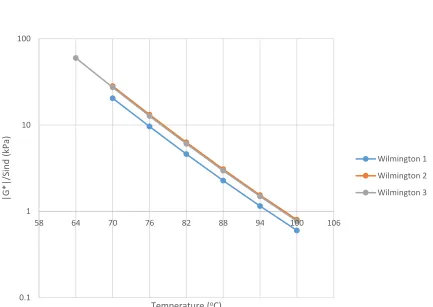
Figure 4-1: DSR Results for the Wilmington RAP Binders (Unaged) at Various Temperatures
0.1 1 10 100
58 64 70 76 82 88 94 100 106
|G
*|/S
in
d
(kPa
)
Temperature (oC)
22 It can be observed from the above tables and the figure that the |G*|/sinδ values decreased as temperature increased and the condition of |G*|/sinδ < 1.0kPa was met at a temperature of 100oC for Wilmington 1, Wilmington 2 and Wilmington 3 RAP binders. All the Wilmington RAP binders qualified for a high temperature PG grade of 94 based on DSR tests on unaged binders. The continuous high temperature PG grades were calculated as 95.3, 97.7 and 97.3 for Wilmington 1, Wilmington 2 and Wilmington 3 RAP binders, respectively, in their unaged condition. The |G*|/sinδ values for Wilmington 1 RAP binder were lower than that of Wilmington 2 and Wilmington 3 RAP binders over the entire range of test temperatures.
4.1.2. Source of RAP – Pineville
Extracted RAP binders from three randomly selected locations within Pineville stockpile were tested on the DSR in their unaged conditions. Table 4-5, Table 4-6 and Table 4-7, and Figure 4-2 show the results of the DSR testing on these three binders. The mean values of |G*|/sinδ and standard deviations are shown in the tables.
Table 4-5: DSR Results of Unaged RAP Binder (Pineville – 1) Temperature
oC
|G*|/sinδ (kPa) δo (Phase Angle)
Mean Std. Deviation Mean Std. Deviation
64 47.41 0.80 70.06 0.08
70 21.45 0.45 73.34 0.07
76 10.00 0.18 76.26 0.04
82 4.77 0.08 78.94 0.08
88 2.35 0.03 81.42 0.07
94 1.19 0.02 83.54 0.05
23 Table 4-6: DSR Results of Unaged RAP Binder (Pineville – 2)
Temperature
oC
|G*|/sinδ (kPa) δo (Phase Angle)
Mean Std. Deviation Mean Std. Deviation
64 49.87 0.80 70.05 0.03
70 22.56 0.41 73.24 0.23
76 10.38 0.10 76.27 0.03
82 4.94 0.03 79.01 0.03
88 2.43 0.02 81.46 0.03
94 1.23 0.01 83.55 0.03
100 0.64 0.01 85.30 0.03
Table 4-7: DSR Results of Unaged RAP Binder (Pineville – 3) Temperature
oC
|G*|/sinδ (kPa) δo (Phase Angle)
Mean Std. Deviation Mean Std. Deviation
64 26.09 0.22 72.55 0.02
70 11.75 0.14 75.54 0.08
76 5.47 0.07 78.43 0.03
82 2.64 0.04 80.95 0.01
88 1.32 0.02 83.01 0.02
24 Figure 4-2: DSR Results for the Pineville RAP Binders (Unaged) at Various
Temperatures
As expected, the |G*|/sinδ values decreased as temperature increased and the condition of |G*|/sinδ < 1.0kPa was met at a temperature of 100oC for Pineville 1 and Pineville 2 RAP
binders, and at a temperature of 94oC for Pineville 3 RAP binder. Pineville 1 and Pineville 2 RAP binders qualified for a high temperature PG grade of 94; Pineville 3 RAP binder qualified for a high temperature PG grade of 88oC based on DSR tests on unaged binders. The Pineville 1, Pineville 2 and Pineville 3 RAP binders’ continuous high temperature grades were calculated as 95.5, 95.7 and 90.4, respectively, in their unaged condition. Pineville 3 RAP binder showed lower values of |G*|/sinδ for the entire range of test temperatures compared to that of Pineville 1 and Pineville 2 RAP binders. Pineville 1 and Pineville 2 RAP binders
0.1 1 10 100
58 64 70 76 82 88 94 100 106
|G
*|/S
in
d
(kPa
)
Temperature (oC)
25 showed comparable values of |G*|/sinδ, and Pineville 3 RAP binder showed the least stiffness values.
4.1.3. Source of RAP – Maymead
The Maymead stockpile was randomly sampled in three locations, and the extracted binders were tested in their unaged conditions. Table 4-8, Table 4-9 and Table 4-10, and Figure 4-3 show the results of the DSR testing on these three binders. The mean values of |G*|/sinδ and standard deviations are shown in the tables.
Table 4-8: DSR Results of Unaged RAP Binder (Maymead – 1) Temperature
oC
|G*|/sinδ (kPa) δo (Phase Angle)
Mean Std. Deviation Mean Std. Deviation
64 178.05 2.31 61.75 0.16
70 83.97 2.33 64.56 0.36
76 38.72 0.78 68.27 0.22
82 18.15 0.40 71.64 0.07
88 8.68 0.30 75.01 0.19
94 4.26 0.14 78.00 0.29
100 2.15 0.07 80.71 0.18
106 1.11 0.03 82.99 0.16
26 Table 4-9: DSR Results of Unaged RAP Binder (Maymead – 2)
Temperature
oC
|G*|/sinδ (kPa) δo (Phase Angle)
Mean Std. Deviation Mean Std. Deviation
64 123.22 1.40 64.65 0.07
70 56.18 0.76 68.01 0.21
76 24.95 0.44 71.88 0.27
82 11.32 0.16 75.56 0.17
88 5.34 0.10 78.81 0.09
94 2.59 0.05 81.49 0.06
100 1.29 0.02 83.81 0.09
106 0.66 0.01 85.71 0.08
Table 4-10: DSR Results of Unaged RAP Binder (Maymead – 3) Temperature
oC
|G*|/sinδ (kPa) δo (Phase Angle)
Mean Std. Deviation Mean Std. Deviation
64 99.73 2.59 65.67 0.15
70 44.75 1.51 68.79 0.27
76 20.35 0.35 72.61 0.18
82 9.60 0.22 75.96 0.02
88 4.64 0.11 79.16 0.16
94 2.30 0.05 81.79 0.12
100 1.17 0.02 83.93 0.13
27 Figure 4-3: DSR Results for the Maymead RAP Binders (Unaged) at Various
Temperatures
As shown in the above tables and figure, the condition of |G*|/sinδ < 1.0kPa was met at a temperature of 112oC for Maymead 1 RAP binder, and at a temperature of 106oC for
Maymead 2 and Maymead 3 RAP binders. Maymead 1 RAP binder qualified for a high temperature PG grade of 106, while Maymead 2 and Maymead 3 RAP binders both qualified for a high temperature PG grade of 100oC. The continuous high temperature PG grades for Maymead binders were calculated as follows: Maymead 1, 106.7; Maymead 2, 102; and Maymead 3, 101.2.
0.1 1 10 100 1000
58 64 70 76 82 88 94 100 106 112 118
|G
*|/S
in
d
(kPa
)
Temperature (oC)
28 4.1.4. Source of RAP – Sunrock
Within the Sunrock stockpile, three samples of RAP were randomly taken and the extracted binders were tested on the DSR. Table 4-11, Table 4-12 and Table 4-13, and Figure 4-4 show the results of the DSR testing on these three RAP binders. The mean values of |G*|/sinδ and standard deviations are shown in the tables.
Table 4-11: DSR Results of Unaged RAP Binder (Sunrock – 1) Temperature
oC
|G*|/sinδ (kPa) δo(Phase Angle)
Mean Std. Deviation Mean Std. Deviation
64 50.07 0.15 68.72 0.06
70 23.07 0.34 71.82 0.04
76 10.63 0.09 75.30 0.08
82 5.05 0.05 78.41 0.05
88 2.48 0.02 81.06 0.04
94 1.25 0.01 83.29 0.03
100 0.66 0.01 85.10 0.03
Table 4-12: DSR Results of Unaged RAP Binder (Sunrock – 2) Temperature
oC
|G*|/sinδ (kPa) δo(Phase Angle)
Mean Std. Deviation Mean Std. Deviation
64 59.73 0.79 67.11 0.15
70 27.65 0.42 70.01 0.27
76 12.93 0.14 73.75 0.31
82 6.17 0.08 76.82 0.06
88 3.04 0.03 79.69 0.05
94 1.54 0.02 82.15 0.07
29 Table 4-13: DSR Results of Unaged RAP Binder (Sunrock – 3)
Temperature
oC
|G*|/sinδ (kPa) δo(Phase Angle)
Mean Std. Deviation Mean Std. Deviation
64 72.26 1.10 65.75 0.06
70 33.22 0.94 68.85 0.27
76 15.47 0.26 72.49 0.24
82 7.30 0.11 75.89 0.14
88 3.54 0.06 78.90 0.11
94 1.77 0.03 81.52 0.09
100 0.91 0.02 83.74 0.06
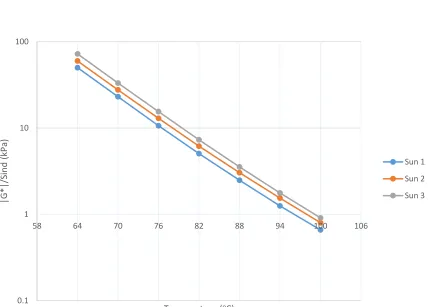
Figure 4-4: DSR Results for the Sunrock RAP Binders (Unaged) at Various Temperatures
0.1 1 10 100
58 64 70 76 82 88 94 100 106
|G
*|/S
in
d
(kPa
)
Temperature (oC)
30 The tables and the figure above indicate that the three binders were different in their stiffness values at the tested temperatures, and the |G*|/sinδ values decreased as temperature increased. The condition of |G*|/sinδ < 1.0kPa was met at a temperature of 100oC for Sunrock 1, Sunrock 2 and Sunrock 3 RAP binders. All of the Sunrock RAP binders qualified for a high temperature PG grade of 94 based on DSR tests on unaged binders.
4.1.5. Source of RAP – Sims
RAP was also randomly sampled from three different locations in the Sims stockpile and the binder was extracted from these three samples. These binders were tested on the DSR in their unaged condition for their high temperature rheological properties. Table 4-14, Table 4-15 and Table 4-16, and Figure 4-5 show the results of the DSR testing on the three Sims RAP binders. The mean values of |G*|/sinδ and standard deviations are shown in the tables.
Table 4-14: DSR Results of Unaged RAP Binder (Sims – 1) Temperature
oC
|G*|/sinδ (kPa) δo (Phase Angle)
Mean Std. Deviation Mean Std. Deviation
64 209.46 3.52 59.51 0.49
70 104.77 1.18 61.13 0.18
76 51.82 0.46 63.50 0.13
82 26.00 0.05 66.18 0.09
88 13.24 0.10 68.78 0.06
94 6.92 0.10 71.80 0.10
100 3.71 0.05 74.53 0.06
106 2.03 0.03 77.05 0.06
112 1.13 0.02 79.44 0.04
31 Table 4-15: DSR Results of Unaged RAP Binder (Sims – 2)
Temperature
oC
|G*|/sinδ (kPa) δo (Phase Angle)
Mean Std. Deviation Mean Std. Deviation
64 321.57 10.07 61.34 0.17
70 193.54 3.76 60.31 0.19
76 93.80 1.38 62.84 0.25
82 46.31 0.54 65.48 0.22
88 23.32 0.28 68.31 0.15
94 11.93 0.20 71.09 0.20
100 6.28 0.13 73.71 0.18
106 3.38 0.06 76.33 0.18
112 1.86 0.04 78.74 0.14
118 1.05 0.02 81.00 0.13
124 0.61 0.01 83.02 0.11
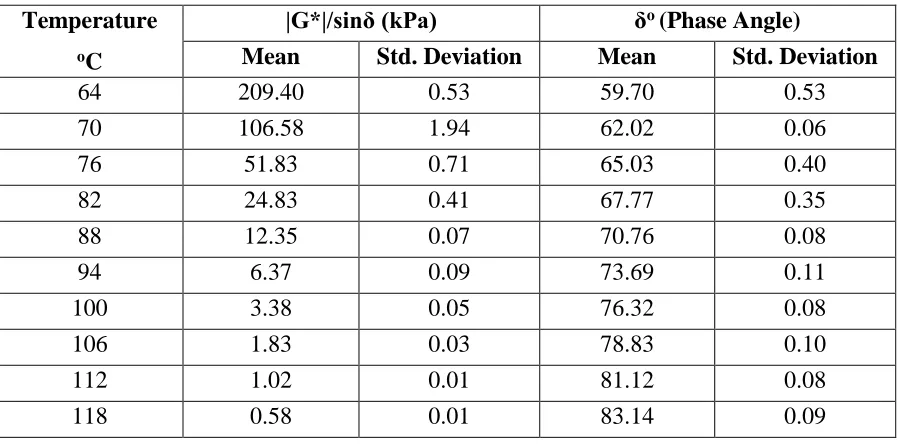
Table 4-16: DSR Results of Unaged RAP Binder (Sims – 3) Temperature
oC
|G*|/sinδ (kPa) δo (Phase Angle)
Mean Std. Deviation Mean Std. Deviation
64 209.40 0.53 59.70 0.53
70 106.58 1.94 62.02 0.06
76 51.83 0.71 65.03 0.40
82 24.83 0.41 67.77 0.35
88 12.35 0.07 70.76 0.08
94 6.37 0.09 73.69 0.11
100 3.38 0.05 76.32 0.08
106 1.83 0.03 78.83 0.10
112 1.02 0.01 81.12 0.08
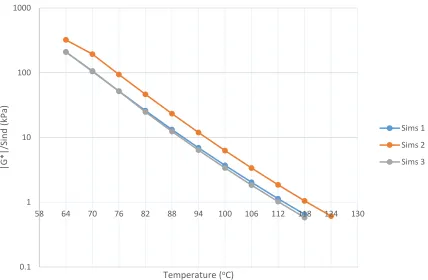
32 Figure 4-5: DSR Results for the Sims RAP Binders (Unaged) at Various Temperatures
The Sims 1 and Sims 3 RAP binders met the condition of |G*|/sinδ < 1.0kPa at a temperature of 118oC; the Sims 2 RAP binder met the condition at 124oC. Sims 1 and Sims 3 RAP binders qualified for a high temperature PG grade of 112. Sims 2 RAP binder qualified for a high temperature PG grade of 118oC based on DSR tests on unaged binders. Sims 1 and 3 RAP binders showed similar stiffness values, whereas, Sims 2 RAP binder showed highest stiffness values.
4.1.6. Source of RAP – Weaverville
Three locations were randomly selected and RAP sampled from the Weaverville stockpile. Table 4-17, Table 4-18 and Table 4-19, and Figure 4-6 show the results of the DSR testing on
0.1 1 10 100 1000
58 64 70 76 82 88 94 100 106 112 118 124 130
|G
*|/S
in
d
(kPa
)
Temperature (oC)
33 the three extracted RAP binders. The mean values of |G*|/sinδ and standard deviations are shown in the tables.
Table 4-17: DSR Results of Unaged RAP Binder (Weaverville – 1) Temperature
oC
|G*|/sinδ (kPa) δo (Phase Angle)
Mean Std. Deviation Mean Std. Deviation
64 34.68 1.51 71.06 0.13
70 16.06 0.53 74.40 0.16
76 7.43 0.18 77.68 0.18
82 3.50 0.07 80.65 0.12
88 1.65 0.03 83.19 0.12
94 0.85 0.01 85.14 0.11
Table 4-18: DSR Results of Unaged RAP Binder (Weaverville – 2) Temperature
oC
|G*|/sinδ (kPa) δo (Phase Angle)
Mean Std. Deviation Mean Std. Deviation
64 38.31 0.85 70.35 0.11
70 17.41 0.38 73.64 0.28
76 8.00 0.23 77.06 0.11
82 3.72 0.06 80.09 0.15
88 1.76 0.02 82.57 0.09
34 Table 4-19: DSR Results of Unaged RAP Binder (Weaverville – 3)
Temperature
oC
|G*|/sinδ (kPa) δo(Phase Angle)
Mean Std. Deviation Mean Std. Deviation
64 42.39 0.59 70.19 0.10
70 19.31 0.35 73.47 0.17
76 8.78 0.13 76.70 0.09
82 4.15 0.06 79.59 0.14
88 2.03 0.03 82.08 0.08
94 1.03 0.01 84.21 0.07
100 0.52 0.01 86.02 0.05
Figure 4-6: DSR Results for the Weaverville RAP Binders (Unaged) at Various Temperatures
0.1 1 10 100
58 64 70 76 82 88 94 100 106
|G
*|/S
in
d
(kPa
)
Temperature (oC)
35 In the case of unaged RAP binders from the Weaverville stockpile, the condition of |G*|/sinδ < 1.0kPa was met at a temperature of 94oC for Weaverville 1 and Weaverville 2 RAP
binders, whereas, the condition was met at a temperature of 100oC for Weaverville RAP 3 binder. Weaverville 1 and 2 RAP binders qualified for a PG 88 high temperature grade, whereas, Weaverville 3 RAP binder qualified for a PG 94 high temperature grade. The variation between the three samples from Weaverville stockpile was relatively low compared to the other stockpiles.
4.1.7. Source of RAP – Highland
Three randomly-selected locations were sampled within the Highland stockpile, and the binder extracted from these samples. These three binders were tested on the DSR in unaged condition for their high temperature rheological properties. Table 4-20, Table 4-21 and Table 4-22, and Figure 4-7 show the results of the DSR testing on the three Highland RAP binders. The mean values of |G*|/sinδ and standard deviations are shown in the tables.
Table 4-20: DSR Results of Unaged RAP Binder (Highland – 1) Temperature
oC
|G*|/sinδ (kPa) δo (Phase Angle)
Mean Std. Deviation Mean Std. Deviation
64 49.46 0.40 68.85 0.03
70 22.82 0.48 72.39 0.24
76 10.49 0.05 75.53 0.06
82 4.74 0.03 78.83 0.04
88 2.32 0.02 81.43 0.05
94 1.18 0.01 83.68 0.04
36 Table 4-21: DSR Results of Unaged RAP Binder (Highland – 2)
Temperature
oC
|G*|/sinδ (kPa) δo (Phase Angle)
Mean Std. Deviation Mean Std. Deviation
64 38.39 0.81 70.33 0.30
70 17.79 0.27 73.54 0.29
76 8.24 0.22 76.83 0.32
82 3.80 0.14 79.90 0.25
88 1.85 0.04 82.39 0.20
94 0.94 0.02 84.45 0.20
Table 4-22: DSR Results of Unaged RAP Binder (Highland – 3) Temperature
oC
|G*|/sinδ (kPa) δo (Phase Angle)
Mean Std. Deviation Mean Std. Deviation
64 40.03 0.40 69.83 0.09
70 18.34 0.20 73.10 0.09
76 8.53 0.11 76.53 0.04
82 3.88 0.06 79.75 0.04
88 1.89 0.03 82.30 0.02
37 Figure 4-7: DSR Results for the Highland RAP Binders (Unaged) at Various
Temperatures
The condition of |G*|/sinδ < 1.0kPa was met at a temperature of 100oC for Highland 1 RAP binder and at a temperature of 94oC for Highland 2 and Highland 3 RAP binders.
Highland 1 RAP binder qualified for a high temperature PG grade of 94. Highland 2 and Highland 3 RAP binders qualified for a high temperature PG grade of 88oC. The variability in the stiffness values among the three RAP binders from this stockpile was also lower compared to the other stockpiles.
0.1 1 10 100
58 64 70 76 82 88 94 100 106
|G
*|/S
in
d
(kPa
)
Temperature (oC)
38 4.1.8. Source of RAP – Harrison
The Harrison stockpile was also randomly sampled in three different locations and the binders extracted. Table 4-23, Table 4-24 and Table 4-25, and Figure 4-8 show the results of DSR testing on the three Harrison RAP binders. The mean values of |G*|/sinδ and standard deviations are shown in the tables.
Table 4-23: DSR Results of Unaged RAP Binder (Harrison – 1) Temperature
oC
|G*|/sinδ (kPa) δo (Phase Angle)
Mean Std. Deviation Mean Std. Deviation
64 39.92 0.49 71.25 0.05
70 17.49 0.11 74.81 0.07
76 7.74 0.12 78.37 0.11
82 3.52 0.03 81.39 0.06
88 1.67 0.02 83.80 0.06
94 0.82 0.01 85.69 0.04
Table 4-24: DSR Results of Unaged RAP Binder (Harrison – 2) Temperature
oC
|G*|/sinδ (kPa) δo (Phase Angle)
Mean Std. Deviation Mean Std. Deviation
64 26.41 0.63 75.63 0.04
70 11.47 0.24 78.98 0.11
76 5.07 0.11 81.77 0.09
82 2.34 0.04 84.14 0.06
88 1.13 0.02 85.98 0.04
39 Table 4-25: DSR Results of Unaged RAP Binder (Harrison – 3)
Temperature
oC
|G*|/sinδ (kPa) δo (Phase Angle)
Mean Std. Deviation Mean Std. Deviation
64 16.62 0.23 77.37 0.03
70 7.20 0.10 80.53 0.13
76 3.23 0.04 83.11 0.07
82 1.51 0.02 85.23 0.05
88 0.74 0.01 86.80 0.02
Figure 4-8: DSR Results for the Harrison RAP Binders (Unaged) at Various Temperatures
For the Harrison 1 and Harrison 2 RAP binders, the condition of |G*|/sinδ < 1.0kPa was met at a temperature of 94oC. The same condition was, however, met at a temperature of
0.1 1 10 100
58 64 70 76 82 88 94 100
|G
*|/S
in
d
(kPa
)
Temperature (oC)
40 88oC for Harrison 3 RAP binder. Harrison 1 and Harrison 2 RAP binders qualified for a high temperature PG grade of 88. Harrison 3 RAP binder qualified for a high temperature PG grade of 82oC based on DSR tests on unaged binders. All the three sampled RAP binders from Harrison stockpile showed strikingly different stiffness values indicating a high variability within stockpile.
4.1.9. Source of RAP – Burlington
The last source of RAP was Burlington. RAP was randomly sampled from three different locations from this stockpile and the binders extracted. Table 4-26, Table 4-27 and Table 4-28, and Figure 4-9 show the results of DSR testing on the three Burlington RAP binders. The mean values of |G*|/sinδ and standard deviations are shown in the tables.
Table 4-26: DSR Results of Unaged RAP Binder (Burlington – 1) Temperature
oC
|G*|/sinδ (kPa) δo (Phase Angle)
Mean Std. Deviation Mean Std. Deviation
64 41.99 0.30 71.51 0.08
70 18.79 0.24 74.89 0.12
76 8.47 0.05 78.13 0.05
82 3.96 0.02 80.85 0.04
88 1.92 0.01 83.21 0.08
41 Table 4-27: DSR Results of Unaged RAP Binder (Burlington – 2)
Temperature
oC
|G*|/sinδ (kPa) δo (Phase Angle)
Mean Std. Deviation Mean Std. Deviation
64 46.29 0.59 71.33 0.09
70 20.56 0.06 74.56 0.14
76 9.26 0.14 77.98 0.18
82 4.29 0.05 80.84 0.09
88 2.07 0.02 83.23 0.07
94 1.03 0.01 85.23 0.01
100 0.54 0.01 86.79 0.01
Table 4-28: DSR Results of Unaged RAP Binder (Burlington – 3) Temperature
oC
|G*|/sinδ (kPa) δo (Phase Angle)
Mean Std. Deviation Mean Std. Deviation
64 44.62 0.62 72.09 0.09
70 19.81 0.05 75.32 0.07
76 8.83 0.18 78.48 0.26
82 4.10 0.06 81.25 0.06
88 1.98 0.03 83.55 0.05
42 Figure 4-9: DSR Results for the Burlington RAP Binders (Unaged) at Various
Temperatures
It can be observed from the above tables and the figure that the |G*|/sinδ values decreased as temperature increased. The condition of |G*|/sinδ < 1.0kPa was met at a temperature of 100oC for Burlington 2 RAP binder, and at a temperature of 94oC for Burlington 1 and Burlington 3 RAP binders. Burlington 2 RAP binder qualified for a high temperature PG grade of 94. Burlington 1 and Burlington 3 RAP binders qualified for a high temperature PG grade of 88oC. All the three RAP binders showed similar stiffness values indicating a low variability within stockpile.
0.1 1 10 100
58 64 70 76 82 88 94 100 106
|G
*|/S
in
d
(kPa
)
Temperature (oC)
![Table 2-1: Continuous High PG Grade of RAP & Blended Binders [4]](https://thumb-us.123doks.com/thumbv2/123dok_us/1215602.1152778/33.612.91.543.98.355/table-continuous-high-pg-grade-rap-blended-binders.webp)