LAI CHUI YEN
A thesis submitted in fulfilment of the requirements for the award of the degree of
Master of Science (Computer Science)
Faculty of Computer Science and Information System Universiti Teknologi Malaysia
ACKNOWLEDMENTS
This thesis was completed with the contribution of many people to whom I want to express my sincere gratitude.
I am especially indebted to my supervisor, Prof. Madya Daut Daman, who gave me the opportunity to work in his research group. He provided a working environment with great facility and opportunities to meet interesting people. I thanked him for the useful suggestions and the freedom he gave me during my research. I am grateful to Universiti Teknologi Malaysia for sponsoring my studies. I would also like to take this opportunity to thank all the lecturers and staffs of Faculty of Geoinformation Science and Engineereing and Faculty of Computer Science and Information System, who have taught or assist me before.
I wish to thank all my lab mates who turned these few years into a pleasant time. Many thanks go to Nor Abidah Rahmat and Chu Kai Chuen for the motivation given. We have gone through a lot of hard time together. I thank Leong Chung Ern for the idea to use MATLAB.
I am deeply grateful to my family for their unconditional love through the years. I express my deepest gratitude to many of my friends who not particularly involved in the research but gave me encouragement and many “just on time” help, Chia Yun Lee, Tan Chooi Ee, Lim Yu Jian and Lau Bok Lih. Ong Boon Sheng deserves a special mention upon his continual patience, boundless encouragement and support during this study.
ABSTRACT
Image matching is a process to establish correspondence between primitives of two or more images that capturing a scene from different viewing position. Various image matching techniques using image features have been known in literature. Feature-based matching algorithm cannot tackle the problem of matching ambiguities easily. This study presents an image matching technique using the structural descriptions of image. Structural descriptions are consist of lines and inter-line relationship in the inter-line-extracted image. Three conditions of inter-inter-line
ABSTRAK
Pemadanan imej adalah satu proses untuk menubuhkan persamaan antara primitif daripada imej-imej yang menangkap satu pemandangan dari kedudukan pandang yang berlainan. Pelbagai teknik pemadanan imej yang menggunakan ciri imej telah diketahui dalam literatur. Pemadanan imej berasaskan ciri tidak dapat mengatasi masalah keraguan pemadanan dengan mudah. Kajian ini menyampaikan satu teknik pemadanan imej yang menggunakan maklumat struktur imej. Maklumat struktur adalah terdiri daripada garisan dan hubungan antara garisan dalam imej penyarian garisan. Tiga keadaan bagi hubungan antara garisan yang dinamakan aturan, persilangan dan co-linearity telah didefinisikan dan diperolehi dalam kajian ini. Kaedah ini melibatkan perwakilan maklumat struktur daripada imej dalam graf hubungan dan pemadanan graf hubungan bagi memadankan imej. Metodologi adalah terdiri daripada enam langkah: (1) kemasukan data imej, (2) penyarian segmen garisan daripada imej, (3) interpretasi dan perolehan maklumat struktur daripada imej penyarian garisan, (4) pembinaan graf hubungan untuk mewakili maklumat struktur, (5) perolehan graf gabungan daripada graf-graf hubungan untuk memadankan graf hubungan, dan (6) pencarian maximal clique yang terbesar dalam graf gabungan untuk menentukan pemadanan terbaik. Dengan itu, pemadanan imej telah diubah sebagai masalah pemadanan graf hubungan dalam kajian ini.
Eksperimen telah dijalankan untuk menilai kesesuaian untuk mengintegrasi
maklumat struktur ke dalam algoritma pemadanan imej. Data adalah terdiri daripada 14 pasang imej stereo. Daripada hasil yang diperolehi, didapati bahawa penggunaan maklumat struktur adalah munasabah hanya untuk imej yang mempunyai
TABLE OF CONTENTS
CHAPTER TITLE PAGE
DECLARATION ii
DEDICATION iii
ACKNOWLEDGEMENTS iv
ABSTRACT v
ABSTRAK vi
TABLE OF CONTENTS vii
LIST OF TABLES xi
LIST OF FIGURES xii
LIST OF SYMBOLS xvi
1 INTRODUCTION
1.1 Introduction 1
1.2 Problem Background 3
1.3 Motivations 5
1.4 Problem Statement 6
1.5 Objectives 7
1.6 Scope 7
1.7 Research Contributions 8
1.8 Organization of the Thesis 8
2 LITERATURE REVIEW
2.1 Introduction 10
2.3 An Overview of Image Matching Approaches 13
2.3.1 Area-Based Image Matching 14
2.3.2 Feature-Based Image Matching 17 2.3.3 Structural-Based Image Matching 18
2.4 Previous Work 19
2.4.1 Matching Primitives 20
2.4.1.1 Image Windows as Matching Primitives
20
2.4.1.2 Image Features as Matching Primitives
21
2.4.1.3 Structural Descriptions as Matching Primitives
22
2.4.2 Matching Constraints and Strategies 25
2.4.3 Measure of Matching 28
2.5 Discussion on the Image Matching Approaches 30
2.6 Image Matching: Problem Areas 33
3 THEORETICAL FRAMEWORK AND
METHODOLOGY
3.1 Introduction 34
3.2 Overall Methodology 34
3.3 Line Segment Extraction 35
3.4 Derivation of Structural Descriptions from the Line-Extracted Image
37
3.4.1 Line Segment Labelling 37
3.4.2 Derivation of Inter-Line Relationship 39
3.4.2.1 Ordering Relationship 39
3.4.2.2 Intersection Relationship 40
3.4.2.3 Co-linearity Relationship 42
3.5 Relational Graph Representation 43
3.8 The Association Graph and Clique Finding Technique
50
3.9 The Construction of Association Graph for Relational Graph Matching
52
3.9.1 Building the Nodes of Association Graph 53 3.9.2 Building the Arcs of Association Graph 54
3.10 The Matching Strategy 58
3.11 The Complexity 65
4 IMPLEMENTATION
4.1 Introduction 67
4.2 The System 67
4.3 Feature Extraction Module 71
4.4 Structural Descriptions Derivation Module 73
4.4.1 Line Segment Labelling 73
4.4.2 Derivation of Inter-Line Relationship 74
4.4.2.1 Ordering Relationship 75
4.4.2.2 Intersection and Co-linearity Relationship
78
4.5 Relational Graph Module 82
4.6 Association Graph Module 84
4.7 Clique-Finding Module 88
5 RESULT AND DISCUSSION
5.1 Introduction 90
5.2 Image Data 90
5.3 Initial Experiment on the firstN Parameter 92 5.4 Experiment 1: Stereo Images on a House 94 5.5 Experiment 2: Stereo Images on a House 100 5.6 Experiment 3: Stereo Images on a Block 104 5.7 Experiment 4: Stereo Images on a Note 107 5.8 Experiment 5: Stereo Images on Some
Rectangles
5.9 Experiment 6: Stereo Images on a Book and a Block
114
5.10 Experiment 7: Stereo Images on a Gear 118 5.11 Experiment 8: Stereo Images on a Gear 122 5.12 Experiment 9: Stereo Images on a Rubik Cube
and a Block
125
5.13 Experiment 10: Stereo Images on Arch of Blocks 129 5.14 Experiment 11: Stereo Images on a Telephone
and a Cup
133
5.15 Experiment 12: Stereo Images on a Tennis ball, an Ice Chest and Two Cylinders
137
5.16 Experiment 13: Stereo Images of a Room 141 5.17 Experiment 14: Stereo Images of a Room 145
5.18 Discussions 150
5.19 Constraint and Drawback 156
6 CONCLUSIONS
6.1 Summary 159
6.2 Conclusion 163
6.3 Suggestions for Further Research 164
LIST OF TABLES
TABLE NO. TITLE PAGE
5.1 The image data used in the experiments 91
5.2 The ranking for left-to-right matching pair based on Blr 94
5.3 The resulted relational graph 151
LIST OF FIGURES
FIGURE NO. TITLE PAGE
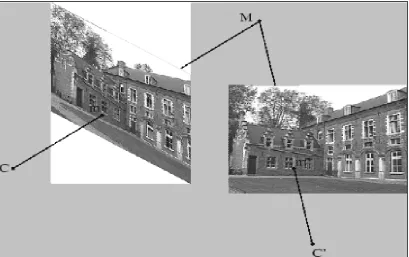
1.1 The plotting of two corresponding imaged points, m and m’ in two images, cast by the same physical point M in 3-D space, from different viewing position, C and C’
2
1.2 The two corresponding imaged points, m and m’ in two images, cast by the same physical point M in real scene (3-D space), from different viewing position, C and C’
2
2.1 Three cameras targeting the scene of a building from different viewing positions (plane view)
11
2.2 Q is the homologous or corresponding point to P 12
2.3 Different approaches of image matching 14
2.4 Area-based matching 16
3.1 The methodology of the study 35
3.2 Generation of label matrix from line-extracted image 38 3.3 Detection of ordering relationship for the line
labelled 5, the displacement is carried on the both side of the line labelled 5 until an edge pixel belongs to other neighbouring line is encountered
40
3.4 A line segment is defined by two end points 41 3.5 Some possible intersection between line segments
that derived for this study
3.6 The co-linearity condition between line segments that derived for this study
43
3.7 A graph representation of relational structure 45 3.8 Line-extracted image with lines labelled as l1to l16 47 3.9 The corresponding relational graph represents the
structural information of the line segment image (of Figure 3.9), where t1 denotes relation type ordering, t2 denotes relation type intersection, and t3 denotes relation type co-linearity
47
3.10 Three different classes of graph matching 49
3.11 Some examples of clique 51
3.12 The definitions of compatibility in terms of co-linearity relation
57
3.13 Two line-extracted images to be matched 60
3.14 Left relational graph, the represented internodes relations are: to the left of (labelled as t1), to the right of (labelled as t2), to the top of (labelled as t3), to the bottom of (labelled as t4), intersect with (labelled as t5), and collinear with (labelled as t6)
60
3.15 Right relational graph, the represented internodes relations are: to the left of (labelled as t1), to the right of (labelled as t2), to the top of (labelled as t3), to the bottom of (labelled as t4), intersect with (labelled as t5), and collinear with (labelled as t6)
61
3.16 The resulted association graph 62
3.17 The corresponding lines between the left and right image
65
4.1 Modules in the system 68
4.2 Statements in buildlabelmatrix function 74
4.3 Statements in detectordering function 77
4.4 Statements in computeoverlap subfunction 77
4.5 Statements in detectconnection function 80
4.7 Statements in searchconnectlabel subfunction 81 4.8 Statements in buildrelationalgraph function 83 4.9 Statements in buildadjacencymatrix function 84 4.10 Statements in plotrelationalgraph function 84 4.11 Statements in buildassociationnode function 86 4.12 Statements in buildassociationarc function 87
4.13 Statements in propagatearc function 88
5.1 The correct correspondence between the left and right image, indicated by 23 set of left-to-right matching pair that labelled with the corresponding number
93
5.2 Some results of the first experiment 98
5.3 Association graph resulted from the first experiment 99 5.4 The matched lines without propagation from the first
experiment
99
5.5 The association graph without propagation of the first experiment
100
5.6 Some results of the second experiment 104
5.7 Association graph resulted from the second experiment
104
5.8 Some results of the third experiment 107
5.9 Association graph resulted from the third experiment 108
5.10 Some results of the third experiment 111
5.11 Association graph resulted from the fourth experiment
111
5.12 Some results of the fifth experiment 115
5.13 Association graph resulted from the fifth experiment 116
5.14 Some results of the sixth experiment 119
5.15 Association graph resulted from the sixth experiment 120
5.16 Some results of the seventh experiment 123
5.17 Association graph resulted from the seventh experiment
124
5.19 Association graph resulted from the eighth experiment
127
5.20 Some results of the ninth experiment 130
5.21 Association graph resulted from the ninth experiment 130
5.22 Some results of the tenth experiment 133
5.23 Association graph resulted from the tenth experiment 134 5.24 Some results of the eleventh experiment 138 5.25 Association graph resulted from the eleventh
experiment
138
5.26 Some results of the twelfth experiment 141
5.27 Association graph resulted from the twelfth experiment
142
5.28 Some results of the thirteenth experiment 146 5.29 Association graph resulted from the thirteen
experiment
146
5.30 Some results of the fourteenth experiment 150 5.31 Association graph resulted from the fourteenth
experiment
150
5.32 The ordering relationship is not well-defined for some conditions
LIST OF SYMBOLS
A - Searching area
Blr - Similarity measure
d - Euclidean distance
e - edges (arcs)
E - Set of edges (arcs)
G - Relational graph
h - The length of a line (in the number of pixels)
l - Line
l - Line in the left image
l: r - Left-to-right matching pair
max - Maximum operation
min - Minimum operation
mc - The slope of the line under consideration
ms - The searching slope
nEdge - The number of edges in an image
nElement - The number of elements in an adjacency matrix
nLine - The number of lines in an image
nNode - The number of nodes in a relational graph
nnz - The number of non-zero elements in an adjacency matrix
nT - The number of relations hold by a line
p - Properties
P - Set of properties
S - Relational Structure
t - Relations
T - Set of relations
v - Elements (Nodes)
V - Set of elements (Set of nodes) θ - The orientation of a line
CHAPTER 1
INTRODUCTION
1.1 Introduction
Generally, image matching is a process of automatically establishing correspondence between primitives of two or more images that capturing at least partly the same object or scene from different viewing position. Image matching also can refer as a process to associate the content or primitives of two or more images that capturing an object or scene from different position (Julien, 1999).
Image matching can be illustrated as a process of identifying the
corresponding points of two images (see Figure 1.1 and Figure 1.2) or more images, which cast by the same physical point in three-dimensional (3-D) space from
Figure 1.1: The plotting of two corresponding imaged points, m and m’ in two images, cast by the same physical point M in 3-D space, from different viewing position, C and C’
Figure 1.2: The two corresponding imaged points, m and m’ in two images, cast by the same physical point M in real scene (3-D space), from different viewing position, C and C’
Image matching is an integral part of many computer vision tasks such as image registration, feature tracking, 3-D structure recovering from stereo images, multiple images or image sequences. For instance, the first step in recovering 3-D information of a static scene from a pair of stereo images is the matching of a set of
Image Plane
M
C’ m’ m
identifiable of corresponding details between images. Where, a number of
corresponding image primitives is used to match different images to each other and establish a local triangulation, to recover the depth of the scene. In addition, establish correspondence between images of a set of image sequences is also a key step in recovering 3-D structure from image sequences. Where, the correspondence is used to calculate the motion parameters of the camera with respect to the objects in the scene, to reconstruct the structure of the objects in the dynamic scene.
Over the years, a broad range of image matching techniques has been proposed for various types of data and many domains of application, resulting in a large body of research. Some interesting areas are recovering 3-D structure from stereo images or image sequence for autonomous vehicle navigation, industrial automation and augmented reality.
Approaches for image matching can be broadly classified into two categories: area-based matching and feature-based matching. Area-based matching uses
intensity profiles or grey value template as the matching primitive. But, more recently, image features have extensively applied to image matching to establish image correspondence. In the feature-based approach, features are first extracted from the images, and then the matching process is based on the attributes associated with the extracted features. Feature-based matching alone might not deal with the problem of matching ambiguities easily. Some additional constraints must be imposed to control the search of matching candidates and reduce the possibility of error caused by ambiguous matching.
1.2 Problem Background
Ambiguous matching might happen, if some image primitives that are visible in one image are occluded partially or totally in the other. In addition, ambiguities might arise if set of corresponding details between images are not available, in a small quantity, or incompatible. Sometimes, a local primitive in one image matches equally well with more than one primitive in the other image (known as one-to-more mapping). All these situations will lead to ambiguities in matching where a one-to-one mapping between image primitives is difficult to establish.
Image matching can be complicated by several factors related to the geometric and radiometric properties of the images. For instance, when working with stereo images that capturing over a scene from different viewing position, geometric distortion in images, variation of image attributes and scene illumination could contribute to ambiguities in the matching result (Salari and Sethi, 1990). Sometimes, periodic structures in the scene can confuse the image matching process because a feature in one image may confuse with features from nearby parts of the structure in the other image, especially if the image features generated by these structures are close together, compared with the disparity of the features (Barnard and Fischler, 1982).
In fact, these ambiguous conditions are likely to occur, when feature extraction does not provide reliable result, when image primitives are missing or partly occluded due to noise or shadow in the image, or when images are
geometrically distorted due to different perspective viewpoint (Medioni and Nevatia, 1985). All these geometric or radiometric changes in images can in turn lead to wrong correspondence and causing the matching result drift away from their original correspondence set.
Therefore, in order to control the search of matching candidates and minimize the occurrence of false matching, some matching constraints should be imposed in conjunction with the matching algorithm (refer Section 2.4.2 for details).
There are a number of reasons for this: (1) feature detection is not perfectly reliable, so false feature may be detected in the images, (2) feature in one image may be partially seen or fully occluded in the other image due to shadow, noise, failure in feature extraction, and thus it is difficult to find a one-to-one mapping between images, (3) one object may look different and varied in its attributes in the other images due to different viewing position and perspective distortion, and (4) ambiguities may occur, caused by repetitive pattern in the scene.
Many feature-based matching approaches have to go through some processes such as edge detection, edge linking, binarization and thinning during the feature extraction process. Feature-based image matching algorithm is relies heavily on the quality of image and the performance of feature extraction.
Thus, a method to tackle the problem is to perform image matching from feature-extracted image without relied solely on the identifiable primitives in the feature-extracted images. This means that the proposed method should not
constrained much by the quality of the image, the performance of feature extraction algorithm and the quality of extracted features. It also should capable to work with two image descriptions that are not likely to have a strict one-to-one correspondence at the feature extraction level.
By considering the clarified needs, a structural-based matching technique is proposed in this study. This study involves the interpretation and derivation of structural descriptions from image, the construction of relational graph to represent the structural descriptions and the matching between relational graphs. Hence, image matching is carried out as relational graph matching in this study.
1.3 Motivations
Given two or more images, the matching of images or other closely related tasks such as image registration, pattern detection and localization, and common pattern discovery can be defined. Image registration is to find the transformation under which an image spatially fits best to another. Pattern detection and
localization is to detect whether a small image is a sub-image of another image and locating the position of the sub-area. Whilst, common pattern discovery is to find the maximum common sub-image of two or more images.
Despite of that, a broad set of applications also motivate the research area of image matching. Related areas include image registration, change detection, map updating, feature tracking, stereo matching, or recovering structure from image sequences for autonomous navigation.
All these research have different level of purposes and difficulties, as a result, often associates with different approaches and solutions. They differ in their choice of primitives and the criteria used to resolve ambiguities, and each method has its own affinity function. The configuration of the method depends on the
correspondence problem and the complexity of the scene. Commonly, there are constraints and schemes that can help reducing the number of false matches. From the review of previous works (refer Chapter 2), many open problems still exist in image matching.
1.4 Problem Statement
1.5 Objectives
The objectives of the study are:
(1) To derive the structural descriptions of an image.
(2) To represent the structural descriptions of an image using relational graph.
(3) To perform image matching based on the constructed relational graphs.
1.6 Scope
This study focuses firstly on the derivation of structural descriptions of an image. The structural descriptions of an image are defined as image features and their interrelationships in the image. Line features are extracted from a greyscale image. No pre-processing of greyscale image is done. Next was the study on the derivation of relationship between the extracted line features. The detection of inter-line relationships would be based upon the inter-line extraction result. Nevertheless, inter-line segment labelling would be studied, prior to the derivation of inter-line relationship. The inter-line relationships that derived for this study are confined to ordering, intersection and co-linearity.
In addition, emphasis is given to the utilization of structural descriptions of the line-extracted image in image matching. Image matching would be based on the result of the first phase of the study. Where, image matching involves the
representation of the derived structural description of an image in relational graph and the relational graph matching to implement image matching.
1.7 Research Contributions
The work addressed in this study has contributed to the following aspects:
(1) An algorithm that transforms a feature-extracted image to its structural descriptions, represents the derived structural descriptions in relational graph, and performs graph matching between these relational graphs, was proposed in this study.
(2) Three conditions of inter-line relationship in the line-extracted image, namely ordering, intersection and co-linearity, were defined and derived. The
applicability and limitation of these inter-line relationships were analyzed.
(3) The idea of applied relational graph matching to image matching was introduced. The incorporation of structural information of an image and the characteristics of relational graph representation in assisting image matching were studied and examined.
(4) Relational graph matching by forming an association graph structure and computing the largest maximal clique in the association graph was performed and evaluated.
1.8 Organization of the Thesis
The thesis is organized as follows: Chapter 1 is a brief introduction of the study. The background, motivation, problem statement, objectives and scopes of the study are discussed in this chapter.
Chapter 3 presents the methodology and theoretical framework of this study. This chapter explains the steps of transforming the line-extracted image to its
structural descriptions and representing the derived structural descriptions as a relational graph for subsequent graph matching process.
Chapter 4 reports on the implementation of the proposed approach. The methodology is designed to be implemented modularly by five computer modules, namely feature extraction module, structural description derivation module, relational graph module, association graph module and clique-finding module.
Chapter 5 presents and discusses the results of conducted experiments based on the proposed structural-based image matching technique.
REFERENCES
Balakrishnan, V. K. (1997). Schaum’s Outline of Theory and Problems of Graph Theory. Orono, Maine: McGraw-Hill.
Ballard, D. H. and Brown, C. M. (1982). Computer Vision. Englewood Cliffs, New Jersey: Prentice-Hall.
Barnard, S. T. and Fischler, M. A. (1982). Computational Stereo. ACM Computing Surveys. 14(4): 553-572.
Barnard, S. T. and Thompson, W. B. (1980). Disparity Analysis of Images. IEEE Transactions on Pattern Analysis and Machine Intelligence, PAMI-2(4): 333-340.
Bomze, I. M., Budinich, M., Pardalos, P.M. and Pelillo, M. (1999). The Maximum Clique Problem. In: Du, D. -Z. and Pardalos, P. M. ed. Handbook of
Combinatorial Optimization (Volume 4). Boston, MA: Kluwer Academic Publishers.
Boyer, K. L. and Kak, A. C. (1988). Structural Stereopsis for 3-D Vision. IEEE Transactions on Pattern Analysis and Machine Intelligence. 10(2): 144-166.
Brown, L. G. (1992). A Survey of Image Registration Techniques. ACM Computing Surveys. 24(4): 325-376.
Chou, G. T. and Teller, S. (1997). Multi-Image Correspondence Using Geometric and Structural Constraints. Defence Advanced Research Projects Agency (DARPA) Image Understanding Workshop. May 11-14. New Orleans, LA, 869-874.
Cox, G. S. (1995). Review: Template Matching and Measures of Match in Image Processing. Technical Report, Department of Electrical Engineering, University of Cape Town. unpublished
Deriche, R. and Faugeras, O. (1990) 2-D Curve Matching Using High Curvature Points: Application to Stereo Vision. Proceedings of the 10th
International Conference on Pattern Recognition (ICPR 1990). June 16-21. Atlantic City, New Jersey, USA: IEEE Computer Society, 240-242.
Dowman, I. J. (1996). Fundamentals of Digital Photogrammetry. In: Atkinson, K. B. ed. Close Range Photogrammetry and Machine Vision. Scotland: Whittles Publishing. 52.-77.
Du, Q. H (1994). Feature-Based Stereo Vision on a Mobile Platform. University of Western Australia: Ph.D. Thesis.
Förstner, W. (1982). On the Geometric Precision of Digital Correlation.
International Archives of Photogrammetry and Remote Sensing. (24)3: 176-189.
Förstner, W. (1986). A Feature Based Correspondence Algorithm for Image
Matching. International Archives of Photogrammetry and Remote Sensing. (26) 3/3: 150-166.
Georgescu, B. and Meer, P. (2004). Point Matching under Large Image
Grün, A. (1985). Adaptive Least Squares Correlation - A Powerful Image Matching Technique. South African Journal of Photogrammetry, Remote Sensing and Cartography. (14)3: 175-187.
Han, J. H. and Park, J. S. (2000). Contour Matching Using Epipolar Geometry. IEEE Transactions on Pattern Analysis and Machine Intelligence, 22(4): 358-370.
Hannah, M. J. (1989). A system for Digital Stereo Image Matching.
Photogrammetric Engineering and Remote Sensing. 55 (12): 1765-1770.
Heipke, C. (1996). Overview of Image Matching Techniques. Organisation Européenne d'Etudes de Photogrammétriques Experimentales (OEEPE)
Workshop on the Application of Digital Photogrammetric Workstations. March 4-6, 1996. Lausanne: OEEPE Official Publications No. 33, 173-189.
Herman, M. and Kanade, T. (1986). Incremental Reconstruction of 3-D Scene from Multiple, Complex Images. Artificial Intelligence. 30: 299-341.
Horaud, R. and Skordas, T. (1988). Structural Matching for Stereo Vision.
Proceedings of the 9th International Conference on Pattern Recognition 1988 (ICPR 1988). November 14-17, 1988. Rome, Italy: IEEE Computer Society, 439-445.
Horaud, R. and Skordas, T. (1989). Stereo Correspondence through Feature Grouping and Maximal Cliques. IEEE Transactions on Pattern Analysis and Machine Intelligence. 11(11): 1168-1180.
Jiang, H. and Ngo, C. W. (2004). Graph Based Image Matching. Proceedings of the
Julien, P. (1999). Principles of Digital Matching. Organisation Européenne d'Etudes de Photogrammétriques Experimentales (OEEPE) Workshop on
Automation in Digital Photogrammetric Production. June 22-24, 1999. Marne la Vallée, France: OEEPE Official Publications.
Kamgar-Parsi, B. and Kamgar-Parsi, B. (2004). Algorithms for Matching 3D Line Sets. IEEE Transactions on Pattern Analysis and Machine Intelligence. 26(5): 582-593.
Kenney, C. S. Manjunath, B. S., Zuliani, M., Hewer, G. A. and Nevel, A. V. (2003). A Condition Number for Point Matching with Application to Registration and Postregistration Error Estimation. IEEE Transactions on Pattern Analysis and Machine Intelligence, 25(11): 1437-1454.
Kim, J. and Fessler, J. A. (2004). Intensity-Based Image Registration Using Robust Correlation Coefficients. IEEE Transactions on Medical Imaging. 23(11): 1430-1444.
Liu, Y. and Huang, T. S. (1992). Three-Dimensional Motion Determination from Real Scene Images Using Straight Line Correspondences. Pattern Recognition. 25(6): 617-639.
Loaiza, H., Triboulet, J., Lelandais Sylvie and Barat, C. (2001). Matching Segments in Stereoscopic Vision. IEEE Instrumentation and Measurement Magazine. 4(1): 37-42.
Medioni, G. and Nevatia, R. (1984). Matching Image Using Linear Features. IEEE Transactions on Pattern Analysis and Machine Intelligence. PAMI-6(6): 675-685.
Medioni, G. and Nevatia, R. (1985). Segment-Based Stereo Matching. Computer Vision, Graphics, and Image Processing. 31: 2-18.
Musse, O., Heitz, F. and Armspach, J. P. (2001). Topology Preserving Deformable Image Matching Using Constrained Hierarchical Parametric Models. IEEE Transactions on Image Processing. 10(7): 1081-1093.
Nasrabadi, N. M. (1992). A Stereo Vision Technique using Curve-Segments and Relaxation Matching. IEEE Transactions on Pattern Analysis and Machine Intelligence. 14(5): 566-572.
Ohta, Y. and Kanade, T. (1985). Stereo by Intra- and Inter-Scanline Search Using Dynamic Programming. IEEE Transactions on Pattern Analysis and Machine Intelligence. 7(2): 139-154.
Pla, F. and Marchant, J.A. (1997). Matching Feature Points in Image Sequences through a Region-Based Method. Computer Vision and Image Understanding. 60(3): 271-285.
Pollefeys, M. (1999). Self-Calibration and Metric 3D Reconstruction from
Uncalibrated Image Sequences. Katholieke Universiteit Leuven: Ph.D. Thesis.
Rosenholm, D. (1987). Multi-Point Matching Using the Least-Squares Technique for Evaluation of Three-Dimensional Models. Photogrammetric Engineering and Remote Sensing. (53)6: 621-626.
Salari, V. and Sethi, I. K. (1990). Feature Point Correspondence in the Presence of Occlusion. IEEE Transactions on Pattern Analysis and Machine Intelligence. 12(1): 87-91.
Schenk, T., Li, J. C. and Toth, C. (1991). Towards an Autonomous System for
Orienting Digital Stereopairs. Photogrammetric Engineering and Remote Sensing. (57)8: 1057-1064.
Shapiro, L. G. and Haralick, R. M. (1987). Relational Matching. Applied Optics. (26)10: 1845-1851.
Ton, J. and Jain, A. K. (1989). Registering Landsat Images by Point Matching. IEEE Transactions on Geoscience and Remote Sensing. 27(5): 642-651.
Torkar, D. and Pavešić, N. (1996). Feature Extraction from Aerial Images and Structural Stereo Matching. Proceedings of the 13th
International Conference on Pattern Recognition 1996 (ICPR 1996). August 25-30. Vienna, Austria: IEEE Computer Society, 880-884.
Ude, A., Bröde, H. and Dillmann, R. (1994). Object Localization Using Perceptual Organization and Structural Stereopsis. Proceedings of the 3rd
International Conference on Automation, Robotics and Computer Vision. November 8-11. Singapore, 197-201.
Ventura, A. D., Rampini, A. and Schettini, R. (1990). Image Registration by
Recognition of Corresponding Structures. IEEE Transactions on Geoscience and Remote Sensing. 28(3): 305-314.
Walder, J. (2000). Using 2-D Wavelet Analysis for Matching Two Images.
Proceedings of 4th Central European Seminar on Computer Graphics 2000. May 1-3. Budmerice, Slovakia: Austrian Computer Association.
Walker, K. N., Cootes, T. F. and Taylor, C. J. (1997). Correspondence Using Distinct Points Based on Image Invariants. Proceedings of the 8th
British
Machine Vision Conference. September 8-11. Colchester, UK: British Machine Vision Association Press, 540-549.
You, J. and Bhattacharya, P. (2000). A Wavelet-Based Coarse-to-Fine Image Matching Scheme in A Parallel Virtual Machine Environment. IEEE Transactions on Image Processing. 9(9): 1547-1559.
Zhang, W. and Košecká, J. (2003). Extraction, Matching and Pose Recovery Based on Dominant Rectangular Structures. 1st
IEEE International Workshop on
Higher-Level Knowledge in 3D Modelling and Motion Analysis 2003 (HLK 2003). October 17, 2003. IEEE Computer Society, 83-91.