OCONNOR, TERRENCE J. Bluetooth Intrusion Detection. (Under the direction of Professor Douglas Reeves),
Bluetooth, a protocol designed to replace peripheral cables, has grown steadily over the last five years and includes a variety of applications. In near ubiquity now, the Bluetooth protocol operates on a wide variety of mobile and wireless devices. Several attacks exist that successfully target and exploit Bluetooth enabled devices. This thesis describes the implementation of a network intrusion detection system for discovering malicious Bluetooth traffic.
This work improves upon existing techniques, which only detect only a limited set of known attacks through measuring anomalies in the power levels of the Bluetooth device. This research illustrates the ability to efficiently and effectively detect a wide variety of malicious traffic by utilizing pattern matching misuse detection. This system identifies reconnaissance, denial of service, and information theft attacks on Bluetooth enabled devices. In addition, this tool includes a visualization interface to facilitate the understanding of Bluetooth enabled attacks. Furthermore, this system implements an intrusion response based on attack classification.
by
Terrence J. OConnor
A thesis submitted to the Graduate Faculty of North Carolina State University
in partial fullfillment of the requirements for the Degree of
Master of Science
Computer Science
Raleigh, North Carolina
2008
Approved By:
Dr. Vincent W. Freeh Dr. Peng Ning
DEDICATION
ACKNOWLEDGMENTS
TABLE OF CONTENTS
LIST OF TABLES . . . vii
LIST OF FIGURES . . . viii
1 Introduction . . . 1
1.1 Bluetooth-Enabled Technology . . . 1
1.2 Motivation . . . 1
1.2.1 Health Care Bluetooth-Enabled Technology . . . 2
1.2.2 Financial Sector Bluetooth-Enabled Technology . . . 2
1.2.3 Military Bluetooth-Enabled Technology . . . 3
1.3 Summary of Contribution . . . 4
1.4 Thesis Organization . . . 4
2 Background . . . 5
2.1 Bluetooth-Enabled Attacks . . . 5
2.1.1 Long Distance Attacks . . . 5
2.1.2 Reconnaissance . . . 6
2.1.3 Denial of Service . . . 9
2.1.4 Information Theft . . . 11
2.1.5 Emerging Trends . . . 14
2.2 Intrusion Detection . . . 15
2.2.1 Network Intrusion Detection Systems . . . 15
2.2.2 Anomaly-Based Intrusion Detection . . . 16
2.2.3 Misuse Intrusion Detection . . . 18
2.2.4 Realtime Intrusion Detection . . . 19
2.2.5 Visualization of Attacks . . . 20
2.2.6 Active Response . . . 21
3 Related Work . . . 22
3.1 Intrusion Detection . . . 22
3.2 Wireless and Mobile Threat Modeling . . . 23
3.3 Current Related Tools . . . 24
4 Bluetooth IDS Design . . . 25
4.1 Overview . . . 25
4.2 Packet Decoding and Preprocessing . . . 26
4.3.1 Pattern Matching . . . 27
4.3.2 Plug-in Modules . . . 28
4.3.3 IDS Engine Rule Grammar . . . 28
4.4 Visualization Interface . . . 28
4.5 Signature Development . . . 31
4.6 Signatures for Reconnaissance Attacks . . . 32
4.6.1 Signature of Device Discovery Attack . . . 32
4.6.2 Signature of Service Discovery Attack . . . 33
4.6.3 Signature of Exploit Discovery Attack . . . 34
4.7 Detection of Denial of Service Attacks . . . 35
4.7.1 Signature of BlueSpamming . . . 35
4.7.2 Signature of Tanya Attack . . . 36
4.7.3 Signatures of Maliciously Formed Bluetooth Packets . . . 37
4.8 Detection of Information Theft Attacks . . . 38
4.8.1 Signature of Btcrack . . . 38
4.8.2 Signature of CarWhisperer Attack . . . 39
4.8.3 Signature of BlueBug Attack . . . 40
4.8.4 Signature of HeloMoto attack . . . 41
4.8.5 Signature of HIDattack . . . 41
4.9 Response System . . . 42
4.9.1 Reconnaissance Response . . . 42
4.9.2 Denial of Service Response . . . 43
4.9.3 Information Theft Response . . . 43
5 Bluetooth IDS Implementation . . . 45
5.1 Overview . . . 45
5.2 Bluetooth IDS Testbed . . . 45
5.2.1 Attack Node . . . 46
5.2.2 Target Nodes . . . 48
5.2.3 Defense Node . . . 48
5.2.4 Intrusion Response Node . . . 50
5.3 Practical Problems Faced . . . 50
5.3.1 Protocol Analyzer Packet Decoding . . . 51
5.3.2 Scheduling Between Bluetooth Piconets . . . 51
6 Evaluation of Results . . . 52
6.1 Overview . . . 52
6.2 Experiment Setup . . . 52
6.3 Evaluation of IDS Metrics . . . 53
6.3.1 Coverage . . . 53
6.3.2 Response Time . . . 54
6.3.4 Probability of False Alarms . . . 55
6.3.5 Resistance to Attacks Directed at the IDS . . . 55
6.3.6 Ability to Identify an Attack . . . 56
6.3.7 Ability to Determine Attack Success . . . 56
6.3.8 Processing Speed . . . 57
6.4 Evaluation of Response Capability . . . 58
6.4.1 Reconnaissance Response . . . 58
6.4.2 Denial of Service Responses . . . 59
6.4.3 Information Theft Responses . . . 60
7 Conclusion . . . 61
7.1 Summary . . . 61
7.2 Limitations and Future Work . . . 62
7.2.1 Hybrid Model for Detection . . . 62
7.2.2 Correlation of Multiple Bluetooth Sensors . . . 62
7.2.3 Further Intrusion Response Development . . . 63
7.2.4 Integration with Existing Defense Tools . . . 63
7.2.5 Integration with Existing Intrusion Detection Systems . . . 64
7.3 Speculation . . . 64
7.3.1 Attacks Against the 2.1 Protocol . . . 64
7.3.2 Attacks Against Infrastructure . . . 65
Bibliography . . . 66
Appendix A Bluetooth Primer . . . 74
A.1 Bluetooth . . . 74
A.1.1 Overview . . . 74
A.1.2 Protocol Stack . . . 77
A.1.3 Application Profiles . . . 79
A.1.4 Device Discovery . . . 79
A.1.5 Pairing and Authentication Process . . . 80
A.1.6 Security . . . 83
Appendix B User’s Manual . . . 85
B.1 Intrusion Detection Graphical User Interface . . . 85
B.1.1 Rule Confiuration . . . 86
B.1.2 Response Actions . . . 86
B.1.3 Statistics Analysis . . . 87
B.2 Example of a Bluetooth Module . . . 89
B.3 Script for Analyzer Control . . . 89
LIST OF TABLES
Table 5.1 Table of Bluetooth-Enabled Attacks . . . 47
Table 5.2 Targeted Devices . . . 48
Table 6.1 Time Required for Detection of Attacks. . . 54
Table 6.2 Off-line Processing Time . . . 57
LIST OF FIGURES
Figure 2.1 Modification of Bluetooth MAC Address under Linux BlueZ Stack . . 11
Figure 2.2 Traffic Deviations Between Attack (BlueSmack) and Baseline Traffic 17 Figure 4.1 Design of Bluetooth Intrusion Detection System . . . 25
Figure 4.2 Packet Reassembly by the Preprocessor . . . 26
Figure 4.3 Rule to Detect Malicious L2CAP Header Overflow Attack . . . 27
Figure 4.4 Bluetooth Intrusion Detection Grammar . . . 29
Figure 4.5 Visualization of RFCOMM Scan Attack . . . 30
Figure 4.6 Visualization of Bluetooth Channel Activity . . . 31
Figure 4.7 Model for Tbear Reconnaissance Attack . . . 33
Figure 4.8 Model for a RFCOMM Scan Reconnaissance Attack . . . 34
Figure 4.9 Bluetooth Stack Smasher Reconnaissance Attack. . . 35
Figure 4.10 Capture of Nasty vCard Attack . . . 36
Figure 4.11 L2CAP Packet used in Tanya Attack . . . 36
Figure 4.12 Nokia N70 Denial of Service Attack . . . 37
Figure 4.13 L2CAP Header Overflow Denial of Service Attack. . . 38
Figure 4.14 Capture of a Packet Used to Reset and a Connection for BTCrack . . 38
Figure 4.15 CarWhisperer Packet Transmission . . . 39
Figure 4.16 BlueBug Attack Traffic Captured by IDS . . . 40
Figure 4.17 Pattern for HeloMoto Traffic . . . 41
Figure 5.1 Testbed Used for Bluetooth Intrusion Detection . . . 45
Figure 5.2 Default Rule List . . . 49
Figure 6.1 Report of Data Stolen During BlueBug Attack . . . 57
Figure 6.2 Attacker’s Console after Denial of Service Response . . . 59
Figure 6.3 Attacker’s Console after Information Theft Response . . . 60
Figure A.1 Example of a Bluetooth Scatternet . . . 75
Figure A.2 Example for a Bluetooth Baseband Packet . . . 76
Figure A.3 The Bluetooth Protocol Stack . . . 77
Figure A.4 Link Manager Protocol (LMP) Classes of Bluetooth Power . . . 78
Figure A.5 Bluetooth MAC Address. . . 80
Figure A.6 Pairing and Mutual Authentication Prior to Core Specification 2.1 . . 81
Figure A.7 Creation of Diffie Helman Key used for Secure Simple Pairing in Core Specification 2.1 . . . 82
Figure A.8 Link Manager Protocol Security Modes . . . 83
Figure B.1 Graphical User Interface . . . 85
Figure B.2 Graphical User Interface . . . 86
Figure B.3 Graphical User Interface . . . 87
Figure B.4 Graphical User Interface . . . 87
Chapter 1
Introduction
1.1
Bluetooth-Enabled Technology
The Bluetooth Special Interest Group developed the Bluetooth, (IEEE 802.15.1 protocol), as a communications protocol for a multitude of mobile devices. In near ubiquity now, over 15 million Bluetooth radios shipped per week in 2007 with over 1.8 billion Bluetooth devices in existence currently.[1, 2] Examples of Bluetooth de-vices include smart-phones, handheld computers, hands-free audio dede-vices, global-positioning devices, and wireless peripherals. Bluetooth devices offer an attractive target for hackers because physical access is not required to attack such device. Fur-thermore, a multitude of attacks exist that can compromise the security of Bluetooth-enabled devices. This thesis proposes a system for detecting malicious use of the Bluetooth communications protocol.
1.2
Motivation
1.2.1
Health Care Bluetooth-Enabled Technology
The health care industry utilizes Bluetooth technology. The Bluetooth specifi-cations provide a generic profile for medical devices.[3] In health care environments, Bluetooth-enabled devices provide patient mobility. Bluetooth serves as an attrac-tive protocol for health care administrators because of the low cost, low power con-sumption, and robustness.[4] Bluetooth-enabled devices exist for heart-rate moni-tors, glucometers, respiramoni-tors, hearing aids, sleep monimoni-tors, and patient records.[5] Bluetooth-enabled medical devices require the highest level of security measures to protect critical and confidential applications. A denial of service attack on a floor of heart-rate monitors could overwhelm a hospital staff. Intercepting and decoding the packets of a hearing aid provides the equivalent of an audio bug. Compromis-ing Bluetooth-enabled devices to reveal hospital records could compromise private, sensitive, and potentially embarrassing patient information. While Bluetooth cer-tainly adds convenience for patients, vendors must ensure mobile medical devices comply with the generic Bluetooth Medical Device Profile and enforce strict security measures.[3] This reality requires medical facilities to employ a means of detecting malicious attacks on medical Bluetooth-enabled devices.
1.2.2
Financial Sector Bluetooth-Enabled Technology
banking exists for Bluetooth, application developers must design systems with secu-rity in mind and require a protection mechanism for detecting malicious Bluetooth traffic.
1.2.3
Military Bluetooth-Enabled Technology
The military also suffers from vulnerabilities of the Bluetooth protocol. To illus-trate the scope of the threat to the military, a researcher can examine a recent Naval recruiting campaign. As a method of recruiting, the Navy constructed a system that distributed motivational videos to nearby Bluetooth devices. The Navy placed the system at key locations on 13 different Naval posts. During a one-month experiment, the program discovered 11,000 unique Bluetooth mobile devices and delivered video to 2,000 devices.[9] Although benign in nature, the program provides insight into the scope of potential targets. Instead of distributing benign videos, the program could have delivered malware via the same mechanism and with the same relative ease.
1.3
Summary of Contribution
The main contribution of this thesis is to design and implement an intrusion detection system that provides:
• The first documented network intrusion detection system (IDS) for malicious Bluetooth traffic.
• A well-defined set of rules and modules for known attacks.
• Several interactive analysis tools to analyze captured attacks.
• A comprehensive recording base of several Bluetooth attacks.
• An intrusion response capability for malicious Bluetooth attacks.
1.4
Thesis Organization
Chapter 2
Background
This chapter provides a background on attacks on the Bluetooth enabled devices and Intrusion Detection Systems (IDS). The first section classifies the threats posed by Bluetooth-enabled attacks. The second section provides an overview of intrusion detection monitoring schemes, detection techniques, visualization schemes and ac-tive responses. For a further explanation of the Bluetooth protocol specifications, Appendix A provides a Bluetooth primer.
2.1
Bluetooth-Enabled Attacks
This section examines some existing attacks on Bluetooth-enabled devices. Fur-ther, this section classifies threats into three different categories, including device reconnaissance, denial of service, and information theft. By classifying the different attacks and tools into different categories, this work enables the system to direct appropriate responses.
2.1.1
Long Distance Attacks
to 30 km. By modifying the antenna, power, and sensitivity of the device radio, several researchers have shown successful Bluetooth connections over extended ranges. Herfurt et al. demonstrated device exploitation over a 1.7 km range as early as 2004.[14] Among Bluetooth hackers, the Linksys USBBT100 Bluetooth dongle serves as a popular device for modification.[15] An attacker can pry open the device and replace it with a more powerful high-gain antenna with specific capabilities and effects. Thus, a Bluetooth hacker can attack devices from a comfortable range away from the target. In building the attack testbed for this work, the author constructed a modified Linksys dongle and attached a 7 dBi gain whip antenna, 12 dBi gain Yagi directional antenna, and a 12 dBI gain omni-directional di-pole antenna. With a successful long-range Bluetooth device, a hacker may conduct reconnaissance of Bluetooth-enabled devices.
2.1.2
Reconnaissance
Device reconnaissance includes any type of attack that attempts to gather infor-mation about a Bluetooth-enabled device in order to proceed with further attacks. Successful reconnaissance detection allows targets to take countermeasures prior to follow-on attacks. For a Bluetooth attacker, the first step in reconnaissance consists of device discovery. This chapter examines three different methods of discovering de-vices. The methods include broadcasting inquiries, brute-force detection, and passive listening to a specific frequency for traffic. Once an attacker has discovered a de-vice, he may proceed with further reconnaissance including location tracking, exploit discovery, or service discovery.
Device Discovery
include btscanner, btcrawler, greenplaque, tbsearch, and ghettotooth.[17] To demon-strate the lethality of such a reconnaissance attack, Van Es of Bluetoothtracking.org established a node in Apeldoorn, Netherlands, that repeatedly sent inquiry requests. Between September and December of 2007, Van Es received replies from 45,953 unique Bluetooth-enabled devices.[18] In addition, F-Secure demonstrated the capability to detect 1,405 unique Bluetooth devices over a 7-day experiment.[19] While capable of finding several discoverable devices, inquiry requests provide no information about non-discoverable devices.
An attacker must use a separate method to find non-discoverable Bluetooth de-vices. Although non-discoverable devices do not respond to inquiry responses, they still respond to any remote name request messages. However, an attacker must know the Medium Access Control (MAC) address of a device to generate a unicast remote name request. The Bluetooth MAC address consists of 24 vendor-specific bits and 24 bits unique to the model and device. Online databases of MAC addresses for common devices exist.[20] With knowledge of the first 24 bits of the MAC, an at-tacker can prepare a limited brute-force attack to discover the remaining bits of the specific model and device. Such attacks will send repeated remote name requests to different MAC addresses until a valid response confirming the presence of a device is received. O. Whitehouse of Symantec Security developed an implementation for this attack that additionally utilizes multiple radios for increased probability of successful discovery.[21]
To discover the offset, Spill and Bittau acknowledge a Bluetooth attacker must make a connection with the device.[20] During that connection, the attacker can generate a read remote name request or read clock offset request.
Location Tracking via Bluetooth
The previous section demonstrated that Bluetooth-enabled devices suffer privacy issues because they will respond to certain requests regardless of the security or discoverability modes. This enables hackers to track movements of all Bluetooth-enabled devices by having knowledge of the device’s MAC address.[17] A hacker can simply create a script that pings a known MAC address and reports when it receives positive acknowledgments. Further, the attacker can use this information to create patterns of travel. Van Es of Bluetoothtracking.org has successfully done this with 16 devices that he has watched travel over 85 miles.[18]
Alongside the location, this type of attack may reveal other information. In the worst example, Apple computers use the owner’s name and computer type to de-termine the name of the Bluetooth device.[22] Generally, the vendor uses at least the product and model name. Thus, a hacker potentially knows who you are, the type of machine you are using, and the times you have been at a location. Working implementations of this attack include BlueAlert, BlueFang, and BlueFish.[17]
Service Discovery
or misconfigured services running on a device.
Exploit Discovery
Tools exist to examine Bluetooth-enabled devices’ discoverable vulnerabilities and exploitability. Most notably, AirDefense markets a commercial Bluetooth scanner that identifies misconfigured and vulnerable Bluetooth devices in organizations.[24] The tool, dubbed BlueWatch, enables companies to take proactive steps to identify threats to an organization prior to attack.
Further, several open source efforts to perform L2CAP and RFCOMM automated, random testing of a wide array of devices exist. Security experts often refer to auto-mated, random testing as fuzzing. The Bluetooth Stack Smasher (BSS) appears as one implementation of a Bluetooth fuzzer.[25] BSS discovers exploits by constructing specially crafted L2CAP messages.[25] Once the tool detects an instance of an exploit, it records the sequence of packets that caused the specific vulnerability. An online repository of known vulnerabilities discovered by BSS exists. With a known device or MAC address, an attacker can create a blueprint and model to attack a device.
2.1.3
Denial of Service
Bluetooth devices operate in the military, hospitals, and other very sensitive en-vironments. Recent work shows Bluetooth communications in military androids, unmanned helicopters, robots, ruggedized military phones, and sensitive military communications.[11, 12, 10] Thus, a denial of service attack can have drastic con-sequences.
BlueJacking
BlueJacking consists of sending unsolicited messages via the Bluetooth protocol.[17] Because certain applications such as the Object Exchange Push Profile require no au-thentication, an attacker can simply distribute unrequested content to target devices. The distributed content can consist of text, images, video, or sound. Because cer-tain image libraries have shown vulnerabilities, this attack can be used to distribute viruses or trojan horses.[26] Further, it can be coupled with long-range attacks to exploit a multitude of targets.[14]
Maliciously Crafted Messages
Maliciously crafted message attacks rely on specific vendor vulnerabilities. Similar to IP Pings of Death, some attacks send repeated L2CAP echo requests of a large size or over an extended period of time. Tanya and BlueSmack prove to be working implementations of this attack.[27] Further, Bluetooth attackers have reported that Nokia and Sony Ericsson devices prove susceptible to incorrectly assembled L2CAP packets. By modifying the L2CAP signal length field to an invalid size, an attacker can disrupt Bluetooth communications on these devices until the user performs a hard reset. Other malicious message attacks exploit particular vendor weaknesses by specially crafting vCard messages that force a device to fault.
Battery Depletion Attacks
Bluetooth Worms
Inqtana provided the first proof of Bluetooth worms. The Inqtana worm specifi-cally targets a vulnerability in the stack of the Apple OS X operating system. Once it infects a Bluetooth-enabled Apple computer, it attempts to find other devices and propagate. Because of the inherent device discovery tools of Bluetooth, the prop-agation of a worm appears a legitimate threat. Yan et al. proposed a model for examining Bluetooth worm propagation.[29] Additionally, the Cabir and CommWar-rior worm implementations demonstrate the ability for an attacker to successfully infect devices in a relatively quick period of time.[30, 31, 29] Bluetooth worms pose a serious threat. To date, F-Secure has identified 71 different mobile malware worms that use Bluetooth as the vector.
2.1.4
Information Theft
Information theft attacks attempt to gain access to unauthorized information by exploiting particular security weaknesses. This section examines some information theft attacks that exist in the protocol, application profiles, and protocol layers. To illustrate the multitude of weaknesses, this section describes the encryption key weaknesses, CarWhisperer, HIDattack, BlueSnarfer, BlueBug, and iPhone MetaSploit attacks.
Encryption Key Disclosure
./bccmd -d hci0 psset -r bdaddr 0x75 0x00 0x12 0xB7 0x07 0x00 0x0E 0x01
Figure 2.1 : Modification of Bluetooth MAC Address under Linux BlueZ Stack
2 billion devices exist with pre-2.1 specifications. Prior to the 2.1 release, a weakness existed in the pairing process that disclosed enough information to compromise the linkkey created for encryption. Tools such as Btcrack and btpincrack provide a means of implementing such attacks.[32, 33] However, both tools require the entire sequence of messages used in the pairing process. Thus, Wool forges the identity of a valid Blue-tooth device and resets the pairing process.[32] Because BlueBlue-tooth does not require authentication, repudiation attacks present a problem in Bluetooth. An attacker can spoof a valid device by flashing the valid MAC address onto his Bluetooth-enabled device. Figure 2.1 shows how an attacker can simply flash a false MAC address onto a Bluetooth radio. With successful theft of a linkkey and a spoofed MAC address, a hacker can essentially hijack a device.[22]
HIDattack
The Hidattack, proposed by Mulliner, exploits the Bluetooth Human Interface Devices (HID), such as mice, keyboards or joysticks.[34] This implementation takes advantage of the flawed HID implementations. The Bluez Linux stack prior to 2.25, the Windows SP2, Widcomm, and Mac OS X stacks all fail to incorporate low-level security modes in their Bluetooth HID implementations.[34] Thus, Hidattack attack either scans for a HID server or waits passively until a user searches for a HID device. In either case, it then connects to the user and appears to be a legitimate HID device. While the attack has a low probability of success, it is a high threat.
CarWhisperer
he further checks the MAC address to determine the default passkey provided by the manufacturer. He uses the passkey to create an RFCOMM connection to the vul-nerable devices. He then creates a control connection, connecting to the SCO links, which carry the audio for the Bluetooth device.[35]
BlueSnarfer
In BlueSnarfing, the attacker gains access to remote data by initiating an OBEX push.[36] The OBEX Push Profile (OPP) generally does not require authentication, so the attacker connects without knowledge of the valid passkey. The attacker then initiates an OBEX get request for known files such as the phone book, device calendar or message list. Marcel Holtman and Aadm Laurie of the Trifinite Group discovered this vulnerability in several devices in late 2003.[36]
BlueBugger
While BlueSnarfing generally allows access to a limited number of resources on devices, a separate type of attack known as BlueBugging can cause much more sig-nificant damage. BlueBugging takes advantage of RFCOMM channels that do not require any authentication.[37] Each Bluetooth device offers 30 RFCOMM channels. In some implementations, these channels require neither authentication nor encryp-tion. Thus, an attacker can simply connect to a vulnerable RFCOMM channel. Once connected, the attacker issues a series of commands that allow initiating calls, utiliz-ing the SMS messagutiliz-ing system, updatutiliz-ing the phonebook, call forwardutiliz-ing or forcutiliz-ing the device to utilize a certain cellular provider.[37] After gaining access, the attacker can easedrop without any knowledge by the attacked device. Herfurt and Laurie discovered this vulnerability and demonstrated it successfully on 50 phones during CeBit 2004.[36, 37]
HeloMoto
places the attacker on the list of authenticated devices on the target phone. The attacker can then execute commands to the phone via the RFCOMM layer. This enables the attacker to have the same level of access as a BlueBug attack, including access to the phonebook, SMS messaging system, and phone settings.[38]
iPhone MetaSploit
Recently, Kevin Mahaffey and John Hering of Flexilis Inc. discovered a vulnera-bility in the Bluetooth implementation on the iPhone.[39] They successfully managed to introduce an exploit via the Service Discovery Profile (SDP). Utilizing a specially crafted SDP message, the attacker can load a framework of tools to attack the entire operating system of the phone. Further, the attack enables access to a root shell on the iPhone device. Mahaffey and Hering also discovered that they can simplify the discovery of the Bluetooth MAC Address for the iPhone by passive capture of the WiFi traffic. Using the address captured in WiFi traffic, they can calculate the Blue-tooth MAC address. As phones and mobile devices continue to grow in functionality, the potential exploits will also grow.
2.1.5
Emerging Trends
The number of Bluetooth attacks have grown steadily over the last five years. The F-Secure Corporation currently has classified 71 attacks that spread mobile malware via Bluetooth. Researchers at Virginia Tech have shown how to combine classic Inter-net protocol attacks such as the SYN flood with a Bluetooth distribution scheme.[28] As the number of attacks have grown, so have the severity of attacks and the ease of implementation. Repositories of attacks exist with source code. Because Bluetooth devices are frequently managed by users that are less security conscious, these devices are more vulnerable to attacks.[40] With almost 2 billion devices in existence, Bluetooth poses a risk to most organizations.
Exposing a vulnerability in any of the protocol interfaces can lead to a possible vulnerability in the others. Means already exist to detect intrusion on WiFi and cellular protocols.[41] Thus, this thesis examines how to detect and prevent intrusion on the Bluetooth interface.
2.2
Intrusion Detection
This section reviews concepts involved in intrusion detection and applies the con-cepts to a Bluetooth-based intrusion detection system. First, this section examines the monitoring schemes and detection techniques of intrusion detection systems. Next, the section presents visualization schemes for intrusion detection systems. Finally, it describes an active response for wireless intrusion detection systems.
2.2.1
Network Intrusion Detection Systems
2.2.2
Anomaly-Based Intrusion Detection
Anomaly-based detection models rely on the assumption that all intrusion activi-ties are anomalous in nature.[42] Thus, an anomaly-based detection system establishes a baseline of normal usage through extensive training and then flags anything that deviates from the established baseline as anomalous and intrusive.[43]
Anomaly-based detection models suffer problems that amplify either false pos-itives or false negatives.[42] False pospos-itives occur when the IDS flags nonintrusive, anomalous traffic as intrusive. False negatives occur when the IDS fails to detect in-trusive behavior that is not anomalous. Selection of an alert threshold level prevents unreasonable magnification of these two problems.[42] By raising the threshold level, the administrator can reduce false positives. Conversely, he can reduce false nega-tives by lowering the alert threshold. Additionally, anomaly-based systems require constant training to ensure the systems have an accurate representation of normal usage. Sundaram provides a survey of anomaly-based IDSs employing a statistical approach, predictive pattern generation, or usage of neural networks.[42] This section examines the use of a statistical approach and predictive pattern generation for a Bluetooth intrusion detection system.
Statistical Approach
A statistical approach relies on models such as the Bayes’ theorem to identify anomalous behavior on the network.[44] As in all anomaly-based systems, a training period establishes routine normal usage. In statistical systems, the IDS compares the baseline behavior created during the training period to the current behavior. Statis-tical systems adaptively learn the behavior of users. Therefore, statisStatis-tical systems detect intrusive behavior with a higher sensitivity than do other systems.[42] However, statistical systems present a major problem in the fact that intruders can gradually train a system to recognizer intrusive behavior as baseline traffic.[42]
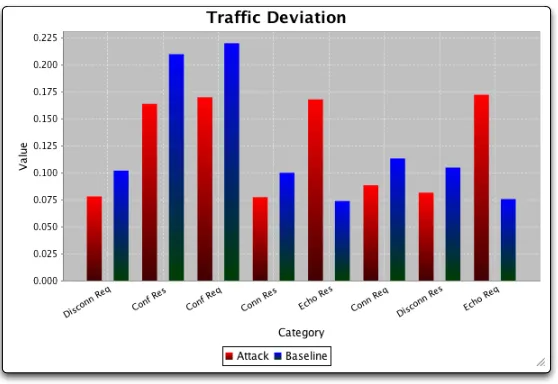
sys-Figure 2.2 : Traffic Deviations Between Attack (BlueSmack) and Baseline Traffic
tem provides the ability to monitor several Bluetooth protocol statistics to analyze attack behavior. Figure 2.2 shows a graph generated from the GUI of the program showing the L2CAP layer Bluetooth traffic captured during a BlueSmack attack com-pared to previously recorded baseline traffic. A BlueSmack attack contains a higher percentage of quality of service messages (echo req and echo res) to implement the attack. Using this data and further analysis, a statistical approach would train the system to classify the behavior as anomalous and intrusive.
Predictive Pattern Generation
Predictive pattern generation presents another method of detecting intrusive be-havior by using an anomaly detection technique. By relying on events that have already occurred, this method attempts to predict future events. The use of patterns can detect behavior unrecognizable by traditional methods and detect and report behavior faster.[42] Additionally, predictive pattern systems can detect attackers at-tempting to influence systems during the training period.[42]
For example, an information theft attack should follow the scan of a vulnerable service. Or a denial of service attack should follow discovery of devices. However, predictive pattern generation may not be able to detect an attack when the hacker has passively gained information to prepare the attack such as in the case of the iPhone MetaSploit attack.
2.2.3
Misuse Intrusion Detection
Misuse detection systems search for known signatures or patterns of unauthorized behavior.[43] While the specific signatures may be benign, they usually serve as le-gitimate indicators of malicious activity. In fact, most modern commercial intrusion detection systems rely on misuse detection.[45] IDSs can detect known patterns with more efficiency than attempting to detect or predict abnormal behavior.[45] Misuse detection systems may employ pattern matching, state transition analysis, or expert systems to detect intrusions.[42]
Pattern Matching
Pattern matching encodes known signatures as patterns. The IDS compares in-coming traffic to the set of signatures to detect an intrusion. Simple to design and build, pattern matching systems detect known attacks. Pattern matching cannot de-tect novel attacks or zero-day attacks. However, pattern matching dede-tection IDSs suffer from signature-evasion techniques. An attacker can craft an attack in such a way to avoid a weak signature.
State Transition Analysis
The state transition analysis model takes state design into account in order to analyze more complex attacks.[43] By maintaining states, the IDS can represent the attack scenario by using a finite state machine. Therefore, any event that leads the network from a safe state to an unsafe state proves intrusive behavior.[45]
Maintaining the state of Bluetooth packets would prove feasible. Since a Bluetooth packet is 625 microseconds long, a device can send only 1600 packets per second. Further, the maximum rate of Bluetooth ranges between 1 MB/s to 3 MB/s, based on the specification.[47] Thus, an intrusion detection system would only require caching of roughly 120 MB to 360 MB of data for a two-minute window. Further, the system can remove several packets, including the majority of radio and baseband traffic to reduce the workload required by the IDS. A modern system could easily maintain this data in physical memory without swapping.
Expert Systems
Expert system models contain a hybrid approach to intrusion detection by com-bining both anomaly and misuse detection models.[42] By encoding known intrusive behavior, the system can look for anomalous behavior. Expert systems attempt to overcome the constraints of misuse-only detection systems by providing the capability of detecting unclassified intrusive behavior.
Depren et al. presented a model utilizing both anomaly and misuse-based de-tection systems.[48] Depren implemented an IDS that contained an anomaly-based detection module and misuse-based detection module. He then correlated the output using a decision output module. The results demonstrated that the hybrid system can benefit from the strengths of both approaches, while negating the weaknesses of each approach.[48]
2.2.4
Realtime Intrusion Detection
of intrusion because of the added mobility of the attackers. Without an immediate response, administrators are not likely to identify and capture the attackers. Thus, the IDS requirements dictate a fast notification of malicious activity.
Li et al. modified a model using the AprioriAll algorithm that correlated multiple alerts.[49] Using his algorithms, he mined attack behavior patterns and make some conclusions. Based on the current sequence of attacks, he predicted the next at-tack and took counter-measures. By predicting atat-tacks, Li’s model proved extremely efficient. However, it required a well-tuned behavior model prior to the attack.
In contrast, Kim et al. presented a model using a sliding window technique.[50] Kim’s model proved to be an efficient event counting method for a predetermined interval. By aggregating alerts that have similar characteristics, using triggers to ex-amine only necessary traffic and avoiding repetitive alerts, Kim’s model demonstrated a less-efficient but more general purpose model.
The use of a sliding window proved to be an efficient method of examining Blue-tooth traffic for malicious patterns. However, selection of a BlueBlue-tooth traffic window size proves critical. If the system selects a traffic window too small, it misses impor-tant traffic that contains data relevant to the attack. If the window is too large, the system runs inefficiently and may drop packets and not recognize malicious activity.
2.2.5
Visualization of Attacks
A major criticism of intrusion detection systems is the high rate of false positives. Displaying the large amount of information collected by a system to an administrator proves challenging. Oline and Reiners explorerd a means of visualizing the aggregate of intrusion detection data.[51] By examining visualized data, administrators can fine-tune intrusion detection systems and reduce the rate of false positives.
2.2.6
Active Response
Finally, this section examines the active response of the implemented Bluetooth IDS. Intrusion detection systems typically contain passive response techniques such as logging and notification. Effective response to a wireless attack could include active countermeasures.[41] Lim et al. proposed a wireless 802.11 IDS with some active countermeasures in 2003.[41] They suggested that a wireless IDS could actively respond to threats against the attacker. Further, they hypothesized that they would have success because in most cases the attackers themselves have configured their network interfaces to authenticate on the network.
Chapter 3
Related Work
This work presents a method of detecting malicious Bluetooth traffic using misuse detection. Therefore, it incorporates a discipline of intrusion detecting and an under-standing of wireless and mobile threats. While intrusion detection is a continually improving 30 year old topic, the study of wireless and mobile threats is a fairly more modern topic. This chapter reviews the related works in intrusion detection, wireless and mobile threat modeling, and current related tools.
3.1
Intrusion Detection
Anderson first described the concept of an intrusion detection system in 1980.[53] He suggested the use of audit trails to detect intrusive behavior such as unautho-rized access to files. Denning then implemented the first generic intrusion detection model in 1987 that detected intrusions by monitoring the audit records of a particu-lar system.[54] For each subject (user), the system kept an audit record of particuparticu-lar services such as access to the filesystem, executables, and system calls. Denning’s model provided a means of detecting intrusive behavior by examining anomalies in the audit records for particular single computer systems.
pat-terns. As processing power increased, further techniques automated intrusion detec-tion to reduce human intervendetec-tion. Gosh and Schwartzbard introduced the use of artificial neural networks in order to detect novel attacks.[56] Their work also com-bined the concept of using both anomaly and misuse detection models to create a hybrid system.
Open source developers have created several popular IDS tools. Roesch created SNORT as a lightweight network intrusion detection tool.[46] The design of SNORT included a packet decoder, preprocessor, and detection engine. SNORT used the libpcap packet sniffer and logger to capture and decode packets. Snort provided the capability to decode and detect intrusive behavior in Ethernet, SLIP, and raw (PPP) data link-protocol packets.[46] The system contained a rules based logging and content pattern matching engine to detect a variety of attacks and probes.
Recent works have discussed the necessity for a wireless intrusion detection system. Intrusion detection in wireless networks proves challenging since wireless IDSs cannot use the same architecture as a network IDS. Lim et. al proposed a wireless IDS that detected threats on the 802.11 protocal.[41] Additionally, the system included the ability for an active response to wireless attackers.[41] In 2004, the US Army awarded a multi-million dollar contract to AirFortress to protect 802.11 networks in use by the military.[57]
3.2
Wireless and Mobile Threat Modeling
Recent works have classified the threats posed against mobile devices. Welch provided an overview and created a taxonomy of wireless threats.[58] Biermann and Cloette examined the necessity for prevention and detection of threats against mobile devices.[59] Finally, Cache and Liu provided a comprehensive source of several wireless threat models, attacks, and implementations.[22]
Bluetooth.[32, 33] Haataja provided a comprehensive model for examining Bluetooth attacks.[17] Finally, the National Institute of Standards and Technology (NIST) doc-umented several the flaws in the security design of the Bluetooth protocol.[40]
Two recent works have attempted to provide a means of modeling and detect-ing particular Bluetooth attacks. Yan et al. developed a model for the growth of Bluetooth works that relied upon Markov Chains.[29] Buennemeyer et al. provided a means of detecting Bluetooth battery depletion attacks using an anomaly detection system that measured the power levels of a particular Bluetooth device.[28]
3.3
Current Related Tools
To capture and decode Blueetooth traffic, Spill and Bittau have provided an ex-cellent means of recording Bluetooth traffic utilizing the Universal Software Defined Radio.[20] Further, they have also provided the means to write firmware for Blue-tooth dongles that perform custom sniffing. A custom firmware solution would prove valuable in the further development of a Bluetooth IDS. Haataja demonstrated the ability for the Lecroy Bluetooth protocol analyzer to record unencrypted and en-crypted Bluetooth traffic.[17]
Combs developed the Wireshark (formerly Ethereal) as a utility to capture and analyze packets.[60] Over 500 authors currently maintain the utility and it allows for the dissection and decoding of hundreds of protocols, including the 802.11 wireless protocols. It also uses the same libpcap decoding library as SNORT. The current maintainers of the tool have already begun working on integrating and translating Bluetooth Host Controller Interface (HCI) packets into a libpcap format.
Chapter 4
Bluetooth IDS Design
4.1
Overview
Packet Decoder Preprocessor IDS Engine
Alert Interface Response System Bluetooth
traffic
Visualization Interface
Figure 4.1 : Design of Bluetooth Intrusion Detection System
4.2
Packet Decoding and Preprocessing
The packet decoder captures Bluetooth packets and prepares the packets for the preprocessor prior to usage by the IDS engine. The packet decoder listens to either a specific frequency or specific piconet in order to capture packets. By synchronizing with the master device on a piconet, the decoder follows the hopping sequence of a particular piconet and exports decoded packets to the preprocessor.
Figure 4.2 : Packet Reassembly by the Preprocessor
Next, the preprocessor reassembles fragmented packets and modifies the data packets to prevent signature evasion techiques. Figure 4.2 depicts the reassembly of two packet fragments back into one logical packet. In addition to reassembly, the preprocessor discards several of the baseband and radio layer packets such as the null, polling, and device ID packets. These packets ensure the radio and baseband layer are established but provide no helpful information to identify known attacks. By reducing these packets, the preprocessor decreases the workload of the IDS engine.
4.3
IDS Engine
This thesis implements a similar engine to SNORT. It has the capability to do pattern matching as well as a set of plug-in modules to analyze and detect more-complex Bluetooth attacks.[46] The author constructed a grammar for rules included in the IDS Engine.
4.3.1
Pattern Matching
alert L2CAP M (SigLen=1; msg="Nokia HeadOverFlow DOS";)
Figure 4.3 : Rule to Detect Malicious L2CAP Header Overflow Attack
The system uses a pattern matching scheme to match malicious packets against a set of user-configurable rules. By matching signatures of known patterns of malicious traffic, the system efficiently detects attacks. Signatures can match a packet against a particular protocol layer, device, and specific fields of each packet.
For example, a signature can match the Signal Length field of an L2CAP layer packet. Figure 4.3 demonstrates a rule to identify a Bluetooth Header Overflow Attack. The rule matches any L2CAP layer packet, originating from a Bluetooth master device, that has a Signal Length of 1 and flags it as a specific attack since the Signal Length field contains an invalid value that causes some Bluetooth devices to reference an invalid memory address.
4.3.2
Plug-in Modules
The IDS uses plug-in modules to detect more-complex attacks that require a stateful inspection of the stream of Bluetooth traffic. Due to the fact that data is organized into a stream by the preprocessor, the plug-in modules can find attacks that use multiple Bluetooth packets. Plug-in modules in this work increase extensibility of the system by allowing users to expand the number of attacks the system can detect. For example, the user can write a plug-in module to detect if any unauthenticated connections to a particular service or channel occurred by examining the stream for the appropriate packets. The user can write a plug-in module to detect the count of a particular packet type in a particular stream of traffic. Additionally, by aggregating several modules that have similar characteristics, the system increases the efficiency of the IDS engine. For further understanding of the plug-in modules implemented in this work, Figure B.5 in Appendix B provides an example of a module used to detect the Bluebugger attack.
4.3.3
IDS Engine Rule Grammar
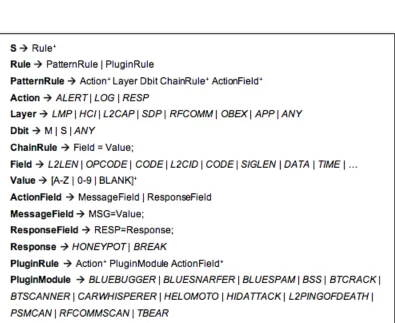
Figure 4.4 lists the grammar for the Bluetooth Intrusion Detection System. The grammar allows the user to detect attacks either through user-specified patterns or the plug-in modules. For each rule the user can alert, log, or direct a specific response. Plug-in modules exist for attacks that require stateful inspection. Each pattern rule consists of a rule header that specifies the layer, direction bit for the rule, and a series of chain rules. Each chain rule consists of a series of rules that match specific fields of the packet. Finally, the last part of the rule is the action field, which directs the specific action for alerting, logging, or action upon matching the rule.
4.4
Visualization Interface
ative ease. Within the field of intrusion detection, previous works have shown the benefit of utilizing visualization to detect attacks. [51, 52] Since the employed system does not have knowledge of zero-day attacks, a visualization tool proves beneficial in allowing the administrator to detect anomalous and potentially malicious behavior. The implemented visualization interface provides details about the deviation between protocol layers, the specific operation codes for the LMP and L2CAP layers, and the activity on the RFCOMM and PSM channels. Figures 4.5 and 4.6 provide examples from the graphical user interface (GUI) of the implemented system.
Figure 4.5 : Visualization of RFCOMM Scan Attack
Figure 4.5 depicts the traffic deviation between protocol layers during an RF-COMM scan attack on a Bluetooth target. The repeated pattern of traffic may give an administrator cause for inspection. Thus, he can drill down and look at the specific distribution of signaling codes on the L2CAP layer. By examining the specific L2CAP signaling codes, the administrator can detect an attacker attempting to repeatedly connect to RFCOMM channels.
Figure 4.6 : Visualization of Bluetooth Channel Activity
RFCOMM connection attempts. Examining all of this information enables the ad-ministrator to suspect that the attacker is attempting an RFCOMM scan of a Blue-tooth target. The next sections discusses the design of signatures to discover such exploits.
4.5
Signature Development
Intrusion detection signatures for exploits can range from simple means, such as checking the header value of a field, to a highly complex stateful inspection or protocol analysis. Many Bluetooth attacks or exploits include purposely modified headers that violate the Bluetooth Core Specifications. Many Bluetooth protocol stacks have been written on the assumption that the specifications would not be violated, hence the particular stacks perform poorly when handling such traffic. Appendix A.1.2 discusses the protocol stack implementations and some of the discovered vulnerabilities. Thus, the IDS signature can look for certain header fields or combinations of values to detect such attacks.
an attack that are not easily evadable by an attacker. Suspicious but legitimate packets are best used in combination with other values to detect an attack. For an example, if a pattern of legitimate Bluetooth traffic causes a particular vulnerability on a particular device, then the IDS signature must take into account the intended device. Since Bluetooth devices perform feature requests that describe the capabilities of each device, the IDS has this information at it’s disposal. Such is the case with the HeloMoto attack that performs an attack by planting a particular file on affected Motorola devices. By verifying that the intended target is a phone with certain feature characteristics, the signature can reduce but not necessarily eliminate false positives. The following sections describe the design for signatures for reconnaissance, denial of service, and information theft attacks. In developing signatures for attacks, the author adhered to two rules for designing signatures.
• Signatures must be based on attack details and if possible strengthened with other characteristics to reduce the rate of false positives.
• Signatures must be written in a manner that an attacker attempting to evade signature would essentially make the attack useless.
4.6
Signatures for Reconnaissance Attacks
This section examines some signatures and plug-ins for detecting reconnaissance attacks. Detecting reconnaissance tools proves invaluable because reconnaissance likely occurs prior to denial of service or information theft attacks. This section describes the signatures for three reconnaissance attacks including Tbear, RFCOMM Scan, and the Bluetooth Stack Smasher (BSS).
4.6.1
Signature of Device Discovery Attack
NAME REQ NAME RES NAME RES INQUIRY TIMEOUT Attacker Target n Time NAME REQ Target n+1 INQUIRY TIMEOUT NAME REQ NAME RES NAME RES NAME REQ TARGET COLLECTION TARGET COLLECTION
Figure 4.7 : Model for Tbear Reconnaissance Attack
request to all targets. The attacker then listens to responses from the inquiry during the inquiry timeout period. The attacker asks for each target’s name by sending a Name Request. Each target responds by sending a Name Result. After the last target response, the attacker again broadcasts a new inquiry. The same pattern repeats itself as the attacker gathers new targets.
To discover such an attack, the IDS detects the pattern for the repeated inquiry requests, followed by repeated name requests to multiple devices. Upon detecting this repeated pattern of traffic over an extended period of time, the IDS then determines the intrusive traffic to be a device discovery reconnaissance attack. Tools such as Tbear and BTscanner implement this attack. However, each tool uses a different time to collect inquiry responses. Therefore, the system can detect both a generic device discovery attack and further classify the tool implementing the attack based on the inquiry timeout value.
4.6.2
Signature of Service Discovery Attack
RFCOMM CONN REQ Attacker Target Time RFCOMM CONN REQ RFCOMM CONN REQ RFCOMM CONN RES RFCOMM CONN REQ RFCOMM CONN REQ vulnerable channel connection requests to
multiple RFCOMM channels
connection requests to multiple RFCOMM channels
Figure 4.8 : Model for a RFCOMM Scan Reconnaissance Attack
similar to a TCP portscan where an attacker may attempt to connect to open TCP ports. Additionally, when the attack succeeds, the target responds with an RF-COMM CONN RES message indicating that the target allowed the attacker access to the channel without authentication or encryption.
Thus, the pattern matches when an attacker repeatedly attempts to connect to multiple RFCOMM channels without requesting any authentication or encryption. A similar attack, PSM Scan, demonstrates the same behavior. However, PSM Scan makes repeated attempts to connect to the PSM services without requesting any authentication or encryption. Thus, the IDS detects the PSM scan in a similar manner by looking for repeated connections to PSM services without any prior authentication or encryption.
4.6.3
Signature of Exploit Discovery Attack
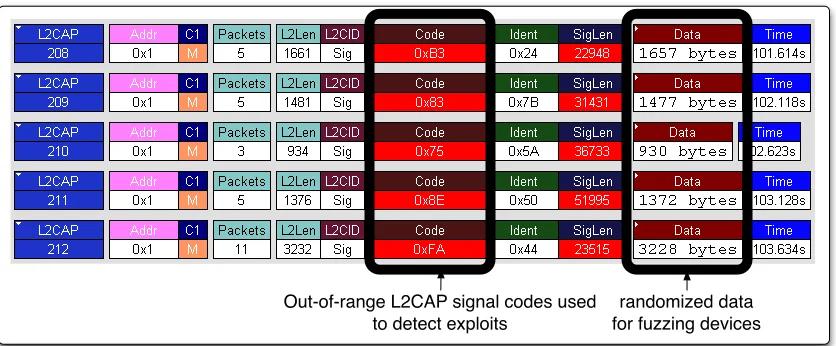
Out-of-range L2CAP signal codes used to detect exploits
randomized data for fuzzing devices
Figure 4.9 : Bluetooth Stack Smasher Reconnaissance Attack
4.7
Detection of Denial of Service Attacks
This section explains the implementations of some of the signatures for denial of service attacks. Specifically, this section examines the BlueSpam, Nasty vCard, Tanya, Nokia N70, and Header Overflow attacks.
4.7.1
Signature of BlueSpamming
First, this section examines the signature of the BlueSpam tool. The BlueSpam tool repeatedly sends unsolicited traffic to targets discovered through the built-in discovery features of Bluetooth. In a BlueSpam attack, the hacker repeatedly connects to a target and initiates an unsolicited object transfer. To detect such an attack, the IDS looks for repeated OBEX transfers and detects the behavior as a BlueSpam attack.
BEGIN:VCARD VERSION:2.1 N:AAAAAAAAAAAAAAAAAAAAAAAAAAAAAAAAAAAAAAAAAAAAA \ AAAAAAAAAAAAAAAAAAAAAAAAAAAAAAAAAAAAAAAAAAAAAAAA \ AAAAAAAAAAAAAAAAAAAAAAAAAAAAAAAAAAAAAAAAAAAAAAAA \ AAAAAAAAAAAAAAAAAAAAAAAAAAAAAAAAAAAAAAAAAAAAAAAAA \ AAAAAAAAAAAAAAAAAAAAAAAAAAAAAAAAAAAAAAAAAAAAAAAAAAAAAAAA;BIALOGLOWY FN:AAAAAAAAAAAAAAAAAAAAAAAAAAAAAAAAAAAAAAAAAAAAA \ AAAAAAAAAAAAAAAAAAAAAAAAAAAAAAAAAAAAAAAAAAAAAAAA \ AAAAAAAAAAAAAAAAAAAAAAAAAAAAAAAAAAAAAAAAAAAAAAAA \ AAAAAAAAAAAAAAAAAAAAAAAAAAAAAAAAAAAAAAAAAAAAAAAAA \ AAAAAAAAAAAAAAAAAAAAAAAAAAAAAAAAAAAAAAAAAAAAAAAAAAAAAAAA;BIALOGLOWY ORG:CHAOSTAL TITLE:MUH TEL;WORK;VOICE; TEL;WORK;FAX; ADR;WORK;ENCODING=QUOTED-PRINTABLE:;;Indonesia LABEL;WORK;ENCODING=QUOTED-PRINTABLE:Indonesia URL;WORK; EMAIL;PREF;INTERNET; REV:20050430T1958490 END:VCARD
In a nasty vCard exploit, the name field (N:) contains more than 245
characters.
Figure 4.10 : Capture of Nasty vCard Attack
string of 245 bytes for the name field in a vCard. Thus, the IDS contains a signature for vCards with name fields equal to 245 bytes and detects the attack.
4.7.2
Signature of Tanya Attack
L2CAP echo request with additional out-of-range signaling command = 0x44
and data field = 4068
Figure 4.11 : L2CAP Packet used in Tanya Attack
To detect the use of these tools, the IDS looks for the specially crafted quality of service messages. The Tanya attack uses a special packet depicted by Figure 4.11 . The packet has an additional out-of-range signaling command with a data field of 4068 bytes. This extra signaling command causes problems in decoding the packet on some devices.
Further, to differentiate between the attacks, the IDS looks at the size of the data field of the messages for Tanya, Symbian Remote Restart, and BlueSmack attacks. Each tool uses different size quality of service messages including 20, 44, and 667 bytes respectively. The different size messages cause vulnerabilities on different vendor devices.
4.7.3
Signatures of Maliciously Formed Bluetooth Packets
specific out-of-range L2CAP signaling code causes exploit
Figure 4.12 : Nokia N70 Denial of Service Attack
To detect maliciously formed bluetooth packets, the IDS uses patterns that match the malicious fields. Figure 4.12 shows an example of a malformed packet that causes denial of service on certain Nokia N70 mobile devices. By sending an L2CAP packet with an code of 7D, an attacker can crash certain Nokia N70 mobile device. 7D does not indicate a reserved code and is therefore not a valid field. When an attacker sends such a packet to a Nokia N70 Device, the IDS matches the known signature and detects the traffic as a specific Nokia N70 attack.
invalid value for signal length causes exploit
Figure 4.13 : L2CAP Header Overflow Denial of Service Attack
L2CAP packet with a malformed Signal Length and also flags it as a specific L2CAP HeaderOverFlow Attack. Furthermore, the IDS detects a similar attack known as HCIDump-Crash that uses a different invalid value for the Signal Length that forces a crash on some versions of the Linux BlueZ protocol stack.
4.8
Detection of Information Theft Attacks
This section explains signatures used in the testbed to detect information theft attacks. Specifically, it looks at the signatures for the Btcrack, CarWhisperer, Blue-Bugger, HIDattack, and Helomoto attacks.
4.8.1
Signature of Btcrack
L2CAP packet with signaling code of "CMD REJ" that causes devices to delete pairing
Figure 4.14 : Capture of a Packet Used to Reset and a Connection for BTCrack
4.14 shows the capture of the specially crafted packet. The signature for a Btcrack attack involves detecting this L2CAP CMD REJ packet followed by immediate pair-ing and mutual authentication of both Bluetooth devices. Such behavior allows an attack access to enough information to execute the Btcrack attack to compromise the linkkey.
4.8.2
Signature of CarWhisperer Attack
AU_RAND SRES START_CRYPT MASTER SLAVE AU_RAND SRES START_CRYPT MASTER SLAVE AU_RAND SRES START_CRYPT
Expected Packet Transmission
CarWhisperer Packet Transmission
Challenge
Response Challenge
Response Challenge
Response Not Mutually Authenticated But Start Encryption
Mutually Authenticated Start Encryption
Figure 4.15 : CarWhisperer Packet Transmission
the target does not authenticate the attacker. The attacker then initiates encryption without performing authentication on the target. After the traffic is encrypted, the attacker connects to the SCO channel and begins receiving the audio links. There-fore, the signature for a CarWhisperer attack includes an incomplete authentication followed by immediate encryption and encrypted SCO traffic.
4.8.3
Signature of BlueBug Attack
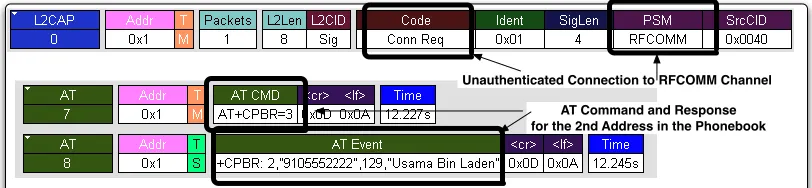
Unauthenticated Connection to RFCOMM Channel
AT Command and Response for the 2nd Address in the Phonebook
Figure 4.16 : BlueBug Attack Traffic Captured by IDS
The signature of a BlueBug attack involves detecting an unauthenticated or un-encrypted RFCOMM connection to a mobile device, followed by RFCOMM-AT com-mands that result in the theft of information from the device. Figure 4.16 demon-strates a BlueBug attack. First, the attacker connects to an RFCOMM channel without authentication. Next, the attacker issues a request for an address in the phonebook. The unsuspecting target device responds with the information.
4.8.4
Signature of HeloMoto attack
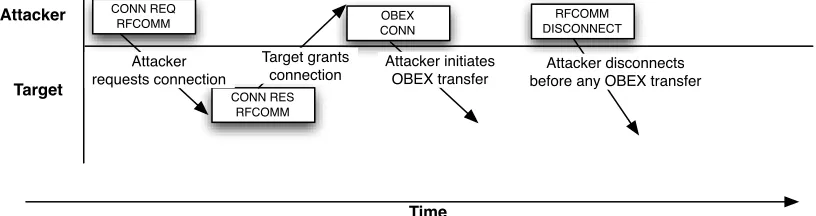
CONN REQ RFCOMM Attacker Target Time OBEX CONN CONN RES RFCOMM Attacker initiates OBEX transfer RFCOMM DISCONNECT Attacker disconnects before any OBEX transfer Attackerrequests connection
Target grants connection
Figure 4.17 : Pattern for HeloMoto Traffic
The HeloMoto attack grants access to an attacker on certain Motorola devices. In order to implement the attack, the hacker initiates an RFCOMM connection to a vulnerable device. The hacker then requests to transfer a file via OBEX. However, the attacker then terminates the connection without completing the OBEX transfer. This uncompleted transfer places the hacker as an authorized user on the vulnerable device. Figure 4.17 depicts the the attack. Thus, to detect the attack, the IDS looks for RFCOMM connections to a mobile phone where an OBEX transfer was requested but not attempted or completed prior to a request to disconnect the connection.
4.8.5
Signature of HIDattack
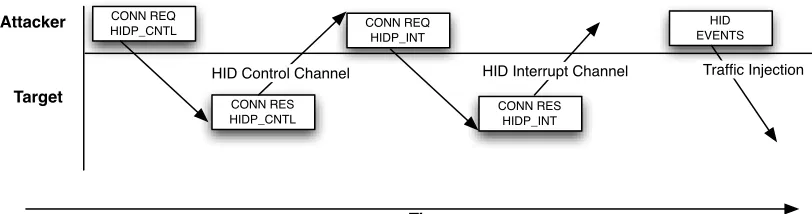
CONN REQ HIDP_CNTL Attacker
Target
Time CONN REQ
HIDP_INT
CONN RES HIDP_CNTL
CONN RES HIDP_INT
HID Control Channel HID Interrupt Channel
HID EVENTS
Traffic Injection
Figure 4.18 : Pattern for HIDattack Traffic
unauthenticated connection to the HIDP control and interrupt Channels followed by a series of HID events. A separate method of implementing the HIDattack relies upon passive capture of Bluetooth traffic. As such, the implemented intrusion detection system cannot detect this. The next section also discusses some of the problems faced in developing the system.
4.9
Response System
Once the system detects an attack signature, it has the capability to respond. This section examines different responses for each attack classification, including re-connaissance, denial of service, and information theft attacks. Directing responses requires close scrutiny to avoid potential reflection attacks. This work does not ad-dress the security of responses but rather suggests methods to prevent, disrupt, and deny detected attacks.
4.9.1
Reconnaissance Response
an attacker obvious knowledge of the boundaries of the wireless intrusion detection system. This thesis implements the response system on a separate machine. By sepa-rating the response system from the IDS engine, the author demonstrates the ability to deploy multiple separate response nodes.
The Bluetooth IDS implementation employs a production honeypot system. Upon detection of reconnaissance probes, the system responds by creating an array of fake devices to overwhelm and distract the attacker. The system creates false targets by randomly generating a name and physical address and flashing the information on a USB Bluetooth dongle. Once the device contains the new address, it responds to inquiries and name requests before burning a new randomly generated name and physical address onto the chipset. By utilizing a limited set of USB dongles, the system creates a mirage of several active Bluetooth devices to distract the attacker from the legitimate Bluetooth devices.
4.9.2
Denial of Service Response
Next, this work implements a means of responding to denial of service attacks by terminating the connection between the attacker and target. A. Wool originally pro-posed the idea of using a false message to terminate legitimate Bluetooth traffic.[32] However, this work uses a similarly crafted message to terminate an attacker. Upon immediate discovery of a denial of service attack, the implemented IDS forges a mes-sage to disrupt communication between the attacker and the target. By sending the attacker an L2CAP CMD REJ message with a forged address of the target, the IDS disrupts ongoing denial of service by the attacker.
4.9.3
Information Theft Response
Chapter 5
Bluetooth IDS Implementation
5.1
Overview
This chapter provides an explanation of the implementation and testing of the Bluetooth intrusion detection system. First, this chapter examines the testbed used to record the metrics of the system. Next, this chapter presents some of the practical problems and limitations faced when constructing the first network-based Bluetooth intrusion detection system.
5.2
Bluetooth IDS Testbed
Defense
Node Attack
Node
Response Node
(3 CSR Bluetooth Radios)
Protocol Analyzer
(12 dBi Yagi Antenna) USB
802.11g WiFi Target Nodes
802.15.1 Bluetooth
(5 Bluetooth Radios)
The testbed for this work included a defense node, response node, attack node, and vulnerable target nodes. Figure 5.1 provides a graphical representation of the experiment. The defense node maintained the responsibility of recording traffic and identifying attacks initiated by the attack node on the target nodes. The response node attempted to disrupt, deny, and prevent Bluetooth attacks as directed by the defense node.
5.2.1
Attack Node
The attack node consisted of a notebook computer running the BackTrack2 live Linux distribution from remote-exploit.org. Built on the Linux 2.6.20 kernel, the distribution includes more than 300 different security tools. Hackers employ Back-Track2 in order to penetrate computer security. The latest release includes exist-ing support for 11 unique Bluetooth attacks. In addition, the testbed software in-cluded the Bluediving (next-generation Bluetooth security tool) available from blue-diving.sourceforge.net. The Bluediving tool includes applications capable of spoofing Bluetooth addresses, generating L2CAP packets, and launching several of the attacks outlined in Section 2.2. Furthermore, the attack software included the tools available from trifinite.org, an organization that hosts a large repository of Bluetooth attack tools. To augment the existing tools, the author wrote several small reconnaissance programs to test the timing and frequency of differing reconnaissance probes for dis-coverable and non-disdis-coverable devices. Appendix C includes version information for all tools used on the attack node. Table 5.1 lists the complete set of attacks launched at the system to test the ability to evaluate the implemented IDS.
5.2.2
Target Nodes
Table 5.2: Targeted Devices
Attack Target Description
BlueBug Attack Nokia 6310 Phone
BlueSnarf Attack Sony Ericsson T68i Phone
CarWhisperer Attack Plantronics M2500 Hands-Free-Audio Headset HeloMoto Attack Motorola v600 Phone
The targets in the experiment included a variety of devices with well documented manufacturer flaws. The experiment conducted reconnaissance and denial of service on a wide array of devices in order to establish a baseline of metrics to evaluate the implemented system. Furthermore, the experiment implemented specific attacks on devices with disclosed vulnerabilities. Table 5.2 outlines some attacks and the respective target devices.
5.2.3
Defense Node
The defense node also included a software application that processed the captured traffic and ran a set of preconfigured rules and plug-in modules to detect Bluetooth-enabled attacks. The software application implemented the design of a Bluetooth IDS engine outlined in Chapter 4. Additionally, the application included a graphical interface that provided the alert and visualization interfaces. Furthermore, the ap-plication provided the security administrator with the capability to further configure rules and write add-on modules for future attack signatures. Appendix B.1 provides more information about the use of the software application.
5.2.4
Intrusion Response Node
To demonstrate the response capabilities hypothesized earlier in this thesis, the author constructed an intrusion response node with the responsibility to distract, deter and terminate Bluetooth attacks. The response node contained three Cambridge Silicon Radio (CSR) chip-based USB Bluetooth dongles. These devices contained flash memory that permitted raw access to the device. As such, the chipsets enabled writing false information to forge the identity of the Bluetooth MAC devices. Forging the Bluetooth address proved essential since it enabled the response node to deploy honeypots with false identities, disrupt ongoing attackers by spoofing an address of an attacker, and prevent future attacks by forging the connection responses of vulnerable targets.
5.3
Practical Problems Faced
5.3.1
Protocol Analyzer Packet Decoding
Next, the hardware analyzer presented a problem in realtime testing of three spe-cific attacks,because of the version of the analyzer. For the research, the author utilized an older Merlin CATC LeCroy Protocol Analyzer that can decode Bluetooth traffic compliant with the 1.1 Core Specification. Later versions of the Analyzer, in-cluding the Merlin II, include support for the succeeding Bluetooth Core Specification. The older analyzer presented a problem as the analyzer required additional specifi-cations to decode a limited set of packets. Specifically, the analyzer required specific channel decoding assignments to understand which protocol layer had generated RF-COMM traffic for some packets during the BlueSnarfer, BlueBugger, and HeloMoto attacks. Thus, the author could only record these attacks manually, because they required the additional input to the analyzer. The author tested the remainder of the attacks autonomously utilizing the scripting language of the analyzers.
5.3.2
Scheduling Between Bluetooth Piconets
Chapter 6
Evaluation of Results
6.1
Overview
This chapter evaluates the implemented intrusion detection system in terms of the Dense Advanced Research Projects Agency (DARPA) metrics for intrusion detections and the implemented response capability.