Behavior of high performance concrete exposed to elevated temperature
under fire load
Moloy K. Chakraborty1,L. R. Bishmoi2 and G. R. Reddy3
1 Technical Officer, Siting & Structural Engineering Division, AERB, Mumbai, India ([email protected])
2 Head, Siting & Structural Engineering Division, AERB, Mumbai, India 3 Head, Seismic & Structural Engineering Section, BARC, Mumbai, India
ABSTRACT
High performance concrete (HPC) possesses characteristics of low diffusivity and low permeability. To simulate the fire response behavior of high performance concrete, a simple model is framed by considering mass diffusivity and permeability as variables like other hydro-thermal parameters. Thermal spalling is considered as a damage parameter to estimate the effect of fire on HPC. A study of diffusivity and permeability with respect to various types of HPC indicates that it is more susceptible to spalling under fire than normal concrete. A comparison of variation of depth of peak pressure below exposed fire surface with varying diffusivity and permeability in HPC and normal strength concrete is also presented.
INTRODUCTION
Behavior of concrete structures exposed to high temperature is an important field of safety research in nuclear industry. Estimation of this behavior requires the study of coupled hydro-thermo-chemo-mechanical parameters.
High performance concrete (HPC) is manufactured with carefully proportioned ingredients and procedures to provide high workability, high strength and high durability. In recent years, HPC is being widely used in nuclear structures, bridges, offshore structures and high-rise buildings due to its enhanced performance attributes compared to conventional normal strength concrete (NSC).
Spalling is a common phenomenon caused by buildup of pore pressure near to surface during rapid heating when concrete structures are exposed to fire. HPC is more susceptible to this phenomenon compared to NSC because of its low permeability and poor diffusivity. Predicting fire performance of HPC in general and spalling in particular is complex due to some additional factors.
To simulate the fire response behavior of HPC in this study, the model is framed by considering variation of mass diffusivity and permeability with other hydro-thermal parameters.
STUDY OF AVAILABLE MODELS
Luikov(1966) was one of the first to study in detail, analytically as well as experimentally, heat and moisture transport in porous materials like concrete, and considered interaction between fluid and heat transfer when moisture evaporates inside the pores of concrete. Luikov proposed coupled differential equations for heat and mass transfer in capillary porous bodies using separate differential equations (Fourier’s equation for heat transfer and Fick’s equation for mass transfer) and their interaction. In the derivation of these equations there are three basic assumptions: (i) Shrinkage due to water mass removal is negligible. (ii) Vapor in capillaries is in thermodynamic equilibrium with liquid. (iii) Masses of vapor and air are negligible.
assessment of the possibility of tensile fracture is made by comparing the computed pore pressure with temperature-dependent tensile strength.
Li et al. (2010) provided a basis for spalling phenomenon in a mathematical representation of the coupled actions of hydro-thermal effects. Temperature and pressure fields are calculated at a given fire temperature. The calculated pore vapor pressures were validated experimentally. The formulation provides relationships between water permeability coefficient or vapor permeability coefficient and the peak pressure at any location within the concrete and compared with the tensile strength to establish whether spalling occurs.
THEORITICAL FORMULATION
Heating of concrete produces significant pore pressure, which causes migration of moisture through concrete and eventual drying. Movement of moisture through concrete may appreciably contribute to heat transfer. The pore pressure depends on available pore space at any time during concrete heating. The material characteristics entering the diffusion problem of moisture and heat transfer are strongly variable. A simplified numerical hydro-thermal model has been developed based on the principles of thermodynamics and conservation of mass with the following assumptions:
(i) Concrete is completely mature, so there is no hydrate reaction in the concrete and concrete is saturated at normal temperature.
(ii) The geometry of solid skeleton of concrete is constant in time. (iii) Concrete is isotropic and homogeneous.
(iv) Pore vapor in concrete is assumed as an ideal gas with negligible mass.
(v) No coupling is considered between mechanical effects of pore pressure and hydrothermal analysis. This is expected to provide conservative prediction of spalling.
(vi) Effects of latent heat and heat of dehydration are not accounted for in the analysis.
It is assumed that heat flux from a standard fire (ISO 834) is incident on one side of a long
concrete wall having small thickness. Temperature field T(x,t) at any time
t along
x-direction
may be expressed as:
( )
(1)
where kT is the effective thermal conductivity and CT is the effective heat capacity of concrete. Temperature dependent values of these parameters are adopted from Lie (1992) model. Q is considered as negative heat source which is the convection and radiation heat loss from fire to wall surface for any temperature T at time t,
( ) (2)
Where h = convection heat transfer co-efficient,
= emissivity factor of radiation source,
= Stefan-Boltzmann constant (5.67 x 10⁻⁸ W/m2.K4). Tf is fire temperature of the standard ISO 834 fire and represented as:(3)
where T
airis the ambient temperature and time
t is in minute. Water inside concrete evaporates
(4)
Flow of vapor mass under pressure gradient is assumed to obey Darcy’s law as per the following
relation:
( )
(5)
Here is mass density of water vapor, D is diffusion co-efficient, K is coefficient of permeability of concrete and P is pressure exerted by vapor mass. Variation of concrete permeability with pressure and temperature is adopted from Gawin et al. (1999),
[
(
)]
(6)Where is permeability of concrete at temperature T, is initial permeability at room temperature, is initial pore pressure (101325 Pa), is initial temperature (°C) and = 0.005, a factor to account for increase in permeability at elevated temperature suggested by Gawin et al (1999).
Pressure field created inside the pores of concrete may also be regarded as a function of temperature (T) and mass density of vapor (w) as per state equation of an ideal gas:
(7)
where R is the universal gas constant and M is the molar mass (0.018 kg/mol for water vapor).
Spalling of concrete is assumed to occur if the resulting pore pressure exceeds the
temperature-dependent tensile strength [
Dwaikat & Kodur (2009)].
(8)
where is the porosity of concrete, and is the tensile strength of concrete at temperature T. Variation of tensile strength of concrete as a function of temperature is adopted from Dwaikat & Kodur (2009).
In general HPC is manufactured with the requirements of high durability and high strength, consequently it possesses low permeability and low diffusivity. High temperature behavior of HPC is modeled by adopting different values of diffusion co-efficient from Issa, M.A. and Khalil, A. (2010).
Numerical approximation by finite difference method
Based on the above theoretical formulation a numerical model is proposed for predicting the behavior of high performance concrete. It involves discretization of section of a 250mm thick concrete wall into a number of elements and calculation of pore pressure for each element exposed to varying temperature with time. The pore pressure calculations are carried out at various time steps using forward difference method as per the discretization shown in figure 1. Once the pore pressure in concrete is calculated, it is compared against the temperature-dependent tensile strength of concrete at each time-step. When pore pressure exceeds tensile strength of concrete, spalling occurs.
derivative of temperature versus time can be expressed in an explicit forward finite difference approximation scheme to obtain the temperature field with given initial and boundary conditions.
Figure 1. Discretization in time and space domain
Vapor mass density (w) at different nodes over various time-steps is determined from equation (4) by applying forward finite difference method and then pore pressure (P) from equation (5). The vapor pressure at the surface boundary is assumed to be constant equal to initial vapor pressure (P0).
DISCUSSION OF RESULTS
The analysis was carried out by using the material properties reported in literature (NIST, 2010). The results of numerical studies at specified parameters like distribution of peak value of temperature, mass density of vapor and pore pressure for initial transients of HPC exposed to fire are as follows.
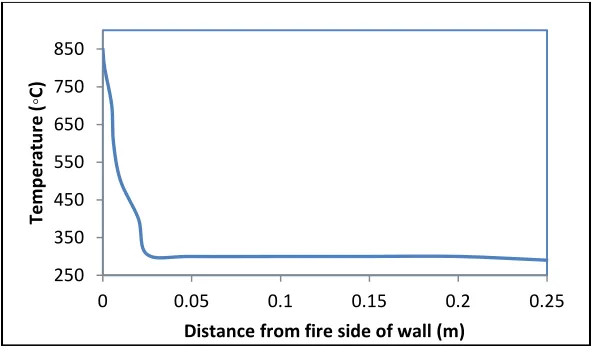
Poor thermal conductivity of concrete yields a steep temperature gradient adjacent to the heated surface of concrete wall (Figure 2).
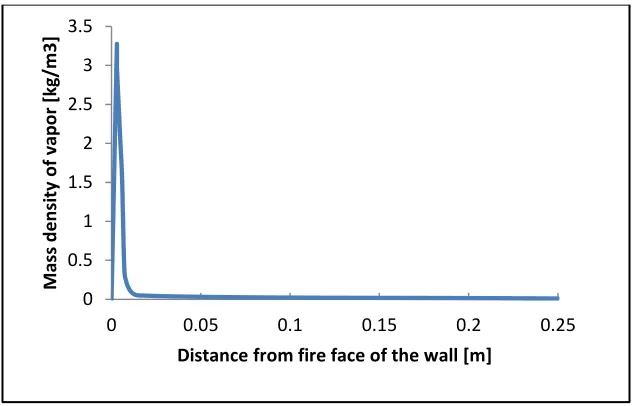
Heating of concrete enhances vapor migration inside concrete. But rate of transfer of vapor mass is smaller than rate of evaporation. This results in accumulation of large vapor mass closer to the fire exposed surface and subsequent build up of steep vapor pressure gradient near the surface (Figure 3).
250 350 450 550 650 750 850
0 0.05 0.1 0.15 0.2 0.25
Tem
p
e
ratu
re
(
◦C)
Distance from fire side of wall (m)
L Space
Ti
m
e
Boundary Nodes
Δx
i, n+1
i, n
i, n-1
i-1, n i+1, n
Figure 2. Distribution of peak temperature value inside concrete wall
Figure 3. Distribution of vapor mass density inside concrete wall
Figure 4. Variation of peak pore pressure inside concrete wall
Due to moisture evaporation the water content in the surface zone of the wall decreases to a very low value. At this point intensive evaporation takes place, increasing the pore vapour pressure to a maximum value (figure 4). If this value is more than the tensile strength of concrete for the particular temperature then thermal spalling commences
A comparison of the temperature and pore pressure predictions from the model with published data [Gawin et al. (2011)] indicates that the trend of predicted temperatures is roughly in agreement with the published data within the temperature range considered in this study. The discrepancies might be attributed to differences in high-temperature behavior of material properties of concrete such as thermal conductivity, specific heat, permeability etc which are
0 0.5 1 1.5 2 2.5 3 3.5
0 0.05 0.1 0.15 0.2 0.25
M
ass d
e
n
si
ty
o
f vapo
r
[kg/m
3]
Distance from fire face of the wall [m]
0 1 2 3 4 5 6 7 8
0 0.05 0.1 0.15 0.2 0.25
Distance from fire face of the wall [m]
P
or
e
P
re
ss
ur
e
[
M
P
complicated and coupled to each other. Moreover these properties are highly dependent on the type of concrete mix and the grades of concrete.
Comparing results of present study for HPC with those of Gawin et al.(2011) for NSC, it is found that the maximum rise in pore pressure in NSC is lower than that in HPC for same duration of fire exposure. The reason may be attributed to lower values of diffusivity and permeability in HPC. Vapor generated from heating by fire takes longer time to diffuse further inside HPC from fire end of the wall. Low value of permeability induces slow movement of vapor inside the pores of HPC. So vapor created near to the fire exposed surface of wall starts accumulated in HPC at a faster rate than NSC. This renders HPC more vulnerable to spalling phenomenon than NSC.
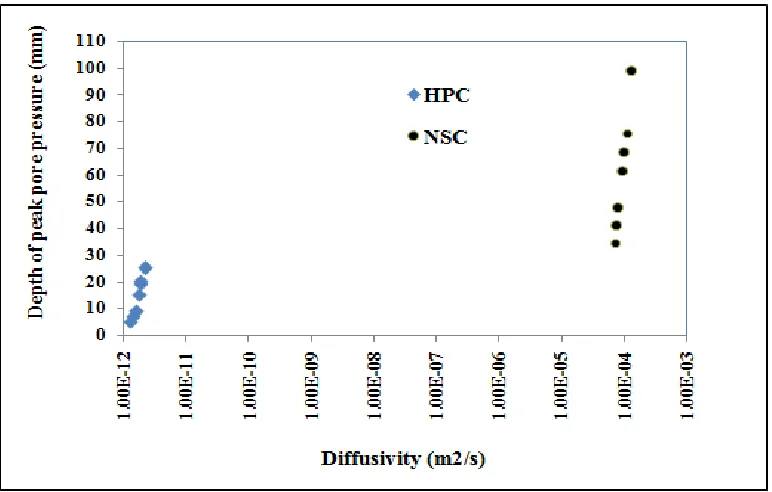
Studies were conducted with variable diffusivity and permeability of HPC and the results were compared with the results of Lie et al. (2010) for NSC to capture the difference in their thermal behavior. The comparison is depicted in Figures 5 and 6 in terms of maximum pore vapor pressure and its depth of occurrence from fire exposed surface for different values of diffusivity and permeability for the prediction of phenomenon of thermal spalling. It is seen from Figure 5 that low diffusivity of HPC causes peak pore pressure developed near to the fire exposed surface. Low permeability of HPC has also the same effect on occurrence of peak pore pressure as depicted in Figure 6.
Figure 5. Comparison of variation of depth of peak pore pressure with diffusivity in NSC (Li et al. 2010) and HSC (current study)
Figure 6. Comparison of variation of depth of peak pore pressure with permeability in NSC (Li et al, 2010) and HSC (current study)
CONCLUSION
A simple model is used to simulate fire induced damage in terms of thermal spalling in HPC. This model estimates the effect of variation of concrete permeability and diffusivity on concrete temperature, pore pressure and extent of thermal spalling. There is a difference in the behavior of HPC exposed to fire as compared to NSC, which is attributable to very low values of diffusivity and permeability of HPC. Further work is required to undertake parametric studies to quantify critical factors for more realistic prediction of behavior of HPC exposed to fire.
REFERENCES
Dwaikat, M.B., Kodur, V.K.R., (2009). “Hydrothermal model for predicting fire-induced spalling in concrete structural systems”. Fire Safety Journal 44, 425–434.
Gawin, D., Majorana, C.E., Schrefler, B.A., (1999). “ Numerical analysis of hygro-thermic behaviour and damage of concrete at high temperature”. Mechanics of Cohesive–Frictional Materials 4, 37–74. Gawin, D., Pesavento, F., Schrefler, B.A., (2011). What physical phenomena can be neglected when
modeling concrete at high temperature? A comparative study. Part 1: Physical phenomena and mathematical model. International Journal of Solids and Structures. 48(2011) 1945-1961.
ISO (1975), Fire Resistance Tests- Elements of Building Construction, ISO 834-1975, International Organization for Standardization.
Issa, M. A. and Khalil, A. (2010). “Diffusivity and permeability of high performance concrete for bridge decks.” PCI Journal 82-95, Chicago.
Li, M., Wu, Z., Kao, H., Qian, C. and Sun W. (2010). “Calculation and analysis of pore vapor pressure of concrete exposed to fire.” International Journal of the Physical Sciences Vol. 5(8), pp. 1315-1323.
Lie, T.T. (1992), Structural Fire Protection, Manual 78, Reston, Va.: American Society of Civil Engineers.
Luikov, A.V., (1966). “Heat and Mass Transfer in Capillary Porous Bodies.” Pergamon Press, London. NIST Technical Note 1681. (November 2010). Best practice guidelines for structural fire resistance