This is a repository copy of
Phosphate availability regulates root system architecture in
Arabidopsis
.
White Rose Research Online URL for this paper:
http://eprints.whiterose.ac.uk/185/
Article:
Williamson, L C, Ribrioux, S P C P, Fitter, A H et al. (1 more author) (2001) Phosphate
availability regulates root system architecture in Arabidopsis. Plant Physiology. pp.
875-882. ISSN 0032-0889
[email protected] https://eprints.whiterose.ac.uk/ Reuse
Items deposited in White Rose Research Online are protected by copyright, with all rights reserved unless indicated otherwise. They may be downloaded and/or printed for private study, or other acts as permitted by national copyright laws. The publisher or other rights holders may allow further reproduction and re-use of the full text version. This is indicated by the licence information on the White Rose Research Online record for the item.
Takedown
If you consider content in White Rose Research Online to be in breach of UK law, please notify us by
Architecture in Arabidopsis
1
Lisa C. Williamson, Sebastien P.C.P. Ribrioux, Alastair H. Fitter, and H.M. Ottoline Leyser* Department of Biology, University of York, Box 373, York YO10 5YW, United Kingdom
Plant root systems are highly plastic in their development and can adapt their architecture in response to the prevailing environmental conditions. One important parameter is the availability of phosphate, which is highly immobile in soil such that the arrangement of roots within the soil will profoundly affect the ability of the plant to acquire this essential nutrient. Consistent with this, the availability of phosphate was found to have a marked effect on the root system architecture of Arabidopsis. Low phosphate availability favored lateral root growth over primary root growth, through increased lateral root density and length, and reduced primary root growth mediated by reduced cell elongation. The ability of the root system to respond to phosphate availability was found to be independent of sucrose supply and auxin signaling. In contrast, shoot phosphate status was found to influence the root system architecture response to phosphate availability.
The root systems of plants show highly plastic development. This plasticity is possible because root systems develop by the continual propagation of new meristems. Factors that affect the initiation and ac-tivity of the meristems will clearly have a large effect on the three dimensional pattern of roots in space: root system architecture (RSA). RSA is greatly influ-enced by the soil environment and especially the availability and distribution of nutrients (Thaler and Pages, 1998). For example, the root systems of many species are able to respond to localized regions of high nutrient supply by proliferating or elongating root branches into these nutrient-rich patches (Drew, 1975; Robinson, 1994). Not all plant species respond in the same fashion to heterogeneity in soil nutrient supply (Farley and Fitter, 1999) and not all nutrient ions elicit the response (Drew, 1975). Furthermore, the overall architecture of the root system can be affected by the nutrient status of the plant, such that in nutrient-limiting conditions the RSA may be very different from the RSA in nutrient-rich environments (Robinson, 1994).
The developmental mechanisms by which plants modify their RSA in response to soil nutrients are unknown. However, important advances have been made recently in understanding the mechanism by which nitrate can act in this respect (Zhang and Forde, 1998; Zhang et al., 1999). Growth of Arabi-dopsis on uniformly high nitrate (10 mm)
sup-presses lateral root development. In contrast, when plants are grown on low levels of nitrate (10 mm),
exposure of a section of the primary root to high nitrate stimulates lateral root production
specifi-cally in that area. The main effect of nitrate appears to be on the rate of lateral root elongation rather than on lateral root initiation (Zhang and Forde, 1998). It is striking that the elongation rate of the primary root is identical on 10mmand 10 mmnitrate
and the metabolism of nitrate is not required for the architectural changes because mutants severely de-ficient in nitrate reductase activity are still able to respond (Zhang and Forde, 1998). This suggests that there are specific nitrate signaling pathways con-trolling lateral root elongation, a hypothesis sup-ported by the isolation of a MADS box transcription factor called ANR1 that appears to be involved in nitrate signaling. Plants in which ANR1 has been down regulated by antisense mRNA expression or by cosuppression show normal root branching on uniform nitrate but are unable to elongate lateral roots in response to a localized patch of high nitrate (Zhang and Forde, 1998). In addition, the auxin-resistant mutant, axr4, appears to be unable to re-spond to a localized supply of nitrate, suggesting a role for auxin in mediating the nitrate signal (Zhang et al., 1999). These data have led to a model in which a shoot-derived signal suppresses lateral root growth when nitrate is abundant, but when nitrate is limiting, nitrate perceived at the lateral root tip stimulates elongation (Zhang and Forde, 1998).
Given the high mobility of nitrate in soil it is perhaps surprising that nitrate supply has such a dramatic effect on RSA because a low root density is sufficient to capture all the nitrate in a volume of soil (Robinson, 1996). However, root proliferation in a nitrogen-containing patch has been shown to be advantageous for plants in competition (Hodge et al., 1999). In contrast, phosphate is often the limiting nutrient for plant growth because of its low mobility in soil. Therefore, it is not surprising that phosphate can have a profound effect on RSA. In barley (Hor-deum vulgare), phosphate-rich patches have been
1This work was supported by the Nature and Environment
Research Council and by the Biotechnology and Biological Science Research Council of the United Kingdom.
shown to promote lateral root development in phosphate-starved plants (Drew, 1975). Bean (Phaseolus vulgaris) plants grown on low phosphate change the angle of growth of basal roots in favor of outward rather than downward growth (Bonser et al., 1996). This effect depends on low shoot phos-phate, rather than a local root response, because no change in angle was observed in split-root system experiments where half the roots were grown on low phosphate and half on high phosphate (Bonser et al., 1996). Because soil phosphate availability al-most invariably decreases with soil depth, the shal-low angle of root growth of phosphate-deficient plants can be viewed as an adaptive response allow-ing increased phosphate uptake. This hypothesis is supported by the observed correlation between the ability of bean cultivars to reduce root angle in low phosphate and yield in phosphate-poor soils (Bon-ser et al., 1996).
The work with nitrate has clearly demonstrated the value of Arabidopsis as a model for understand-ing the control of RSA. The effects of phosphate availability on the RSA of Arabidopsis are largely unknown. The characterization of these effects could be of great value because of the wealth of tools available for studying phosphate uptake and RSA available in Arabidopsis. Two phosphate accu-mulation mutants have been described: pho1 and pho2. Inpho1mutants, loading of phosphate into the xylem appears to be blocked so that shoot phos-phate is 5-fold lower in 21-d-old plants when com-pared with the wild type (Poirier et al., 1991). In contrast,pho2mutants overaccumulate phosphate in the shoot so that, when the plants are grown in well-fertilized conditions, shoot phosphate is 4-fold higher in 21-d-old plants when compared with the wild type (Delhaize and Randall, 1995). The concen-tration of phosphate in 21-d-old roots of both mu-tants is not significantly different from wild type (Delhaize and Randall, 1995). Therefore, thepho mu-tants provide an excellent opportunity to study the effects of shoot phosphate levels on RSA. The existence of a large collection of auxin-related mu-tants similarly can be used to test whether any phosphate-induced RSA changes are mediated by auxin. Addition of exogenous auxin inhibits pri-mary root elongation but promotes lateral root
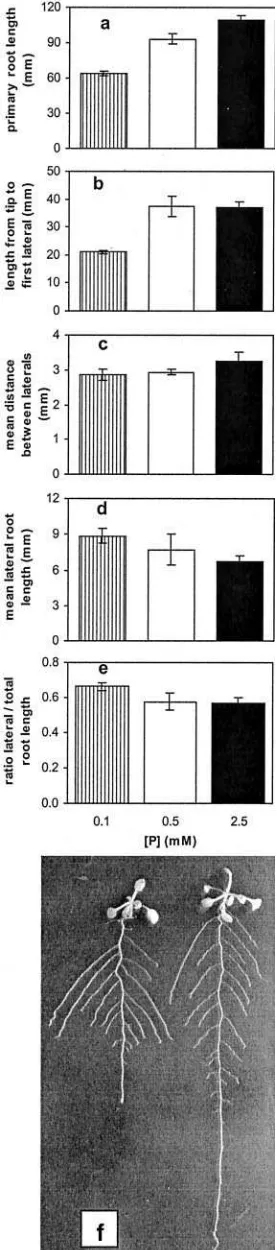
for-Figure 1.The effect of phosphate availability on RSA. Wild-type Columbia seedlings were grown for 14 d on initial concentrations of
0.1, 0.5, and 2.5 mM phosphate without added Suc on vertically oriented agar dishes. Data are given for the length of the primary root axis (a), the distance from the primary root tip to the first (nearest) lateral root (b), the average distance between the lateral roots (c), the average length of the lateral roots (d), and the distribution of growth between primary and lateral roots (e). Values shown represent mean of six seedlings 6 SE. The overall effect is of redistribution from primary axis growth to lateral growth as shown in f, a photograph of 10-d-old plants grown on 0.1 mM phosphate (left) and 2.5 mM phosphate (right) on 1% (w/v) Suc. The root systems have been spread to show their architecture.
Williamson et al.
[image:3.587.93.232.81.708.2]mation. Consistent with this, theaux1,axr4, andaxr1 auxin-resistant mutants have all been shown to have long primary roots but a reduced number of lateral roots (Lincoln et al., 1990; Hobbie and Estelle, 1995). These observations illustrate the importance of auxin in the regulation of RSA.
Here, we describe the effects of phosphate avail-ability on Arabidopsis RSA. The involvement of shoot phosphate and auxin in mediating the ob-served changes are tested using mutants in phos-phate uptake and auxin response.
RESULTS
The Effect of Phosphate Availability on RSA
Wild-type Arabidopsis seeds (ecotype Columbia) were germinated on vertically oriented petri dishes containing agar-solidified nutrient solutions with a range of phosphate availibilities. After 14 d their RSA was examined. The effect of increasing phosphate availability was to increase the length of the primary root axis (Fig. 1a), increase the distance from the pri-mary root tip to the first lateral root (Fig. 1b), increase the distance between lateral roots (Fig. 1c), and re-duce the length of lateral roots (Fig. 1d). Hence, low phosphate leads to a redistribution of growth from the primary root to lateral roots (Fig. 1f). The dose response relationships for these effects were not identical. In particular, the distance from the tip to first lateral root was not significantly different on 0.5 and 2.5 mm phosphate but was greatly reduced on
0.1 mm phosphate. In contrast, the mean distance
between the lateral roots was not significantly differ-ent on 0.1 and 0.5 mmphosphate. Although all these
trends were reproducible in many experiments, the increases in primary root length and in the distance between the primary root tip and first lateral root were the most robust responses to increasing phos-phate, with the other RSA responses being appar-ently more variable between experiments (data not shown).
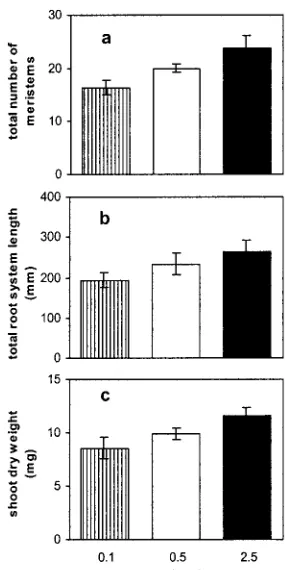
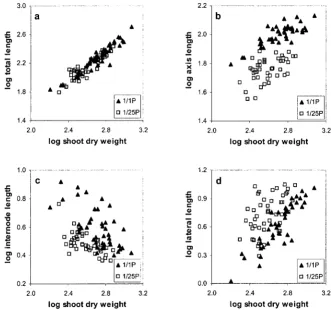
The plants growing on high phosphate were more vigorous than those on lower phosphate. The total number of root branches (Fig. 2a) and total root system length (Fig. 2b) were greater on higher phos-phate and an increase in shoot dry weight was ob-served (Fig. 2c). It could be argued then that the observed architectural differences simply reflect dif-ferences between smaller and larger root systems. This also could explain the variability between ex-periments mentioned above because in some experi-ments the plants were more vigorous than in others. To test this hypothesis we examined the relationship between shoot dry weight and total root length, pri-mary root length, lateral root length, and lateral root density (Fig. 3). Data from four independent experi-ments, in which plants were grown as described above on 2.5 mm and 0.1 mm phosphate, were
pooled. As expected, all the RSA parameters vary
with shoot dry weight (Fig. 3). Total root length (Fig. 3a), primary root length (Fig. 3b), and lateral root length (Fig. 3d) all increase as shoot dry weight in-creases. In contrast, the mean distance between lat-eral roots decreases with increasing shoot dry weight (Fig. 3c). However, these graphs clearly demonstrate that although the relationship between shoot dry weight and total root length is unaffected by phos-phate availability, growth on reduced phosphos-phate re-sults in reduced primary root length, reduced inter-node length, and increased lateral root length for any one shoot dry weight. Therefore, these data confirm that growth on reduced phosphate results in a redis-tribution of root growth from the primary root to lateral roots.
The Effect of Phosphate Availability on Cell Length at the Primary Root Tip
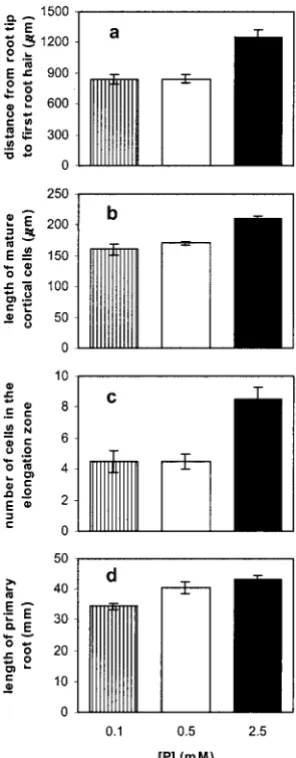
[image:4.587.354.497.390.676.2]To investigate the cellular basis for the reduction in primary root length, the primary root tips of plants grown on a range of phosphate availabilities were examined. The root tip is classically divided into zones (Dolan et al., 1993). Immediately behind the root cap and root cell initials is a zone of cell division, followed by a zone of elongation and then a zone of
differentiation, which is most clearly defined by the differentiation of root hairs. The total length from the tip of the root cap to the first root hair was found to be significantly longer in plants grown on 2.5 mm
phosphate compared with either 0.5 or 0.1 mm
phos-phate (Fig. 4a). The lengths of mature cortical cells from immediately above the differentiation zone were found to be significantly longer in roots grown on 2.5 mmphosphate compared with those grown on
the lower phosphate availabilities (Fig. 4b). This dif-ference, which involves a 30% increase in mature cortical cell length between 0.1 and 2.5 mm
phos-phate, mirrors the change in primary root length (Fig. 4d) across those two phosphate levels (26%). Cell files were traced toward the tip from the first root hair and the number of cells in the elongation zone was determined. Cells were deemed to have entered the elongation zone when their length exceeded 35
mm because this length appeared to mark the
begin-ning of the elongation phase. Roots growing on the highest phosphate availability had significantly more cells in the elongation zone (Fig. 4c).
Photosynthate Availability and RSA Responses to Phosphate
The observed changes in RSA might be controlled by a variety of factors. One hypothesis is that on low phosphate, photosynthate is redistributed away from the primary root and into lateral roots. To test this hypothesis, 1% (w/v) Suc was added to the medium so that all root tips would receive a ready supply of photosynthate. This had no effect on the root system responses to phosphate (Fig. 5). Primary root length decreased with decreasing phosphate availability (Fig. 5a) without any significant change in total root system length (Fig. 5b), illustrating the redistribution of resources from primary to lateral roots.
RSA Responses in thepho2Phosphate Uptake Mutant
[image:5.587.127.459.76.386.2]Phosphate-induced changes in RSA could be af-fected by the phosphate status of the shoot. To test whether phosphate accumulation in the shoot influ-ences root RSA, the RSA of the phosphate overaccu-mulating mutant, pho2, was examined on low and
Figure 3. Comparison of the effect of different phosphate availabilities on the relationship between RSA and shoot dry weight. Log:log plots are presented for total root length against shoot dry weight (a), primary root length against shoot dry weight (b), internode length against shoot dry weight (c), and lateral root length against shoot dry weight (d). Analysis of covariance shows that log shoot dry weight varies significantly with each RSA parameter (degrees of freedom 1, 86;P,
0.001). Phosphate availability has no significant effect on the relationship between shoot dry weight and total root length (a: F1,8653.25 andP.0.075), but a highly significant effect on the relationship between shoot dry weight and all the other
RSA parameters (b: F1,865266 andP,0.001; c: F1,86572.0 andP,0.001; and d: F1,86543.5.0 andP,0.001).
Williamson et al.
high phosphate. Phosphate overaccumulation inpho2 shoots was previously only verified in plants grown on agar in the phosphate range between 0.2 and 10 mm(Delhaize and Randall, 1995). Phosphate levels in
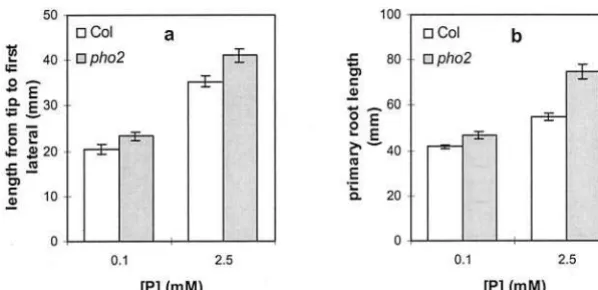
the roots ofpho2mutants are wild type (Delhaize and Randall, 1995). At our highest phosphate level, which lies within this range, the RSA ofpho2and wild-type roots differs significantly, with pho2showing an ex-aggerated response (Fig. 6). At high (2.5 mm)
phos-phate, compared with wild type, thepho2plants have a longer primary root and a longer distance from the primary root tip to the first lateral root. These differ-ences are greatly reduced at 0.1 mmphosphate.
RSA Responses in Auxin Signaling Mutants
The architecture of plants growing on low phos-phate is reminiscent of plants treated with the
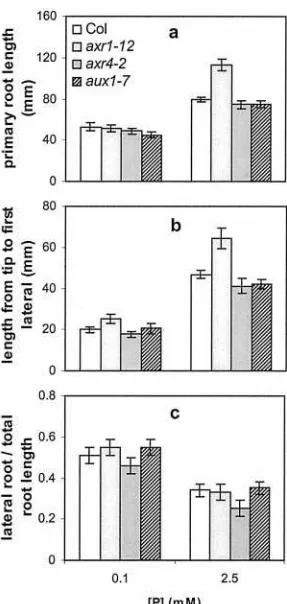
hor-mone auxin, which stimulates lateral root formation and inhibits primary root growth. To test whether auxin is involved in mediating the RSA changes in response to phosphate levels, the RSA of auxin-resistant mutants was studied on low and high phos-phate. Theaxr1–12,axr4–2, andaux1–7mutants were used because these mutations have previously been shown to affect RSA (Lincoln et al., 1990; Hobbie and Estelle, 1995). In our growth conditions RSA differ-ences were most striking for axr1–12, which com-pared with the other genotypes showed longer pri-mary roots and a longer distance from the root tip to the first lateral root when grown on 2.5 mm
phos-phate (Fig. 7). At this phosphos-phate level, consistent with previous reports, all the mutant genotypes showed a reduced lateral root density compared with wild type (data not shown; Lincoln et al., 1990; Hob-bie and Estelle, 1995). Despite these differences in RSA, when the auxin mutant plants grown on low phosphate were compared with those grown on high phosphate, the changes in RSA observed were simi-lar to those observed in wild-type plants (Fig. 7). At the lower phosphate level, all genotypes showed a similar increase in the ratio of lateral to primary root, indicating that in all genotypes, low phosphate fa-vors lateral root growth over primary root growth.
DISCUSSION
We have shown that phosphate availability clearly affects RSA in Arabidopsis. Lower phosphate favors lateral root growth over primary root growth by reducing primary root elongation, increasing lateral root elongation, and increasing lateral root density. It is interesting to compare this redistribution of growth with the changes in angle of growth observed in bean plants grown on low phosphate (Bonser et al., 1996). In both cases, the changes in growth pattern result in root biomass being concentrated near the soil surface. Because phosphate availability decreases with soil depth, these changes are likely to improve phosphate acquisition.
[image:6.587.88.236.76.455.2]The phosphate-dependent changes we observed in Arabidopsis RSA are different from those observed with nitrate. Varying nitrate availability over several orders of magnitude apparently has no effect on primary root elongation or on lateral root spacing (Zhang et al., 1999). The effects of nitrate observed by Zhang et al. (1999) are entirely on lateral root elon-gation, with uniformly applied high nitrate levels being inhibitory. In contrast, phosphate appears to influence all these variables. The differences in re-sponse may reflect different adaptive strategies for nitrate foraging because nitrate is much more mobile than phosphate. Therefore, RSA responses to phos-phate may reflect a phosphos-phate-foraging strategy, whereas RSA responses to nitrate distribution may reflect improved nitrate acquisition in competition with neighboring plants (Hodge et al., 1999).
The mechanisms regulating the redistribution of growth in response to phosphate availability are un-known. We have shown that redistribution occurs when plants are grown on 1% (w/v) Suc, indicating that redistribution of photosynthate is unlikely to direct RSA changes. Auxin similarly does not appear to be directly involved because the RSAs of three different auxin resistant mutants, axr1, aux1, and axr4, appear to respond normally to changes in phos-phate availability. This is in contrast to the role of the AXR4 gene in the root response to a patch of high nitrate because theaxr4mutant is apparently unable to increase the growth of lateral roots in such nitrate patches (Zhang et al., 1999).
Shoot phosphate homeostasis appears to have a role in regulating RSA because RSA and changes in RSA are affected in the shoot phosphate overaccu-mulator pho2. pho2 mutant plants have been previ-ously shown to overaccumulate phosphate in the shoot when phosphate is plentiful. Shoot phosphate was not measured in this study so the correlation between shoot phosphate and RSA can only be im-plied from the observations of Delhaize and Randall (1995). However, there is good evidence for a similar role for shoot nitrate concentration (Scheible et al., 1997; Zhang et al., 1999). In tobacco (Nicotiana taba-cum) plants, growth on low nitrate promotes root growth and there is a strong inverse correlation be-tween shoot nitrate levels and root growth (Scheible et al., 1997). If tobacco plants are grown in a split-root
system with half the roots exposed to high nitrate and half to low nitrate, then the stimulatory effect of low nitrate is not observed in the low nitrate-treated roots, despite the fact they accumulate only low lev-els on nitrate (Scheible et al., 1997). This suggests that shoot nitrate status regulates root growth responses to exogenous nitrate. It is interesting that the sup-pression of root growth by high nitrate can be over-ridden by growth on low phosphate (Scheible et al., 1997).
[image:7.587.235.545.74.224.2]As well as the evidence for signaling from the shoot, it is possible that the phosphate-dependent changes in growth rate of the primary and lateral roots are regulated locally at the root tips. Measure-ments of mature cortical cells at the primary root tip indicate that cell elongation decreases with decreas-ing external phosphate availability. This correlates with a decrease in the number of cells in the elonga-tion zone and a corresponding decrease in the dis-tance from the root tip to the first root hair. Not only is root hair differentiation accelerated on low phos-phate, but also root hair elongation is stimulated (Bates and Lynch, 1996). Hence, at a cellular level, as for the whole root system, lateral growth is favored over elongation of the primary axis. In the case of root hair elongation, however, there is some evidence that auxin is involved in mediating the phosphate effect because auxin antagonists were found to in-hibit low phosphate-induced root hair elongation (Bates and Lynch, 1996).
Figure 5. The effect of phosphate availability on RSA in plants grown on 1% (w/v) Suc. The graphs show primary root length over time (a) and total root system length over time (b). Val-ues shown represent the mean of nine to 10 seedlings6SE.
Figure 6. Comparison of the root architectures of wild-type Columbia (Col) and thepho2 mu-tant under two different phosphate availabilities and 1% (w/v) Suc. The graphs show the distance from the primary root tip to the first (nearest) lateral root (a) and primary root length (b). Val-ues shown represent the mean of seven to 10 seedlings6SE.
Williamson et al.
[image:7.587.237.536.586.731.2]As mentioned above, varying the level of nitrate appears to have little effect on the rate of primary root growth, but nitrate can affect the rate of lateral root elongation. Cellular level measurements indicate that this response to locally high nitrate is accompa-nied by an increase in size of the division zone of the meristem, whereas cell length is not greatly affected (Zhang et al., 1999). This contrasts with the effects of varying phosphate levels reported here, which indi-cate changing external phosphate availability can significantly change cell elongation at the primary root tip.
In addition to the contrasting effects on cell behav-ior, phosphate and nitrate availabilities affect the primary root and lateral roots completely differently. Low nitrate has no effect on primary root growth but promotes lateral root growth (Zhang and Forde, 1998). Therefore, it seems likely that the primary site for nitrate action is at the lateral root tips. In contrast, low phosphate inhibits primary root growth and pro-motes lateral root growth. It is possible that the elon-gation of the lateral roots is a secondary response to the reduction in primary root growth. In this case, the primary site for phosphate action would be the pri-mary root tip. However, this inhibition of pripri-mary
root growth by low phosphate cannot be caused by direct phosphate starvation because the levels of phosphate are clearly sufficient to allow vigorous growth of the lateral roots.
In conclusion, the data presented here suggest that the cells of root tips are highly sensitive to external phosphate availability and to shoot phosphate status. They alter their growth rate in a cell type-specific manner, which may improve phosphate acquisition. However, both the adaptive significance of these changes and the mechanism by which they are achieved remain to be established.
MATERIALS AND METHODS
Seed
Seed from thepho2mutant was kindly provided by Dr. Emmanuel Delhaize (Commonwealth Scientific and Indus-trial Research Organization, Canberra, Australia). All the lines used are in the Columbia genetic background.
Plant Growth Conditions
Arabidopsis seedlings were grown under sterile condi-tions on vertical 10-cm2
square petri dishes (Sterilin, Stone, UK) containing 75 mL of Arabidopsis salts (ATS) agar medium (Wilson et al., 1990). ATS agar contains 5 mm
KNO3, 2.5 mmKH2PO4 buffered with 2.5 mmK2HPO4to
pH5.5, 2 mmMgSO4, 2 mmCa(NO3)2, 70mmH3BO4,50mm
FeEDTA, 14mmMnCl
2, 10mmNaCl, 1mmZnSO4,0.5mm
CuSO4, 0.2mmNaMoO4, 0.01mmCoCl2, and 0.8% (w/v)
agar (plant cell culture tested, Sigma, St. Louis). Seedlings grown with Suc were grown on medium containing 1% (w/v) Suc. Where seedlings were grown on lower phos-phate levels, the KH2PO4/K2HPO4was replaced with KCl
to maintain the potassium ion concentration in the me-dium. The phosphate levels chosen represent a range from plentiful phosphate to growth-limiting phosphate (Fig. 2). Although the concentrations at the start of the experiment are above those usually found in soil (Farley and Fitter, 1999), soil phosphate concentration is well buffered, whereas in this agar plate system, phosphate is depleted over the course of the experiment.
[image:8.587.91.235.74.377.2]Seeds were surface sterilized for 15 min in 10% (v/v) bleach and 0.01% (v/v) Triton X-100 solution, washed briefly in 70% (v/v) ethanol, and rinsed four to five times in sterile distilled water. After cold treatment for 2 d at 4°C, seeds were individually pipetted out in a single row at the top of the petri dishes. Plants grown on Suc-free medium were grown for either 8 d (in the cell length experiments), 14 d (for RSA and dry weight measurements), or 28 d (for dry weight measurements). Plants grown on medium con-taining Suc were grown for 10 d. All plants were grown at 22°C under a 16-h-light/8-h-dark regime and a light inten-sity of approximately 65mmol m22s22.
RSA and Dry Weight Measurements
Seedlings Grown on Suc-Free Medium
For each phosphate level in an experiment (2.5, 0.5, and 0.1 mmphosphate), six ATS agar plates with eight
wild-type seeds per plate were used (18 plates in all). After 14 d, three healthy seedlings on each plate were kept and the rest discarded. One seedling per plate was used for RSA mea-surements. Arabidopsis root systems were viewed with a MAGISCAN image analysis system (Joyce-Loebl, now Ap-plied Imaging, Newcastle, UK), measurements made using the TRACKROOT program (written by A.H. Fitter and T. Stickland), and statistics from the measurements (e.g. av-erage lateral root length) compiled using SMART 4.1. The same seedling subsequently was dried at 70°C and the shoots and roots weighed separately. The remaining two seedlings were left to grow until d 28 when they were dried and the shoots and roots weighed separately.
Seedlings Grown on Medium Containing Suc
The more uniform growth of plants grown on 1% (w/v) Suc allowed all germinated seeds to be used for the RSA measurements. Measurements were made at 10 d for wild-type Columbia (Col),axr1–12,axr4–2, andaux1–7seedlings using the MAGISCAN image analysis system described above. pho2 seedlings and their wild-type controls were viewed using a desktop scanner (ScanJet 6100C, Hewlett-Packard, Palo Alto, CA) connected to a PC, and root sys-tems analyzed with WinRhizo software (Re´gent Instru-ments, Quebec).
Cell Length Measurements
Three ATS agar plates were used for each phosphate level in the experiment (2.5, 0.5, and 0.1 mmphosphate).
Eight seeds were plated out per dish, and two healthy seedlings were selected from each plate for cell length measurements. Root cortical cells were viewed under phase contrast microscopy (optiphot-2, Nikon, Tokyo) con-nected to a video camera (TK-1070E, JVC, Yokohama, Ja-pan), and cell lengths measured using LUCIA G. software (v.3.5, Laboratory Imaging Ltd., Prague). Measurements started 385mm from the root tip until the first root hair was
reached. Measurements of mature cortical cell lengths were taken from cells 11 through 16 behind the first root hair.
Statistics
Except for the data in Figures 3 and 5, data were ana-lyzed in MINITAB using one-way ANOVAs with Fisher’s LSD test (thresholdP50.05). Analysis of covariance was used to analyze the data in Figure 3 (thresholdP5 0.05). Two sample Student’s t tests were used for the data in Figure 5 (thresholdP50.05).
ACKNOWLEDGMENTS
We would like to thank the horticultural team for expert plant care and Birgit Linkohr, Hugh Williamson, and Ste-phen Day for critical reading of the manuscript.
Received March 22, 2001; accepted April 3, 2001.
LITERATURE CITED
Bates TR, Lynch JP(1996) Stimulation of root hair elonga-tion inArabidopsis thalianaby low phosphorus availabil-ity. Plant Cell Environ19:529–538
Bonser AM, Lynch J, Snapp S(1996) Effect of phosphorus deficiency on growth angle of basal roots in Phaseolus vulgaris. New Phytol132:281–288
Delhaize E, Randall PJ (1995) Characterization of a phosphate-accumulator mutant of Arabidopsis thaliana.
Plant Physiol107:207–213
Dolan L, Janmaat K, Willemsen V, Linstead P, Poethig S, Roberts K, Scheres B(1993) Cellular organization of the
Arabidopsis thalianaroot. Development119:71–84
Drew MC(1975) Comparison of the effects of a localized supply of phosphate, nitrate, ammonium and potassium on the growth of the seminal root system, and the shoot, in barley. New Phytol75:479–490
Farley RA, Fitter AH(1999) Temporal and spatial variation in soil resources in a deciduous woodland. J Ecol 87:
688–696
Hobbie L, Estelle M(1995) The axr4 auxin-resistant mu-tantsof Arabidopsis thaliana define a gene important for root gravitropism and lateral root initiation. Plant J 7:
211–220
Hodge A, Robinson D, Griffiths BS, Fitter AH(1999) Why plants bother: root proliferation results in increased ni-trogen capture from an organic patch when two grasses compete. Plant Cell Environ22:811–820
Lincoln C, Britton JH, Estelle M(1990) Growth and devel-opment of theaxr1 mutants ofArabidopsis. Plant Cell 2:
1071–1080
Poirier Y, Thoma S, Somerville C, Schiefelbein J(1991) A mutant ofArabidopsisdeficient in xylem loading of phos-phate. Plant Physiol97:1087–1093
Robinson D(1994) The responses of plants to non-uniform supplies of nutrients. New Phytol127:635–674
Robinson D (1996) Resource capture by localized root proliferation: why do plants bother? Ann Bot77:179–185
Scheible WR, Lauerer M, Schulze ED, Caboche M, Stitt M
(1997) Accumulation of nitrate in the shoot acts as a signal to regulate shoot-root allocation in tobacco. Plant J11:671–691
Thaler P, Pages L(1998) Modeling the influence of assim-ilate availability on root growth and architecture. Plant Soil201:307–320
Wilson AK, Pickett FB, Turner JC, Estelle M (1990) A dominant mutation in Arabidopsis confers resistance to auxin, ethylene and abscisic acid. Mol Gen Genet 222:
377–383
Zhang H, Forde B(1998) An ArabidopsisMADS box gene that controls nutrient-induced changes in root architec-ture. Science279:407–409
Zhang H, Jennings A, Barlow PW, Forde B(1999) Dual pathways for regulation of root branching by nitrate. Proc Natl Acad Sci USA96:6529–6534
Williamson et al.