Western University Western University
Scholarship@Western
Scholarship@Western
Electronic Thesis and Dissertation Repository
11-22-2013 12:00 AM
Efficient Arithmetic for the Implementation of Elliptic Curve
Efficient Arithmetic for the Implementation of Elliptic Curve
Cryptography
Cryptography
Ebrahim Abdulrahman Hasan Abdulrahman The University of Western Ontario
Supervisor Reyhani-Masoleh
The University of Western Ontario
Graduate Program in Electrical and Computer Engineering
A thesis submitted in partial fulfillment of the requirements for the degree in Doctor of Philosophy
© Ebrahim Abdulrahman Hasan Abdulrahman 2013
Follow this and additional works at: https://ir.lib.uwo.ca/etd
Part of the Computer and Systems Architecture Commons, Digital Communications and Networking Commons, and the Hardware Systems Commons
Recommended Citation Recommended Citation
Hasan Abdulrahman, Ebrahim Abdulrahman, "Efficient Arithmetic for the Implementation of Elliptic Curve Cryptography" (2013). Electronic Thesis and Dissertation Repository. 1744.
https://ir.lib.uwo.ca/etd/1744
This Dissertation/Thesis is brought to you for free and open access by Scholarship@Western. It has been accepted for inclusion in Electronic Thesis and Dissertation Repository by an authorized administrator of
(Thesis format: Monograph)
by
Ebrahim Abdulrahman Hasan
Graduate Program in Electrical and Computer Engineering
A thesis submitted in partial fulfillment
of the requirements for the degree of
Doctor of Philosophy
The School of Graduate and Postdoctoral Studies
The University of Western Ontario
London, Ontario, Canada
c
Abstract
The technology of elliptic curve cryptography is now an important branch in public-key
based crypto-system. Cryptographic mechanisms based on elliptic curves depend on the
arith-metic of points on the curve. The most important aritharith-metic is multiplying a point on the curve
by an integer. This operation is known as elliptic curve scalar (or point) multiplication
oper-ation. A cryptographic device is supposed to perform this operation efficiently and securely. The elliptic curve scalar multiplication operation is performed by combining the elliptic curve
point routines that are defined in terms of the underlying finite field arithmetic operations.
This thesis focuses on hardware architecture designs of elliptic curve operations. In the first
part, we aim at finding new architectures to implement the finite field arithmetic multiplication
operation more efficiently. In this regard, we propose novel schemes for the serial-out bit-level (SOBL) arithmetic multiplication operation in the polynomial basis overF2m. We show that the
smallest SOBL scheme presented here can provide about 24-26% reduction in area-complexity
cost and about 21-22% reduction in power consumptions for F2163 compared to the current
state-of-the-art bit-level multiplier schemes. Then, we employ the proposed SOBL schemes to
present new hybrid-double multiplication architectures that perform two multiplications with
latency comparable to the latency of a single multiplication.
Then, in the second part of this thesis, we investigate the different algorithms for the imple-mentation of elliptic curve scalar multiplication operation. We focus our interest in three
as-pects, namely, the finite field arithmetic cost, the critical path delay, and the protection strength
from side-channel attacks (SCAs) based on simple power analysis. In this regard, we propose
a novel scheme for the scalar multiplication operation that is based on processing three bits
of the scalar in the exact same sequence of five point arithmetic operations. We analyse the
security of our scheme and show that its security holds against both SCAs and safe-error fault
attacks. In addition, we show how the properties of the proposed elliptic curve scalar
multi-plication scheme yields an efficient hardware design for the implementation of a single scalar multiplication on a prime extended twisted Edwards curve incorporating 8 parallel
multiplica-tion operamultiplica-tions. Our comparison results show that the proposed hardware architecture for the
twisted Edwards curve model implemented using the proposed scalar multiplication scheme is
the fastest secure SCA protected scalar multiplication scheme over prime field reported in the
literature.
Keywords: Finite field arithmetic multiplication, elliptic curve cryptography, scalar multi-plication, serial-out bit-level.
To my mother for her love, inspiration, and guidance.
Acknowledgments
This work would not have been possible without the support of many people. I would like
to use this space to express my most sincere gratitude to all those who have made this possible.
First and foremost I would like to thank my supervisor Prof. Arash Reyhani-Masoleh for
the advice, guidance, and trust he has provided me with. I could not forget the valuable benefits
I have gained from his constructive criticism, invaluable advice, many long night discussions
and the amount of time he spent on going over my draft papers. I feel honored by being able
to work with him and look forward to a continued research relationship in the future.
I also am deeply indebted to Prof. Wu Huapeng, University of Windsor for taking the
time to review this work as an external examiner. Moreover, I would like to thank Prof. Marc
Moreno Maza, Prof. Abdallah Shami, and Prof. Anestis Dounavis for serving on the thesis
committee and for offering their insightful comments and invaluable suggestions. I would like to truly appreciate the financial support provided by the University of Bahrain during my PhD
thesis.
Thanks must also go out to my colleagues in the VLSI lab at Western University Hayssam,
Behdad, Sasan, Depanwita, and Shahriar for the good spirit and friendship. A big Thank you!
to my friends Yasser, Fadah, and Aiman for interesting discussions and general friendship.
Finally, this work will not have been possible without the love and moral support of my mother Mariam and brother Hasan. Lastly but certainly not least, my wonderful wife Fayeza
who helped me in more way than I can count. Without her love and support, I would not have
finished this dissertation.
To all of you thank you very much!
Ebrahim A. H. Abdulrahman 2013/11/12
Abstract ii
Dedication iii
Acknowledgments iv
List of Figures viii
List of Tables xi
List of Algorithms xiii
List of Abbreviations xiv
List of Notations xvi
1 Introduction 1
1.1 Motivation . . . 3
1.1.1 Field Multiplication Operation . . . 5
1.1.2 Bit-Level Finite Field Double Multiplication . . . 6
1.1.3 Elliptic Curve Scalar Multiplication . . . 7
1.2 Objectives . . . 8
1.3 Thesis Organization and Outlines . . . 10
2 Preliminaries 12 2.1 Public-Key Based Schemes . . . 13
2.2 Introduction to Elliptic Curves . . . 15
2.2.1 Elliptic Curve Diffie-Hellman Key Agreement Scheme . . . 18
2.3 Group Low Operations in Affine Coordinates . . . 19
2.4 Group Low Operations in Projective Coordinates . . . 20
2.4.1 Inverse of a Point . . . 25
2.5 Elliptic Curve Scalar Multiplication . . . 25
2.5.1 Binary Methods . . . 26
2.5.2 Window Based Methods . . . 27
2.6 Power Analysis Attacks . . . 28
2.6.1 The Secured ECSM Schemes . . . 29
2.7 Standard Curves . . . 30
2.8 Finite Field Arithmetic . . . 31
2.9 Arithmetic over Prime FieldsFp . . . 32
2.9.1 Field Arithmetic Addition . . . 32
2.9.2 Field Arithmetic Subtraction . . . 33
2.9.3 Field Arithmetic Multiplication . . . 34
2.9.4 Field Reduction . . . 36
2.9.5 Field Arithmetic Squaring . . . 37
2.9.6 Field Arithmetic Inversion . . . 37
2.10 Arithmetic over Binary Extension FieldsF2m . . . 37
2.10.1 Field Arithmetic Addition . . . 39
2.10.2 Field Arithmetic Squaring . . . 39
2.10.3 Field Arithmetic Multiplication . . . 40
2.10.4 Traditional Parallel-Out Bit-Level Polynomial Basis Multiplication Op-eration . . . 44
2.10.5 Field Arithmetic Division/Inversion . . . 46
3 Architectures for SOBL Multiplication Using Polynomial Basis 47 3.1 Introduction . . . 47
3.2 Preliminaries . . . 49
3.2.1 Notations . . . 51
3.2.2 Reduction Process . . . 51
3.3 Proposed SOBL Multiplication Algorithm . . . 53
3.3.1 Proposed SOBL Multiplication Algorithm forω-nomials . . . 54
3.4 Multiplier Architectures . . . 57
3.4.1 Multiplier Architecture forω-nomials . . . 58
3.4.2 Multiplier Architecture for Trinomials . . . 61
3.5 Novel Very Low Area Multiplication Architecture . . . 63
3.5.1 Proposed Compact Multiplier Architecture . . . 65
3.5.2 Extending to a Digit-Level Scheme . . . 68
3.6 Comparison . . . 69
3.7 ASIC Implementation . . . 73
3.8 Conclusions . . . 75
4 Hybrid-Double Multiplication Architecture 76 4.1 Introduction . . . 76
4.2 Architectures for Double Multiplication . . . 77
4.2.1 New LSB-first/MSB-first POBL Double Multiplications . . . 77
4.2.2 New Parallel-Out Digit-Level Polynomial Basis Double Multiplication . 78 4.3 Hybrid-Double Multiplication . . . 82
4.4 ASIC Implementation . . . 84
4.5 Conclusions . . . 86
5 New Regular Radix-8 Scheme for ECSM 88 5.1 Introduction . . . 88
5.2 Preliminaries . . . 91
5.3 Proposed Radix-8 Scalar Multiplication Algorithm . . . 93
5.3.1 High-Radix Scalar Expansion . . . 93
5.3.2 Recoding the ScalarkInto Signed Radix-8 . . . 95
5.3.3 Proposed Radix-8 Algorithm for Scalar Multiplication . . . 96
5.4 Proposed Regular ECSM Scheme . . . 99
5.4.1 The Four-Stage Levels . . . 99
5.4.2 The Three-Stage Levels . . . 103
5.5 Performance Analysis of The Proposed ECSM Scheme . . . 104
5.6 Parallel Architectures . . . 108
5.7 Conclusion . . . 114
6 Summary and Future Work 115 6.1 Future Work . . . 116
Bibliography 118
Curriculum Vitae 133
List of Figures
1.1 Hierarchical Scheme for The Implementation of ECC Crypto-System [1]. . . . 2
2.1 Diffie-Hellman Key Exchange Scheme [1, 10]. . . 14
2.2 Graphical Representation of The Chord-and-Tangent Group Low (EC-Operations) for an Elliptic CurveE :y2= x3−2 overFp[1, 91]. (a) Point Addition (ADD) Operation ofPandQonEand Resulting in The PointR. (b) Point Doubling (DBL) Operation ofPonE and Resulting in The PointQ. . . 17
2.3 Elliptic Curve Diffie-Hellman Key Exchange Scheme [1]. . . 18
2.4 Modular Addition overFp[90]. . . 33
2.5 Modular Subtraction overFp[90]. . . 34
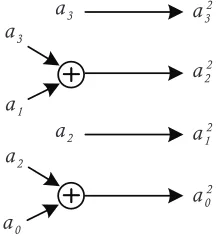
2.6 Field Arithmetic Squaring constructed viaP(x)= x4+ x+1 overF24. . . 40
2.7 The Traditional Parallel-Out Bit-Level (POBL) Field Arithmetic Multiplication Schemes [31]. (a) LSB-First POBL Multiplier. (b) MSB-First POBL Multiplier. 45 3.1 Constructing The Mastrovito MatrixMoverF2163 Generated byx163+x7+x6+ x3+1. . . 56
3.2 The Process for Constructing The Coordinates of The Signal VectorsoverF2163. 56 3.3 The Proposed SOBL Mastrovito Multiplier Architecture for Theω-nomial Ir-reducible Polynomials. (a) The High-Level Architecture. (b) The Implemen-tation of The CircuitS. . . 59
3.4 The Proposed SOBL Mastrovito Multiplier Architecture for The Irreducible Trinomials. (a) The High-Level Architecture. (b) The Implementation of The CircuitS. . . 62
3.5 The proposed compact SOBL multiplier architecture for the pentanomial irre-ducible polynomial. (a) The high-level architecture. (b) The implementation of the circuitS. (c) An example forBTX4 module when P(x) = x163+ x7 + x6+ x3+1. . . 66
3.6 The architecture of serial-out digit-level (SODL) polynomial basis multiplier overF2m for the pentanomial irreducible polynomial, i.e., xm+xt1+xt2+xt3+1, where digitd =2. . . 69
Enables a Register to be Switched Between Two Inputs (MUX). . . 71
4.1 The Proposed Double Multiplication Architectures That Extend The POBL
Schemes Presented in [31]. (a) LSB-First POBL Double Multiplication
Ar-chitecture. (b) MSB-First POBL Double Multiplication Architecture. . . 79
4.2 Proposed architecture for the LSD-first PODL Double Multiplication Operation. 82
4.3 Proposed architecture for the MSD-first PODL Double Multiplication Operation. 83
4.4 Architectures for The Hybrid-Double Multiplication. The Hybrid-Double
Mul-tiplier Structure is Developed by Connecting The Output of The SOBL
Multi-plier Into The Input of The POBL MultiMulti-plier. . . 84
4.5 Architectures for The Hybrid-Double Multiplication. (a) The Critical-Path
De-lay of The Hybrid-Double Multiplier (th). (b) Reducing The Delay by
Insert-ing Registers at TheIPmBlock Inside The SOBL Multiplier. . . 85
5.1 EC-Operations Dependency Graph for The Montgomery Ladder ECSM Method
[189, 190, 191], Which Shows That a Fixed Sequence of Both The ADD and
The DBL Blocks Are Performed for Any Value of The ki Bit, i.e., Only The
Operands Are Transposed. . . 93
5.2 EC-Operation Dependency Graph That Shows The Usage of Both The ADD
and The DBL Blocks Whenkj = 3 orkj = 4. . . 100 5.3 EC-Operation Dependency Graph That Shows The Usage of Both The ADD
and The DBL Blocks Whenkj = 2 orkj = 5. . . 101 5.4 EC-Operation Dependency Graph That Shows The Usage of Both The ADD
and The DBL Blocks Whenkj = −1, 0, 1, or 6. Notice That The SUB Opera-tion is Used at Stage 3 for Both Caseskj =−1 andkj = 0. . . 102 5.5 EC-Operation Dependency Graph That Shows The Usage of Both The ADD
and The DBL Blocks for All Cases ofkj, i.e.,kj ∈ { −1, 0, 1,· · ·, 6}. . . 102
5.6 EC-Operation Dependency Graph for The Proposed Radix-8 ESCM Method
That Shows The Total Memory Points Required, The Total EC-Operations Cost, and The Total Computational Time Complexity Per 3 Scalar Bits at The
EC-Operation Level. . . 103
5.7 EC-operation Dependency Graph for The Width-4 Okeya Method [64] That
Shows The Total Memory Points Required, The Total EC-Operations Cost,
and The Total Computational Time Complexity Per 3 Scalar Bits at The
EC-Operation Level. . . 105
5.8 EC-Operation Dependency Graph for The Montgomery Ladder and Joye’s
Bi-nary Methods [189, 192] That Shows The Total Memory Points Required, The
Total EC-Operations Cost, and The Total Computational Time Complexity Per
3 Scalar Bits at The EC-Operation Level. . . 105
5.9 Data Dependency Graph for Parallel Computing of The ADDDBL Operation
for Thex-Coordinates OnlyMontgomery Ladder Method on The Montgomery
Curve. . . 110
5.10 Data Dependency Graph for Parallel Computing of The Proposed ADDDBL Operation for The Prime Extended Twisted Edwards Curve. . . 112
2.1 NIST Recommended Key Sizes Measured in Number of Bits [104]. . . 15
2.2 NIST Recommended Finite Fields and Their Corresponding Reduction
Poly-nomials [16]. . . 31
3.1 List of Notations. . . 51
3.2 The Operations of The Control Signals Ctrl1, and Ctrl2 in Figure 3.3(a). . . 60
3.3 Comparison Table for The Proposed Multiplier Schemes (Figures 3.3(a), 3.4(a),
and 3.5(a)) With The Related Bit-Level Multiplier Schemes in Terms of Time
and Space Complexities for The ω-nomial, The Pentanomial, and The
Irre-ducible Trinomial. . . 70
3.4 Comparison Table for The Proposed Multiplier Schemes (Figures 3.3(a), 3.4(a),
and 3.5(a)) With The Related Bit-Level Multiplier Schemes When Having The
Same Parallel I/O Data Transfer Format. . . 72
3.5 Comparison of Bit-Level Polynomial Basis Multipliers on an ASIC
Implemen-tation (Post Synthesis) Over BothF2163 andF2233 Using 65-nm CMOS Standard
Technology. . . 74
4.1 Comparison Table for The ASIC Synthesis Results for The Proposed Double
Multiplication Architectures (Figure 4.5(a), 4.5(b)) for The Polynomial Basis
OverF2163 Using 65-nm CMOS Standard Technology. . . 86
4.2 Comparison Table for The ASIC Synthesis Results for The Proposed Double
Multiplication Architectures (Figure 4.5(a), 4.5(b)) for The Polynomial Basis
OverF2233 Using 65-nm CMOS Standard Technology. . . 87
5.1 An Example That Shows The Computation forkP = 6644P Using The Pro-posed Signed Radix-8 Scalar Multiplication. . . 98
5.2 The 4 Stages That The Proposed Algorithm 13 Evaluates for Each Value ofkj. . 99
5.3 Comparison Table of Related Binary, and Width-4 Window-Based ECSM Schemes
With The Proposed Radix-8 Scheme (Figure 5.6) in Terms of Memory Register
Space Used, Total EC-Operations Cost, and Computation Time Complexity at
The EC-operations Level per 3 Scalar Bits Evaluations. . . 106
5.4 Comparison Table of The Proposed Radix-8 Scheme (Figure 5.6) With the
U-nified Operation Technique and With Different ECSM Schemes That are Resist Against Side Channel Attacks in Term of Total Field Arithmetic Operations Per
3 Scalar Bits on the Weierstraß Elliptic Curve Model. . . 108 5.5 Comparison Table of The Proposed Radix-8 ECSM Scheme (Figure 5.6) With
Different Scalar Multiplication Schemes That Offers Resistance Against Side-Channel Attacks Using Parallel Environments With Respect to The
Computa-tion Time Complexity. . . 111
5.6 Comparison Table of Related Parallel Schemes With The Proposed 8-Processor
Scheme for The Extended Twisted Edwards Curve over Prime Fields, Which is
Shown in Figure 5.10, With Respect to The Computational Time Complexities
for The Bit Lengths of The Underlying Fields of NIST Recommended Curves
[16]. . . 113
1 The Addition Law for Elliptic CurveE overFp in Affine Coordinates [1] . . . 19
2 The Addition Law for Elliptic CurveE overF2m in Affine Coordinates [1] . . 20
3 Left-to-Right Double-and-Add Binary Scalar Method [1, 91] . . . 25
4 Left-to-Right Binary NAF Scalar Method [1, 91] . . . 27
5 Left-to-Right Standard Signed Radix-rScalar Multiplication [126] . . . 28
6 Addition Modulop[103] . . . 33
7 Subtraction Modulop[103] . . . 34
8 Left Shift Multiplication [101] . . . 36
9 Proposed Serial-Out Bit-Level Mastrovito Multiplier forω-nomialsxm+xt1+ · · ·+xtω−2 +1 . . . 55
10 Proposed Serial-Out Bit-Levelω-nomials xm+xt1 +· · ·+ xtω−2 +1 . . . 64
11 Proposed LSD-First Parallel-Out Digit-Level Double-Multiplication Operation 81 12 Proposed Non-Seven Encoding Method . . . 96
13 Proposed Signed Radix-8 Scalar Multiplication . . . 97
List of Abbreviations
3DES Triple Data Encryption Standard
ADD Point Addition Operation
ADDDBL Consdiering Both the ADD and DBL as a Single Composite Operation.
AES Advanced Encryption Standard
AFIPS American Federation of Information Processing Societies
ANSI American National Standards Institute
ASIC Application-Specific Integrated Circuit
DBL Point Doubling Operation
DLP Discrete Logarithm Problem
DSA Digital Signature Algorithm
DSS Digital Signature Standard
ECC Elliptic Curve Cryptography
ECDLP Elliptic Curve Discrete Logarithm Problem
ECDSA Elliptic Curve Digital Signature Algorithm
ECSM Elliptic Curve Scalar Multiplication
EC-operations Elliptic Curve Group (Arithmetic Points) Operations
EEA Extended Euclidean Algorithm
FIPS Federal Information Processing Standards
FLT Fermat’s Little theorem
FPGA Field-Programmable Gate Array
IDEA International Data Encryption Algorithm
IEC International Electrotechnical Commission
IEEE Institute of Electrical and Electronics Engineers
IETF Internet Engineering Task Force
IFP Integer Factorization Problem
ISO International Organization for Standardization
LSB Least Significant Bit
LUT Look-Up Table
MAC Message Authentication Code
mADD Mixed Addition Operation
MOF Mutual Opposite Form
MSB Most Significant Bit
NAF Non-Adjacent Form
NB Normal Basis
NIST National Institute of Standards and Technology
NSA National Security Agency
PB Polynomial Basis
PK Public-Key based scheme
PKI Public Key Infrastructure
POBL Parallel-Out Bit-Level
RC4 Rivest Cipher 4 Stream
RC5 Rivest Cipher 5 Stream
RCS Right Cyclic Shift
RFID Radio Frequency IDentification
RSA Rivest-Shamir-Adleman
SCA Side-Channel Attack
SECG Standards for Efficient Cryptography Group
SOBL Serial-Out Bit-Level
SODL Serial-Out Digit-Level
SSCA Simple Side-Channel Attack
SUB Point Subtraction Operation
TDEA Triple Data Encryption Algorithm
uADD Unified Addition Operation
VHDL Very-high-speed-integrated circuit Hardware Description Language
VLSI Very Large Scale Integration
VoIP Voice over Internet Protocol
List of Notations
⊕ An Addition Group Low Binary Operation on a Curve
Point Subtraction (SUB) Operation
∆ The Discriminant of a Curve
|G| The Order ofG
[vj, · · ·, vi] The Range of Bits in The VectorvFrom Positionito Position
j, j>i
D
rj, · · ·, ri
E
The Range of Bits in The RegisterhRiFrom Positionito Position
j, j>i
O The Point at Infinity
α Root of an Irreducible Polynomial
ω Non-Zero Terms in an Irreducible Polynomial
ω-nomials An Irreducible Polynomial WithωNon-Zero Terms
−P A Unary Operation on a CurveE, Namely, Point Inverse
A Finite Field Arithmetic Addition
An(F) Affinen-Space over The FieldF
Bit-latency Number of Clock Cycles Required to Generate The First
Output Bit
char(F) The Characteristic ofF
D Finite Field Arithmetic Multiplication by Curve Constant
E An elliptic curve
ei||v The Process of Concatenating an Elementeiand a Vectorv
E(F) A Group Formed by The Points onEDefined over The FieldF
E(a1, · · ·,a6) CurveE Parameter
F An Arbitrary Finite Field
F2m Finite Fields over Characteristic Two (Binary Extension Fields)
Fp ={0, 1, · · ·, p−1} Finite Field With pElements Fp∗ ={a∈Fp |gcd (a, p=1)} The Units modp
Fp+ ={1, 2, · · ·, p−1} The Non-Zero Residues modp
g Generator ofFp
G= {gr: 0≤ r≤ p} A Random Finite Cycle Group ofpElements
ga = ga mod p A’s Public key
gb = gb mod p B’s Public key
gab = gba Shared Key Between A and B
gcd The Greatest Common Divisor ofaandb
GF(2m) Finite Fields over Characteristic Two (Binary Extension Fields)
GF(p) Finite Fields over Prime Integer
I Finite Field Arithmetic Inversion
k A Scalar Integer
kP Elliptic Curve Scalar Multiplication of an Elliptic Curve PointP
With a Scalark
kPcost Cost at The Arithmetic Point Level for Computing ECSM
m Positive Integer
M[↓n] A Down Shift of The MatrixMbynPositions, Emptied Positions After The Shifts are Filled by Zeros
M(: , j) The jthColumn of The MatrixM
M(i, :) TheithRow of The MatrixM
M(i: j) An Entry With Position (i, j) of The MatrixM
M(j, :) [→1] A Right Shift of The jthRow of The MatrixMby 1 Position, Emptied Positions After The Shifts are Filled By Zeros
p Prime Number
P A Point on a Curve
P(x) An Irreducible Polynomial
P(xP,yP) A Point With Coordinates (xP,yP) in Affine Coordinates
P(XP,YP,ZP) A point With Coordinates (XP,YP,ZP) in Projecitve Coordinates
r-NAF Radix-rNon-Adjacent Form
S Finite Field Arithmetic Square
trinomials An Irreducible Polynomial With 3 Non-Zero Terms
v[f0, →1] A Right Shift of The VectorvBy One-Bit With Cell f0Fed in Its Left-Most Bit,
i.e., For The Vectorvof Lengthl-Bits v[f0, →1]=[f0,
l−1
z }| {
0 , · · · , 0]+v[→ 1]
w-NAF Width-wNon-Adjacent Form
Z Set of All Integers
1
Introduction
A
ges ago, there was only a negligible probability of confidential data beingeaves-dropped, monitored, stolen or destroyed without being noticed. Because, direct
talk was the only way to communicate between people, payments were done
us-ing cash, and secret documents were saved in tightly sealed boxes (e.g. treasure
chest). However, with the proliferation of communication technologies in the last couple of
decades, new communication channels have been created to satisfy the people’s desire to
en-hance the quality of life in the communities. By the times, those channels become faster, wider
and more accessible for everyone. Nowadays, an enormous amount of data is flooding the
communication lines each day, carrying love notes, digit cash, secret corporate documents and
other treasured information. These communication trends make the life easier but at the same
time reveal more security risks and more information about individuals and companies than
appreciated.
Cryptography -the art and science of hiding data- is a mathematical tool that is used by
security engineers to secure data against unauthorized access or manipulation. Cryptography
plays a crucial role in many aspects from communication and commercial applications in the
Internet to many other digital applications. Cryptography supplies the people, who are
re-sponsible for security, the required utilities to hide data, control accesses to them, verify their
integrity, and estimate the required cost and time to break the security. Understanding the
prin-ciples on which the cryptography is based, requires a cryptographer to gain enough knowledge
with cryptographic algorithms and protocols, computational complexity and a range of topics
in computer arithmetic and mathematics.
In the early days of cryptography, the secret keys used to encrypt and decrypt messages
were exchanged through the direct meeting of the parties or through the use of a trusted third
Scalar Multiplication Q = kP Elliptic Curve Primitives
M e s s a g e E n c ry p tio n M e s s a g e D e c ry p tio n M e s s a g e A u th e n tic a tio n D . S ig n a tu re G e n e ra tio n
....
Point Triple Point Addition Point Halving
Elliptic Curve Point Routines:
....
Point Quadrupling Point Doubling Point Quintupling
Elliptic Curve Point Routines:
....
Arithmeti c Squarin g Arithmeti cAddition Arith metic Multiplic ation Arithmeti c Inversio n
Finite Field Arithmetic Operations
Figure 1.1: Hierarchical Scheme for The Implementation of ECC Crypto-System [1].
party. Public-key (PK) based cryptography overcome this key distribution and key
manage-ment problem through the complex number based theory. PK based cryptography is essential
in today’s digital communication and storage infrastructure. The technology of PK schemes
can benefit a large number of application contexts ranging from high performance network
processor down to hand-held and resource constrained appliances.
Elliptic curve cryptography (ECC) is a technology of choice for developing PK based
cryp-tography. This is due to its resistance against powerful index-calculus attacks. Cryptographic
mechanisms based on elliptic curves depend on the arithmetic of points on the curve. The most
important arithmetic is multiplying a point on the curve by an integer. This operation is known
as elliptic curve scalar (or point) multiplication (ECSM) operation. The computation of the
ECC based crypto-system can be visualized in a hierarchical layer of operations as illustrated
in Figure 1.1. This hierarchical view is helpful for understanding the mechanisms of the
op-erations implementation and execution. It represents multiple levels of abstractions. The top
level of the figure represents the elliptic curve cryptographic applications that make up a secure
communication. The next level represents the scalar multiplication algorithm that depends on
a number of elliptic curve group operations. Finally, at the bottom level, the elliptic curve
arithmetic operations are defined based on the use of number theory, that is, all the low-level
operations are carried out in finite fields. For cryptographic applications, elliptic curves are
1.1. Motivation 3
extension fields, i.e., fields of characteristic two F2m1. We restrict ourselves to prime values
of m to avoid weaknesses by plunging into sub-field2. The most common finite field
oper-ations used in ECC are addition/subtraction, multiplication, squaring, and inversion/division. In general, an ECC cryptographic primitive requires few scalar multiplication operations, but
hundreds of elliptic curve group operations and correspondingly many thousands of finite field
arithmetic operations.
In this thesis, we investigate the operations at the lower three levels of the ECC hierarchical
scheme, namely, finite field arithmetic level, elliptic curve point arithmetic level, and the ECSM
operation. Emphasis has been placed on the development of hardware oriented algorithms and
operations for the ECC. In this regard, we introduce several algorithms for speeding up or
reducing the area of both the finite field arithmetic multiplication and the ECSM operation.
This opening chapter aims to provide the reader with a clear idea of what my research
thesis focus on. In this chapter, we introduce the topics at a high level of abstraction. More
specifically, in Section 1.1, we elaborate on the motivation of this research, in Section 1.2, we
list the main and specific objectives pursed in this research, and present the main contributions
of this research, and finally, we outline of the rest of the research thesis in Section 1.3.
1.1
Motivation
There are two main forms of cryptographic schemes. These are PK based schemes3 and
private-key based schemes4. In the private-key based schemes, the communication parties must share a key in a “secret way”. The underlying primitives used by private-key based
schemes are generally not computationally intensive. However, in order for the key to be
dis-tributed, a secure communication channel5 must be established, or the involved parties must
have access to a trusted third party such as the Kerberos authentication system, which is
re-sponsible for key distribution6. In practice, both possibilities are problematic, as the key
estab-lishment scheme does not scale well in multi-entity systems. Further, keys must be stored and
1 It can also be defined over fields of characteristic three
F3m, however, it is not common as the prime and
binary extension fields.
2 Curves over
F2m for some non-prime values of mare avoided for cryptographic applications since the
ECDLP can be reduced [2, 3, 4].
3 These are typically based on number theory and usually needs complex arithmetic operations.
4 These are usually built with substitution and permutation networks.
5 A secured channel is one from which an adversary does not have the ability to reorder, delete, insert, or
read.
6 These are the set of processes and mechanisms, which support key establishment and the maintenance of
distributed for each pair of entities, consuming the number of keys to grow asN∗(N −1)/2,
whereNis the number of entities in the system. For private-key based schemes, confidentiality
is achieved via an encryption algorithm, e.g., the Triple Data Encryption Standard (3DES) [5],
Advanced Encryption Standard (AES) [6], RC4 and RC5 stream cipher (Rivest Cipher) [7],
and IDEA [8]. Data integrity and data origin authentication are accomplished by message
au-thentication codes (MACs/HMACs) [1] or keyed hash functions. However, the non-repudiation feature is not achievable as the secret key is not in the possession of a single entity.
PK based schemes, on the other hand, have higher computation demands, which reduce
their throughput and make them difficult to implement in hardware. However, due to the key distribution, key management, and the provision of non-repudiation problems with the
private-key based schemes, there is an increasing trend of implementing PK based schemes in
hard-ware. PK based schemes allow two (or more) communicating parties to negotiate a secret key
on demand. PK based applications and services entering worldwide trade on the Internet have
been expanding enormously in the last few years. A few examples are the numerous financial
transactions that occur over the Internet in daily life, remote accessing through virtual private
networks, and Voice over Internet protocol (VoIP).
In the 18th century, the idea of using the intractability of a number theoretic method for cryptography was introduced by William Stanley Jevons [9]. Two centuries later, Diffie and Hellman invented their famous key exchange protocol based on the discrete logarithm problem
(DLP) [10]7. Rivest, Shamir, and Adleman then introduced the first practical PK encryption
and signature scheme8. Their scheme referred to as RSA9and is based on another hard math-ematical problem, i.e., the integer factorization problem (IFP) [12]. In 1984, ElGamal invented
another class of powerful and practical PK based schemes. These are also based on the DLP
[13]. For PK based scheme, confidentiality is achieved by means of encryption. For that
pur-pose, the most commonly used building blocks are RSA, ElGamal and elliptic curve variants of
ElGamal. Data integrity and origin authentication with non-repudiation can be accomplished
by the signature schemes such as RSA-PSS [14, 15], the digital signature algorithm (DSA)
[16], and the elliptic curve digital signature algorithm (ECDSA) [17].
Elliptic curves have been studied long time before they were introduced to cryptography.
Based on the specific properties of elliptic curves, in the mid-1980s, Victor Miller [18], and
Neal Koblitz [19] independently proposed using the group of points on an elliptic curve defined
7 This paper is the one that officially gave birth to PK base cryptography. There is a companion paper
entitled “Multiuser Cryptographic Techniques” that was presented by the same authors at the National Computer Conference that took place on June 7-10, 1976, in New York City [11].
8 It is currently the most deployed scheme but is intended to be supplanted by elliptic curve cryptography.
1.1. Motivation 5
over a finite field in PK based cryptography. Since then, ECC has been intensively studied, and
has become popular among other common PK based schemes, i.e., Diffie-Hellman [10], RSA [12], and ElGamal [13]. The main advantage of ECC is the absence of sub-exponential
al-gorithms to solve the underlying hard problem, namely, the elliptic curve discrete logarithm
problem (ECDLP). ECC therefore features smaller security parameter, providing an
equiva-lent protection compared to factoring-based and classical discrete logarithm techniques for PK
based cryptography.
The technology of ECC is currently well accepted in the industry and the academic
commu-nity and has been included in the following major standards: The German Brainpool Standard
[20], Institute of Electrical and Electronics Engineers (IEEE) 1363-2000 [21], the National
Institute of Standards and Technology (NIST) in the US Federal Information Processing
Stan-dard (FIPS) 186-3 [16], American National StanStan-dards Institute (ANSI) X9.62 [17], StanStan-dards
for Efficient Cryptography Group (SECG) [22], and ISO/IEC 15946-2 [23]. ECC has also become the standard to protect U.S. information, the United States’ National Security
Agen-cy (NSA) restricts the use of PK based schemes in “Suite B” to ECC [24]. It is also worth
mentioning that ECC is utilized in Cisco systems for its network infrastructure solutions,
Re-search In Motion (BlackBerry) for its enterprise software, Unisys for banking applications and
Motorola and Sony for its mobile security [25].
The underlying cryptographic primitive in ECC is based on the ECSM operation. This
operation is certainly, the most computationally intensive step in each ECC based PK schemes.
Most of the time, the computation of the scalar multiplication becomes the bottleneck of the
performance. In this thesis, with respect to special-purpose hardware, we want to explore
and optimize the performance of ECC underlying operations. The specific motivations for
the research presented in this thesis and the corresponding contributions are summarized as
follows:
1.1.1
Field Multiplication Operation
Motivation: The motivations for developing fast and area efficient hardware solutions for the arithmetic multiplication operation come from two facts. First, the fact that the arithmetic
mul-tiplier has been widely used in applications of different fields like error-control coding, cryp-tography, and digital signal processing [26, 27, 28, 29]. Second, the fact that other complex
and time consuming operations such as exponentiation and division/inversion are implemented by the iterative application of the multiplication operations. In PK based schemes, many
large operands, i.e., sizes from 163 to 4096 bits. Hence, this important operation has a high
impact in the performance of the entire crypto-system.
The serial-out bit-level (SOBL) multiplication scheme is characterized by an important
low-latency feature. It has an ability to sequentially generate an output bit of the multiplication
result in each clock cycle. To current knowledge, the best architecture for the SOBL
multipli-cation is the scheme proposed by Reyhani-Masoleh in [30]. It is highly desirable to investigate
and develop other methods for such a serial-out multiplier structure in order to lower its area
cost and its critical path delays.
Contribution 1: We proposed novel schemes for the SOBL finite field multiplication op-eration that are constructed by an irreducible polynomial withω, ω ≥ 3, non-zero terms
(de-noted byω-nomials). We showed that in terms of the area and time complexities, the smallest
SOBL scheme proposed outperforms the existing SOBL schemes available in the literature. In
addition, we showed that the proposed scheme can provide about 24-26% reduction in area
complexity cost and about 21-22% reduction in power consumptions compared to the current
state-of-the-art bit-level multiplier schemes. The proposed multiplier scheme, as its area and
power consumptions are dropped, is ideally suitable to be used by the manufacturer’s of RFID
tags and sensor networks.
1.1.2
Bit-Level Finite Field Double Multiplication
Motivation: A multiplication scheme based on the SOBL structure has certain advantages as compared to the traditional parallel-out bit-level (POBL) multiplication structures [31]. For
instance, a hybrid-double multiplier has been recently proposed inF2m using normal basis
(N-B) representation [32, 33]. In their architecture, the hybrid-double multiplier is achieved by
combining and interleaving a SOBL Gaussian NB multiplier that is implemented based on
[34], and a POBL NB multiplier that is based on [31]. It has been shown in [32, 33] that the
hybrid-double multiplier would make fast exponentiation and inversion possible. A multiplier
operates using the PB, in compared to the NB representation, has lower hardware requirements
and easy-to-derive structure based on the defining irreducible polynomial for the field P(x)
[35]. Hence, it is desirable to investigate the similar hybrid-double architecture using the PB
representation to broad its usefulness in performing arithmetic computations.
Contribution 1: In order to investigate the applicability of the proposed SOBL schemes, we employed the proposed SOBL schemes to present, to our knowledge, the first approach
for a hybrid-double multiplication architecture in the PB over F2m. This hybrid multiplier
1.1. Motivation 7
latency comparable to the latency of a single multiplication.
Contribution 2: We extended the traditional POBL multiplier schemes presented in [31] to propose new LSB-first/MSB-first POBL double multiplication architectures, which perform two multiplications in the PB over F2m together after 2m clock cycles. To obtain the actual
implementation results, all the proposed schemes are coded in
Very-High-Speed-Integrated-Circuit Hardware Description Language (VHDL) and implemented on application-specific
in-tegrated circuit (ASIC) technology (10 schemes in total), over bothF2163 andF2233.
1.1.3
Elliptic Curve Scalar Multiplication
Motivation: Secure PK based scheme is essential in today’s age of rapidly growing Internet communication. ECC has become popular due to its shorter key size requirement in
compar-ison with the existing PK based algorithms. Elliptic curves are widely used in many
crypto-graphic primitives such as digital signature, key exchange, and data encryption/decryption. The most important and time consuming operation in ECC is the scalar multiplication operation.
The speed of the scalar multiplication operation plays an important role in the security and
the efficiency of an implementation of the whole system. Designing secure implementations requires taking into account the physical attacks. Due to its importance, it is an interesting
problem to explore new approaches and algorithms to perform the scalar multiplication
opera-tion.
It is stated in [36] that the fastest known approach to perform the scalar multiplication over
prime fields is due to Hisil et al. in [37]. Hisil et al., have used the maximum possible parallel
operations, i.e., 4-processes, for computing the extended twisted Edwards curve model. This
has motivates us to come up with a new scalar multiplication scheme that allows incorporating
8 parallel operations for computing the point arithmetic (underlying group) operations on the
extended twisted Edwards curve model.
Contribution 1: We proposed a novel approach for computing ECSM operation that can be used on any abelian group. We analysed the security of our approach and showed that its
security holds against both simple side-channel (power analysis) attack (SSCA) [38, 39, 40],
and safe-error (C-safe) fault attacks [41, 42, 43].
Contribution 2: We employed the proposed approach for computing the scalar multi-plication to present a new design for the implementation of an ECSM operation on a prime
extended twisted Edwards curve model incorporating 8 parallel operations. We showed that in
comparison to the other SSCA protected schemes over prime fields, the proposed design of the
the literature.
1.2
Objectives
According to the formulated motivations, we may define the research objectives, which for us
seem worth obtaining. They are two main objectives and one main goal:
1. Based upon the analysis of recent publications on hardware design for the finite field
mul-tiplication operation, we aimed at proposing a new hardware architecture for the SOBL
multiplication operation that is more efficient in terms of speed, size (implementation cost), or power and energy consumption in compared to previously published results.
We also aimed at extending the traditional POBL multiplication hardware scheme to a
POBL double multiplication operation that performs two sequential multiplications. We
further, aimed at proposing new hardware architecture for the hybrid-double
multiplica-tion architecture. In order for us to develop a new arithmetic multiplicamultiplica-tion scheme over
the fields of characteristic two, i.e.,F2m, we have to:
• Perform a vast literature research to appoint the most suitable basis (e.g.,
polyno-mial basis [31, 44, 45, 46, 47], normal basis [34, 48, 49, 50, 51], shifted polynopolyno-mial
basis [52], etc.) to represent the finite field elements .
• Familiarise ourselves with details of the hardware structures of the arithmetic
multi-plication unit (e.g., bit-level [31], digit-level [53], bit-parallel [46], pipelined
struc-ture [54, 55], hybrid strucstruc-ture [32], etc.).
• Carefully study the existing algorithms and approaches for the arithmetic
multi-plication operations overF2m (e.g., Mastrovito multiplication [56, 46], dual basis
multiplication [57, 58], Montgomery multiplication [59, 60], etc.).
• Carefully study the irreducible polynomials (e.g., irreducible trinomials [61],
pen-tanomials [45], all-ones [62], andω-nomials [30], etc.) that are associated with the
arithmetic multiplication over a finite fieldF2m.
• Carefully interpret and model the favourable algorithms into VHDL codes and
anal-yse them to inspire us to create our own solutions as efficient as possible.
• Familiarise ourselves with many of the Synopsys Design Compiler tools to verify
1.2. Objectives 9
2. Based upon the hardware architecture and the analysis of the different algorithms for the implementation of ECSM operation, we aimed at building a new hardware scheme for
the scalar multiplication operation that would work on any abelian group. We also aimed
at utilizing the proposed ECSM scheme for the implementation of scalar multiplication
in a special model of elliptic curves known as extended twisted Edwards model. There
are several design options for implementing the scalar multiplication. In order for us to
propose a new approach to computing the scalar multiplication the following must be
considered:
• Select an appropriate addition chain method (e.g., sliding window [1, 63, 64],
multi-based [65, 66, 67], ternary expansion [68], methods multi-based on signed digit
represen-tations [69, 70], etc.).
• Use a representation of the scalar such that the number of point arithmetic
opera-tions is reduced (e.g., non-adjacent form (NAF) [71], radix-r NAF (r-NAF) [72],
width-wNAF (w-NAF) [1, 64, 73], Frobenius map [73, 74], etc.).
• Select an appropriate elliptic curve model with corresponding parameters (e.g., the
Hessian [75], Edwards [76], Huffs [77], Koblitz [74], Jacobi quartics [78] curve models, etc.).
• Select the most appropriate coordinate system to represent elliptic curve points
(e.g., the affine, projective, mixed,x-only coordinates, etc.).
• Utilize efficient point arithmetic operation formulas based on a combination of the underlying finite field arithmetic operations (e.g., implementing point halving
in-stead of the doubling over binary fields [79], point tripling over fields of
character-istic three [66, 68], and using composite operations, i.e., 2Q+P[80]).
• Optimize the architectures of the underlying finite field arithmetic operations (e.g.,
utilizing pipelining methods [81, 82], parallel operations schemes [37, 83, 84, 85,
86, 87, 88], etc.).
• Ensure that the security of a method holds against both side-channel attacks and
safe-error fault attacks.
In the end, the goal is to utilize the proposed ECC underlying operations to achieve a
perfor-mance gain in the implementation of the elliptic curve crypto-coprocessor over both Fp and
F2m10. Hardware implementations of ECC overF2m are more popular thanFpdue to their carry
10 Prime fields are commonly used for software implementations because the integer arithmetic is more
free addition [89]. However, in case of the field-programmable gate arrays (FPGAs), carry
chain adders are optimized so that arithmetic over Fp are less complex and more suitable for FPGA implementation [90].
1.3
Thesis Organization and Outlines
This thesis is divided into six chapters. The next chapter provides a basic introduction and
preliminaries while the following three chapters, i.e., Chapters 3, 4 and 5, exhibit the results
of our contribution. In the following, we give an overview of the structure of the thesis and
highlight the main contributions
• Chapter 1: Introduction.This opening chapter is intending to bring the readers quickly on the different works developed in this thesis. The chapter starts with identifying the motivation of our research topics. Once the motivation has been identified, it ensures
that the main contributions are highlighted. Then, the chapter proceeds with outlining
the objectives and the organization of the thesis.
• Chapter 2: Preliminaries. The ultimate purpose of this chapter is to ensure we collect the prerequisites that form the basis for the novel contributions that follow in the main
chapters, i.e., Chapters 3, 4, and 5. This chapter gives background related to
ECC-based crypto-system. The advantages of using PK ECC-based schemes are first presented
before providing an overview of the Diffie-Hellman key exchange protocol. The ECC crypto-system is then reviewed in more details and its main algorithms and operations are
provided. Since the elliptic curve arithmetic point operations, i.e., group low and scalar
multiplication operations, rely on the finite field arithmetic operations, an introduction
to the modular arithmetic algorithms over bothFpandF2m is provided. The introductory
material presented in this chapter could be extended in [1, 91, 92, 93, 94, 95, 96, 97].
• Chapter 3: Architectures for SOBL Multiplication Using Polynomial Basis. This chapter is based on our work in [98]. In this chapter, novel schemes for SOBL
multipli-cation operation using polynomial basis is introduced. It is then, proceeds with analysing
the performance of the proposed SOBL schemes and comparing them to the counterpart
bit-level ones.
1.3. ThesisOrganization andOutlines 11
architectures using polynomial basis. Then the performance of the proposed
architec-tures is investigated by implementing each arithmetic double multiplication architecarchitec-tures
on ASIC technology.
• Chapter 5: New Regular Radix-8 Scheme for Elliptic Curve Scalar Multiplication Without Pre-computation. This chapter is based on our work in [99]. It starts with an overview of side channel attacks (SCAs) and its countermeasures. Then, a novel scheme
for the ECSM operation is introduced. It shows how the properties of the proposed
EC-SM scheme enhance parallelism at both the point arithmetic and the finite field arithmetic
levels. It also provides detailed security analyses of the proposed scheme and shows that
it can be used to provide a natural protection from SCAs based on simple power analysis
as well as safe-error fault attacks. Finally, it shows how the proposed ECSM scheme can
be employed in proposing a new hardware design for the implementation of an ECSM
on a prime extended twisted Edwards curve incorporating 8 parallel operations.
• Chapter 6: Summary and Future Work. In this final chapter, we present brief com-ments on possible directions for future ongoing work. Summary of our contributions and
2
Preliminaries
T
heECC-based crypto-system is considered to be one of the best choices forimple-menting PK based schemes. Although the operations involved in ECC are more
computationally intensive, the significant smaller key parameters that can be used
by ECC lead to a more efficient implementation compared to other PK based crypto-systems. ECC standards provide different parameter options that can meet a wide range of de-sign requirements, which are suitable for applications ranging from a “tiny chip” in a
resource-constrained device, to NSA Suite B and high-end embedded devices [100]. Cryptographic
mechanisms based on elliptic curves depend on the arithmetic of points on the curve. The most
important arithmetic is multiplying a point on an elliptic curve by an integer. This operation
is known as elliptic curve scalar (or point) multiplication (ECSM) operation. A cryptographic
device for ECC is supposed to perform this operation efficiently and securely. ECSM is per-formed by implementing and evaluating the elliptic curve point routines, e.g., point addition
(ADD) and point double (DBL) operations. Both operations are originated from the arithmetic
operations in the underlying finite field.
In ECC, parameters such as keys and the point coordinates can be seen as finite field
ele-ments. Hence, all the operations involved in ECC are carried out in finite fields. Elliptic curves
are usually defined over two types of finite field: prime fields Fp with p a large prime, or bi-nary extension fields, i.e., fields of characteristic twoF2m, withma prime integer. In order for
us to understand, build, analyse and study the ECC systems, we have to achieve a sufficient knowledge about the elliptic curve’s underlying field arithmetic operations over both Fp and
F2m.
This chapter gives background related to ECC-based crypto-system. The advantages of
using PK based schemes are first presented before providing an overview of the Diffie-Hellman
2.1. Public-KeyBasedSchemes 13
key exchange protocol. The ECC crypto-system is then reviewed in more details and its main
algorithms and operations are provided. In addition, this chapter provides an introduction
to the modular arithmetic algorithms over both Fp and F2m. More precisely, the finite field
arithmetic addition/subtraction, multiplication and division/inversion algorithms suitable for hardware implementations are presented. The introductory material presented in this chapter
could be extended in [1, 91, 92, 93, 94, 95, 96, 97].
2.1
Public-Key Based Schemes
As discussed in the Motivation Section in Chapter 1, modern cryptography can be categorized
into PK and private-key based schemes. In private-key based schemes, two parties in
com-munication agree upon a single key known only to them. The computation of the private-key
based schemes are typically very efficient1. However, they have significant drawbacks of key
distribution and key management problems. To overcome these problems, Diffie and Hellman introduced a practical algorithm for key exchange [10]. They showed that two parties can
es-tablish a shared secret over an insecure channel2 without having any prior knowledge of one another.
The simplest version of the Diffie-Hellman key exchange protocol usesFp∗, the multiplica-tive group version of integer modulo p. There is also a public generator elementg∈Fp, which is a primitive root3 mod p. Figure 2.1 shows how the Diffie-Hellman key exchange can be
used when two parties Aand Bwish to communicate securely4. As shown in this figure, both
AandBhave a public and a private key5. The private key is a randomly chosen integer, which we denote byafor party Aandb for party Bsuch that a,b ∈ Fp+. Then, the protocol can be defined as follows:
1. Party Ahides his secret key by raising the generator g to the power of his private key,
i.e.,Acomputesga =ga mod p.
1 Therefore, it is usually employed for confidentiality purposes and when the non-repudiation feature is not
required in addition to data integrity and origin authentication.
2 An insecure channel is one from which parties other than those for which the information is intended can
reorder, delete, or read.
3 a numbergis a primitive root modulopif every number co-prime topis congruent to a power ofgmodulo
p.
4 The scheme presented here is the basic one and is used for the illustrative purpose, additional features (such
as padding plaintext messages with random strings prior to encryption) to the schemes should be added before it can be considered to offer adequate protection against real attacks.
5 To avoid ambiguity, a common convention is to use the termprivate keyin association with public-key
Integer
Integera
Party A
Party A Party BParty B
Private Key
Private Key
Publicly Known
Publicly Known
(1) Calculate Public Key (1) Calculate Public Key
(2) Calculate Shared Secret Key (2) Calculate Shared
Secret Key
Integer
Integer
g = g modp a b a
b
b g = g modp
b b p
g Modulo Modulo Generator Generator
b
g
a
g
Private Key
Private Key
(1) Calculate Public Key (1) Calculate Public Key
(2) Calculate Shared Secret Key (2) Calculate Shared
Secret Key
g = g modp a b b
a g = g modp
a a
ey
20 20
Insecure Channel
Insecure Channel
Figure 2.1: Diffie-Hellman Key Exchange Scheme [1, 10].
2. The valuega (calledA0s public key) is then sent over an insecure channel to B, to which
Bcan exponentiategaand computegab= gab mod p.
3. Party B computes his public key, i.e., gb = gb mod p, and sends it over an insecure channel toA, who can compute the shared secretgab =gba mod p.
Both parties are now in possession of a shared secret key gab. The individual secrets, i.e.,
private keys, of both parties are assumed to be safe under the DLP [101], which can be defined
as follows. LetG = {gr : 0 ≤ r ≤ p−1}be a random cyclic group of pelements generated byg > 1. Given a primitive elementgand a random element s = gr ∈ G, it is very hard to computer =loggs.
Despite the difficulty of recovering gab fromg, ga, and gb, there is still the “brute force” method that solves this problem. An eavesdropper can start successively computing higher power ofguntil it matches the public key. This requires at most|g|multiplications, where|g| is the order ofgin the groupG. It is the case, however, that|G| ≈ 10160 and p≈ 21880[102]6
and hence the schemes based on DLP methods are intractable [103].
Example:
1. Choose the modulop=17, and the generatorg=8.
2. Select a positive integer as a private key,a=5 andb=4.
3. Compute public keyga=ga mod p=85 mod 17=9, andgb=gb mod p=84 mod 17=16.
4. Compute the shared secret,gab=gab mod p=94 mod 17=16, andgab=gab mod p=165 mod 17=16.
It is worth-noting that this simple version of Diffie-Hellman key exchange does not provide authentication of the origin of information. Thus, one needs to make sure that the key
ex-change process is initiated only between the intended user and not an intruder in the middle.
2.2. Introduction toEllipticCurves 15
Table 2.1: NIST Recommended Key Sizes Measured in Number of Bits [104].
Symmetric Key Size RSA & Diffie-Hellman Key Size Elliptic Curve Key Size
(bits) (bits) (bits)
80 1024 160
112 2048 224
128 3072 256
192 7680 384
256 15360 521
A
t
This is done by defining authenticated agreement scheme wherein the users first authenticate
themselves and then initiate the process after validating their identification or authority7.
Although, today used PK based algorithms such as RSA and ElGamal are believed to be
secure, some of their implementations have been challenged by the quick factoring, and integer
discrete logarithm attacks [1, 105, 106]. ECC that can provide the same level of security with
shorter key size becomes more attractive [107]. For example, a 160-bit ECC is as secure as
1024-bit RSA crypto-system [108]8. Table 2.1 from [104] provides the key sizes recommended
by NIST, as of 2009, that are used in conventional encryption algorithms such as DES and
AES together with the key sizes for RSA, Diffie-Hellman and elliptic curves that are needed to provide equivalent security.
2.2
Introduction to Elliptic Curves
Elliptic curves are important objects occurring in many different areas (e.g., geometry algebra, number theory, complex analysis, etc.). Recently, elliptic curves have become widely used
in applications such as factoring [109] and cryptography [18, 19]. Elliptic curves are groups
that are defined over fields. Elliptic curve groups allows only one binary operation (denoted
by addition group low operation), which is originated from the arithmetic operations in the
underlying finite field. There are many ways to represent elliptic curves such as Legendre
equation, cubic equations, quartic equations, and intersection of two quadratic surfaces [95]. It
can also be expressed as the form of Weierstraß equation.
Definition [1, 93] An elliptic curveEdefined over a fieldFusing affine coordinates is defined 7 This is achieved by public key infrastructures (PKIs) like X.509.
8 The reason for this significant difference is the lack of a known index-calculus attack on elliptic curve
by the Weierstraß equation.
E(F) :y2+a1xy+a3y= x3+a2x2+a4x+a6, (2.1)
wherea1,a2,a3,a4,a6 ∈Fand∆,0.
Here∆9is the discriminant ofE(
F)10. Equation (2.1) is called the general Weierstraß equation for elliptic curves. Miller [18] and Koblitz [19] were the first to show that the group of rational
points on an elliptic curve E over F can be used for the DLP in a PK based crypto-system. Aside from all the (x,y)∈Fsolutions to the equation above, there is an extra point which cannot be defined using the affine equation, but must be included to complete the group definition. This point is called the point at infinity, which we denote byO.
Ifchar(F)<{2, 3}, thenE(F) can be transformed to [1]
E(Fp) :y2 =4x3+b2x2+2b4x+b6,
and then applying change of coordinates (x,y)7→(x−3b2
36 ,
y
108), which yields the following
sim-plified equation [1]
E(Fp) :y2 = x3+ax+b, (2.2)
witha,b ∈ Fp. Equation (2.2) is called the short Weierstraß equation for elliptic curves. It is proved that the condition 4a3+27b2 , 011 is necessary and sufficient to prove that (2.2) has three distinct roots12. Such an elliptic curve with distinct roots is called a non-singular EC and forms an abelian group with respect to a binary operation
If char(F) = 2, then an admissible change of variables transforms E(F) to the curve of equation [1]
E(F2m) :y2+ xy= x3+ax2+b, (2.3)
wherea,b ∈ F2m. Such a curve is said to be non-supersingular and has a discriminant∆ = b
[1].
The set of points { (x, y) ∈ E(Fp)} ∪ { O } under the addition group operation rule, i.e., ⊕, which forms an additive abelian group, the sum of any two points on a curve is a gain a
point of the same curve. The elliptic curve group low operation is defined by point addition
9 The condition∆
,0 ensures that the elliptic curve is smooth, that is, there are no points at which the curve
has two or more distinct tangent lines [1].
10 Detailed definition of∆can be found in [1].
11 This inequality comes from examining the discriminant of the curve in the short Weierstraß equation, viz.
∆ =−16(4a3+27b2).
2.2. Introduction toEllipticCurves 17
Q
P P Q!
P
x x
y y
Q
P
R
Q P
R!
(a) (b)
Figure 2.2: Graphical Representation of The Chord-and-Tangent Group Low (EC-Operations) for an Elliptic CurveE :y2 = x3−2 overFp[1, 91]. (a) Point Addition (ADD) Operation of
PandQonE and Resulting in The PointR. (b) Point Doubling (DBL) Operation ofPonE
and Resulting in The PointQ.
(ADD) and point doubling (DBL) operations. Both ADD and DBL are usually called the
chord-and-tangent method [91]. To visualize these operations, Figure 2.2 illustrates the graphical
representation of the group axioms. Given three pointsP, Q, andR ∈E(Fp) : y2+x3−2, the addition of two distinct pointsPandQis shown in Figure 2.2(a). It is defined by drawing a line
through the two points, this line intersects the graph ofE at a third point−R. ThenR= P⊕Q
is defined to be the other point where the vertical line through −R intersects the graph of E.
The double of a pointPis shown in Figure 2.2(b). It is defined by drawing the tangent line to
the elliptic curve at P. This line intersects the elliptic curve at a second point. Then Qis the
reflection of this point about thex-axis. Let us consider the following example:
E(F17) :y2 = x3+x+7. (2.4)
Equation (2.4) is an elliptic curve. Along with the point at infinityO, the set of rational points
of such an elliptic curve overF17is defined by
E(F17)={(x: y)∈A2(F17) : y2= x3+ x+7} ∪ { O }. (2.5)
Here E(F17) denotes the set of all points on E(F17), andA2(F17) denotes the affine plane over
F17. It consists of equivalence classes of doubles (x,y)∈F17×F17, (x,y),(0, 0), two doubles
(x,y) and (x0,y0) being equivalent if there exists c ∈ F∗
17 such that cx = x
0
, cy = y0; the equivalence class containing (x,y) is denoted by (x: y). The pointP=(xP,yP)=(1, 3) lies in
Scalar
Scalar
Private Key Private Key
k
B
(1) Calculate Public Key (1) Calculate Public Key
Q = k P
B B
Scalar
Scalar Party AParty A Party BParty B
Publicly Known Publicly Known
(2) Calculate Shared Secret Key (2) Calculate Shared
Secret Key
P
E Point
Point
Elliptic Curve
Elliptic Curve
B
Q
Private Key Private Key
(1) Calculate Public Key (1) Calculate Public Key
(2) Calculate Shared Secret Key (2) Calculate Shared
Secret Key
Q = k P
A
Insecure Channel
Insecure Channel
A
k
A
Q = k Q
A B
Q = k Q
B A
A
Q
Figure 2.3: Elliptic Curve Diffie-Hellman Key Exchange Scheme [1].
R = P⊕Q, where ⊕ is an EC-point addition (ADD in this case). The coordinates xR, yR are computed fromxP,yP, xQ,yQusing the underlying finite fields inF17. Furthermore, it can also
be verified thatQ = P⊕P(DBL in this case), accordinglyR = P⊕ P⊕P; we usually write these as Q = 2P andR = 3P, whereP⊕P· · · ⊕P
| {z }
k
= kPin general is called scalar (or point)
multiplication and is defined by the addition of the pointP to itselfk−1 times. The security
of ECC is based on the hardness of the ECDLP, namely, finding out the scalarkfor any given
two pointsP andS such thatS = kP. It is supposed intractable to solve this for well chosen curves, parameters, and base pointP.
2.2.1
Elliptic Curve Di
ffi
e-Hellman Key Agreement Scheme
The simplest elliptic curve scheme is the elliptic curve Diffie-Hellman key exchange protocol. The scalar multiplication operation in this scheme is equivalent to the modular exponentiation
in Diffie-Hellman key exchange scheme. Figure 2.3 shows how this protocol permits the two partiesAandBto communicate securely and agree about a secretQ. In this figure, the scalars
kA and kB are the secret keys (private keys) of A, and B, respectively. The elliptic curve
pa-rameters and the point P are assumed to be publicly known. Party A hides his secret key by
computing QA = kAP, and party Bcomputes QB = kBP. The values QA, and QB (called A’s and B’s public key, respectively) are send to each other over an insecure channel. Finally, party
A computesQ = kAQB and partyBcomputes Q = kBQA. As a result they both share a secret
Q. The security of this scheme is based on the elliptic curve computational Diffie-Hellman assumption, which states that if the parameters are chosen carefully, it is computationally
in-feasible to calculate kAkBPwhen P, kAPand kBPare given. Till date there is no good attack
method on the ECDLP. Other frequently used attacks such as Pohlig-Hellman and Baby step
![Figure 1.1: Hierarchical Scheme for The Implementation of ECC Crypto-System [1].](https://thumb-us.123doks.com/thumbv2/123dok_us/7790690.1290748/20.612.93.499.80.304/figure-hierarchical-scheme-implementation-ecc-crypto.webp)
![Figure 2.1: Diffie-Hellman Key Exchange Scheme [1, 10].](https://thumb-us.123doks.com/thumbv2/123dok_us/7790690.1290748/32.612.126.466.70.200/figure-die-hellman-key-exchange-scheme.webp)
![Figure 2.2: Graphical Representation of The Chord-and-Tangent Group Low (EC-Operations)for an Elliptic Curve E : y 2 = x 3 − 2 over Fp [1, 91].(a) Point Addition (ADD) Operation ofP and Q on E and Resulting in The Point R.(b) Point Doubling (DBL) Operation of P on Eand Resulting in The Point Q.](https://thumb-us.123doks.com/thumbv2/123dok_us/7790690.1290748/35.612.129.504.72.227/graphical-representation-operations-addition-operation-resulting-operation-resulting.webp)
![Figure 2.3: Elliptic Curve Diffie-Hellman Key Exchange Scheme [1].](https://thumb-us.123doks.com/thumbv2/123dok_us/7790690.1290748/36.612.125.465.72.205/figure-elliptic-curve-die-hellman-key-exchange-scheme.webp)
![Table 2.2: NIST Recommended Finite Fields and Their Corresponding Reduction Polynomials[16].](https://thumb-us.123doks.com/thumbv2/123dok_us/7790690.1290748/49.612.168.459.123.263/table-nist-recommended-finite-fields-corresponding-reduction-polynomials.webp)
![Figure 2.4: Modular Addition over Fp [90].](https://thumb-us.123doks.com/thumbv2/123dok_us/7790690.1290748/51.612.87.540.69.458/figure-modular-addition-over-fp.webp)
![Figure 2.5: Modular Subtraction over Fp [90].](https://thumb-us.123doks.com/thumbv2/123dok_us/7790690.1290748/52.612.68.529.75.501/figure-modular-subtraction-over-fp.webp)
![Figure 2.7: The Traditional Parallel-Out Bit-Level (POBL) Field Arithmetic MultiplicationSchemes [31]](https://thumb-us.123doks.com/thumbv2/123dok_us/7790690.1290748/63.612.145.483.68.509/figure-traditional-parallel-level-pobl-field-arithmetic-multiplicationschemes.webp)