Influence of aggregate size and free water on the dynamic
behaviour of concrete subjected to impact loading
B. Erzar1, P. Forquin1,a, C. Pontiroli2, and E. Buzaud2
1Laboratoire de Physique et Mécanique des Matériaux, Université Paul Verlaine – Metz, 57045 Metz Cedex 01, France
2Centre d’Etudes de Gramat, Commissariat à l’Energie Atomique, 46500 Gramat, France
Abstract. Concrete is a material widely used in civil engineering. Thus the knowledge of its mech anical behaviour is a major safety issue to evaluate the ability of a stru cture to resist to an intense dynamic loading. In this study, two experimental techniques have been applied to a micro-concrete and a co mmon concrete to assess the influence of the aggregate size on the dynamic response. First, spalling tests o n dry and wet specimens have been performed to characterize the tensile strength of concrete at strain rates in the range 30 – 150/s. Then, edge-on impact tests in sarcophagus configuration have been
conducted. The cracking pattern of the micro-concrete and the concrete plates in wet and dry conditions have been compared to appraise the influence of aggregate size and free water on the damaging process.
1 Introduction
Although concrete is widely used for construction all around the world, its mechanical behaviour is not well understood in dynamic conditions. The tensile properties of concretes constitute generally the main weakness o f these materials. T outlemonde [1] perf ormed direct te nsile te sts on different concretes at relatively low strain rates (up to 1/s). The influence of aggregate size and the free water were particularly investigated. The results showed that, in this range of loading rate, th e aggregate size presents a limited influence on the tensile strength while the free water appeared as a prominent parameter. An enhancement of tensile stre ngth of 3 MPa was observed bet ween qu asi-static value (obtained at 1 e-5/s) and t he dy namic on e ( at ab out 1/s) f or wet speci mens while dr y co ncrete samples present a limited improvement of about 1 MPa in the same range of loading rate. At higher rates of strain, spalli ng te sts are suitable to identify t he dy namic strength of co ncrete [2 -4]. Klepaczko and B rara [2 ] a dapted th e Ho pkinson bars ap paratus to test co ncrete in d ynamic conditions b y re moving the output bar . Using this technique, several experi mental data h ave been gathered on wet and dr y specimens. Unfortunately, no measurement was performed directly on the specimen. Based on the same principle, Schuler et al. [3] used an acceleration se nsor placed on the rear face of the specimen to get the free surface velocity, and computed the tensile strength from this signal. W eerheijm and Va n Doormaal [ 4] realised e xperiments o n co ncrete using a si milar configuration. They u sed str ain g auges on the tested concrete specimen to obtai n local data
ae-mail : [email protected]
concerning the loading field that allowed deducing the tensile strength. In this study, two concretes are compared: the MB50 micro-concrete with a maximum aggregate size o f 2 mm and t he R30A7 concrete, a co mmon concrete with a maximum grain size o f 8 mm. In the first part, these materials are presen ted and th eir m ain m echanical properties are g iven. A seco nd part is ded icated to th e experimental ca mpaign of spalling test s perf ormed to i nvestigate t he sensitivity o f th e tensile strength to the strain rate. In the third part, another technique is applied to investigate the response of a concrete target to a ballisti c i mpact: t he so-called edge-on i mpact tests have bee n conducted o n both co ncretes. Consequently, by crossc hecking all experimental data, the i nfluence o f ag gregate size and free water on the dynamic response of concrete has been appraised.
2 Tested concretes
2.1 The MB50 micro-concrete
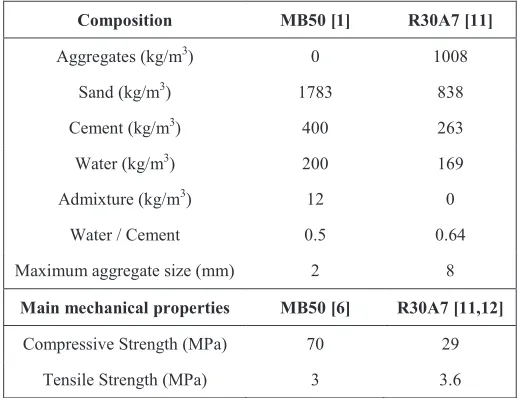
Due to their macroscopic heterogeneities, concretes are generally difficult to test in dynamic conditions. The MB50 micro-concrete has been designed to be representative of a standard concrete with a small maximum aggregate size (2 mm): the distribution of aggregates and the water to cement ratio are similar to a common concrete. This particularity allows reducing the tested volume which is convenient for laboratory testing. Its main properties are gathered in Table 1. Several experimental data are available for this material in direct tension [1], in bending [5] or in splitting [6]. Moreover, its compressive behaviour has been studied in simple compression [7] and under high confining pressure [8-10].
2.2 The R30A7 concrete
The R30A7 concrete has been designed to be representative of a standard concrete. Oppositely to the MB50 micro-concrete, bigger inclusions are included: its m aximum aggregate size is 8 mm. Its behavior has already been studied in confined compression [11] and quasi-oedometric tests [12]. Its composition and its main mechanical properties are reported in Table 1.
2.3 Tested specimens
The specimens used for spalling tests are c ylinders 46 mm in dia meter a nd 120 or 140 mm in length. T o perf orm ed ge-on i mpact test s plates of 200 x 120 x 15 mm3 w ere u sed. They were all obtained from large blocks (30 x 30 x 20 cm3) b y d rilling, c utting and g rounding. Af ter th e machining processes, they have been stored in water saturated by lime to a void the dissolution of portlandite. On the one hand, sat urated speci mens were pi cked up from water le ss than one hour before testing and regularly re-hydrated during their preparation. On the other hand, a second set of specimen was des iccated at 6 0°C during several weeks. T he los s o f water was reg ularly c hecked until the mass of the specimen stabilized.
3 Dynamic tensile testing: spalling experiments
Table 1. Composition and main mechanical properties of the MB50 and the R30A7 concrete.
Composition MB50 [1] R30A7 [11]
Aggregates (kg/m3) 0 1008
Sand (kg/m3) 1783 838
Cement (kg/m3) 400 263
Water (kg/m3) 200 169
Admixture (kg/m3) 12 0
Water / Cement 0.5 0.64
Maximum aggregate size (mm) 2 8
Main mechanical properties MB50 [6] R30A7 [11,12]
Compressive Strength (MPa) 70 29
Tensile Strength (MPa) 3 3.6
Fig. 1. Experimental configuration of the spalling test.
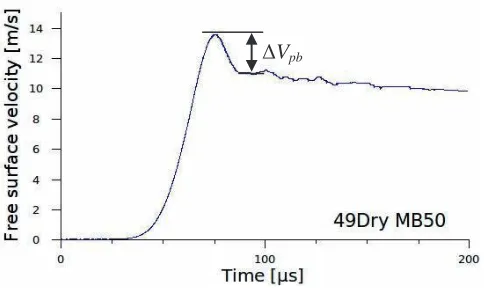
These tests are unu sual because t he mechanical eq uilibrium of t he speci men is n ever reached during the e xperiment. In thi s study, t he b asic setup co nsists of a proj ectile and a Ho pkinson bar diameter 46 mm a nd length r espectively 75 an d 1200 mm made of aluminium alloy to reduce the impedance mismatch with concrete. Several strain gauges are placed on the input bar to characterize the incident loading. Other gauges are glued directly on the specimen. Linked to the high frequency scope (Bandwidth: 500 MHz, recordin g frequency: 10 MS/s), they allow recording t he stress field evolution during the spalling test. Moreover, a laser extensometer (Bandwidth: 1.5 MHz) points out the rear f ace of the tested specimen to g et the free velocity signal. From this last experimental data the d ynamic te nsile stre ngth σdyn is ide ntified using t he li near acoustic ap proximation of No vikov [13]:
σdyn= ½ ρ C0 ΔVpb (1)
Fig. 2. Free surface velocity recording with the laser extensometer – 49Dry test performed on MB50
micro-concrete.
The experimental ca mpaign w as co nducted on dry and wet speci mens of concrete and m icro-concrete. During the experiments, an ultra-high speed camera with a maximum frame rate of 1 Mfps has been used to study the fragmentation kinetics in both concretes. After the test, frames have been post-processed with the Correli Q4 data image correlation (DIC) software (LMT-Cachan) to perform quantitative measurements of th e di splacement field. An example of spalling test perform ed o n MB50 micro-concrete specimen is presen ted in Figure 3a. T he corresponding field of displace ment (in pixels) obtain ed b y usi ng Correli Q4 is sh own. No crack s are v isible on th e specimen at t his point. Nevertheless the correlation results reveal several discontinuities of displacement. In Figure 3b th e displace ment ded uced f rom t he velocity signal o f laser ex tensometers is co mpared to th e average v alue of fragments, time t = 0 co rresponding to th e begi nning of ten sile stres ses in t he concrete specimen according to strain gauges. A good agreement between these two techniques is observed. This technique has been applied to spalling test p erformed on R30A7. Figure 3c presents the displacement field and s hows that the detected discontinuities correspond to f racture planes of the specimen. Thus the DIC method allows detecting early the damage in the specimen and carrying out an accurate evaluation of the strain field.
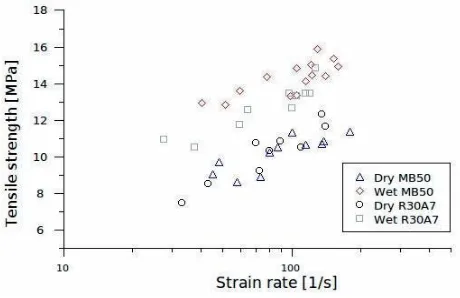
The spalling strength sensitivity to the strain rate of the micro-concrete and the concrete has been studied bet ween 30 a nd 150/s b y v arying t he i mpact velocity o f t he proj ectile. Dynamic tensile strengths obtained are plotted in Figure 4. The trends of the MB50 micro-concrete are similar to data of R 30A7 con crete. T his obs ervation s upports th e hy pothesis t hat a ggregate s ize has a li mited influence even at high strain rates.
(a)
Δ
V
pb1 2 3 4
Hopkinson bar
(b) (c)
Fig. 3. (a)Displacement field measured by Digital Image Correlation (scale in pixels) in a spalling test
(MB50 specimen – 49Dry test), (b) Comparison of axial displacements deduced from DIC and from the
laser extensometer signal (MB50 49Dry test), (c) Comparison of the displacement field (in pixels) and the post mortem cracking pattern of a R30A7 specimen (23Wet test).
Fig. 4. Dynamic tensile strength of the MB50 and the R30A7 concretes obtained from spalling tests.
4 Damage under impact: edge-on impact test
4.1 Principle of the EOI experiment
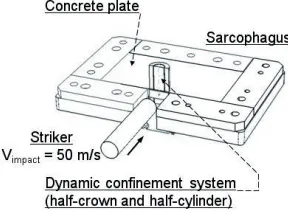
icro-concrete and of the R30A7 icro-concrete in the so-called sarcophagus configuration: icro-concrete plates are encapsulated in an aluminium box that keeps fragments close to th eir original position (cf. Fig. 5). After the test, a coloured hyperfluid resin is injected to highlight the damage pattern. Additionally, a dynamic confinement system [5] was used to locally increase the pressure in the projectile-specimen contact zo ne at the begi nning o f t he load ing, red ucing t his way t he co mpressive da mage a nd improving the spread of the incident wave in the tile (see Fig . 5).
Fig. 5. Experimental configuration of the EOI test.
4.2 Experiments conducted on the MB50 micro-concrete
Several numerical simulations were conducted to determine a test configuration (impact velocity and length of projectile) that creates a dynamic tensile loading in the concrete target comparable to that observed in spalling tests. It was established that a projectile 22.5 mm in diameter and 100 mm in length with an initial velocity of 50 m/s may generate a tensile strain rate of about 150/s at 50 mm from the impact spot [17].
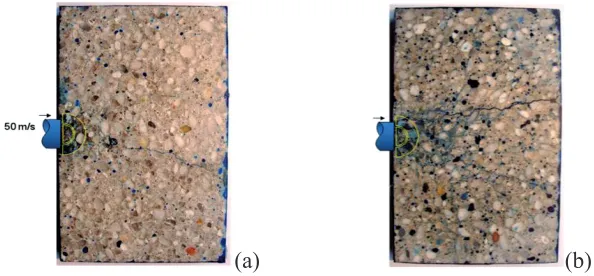
First EOI tests were carried out on MB50 micro-concrete plates of 200 x 120 x 15 mm3. T he specimens were infiltrated post mortem and polished to reveal the cracks. The results obtained on dry and wet specimens are reported in Figure 6. It can be remarked that a higher cracking density has developed during the te st per formed on a dr y specimen. Moreover, the e xisting crac ks in t he wet target see m t hinner a nd more clo sed. Con sequently, free water i n t he micro-concrete sh ows a significant i nfluence on the damage pattern. P erforming these test s o n co ncrete R30 A7 al lows determining the influence of aggregate size on damages due to an impact loading.
(a)
(b)
4.3 Experiments conducted on the R30A7 concrete
Standard c oncretes in clude generally ag gregates a t t he c entimetre sca le. Co nsequently, it i s necessary to evaluate the influence of aggregate size on the dynamic response of concrete. EOI tests were performed on dry and wet specimens of R30A7 concrete keeping the previous parameters: the projectile has a d iameter of 22.5 mm and a length of 100 mm and is projected onto the target at a speed of 50 m/s. Like for the MB50 micro-concrete, the specimens were infiltrated post-mortem and polished to bring out the cracks. The damage patterns are presented Figure 7. Again, the influence of free water is obvious: the damage is much more pronounced in the dry tile. In the same way as the MB50 micro-concrete, an int ense cracking develo ped n ear th e i mpacted area. Farth er, many long radial cracks are obs erved. Oppositely, in the wet tile the cracking network i s le ss developed and cracks are hardly v isible. B esides, on e can se e th at few ag gregates are brok en: crack s h ave circumvented the inclusions during their propagation.
(a)
(b)
Fig. 7. Cracking pattern of EOI tests performed on (a) a wet R30A7 tile and (b) a dry R30A7 tile.
4.4 Maximum aggregate size influence on damage under impact
Despite si gnificant diff erences i n ter ms o f microstructure bet ween MB50 micro-concrete and R30A7 co ncrete, da mage patterns produ ced b y i mpact ar e v ery s imilar: i n wet co nditions small cracks and li mited crack ope ning are n oted, whereas in d ry co nditions a pron ounced damage is observed. It is i nteresting to n ote t hat few a ggregates ar e brok en, crack ing being pre dominantly inter-granular: thus the matrix behaviour seems to drive t he dynamic fragmentation. Consequently, the maximum size of aggregates appears to play a limited role on the cracking pattern of samples subjected to im pact. Otherwise, the free water appears as a m ore important factor. The differences between dry and wet samples are more pronounced than between micro-concrete and concrete.
5 Conclusions
moisture has shown a great influence on the dynamic strength of both concretes. Moreover an ultra-high speed ca mera has been used. T he acqu ired f rames have been post -processed with a Digital Image Correlation software. It allowed identifying the fracture planes at th e early stage of damage and evaluating finely the strain field evolution during the spalling test. On the other hand, EOI tests have been co nducted to asse ss th e influence of aggregate size on th e da mage pattern of co ncrete when subjected to an impact loading. Similar trends than in spalling tests have been observed in both concretes: t he crack ing is predominantly i nter-granular. Agai n, th e free water changes more significantly the da mage patt ern. T hese observations show that t he results obtai ned from d ynamic tensile experiments on a micro-concrete, easier to test, can be transposed to a standard concrete.
References
1. F. Toutlemonde, Ph.D. thesis, LCPC, Paris, France (1994) 2. J.R. Klepaczko, A. Brara, Int. J. Impact Engrg. 25 (2001)
3. H. Schuler, C. Mayrhofer, K. Thoma, Int. J. Impact Engrg. 32 (2006)
4. J. Weerheijm, JCAM. Van Doormaal, Int. J. Impact Engrg. 34 (2007)
5. P. Forquin, Ph.D. thesis, LMT Cachan, France (2003) 6. G. Bernier, JM. Dalle, Report, Science Pratique S.A (1998)
7. G. Gary, J.R. Klepaczko, GRECO Geomaterial scientific report (1992) 8. E. Buzaud, Report Centre d’Etudes de Gramat (1998)
9. P. Forquin, G. Gary, F. Gatuingt, Int. J. Impact Engrg 35 (2008)
10. P. Forquin, K. Safa, G. Gary, Cement Con. Res., DOI: 10.1016/j.cemconres.2009.09.024 (2009) 11. X.H. Vu, Ph.D. thesis, L3S-R, Grenoble, France (2007)
12. T. Gabet, Ph.D. thesis, L3S-R, Grenoble, France (2006)
13. S.A. Novikov, II. Divnov, A.G. Ivanov, Fizika Metallov i Metallovedeniye 21 (1966)
14. E. Strassburger, H. Senf, EMI Report (1994)
15. X. Brajer, P. Forquin, R. Gy, F. Hild, J Non Crystal Solids, 316 (2003)
16. P. Forquin, F. Hild, J. Eng. Mech., 134 (2008)