Adapting Egyptian Vulture Optimization
Algorithm for Vehicle Routing Problem
Dilip Kumar, M. Nandhini
Department of Computer Science, Pondicherry University Puducherry, India
Abstract— Vehicle Routing problem (VRP) is the
challenging and sophisticated optimization problem which can be solved by various approaches like Exact methods, meta-heuristic optimization algorithm and Mathematical approaches including linear and integer programming Techniques. Exact algorithms can only solve relatively small problems of VRP. Several approximate algorithms have proven successfully to finding a feasible solution but not necessarily an optimum. In this paper, survey on various methods for solving VRP, variants of VRP, definition of VRP and the proposal for adapting Egyptian Vulture Optimization Algorithm for VRP are discussed.
Keywords— Vehicle Routing problem, Depot, Egyptian
Vulture Optimization Algorithm, Combinatorial Optimization.
I. INTRODUCTION
The vehicle routing problem (VRP) concerns the problem of finding the optimal routes from central depot to a number of geographically distributed customers or cities. The VRP is class of combinatorial optimization problem which can be considered as NP-Hard problem and manages the administrations of vehicles and customers in order to achieve a specific goal under the given constraints [1].
VRP is used in supply chain management for physical delivery of goods and services. Some application areas of VRP includes transportation, logistic, couriers and dial-a-services, school bus routing, communications, newspapers delivery, waste management, military and relief systems and so on[1].
The essential goals of VRP can be recognized as minimization of the quantity of vehicles utilization and aggregate travel time. The solution of a VRP requires the determination of an arrangement of routes and each route traversed by a different vehicle which begins and closes at its own particular depot such that every prerequisites of the customers are satisfied and the global transportation expenses is minimized[2].
The different techniques are available in literature in order to solve VRP covering the exact methods, heuristic and metaheuristics approaches. The exact method includes different methodologies like branch- and- bound, brute-force approach. Heuristic approach can be categorized into three parts as construction algorithms, Savings-based algorithms and Tour Splitting Algorithms [9]. Metaheuristics approaches include ant colony algorithm, constraints, deterministic annealing, genetic algorithm, tabu search [2].
Chiranjib Sur et al. [3] introduced the Egyptian Vulture Optimization Algorithm (EVOA), which is a nature-inspired inspired metaheuristic algorithm]. The same has been
adopted in this paper to solve the vehicle routing problem persisting in the existing system.
EVOA is inspired by habits of Egyptian vulture having the natural and phenomenal activities, intelligence and unique perceptions for leading lifestyle and acquisition of food. Egyptian vultures are uniquely known among the birds because of its dexterous capabilities in the tough challenging problems and use of tools with association of weakness finding ability and force [5].
EVOA algorithm is graciously applicable for graph based problems and node based continuous search. The main advantage of EVOA is its capability of different combinations formation and preventing the loop formation while developing the solution. So, EVOA is better option for solving the vehicle routing problem to find optimal solution [6].
II. RELATED WORKS
Vehicle routing problem was first introduced by Goerge Dantzig and John Ramser in paper (1959) [1]. The Classical Algorithm (or savings algorithm), an improved version of Dantzig and Ramser’s approach, was initially proposed in 1964 by Clarke and Wright as greedy approach [9].
David Pisinger and Stefan Ropke [11] solved the VRP using the Adaptive Large Neighborhood Search (ALNS) framework which is an extension of the Large Neighbourhood Search framework. The problem can be transformed into a rich pickup model using ALNS framework and can produce better solution. Secomandi introduced Dynamic programming to VRP with stochastic demands and solved the largest instances (up to 10 customers) using dynamic programming approach [15]. Balinski and Quandt[17] have developed a set partitioning formulation for VRPs including a large number of binary variables and then computed difficulties associated with the formulation.
'k-degree centre tree relaxation” of the m-TSP, where m is altered.
Laporte and Nobert have proposed Exact Algorithms for the VRP and divided it into three general classes dynamic programming, integer linear programming and direct tree search methods. Dynamic Programming was initially proposed for VRPs by Eilon,Watson-Gandy and Christofides and it was considered as VRP with a fixed number of vehicles and accomplished the minimum cost using recursion [17].
Jiafu Tang et al. [35] have solved the rich vehicle routing problem based on tabu search metaheuristics, variable neighborhood search and General Variable Neighborhood Search (GVNS). Frank W. Takes and Walter A. Kosters [22] have developed the binaryMCS-CWS method based on Monte Carlo Simulation and Clarke and Wright Savings heuristic to solve the VRP.
David S.W. Laie et al. [24] solved the heterogeneous vehicle routing problem on a multigraph using a tabu search heuristic approach. Saso Karakatic and Vili Podgorelec [25] have used a glowworm swarm optimization algorithm approach to solve VRP and developed the combinatorial neighborhood topology glowworm swarm optimization (CNT-GSO).
Claudio Contardo and Rafael Martinelli [26] have given solution for MDVRP under the capacity and route length constraints using the exact methods approach. They modeled the MDVRP using the adhoc vehicle flow and set -partitioning formulation and solved it by using two approaches of cutting plane methods and column –and- cut generation.
Mustafa Avci and Seyda Topaloglu [29] have solved heterogeneous VRP with simultaneously pickup and delivery by using the method of threshold accepting and tabu search algorithm. Rui Borges Lopes et al. [32] have applied evolutionary algorithm methodology to find solution of the capacited-location routing problem using as hybrid genetic algorithm.
Most of solution techniques have solved the relatively small problems and results in optimal but in context of larger problems, results are not optimal. A few of them also work for the larger problems up to some extent but not to level of optimality.
III. VRP -PROBLEM DEFINITION
Vehicle Routing Problem (VRP) is utilized to develop an optimal route for a fleet of vehicles to benefit the geographically distributed customers under given a set of constraints. A route means the path traversed by every vehicle in order to serve the customers.
Mathematical Formulation:
Let G = (V, E) be graph (directed or undirected). The number of customers/cities is represented by V= {0,1,2,3,……,n-1} and number of edges between customers/cities is represented by E={1,2,3,……,n}.The 0 vertex of graph represents the depot.
Objective Function:
Minimize Z = i=0∑n j=0∑n k=1∑n ci,j xki,j such that
n
j i
k j i
i
x
Q
q
, ,
Where,
c
i,j = transportation cost from i to j kj i
x, = 1, if vehicle k travels from i to j
= 0, otherwise
q
i = quantity/ amount demanded at location iQ = vehicle capacity/loading capacity of vehicle/storing capacity.
The constraints for vehicle routing problem are:
Every customer is served exactly once by one vehicle.
Every route begins and closes at the same depot.
The aggregate demand of the customer served by a route does not surpass the limit of vehicle capacity Q.
The length of every route does not surpass a predefined route length. [4],[5],[13].
A. Components of VRP
1) Road Network:
The road network can be depicted using a graph where the circular segments are streets/roads and cross section points are considered as vertices. The circular segments may be directed or undirected because of the possible ways having some restriction and expenses related to different path can vary anomalously.
2) Customer:
The component that requiring the organizations is suggested as customers. Each customer has a requirements that can be fulfilled in the different time periods (or time window) and different constraints.
3) Vehicles:
Transportation medium that used to delivery and it placed at depot. Each vehicle has a limit on the goods carried and a time period when it leaves the depot.
4) Depots:
The place where all vehicle can be placed for transportation purpose. The depot can be single or multiple type.
5) Drivers:
6) Operational Cconstraints:
Operational requirements allude to the way of transport and the nature of administration. Two classes of constraints are:
a) Local constraints b) Global constraints
a)Local Cconstraints:
In local constraints, our considerations are vehicle limit, maximum permitted route, separate/length of time, time imperatives (entry, time windows), kind of administration.
b) Global Constraints:
In global constraints, we consider the most extreme number of vehicles, maximum number of routes (for vehicle or depot), workload adjusting, working periods and shifts (least time between routes).
B. Types of VRP
1) Vehicle Routing Problem with Pickup and Delivery (VRPPD):
Vehicle Routing Problem with Pick-up and Delivery (VRPPD) is a VRP in which there is probability of return back a couple of things [17]. In VRPPD, it's expected to consider the products that customer give back to the conveyance vehicle must fit into it. This confinement makes the management more difficult and can prompt terrible usage of the vehicles limits, expanded travel time or a requirement of more vehicles.
2) Capacitated Vehicle Routing Problem (CVRP): CVRP is a VRP in which vehicle capacity is considered for the required route in order to fulfil the customer’s requirements that cannot exceed the vehicle’s capacity on route. CVRP is similar to VRP with the extra requirements that each vehicle must have uniform limit of loading product [12], [21].
3) Vehicle Routing Problem with Time Windows (VRPTW):
The VRPTW is the same as VRP with the extra confinement of a period window which is connected to every customer and within this time window the product must be delivered to customers. The goal of VRPTW is to minimize the vehicle armada, the entirety of travel time and holding up time expected to supply all customers in their required hours [9], [13], [19].
4) VRP with Backhauls (VRPB):
VRPB is a kind of VRP in which customers can request or give back a few products. The basic attention is that all conveyances must be made on every route before any pickups can be made [2].
5) Periodic VRP (PVRP):
In Periodic VRP, ordinarily the organizing period is a lone day. By virtue of the Period Vehicle Routing Problem (PVRP), the PVRP is summed up by extending the organizing period to settled day.
6) Multiple Depots VRP (MDVRP):
An association might have a couple of depots from which it can serve its customers. A group of vehicles is based at each depot. Each vehicle starts from one depot, serve the customers allocated to that depot, and return back to the same depot. In the event that the customers are bunched around depot, then the circulation issue ought to be displayed as an arrangement of free VRPs [11].
7) Split Delivery VRP (SDVRP):
In SDVRP, the customers can be served by different vehicles if the customers' sales are extensive as the limit of a vehicle capacity. SDVRP is an unwinding of the VRP wherein it is permitted that the same customer can be served by different vehicles. The target of SDVRP is to minimize the vehicle armada and the total travel time expected to supply to all customers.
8) Stochastic VRP (SVRP):
Stochastic VRP (SVRP) is VRP where one or a few segments of the problem are arbitrary. Stochastic customers, stochastic demand and stochastic times are the types of Stochastic VRP.
9) Vehicle Routing Problem with LIFO:
Vehicle routing problem with LIFO considered as VRPPD, aside from an extra confinement is to stack the things at any conveyance area, the thing being conveyed as of late grabbed [1].
10) Open Vehicle Routing Problem (OVRP): OVRP is eluded as to outline the base expense set of routes beginning from a central depot for fulfilling customer’s requests. Vehicles don't have to come back to the depot after serving last customer.
11) VRP with Satellite Facilities:
A vital part of the vehicle routing problem (VRP) is the utilization of satellite offices to renew vehicles along with a route. Whenever possible, satellite recharging permits the drivers to keep making conveyances until the end of their day of work without fundamentally coming back to central depot.
IV. SOLUTION TECHNIQUES FOR VRP
In literature, many types of solution methods are listed/ recorded and most of them were used to solve the vehicle routing problem and its variants. Mostly solution techniques are mainly comes under heuristics and meta-heuristic approaches.
1) Exact Methods
Exact methods were proposed to calculate each and every possible solution until reached the most optimum. A branch and bound algorithm uses a technique of divide and conquer to separate the solution space into sub problems and then optimizes individually over each sub problem. A branch-and-bound algorithm for the VRP clearly requires a lower bound because of getting the minimal total cost [2].
2) Heuristics:
Heuristic techniques perform a moderately constrained investigation of the search space and commonly create great quality solutions within modest computing times [11].
The Clarke and Wright savings algorithm is one of the most known heuristics for VRP which applies to problems where number of vehicles are not fixed and it works equally well for both directed and undirected problems [15]. Savings-based algorithms adopted the savings as parameter to find solution of VRP. It starts with a lot of small routes and combines them as long as possible [9].
Construction algorithms start with an empty route and gradually extended keeping eye on the total cost to minimize as possible. In Multi-route Improvement Heuristics algorithms, a sequence of vertex (or edges) can be exchange to find the feasible solution [15].
The Petal Algorithm [2] which is a natural extension of the sweep algorithm used to generate a number of routes, called petals, and create a final selection by solving a set partitioning problem. In Talliard’s algorithm, the main problem can be decomposed into two sub problems named as planar and non-planar and solve these two problems individually and finally conquer them to obtain an optimal solution [2].
3) Meta-Heuristics:
In meta-heuristics [6], the emphasis is to explore the regions of solution space. Meta-heuristics produces better solution compared to classical heuristics.
Genetic Algorithms is meta-heuristics algorithm which can apply to solve the VRP for getting the optimal solution [9]. Bell and McMullen [4] have been proposed Ant colony optimization technique to solve the vehicle routing problem. Granular Tabu Search was introduced by Toth and Vigo [2] to find the optimal solution of the VRP.
V. LIMITATIONS OF EXISTING ALGORITHMS/METHODS
1) Exact methods:
Generally, Exact methods can take care of small problems. It can be also applicable for large problems up to some extent if it has given adequate time and space. For big problems, Exact methods do not give an optimal solution and most of cases it gives the solution beyond the expectation. It is difficult to develop algorithms that solve NP-difficult problems in polynomial time unless NP = P [9].
2) Heuristics:
Neighbourhood search heuristics will be heuristics that take an answer as data, alter arrangement by performing a succession of operations on the arrangement and produce another, ideally enhanced arrangement. Masum and M. Faruque et. al [19] actualized one that embeds new components as a sub route utilizing heuristic technique. They discovered that great results can be achieved after putting high heuristics level but not all cases. Laporte and Semet characterized heuristics as takes after Constructive heuristics step by step produced a practical solution while watching out for arrangement cost, yet they don't contain a change stage for every solution.
3) Meta-heuristics:
In meta-heuristics approaches, small problems can be solved optimally but in lager problems, it faces difficulties.
EVOA is a metaheuristics algorithm which can produces the good solution in graph based problems. VRP is also a graph based application. With the compatibility found between VRP and EVOA, it is adopted for VRP to find the optimum solution.
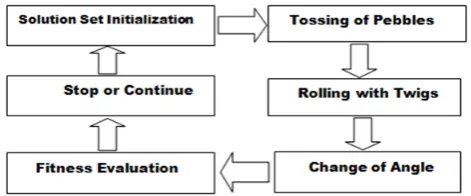
VI. EGYPTIANVULTUREOPTIMIZATIONALGORITHM The Egyptian Vulture Optimization Algorithm proposed by Chiranjib Sur, Sanjeev Sharma and Anupam Shukla, is inspired by the activities of Egyptian vulture which having the extra intelligence for livelihood and food acquisition compare to other birds. It gives the choice of versatile experimentation for the problem which can be done in multi-steps procedure [3]. The Egyptian Vulture Optimization Meta-Heuristics Algorithm has been described in steps. The two main activities of the Egyptian Vulture are the tossing of pebbles and the ability of rolling things with twigs [2].
Steps in Egyptian Vulture Optimization Algorithm Step 1: Initialization of the solution set or string which contain the representation of parameters in form of variables. The String represents a set of parameters which as a whole represents a single state of permissible solution.
Step 2: Refinement of the variable representatives, checking of the superimposed conditions and constraints.
Step 3: Tossing of Pebbles at selected or random points. Step 4: Rolling of Twigs on selected or the whole string. Step 5: Change of angle through selective part reversal of solution set.
Step 6: Fitness Evaluation.
Step 7: Check Condition for stopping.
Fig. 1. Steps for Egyptian Vulture Optimization Algorithm
A. Pebble tossing
The Egyptian Vulture uses the stones to break the eggs of other feathered birds with modestly harder eggs and it can have food inside after breaking eggs entirely. This technique is used for presentation of new route of action in the route plan set subjectively at particular positions. The three cases created are the presumable and actually emerge happens [5].
B. Rolling with Twigs
Egyptian Vulture is assumed as modification of the solution set for variables’ position changes and creates new solutions set which may produce better results.
Degree of roll and direction of rolling are parameter variables which can be formulated mathematically.
DS = Degree of Roll
DR as Direction of rolling
DR = 0, if shift is right = 1, if shift is left
Where 0 and 1 is generated randomly [6].
C. Change of Angle
In change of angle operation, the Egyptian Vulture can perform rotation of angle of stone to hit the egg in order to break it [4].
VII. PROBLEM SOLVING BY EGYPTIAN VULTURE ALGORITHM
Chiranjib Sur et al. [3] have tackled the Travelling salesman problem using the Egyptian vulture optimization algorithm. Egyptian Vulture Optimization Algorithm has been applied well on the TSP and the outcomes demonstrated that the Egyptian Vulture Optimization meta-heuristics has potential for inferring answers for the TSP. The EVOA can be utilized for a wide range of node based search problems and the fitness evaluation strategy and validation checking strategy varies for every situation [3].
Chiranjib Sur et al. [5] have solved the road traffic management using the Egyptian vulture optimization algorithm. The outcomes through graph demonstrated unmistakably mirrored the capability of the EVOA as a superior discrete heuristics and taking care of graph based combinatorial problems.
Chiranjib Sur et al. [6] have solved the knapsack problem using the Egyptian vulture optimization algorithm. The results of simulation using different data set showed that it is good meta-heuristic in the revolutionary algorithm. It is completely randomized and depends more on the way creation than on the neighborhood heuristics.
VIII. ADAPTATION OF EGYPTIAN VULTURE OPTIMIZATION ALGORITHM
A. EVOA Parameters adapted for VRP
1) Pebble tossing:
This activity is used for introducing the new solution set randomly at certain position keeping eye on the capacity of vehicle [6].
2) Rolling with Twigs:
The rolling of twigs activity of Egyptian Vulture is considered as Rolling of the solution set for changing of the positions of the variables[6].
3) Change of Angle
The change of angle operation of Egyptian Vulture can perform the mutation step where the detached connected vertices originates from the change of point of the hurling
of rocks in order to try different things with method and expand the possibility of spillage of the hard eggs[6].
B. Fitness Function for VRP
1) Fitness function:
A fitness function is used as single figure of merit to achieve predefined goal. Two main classes of fitness functions exist: one where fitness function does not change and other the fitness function is changeable [1].
The fitness function is of importance when it comes for decision making of system and optimization selection. The probabilistic approach can result in worse case. So, it needs the secondary fitness function and it can be calculated as (summation of fitness / number of nodes including depot).
IX. INITIAL SOLUTION FOR VRP
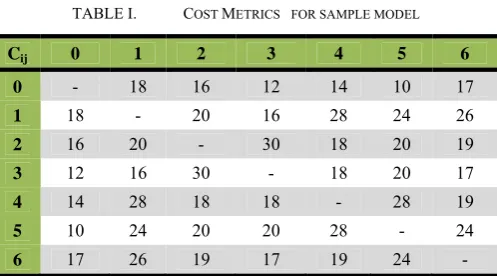
VRP has been solved by many solution approaches and showing different solutions. Here, we have considered a model and tried to find the initial solution. The transportation cost of model has been represented in form of the table.
TABLE I. COST METRICS FOR SAMPLE MODEL
Cij 0 1 2 3 4 5 6
0 - 18 16 12 14 10 17
1 18 - 20 16 28 24 26
2 16 20 - 30 18 20 19
3 12 16 30 - 18 20 17
4 14 28 18 18 - 28 19
5 10 24 20 20 28 - 24
6 17 26 19 17 19 24 -
In the table I, cost metrics represents the transportation costs among vertices including depot (0 vertex). The vertices 1,2,3,4,5,6 are customers and each customer has assigned a cost. If we have considered that there is no restriction on the number of vehicle then each customer can be served by one vehicle. In this case, six routes 1-0, 2-0, 3-0, 4-0, 0-5-0 and 0-6-0 can be formed. The resultant total transportation cost has calculated as 174. Further we applied the simple random method to solve the sample model and obtained two routes as 0-3-4-5-0 and 0-2-1-6-0 and transportation cost has calculated as 147.
X. EXPERIMENTAL EXPECTATION
XI. CONCLUSION
In literature, many types of methods and techniques are used for the solution of vehicle routing problem because of its challenges associated with it. The VRP can be used in fields of transportation and logistics. Egyptian vulture optimization algorithm provides promising results in graph based problems. EVOA can provide the better result in order to find the optimal solution of VRP. The future works need to find the improved solutions of vehicle Routing Problem and its variants in order to get most optimal solution over existing solutions.
REFERENCES
[1] https://en.wikipedia.org/wiki/Vehicle_routing_problem [2] http://neo.lcc.uma.es/vrp/solution-methods
[3] A. S. Chiranjib Sur, Sanjeev Sharma, “Solving Travelling Salesman Problem Using Egyptian Vulture Optimization Algorithm - A New Approach,” Pervasive Comput. Networked World, pp. 254–267, 2013.
[4] J. E. Bell and P. R. McMullen, “Ant colony optimization techniques for the vehicle routing problem,” Adv. Eng. Informatics, vol. 18, no. 1, pp. 41–48, 2004.
[5] N. Meghanathan, D. Nagamalai, and S. Rajasekaran, Networks and Communications. .
[6] P. Meesad, The 9th International. 2013.
[7] N. E. El-gharably, K. S. El-kilany, and A. E. El-sayed, “Optimization Using Simulation of the Vehicle Routing Problem,” vol. 7, no. 6, pp. 1593–1599, 2013.
[8] J. R. Montoya‐torres, J. López, S. Nieto, H. Felizzola, and N. Herazo‐ padilla, “Computers & Industrial Engineering A literature review on the vehicle routing problem with multiple depots,” Comput. Ind.
Eng., vol. 79, pp. 115–129, 2015.
[9] S. N. Kumar and R. Panneerselvam, “A Survey on the Vehicle Routing Problem and Its Variants,” vol. 2012, no. May, pp. 66–74, 2012. [10] C. Contardo and R. Martinelli, “A new exact algorithm for the multi‐
depot vehicle routing problem under capacity and route length constraints,” Discret. Optim., vol. 12, pp. 129–146, 2014.
[11] D. Pisinger and S. Ropke, “A general heuristic for vehicle routing problems,” Comput. Oper. Res., vol. 34, no. 8, pp. 2403–2435, 2007. [12] R. Baldacci, P. Toth, and D. Vigo, “Exact algorithms for routing
problems under vehicle capacity constraints,” Ann. Oper. Res., vol. 175, no. 1, pp. 213–245, 2010.
[13] B. Crevier, J.‐F. Cordeau, and G. Laporte, “The multi‐depot vehicle routing problem with inter‐depot routes,” Eur. J. Oper. Res., vol. 176, no. 2, pp. 756–773, 2007.
[14] M. M. Solomon, “Algorithms for the Vehicle Routing and Scheduling Problems with Time Window Constraints,” Oper. Res., vol. 35, no. 2, pp. 254–265, 1987.
[15] “Vehicle routing problem.”
[16] K. F. Doerner and V. Schmid, “Survey: Matheuristics for rich vehicle routing problems,” Hybrid Metaheuristics, vol. 6373, pp. 206–221, 2010.
[17] G. Laporte, “The vehicle routing problem: An overview of exact and approximate algorithms,” Eur. J. Oper. Res., vol. 59, no. 3, pp. 345– 358, 1992.
[18] H. C. Lau, M. Sim, and K. M. Teo, “Vehicle routing problem with time windows and a limited number of vehicles,” Eur. J. Oper. Res., vol. 148, no. 3, pp. 559–569, 2003.
[19] A. Masum and M. Faruque, “Solving the Vehicle Routing Problem using Genetic Algorithm,” Int. J., vol. 2, no. 7, pp. 126–131, 2011. [20] N. Christofides, “The vehicle routing problem,” RAIRO‐Operations
Res. Opérationnelle, vol. 10, no. V1, pp. 55–70, 1976.
[21] P. Chand, “A Multi‐objective Vehicle Routing Problem using Dominant Rank Method,” pp. 29–34, 2013.
[22] W. A. Kosters, “Applying Monte Carlo Techniques to the Capacitated Vehicle Routing Problem.”
[23] M. Marinaki and Y. Marinakis, “A Glowworm Swarm Optimization algorithm for the Vehicle Routing Problem with Stochastic Demands,” Expert Syst. Appl., vol. 46, pp. 145–163, 2016.
[24] D. S. W. Lai, O. Caliskan, and J. M. Y. Leung, “A tabu search heuristic for the heterogeneous vehicle routing problem on a multigraph,” Transp. Res. Part E, vol. 86, pp. 32–52, 2016.
[25] V. Podgorelec, “A survey of genetic algorithms for solving multi depot vehicle routing problem Saˇ so Karakatiˇ,” vol. 27, pp. 519– 532, 2015.
[26] C. Contardo and R. Martinelli, “A new exact algorithm for the multi-depot vehicle routing problem under capacity and route length constraints,” Discret. Optim., vol. 12, pp. 129–146, 2014.
[27] J. Brito, F. J. Martínez, J. A. Moreno, and J. L. Verdegay, “An ACO hybrid metaheuristic for close – open vehicle routing problems with time windows and fuzzy constraints,” Appl. Soft Comput. J., vol. 32, pp. 154–163, 2015.
[28] P. Hokama, F. K. Miyazawa, and E. C. Xavier, “A branch-and-cut approach for the vehicle routing problem with loading constraints,” vol. 47, pp. 1–13, 2016.
[29] M. Avci and S. Topaloglu, “A hybrid metaheuristic algorithm for heterogeneous vehicle routing problem with simultaneous pickup and delivery,” Expert Syst. Appl., 2016.
[30] J. R. Montoya-torres, J. López, S. Nieto, H. Felizzola, and N. Herazo-padilla, “Computers & Industrial Engineering A literature review on the vehicle routing problem with multiple depots,” Comput. Ind. Eng., vol. 79, pp. 115–129, 2015.
[31] B. Duk and Y. Dae, “A vehicle routing problem of both refrigerated- and general-type vehicles for perishable food products delivery,” J. Food Eng., vol. 169, pp. 61–71, 2016.
[32] R. Borges, C. Ferreira, and B. Sousa, “Computers & Operations Research A simple and effective evolutionary algorithm for the capacitated location – routing problem,” Comput. Oper. Res., vol. 70, pp. 155–162, 2016.
[33] N. Mohd, “An Efficient Genetic Algorithm for Large Scale Vehicle Routing Problem Subject to Precedence Constraints,” Procedia - Soc. Behav. Sci., vol. 195, pp. 1922–1931, 2015.