Non-perturbative effects of the electroweak interaction at the
LHC
B.A. Arbuzov1,⋆
1M.V. Lomonosov Moscow State University, 119991 Moscow, Russia
Abstract. Assuming an existence of the anomalous triple electro-weak bosons inter-action being defined by coupling constant λ we calculate its contribution to interac-tions of the Higgs with pairs of heavy particles. Bearing in mind experimental re-strictions −0.011 < λ < 0.011 we present results for possible effects in processes p p→W+W−H, p p→W+ZH, p p→W−ZH,p p→ttH,¯ pp →bbH. Effects could¯
be significant with negative sign ofλin associated heavy quarkst,bpairs production with the Higgs. In calculations we rely on results of the non-perturbative approach to a spontaneous generation of effective interactions, which defines the form-factor of the three-boson anomalous interaction.
1 Introduction
The totality of data nowadays confirms main features of the Standard Model, which consists of QCD, describing strong interactions, and the EW theory, describing electroweak interactions. This confir-mation is essentially based on numerous perturbative calculations which describe corresponding data. However in QCD the inevitable introduction of non-perturbative effects is also evident. First of all the low momenta region of the strong interaction definitely can not be described in the framework of the perturbative calculations. Examples of non-perturbative quantities are well-known: vacuum averages the gluon condensate< αs
πGaµνGaµν >, the quark condensate< q q¯ >etc. One of the most powerful methods of dealing with the non-perturbative effects is provided in the framework of approaches using the so-called effective interactions. The eldest and the most popular such effective interaction is the famous Nambu–Jona-Lasinio interaction [1, 2]. With application to quark structure of hadrons this approach adequately describes the low momenta region, seee.g.reviews [3–5].
The Nambu–Jona-Lasinio interaction deals with four-quark effective terms. However, the non-zero gluon condensate testifies for additional effective terms also in gluon interactions. There were also proposals for such terms. In particular, triple gluon interaction in the low momenta region of the following form
Le f f = −G
3!fabcGaµνGbνρGcρµ; (1)
whereGa
µνis a gauge covariant gluon field and fabc are structure constants of the colorS U(3), was proposed in work [6].
In the electro-weak theory necessity of non-perturbative contribution is not nowadays so evident as in QCD. However the structure of gauge theories is the same for both cases. One might expect similar features in three-boson interactions. In particular, the following three weak boson interaction was introduced [7, 8]
Le f f = −GW
3! F(pi)ϵabcW a
µνWνρbWρµc; GW=
g λ
M2
W ; W3
µν=cosθWZµν+sinθWAµν; (2)
wheregis the electro-weak gauge coupling and indicesa,b,ctake three values and the third boson W3
µν is a composition of neutral bosonsZ andγ. Form-factor F(pi) in [7, 8] is postulated and it has to vanish for|p2
i| ≫ Λ2, whereΛis a characteristic scale. Interaction (2) would lead to effects e.g.in electro-weak bosons pair production and was studied in experiments. The best limitations for parameterλis provided by recent data of the CMS Collaboration [9]
−0.011< λ <0.011. (3)
The ATLAS Collaboration presents similar results [10]
−0.013< λ <0.013. (4)
Both the Nambu–Jona-Lasinio interaction and interaction (1) are supposed to act in a low momenta re-gion. This means, that in both cases form-factors are present, which guarantee decreasing of intensity of the interactions for large momenta. In the original NJL [1, 2] interaction a cut-offwas introduced for the purpose. Starting of fundamental gauge theories of interactions of the Standard Model we have to understand the origin of such effective cut-off. This can be done under assumption of these interac-tions being spontaneously generated. The notion of spontaneous generation is traced back to methods of the superconductivity theory. In application to superconductivity the conception of compensation principle was elaborated [11, 12] by N.N. Bogoliubov. This approach was applied to spontaneous generation of Nambu–Jona-Lasinio interaction in work [13] and of interaction (1) in work [14]. In the course of this application form-factors inherent to corresponding interactions are uniquely defined1.
As an additional confirmation of applicability of the method to non-perturbative quantities, valueV2
of the gluon condensate was calculated [14] in agreement with its phenomenological value.
2 Additional interactions of the Higgs with electro-weak bosons
Electro-weak bosonsW±,Z due to their large masses interact with HiggsH significantly. Namely there are the following vertices for interaction of HiggsHwithW+W−andZ Zrespectively
ı gMWgµν; ı
gMZ
cosθWgµν. (5)
Now let us assume, that in addition to usual three-boson gauge interaction, interaction (2) really exists. Then three-boson vertex takes the form
V(µ,p;ν,q;ρ,k)=−gϵabc(gµν(qρ−pρ)+gνρ(kµ−qµ)+gρµ(pν−kν)+ λ M2
W
F(p,q,k)×
(gµν(qρpk−pρqk)+gνρ(kµpq−qµpk)+gρµ(pνqk−kνpq)+qµkνpρ−kµpνqρ)). (6)
In the electro-weak theory necessity of non-perturbative contribution is not nowadays so evident as in QCD. However the structure of gauge theories is the same for both cases. One might expect similar features in three-boson interactions. In particular, the following three weak boson interaction was introduced [7, 8]
Le f f = −GW
3! F(pi)ϵabcW a
µνWνρbWρµc; GW=
g λ
M2
W ; W3
µν=cosθWZµν+sinθWAµν; (2)
wheregis the electro-weak gauge coupling and indicesa,b,ctake three values and the third boson W3
µν is a composition of neutral bosons Z and γ. Form-factor F(pi) in [7, 8] is postulated and it has to vanish for|p2
i| ≫Λ2, whereΛis a characteristic scale. Interaction (2) would lead to effects e.g.in electro-weak bosons pair production and was studied in experiments. The best limitations for parameterλis provided by recent data of the CMS Collaboration [9]
−0.011< λ <0.011. (3)
The ATLAS Collaboration presents similar results [10]
−0.013< λ <0.013. (4)
Both the Nambu–Jona-Lasinio interaction and interaction (1) are supposed to act in a low momenta re-gion. This means, that in both cases form-factors are present, which guarantee decreasing of intensity of the interactions for large momenta. In the original NJL [1, 2] interaction a cut-offwas introduced for the purpose. Starting of fundamental gauge theories of interactions of the Standard Model we have to understand the origin of such effective cut-off. This can be done under assumption of these interac-tions being spontaneously generated. The notion of spontaneous generation is traced back to methods of the superconductivity theory. In application to superconductivity the conception of compensation principle was elaborated [11, 12] by N.N. Bogoliubov. This approach was applied to spontaneous generation of Nambu–Jona-Lasinio interaction in work [13] and of interaction (1) in work [14]. In the course of this application form-factors inherent to corresponding interactions are uniquely defined1.
As an additional confirmation of applicability of the method to non-perturbative quantities, valueV2
of the gluon condensate was calculated [14] in agreement with its phenomenological value.
2 Additional interactions of the Higgs with electro-weak bosons
Electro-weak bosonsW±,Z due to their large masses interact with HiggsHsignificantly. Namely there are the following vertices for interaction of HiggsHwithW+W−andZ Zrespectively
ı gMWgµν; ı
gMZ
cosθWgµν. (5)
Now let us assume, that in addition to usual three-boson gauge interaction, interaction (2) really exists. Then three-boson vertex takes the form
V(µ,p;ν,q;ρ,k)=−gϵabc(gµν(qρ−pρ)+gνρ(kµ−qµ)+gρµ(pν−kν)+ λ M2
W
F(p,q,k)×
(gµν(qρpk−pρqk)+gνρ(kµpq−qµpk)+gρµ(pνqk−kνpq)+qµkνpρ−kµpνqρ)). (6)
1Of course, in the framework of an approximation.
HereF(p,q,k) is a form-factor, which is defined in the framework of the spontaneous generation of effective interaction (2) [15] in the compensation approach, which we have discussed in the Intro-duction. Then we have additional contribution toVVHvertex due to terms proportional toλand to λ2 according to diagrams presented in Fig. 1. As a consequence we have additional contribution to verticesVVV′H, whereVandV′correspond to electro-weak bosonsW,Z, γ.
The combined account of both vertices (5, 6) leads to corrections forVV′Hvertex according to diagrams shown in Fig. 1.
We have for vertices of interactions of the Higgs with two electro-weak bosonsV(p, µ)V′(q, ν) instead of (5)
VW+W−H=ıgMW(gµν+GWW(gµνpq−pνqµ));
VZZH =ı gMZ
cosθW(gµν+GZZ(gµνpq−pνqµ)); VZAH=ı gMZ
cosθWGZγ(gµνpq−pνqµ); VAAH =ı
gMZ
cosθWGγγ(gµνpq−pνqµ); (7) GZ Z=cos2θWGW0W0; Gγ γ=sin2θWGW0W0; GZγ =2 cosθWsinθWGW0W0;
GW0W0 =
2g
M2
W
(3gλ 8π2I1−
√ 2λ2
π I2 )
;
GW W= g M2
W
(3gλ 8π2IW1−
√ 2λ2 π IW2+
3gλ 8π2IZ1−
√ 2λ2 π IZ2
) .
Here
I1= ∫ z0
0
F(t)dt 2(√t+µ)2; I2=
∫ z0
0
2tF2(t)dt
(√t+µ)3; IW1= ∫ z0
0
F(t)(√t+sµZ)dt (√t+µZ)2(√t+µ)
;
IW2= ∫ z0
0
F2(t)√t(√t+sµZ)dt
(√t+µZ)2(√t+µ)
; IZ1= ∫ z0
0
F(t)√t dt (√t+µZ)2(√t+µ)(1−s)
; (8)
IZ2 = ∫ z0
0
F2(t)t dt
(√t+µZ)2(√t+µ)(1−s)
; µ= g|λ|
16√2π; µZ=
g|λ| 16√2π(1−s);
t=G
2
W(p2)2
512π2 ; s=sin2θW.
We take form-factor F(t) = F(p,−p,0) from results of work [15] in which the compensation approach was applied to the electro-weak interaction:
F(t)=1
2G3115(t|10,1/2,0,−1/2,−1)−
85√2g0
128π G
31
15(t|11,/12/2,1/2,−1/2,−1)+C1G1004(t|
1 2,1,−
1 2,−1
)+
C2G1004(t|1,21,−12,−1); t=
G2
W(p2)2
512π2 ; F(t)=0,t≥t0; t0=9.6175,
g0=0.6037,C1=−0.0351,C2=−0.0511. (9)
Hereg0is the value of gauge electro-weak couplinggat pointt=t0and we use Meijer functions
Gmn pq(t|ab11,...,abqp
) ,
With definitions (7,8,9) we calculate the couplings and show results in Table 1. Note, that addi-tional interactions (7) were already considerede.g.in works [17, 18].
Table 1. Coupling constantsGVV′GeV−2 of effective interactionsHVV′in dependence on value
ofλ. All coupling values are multiplied by 107.
λ GWW GZZ GZγ Gγγ
0.01 3.10 4.40 4.71 1.26 0.006 2.20 3.10 3.32 0.89 0.003 1.33 1.86 2.00 0.54
0 0 0 0 0
−0.003 −3.51 −4.83 −5.17 −2.58
−0.006 −6.54 −9.01 −9.65 −2.58 −0.01 −10.3 −14.2 −15.2 −4.08
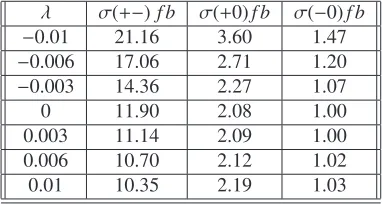
Then we calculate cross sections of pair weak boson production accompanied by the Higgs. In doing this we apply the CompHEP package [19]. In subsequent Tables we show results for values of couplings in (7) and cross sections of processesp+p→W+W−H+X(σ(+−)),p+p→W+ZH+X
(σ(+0)) and p +p → W−ZH +X (σ(−0)). Results are shown in dependence on value of λ in admissible interval (3).
Table 2. Production LO cross sections ofVV′Hfor √s=8TeVat the LHC.
λ σ(+−)f b σ(+0)f b σ(−0)f b −0.01 5.18 1.21 0.499
−0.006 4.62 1.09 0.45
−0.003 4.22 1.02 0.43
0 3.86 0.98 0.42
0.003 3.75 0.98 0.42 0.006 3.69 0.98 0.42 0.01 3.62 0.98 0.42
Table 3. Production LO cross sections ofVV′Hfor √s=13TeVat the LHC.
λ σ(+−)f b σ(+0)f b σ(−0)f b
−0.01 21.16 3.60 1.47
−0.006 17.06 2.71 1.20
−0.003 14.36 2.27 1.07
0 11.90 2.08 1.00
0.003 11.14 2.09 1.00 0.006 10.70 2.12 1.02 0.01 10.35 2.19 1.03
With definitions (7,8,9) we calculate the couplings and show results in Table 1. Note, that addi-tional interactions (7) were already considerede.g.in works [17, 18].
Table 1. Coupling constantsGVV′GeV−2 of effective interactionsHVV′in dependence on value
ofλ. All coupling values are multiplied by 107.
λ GWW GZZ GZγ Gγγ
0.01 3.10 4.40 4.71 1.26 0.006 2.20 3.10 3.32 0.89 0.003 1.33 1.86 2.00 0.54
0 0 0 0 0
−0.003 −3.51 −4.83 −5.17 −2.58
−0.006 −6.54 −9.01 −9.65 −2.58 −0.01 −10.3 −14.2 −15.2 −4.08
Then we calculate cross sections of pair weak boson production accompanied by the Higgs. In doing this we apply the CompHEP package [19]. In subsequent Tables we show results for values of couplings in (7) and cross sections of processesp+p→W+W−H+X(σ(+−)),p+p→W+ZH+X
(σ(+0)) and p +p → W−ZH +X (σ(−0)). Results are shown in dependence on value of λ in admissible interval (3).
Table 2. Production LO cross sections ofVV′Hfor √s=8TeVat the LHC.
λ σ(+−)f b σ(+0)f b σ(−0)f b −0.01 5.18 1.21 0.499
−0.006 4.62 1.09 0.45
−0.003 4.22 1.02 0.43
0 3.86 0.98 0.42
0.003 3.75 0.98 0.42 0.006 3.69 0.98 0.42 0.01 3.62 0.98 0.42
Table 3. Production LO cross sections ofVV′Hfor √s=13TeVat the LHC.
λ σ(+−)f b σ(+0)f b σ(−0)f b
−0.01 21.16 3.60 1.47
−0.006 17.06 2.71 1.20
−0.003 14.36 2.27 1.07
0 11.90 2.08 1.00
0.003 11.14 2.09 1.00 0.006 10.70 2.12 1.02 0.01 10.35 2.19 1.03
From Table 3 we see, that for √s = 13TeV with negativeλ the effect is noticable, especially for processp+p → W+W−H+X, ande.gfor λ = −0.01 the cross-section is almost two times more than the SM one. However the cross-section itself is presumably not sufficiently high for a productive study of the effect.
Let us note also, thatVV′H the additional interaction withλ 0 might give effect for VBF Higgs production. However calculations show, that with couplings from Table 1 effects even for √s
=13TeVare insignificant, as well as effects for branching ratios of the Higgs decays.
We have also calculated effects of the interaction for an associated single electro-weak boson production with the Higgs. While cross sections of processes are significant (few hundreds offb), contributions of the additional interaction do not exceed few per cent. For example, for process p p→W+H+Xat √s=13TeVwith|λ|=0.01 ratioµ=1.033.
Possible manifestations of vertices (7) were studied in decays H → W+W−,H → Z Z [18] . Results of this work give limitations, which definitely do not contradict values for couplings presented in Table 1.
In the next section we consider additional contributions of interactions (7) to interaction of the Higgs with quarks, especially with the heavy ones, which can lead to essentially more significant effects at the LHC.
3 Additional top and bottom quarks interaction with the Higgs
We use vertices (6) to define additional contribution for quarks interactions with Higgs. For the beginning we shall be interested in interactions of the most heavy top quarks.
Taking into account these vertices we calculate loop diagrams presented in Fig. 2 to obtain the following expression for ¯ttHvertex, which corresponds to the first diagram in Fig.2
V¯ttH=− g 2MWt¯
(M
t+9 cosθWMZMWGWWI1( ˆp1−pˆ2)(1+γ5))tH; ˆa=aµγµ; (10)
whereGWWis already defined in (6) and calculated in Table 1,p1andp2are respectively outcoming
momenta oftand ¯tquarks. IntegralI1is defined in (8). For calculation of the integral we here use the
same form-factorF(t) (9).
Due to QCD gauge invariance we have to take into account also vertex for fourfold interaction involving also a gluon: ¯ttHGµ, which actually corresponds to the second diagram in Fig.2
VttHG¯ =9ggscosθWMZGWWI1t¯Gˆ(1+γ5)tH; (11)
wheregsis the QCD gauge coupling constant and of course usual structure of the QCD is used. Then we perform calculations for cross sections of processp+p→t t H¯ +Xfor two energies of the LHC: √s
=8TeVand √s=13TeV
Let us define for the same values of √sratios of cross-sections with nonzero λin admissible interval (3) and its SM value forλ=0
µ√s = σλ(pp→ttH¯ )
σ0(pp→ttH¯ ); (12)
whereσ0 is actually SM value for the cross section. Results of calculations with application of
CompHEP package [19] are shown in Table 4.
λ σ(13TeV) σ(8TeV) µ13 µ8
−0.01 1628.2 460.6 3.14 3.15
−0.006 1212.9 342.6 2.34 2.34 −0.003 853.3 241.0 1.65 1.65
0 517.8 146.1 1.00 1.00
0.003 401.4 113.6 0.78 0.78 0.006 348.7 98.4 0.67 0.67 0.01 304.4 85.9 0.59 0.59
Values for cross-sections are calculated with the current value for the strong coupling [20]
αs(MZ) = 0.1181±0.0011. (13)
The uncertainty in (13) means 2% accuracy for calculated ross-sections. With taking into account of other sources of uncertainties we estimate overall accuracy to be around 10%.
The combination of the ATLAS and the CMS data, collected with √s=7TeVand 8TeV, gives the following experimental result for ratioµ8[21]
µ8 = 2.3+0−0..76. (14)
Due to significant uncertainties, result (14) does not mean convincing deviation from the SM value. With numbers from Table 4 we have from (14) the following prediction
λ = −0.0057+0.0028
−0.0039. (15)
The result is safely inside experimental limitations (3, 4). Let us note, that estimates for cut-offan energy scale also evidently do not contradict LHC results [9]. Of course we have in (15) again only two standard deviations effect, which undoubtedly needs further studies. We see that values of µ, practically, do not depend on √sbut with √s=13TeVcross sections are more than three times as much as those for conditions of result (14). One might hope to check the predictions in forthcoming experimental studies at the LHC with increased statistics. Emphasize, that in case of this study would give resultλ 0, we would come to the fundamental conclusion of non-perturbative effects in the electro-weak interaction to be necessarily present. Let us note, that recent NLO and NNLL SM calculations of ¯ttHproduction cross section at 13 TeV are presented in works [22–24].
Let us consider also associative production of the Higgs with ¯b bpairs. Unlike thetquark pairs case, for which the experimental studies were performed and have given results,e. g.(14), there were no dedicated studies. However, interactions (10,11) in our consideration also exist for other quarks. All the difference is connected only with value of the quark mass in (10). In particular, it is advisable to consider also process ofbquark associative pair production with Higgs
p+p→bbH¯ +X. (16)
Results of calculations are shown in Table 5.
λ σ(13TeV) σ(8TeV) µ13 µ8
−0.01 1628.2 460.6 3.14 3.15
−0.006 1212.9 342.6 2.34 2.34 −0.003 853.3 241.0 1.65 1.65
0 517.8 146.1 1.00 1.00
0.003 401.4 113.6 0.78 0.78 0.006 348.7 98.4 0.67 0.67 0.01 304.4 85.9 0.59 0.59
Values for cross-sections are calculated with the current value for the strong coupling [20]
αs(MZ) = 0.1181±0.0011. (13)
The uncertainty in (13) means 2% accuracy for calculated ross-sections. With taking into account of other sources of uncertainties we estimate overall accuracy to be around 10%.
The combination of the ATLAS and the CMS data, collected with √s=7TeVand 8TeV, gives the following experimental result for ratioµ8[21]
µ8 = 2.3+0−0..76. (14)
Due to significant uncertainties, result (14) does not mean convincing deviation from the SM value. With numbers from Table 4 we have from (14) the following prediction
λ = −0.0057+0.0028
−0.0039. (15)
The result is safely inside experimental limitations (3, 4). Let us note, that estimates for cut-offan energy scale also evidently do not contradict LHC results [9]. Of course we have in (15) again only two standard deviations effect, which undoubtedly needs further studies. We see that values of µ, practically, do not depend on √sbut with √s=13TeVcross sections are more than three times as much as those for conditions of result (14). One might hope to check the predictions in forthcoming experimental studies at the LHC with increased statistics. Emphasize, that in case of this study would give resultλ 0, we would come to the fundamental conclusion of non-perturbative effects in the electro-weak interaction to be necessarily present. Let us note, that recent NLO and NNLL SM calculations of ¯ttHproduction cross section at 13 TeV are presented in works [22–24].
Let us consider also associative production of the Higgs with ¯b bpairs. Unlike thetquark pairs case, for which the experimental studies were performed and have given results,e. g.(14), there were no dedicated studies. However, interactions (10,11) in our consideration also exist for other quarks. All the difference is connected only with value of the quark mass in (10). In particular, it is advisable to consider also process ofbquark associative pair production with Higgs
p+p→bbH¯ +X. (16)
Results of calculations are shown in Table 5.
Table 5. Production LO cross sections f bof ¯bbHfor √s=8TeV,13TeVand ratioµb√sat the LHC.
λ σ(13TeV) σ(8TeV) µb13 µb8
−0.01 1612.5 572.7 2.93 2.77
−0.006 1204.4 433.6 2.19 2.10 −0.003 903.0 329.1 1.64 1.59
0 550.8 206.7 1.00 1.00
0.003 446.0 151.8 0.81 0.82 0.006 396.4 151.8 0.72 0.73 0.01 354.6 137.1 0.64 0.66
Effects for the b-quarks are of the same order of magnitude as for thet-quark pairs. Unlike thet-quark case we have no datum for a comparison. As a matter of fact, analogous results are valid for light quarksu,d,c,sas well.
4 Conclusion
The problem of an existence of non-perturbative contributions in the electro-weak interaction is with-out doubt a fundamental one. Anomalous three-boson interaction (2) provides the crucial test for this problem. We have shown above, that there are promising processes
p+p→ttH¯ +X p+p→bbH¯ +X; (17)
for investigation of the problem at the LHC, and we can hope, that future results for these processes at√s=13TeVwill confirm the existence of non-perturbative effects in the electro-weak interaction. Let us note, that we have studied how results for processes under the study depend on different cuts. It comes out, that for main process p+ p → ttH¯ cuts M(¯tt) > M0,M(tH) > M′0,pT(H) > pT0
etclead, of course, to decreasing of cross sections, but, practically, do not change ratiosµfor data. Thus introduction of cuts is to be defined by conditions of experiments, in particular by background considerations.
The important problem is, if predictions under the discussion could in any way contradict the present knowledge. We have already mentioned, that contributions of the additional interactions to branching ratios of the Higgs are negligible. The effects in processp+p→qqH¯ +X, where we have to take into account all six flavors of quarks would lead to an additional contribution to the total Higgs production cross section. For example, forλ =−0.006, which actually is quite close to the central value in estimate (15) we have from Tables 4, 5 the following additional contributions∆σto the total cross section of the Higgs production
∆σ(8TeV)=1.36pb; σ(8TeV)=22.3pb;
∆σ(13TeV)=4.03pb; σ(13TeV)=50.6pb; (18)
where we also show the SM values for the total cross-sections [20]. These additional contributions lead to a change in the global signal strength, which currently reads [20]
µ=1.09±0.07±0.04±0.03±0.07; (19)
where two last errors are connected with uncertainties in the theoretical estimates. We easily see, that additional contributions (18) give the following changes for theoretical predictions for effectiveµ instead of unity
The results evidently do not contradict to value (19), which is based mostly on data collected with √s
=7 and 8TeV.
In case of an existence of triple interaction (2),e.g.in processes (17), being confirmed, extensive studies of other possible non-perturbative effects will be desirable. Let us emphasize that simultaneous consideration of effects in reaction (17) and searches for anomalous interaction (2) are of the utmost importance. Provided these searches would give a positive and compatible results, we would obtain the strong evidence in favour of non-perturbative contributions of the electro-weak interaction.
Let us note also, that effects in top pair production in association with an electro-weak boson W±,Z, which were discussed in work [25] under assumption of wouldbe existence of four-fold electro-weak bosons effective interaction [26, 27]. These effects might also indicate for the non-perturbative contributions.
In case the non-perturbative effects being discussed above would be discovered, there could ap-pear new and really attractive possibilities. The approach [13–16, 25, 28] is connected with non-trivial solutions of compensation equations. Such solutions exist only for definite values of parameters in-herent in a problem under a study. For example, the non-trivial solutions exist for values of cou-pling constants at the characteristic scaleΛfor QCDgs(Λs) = 3.116 [14] and for the EW theory
gEW(ΛEW) = 0.604 [15] (see also (9)), that seems quite reasonable. Thus in case of the successful confirmation of the approach, we could hope to find a way for understanding of why physical values of couplings and maybe also of mass ratios are such as we do observe.
5 Acknowledgment
The results evidently do not contradict to value (19), which is based mostly on data collected with √s
=7 and 8TeV.
In case of an existence of triple interaction (2),e.g.in processes (17), being confirmed, extensive studies of other possible non-perturbative effects will be desirable. Let us emphasize that simultaneous consideration of effects in reaction (17) and searches for anomalous interaction (2) are of the utmost importance. Provided these searches would give a positive and compatible results, we would obtain the strong evidence in favour of non-perturbative contributions of the electro-weak interaction.
Let us note also, that effects in top pair production in association with an electro-weak boson W±,Z, which were discussed in work [25] under assumption of wouldbe existence of four-fold electro-weak bosons effective interaction [26, 27]. These effects might also indicate for the non-perturbative contributions.
In case the non-perturbative effects being discussed above would be discovered, there could ap-pear new and really attractive possibilities. The approach [13–16, 25, 28] is connected with non-trivial solutions of compensation equations. Such solutions exist only for definite values of parameters in-herent in a problem under a study. For example, the non-trivial solutions exist for values of cou-pling constants at the characteristic scaleΛfor QCDgs(Λs) = 3.116 [14] and for the EW theory
gEW(ΛEW) = 0.604 [15] (see also (9)), that seems quite reasonable. Thus in case of the successful confirmation of the approach, we could hope to find a way for understanding of why physical values of couplings and maybe also of mass ratios are such as we do observe.
5 Acknowledgment
The author appreciates the collaboration with I.V. Zaitsev in obtaining results of the talk (see works [25, 28]). The studies are supported in part by grant NSh-7989.2016.2 of the President of Russian Federation.
Figure 1.Diagram representation of non-perturbative contribution toVVHvertices depicted as square. Double lines represent Higgs boson, dotted lines represent electro-weak bosons. Black spots represent non-perturbative vertex (2, 6) and simple points corresponds to usual SM interaction.
Figure 2.Diagram representation of non-perturbative contribution to ¯ttHand ¯ttHG. Double lines represent Higgs boson, dotted lines represent electro-weak bosons. Thick lines represents thetquark, the wavy line corresponds to a gluon. Non-perturbative part ofVVHvertex is defined in the previous section and simple points correspond to usual gauge interaction.
References
[1] Y. Nambu and G. Jona-Lasinio, Phys. Rev., 122 (1961), p. 345. [2] Y. Nambu and G. Jona-Lasinio, Phys. Rev., 124 (1961), p. 246. [3] M. K. Volkov, Annals Phys.,157 (1984), p. 282.
[6] A. I. Alekseev, B. A. Arbuzov and V. A. Baikov, Theor. Math. Phys., 52 (1982), p. 739. [7] K. Hagiwara, R. D. Peccei, D. Zeppenfeld and K. Hikasa, Nucl. Phys. B, 282 (1987), p. 253. [8] K. Hagiwara, S. Ishihara, R. Szalapski and D. Zeppenfeld, Phys. Rev. D, 48 (1993), p. 2182. [9] A.M. Sirunyanet al.(CMS Collaboration), Phys. Lett. B, 772 (2017) p. 21.
[10] M. Aabudet al.(ATLAS Collaboration), Eur. Phys. J. C, 77 (2017) p. 563. [11] N. N. Bogoliubov, Soviet Phys.-Uspekhi, 67 (1959), p. 236.
[12] N. N. Bogoliubov, Physica Suppl. (Amsterdam), 26 (1960), p. 1.
[13] B. A. Arbuzov, M. K. Volkov and I. V. Zaitsev, Int. J. Mod. Phys. A, 21 (2006), p. 5721. [14] B. A. Arbuzov and I. V. Zaitsev, Int. J. Mod. Phys. A, 28 (2013), Article 1350127. [15] B. A. Arbuzov and I. V. Zaitsev, Phys. Rev. D, 85 (2012), Article 093001.
[16] B. A. Arbuzov, Non-perturbative Effective Interactions in the Standard Model, De Gruyter, Berlin, 2014.
[17] I. Andersonet al., Phys. Rev. D, 89 (2014), Article 035007.
[18] V. Khachatryanet al.(CMS Collaboration) Phys.Rev. D, 92 (2015) Article 012004. [19] E. E. Booset al.(CompHEP Collaboration), Nucl. Instr. Meth. A, 534 (2004), p. 250. [20] C. Patringnaniet al.(Particle Data Group), Chin. Phys. C, 40 (2016), Article 100001. [21] G. Aadet al.(ATLAS and CMS Collaborations), J. High Energy Phys., 1608 (2016), p. 045. [22] A. Broggioet al., JHEP, 1603 (2016) p. 124.
[23] A. Broggioet al., JHEP, 1702 (2017) p. 126. [24] A. Kuleszaet al., arXiv: 1704.03363 [hep-ph].
[25] B. A. Arbuzov and I. V. Zaitsev, Prog. Theor. Exp. Phys. 85 (2016), Article 093001. [26] G. Belanger and F. Boudjema, Phys. Lett. B, 288 (1992), p. 201.
[27] G. Belangeret al., Eur. Phys. J. C, 13 (2000), p. 283.