and Putative Extracellular Proteins of
Streptococcus pyogenes
in India,
a Region with High Streptococcal Disease Burden, and Implication for
Development of a Regional Multisubunit Vaccine
Vivek Sagar,aRené Bergmann,aAndreas Nerlich,a* David J. McMillan,bD. Patric Nitsche Schmitz,aand Gursharan S. Chhatwala
Department of Medical Microbiology, Helmholtz Centre for Infection Research, Braunschweig, Germany,aand Queensland Institute for Medical Research, Brisbane, Australiab
Streptococcus pyogenescauses a wide variety of human diseases and is a significant cause of morbidity and mortality. Attempts to
develop a vaccine were hampered by the genetic diversity ofS. pyogenesacross different regions of the world. This study sought to identify streptococcal antigens suitable for a region-specific vaccine in India. We used a two-step approach, first performing epidemiological analysis to identify the conserved antigens among Indian isolates. The second step consisted of validating the identified antigens by serological analysis. The 201 streptococcal clinical isolates from India used in this study represented 69 differentemmtypes, withemm12 being the most prevalent. Virulence profiling of the North and South IndianS. pyogenes iso-lates with a custom-designed streptococcal virulence microarray identified seven conserved putative vaccine candidates. Colla-gen-like surface protein (SCI), putative secreted 5=-nucleotidase (PSNT), and C5a peptidase were found in 100% of the isolates, while R28, a putative surface antigen (PSA), and a hypothetical protein (HYP) were found in 90% of the isolates. A fibronectin binding protein, SfbI, was present in only 78% of the isolates. In order to validate the identified potential vaccine candidates, 185 serum samples obtained from patients with different clinical manifestations were tested for antibodies. Irrespective of clinical manifestations, serum samples showed high antibody titers to all proteins except for SCI and R28. Thus, the data indicate that PSNT, C5a peptidase, PSA, HYP, and SfbI are promising candidates for a region-specific streptococcal vaccine for the different parts of India.
S
treptococcus pyogenes(group A streptococcus [GAS]) is exclu-sively a human pathogen and the etiological agent of a wide variety of diseases that vary in clinical severity, while also being a significant cause of morbidity and mortality (7). These diseases include pharyngitis, impetigo, scarlet fever, poststreptococcal glo-merulonephritis, invasive diseases, rheumatic fever (RF), and rheumatic heart disease (RHD) (9). While rheumatic fever and rheumatic heart disease are the greatest cause of mortality in de-veloping nations, deaths in developed nations are mainly attrib-utable to invasive diseases (7,26).The differences in the prevalence and molecular epidemiol-ogy of GAS isolates reflect the differences in the importance of RF/RHD and invasive diseases in these populations. GAS car-riage and infection are prevalent in many developing nations, with a large number of differentemmtypes circulating at one time and no one type being dominant. In contrast, a limited number of specificemmtypes are predominant in developed nations and are often associated with specific clinical manifes-tations (2,11,31–33,37,41).
Despite the majority of GAS-associated deaths occurring in developing nations, the majority of comparative genetic and genomic studies have focused on isolates from developed nations (3,5,13,20,38). These studies report a high degree of genetic diversity between isolates with divergentemmtypes, as well as diversity within anemmtype. In regions with high streptococcal disease burden, where GAS isolates are more likely to come into direct contact, the probability of lateral gene transfer (LGT) is increased. Greater inter- and intra-emm-type genetic diversity is likely to exist. Such diversity and potential changes in population structure are
im-portant considerations when designing vaccine candidates that should provide coverage against the entire GAS population.
In this study, we used a two-step approach in order to identify promising candidates for a region-specific vaccine. In the first step, we conducted epidemiological analysis in order to identify antigens conserved in different parts of India; in the second step, we purified these antigens and performed serological analysis us-ing convalescent-phase serum samples. We used virulence gene profiling to assess genetic diversity and population structure of GAS in India, a country where the streptococcal disease burden is high (1,7,11,31,32). We found a high degree of genetic diversity between isolates of differentemmtypes, but relatively conserved genotypes within anemmtype. We assessed the distribution of seven genes conserved in Indian isolates encoding current vaccine targets in this population and report on the serological responses against each of these antigens.
Received19 April 2012Returned for modification11 June 2012
Accepted6 September 2012
Published ahead of print12 September 2012
Address correspondence to Gursharan S. Chhatwal, [email protected]. * Present address: Andreas Nerlich, University of Veterinary Medicine Hannover Foundation, Institute of Microbiology, Centre for Infection Medicine, Hannover, Germany.
V.S., R.B., and A.N. contributed equally to this article.
Supplemental material for this article may be found athttp://cvi.asm.org/. Copyright © 2012, American Society for Microbiology. All Rights Reserved. doi:10.1128/CVI.00112-12
on August 17, 2020 by guest
http://cvi.asm.org/
MATERIALS AND METHODS
Bacterial strains and human sera.The bacterial isolates and sera used in the present study were collected as part of the ASSIST program, funded by the European Commission, with three Indian and three European part-ners (http://www.helmholtz-hzi.de/en/research/research_projects/view /projekt/projekt/assist/). The samples were collected from 2007 to 2010 in two defined areas in Chandigarh (northern India) and Vellore (southern India), which are about 3,000 km apart, have high streptococcal disease burdens, and different climatic conditions. Besides hospital patients, 3,000 and 2,400 school children were screened in Chandigarh and Vellore, respectively. Sixty-five isolates from Chandigarh and 136 from Vellore were included here. The isolates were also classified on the basis of recov-ery from the throats of asymptomatic carriers (n⫽44) or patients pre-senting with pharyngitis (n⫽20). Another 32 isolates were collected from the skin in these surveys. Thirty-four isolates were collected from patients presenting with invasive disease at clinics in Chandigarh and Vellore. The isolation site of 71 isolates was unknown. Serum samples were collected from individuals in northern (n⫽110) and southern (n⫽75) India. Eighty-two of these samples were obtained from patients with RHD, 24 were collected from patients with RF, and 9 were obtained from patients with invasive disease. Another 15 were obtained from patients presenting with symptoms of pharyngitis, 30 were asymptomatic patients positive for GAS, and 25 sourced from healthy people from the survey areas with no current signs of streptococcal infection. Because of the possibility of sub-clinical exposure in the survey areas due to high disease burden, we in-cluded 10 serum samples collected from healthy people from Germany as controls. The serum samples and streptococcal isolates were from the same patients in case of invasive diseases. For all other clinical manifesta-tions, the isolates and serum samples were from the defined survey areas, but not from the same patients.
DNA extraction andemmtyping.Genomic DNA was isolated using zirconium beads in combination with a DNeasy kit (Qiagen, Hilden, Germany). The emm type of individual strains was determined by amplification and sequencing the 5=-end region of theemmgene de-scribed by Beall et al. (4) and comparison with theemmgene database (http://www.cdc.gov/ncidod/biotech/strep/strepblast.htm).
Microarray, hybridization, and data analysis.The microarray used here has been described in detail in a previous study (19). Sample preparation, array hybridization, and data processing were performed as described previously (27). Briefly, isolated genomic DNA was di-gested with AluI and labeled with biotin/streptavidin-Cy5, and fluo-rescence signals were quantified after hybridization using ImaGene software (BioDiscovery). A two-component mixture model was fitted to the background-corrected and log2-transformed data by a
maxi-mum-likelihood method. A discriminant function was used to repre-sent the propensity of a gene for being prerepre-sent or abrepre-sent in a particular
isolate. Discriminant values were stored in a signal probability matrix and used to construct dendrograms using Bayesian agglomerative hi-erarchical clustering (34). All routines for statistical calculations were implemented in the R statistics package (www.r-project.org).
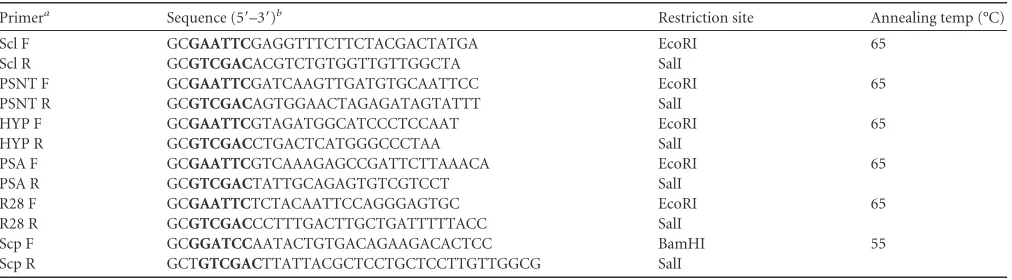
Cloning and expression of cell surface proteins.Of 219 genes on the array, 7 were selected that showed 75% or more frequency in 201 strains and encode for cell wall proteins. These proteins, which in-cluded collagen-like surface protein (SCI), putative secreted 5= -nucle-otidase (PSNT), C5a peptidase (C5a), R28 (R28), putative surface an-tigen (PSA), and a hypothetical transposase (HYP), were amplified (Table 1) and cloned into the pGEX-6P-1 vector (GE Healthcare). The cloning of streptococcal fibronectin binding protein I (SfbI) was de-scribed by Talay et al. (42). The expression of the recombinant gluta-thione S-transferase (GST) fusion proteins in Escherichia coli
BL21(DE3) was induced by the addition of IPTG (isopropyl--D
-thio-galactopyranoside) to 0.5 mM. Cultures were harvested and lysed us-ing a French press (SLM Instruments, Inc.). Cellular debris was re-moved by centrifugation, and the presence of recombinant proteins in supernatants was confirmed by SDS-PAGE.
Antibody responses to putative vaccine candidates.Enzyme-linked immunosorbent assay (ELISA) was performed using glutathione-coated microtiter plates (Thermo Fisher Scientific) withE. colilysates (0.25g/l) containing GST-tagged recombinant proteins according to the method of Sehr et al. (35). Phosphate-buffered saline (PBS) and
E. colilysate containing GST alone served as controls. A peptide rep-resenting the IgG binding motif from FOG, a streptococcal protein with IgG-Fc fragment binding capacity (23), was used as the normal-ization control. Horseradish peroxidase-conjugated goat antihuman IgG antibody and ABTS [2,2=azinobis(3-ethylbenzthiazolinesulfonic acid)] were used for color development that was measured at 405 nm. Absorbance values were subsequently normalized against values ob-tained from wells containing PBS, GST, and the FOG IgG binding peptide. Differences in absorbance between groups were examined using one-way analysis of variance (ANOVA). Because of the high number of serum samples and eight proteins, the experiment was de-signed in such a way that the maximum number of serum samples could be covered by one experiment in order to avoid experiment to experiment variations. Therefore, we chose to monitor the immuno-genicity of proteins in all serum samples at the dilution of 1:200 and expressed the result as the optical density.
RESULTS
emmsequence type distribution of GAS isolates from northern and southern India.The 201 isolates collected represent 69 dif-ferentemmsequence types (see Table S1 in the supplemental ma-terial) and 83 differentemmsequence subtypes (data not shown).
TABLE 1Oligonucleotides used in this study
Primera Sequence (5=–3=)b Restriction site Annealing temp (°C)
Scl F GCGAATTCGAGGTTTCTTCTACGACTATGA EcoRI 65 Scl R GCGTCGACACGTCTGTGGTTGTTGGCTA SalI
PSNT F GCGAATTCGATCAAGTTGATGTGCAATTCC EcoRI 65 PSNT R GCGTCGACAGTGGAACTAGAGATAGTATTT SalI
HYP F GCGAATTCGTAGATGGCATCCCTCCAAT EcoRI 65 HYP R GCGTCGACCTGACTCATGGGCCCTAA SalI
PSA F GCGAATTCGTCAAAGAGCCGATTCTTAAACA EcoRI 65 PSA R GCGTCGACTATTGCAGAGTGTCGTCCT SalI
R28 F GCGAATTCTCTACAATTCCAGGGAGTGC EcoRI 65 R28 R GCGTCGACCCTTTGACTTGCTGATTTTTACC SalI
Scp F GCGGATCCAATACTGTGACAGAAGACACTCC BamHI 55 Scp R GCTGTCGACTTATTACGCTCCTGCTCCTTGTTGGCG SalI
aF, forward; R, reverse.
b
Restriction sites are indicated in boldface.
Genotyping of Indian GAS Isolates
on August 17, 2020 by guest
http://cvi.asm.org/
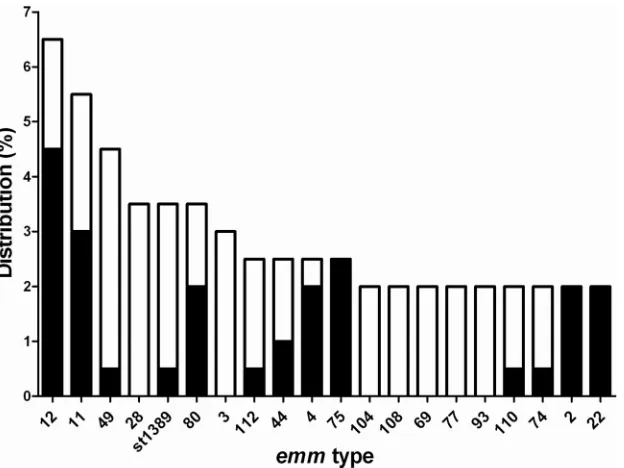
The 20 most prevalentemmtypes (Fig. 1) wereemm12 (6.5%),
emm11 (5.5%),emm49 (4.5%),emm28, andemm80,st1389 (3.5% each),emm3 (3.0%), andemm4,emm44,emm75, and emm112 (2.5% each). The typesemm2,emm22,emm69,emm74,emm77,
emm93,emm110,emm104, andemm108 accounted for 2% of all strains recovered. The 20 prevalentemmtypes represented 57.7% of all GAS isolated in both regions.
Of these 20 prevalentemmtypes, 10 (emm4,emm11,emm12,
emm44,emm49,emm74,emm80,emm110,emm112, andst1389) were found both in northern and southern India.emm3,emm28,
emm69,emm77,emm93,emm104, andemm108 were only found in southern India, whereasemm2,emm22, andemm75 were spe-cific for northern India. With 55 differentemmsequence types, the southern Indian strains showed a greater heterogeneity compared to 32 differentemmsequence types found within the northern Indian strains. This is reflected in the Simpsons index of diversity (D) foremmtypes in southern India (D⫽0.981; 95% confidence interval, 0.976 to 0.986) compared to northern India (D⫽0.957; 95% confidence interval, 0.936 to 0.977).
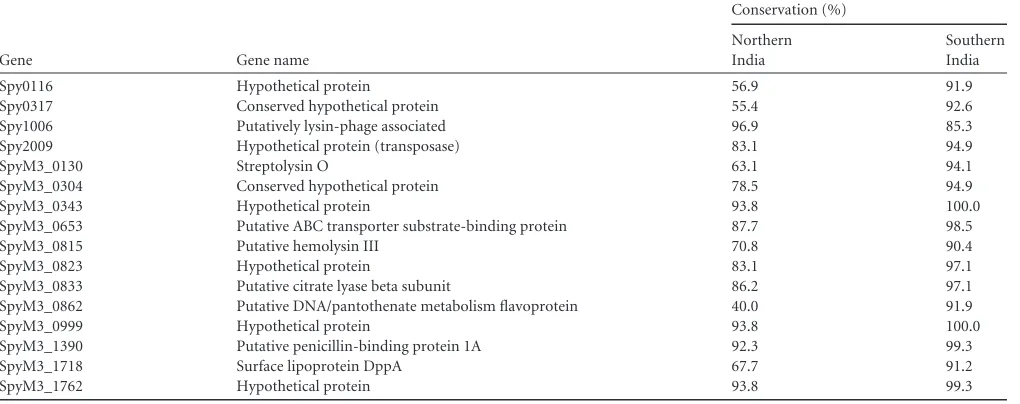
Overview of gene distribution in Indian isolates.Of the 219 streptococcal virulence factors and extracellular surface proteins (VF/ECP) represented on the array, 91 (41.5%) were found in all isolates (see Table S2 in the supplemental material), and 150 (68.5%) were found in more than 80% of the isolates. When we analyzed the distribution of the VF/ECP genes with respect to geographic region, 102 genes (46.6%) and 100 genes (45.7%) were present in all northern and southern Indian isolates, respectively. In order to identify region-specific virulence genes, we statistically analyzed the distribution of VF/ECP genes in both regions. We identified one gene in the northern Indian isolates and 15 genes in the southern Indian isolates with a statistically significant differ-ence in distribution (Fisher exact test,P⬍0.05,Table 2), reflect-ing the higheremmtype heterogeneity in southern India. How-ever, none of the 16 genes was found exclusively in one of the regions.
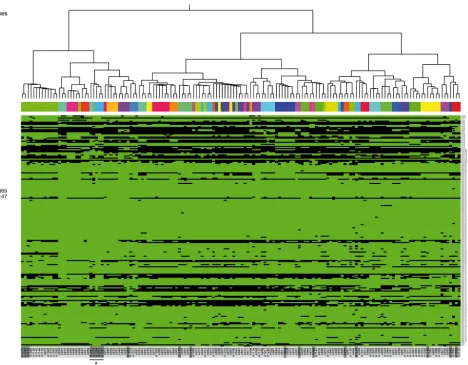
Genetic relationships among isolates. emm typing is still largely accepted as sufficient for defining related strains in GAS research. However, epidemiological and molecular observations also demonstrate that LGT involving theemmgene occurs, sug-gesting that isolates of the sameemmtype that are temporally or geographically displaced may be genetically diverse and are more closely related to isolates of a differentemmtype (6,12,22,25). To investigate the relationship between all isolates, we used a Bayes-ian agglomerative hierarchical cluster algorithm (BHC) to con-struct a dendrogram of all isolates that were represented byⱖ3 isolates peremmtype (n⫽154 isolates), based on the presence or absence of all genes represented on the array. Using this approach, we found isolates of the sameemmtype to predominantly cluster together (Fig. 2). However, there were instances where this did not occur, suggesting that LGT of theemmgene may have occurred in these instances. We next analyzed the association of the clusters with regard to disease type. As shown inFig. 2, there was only one distinct subcluster solely composed of invasive isolates consisting of oneemm4, oneemm28, and threeemm49 strains. Using BHC clustering, we did not find any significant clustering of virulence factors with invasive and noninvasive isolates. However, when we analyzed the association of virulence factors with invasiveness us-ing the Fisher exact test (P⬍0.05), we found 13 genes positively associated with invasiveness (see Table S3 in the supplemental material). Six genes were negatively associated with invasiveness (odds ratio⬍1).
Serological response to vaccine antigens.We examined the distribution of the shortlisted seven GAS vaccine candidates in the Indian population and found them to be highly conserved across the population (Table 3). Collagen-like surface protein (SCI), pu-tative secreted 5=-nucleotidase (PSNT), and C5a peptidase were found in 100% of isolates. R28, the putative surface antigen (PSA), and the hypothetical protein (HYP) were found in⬎90% of the isolates. Streptococcal fibronectin binding protein I (SfbI) was found in 78.5% of isolates.
FIG 1Distribution of the 20 most common GASemmtypes. Black bars representemmtypes found in northern India, and open bars represent isolates found in southern India. The 20 prevalentemmtypes only represented 58% of all GAS isolated in both regions.
on August 17, 2020 by guest
http://cvi.asm.org/
Serum antibodies indicate that epitopes of a particular protein are visible to the host immune system, and these proteins are likely to be recognized by antibodies generated against corresponding vaccine candidates. Therefore, we next investigated serological re-sponses to these seven identified GAS vaccine candidates. We ex-pressed these proteins as fusions with GST and used them in ELISAs with human sera (Fig. 3).
Control healthy sera had very low immune response against all of the proteins. The majority of serum samples from India had elevated responses to PSNT, C5a peptidase, and PSA, demonstrat-ing the high incidence of GAS infection in these populations. PSA-specific IgG responses were statistically more frequent in the phar-yngitis group than in healthy and RHD groups (P⬍0.05). Lower antigen specific antibody responses were observed with HYP and SfbI. For these two proteins, the highest responses were observed with sera collected from pharyngitis patients and patients with GAS throat colonization at the time of sera collection. For HYP, IgG responses in the pharyngitis group were statistically signifi-cantly higher than in the healthy groups from nonsurvey and sur-vey areas and in the RF group (P⬍0.05). The SfbI response for both the carrier group and pharyngitis group was statistically sig-nificantly higher than control and RHD groups (P⬍0.05) (see Table S4 in the supplemental material). The majority of sera did not respond or responded weakly to R28 and SCI. No differences in responses were observed in sera collected from northern and southern India. For 4 of 7 of the proteins used here the response in pharyngitis sera was significantly higher than nonsurvey area healthy sera (see Table S4 in the supplemental material), indicat-ing the possibility that these proteins are most likely expressed in the early phase of infection.
DISCUSSION
This study is the most comprehensive assessment of the genetic repertoire of GAS carried out in a country with a high streptococ-cal disease burden. The 20 most commonemmtypes accounted for 57.7% of the isolates collected, reinforcing the high degree of diversity in the population based onemmtyping and is consistent
with results of other studies of GAS population structure carried out in developing nations (41). Within the Indian population, 91 genes were conserved in 100% of isolates. Using the same array, we previously reported that 129 and 125 genes were 100% conserved in GAS isolates from the Netherlands and the United States (18, 19), respectively. The majority (80 genes) of conserved genes in the isolates from Europe and India were similar, indicating that they are part of the GAS core genome and encode proteins that are critical for virulence or confer biological functions essential to the fitness of the organism and are therefore promising vaccine can-didates.
The M protein remains a favored GAS vaccine candidate. The predominant bactericidal antibody response raised after GAS in-fection targets the amino-terminal of the M protein, the same region that is used foremmtyping. However, antibodies raised against this region have traditionally been thought to be type spe-cific, i.e., antibodies raised against the amino terminus of one M protein will not recognize the amino terminus of other M pro-teins. Candidate vaccines that target this region therefore must include amino termini from multiple M proteins. Of the 69emm
sequences reported in the present study, 14 are represented in the 26-valent amino-terminal GAS vaccine candidate (14) and repre-sent 31.8% of isolates recovered. The highest proportion of iso-lates included in the vaccine was found in southern Indian GAS isolates (17.4%) and included 10 vaccine-relatedemmtypes. Of the northern Indian isolates, 14.4% were covered by the vaccine and included six vaccine-relatedemmtypes. Recently, a similar 30-valent vaccine has also been reported (10). Nineteen of the
emmtypes present in the 30mer vaccine were present in isolates in the present study. That same study also reported that cross-reac-tivity was observed with another 24 M proteins not present in the vaccine. Fourteen of these cross-reactive emm types were also present here. In theory, the 30-valent vaccine would induce anti-bodies that are effective against 58% of the isolates recovered here. Theemmtypes present in the 26-valent vaccine and 30-valent vaccine were chosen based on their importance in North Ameri-can and European contexts. A retailored vaccine, containing
TABLE 2Genes differentially conserved in northern and southern Indian GAS populationsa
Gene Gene name
Conservation (%) Northern India
Southern India
Spy0116 Hypothetical protein 56.9 91.9
Spy0317 Conserved hypothetical protein 55.4 92.6 Spy1006 Putatively lysin-phage associated 96.9 85.3 Spy2009 Hypothetical protein (transposase) 83.1 94.9
SpyM3_0130 Streptolysin O 63.1 94.1
SpyM3_0304 Conserved hypothetical protein 78.5 94.9
SpyM3_0343 Hypothetical protein 93.8 100.0
SpyM3_0653 Putative ABC transporter substrate-binding protein 87.7 98.5
SpyM3_0815 Putative hemolysin III 70.8 90.4
SpyM3_0823 Hypothetical protein 83.1 97.1
SpyM3_0833 Putative citrate lyase beta subunit 86.2 97.1 SpyM3_0862 Putative DNA/pantothenate metabolism flavoprotein 40.0 91.9
SpyM3_0999 Hypothetical protein 93.8 100.0
SpyM3_1390 Putative penicillin-binding protein 1A 92.3 99.3 SpyM3_1718 Surface lipoprotein DppA 67.7 91.2
SpyM3_1762 Hypothetical protein 93.8 99.3
aFisher exact test,P⬍0.05.
Genotyping of Indian GAS Isolates
on August 17, 2020 by guest
http://cvi.asm.org/
amino termini from M types common in India or other regions where streptococcal disease is prevalent, may increase vaccine coverage by this approach. However, given the large numbers of
emmtypes circulating and the differences in M types present in
northern and southern India, such a vaccine may prove difficult to design.
Both traditional and reverse vaccinology approaches have been used to identify alternatives to the M protein (8). Rodriguez-Ortega et al. (29) used a proteomic approach for identifying strep-tococcal surface-exposed proteins for their use as vaccine candi-dates. Those researchers, however used only threeemmtypes that were not prevalent in India. Reverse vaccinology, a genome-based approach to vaccine development, has also been used to identify streptococcal vaccine candidates (17, 36). That approach, how-ever, requires the whole genome sequence of the isolates and, to date, no prevalentemm-type strain in India has been sequenced. Proteins that confer essential virulence and biological functions and are therefore encoded in the core genome are attractive vac-cine targets. In addition to functionality through bactericidal or neutralizing activity, antibodies raised against critical proteins may contribute to prevention of infection by inhibiting protein function. Multisubunit vaccines containing several proteins have added appeal, since the abolition of multiple biological activities
FIG 2Bayesian agglomerative hierarchical clustering of 154 GAS isolates collected in northern and southern India. The dendrogram shows the clustering of the isolates into groups with similar genetic profiles. Rows represent VF/ECP genes. Genes that are present in specific isolates are shown in green, and genes that are absent or highly divergent are shown in black. Columns represent isolates, and the color bar below the dendrogram represents the differentemmtypes. The strain numbers of invasive isolates are shaded in dark gray, whereas noninvasive isolates are shaded in light gray. The asterisk indicates a subcluster consisting solely of invasive isolates.
TABLE 3Distribution of genes encoding putative vaccine antigens in the Indian GAS population and comparison to isolates from the Netherlandsa
Protein Gene
Distribution (%) India Netherlands Collagen-like surface protein (SCI) Spy1983 100 100 Putative secreted 5=-nucleotidase (PSNT) SpyM3_0591 100 100 C5a peptidase SpyM3_1726 100 100 R28 AF091393 97.6 55 Putative surface antigen (PSA) SpyM3_0569 99.5 100 Hypothetical protein (HyP) Spy2009 91.2 70 SfbI X67947 78.5 68
aMcMillan et al. (18).
on August 17, 2020 by guest
http://cvi.asm.org/
FIG 3Serological responses to streptococcal antigens in sera. Samples were collected from healthy individuals, asymptomatic carriers, and patients presenting with pharyngitis, RF, RHD, and invasive diseases. Control sera (non-endemic healthy) were collected from patients living in Germany. Statistical differences between the mean absorbance for each group were determined using one-way ANOVA and are presented in Table S4 in the supplemental material.
on August 17, 2020 by guest
http://cvi.asm.org/
may attenuate the virulence of the organism further. The targeting of several proteins also potentially has an additive effect with re-spect to opsonic or neutralizing antibodies. A multisubunit ap-proach to vaccine development can also reduce the probability of vaccine escape that may occur after the loss of epitopes targeted by the vaccine that may occur through mutation or lateral gene trans-fer (24).
The seven proteins that we examined serologically have all been proposed as potential vaccine candidates and were used here because they represent both well-characterized and relatively new targets. All of these proteins are also predicted to be surface asso-ciated. Our array data support this selection because six of these proteins were conserved in all of the invasive isolates tested here. R28 is a cell surface virulence protein that has many repetitive sequences and has homology with a protein found in group B streptococcus (39,40). SCI is a collagen-like protein that is known to have a collagen-like sequence (16). HYP has homology to FbaA proteins (43), suggesting that it has fibronectin binding ability. PSNT is a putative surface nucleotidase protein likely to be in-volved in nutrient acquisition (44). The corresponding PNST of
Haemophilus influenzaehas been reported to have protective effi-cacy in a rat infection model (44). PSA is a homologue to Spy0843 ofS. pyogenesMGAS5005, which contributed to a protective host immune response in a mouse infection model (28).
The identified antigens were validated for their vaccine poten-tial by serological analysis. For invasive disease, we had the match-ing isolates and serum samples, because these were acute manifes-tations that required hospitalization. For other manifesmanifes-tations, which were not acute, it was not possible to have the matching isolate serum samples, so we had to rely on the samples from defined survey areas. The immunogenicities of the identified pro-teins were tested using ELISA in order to determine their suitabil-ity as vaccine candidates. For simplicsuitabil-ity, antibodies were deter-mined using a single dilution and results were expressed as optical density values. For further studies on these antigens, however, the endpoint titers or the use of a reference standard serum will be required (21). Our data demonstrate that antibodies to five of the seven GAS proteins are present in sera in individuals living in a region where streptococcal disease is common. In general, there was no difference between antibody levels between individuals, irrespective of an individual’s disease status. However, two pro-teins, HYP and SfbI, had higher antibody responses in sera from pharyngitis and asymptomatic throat carriers compared to sera from RF/RHD and asymptomatic noncarriers. Fibronectin bind-ing proteins have been shown to be involved in adherence to epi-thelial cells (30,42) and may therefore be important in coloniza-tion and early infeccoloniza-tion. The responses to PSA, which binds to the surfaces of epithelial cells (15), were also significantly higher in sera from pharyngitis patients. Given the increased antibody re-sponse to these three antigens (HYP, SfbI, and PSA) in carriers and patients with pharyngitis, they may be excellent candidates for inclusion in a vaccine designed to prevent initial colonization. In the present study, a lower immune response was generally de-tected against all of the proteins with serum samples from invasive diseases. This could be due to the fact that the invasive disease is an acute manifestation, where the time is too short for the generation of sufficient antibodies to give a high response.
In conclusion, PSNT, C5a peptidase, PSA, HYP, and SfbI are promising candidates for a region-specific streptococcal vaccine for the Indian continent. Among these five candidates, PSA and
PSNT have not been well studied and can be further explored in future studies. The two-step approach used here to identify vac-cine candidates with regional specificity seems very promising. However, more isolates and more defined serum samples should be analyzed in order to more fully evaluate this technique.
ACKNOWLEDGMENTS
We thank N. Janze for excellent technical assistance. We are grateful to the ASSIST epidemiology team members, especially A. Kumar, K. N. Brah-madathan, V. Abraham, and Y. Sharma, for providing streptococcal iso-lates and serum samples. We thank A. P. Oxley for carefully reading the manuscript.
This study was supported by the European Community’s Sixth Frame-work Programme ASSIST under contract 032390.
REFERENCES
1.Agarwal AK, Yunus M, Ahmad J, Khan A.1995. Rheumatic heart disease in India. J. R. Soc. Health115:303–309.
2.Asrat D, et al.2006. High diversity of group A streptococcal emm types among healthy schoolchildren in Ethiopia. Clin. Infect. Dis.42:1362– 1367.
3.Banks DJ, et al.2004. Progress toward characterization of the group A streptococcus metagenome: complete genome sequence of a macrolide-resistant serotype M6 strain. J. Infect. Dis.190:727–738.
4.Beall B, Facklam R, Thompson T.1996. Sequencing emm-specific PCR products for routine and accurate typing of group A streptococci. J. Clin. Microbiol.34:953–958.
5.Beres SB, et al.2006. Molecular genetic anatomy of inter- and intrasero-type variation in the human bacterial pathogen group A streptococcus. Proc. Natl. Acad. Sci. U. S. A.103:7059 –7064.
6.Bessen DE, Hollingshead SK.1995. Horizontal transfer and mosaic-like emm gene structures in group A streptococci. Dev. Biol. Stand.85:169 – 173.
7.Carapetis JR, Steer AC, Mulholland EK, Weber M.2005. The global burden of group A streptococcal diseases. Lancet Infect. Dis.5:685– 694. 8.Cole JN, Henningham A, Gillen CM, Ramachandran V, Walker MJ.
2008. Human pathogenic streptococcal proteomics and vaccine develop-ment. Proteomics Clin. Appl.2:387– 410.
9.Cunningham MW.2000. Pathogenesis of group A streptococcal infec-tions. Clin. Microbiol. Rev.13:470 –511.
10. Dale JB, Penfound TA, Chiang EY, Walton WJ.2011. New 30-valent M protein-based vaccine evokes cross-opsonic antibodies against non-vaccine serotypes of group A streptococci. Vaccine29:8175– 8178. 11. Dey N, et al.2005. High diversity of group A Streptococcalemmtypes in
an Indian community: the need to tailor multivalent vaccines. Clin. Infect. Dis.40:46 –51.
12. Eshaghi M, Ali AM, Jamal F, Yusoff K.2002. Existence of twoemm-like “mrp” and “emm” genes in themgaregulon of theStreptococcus pyogenes
strain ST4547. J. Biochem. Mol. Biol. Biophys.6:23–28.
13. Ferretti JJ, et al.2001. Complete genome sequence of an M1 strain of
Streptococcus pyogenes. Proc. Natl. Acad. Sci. U. S. A.98:4658 – 4663. 14. Hu MC, et al.2002. Immunogenicity of a 26-valent group A streptococcal
vaccine. Infect. Immun.70:2171–2177.
15. Loimaranta V, et al.2009. Leucine-rich repeats of bacterial surface pro-teins serve as common pattern recognition motifs of human scavenger receptor gp340. J. Biol. Chem.284:18614 –18623.
16. Lukomski S, et al.2000. Identification and characterization of thesclgene encoding a group A streptococcus extracellular protein virulence factor with similarity to human collagen. Infect. Immun.68:6542– 6553. 17. Maione D, et al.2005. Identification of a universal group B streptococcus
vaccine by multiple genome screen. Science309:148 –150.
18. McMillan DJ, et al.2006. Genes for the majority of group a streptococcal virulence factors and extracellular surface proteins do not confer an in-creased propensity to cause invasive disease. Clin. Infect. Dis.43:884 – 891. 19. McMillan DJ, et al.2007. Variations in the distribution of genes encoding virulence and extracellular proteins in group A streptococcus are largely restricted to 11 genomic loci. Microbes Infect.9:259 –270.
20. McShan WM, et al. 2008. Genome sequence of a nephritogenic and highly transformable M49 strain ofStreptococcus pyogenes. J. Bacteriol.
190:7773–7785.
on August 17, 2020 by guest
http://cvi.asm.org/
21. Miura K, et al.2008. Development and characterization of a standardized ELISA including a reference serum on each plate to detect antibodies induced by experimental malaria vaccines. Vaccine26:193–200. 22. Musser JM, et al.1995. Genetic diversity and relationships among
Strep-tococcus pyogenesstrains expressing serotype M1 protein: recent intercon-tinental spread of a subclone causing episodes of invasive disease. Infect. Immun.63:994 –1003.
23. Nitsche-Schmitz DP, et al.2007. Group G streptococcal IgG binding molecules FOG and protein G have different impacts on opsonization by C1q. J. Biol. Chem.282:17530 –17536.
24. Pai R, et al.2005. Postvaccine genetic structure ofStreptococcus pneu-moniaeserotype 19A from children in the United States. J. Infect. Dis.
192:1988 –1995.
25. Panchaud A, et al.2009. M-protein and other intrinsic virulence factors ofStreptococcus pyogenesare encoded on an ancient pathogenicity island. BMC Genomics10:198. doi:10.1186/1471-2164-10-198.
26. Pfoh E, Wessels MR, Goldmann D, Lee GM. 2008. Burden and economic cost of group A streptococcal pharyngitis. Pediatrics121: 229 –234.
27. Rato MG, et al.2011. Virulence gene pool detected in bovine group C
Streptococcus dysgalactiaesubsp.dysgalactiaeisolates by use of a group AS. pyogenesvirulence microarray. J. Clin. Microbiol.49:2470 –2479. 28. Reid SD, et al.2002. Postgenomic analysis of four novel antigens of group
a streptococcus: growth phase-dependent gene transcription and human serologic response. J. Bacteriol.184:6316 – 6324.
29. Rodriguez-Ortega MJ, et al.2006. Characterization and identification of vaccine candidate proteins through analysis of the group A streptococcus surface proteome. Nat. Biotechnol.24:191–197.
30. Rohde M, et al.2011. Differences in the aromatic domain of homologous streptococcal fibronectin-binding proteins trigger different cell invasion mechanisms and survival rates. Cell Microbiol.13:450 – 468.
31. Sagar V, et al.2004. Molecular heterogeneity among north Indian isolates of group A streptococcus. Lett. Appl. Microbiol.39:84 – 88.
32. Sagar V, Kumar R, Ganguly NK, Chakraborti A.2008. Comparative analysis ofemmtype pattern of group A streptococcus throat and skin isolates from India and their association with closely related SIC, a strep-tococcal virulence factor. BMC Microbiol.8:150. doi:10.1186/1471-2180-8-150.
33. Sakota V, et al.2006. Genetically diverse group A streptococci from children in far-western Nepal share high genetic relatedness with isolates from other countries. J. Clin. Microbiol.44:2160 –2166.
34. Savage RS, et al.2009. R/BHC: fast Bayesian hierarchical clustering for microarray data. BMC Bioinformatics10:242.
35. Sehr P, Zumbach K, Pawlita M.2001. A generic capture ELISA for recombinant proteins fused to glutathioneS-transferase: validation for HPV serology. J. Immunol. Methods253:153–162.
36. Sette A, Rappuoli R.2010. Reverse vaccinology: developing vaccines in the era of genomics. Immunity33:530 –541.
37. Smeesters PR, et al.2006. Differences between Belgian and Brazilian group A streptococcus epidemiologic landscape. PLoS One1:e10. doi: 10.1371/journal.pone.0000010.
38. Smoot JC, et al.2002. Genome sequence and comparative microarray analysis of serotype M18 group A streptococcus strains associated with acute rheumatic fever outbreaks. Proc. Natl. Acad. Sci. U. S. A.99:4668 – 4673.
39. Stalhammar-Carlemalm M, Areschoug T, Larsson C, Lindahl G.1999. The R28 protein ofStreptococcus pyogenesis related to several group B streptococcal surface proteins, confers protective immunity and promotes binding to human epithelial cells. Mol. Microbiol.33:208 –219. 40. Stalhammar-Carlemalm M, Areschoug T, Larsson C, Lindahl G.2000.
Cross-protection between group A and group B streptococci due to cross-reacting surface proteins. J. Infect. Dis.182:142–149.
41. Steer AC, Law I, Matatolu L, Beall BW, Carapetis JR.2009. Global emm type distribution of group A streptococci: systematic review and implica-tions for vaccine development. Lancet Infect. Dis.9:611– 616.
42. Talay SR, et al.2000. Co-operative binding of human fibronectin to Sfbl protein triggers streptococcal invasion into respiratory epithelial cells. Cell Microbiol.2:521–535.
43. Terao Y, et al.2001. Fba, a novel fibronectin-binding protein from Strep-tococcus pyogenes, promotes bacterial entry into epithelial cells, and thefba
gene is positively transcribed under the Mga regulator. Mol. Microbiol.
42:75– 86.
44. Zagursky RJ, et al.2000. Identification of aHaemophilus influenzae5= -nucleotidase protein: cloning of thenucAgene and immunogenicity and characterization of the NucA protein. Infect. Immun.68:2525–2534.
Genotyping of Indian GAS Isolates