Streaming Data Analysis using Apache Cassandra and Zeppelin
A. MadhaviLatha1, G.Vijaya Kumar2
1
PG Student, Computer Science and Engineering Dept, GPREC,
Kurnool (District), Andhra Pradesh-518007, INDIA. [email protected]
2
Assistant Professor, Computer Science and Engineering Dept, GPREC, Kurnool (District), Andhra Pradesh-518007, INDIA. [email protected]
Abstract
Big data is a popular term used to describe the large volume of data which includes structured, semi-structured and unstructured data. Now-a-days, unstructured data is growing in an explosive speed with the development of Internet and social networks like Twitter,Facebook & Yahoo etc., In order to process such colossal of data a software is required that does this efficiently and this is where Hadoop steps in. Hadoop has become one of the most used frameworks when dealing with big data. It is used to analyze and process big data. In this paper, Apache Flume is configured and integrated with spark streaming for streaming the data from twitter application. The streamed data is stored into Apache Cassandra. After retrieving the data, the data is going to be analyzed by using the concept of Apache Zeppelin. The result will be displayed on Dashboard and the dashboard result is also going to be analyzed and validating using JSON.
Keywords: BigData, Unstructured, Hadoop, Flume, Spark
Streaming,Twitter, Apache Cassandra, Zeppelin, Analysis, JSON.
1. INTRODUCTION
In terms of relational databases, moving and
modifying large volumes of data into the necessary form
for Extraction, Transformation, Loading (ETL) can be
both costly and time consuming. To process or analyze this
huge amount of data or extracting meaningful information
is a challenging task now a days. Big data exceeds the
processing capability of traditional database to capture,
manage, and process the voluminous amount of data.
Falling storage costs and access to better compute power
for less money have made the software more attractive as
datasets continue to grow, As a result, many companies are
rethinking their move toward to traditional enterprise
storage and architecture to leverage big data. Hadoop is
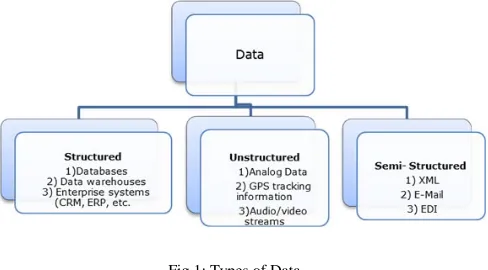
best suited for processing all types of data. Fig 1 represents
all types of data.
Big Data consists of very large volumes of
heterogeneous data that is being generated, often, at high
speeds. These data sets cannot be managed and processed
using traditional data management tools. The size of the
data will ranges from terabytes to many petabytes. Big
data[1] is an umbrella term that not only refers to the
enormous amount of data available today but also the
complete process of gathering, storing, retrieving, and
analyzing the available data.
Fig 1: Types of Data
Hadoop[2] was created by Doug Cutting and Mike.Hadoop
is a framework from the Apache software foundation
Reduce and Google File System. Fig2 represents Apache
Hadoop Ecosystem, it describes all tools available in
Hadoop.
Fig 2: Describes Hadoop Ecosystem
The data can be generated from different sources like
social media (Face book, Twitter, and YouTube); sensor
data, stock market exchanges, transactional applications
etc. A huge amount of data is stored by different kinds of
applications for future analysis. Relational databases[5] are
used for decades as data storages, although in some cases
they are not proper for Big Data processing. To solve this
problem, non-relational databases be developed.
Non-relational databases, also called NoSQL databases, the
most popular used databases are MongoDB, DocumentDB,
Cassandra, HBase.
The phrase unstructured is data usually refers to
information that doesn't reside in a traditional row-column
database. As you might expect, it's the opposite
of structured data the data stored in fields in a database.
Unstructured data can be textual or non-textual. Textual
unstructured data is generated in media like email
messages, Power Point presentations, Word documents,
collaboration software and instant messages. Non-textual
unstructured data is generated in media
like JPEG images, MP3 audio files and Flash video files.
Apache Flume is a tool for collecting and
transporting large amounts of streaming data from various
sources to a centralized data store. Spark fits into the
Hadoop open-source community, building on top of the
Hadoop Distributed File System (HDFS)[6]. However,
Spark provides an easier to use alternative to Hadoop
MapReduce and offers performance up to 10 times faster
than previous generation systems like Hadoop MapReduce
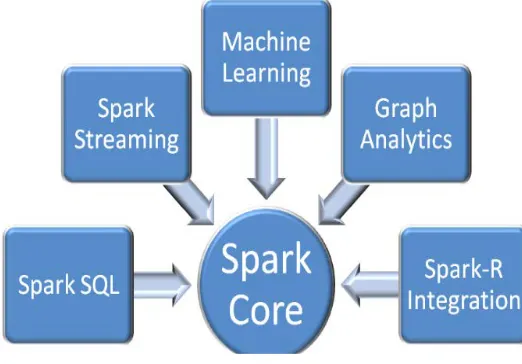
for certain applications. Fig 3 represents spark core
components. In this spark streaming is required for our
project.
Fig 3: Spark Core Components
Spark Streaming is an extension of the core Spark
API that enables scalable, high throughput, fault-tolerant
stream processing of live data streams. Data can be
ingested from many sources like Kafka, Flume, Twitter,
Kinesis, and can be processed using complex algorithms
expressed with high-level functions like map, reduce.
Finally, processed data can be pushed out to file systems,
The rest of the paper is organized as follows.
Section 2 describes related work; Section 3 represents the
system model; Section 4 explains clear plan of work and
the results; Section 5 concludes the paper with future work.
2. RELATED WORK
RDBMS(Relational Data Base Management
System) is a database management system that is based on
the relational model. RDBMS is structured in database like
tables, fields and records. The limited amount of data will
be present in RDBMS. Processing of large data is very
difficult to handle and also time expenditure process.
RDBMS cannot access semi structured and unstructured
data. To overcome the drawbacks of this, Hadoop takes
place. Hadoop is an open source java based programming
framework that supports the processing and storage of
extremely large datasets in a distributed computing
environment. It can handle all types of data.
According to Ekata Banerjee[11],MongoDB is
best for data storage,which is a NoSQL database. Its stored
in the form of key value pairs which makes it easier for
latter updation and creating the index than using traditional
relational database.Now-a-days, unstructured data is
growing in an explosive speed with the development of
Internet and social networks.In my view MongoDB doesn’t
support all types of data. Instead of MongoDB here we are
using the Cassandra. Cassandra supports all types of data
in Hadoop 2.x version.
According to Elena Lazovik[12] Apache Storm is
used for Analysis of Streaming Data. Here my proposesd
tool for analyzing the streaming data is Apache Zeppelin.
It is a web based notebook. Previously the concept of
flume streaming is used for storing the streamed data into
the hdfs. Now the concept of spark streaming is using for
effective streaming.
According to Tripti Baraskar[14], HMR LOG
ANALYZER is used for analyzing the data. In this
map-reduce program is run.In our proposed system scala
programming is run because scala is 100 times faster than
the map reduce program. According to research and
journals hadoop 2.x has high scalable than 1.x.In 1.x MR
does both processing and cluster-resource management
where as in 2.x YARN done cluster resource management
and processing is done by using different processing
models.
Our proposed system is using the following
concepts for effective streaming data analysis.Apache
flume, spark streaming, Cassandra and zeppelin. Apache
flume is used to access the streaming data through twitter
application. For any real-time data statistics, adaptive
analysis and response, spark with spark streaming are a
perfect fit. Flume is integrated with spark streaming and
storing the data into Cassandra data storage. The twitter
data is analyzed and validating by using apache zeppelin
and json validation respectively. The result will be
displayed on zeppelin dashboard.
The subsequent figure shows the architecture
view for the proposed system. By this we can understand
how our project is effective using the Hadoop and how the
streamed data is going to be stored in the data storage
from the Flume and spark streaming, also how it is going
to display the result on dashboard.
3. SYSTEM MODEL
This section describes the overview of tools and
technologies used in this project.
3.1 Extracting Twitter Data Using Flume:
Apache Flume is a tool for collecting and
transporting large amounts of streaming data from various
sources to a centralized data store. Using Flume, we can
fetch data from various services and transport it to
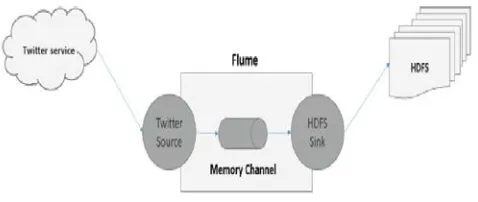
centralized stores.The following fig 5.describes how to
extract the twitter data into hdfs.
Fig 5:Apache flume streaming by using twitter source
In order to get the tweets from Twitter, it is
needed to create a Twitter application. After creating the
Application, the twitter agent will provide the consumer
key & consumer secret key for accessing the tweets. As,
the Twitter Streaming API gives a constant stream of tweet
data coming from the application it must reside in HDFS
securely. The security can be ensured by the generation of
keys at the time of creating an application in twitter. This
is called flume streaming.
3.2 Apache Flume is integrated with Spark
Streaming.
Spark fits into the Hadoop open-source \
community, building on top of the Hadoop Distributed File
System (HDFS). However, Spark provides an easier to use
alternative to Hadoop MapReduce and offers performance
up to 10 times faster than previous generation systems like
Hadoop MapReduce for certain applications. Apache
Flume is configured and integrated with spark streaming
for streaming the data (unstructured) from twitter
application. This is called spark streaming.
In most environments, Hadoop and Storm (or
other stream processing systems) have been used for batch
processing and stream processing, respectively. The use of
two different programming models causes an increase in
code size, number of bugs to fix, development effort,
introduces a learning curve, and causes other issues. Spark
Streaming helps in fixing these issues and provides a
scalable, efficient and resilient.
Fig 6: Describes spark streaming
In Spark Streaming, batches of Resilient
Distributed Datasets (RDDs) are passed to Spark
Streaming, which processes these batches using the Spark
Engine as shown in the fig 6 and returns a processed
a file system. The batch size can be as low as 0.5 seconds,
leading to an end to end latency of less than 1 second. In
this project scheduling algorithm is used.
3.3 Result will be displayed on dashboard by
using Apache Zeppelin and JSON validator.
For the displaying of final results, first we need to
store the streaming data into the Cassandra data storage,
after that analyzing the streamed data by using dashboard
and validating the results using JSONLint. The following
sections gives detailed flow.
Data Storage: Apache Cassandra is an open source, highly
scalable and performance distributed database. It is
designed to handle colossal of data across many
commodity servers, providing high availability with no
single point of failure. It is a type of NoSQL database.
Cassandra implements a Dynamo-style replication model
with no single point of failure, but adds a more powerful
“column family” data model. Cassandra is being used by
some of the biggest companies such as Face book, Twitter,
Cisco, eBay, and more. After retrieving the data from
twitter, the data is stored in json format. Cassandra
Referenced API class is the main entry point of the driver.
It belongs to com.datastax.driver.core package. Session
connect creates a new session on the current cluster and
initializes it.
Apache Zeppelin: Apache Zeppelin is a web based and
multipurpose notebook that enables interactive data
analytics. The notebook is the place for data ingestion,
discovery, analytics, visualization and collaboration. It can
make beautiful data driven, interactive and collaborative
documents with scala and more. Apache Zeppelin
Interpreter allows any language/data-processing-backend
to be plugged into Zeppelin. Currently Apache Zeppelin
supports many interpreters such as Apache Spark, Python,
JDBC, Markdown and Shell. Apache Zeppelin with Spark
integration provides
• SparkContext and SQLContext injection.
• Runtime jar dependency loading from local file
system.
• Canceling job and displaying its progress.
JSON Validation: JSON or JavaScript Object Notation is
a web based tool and it is a language independent open
data format that uses human readable text to express data
objects consisting of attribute value pairs. JSON
[15]validator is used to validate the json format data. The
JSON Formatter was created to help with debugging. As
JSON data is often output without line breaks to save space,
it is extremely difficult to actually read and make sense of
it. This little tool hoped to solve the problem by formatting
the JSON data so that it is easy to read and debug by
human beings.
4 PLAN OF WORK AND RESULTS
This project involves the following modules:
• Streaming the data from Twitter application- is
the required input [Module I]
• Storing the streaming data into Cassandra
[Module II]
• Streaming data analysis using Zeppelin and
validating using JSON [Module III]
A.Streaming the data from Twitter
application [Module I]
By the application of Twitter, JSON format files are
generated which have to be dumped into the Cassandra. To
fetch Twitter data, we will have to follow the steps given
below-
• Spark streaming + flume integration
The following Fig 7 represents how to create a new
twitter app by following the steps.
Fig 7: Create New Twitter App
To create a Twitter application, click on the following link
https://apps.twitter.com/.Sign in to your Twitter account.
You will have a Twitter Application Management window
where you can create, delete, and manage Twitter Apps.
Click on the Create New App button. You will be
redirected to a window where you will get an application
form in which you have to fill in your details in order to
create the App. This will lead to a page which displays
your Consumer key, Consumer secret, Access token, and
Access token secret. Copy these details. These are useful
to configure the agent in Flume. By following the steps
mentioned above, the twitter app is created with given
name. Fig 8 represents created the app by given name.
Fig 8:Created the Twitter App
There are two approaches to configure Flume and Spark
Streaming to receive data from Flume: i) Flume-style
Push-based Approach ii) Pull based Approach using a
Custom Sink. Here we are using push based approach. For
streaming the data first of all we need to login into our own
twitter account.
B.Storing the streaming data into Cassandra
[Module II]
The design goal of Cassandra is to handle big data
workloads across multiple nodes without single point of
failure. Cassandra has peer-to-peer distributed system
across nodes, and data is distributed among all nodes in the
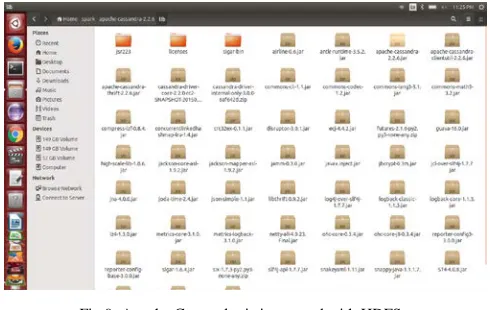
cluster. Fig 9 represents how to integrate with hdfs. In this
we have libraries.
Fig 9: Apache Cassandra is integrated with HDFS
For Storing the streaming data into Cassandra[16] add the
Cassandra-specific functions on the StreamingContext and
RDD into scope, and simply replace the print to console
with pipe the output to Cassandra:
import com.datastax.spark.connector.streaming._
Fig 10:Spark Streaming & Storage
Fig 10 is an data flow diagram for input and
storage. Here an input is streaming data and storage
database is Cassandra. The main purpose of storing the
streamed data is for analysis.
Fig 11:After Streaming the data stored in the web browser
After streaming the data, the data is going to be stored in
web browser. To see this results in the web browser means
go to the local host.
C.Streaming data analysis using Zeppelin and
validating using JSON [Module III]
The main purpose of analyzing the streamed data
is to know how many likes, shares and tweets etc., are
coming for an images or videos and also in this we can
easily identify who is the person posting or doing
mentioned things from the huge amount of streamed data.
Streaming data is basically a continuous group of data
records generated from different sources. With streaming
data processing, computing is done in real-time as data
arrives rather than as a batch. Real-time data processing
and analytics is becoming a critical component of the big
data strategy for most organizations. Streaming data
processing applications help with live dashboards,
real-time online recommendations, and instant fraud detection.
After streaming the data, retrieving from apache
Cassandra for analysis by using scala programming. The
scala programming is configured on scala IDE 1.4.0 build
on eclipse lona version. The scala IDE running the data by
using Activator dist, these activator dist analyzes the
streaming data. After analyzing the data the result will be
displayed on apache zeppelin[18] dashboard.
Fig 12: Dashboard result on bar chart
For the results, first we need to start the zeppelin,
after that run the scala program. The results will be
displayed as shown in the fig 12.
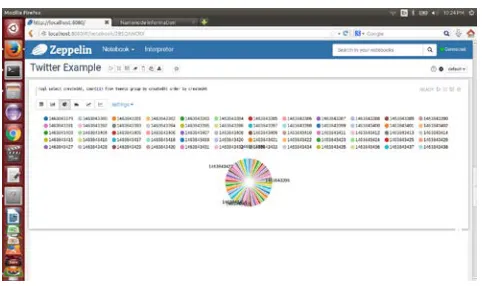
Fig 13: Dashboard result on pie chart
The dashboard will shows the results in different
styles.Fig 13 represents results on pie chart. After
displaying the results on dashboard,now validating the
results.For this,first we need to select the customer_id
which is shown in fig 12 for validating the results.When
we clicked the particular id,the data is in unreadable
format.By using the JSONLint we can read the data as
Fig 14: JSON data validate by using JSONLint
The reading data contains the information like name,liked
images or videos,tweets etc.,By this we can analyze the
streamed data.
5 Conclusion
The generalized method called zeppelin for analyzing the
streaming data with the help of apache flume, Cassandra
and spark streaming. It’s working on online applications
like Twitter; it will access the streaming data. The data
flow is maintained by the Apache spark streaming and
dumped into the Cassandra data storage. The stored data or
streaming data is analyzed and displayed on dashboard. In
Hadoop 1.x name node failure will occur. The problem
will cleared in Hadoop 2.x. When the data is storing the
data loss will occur in HDFS where as in Cassandra no
single point of failure. Spark streaming is efficient than
flume streaming. After analyzing the data later we can do
analytics. In future we can do this by using multiple nodes
form in a cluster way.
REFERENCES:
[1] S.Vikram Phaneendra & E.Madhusudhan Reddy “Big Data- solutions for RDBMS problems- A survey” In 12th IEEE/IFIP Network Operations & Management Symposium (NOMS 2010) (Osaka, Japan, Apr 19{23 2013).
[2] Vavilapalli, A. Murthy, C. Douglas, S. Agarwal, M. Konar, R. Evans, T. Graves, J. Lowe, H. Shah, S. Seth, B. Saha, C. Curino, O. O’Malley, S. Radia, B. Reed, and E. Baldeschwieler, “Apache Hadoop YARN: Yet Another Resource Negotiator,” in IEEE SOCC, pages 5:1–5:16, Santa Clara, CA, Oct. 2013.
[3] Go, A., Bhayani, R., & Huang, L. (2009). Twitter sentiment classification using distant supervision. CS224N Project Report, Stanford, 1-12.
[4] Mrigank Mridul, Akashdeep Khajuria, Snehasish Dutta, Kumar N “ Analysis of Bidgata using Apache Hadoop and Map Reduce” Volume 4, Issue 5, May 2014” 27.
[5] Kiran kumara Reddi & Dnvsl Indira “Different Technique to Transfer Big Data : survey” IEEE Transactions on 52(8) (Aug.2013) 2348 { 2355}
[6]HadoopDistributedFileSystem(HDFS), http://hortonworks.com/hadoop/hdfs/
[7] D.Fisher, R. DeLine, M.Czerwinsiki, and S. Drucker, “Interactions with big data analytics,” Interactions, vol.19, no. 3, pp, 50_59, May 2012.
[8] M. Zaharia, T. Das, H. Li, S. Shenker, and I. Stoica, “Discretized streams: an efficient and fault-tolerant model for stream processing on large clusters,” in HotCloud,2012. [9] M. R. Ackermann, C. Lammersen, M. Märtens, C.
Raupach,C. Sohler, and K. Swierkot, “StreamKM++: Aclustering algorithm for data streams,” ACM Journal ofExperimental Algorithmics, vol. 17, 2012.
[10] Go, A., Bhayani, R., & Huang, L. (2009). Twitter sentiment classification using distant supervision. CS224N Project Report, Stanford, 1-12.
[11] Jyoti Nandimath, Ankur Patil and Ekata Banerjee “Big Data Analysis Using Apache Hadoop” IEEE IRI 2013.
[12] Jan Sipke van der Veen, Bram van der Waaij, Elena Lazovik,“Dynamically Scaling Apache Storm for the Analysis of Streaming Data” IEEE 2015.
[13] Avita Katal, Mohammad Wazid AND R H Goudar “Big Data: Issues, Challenges, Tools and Good
Practices”, 978-1-4799-0192-0/13/$31.00 ©2013 IEEE. [14]Sayalee Narkhede And Tripti Baraskar “Hmr Log
Analyzer:Analyze Web Application Logs Over Hadoop Mapreduce” vol 4,no 3,july 2013.
[15] (Online Resource)http://jsonlint.com/ [16]ApacheCassandra
"http://en.wikipedia.org/wiki/Apache_Cassandra.2014. [17]“Designing performance monitoring tool for NoSQL
Cassandradistributeddatabase”.
http://ieeexplore.ieee.org/xpl/articleDetails.jsp?tp=&arnumbe r=6360579&queryText%3DCASSANDRA, 2012 IEEE. [18]ApacheZeppelin.Available: